




 NFSIJ Home



Abstract
Unconsumed parts of fruits can be a source of inorganic and organic elemental supplies to the biosphere, the geosphere and/or the hydrosphere that may induce changes in the chemical characteristics of the environment. The purpose of the present study is an investigation of fractionation of major and trace elements including the rare-earth elements (REEs) in the skin, the soft part, and the seed of the date fruit to evaluate the elemental amounts in uneaten parts of this fruit. The date seeds are concentrated in Fe, Ni, P, Zn, Mn, Co and REEs. Their soft parts can be sources of K, Sr, Rb, Zr, Ca and Mg, and the skin concentrates Cu, Si, Al, Cd, Ba, P, Th and Pb. About 40% of Si, 79% of Al%, 26% of Mg and Ca, 21% of Fe, 30% of Mn, 15% of Ti and 24% of Na from whole fruit are located in the skin. The REEs are depleted in the soft part relative to the other ones. The seed skin has an ability to accumulate the light REEs (LREEs) relative to the middle REEs (MREEs) and heavy REEs (HREEs); no fractionation being visible in the soft part. The non-consumable parts of dates, such as the seeds and the skin may contribute to an REE enrichment of the ecosystem. About 0.14 to 1.1 mg of REEs can be extracted yearly per capita from uneaten date seeds with an overallf interest in industrial applications and production of energy since availability of REEs is limited.
Keywords:Elemental fractionation; Trace; Rare-earth elements; Seed; Soft; Skin anomalies
Introductıon
To maintain life, a plant body possesses a variety of tissues and organs capable of division, differentiation and growth along defined processes. Food constituted of sugar, proteins (enzymes) and lipids manufactured by some tissues is transferred to other tissues for storage and use for the growth process with developments of organs with distinctive functions. For most plants with diversified organs (roots, stems, leaves, flowers, fruits and seeds), the functions are diversified too. For example, the main function of fruits is to protect seeds during the development and to attract birds, bees and other animals to eat the seeds and/or to carry them into new areas. During the growth of plants and the development of their fruits, three distinct parts develop: the exocarp (the outermost part), the mesocarp (that supports the fleshy middle part), and the endocarp (the innermost part with stony seed) [1]. The literature is replete with information on morphological and physiological constructs of a wide variety of fruits, each at different life stage from a nascent growth state to a mature or ripened state [2-5]. Organic compounds that constitute the various components of a fruit have also been extensively investigated [6-8]. Such organic compounds are basically made of six essential elements that include C, H, N, O, P, and S and they constitute nearly 95% of the biomass on average.
Very significantly, all life forms also require various amounts of environmentally common inorganic ions such as K, Ca, Mg, Na, Si, and others, as well as traces including Fe, Mn, Co, Zn, Cu, Mo, and few others. Fruits are a main source of these major and trace elements that are involved in human physiology. As for human physiology, the main role of metals in plant growths is their effect on enzyme activity, which is primordial for activation of cellular processes and growth of plants. Metals are activators of many basic processes: assimilation and decomposition (polysacharids to monosacharids) for growth of fruits. Several previous studies have been reported on major elements chemistry of whole fruits [9-13]. However, little information is available on metals contents and their fractionation in various parts of the fruits.
Most of fruits and vegetables are not entirely consumed by humans [14] reported that many fruits and vegetables can generate up to 25% to 30% of waste materials, which are not further used [15] reported that apples, for instance, generate 10.9% of seeds and pulp as by‐products, and 89.1% of final products during slicing, Papaya produces about 8.5% of peel waste, 6.5% of seeds, 32% of unusable pulp and the peeling of mandarins generates about 16% of peels and 84% of finished product. The unconsumed parts such as seeds or skins may contain nutrients and organic molecules [16] and may lead to accumulation of nutrients in soils and oceans. These nutrients supplied to the biosphere, the geosphere and/or hydrosphere may induce changes in the chemical characteristics of the environment such as the chemical composition of surface waters, which may have a major impact on the natural systems linked to surface processes [17] showed that river chemistry is influenced in a major way by plant kingdom.
The present study is an investigation of both major and trace element data from different parts of a fruit; the selected fruit for this study being the date Phoenix dactylifera L since it is a very consumed fruit in many countries. Dates belong to fruits with a hardened endocarp called drupes. The hardened endocarp provides a physical barrier around the seed protecting it from disease and herbivory [18]. The date fruit is composed of a pericarp, mesocarp, endocarp and seed. The mesocarp represents the most part of the fruit pulp. The study is focused on the differentiation of a number of inorganic ions in edible, mature fruits (dates) and drupes of palm plants. Although this study does not specifically try to connect the array of distributions of the inorganic ions to their assimilation into organic macromolecules of various parts of ripened date fruits, the information has been gathered to capture information about the elemental roles in potential carbohydrate-fat relationships of seeds, which seem to indicate that fat contents in fat-storing seeds increase while carbohydrate contents decrease as seeds mature. The inorganic influences may be viewed from some other perspectives, such as their supplies from their ultimate root zone environments and net growth of cell populations at ripened stages.
Material and Methods
For the present study, we took dates produced in local agricultural farms (Sultanate of Oman) from supermarkets. The different parts of the date fruit were separated into epicarp, mesocarp, seed skin and seed. These samples were washed twice with distilled water and with distilled-deionized water. The samples were wiped with clean tissue paper and cut into small pieces with a stainless-steel knife. The seeds were isolated and washed, dried and grounded into a fine powder. The freeze-dried fruits were digested using HNO3 and HClO4.
The elemental contents of the different samples were determined on an inductively coupled plasma atomic emission spectrometer (ICP-AES of the Laboratoire d’Hydrologie et de Géochimie de la Surface de Strasbourg, France) for the major (Si, Al, Mg, Ca, Na, K and P) and some trace (Sr, Fe, Mn and Zn) elements, and on an inductively coupled plasma mass spectrometer (ICP-MS of the same laboratory) for the other trace elements (V, Cu, Ba, Cr, Co, Ni, Rb, As, Zr, Cd, U and Th) and the rare-earth elements (REEs). Repeated analysis of international standards on a weekly basis provided an analytical precision of +2.5% for the major elements, +5% for the trace elements and +10% for the REEs, on the basis of the analytical procedure [19].
Results
Concentrations of major and trace elements including rare earth elements (REEs) in the skin, soft part, seed skin and the seed of the date fruits are stored in Table 1.
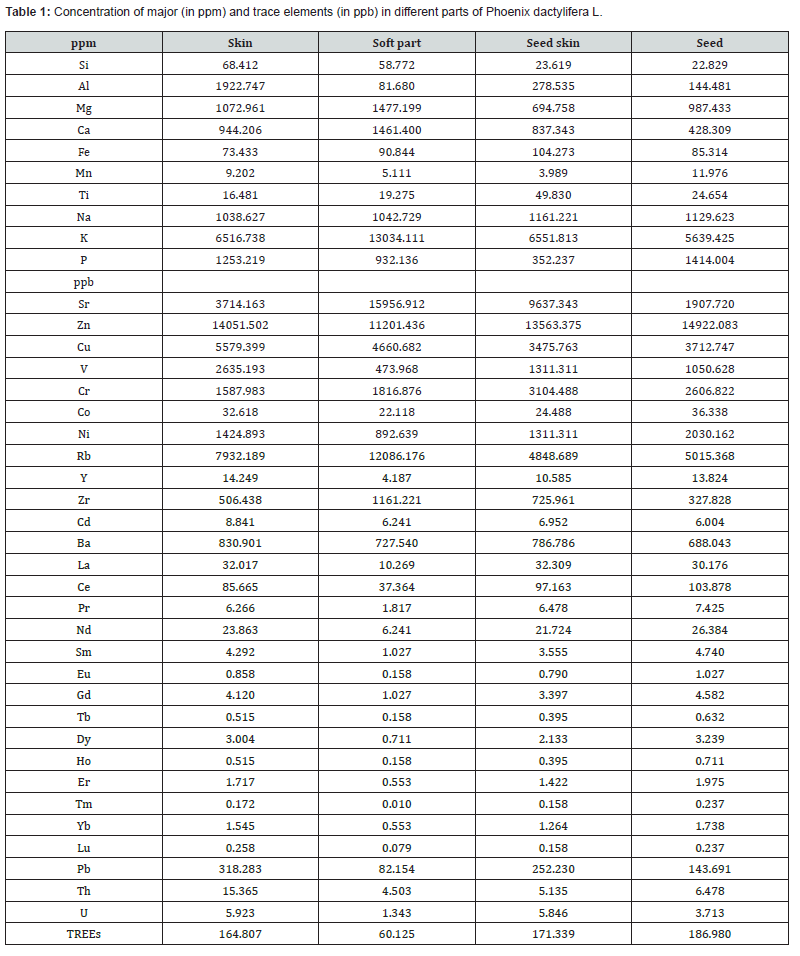
Major elements: Na, K, Mg, Ca, Al, Si, P, Ti
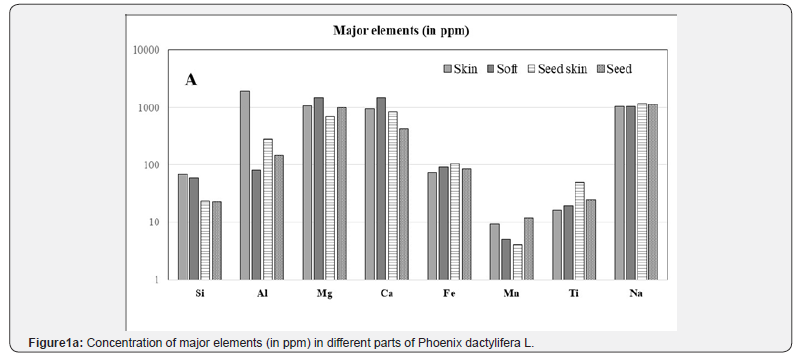
The concentration of Na ranges from 1039 to 1161.2 ppm (average =1081 ppm), while that of Si ranges from 24 to 68 ppm (average = 23 ppm) and that of Al from 82 to 1923 ppm (average = 761 ppm). The concentration of Mg ranges from 695 to 1477 ppm (average = 1082), and that of Ca from 837 to 1461 ppm (average = 1081 ppm). That of Fe ranges from 91 to 104 ppm (average = 90 ppm), while that of K ranges from 6517 to 13034 ppm (average = 8701 ppm) and that of P from 352 to 1253 ppm (average = 846 ppm). The elemental distribution in the different parts of dates, including the skin, the soft part, the seed skin and the seeds range in the following order: for Si, skin=soft> seed skin=seed, for Al: skin>seed>soft, for Mg, soft>skin=seed>skin seed, for Fe: similar in these different parts, for Mn: seed >skin>soft>skin seed, for Ti: seed skin>seed>skin=soft; for Na, similar distribution in all parts, for K: soft>skin=seed=seed skin; and for P: seed>skin>soft>seed skin (Figure 1).
Transition metals
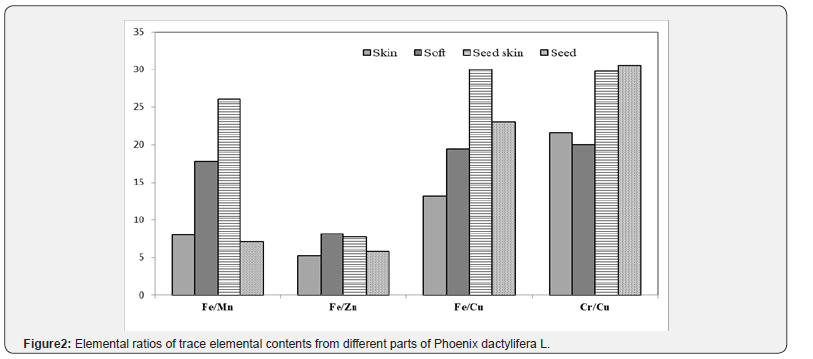
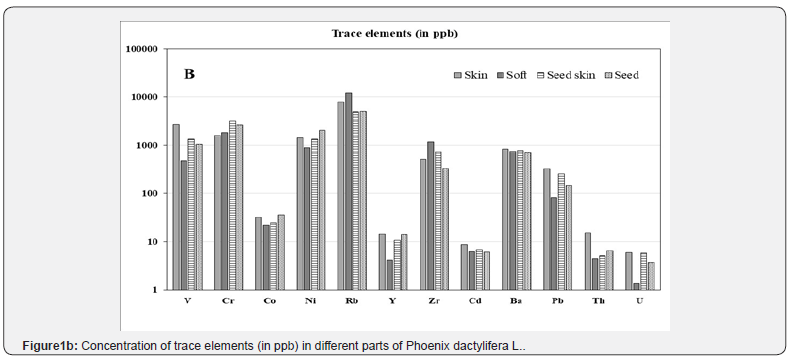
The total content of the metals Ni, Cu, V, Cr, Co, Zn, Mn, Fe, Ti and Zr is about 125 ppm in the skin, 135 ppm in the soft part, 147 ppm in the seed and 182 ppm in the seed skin. The Cu concentrations range from 3.7 to 5.6 ppm (average n= 4.4 ppm) and those of Zn range from 11.2 to 14.9 ppm (average = 13.4 ppm). Large differences can be seen for the different parts of the date fruit (Table 1, Figure 2). For Sr: soft>seed skin>skin>seed; for Zn: seed>skin>soft>seed; for Cu: skin>soft>seed=seed skin; for V: skin>skin seed>seed>soft; for Cr: seed skin>seed>skin=soft, for Co: seed=skin>soft=skin seed; for Ni: seed=skin>soft=skin seed; for Rb: soft>skin>seed skin=seed; for Zr: soft>seed skin>skin>seed; for Cd: skin>skin seed>soft=seed: for Ba: similar contents; for Pb: skin>seed skin>seed>soft; for Th: skin>seed>soft=seed skin ; for U: skin=seed skin>seed>soft. Among the different organs, the skin is especiallyt enriched in Cu, Cd, Ba, Pb, Th and U. The depleted remaining elements are Sr and Cr.
Rare-earth elements
The total contents of REEs are about 164.8 ppb in the skin, 60.1 ppb in the soft part, 171.3 ppb in the skin of the seeds and 187.0 in the seeds. The contents are higher in the skin than in the soft part and higher in the seeds than in the skin of the seeds. Skins have a tendency to accumulate REEs in the opposite to the soft part.
Discussion
Distribution of elements between the skin, soft part, seed skin and the seed of the studied dates
Compared to results of [20], the date seeds yield similar ratios than the date fruit (about 6.5 to 11.3). Our results on Fe content fell within the range of 0.3–10.4 mg/100 g that were reported previously for date varieties from different countries. As stated above, K yields the highest concentrations among the different elements in the different parts of the date fruit. Similar results were observed by [21] for date seeds of 3 varieties of Moroccan dates (about 4153.3 ppm for seeds of the Boufgous Moroccan variety of dates). Another variety of Moroccan dates contains about 4 times more K than in the seed of the Dates studied here [21]. Beside K, the content of Ca, Mg, P and Na in the soft parts of the dates are also higher than the other elements. In the seed skin, Na is the second most concentrated element after K with significant concentrations compared to the other elements. In the seed, the abundant elements beside K, are P, Na, and Mg. Similar ranges were observed for Mg and Ca content in seeds of Omani dates, which are investigated here, compared to Moroccan dates [21]. The content of Na in seeds of the present study is higher than in the Moroccan dates.
Relative to previous studies on fruits, there is more Na than in the seeds of Baobab (Adansonia digitata) [22] but less K, Ca, Mg and Fe. Similar amounts of K and Fe were observed in the soft parts of the fruits from both studies. Compared to data of lupine seeds [23] there is more Fe and Zn and Cu, and less Mn in date seeds investigated during this study. Potassium has many functions in plants and fruits, such as stomatal regulation of transpiration and photosynthesis, enzyme activation and protein synthesis. It is also involved in photo-phosphorylation, transportation of photo assimilates from source tissues via the phloem to sink tissues [24- 27].
Major elements
Comparison of elemental contents in the different organs shows that the most enriched elements in the date skin are Si, Al and P and the most depleted are Fe, Ti and Na. There is more Al and Si in the skin compared to the other parts, which suggests an external supply of these elements probably by dust particles from atmosphere. Aluminum could be also due to internal distribution from roots being selectively transferred to the skin. The most enriched elements in the seed itself are Mn, K and P and the most depleted are Si and Ca, while the most enriched elements in the skin of the seeds are Fe, Ti, K, Al and Na and the most depleted are Si, Mg, Mn and P. The most enriched elements in the soft part of the dates are Mg, Ca and K and the most depleted are Al, Mn and P. The elements such as Ca and Mg are provided more from the soft part than from the other parts.
Trace elements
Most of the heavy metals are cofactors for several enzymes. In particular, Ni and Zn are present in a number of enzymes in plants and microorganisms and are used as co-factors for enzymes [28- 36]. On the other hand, the abundance of elements in plants and fruits reflect their mobility from roots to the parts above ground. Inputs from atmosphere may be a secondary source of elements in plants. The release of elements in the rhizosphere and their transportation to stems and leaves or to fruits require enzymes with specific sites for specific metals.
Among the different compartments of the date fruit, the most enriched elements of the soft part are Sr, Rb and Zr, while V, Co, Ni, Pb, Th and U are the most depleted ones. The most enriched element in the skin of the seeds is Cr and the most depleted is Rb. The most enriched elements in the seeds are Zn and Ni and the most depleted are Sr, Zr, Cd and Ba. Compared to contents of Cu and Zn already analyzed in dates by [37], the different parts of the dates here have higher Cu and Zn contents, which is in the opposite to lower Pb in the analyzed date samples of this study. The distribution of Zn and Co are similar with higher concentration in the seed and less in the skin, Th and U having the same distribution. Elements such as Fe and Cr are more concentrated in the seed skin and less in the skin, which suggests a low mobility from the seed to the other parts. Iron may occur under ferrous and ferric forms; the ferrous form being more mobile than the ferric one. Such distribution suggests more oxidized conditions in the seed than in the other parts of the dates. The oxidized form of Cr is more mobile than the reduced one.
Fractionation of Cr, Mn, and Co more abundant in the seed indicates oxidized conditions, as well as in its skin. In the opposite, higher concentration of U, Th and Cu in the skin relative to the other parts suggests external sources of these elements. Similar results were reported by [38] for Cu and Pb, more abundant in the skin than in the pulp of peach fruits. For plums and marrows, the trace elements tested were higher in the pulp than in the skin. For both the K/Rb and Sr/Ca ratios (Table 2), the highest values are in the seed skin and the lowest are calculated for the skin (Figure 3). The K/Rb values reflect an organic effect more than an inorganic one. The lowest K/Rb ratio observed in the skin indicates an impact of silicate inputs, probably as atmospheric dust.
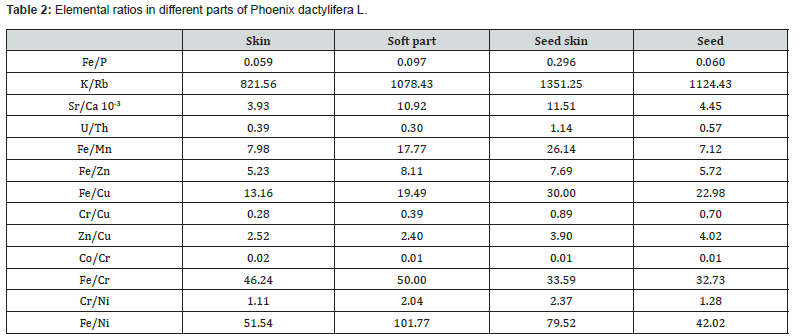
As for Mn, Fe is essential in chlorophyll synthesis and P is essential for ATP elaboration from ADP. Similar changes of P and Mn in the fruit are in the opposite to Fe, generating Mn/Fe and P/Fe ratios that change in the same way. For both Mn and P, the transfer from the seed to the other parts is less significant than the transfer of Fe in the same conditions. Such relocation of Fe suggests the contribution of specific enzymes to facilitate the transfer from the seed. The ratios such as Fe/Cu and Fe/Mn change in similar way with high values in the seed skin; the ratios such as Zn/Ni, Fe/Zn and Fe/Cr (Table 2) showing the highest values in the soft part. The Zn/Cu ratio increases from seed to skin, which is to the opposite to decreasing Mn/Cu from seed to the other organs. The P/Fe and Mn/Fe ratios decrease in the soft part and in the seed skin, reflecting in turn a decrease of P and an increase of Fe in these parts.
In summary, about 40% of Si, 79% of Al, 26% of Mg and Ca, 21% of Fe, 30% of Mn, 15% of Ti and 24% of Na from the whole fruit, are located in the skin more than in the soft part except for Mg and Ca and K with higher concentration in the soft part. For an average weight of 10g per date and based on the daily dietary invoke estimates of fruits: about 4 dates per day may provide 5 mg of Si, 80 mg of Al, 100 mg of Mg, 82 mg of Ca, 6.5 mg of Fe, 0.5 mg of Mn, 1.5 mg of Ti, 83 mg of Na, 88 mg of P, 0.8 mg of Sr, 1 mg of Zn and 0.4 mg of Cu.
Rare-earth elements (REEs)
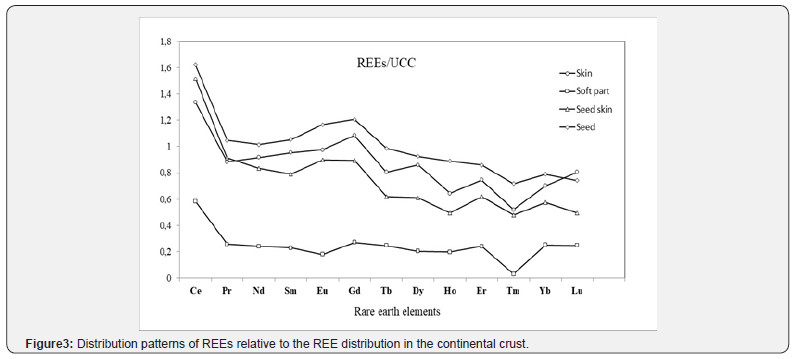
Unlike the results of Bertoldi D. R, et al. [39], there are more REEs in the seed of Vitis vinifera L. and in its skin. Bertoldi D. R, et al. [39] reported more REEs not only in the seeds but also in the flesh parts of Vitis vinifera. As for the other metals, the REEs are provided by the rhizosphere. Their transportation requires ligands, which characteristics can be traced by metals. The distribution patterns of REEs can provide information about the type(s) of ligands used for transportation. It can also provide information about oxydation-reduction processes. Relative to crust, there is a similar distribution for the different parts: an enrichment in LREEs (Figure 4) with a positive anomaly in Ce and a negative anomaly in Tm observed for the seeds and their skin. The distribution of the REEs in the skin and the soft part is flat with the same anomalies.
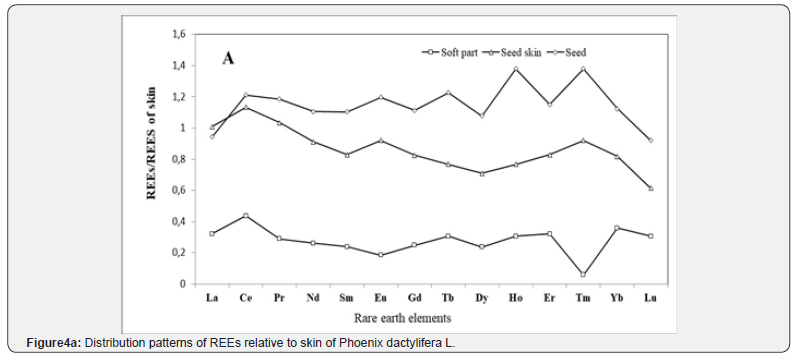
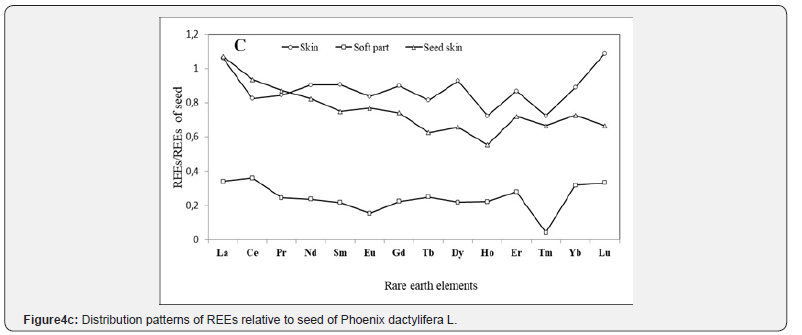
The enrichment in LREEs reflects a complexation with silicates. The soft part of the dates is characterized by a negative Tm anomaly and a positive Ce anomaly. Relative to skin, there is an enrichment of REEs in the seeds, a depletion of MREES in the seed skin with a positive Ce anomaly, which indicates more Ce4sup>+ than Ce3+ and an Eu positive anomaly suggesting more Eu3sup>+ than Eu2sup>+. For the soft part, there is a slight depletion in MREEs with a Ce positive anomaly and slight negative Eu and Tm anomalies (Figure 4). As stated above, there is less P in the soft part and in the skin of the seed, which suggests that the depletion of MREES in these two parts relative to the skin reflects a complexation of REEs with P in the skin. No correlation was observed between Fe and either the Ce or Eu anomalies, which suggests that the oxydationreduction process is not the dominant process controlling the Ce concentration in the different parts. An enzyme action may have a control on the distribution of elements.
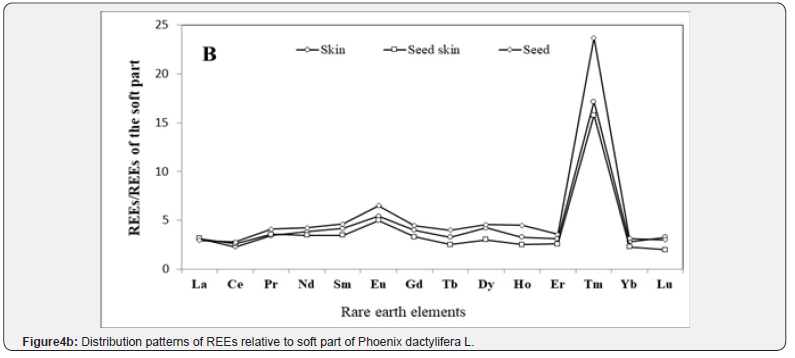
Relative to the soft part of the fruit, there is a slight enrichment in MREEs in the other parts, with a negative Ce anomaly and positive Eu and Tm anomalies (Figure 4). Relative to the seeds, the seed skin is characterized by depletion in MREEs and HREEs. The patterns are flat in the skin, flat in the soft part except for Ce with a positive anomaly and Eu with a negative anomaly (Figure 4). The slight depletion in MREEs characterizes the skin of the seeds and the soft part and may reflect less complexation with P in these two parts rather than in the seed. The Ce and Eu anomalies may reflect an oxydation—reduction or an enzyme effect. Since there is also a Tm anomaly, the enzyme effect is more credible. Enzymes are essential for chemical reactions and possess sites specific for elements. The soft part of the dates is depleted in REEs compared to the other parts. Unlike the soft part which is loaded with sugar and where there is little ability to complex REEs, the other parts are enriched in LREEs and depleted in MREEs and HREEs. For an average seed weight of about 0.5 g to 4 g and on the basis of a daily consumption of 4 dates, we observed that about 0.37 to 3 mg of REEs per day per capita would be provided by seeds that are never consumed. Yearly about 0.14 to 1.1 mg of REEs can be provided per capita by the seeds, which are the uneaten part of dates. This result can be interested in industrial applications and production of energy since availability of REEs is limited.
Conclusion
We can learn from this study on various components of date fruits, that: (1) the skin is more enriched in Si, Al, Mn, Cd, Pb, Th and U than the other parts of the fruit, (2) the soft part is more enriched in Mg, Ca and Zr, (3) the seeds are more enriched in Mn, Ni, Co and REEs, (4) the seed of date is the most oxidized part. The REEs of the seeds and of the skin of the seeds are characterized by an enrichment in LREEs relative to crust with a positive anomaly in Ce and a negative anomaly in Tm that suggest a complexation with silicates. The REEs in the skin and the soft part are flat with the same anomalies.
The significant REE fractionation in the soft part outlines a slight depletion in MREEs relative to the skin of dates. For the skin of the dates, there is an enrichment in MREEs with a negative Ce anomaly and a positive anomaly in Eu and in Tm relative to the soft part. In the case of the seeds, there is an enrichment of REEs relative to skin, a slight enrichment in MREEs relative to the soft part. For 4 dates consumed per capita per day, about 0.14 to 1.1 mg of REEs can be yearly provided from uneaten seeds.
Acknowledgement
Sincere thanks are for Hilal Zidi and Khamis Dafri (College of Science, SQU) for their laboratory help.
Author Contributions
Khadija Semhi wrote the manuscript and contributed to the interpretation. Sam Chaudhuri contributed to elaboration of the project, to writing and interpretation.
Funding
This work is not supported by any external funding.
Data Availability Statement
The data supporting the outcome of this research work has been reported in this manuscript.
Conflicts of Interest
The authors declare no conflicts of interest.
References
- Dardick C, Callahan AM (2014) Evolution of the fruit endocarp: molecular mechanisms underlying adaptations in seed protection and dispersal strategies. Front Plant Sci 5: 284.
- Mourão KSM, Beltrati CM (2001) Morphology and anatomy of developing fruits and seeds of Vismia guianensis (AUBL.) Choisy (Clusiaceae). Braz J Biol 61(1): 147-158.
- Gomes Junior FG (2010) Application of image analysis for evaluation of seed morphology = Aplicação da análise de imagens para avaliação da morfologia interna de sementes. Informativo Abrates 20: 33-39.
- Tiwari Aparna, Adam Vivian-Smith, Karin Ljung, Remko Offringa (2012) Physiological and morphological changes during early and later stages of fruit growth in Capsicum annuum. Physiol Plant 147(3): 396-406.
- Dos Santos Rayssa Fernanda, Francisco Guilhien Gomes-Junior, Julio Marcos-Filho (2020) Morphological and physiological changes during maturation of okra seeds evaluated through image analysis. Sci agric (Piracicaba, Braz) 77(3): 020.
- Al‐Farsi MA, Lee CY (2008) Optimization of phenolics and dietary fibre extraction from date seeds. Food Chem 108: 977–985.
- Yala‐Zavala JF, Rosas‐Domínguez C, Vega‐Vega V, González‐Aguilar GA (2010) Antioxidant enrichment and antimicrobial protection of fresh‐cut fruits using their own byproducts: looking for integral exploitation. J Food Sci 75: 175– 81.
- Gómez‐García R, Martínez‐Ávila GC, Aguilar CN (2012) Enzyme‐assisted extraction of antioxidative phenolics from grape (Vitis vinifera L.) residues. 3 Biotech 2: 297–300.
- Sobukola OP, Adeniran, OM Odedairo AA, Kajihausa OE (2010) Heavy metal levels of some fruits and leafy vegetables from selected markets in Lagos, Nigeria. African Journal of Food Science 4(2): 389-393.
- Hameedur Rehman, Rehman Ullah, Tahir Iqbal, Muhammad Farhan, Tahir Javed, et al. (2014) Elemental Assessment of Fruits and Vegetables. Journal of Pharmacy Research 8 (4).
- Anjali Verma, Priyanka Sharma, Namita Dhusia, Nandkishor More (2016) Determination of heavy metal content in fruits and fruits juices consume in urban areas of Lucknow, India. International Journal of Food Science and Nutrition 1(5): 44.
- Bolowa OE, Akintobi OJ (2019) Evaluation of the Nutrient Composition of Fruits Selected from Different Markets in Lagos, Nigeria Together With Their Heavy Metals Contents. Earth & Envi Sci Res & Rev 2(4): 1-4.
- Ikechukwu Uroko Robert, Victor Eshu Okpashi, Uchenna Nwuke Chunedu Paulinus, Nduka Florence Obiageli, Ogbonnaya Precious (2019) Evaluation of heavy metals in selected fruits in Umuahia market, Nigeria: Associating toxicity to effect for improved metal risk assessment. Journal of Applied Biology & Biotechnology 7(4).
- Ajila CM, Aalami M, Leelavathi K, Rao UP (2010) Mango peel powder: a potential source of antioxidant and dietary fiber in macaroni preparations. Innov Food Sci Emerg Technol 11: 219–224.
- Sagar Narashans Alok, Sunil Pareek, Sunil Sharma, Elhadi M Yahia, Maria Gloria Lobo (2018) Fruit and Vegetable Waste: Bioactive Compounds, Their Extraction, and Possible Utilization. Comprehensive Reviews in Food Science and Food Safety 17 (3): 512-531.
- Rudra SG, Nishad J, Jakhar N, Kaur C (2015) Food industry waste: mine of nutraceuticals. Intl J Sci Environ Technol 4: 205-229.
- Chaudhuri, Clauer N, Semhi K (2007) Plant decay as a major control of river dissolved potassium: A first estimate. Chemical Geology 243(1–2): 178-190.
- Mark A Doster, Themis J. Michailides (1999) Relationship Between Shell Discoloration of Pistachio Nuts and Incidence of Fungal Decay and Insect Infestation. Plant Diseas 83(3): 259-264.
- Samuel J, Rouault R, Besnus Y (1985) Standardized multi-element analysis of geological material by Inductively Coupled Plasma Atomic Emission Spectrometry and Mass spectrometry. Analusis 13: 312–317.
- Bouhlali Eimad dine Tariq, Chakib Alem, Jamal Ennassir, Mohamed Benlyas, Addi NaitMbark et al. (2017) Phytochemical compositions and antioxidant capacity of three date (Phoenix dactylifera L.) seeds varieties grown in the South-East Morocco. Journal of the Saudi Society of Agricultural Sciences. 16(4): 350-357.
- Sawaya WN, Khalil JK, Safi WJ (1984) Chemical Composition and Nutritional Quality of Date Seeds. 49(2): 617-619.
- Magdi Osman, Magdi AO (2004) Chemical and Nutrient Analysis of Baobab (Adansonia digitata) Fruit and Seed Protein Solubility. Plant Food Hum Nutr 59: 29-33.
- Roman Laura , Emmanouil Tsochatzis, Kubra Tarin, Eje M Röndahl, Carl-Otto Ottosen, et al. (2023) Compositional Attributes of Blue Lupin (Lupinus angustifolius) Seeds for Selection of High-Protein Cultivars. J Agric Food Chem 71(45):17308–17320.
- Doman DC, DR Geiger (1979) Effect of exogenously supplied potassium on phloem loading in Beta vulgaris L. Plant Physiol 64: 528-533.
- Usherwood (1985) The role of potassium in crop quality. In: Munson R.D. (Edtn.) Potassium in Agriculture. Am Soc of Agron, USA. pp. 489-513.
- Marschner H (1995) Functions of mineral nutrients: macronutirents. In: H. Marschner (2nd Edtn). Mineral nutrition of higher plants. Academic Press, USA pp. 299-312.
- Pettigrew WT (2008) Potassium influences on yield and quality production for maize, wheat, soybean and cotton. Physiol Plant 133: 670-681.
- Hausinger RP (1997) Metallocenter assembly in nickel-containing enzymes. J Biol Inorg Chem 2: 279–286.
- Cakmak I (2000) Possible roles of zinc in protecting plant cells from damage by reactive oxygen species. New Phytol 146: 185-205.
- Broadley MR, White PJ, Hammond JP, Zelko I, Lux A (2007) Zinc in plants. New Phytol 173: 677-702.
- Auld D S, T Bergman (2008) Medium- and short-chain dehydrogenase/reductase gene and protein families: The role of zinc for alcohol dehydrogenase structure and function. Cell Mol Life Sci 65(24): 3961-3970.
- Escudero-Almanza DJ, Ojeda-Barrios DL, Hernández-Rodríguez OA, Sánchez-Chávez E, Ruíz-Anchondo T, et al. (2012) Carbonic Anhydrase and Zinc in Plant Physiology. Chil J Agric Res 72: 140-146.
- Boer Jodi L, Scott B Mulrooney, Robert P Hausinger (2013) Nickel-Dependent Metalloenzymes. Arch Biochem Biophys 15: 142-152.
- Samreen T, Shah HU, Ullah S, Javid M (2017) Zinc effect on growth rate, chlorophyll, protein and mineral contents of hydroponically grown mungbeans plant (Vigna radiata). Arab J Chem 10: S1802-S1807.
- Castillo-González J, Dámaris OB, Adriana HR, Ana C González-Franco, Loreto RH et al. (2018) Zinc metalloenzymes in plants. Interciencia 43(4): 242-248.
- Maier Robert J, Benoit Stéphane L (2019) Role of Nickel in Microbial Pathogenesis. Inorganics 7(7): 80.
- Taha Kamal K, Al Ghtani Fahad M (2015) Determination of the elemental contents of date palm (Phoenix dactylifera L.) from Kharj Saudi Arabia. WSN 6(2015): 125-135.
- Papa Stefania, Laura Cerullo, Anna Di Monaco, Bartoli G, Antonietta Fioretto (2009) Trace elements in fruit and vegetable. EQA – Environmental quality/Qualité de l’Environnement/Qualità ambientale 2(2009): 79-83.
- Bertoldi DR, Larcher G, Nicolini M, Bertamini G, Concheri (2009) Distribution of rare earth elements in <i>Vitis vinifera</i> L. 'Chardonnay' berries. Vitis 48 (1): 49–51.

























