




 NFSIJ Home



Abstract
Introduction: Sarcopenia is a disease syndrome characterized by loss of muscle mass and function. Objective: To evaluate the risk of sarcopenia and its stages in older adults according to nutritional status by Electrical Bioimpedance.
Method: A descriptive randomized cross-sectional study was carried out in 2023 with older adults ≥ 60 years of age of both sexes, from Popular Councils of the Municipality of Santiago de Cuba. Sociodemographic and clinical parameters were evaluated. The risk of sarcopenia was
determined by the Mini Nutritional Questionnaire, SARC-F and physical tests according to EWOSOP 2 and Senior Fitness. The skeletal muscle
mass index was determined by BIA, according to the cut-off point by EWOSOP1, with the Cuban reference population by nutritional status, also
for the risk and stages of sarcopenia.
Result: The risk of sarcopenia occurred in obese women 82.1% and overweight men 40%, with a lower proportion in the other nutritional
states, due to the decreased strength in the majority. The low muscle mass index in men 40% and women 23.8%, with a greater number of obese
pre-sarcopenics; men 83.3%, women 80%, in addition to overweight 100% and thin 50%. Sarcopenic women and normal men 100% and thin
women 50%.
Conclusion: The risk of sarcopenia occurred in a higher percentage in obese women and decreased strength predominated for both sexes. The
disease prevailed in men with presarcopenia and sarcopenia stages and these in different proportions by nutritional status in both sexes.
Keywords:Sarcopenia risk; Presarcopenia; Sarcopenia; Physical tests; Electrical Bioimpedance.
Introductıon
The consensus of international European and Asian groups defined sarcopenia as a disease syndrome characterized by the loss of muscle mass and function [1-4]. It was classified in 2016 as a disease by the International Statistical Classification of Diseases and Related Health Problems (ICD 10) of the World Health Organization [5]. For its diagnosis, the European Working Group on Sarcopenia in Older People (EWGSOP) considered developmental stages such as: presarcopenia, sarcopenia, and severe sarcopenia. In all these stages, there is a reduction in muscle mass, with the decrease in strength and/or physical performance being variable in stage two. In stage three, there is a decrease in strength and physical performance [1,3,6,7]. The EWGSOP 2 considered giving greater attention to muscular strength, which can identify the risk of disease with the simple quick risk questionnaire for sarcopenia (SARC-F).
Then its confirmation with strength, muscle mass, and physical performance [8,9]. Electrical Bioimpedance (BIA) is an alternative to dual-energy X-ray absorptiometry (DEXA) and MRI for assessing muscle mass (SMM), due to being simple, low-cost, and portable [1]. For the cutoff point of muscle mass, it is recommended to use reference populations of young adults [6]. While dynamometry is used for hand pressure and as an alternative for muscle strength, the EWOGSOP 2 proposed the Chair Stand Test. For physical performance, the application of the Short Physical Performance Battery (SPPB) [4,8] is used. This technique is also used for nutritional classification [10]. However, there is no scientific evidence showing the risk and stages of sarcopenia in older adults based on their nutritional classification with Bioelectrical Impedance Analysis. Therefore, in this work, the risk of sarcopenia and its stages in older adults was evaluated according to their nutritional status by BIA.
Method
A descriptive randomized cross-sectional study was conducted in 2023 with the selection of elderly adults aged ≥ 60 years of both sexes, apparently healthy, living without restrictions in their community, belonging to the grandparents’ circles of the Popular Councils of Sueño, Abel Santa María, and Flores in the Municipality of Santiago de Cuba. These gave their approval for participation by signing the informed consent, respecting the ethical principles of the Declaration of Helsinki. The evaluation of sociodemographic parameters included toxic eating habits, lifestyle, professional level, planned physical activities, and work activities. The clinical assessment revealed the history of non-communicable chronic diseases, as well as their physical and general health status [11]. As inclusion criteria, older adults aged ≥ 60 years and up to 89 years were included, with a compatible mental state, adequate physical capacity to walk and engage in physical activity. With compensated hypertension, type 2 diabetes mellitus, and cardiovascular diseases. Older adults aged ≥ 60 years with motor disabilities, those using canes or wheelchairs for mobility, and those with diseases that affect muscle strength (neuromuscular conditions) were excluded. Older adults who dropped out of the study were also removed. To assess the risk of sarcopenia, the Mini Nutritional Questionnaire (MNA) [12] was applied. Those scoring < 17 points were classified as malnourished, 17-23.5 points as at risk of malnutrition, and ≥ 24 points as in good nutritional status. This was complemented with the SARC-F questionnaire according to the EWGSOP 2, with scores ≥ 4 indicating the risk of the disease [8,13]. The risk of sarcopenia was corroborated with physical tests of chair stand strength (sitting and standing 5 times) with a cutoff point of > 15 seconds [4,8] and the flexion and extension test of elbows with 5lb weights (2.27 Kg) for women and 8lb (3.63 kg) for men on the dominant limb with repetitions in 30s, according to age range and sex [14]. Physical performance was measured by the Short Physical Performance Battery (SPPB) with a walking speed of ≤0.8m/s and scoring from 0 to 6 points considered as low physical performance [4,8].
The BIA was conducted using the BIOS CAN 98 ® equipment (Biological Medical Technology S.L., Barcelona, Spain. URL: http://www.bl-biologica.es BIOSCAN). For this, the established guidelines from the National Institutes of Health Technology Assessment Conference Statement, 1984 were applied. Height was measured using the HEALTH SCALE equipment and weight with an electronic scale of 500 kg. For the nutritional status by BIA, the fat-free mass (FFM), the fat mass (FM), and the percentage of body fat mass (%FM) were estimated according to Nhanes III. Older adults were classified as recommended by Bray in 1993 [15] into: normal, overweight, obese, and thin by sex. Skeletal muscle mass (SMM) was estimated by BIA according to the EWGSOP1, following the Janssen [6,16] formula. Muscle mass was classified as low when it was equal to or below the cut-off point of the skeletal muscle mass index (SMMI) (SMMI = SMM / T2), being T the individual size, based on nutritional status and sex of young adults aged 18 to 35 from a reference Cuban population [6,8, 17] The cut-off points for the SMMI of the young population by nutritional status were for obese women 5.93 kg/m2, overweight 6.35 kg/m2; normal 6.93 kg/m2 and thin 5.53 kg/m2. For obese men, the cut-off was 8.64 kg/m2, overweight 8.66 kg/m2, normal 8.75 kg/m2 and thin 6.04 kg/m2. Results were analyzed using the SPSS® (Statistical Package for the Social Sciences) version 21.0 IBM (Statistics, 2023). For the data analysis, descriptive statistics were applied.
Result
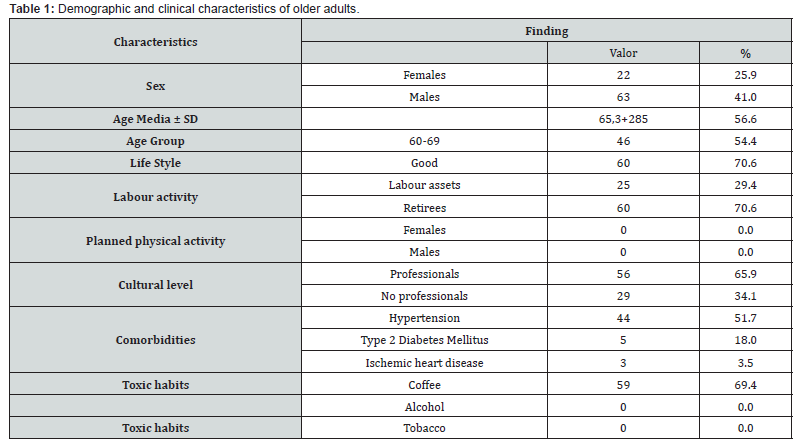
The study universe consisted of 150 elderly individuals who attend grandparent circles of the Popular Councils in the neighborhoods of Sueño, Abel Santa María, and Flores in Santiago de Cuba without restrictions. According to inclusion and exclusion criteria, the study sample was composed of 85 elderly individuals, representing 56.6% of the universe. Table 1 Demographic and clinical characteristics of the elderly individuals.
As shown in Table 1, the average age was 65 years, with the highest percentage being female. Among age groups, the largest number was represented by elderly adults aged 60-69 years, and the smallest by those aged 80-89 years. Good living conditions were revealed in most of them, with acceptable housing and a higher representation of retirees and professionals. No elderly adults engaged in planned physical activity for strength and endurance. Hypertension was the most frequently occurring comorbidity, with a higher percentage in women. Following that, type 2 diabetes was more common in women and in fewer elderly men but the categories ischemic heart disease and no clinical signs showed similarity in both sexes. Toxic habits related to coffee consumption were reported by more than half of them. None reported consuming alcoholic beverages or tobacco.
In the classification of nutritional status, the highest percentage was of obese individuals, with women reaching the value of 71.4% compared to 36.4% of men. The normal (36.4%) and overweight (22.7%) categories were predominantly men, as opposed to 17.4% and 6.3% of women being classified as normal and overweight, respectively. The classification of thin women and men was similar (women 4.8% and men 4.5%). In the mini nutritional questionnaire, 28.6% of women were at risk of malnutrition compared to 27.7% of men, totaling 28.4% of older adults, with an average score of 18.9 ± 0.9 among all participants in the study. There were no malnourished individuals. 71.7% were classified as nourished. According to the SARC-F questionnaire (Table 2), women had a lower perception of their functional limitations, with a lower percentage than men. The risk of sarcopenia confirmed by physical tests was higher for women and lower for men.
Fonte: Study register Study serie: 85

SARCF: Simple questionnaire for quick diagnosis of sarcopenia risk. Physical tests: Short physical performance test for lower limbs, Strength: Chair stand test, arm curl with weights.
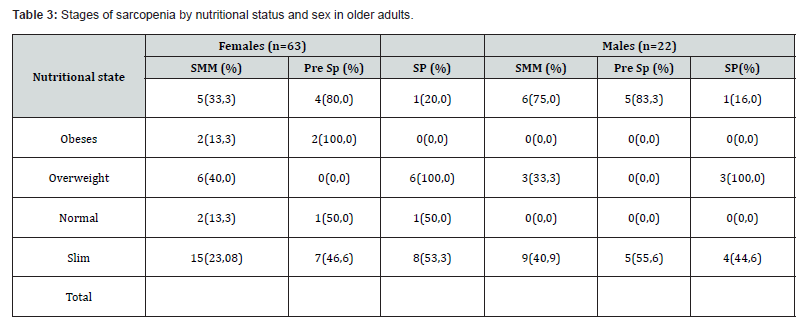
ISMMB index of low skeletal muscle mass; PreSp: Pre-sarcopenia Sp: sarcopenia.By nutritional status, Pre-sarcopenic, obese, and overweight women predominated, with underweight women being 88less common. In men, only obese Pres-arcopenic individuals were present. In the sarcopenia stage, normal, obese, and underweight women predominated, while normal and obese men were the majority. At this stage, 85.7 % of women had diminished strength, with 100 % of obese and underweight women and 83.3 % of normal women affected. Only 12.5 % presented low physical performance in a small percentage of normal individuals. All sarcopenic obese and normal men had diminished strength at 100 %. There was no risk or any stage of sarcopenia in 31.7 % (20) of women and 36.4 % (8) of men (not shown results).
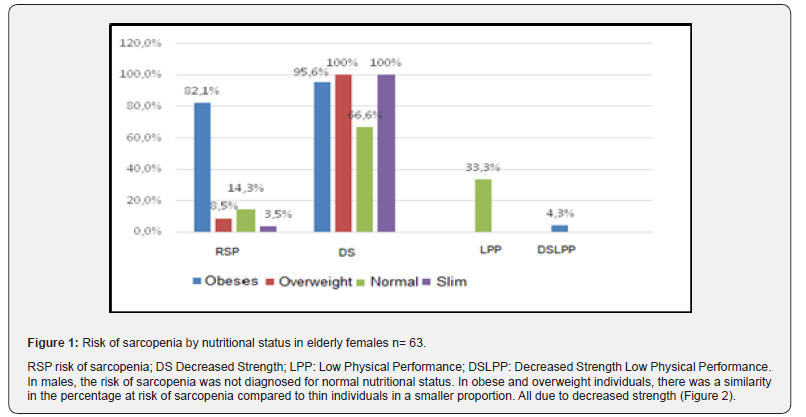
In all nutritional states, there were elderly females at risk of sarcopenia (Figure 1). Obese women were in greater proportion, due to decreased strength, and few were due to decreased strength and physical performance, in relation to the total of them.
Discussion
The results show older adults at risk of sarcopenia due to decreased strength or physical performance and those who presented stages of sarcopenia, solely due to reduced muscle mass and physical functionality, with different behaviors depending on nutritional status and sex. As demonstrated by MNA, the risk of malnutrition was similar for both sexes in a small fraction, concerning the study series, and none were undernourished. Coincidentally, Carbó et al., [12] reported similar behavior. However, there was a similarity in nutritional risk with the results of SARC-F (28.4%) regarding the study series (Table 2). But the physical tests did not match 10.6% with MNA and SARC-F (Table 2). The importance of physical tests could be valued to confirm the risk of disease, when nutritional risk and perception of functional limitations were recorded in few older adults [8].
Carbó et al., [ [12] also reported the prevalence of sarcopenic syndrome according to the Body Mass Index (BMI) by sex. This work classified nutritional status using Bioelectrical Impedance Analysis (BIA), estimating body fat, which had not been previously evaluated for the risk and stages of sarcopenia by nutritional status. It demonstrated differentiated behavior in physical functionality (muscle strength) and muscle mass, not only by sex as is currently done (Figures 1 & 2, Table 3) [18]. This is based on changes in body composition, specifically in skeletal muscle mass, obtaining a cutoff point for BMI by nutritional status in young Cuban adults, as a reference value to measure the same and evaluated to determine those who are sarcopenic. These results represent a novelty for Cuba, differing from Latin America, where reference populations from the region are generally not used..
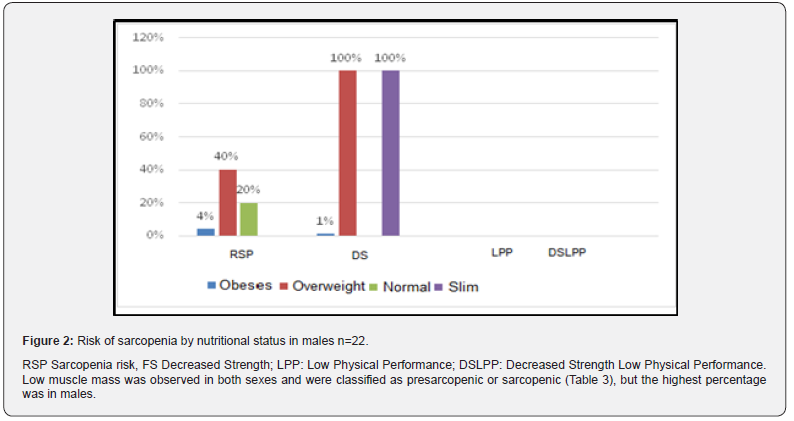
In obese individuals of both sexes, there were more older adults at risk of sarcopenia. Although they all maintained their preserved muscle mass, their diagnosis corresponded fundamentally to a decrease in strength, and to a lesser extent to physical performance or both at the same time, closely related to their non-exercise lifestyle and the behavior of body fat in this nutritional state. Coincidentally, Pinzón in 2020 [18] notes that the pathophysiology of muscle strength loss or dynapenia is related to different factors such as lifestyle, inadequate nutrition, lack of physical activity, psychological factors, and subjective perception of functional limitations, assessed by SARC-F. Older adults at risk of sarcopenia had a nutritional risk of 27.05% [23], apart from not engaging in strength and resistance physical activity.
Obesity exacerbates the decline of age-related physical function, caused by a decrease in muscle strength and an increase in fat mass, leading to limitations in activities of daily living according to Guadamuz et al. [19] Other authors report that the decrease in muscle strength occurs at a faster rate than the loss of muscle mass and may be unrelated to preserved muscle mass as evidenced by the risk of sarcopenia. This confirms the current approach, where muscle strength is prioritized as a risk for the development of the disease [8].
There was agreement on the predominance of men with the disease compared to women, as recorded in prevalence studies [12,20,21]. Only a very small proportion of women with sarcopenia had low physical performance. This is justified as it corresponds more with the severe stage, with possible disability and death [4]. However, in this study, older adults were engaged in daily activities without restrictions, and none were confirmed to be severely sarcopenic. The sarcopenic syndrome was present in the obese, normal, and thin individuals. In the obese, possibly due to metabolic imbalance, which increases the processes of degradation and fat infiltration in muscle, and inflammatory processes with muscle atrophy, leading to a decrease in strength and muscle mass [19]. In the thin individuals, the decrease in body fat and lean mass can manifest in the decrease of muscle mass and strength. Although it was not logical to expect the development of sarcopenia in normal, it can be explained by the decrease in lean mass with an increase in fat mass with aging and the maintenance of weight [22].
Conclusion
The increase in fat influences the decrease in muscle strength [23] determined in these older adults and to a greater extent in the obese. Additionally, they align with the decrease in skeletal muscle mass with age [12] as observed in this research (not shown). This behavior is not only physiological with aging, where hormonal changes occur, an increase in catabolic processes, and a decrease in anabolic processes, which constitute risk factors for the development of disease. It can be accelerated by type 2 diabetes mellitus (T2DM), hypertension (HTA), or sarcopenic obesity (SO), and they impact the decrease in muscle mass and muscle functionality [7,24]. Those at greater risk of developing cardiovascular diseases include the obese, due to the decrease in strength and the increase in stiffness of blood vessels [23]. In this study, the majority of older adults at risk of sarcopenia or sarcopenic. They presented obesity sarcopenia (23.8%), hypertension (52.6%), type 2 diabetes mellitus (21.1%), ischemic heart disease (3.5%), and these increased with the stage of the disease. These results are important for establishing the treatment of the disease according to nutritional status, from the risk of the disease and preventing it from progressing to another stage, with possible follow-up in primary health care. The risk of sarcopenia was higher in obese women and the decrease in strength predominated in both sexes. The disease was more prevalent in men with presarcopenia and sarcopenia stages, and these in different proportions by nutritional status in both sexes, regardless of cultural level, lifestyle gender, and work activity they develop, but dependent on lifestyle, without planned physical activity.
References
- Hernández Rodríguez J, Arnold-Domínguez Y (2019) Key elements to consider for the correct diagnosis of sarcopenia. Medisur, 17(1).
- Rojas Bermudez C, Buckcanan Vargas A, Benavides Jiménez G (2019) Sarcopenia: comprehensive approach to the elderly. RevistaMédicaSinergia 4(5): 24-34.
- Crushiria Reina OR, Bastidas Rueda GD, Yépez Guachamín E, VilatuñaLlumiquinga KA, AgualangoCubi PA, et al., (2019) Sarcopenia: clinical and therapeuticaspects. Archivos Venezolanos de Farmacología y Terapéutica 38(1): 72-76.
- Coletta G, Phillips SM (2023) An elusive consensus definition of sarcopenia impedes research and clinical treatment: A narrative review. Aging Research Reviews 86: 101883.
- Vellas B, Fielding RA, Bens C, Bernabei R, Cawthon PM, et al., (2018) Implications of ICD-10 for sarcopenia clinical practice and clinical trials: Report by the International Conference on Frailty and Sarcopenia Research Task Force. Journal of Frailty Aging, 7(1): 2-9.
- Cruz-Jentoft AJ, Baeyens JP, Bauer JM, Boirie Y, Cederholm T, et al., (2010) Sarcopenia: European consensus on definition and diagnosis. Age and Ageing, 39(4): 412-423.
- Sepúlveda Loyola WA, Luna Corrales AG, Ganz Felipe, González Caroa H, Luziane Probst V (2020) Sarcopenia: Definition and diagnosis. Do we need reference values for older adults in Latin America? Revista Chilena de Terapia Ocupacional 20(2): 259-267.
- Cruz-Jentoft AJ, Bahat G, Bauer JM, Boirie Y, Bruyere O, et al., (2019) Sarcopenia: Revised European consensus on definition and diagnosis. Age and Ageing, 48(1): 16-31.
- Chen KL, Woo J, Assantachai P, Auyeung WT, Chou YM, et al., (2020) Asian Working Group for Sarcopenia: 2019 consensus update on sarcopenia diagnosis and treatment. Journal of the American Medical Directors Association 21(3): 300-307.e2.
- Alvero Cruz JR, Correas Gómez L, Ronconi M, Fernández Vázquez R, Porta Manzañido J (2011) Bioelectrical impedance as a method for estimating body composition: Practical guidelines for use. Revista Andaluza de Medicina del Deporte 4(4): [approx. 7 pages].
- Estrella López V, Garantes Losa JL, González García G, Dávila Núñez T (1996) Adultprogram. Cuba.
- Carbó Alfonso Y, Peña González M, Rodríguez Graño T, Rivas Carralero R, Sains Jorge Y (2021) On the presentation of sarcopenic syndrome among older adults attending a sports complex in the city of Holguí Revista Cubana de Alimentación y Nutrición RNPS. ISSN 1561-2929.
- YS Yoshida A, Matsunaga A (2022) Limitations of SARC-F as a Screening Tool for Sarcopenia in Patients on Hemodialysis. Nephron 146(1):32-39.
- Merino Garcia (2019) Senior Fitness Test (SFT) Universidad Europea de Madrid. Spain.
- Rondón Ortega A, Vallejo Castillo FJ, García Falcón ME (2014) Nutritional assessment using impedance techniques: Advantages and disadvantages in eating disorders. Conducta Alimentaria 19: 20290’2014.
- R Roman Montoya A, Lara Lafargue A, Morales Larramendi R, Marañón Cardonne M, Castillo Bonne J, et al., (2021) Database of bioelectrical parameters characterization by bioelectrical impedance methods [ISBN 978-959-207-679-2]. University of Oriente - CNEA, U.O. Editions, Cuba.
- Janssen I, Heymsfield SB, Baumgartner RN, Ross R (2000) Estimation of skeletal muscle mass by bioelectrical impedance analysis. Journal of Applied Physiology 89(2): 465-471.
- Pinzón Rios ID (2020) Dynapenia: Exercise prescription. Revista Observatorio del Deporte 6(3): 35-51.
- Guadamuz Hernández SH, Suarez Brenes G (2020) Overview of sarcopenic obesity in older adults. Revista Medicina Legal de Costa Rica 37(1).
- Baumgartner RN, Koehler KM, Gallagher D, Romero L, Heymsfield SB, et al. (1998) Epidemiology of sarcopenia among the elderly in New Mexico. American Journal of Epidemiology 147(8): 755-763.
- Bian A, Ma Y, Zhou X, Guo Y, Wang W, et al., (2020) Association between sarcopenia and levels of growth hormone and insulin-like growth factor-1 in the elderly. BMC Musculoskeletal Disorders 21: 1-9.
- Khor EQE, Lim JP, Tay L, Yeo A, Yew S, et al. (2020) Obesity definitions in sarcopenic obesity: Differences in prevalence, agreement, and association with muscle function. Journal of Frailty Aging 9(1): 37-43.
- Rodríguez Cuba A, Ibarra Abanto SJ, Parodi J F, Runzer Colmenares F (2022) Sedentarism and mortality in hypertensive patients: Role of sarcopenia criteria. Revista Federación Argentina de Cardiología 51(1): 16-22.
- Kishore Gamgaran V, García Olivera M, Oliveira Fuster G (2023) Diabetes and sarcopenia. Nutrición Clínica en Medicina 17(19): 75-88.

























