




 NFSIJ Home



Abstract
In Chad, farmers are faced with the problem of seeds with low nutritional value. They do not make a judicious choice of varieties of cultivated species. The aim of the study is to determine the physico-chemical characteristics of sorghum and maize. The plant material consists of local sorghum and maize varieties. Sorghum and maize samples were collected and analyzed using non-destructive energy dispersive fluorescence spectroscopy. Iron levels in sorghum samples from the villages of Doyaba and Banda were 3.42 mg/100 g and 4.20 mg/100 g of seed. Those for Balimba are 3.90 mg/100g and 4.10 mg/100g of seed. Lipid levels are 2.25% and 3.45% for Doyaba and Banda sorghum. They are 2.64% and 3.22% for the Balimba samples. The protein contents of sorghum from Doyaba and Banda are 7.74% and 8.35%, those of Balimba are 8.25% and 9.15%. The carbohydrate contents of Doyaba and Banda sorghums are 71.15% and 72.45%, and 71.95% and 72.25% for Balimba samples. Iron levels in Doyaba and Banda maize are 1.1mg/100g and 1.2mg/100g of seed. Balimba seed contains 1.3mg/100g and 1.7mg/100g. The lipid content of maize at Doyaba and Banda is 3.19% and 6.76%, and 3.32% and 4.12% at Balimba.Les teneurs en protéines de maïs de Doyaba et Banda sont de 6,98% et 7,88%, celles de Balimba sont de 7,47% et de 7,9 Carbohydrate contents are 65.15% and 67.05% for the Doyaba and Banda samples, and 68.20% and 70.10% for the Balimba maize. The nutritional values of the seeds of these growers’ local varieties are below limit values, so they must also use seeds of improved varieties.
Keywords:nutritional values; seeds; local varieties; Zea mays L; Sorghum bicolor L; Chad
Introductıon
Chad’s agricultural policy is to ensure food security for the population with low-cost, quality agricultural products on sustainable bases [1] and to contribute to poverty reduction in rural areas. However, producers are faced with the problems of seeds with low nutritional values. Producers generally use low-quality seeds because they do not make a judicious choice of varieties of cultivated species. With regard to seeds with nutritional value, the problem is paramount throughout the world. Solutions vary according to the technical level of farmers and the organization of seed production at national level. In the USA and Israel, selected seed is delivered ready for sowing [2], which guarantees its nutritional quality. In many countries, seed production and conservation are left to the initiative of growers, and sometimes leads to the use of bad seeds [3]. As a result, farmers are forced to use market seeds whose genetic identity, varietal and nutritional characteristics are unknown. Indeed, the introduction of certain varieties currently used in Chad dates back a very long time, with the result that the nutritional quality of the seeds has deteriorated.
Moreover, in West and Central Africa, growers generally keep seeds from their fields from one year to the next. This seed stock is highly exposed to various degradation factors, as well as to cyclical conditions that may lead the farmer to sell his seeds to meet urgent monetary needs [3], without regard for the nutritional quality of the seeds. As a result, the population is forced to consume crop products of poor nutritional quality.
Moreover, if the grower does not have enough seeds at sowing time, he turns to a neighbor or the rural community, and in most cases buys “off-the-shelf” seeds of low nutritional quality to meet his needs [4].
Chad’s population was estimated at 10,238,807 in 2007, with an annual growth rate of 3.14%. 87% of this population is poor, 80% of whom live in rural areas and derive most of their income from agricultural activities. Before the advent of oil, Chad’s economy was mainly based on agro-pastoral activities. Although over 74% of the population lives in rural areas, agriculture accounts for only 22.7% (2005) of GDP, compared with 51.2% (2005) for industry and 26.1% (2005) for other services. This population is also confronted with the problem of seeds of low nutritional value. Determining the physico-chemical characteristics of biofortifying varieties rich in iron, zinc and protein of sorghum and maize in Chad will enable us to guarantee a rich and varied diet for the population.
Agronomic research results, particularly on sorghum and maize, are available [5-10]. Nevertheless, research should focus more on the development of appropriate cultivation techniques [11] and the introduction of new varieties to increase crop yields in Chad.
In the study area, the main activity of the population is agriculture, so the main objective of this work is to help improve the nutritional quality of the population. Specifically, the objective is to identify sorghum and maize varieties rich in (iron, zinc, protein, etc.) and guide producers’ choice of the best nutrient-rich varieties.
Materials and Methods
Study Area
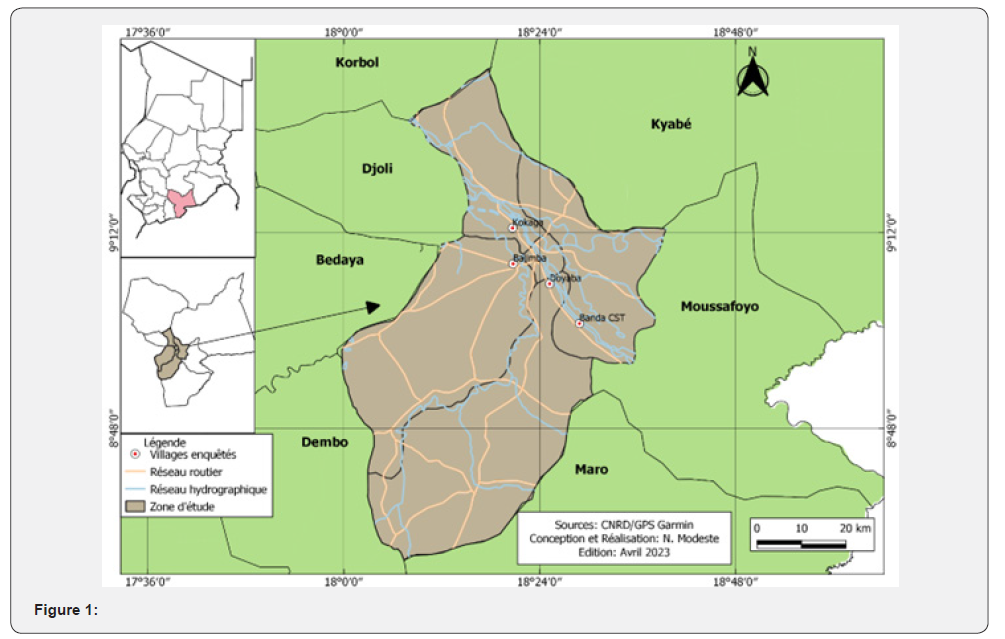
The study area covers three villages (Doyaba, Banda and Balimba) in the Barh Koh Department of Chad. In this area, the population’s main activity is agriculture (Figure 1).
Plant material
The plant material consists of the local “guidgodje” variety of sorghum and the local “gôdjido-kobé” variety of maize, the most widely grown and consumed in southern Chad because of their organoleptic characteristics and their adaptation to the agroecological zone.
Methods
Collect samples of two cereals (sorghum, maize) from producers in three villages (Doyaba, Banda and Balinba) in the study area and analyze them in the laboratory to determine physico-chemical parameters.
Physicochemical analysis
All physicochemical analyses were carried out at the Centre de Contrôle de Qualité des Denrées Alimentaires (CECOQDA) laboratory in Ndjamena (Chad). For each sample, various parameters were determined by methods based on the international standard.
Sample collection
Two cereals were collected for physicochemical analysis. The cereals consisted of sorghum and maize seed samples. All samples were collected from producers in the villages of the study area. Samples were collected between October and November 2024.
Sample preparation
To determine the physicochemical characteristics of the species, five hundred (500) gram samples of each cereal were cleaned, packaged in sterile plastic bags, kept in an isothermal cooler at room temperature and then sent to the laboratory for various analyses. Analyses were carried out at the physicochemical quality control department of the Food, Water and Beverage Quality Control Centre (CECOQDA) in Ndjamena (Chad), in accordance with international standards (NF EN ISO).
Physico-chemical analysis
Evaluate the nutrient content of sorghum and maize variety samples (iron, zinc, protein, lipid, carbohydrate and energy content) using the non-destructive Energy Dispersive Radio Frequency (EDXRF) spectroscopy method.
Data processing
The data collected were analyzed using SPSS software (Statistical Package for Social Sciences version 20.0). The means of the various parameters are separated by the Student-Newman- Keuls (SNK) multiple comparison test.
Results and Discussion
Iron, water, ash and lipid composition of the local sorghum variety (guidgodje)

The physicochemical compound contents of samples of the local guidgodje variety of sorghum from the Bar-Kôh Department are shown in (Table 1). The iron content of samples of the guidgodje variety of sorghum from producers in the villages of Doyaba and Banda is 3.42 mg/100 g and 4.20 mg/100 g of seed. In the village of Balimba, iron levels recorded in samples of this variety were 3.90 mg/100g and 4.10 mg/100g of seed. These iron contents are below the limit value of 3.8 mg/100g obtained in sorghum grains in Burkina Faso. The water content of samples of the guidgodje variety of sorghum from producers in the villages of Doyaba and Banda was 7.64% and 9.25% respectivelyOn the other hand, the sorghum water content recorded in the Balimba village samples was 8.45% and 8.65%. The rates are in line with the reference value applied, which must not exceed 13% [12]. Songre- Ouattara et al [13] found an average rate of 10.8±0.9 ranging from 9.6 to 12.5%. Mahamat-Silaye [14], obtained a rate of 9.7% for West African sorghum. Sorghum samples had an ash content of 1.85% and 1.82% for producers in the villages of Doyaba and Banda, while in the village of Balimba, an ash content of 2.20% and 3.05% was obtained for sorghum samples. All samples in the study area exceeded the 1.5% ash limit [12], and therefore failed to meet the reference value. Songre-Ouattara et al [13] obtained an average ash content of 1.6%, Mahamat-Silaye [14], obtained a value of 1.8%. However, Ndjangbei [15] recorded values from 1.03 to 1.42% on sorghum varieties Lipid contents of sorghum guidgodje samples were 2.25% and 3.45% for producers in the villages of Doyaba and Banda. Lipid contents of 2.64% and 3.22% were obtained on samples of the sorghum guidgodje variety from producers in the village of Balimba. This lipid contents comply with the upper limit set at 5% (Codex Standard 172-1989). Our results corroborate those of Ndjangbei [15], who obtained lipid contents ranging from 1.98 to 2.12% (Table 1).


Composition of the local sorghum variety (guidgodje) in terms of protein, carbohydrates, energy value and zinc.
Protein levels in samples of the local sorghum variety guidgodje from growers in the villages of Doyaba and Banda were 7.74% and 8.35%, while those from growers in the village of Balimba were 8.25% and 9.15% (Table 2). These protein contents for the guidgodje variety of sorghum in the study area are high compared with those obtained by Mahamat-Silaye [14]. However, all samples comply with the reference limit set at the minimum threshold of 7%. The carbohydrate content of samples of this local sorghum variety was 71.15% and 72.45% for producers in the villages of Doyaba and Banda, and 71.95% and 72.25% for producers in the village of Balimba. These levels are lower than those found in sorghum samples by Toury et al [16], who reached a value of 75.8%, and Ndjangbei [15], who noted sorghum carbohydrate values ranging from 79.21 to 83.53%. The energy values of sorghum samples from producers in the villages of Doyaba and Banda are 330.10 Kcal and 340.25 Kcal per 100g of seed samples respectively. These energy values are 335.05 Kcal and 342.15 Kcal per 100g of seed samples for producers in the village of Balimba. These values are lower than those obtained by Toury et al [16], and Mahamat-Silaye [14] on West African sorghum. These authors obtained values of 344 kcal/100g and 349 kcal/100g respectively. Also, Ndjangbei [15] recorded values ranging from 369.82 to 389.09 Kcal/100g of seed on sorghum varieties. Similarly, Nazal et al [17] obtained values ranging from 369.82 Kcal/100g to 385.09 Kcal/100g, which are not consistent with those of our study. The results of the physico-chemical analysis revealed that samples of the guidgodje variety of sorghum from producers in the villages of Doyaba and Banda have a zinc content of 1.2 mg/100g, while zinc contents of 0.98 mg/100g and 1.1 mg/100g were recorded in samples from the village of Balimba (Table 2).
Iron, water, ash and lipid composition of the local maize variety (guidgodje)
The levels of physicochemical compounds in maize samples from Bar-Koh Department are shown in (Table 3). The iron content of maize samples from producers in the villages of Doyaba and Banda was 1.1 mg/100 g and 1.2 mg/100 g of seed. In the village of Balimba, on the other hand, samples contained 1.3mg/100g and 1.7mg/100g of seed. These iron contents are below the limit value of 3.8 mg/100 g obtained in maize grains in Burkina Faso. Water content data for maize samples ranged from 8.13% to 9.55% for producers in the villages of Doyaba, Banda and Balimba. These values show that maize samples are well dried after harvesting in these localities. These values therefore comply with the CXS 154-1985 standard, which sets the limit value at 15%, and the FAO [18] standard, which sets the maximum rate at 15.5%. Corn samples had ash contents of 3.9% and 4.4% for producers in the villages of Doyaba and Banda, while ash contents for producers in the village of Balimba ranged from 3.75% to 4.3%. All maize samples exceeded the 3% limit set by CXS 154-1985. The lipid contents of the maize samples are 3.19% and 6.76% for producers in the villages of Doyaba and Banda, and 3.32% and 4.12% for farmers in the village of Balimba. Lipid contents are similar to those recorded by Deffan et al. [19] in Benin and Côte d’Ivoire, which vary between 3% and 5%. These values are in line with standard CXS 154-1985, which sets the lower limit for lipid content in maize at 3.10% (Table 3).
Composition of the gôdjido-kobé maize variety in terms of protein, carbohydrates, energy value and zinc
The protein content of maize samples from producers in the villages of Doyaba and Banda is 6.98% and 7.88%, while that of producers in the village of Balimba is 7.47% and 7.9% (Table 4). These protein levels are well below those of maize samples from Senegal, Benin and Côte d’Ivoire, which range from 9.1% to 12.8% [14] [19-20]. Also, these values are within the 7-12% range reported by Watson (1987These protein values for maize samples do not all comply with the CXS 154-1985 standard, which sets the lower limit for protein at 8%. The carbohydrate content of maize samples was 65.15% and 67.05% for producers in the villages of Doyaba and Banda, and 68.20% and 70.10% for producers in the village of Balimba. Carbohydrate levels in excess of 70% were found in maize samples from Burkina Faso, Benin and Senegal. These data are within the range of those reported by Watson [21], which vary between 69.5 and 81%. Only the values for MAI01174 from Balimba (70.10%) comply with the standard. The energy values of maize samples from growers in the villages of Doyaba and Banda are 320.50 Kcal and 325.43 Kcal respectively per 100g of seed samples. These energy values are 311.22 Kcal and 367.05 Kcal per 100g of seed samples for producers in the village of Balimba. These values are generally lower than those obtained by Mahamat-Silaye [14], 1981 (362 kcal/100g), Autissier [22], (363 kcal/100g) with the exception of MAI01175 from the village of Balimba which has a value of 367.05 Kcal. Indeed, the energy values of these growers’ samples are generally lower than the norm, which could be explained by the fact that the seeds are not homogeneous [23]. Almost all growers in the study area buy their seed at the market, rather than from approved multipliers or organizations. The results of the physico-chemical analysis showed that in the maize samples from producers in the villages of Doyaba and Banda, no zinc content was identified; this trace element was obtained in the MAI01174 samples from the village of Balimba with a content of 0.1 mg/100 g of seed (Table 4).
Conclusion
The aim of the study was to carry out a physico-chemical analysis of seed samples of sorghum and maize varieties collected from growers. The results of the physico-chemical analysis showed that the iron, zinc, protein, lipid, carbohydrate and energy contents of the seeds of these growers’ local varieties are below the limit values or contents obtained in most West African countries. During the course of our work, no certified or improved seeds were collected from growers for analysis. In Chad, certified or improved seeds are generally very expensive and unavailable. As a result, growers are obliged to use seeds of local varieties from their own harvests, which have low nutritional values. With this in mind, improved or certified seeds should be promoted at affordable prices, and growers should be encouraged to use seeds of improved varieties alongside local varieties. When growers are using seeds of improved varieties, it’s time to think again about carrying out physico-chemical analyses to identify the seeds of all nutrient-rich varieties.
References
- Goalbaye T, Ali Mahamat Z, Guiguindibaye M, Ahmat AC, Mahamat SM, et al. (2018) Impact of tractor ploughing on groundnut productivity in the Sudanian zone of Chad. Afrique Science 14(2) : 385-393.
- Gillier P, Silvestre P (1969) Peanut, Paris : Maisonneuve et Larose. Agricultural techniques and tropical production 15 pp.292
- OCDE (Organisation de Coopération et Développement Economique) (2025) OECD schemes for varietal certification or control of seeds intended for international trade.
- CXS 154-1985 (CODEX ALIMENTARIUS): International Food Standards (2023) adopted 1985 revised 1995 amended 2019.
- Habou AZ (2003) Effects of seed quality on groundnut production in Senegal. Diploma thesis, Ecole Nationale Supérieure d'Agriculture (ENSA), Thiès Senegal.
- Goalbaye T, Alhadj MN, Issiné A, Ahmat AC, Guiguindibaye M (2024) Effect of mini Doses of compost on maize development and yield at the Refugee site in Maro in the greater Sido Region. International Journal of Life Science and Agriculture Research 3(12): 961-967.
- Goalbaye T, Diallo MD, Madjimbé G, Mahamat-Saleh M, Guissé A (2017) Codification and morphological characterization of local varieties of corn (Zea mays) of Chad in way of extinction. International Journal of Development Research 7(1): 10897-10901.
- Madjimbe G, Yamtebaye N, Touroumgaye G, Mbang D, Laouali A (2017) Effect of agroforestry systems with shea (Vitellaria paradoxa F. Guertn) on sorghum (Sorghum bicolor (L) Moench) production in the canton of Koumra in southern Chad. Afrique Science 13(6) : 135-148.
- FAO (2015) The state of food insecurity in the world. Rome : FAO.
- Sène D (1987) Overview of agricultural technologies available in Senegal. Methodological report. SPAAR-CIRAD, Paris, octobre 192p.
- Taffoua VD, Etamé J, Din N, Nguelemeni M, Eyambé M, et al. (2008) Effects of sowing density on growth, yield and organic compound content in five varieties of niebe. (Vigna unguiculata L. ). Journal of Applied Biosciences 12 : 623-632.
- PAM (Programme Alimentaire Mondial) (2025) Regulations applicable to ready-to-eat foods.
- Songré-Ouattara LT, Bationo F, Parkouda C, Dao A, Bassole IHN, et al. (2015) Grain quality and processability : the case of Sorghum bicolor, Pennisetumg laucum and Zea mays varieties in use in West Africa. International Journal of Biological and chimist sciences 9(6): 2819-2832.
- Mahamat SO (1981) Etude de la composition chimique et de la valeur nutritive de quelques aliments du Séné Internship report, ORSTOM -Nutrition pp.43.
- Ndjanbei V (2025) Evaluation of the nutrient content of cereals and legumes in southern Chad. Dissertation for the Master's degree in Environment and Sustainable Development.
- Toury J, Giorgi R, Favier JC, Savina JF (1967) West African foods. Tables de composition. Annals of Nutrition and Food 21(2):
- Nazal AM, Hisseine MA, Touroumgaye G, Moukhtar R, Serferbe S, Seraye BO (2023) Nutritional quality of cereals grown in Chad : the case of millet, sorghum and maize. J. FOOD. Stab 6(4) :34-43.
- FAO (1989) Practical guide - On-farm grain storage and preservation.
- Deffan KP, Akanvou L, Akanvou R, Nemlin GJ, Kouame PL (2015) Morphological and nutritional evaluation of local and improved varieties of maize (Zea mays L.) produced in Côte d' 11(3): 181-196.
- Nago CM (1997) Traditional food processing of maize in Benin: determination of the physico-chemical characteristics of the varieties in use; relationships with the obtaining and quality of the main by-products. PhD Thesis ES-Sciences, Université Paris7-Denis Diderot-UFR de Biochimie pp.199.
- Waston SA (1987) Structure and composition. In: Corn Chemistry and technology, Watson S.A. and Ramstad PE Ed American Association of cereal Chemists St Paul MN USA pp. 55-82.
- Autissier V (1994) City gardens, field gardens, market gardening in West Africa : from diagnosis to intervention. Collection le point sur GRET Paris pp.295.
- Goalbaye T, Mahabou ST, Mariama DD, Bienvenu HK, Aliou G (2020) Evaluation of the agronomic performance of improved varieties of maize (Zea mays L) in the Sudanian zone of Chad. J Anim Plant Sci 41(3): 6977-6988.

























