




 NFSIJ Home



Abstract
There is a dire need for healthy and nutrient-dense green tea that can alleviate oxidative stress and cure related diseases. Kenaf leaves varieties (Ifeken Di-100) harvested eight weeks after planting (H) and ten weeks after planting (BR) were screened (using mineral analysis) for green tea production. The selected kenaf leaves were evaluated for total antioxidant content, 1, 1- diphenyl-2-picrylhydrazyl (DPPH) scavenging assay, total phenolic, chlorophyll content as well as High Performance Liquid Chromatographic (HPLC) analysis for vitamin E, caffeine and caffeic acid following the standard protocols. The results showed that kenaf green tea from BR samples was significantly higher in micro-nutrients and magnesium than the kenaf green tea from H samples. However, there was no significant difference in some macro- nutrients like potassium and sodium (K and Na) between the two samples. The results of other biochemical analyses showed that kenaf green tea (BR) contained significant number of total antioxidants, flavonoids, total phenolic compounds and the least amount of chlorophyll A & B. In addition, kenaf green tea exhibited high capacity to scavenge 1, 1- diphenyl-2-picrylhydrazyl (DPPH) free radical. HPLC analysis showed that caffeic acid was detected with conspicuous peak at 275nm wavelength and a retention time (RT) of 0.66905min with the Limit of quantification (LOQ) of 7.72 mg/l while caffeine was also detected at a retention time (RT) of 1.341min with the LOQ of 1.75 mg/l. Furthermore, HPLC analysis revealed that kenaf green tea contained vitamin E (Tocopherol). Conclusively, Kenaf leaf was found to be rich in total phenols and antioxidants which subsequently support its ability to mop/scavenge DPPH freeradicals.
Keywords:Kenaf; Green tea; Oxidative stress; Free radical; Antioxidant
Introduction
Kenaf is a multi-purpose crop that can be used as a source of food for humans, animal feed and fibre for different products and these are great sources of income to many categories of people. Kenaf (Hibiscus cannabinus L.) is a fibre plant native to East Central Africa where it has been grown for several thousand years for food, vegetables and fibre [1,2]. Kenaf leaf is found to be rich in bioactive compounds that are beneficial to human health [3]. In humans, numerous phytochemicals have been found to be protective and preventive against many degenerative diseases and pathological conditions such as: ageing, coronary heart disease, Alzheimer’s disease, neurodegenerative disorders, atherosclerosis, cataracts, and inflammation. Epidemiological and clinical studies provided evidence that most of these bioactive compounds exhibit their protective and disease-preventing functions through their antioxidant activities [3-5].
Research has shown that the health-promoting effects of green tea are majorly attributed to its polyphenol content particularly flavanols and flavonols, which represent 30% of fresh leaf dry weight [6,7]. Phenolic compounds have been shown to have bioactive properties including antioxidants and anti-inflammatory effects, anti-cancer and anti-cardiovascular disease as well as neuro-protective and anti-diabetic effects. This research aimed at developing a safe and healthy kenaf green tea for improved nutrition, human mood and alertness as well as oxidative stress alleviation.
Methodology
Samples of kenaf leaves variety (Ifeken Di-100) were harvested at eight weeks after planting (H) and ten weeks after planting (BR). Both samples were shade dried at room temperature (25-30oC) and then oven dried at 55oC for 4 hours. The dried kenaf leaves were processed under hygienic environment and well-packaged into green tea. Kenaf green tea was subjected to biochemical analyses following the standard protocol according to [8]. The following biochemical evaluations conducted on the samples, and these included mineral and antioxidant analyses. Kenaf green tea sample with higher minerals content was further subjected to antioxidant and HPLC analyses. Kenaf leaf tea were analysed by a HPLC system (CBM-20A, Shimadzu Co. Ltd., Japan) with two gradient pump systems (LC20AT, Shimadzu), a UV-detector (SPD- 10A, Shimadzu), an auto sample injector (SIL-20A, Shimadzu) and a column oven (CTO20A, Shimadzu). HPLC analysis for vitamin E, caffeine and caffeic acid were carried out using the external standard method for quantitation following the manufacturer’s instructions. Peak areas from HPLC Chromatogram were recorded.
Separation was achieved on a Gemini C18 column (4.6 × 100 mm, 3 μm, Phenomenex. Inc., Torrance, CA, USA) using a linear gradient elution program with a mobile phase containing solvent A (0.4%, v/v, formic acid in distilled deionized water) and solvent B (acetonitrile). Initially it started with a gradient of 18% B, changing to 32% in 15 min and finally to 50% in 40 min followed by washing for 25 min with a flow rate of 1.0 mL/ min. Sample injection volume was 10 μL and the resulting peaks were monitored at 280 nm. Identification of caffeic acid, caffeine and other compounds were achieved by comparing the retention time and absorption spectra of peaks to the external standard compounds.
Results
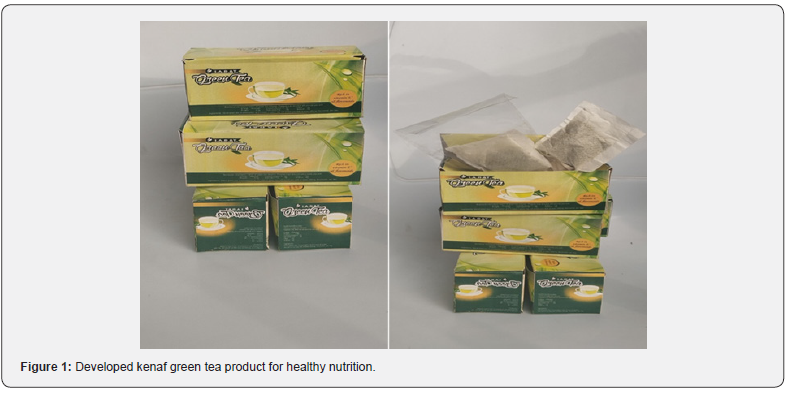
The developed and well packaged kenaf green tea is shown in (Figure 1).
Mineral analysis
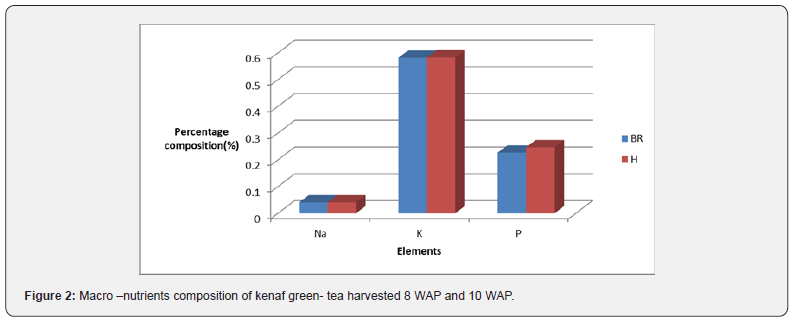
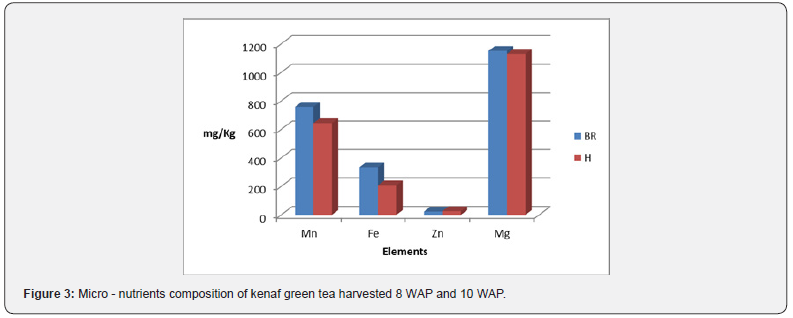
The result of mineral analysis showed that kenaf green tea sample (BR) harvested at10 WAP was significantly higher in micro-nutrients and magnesium than the kenaf green tea (H) sample harvested at 8 WAP, although there was no significant difference in some macro-nutrients like potassium and sodium (K and Na) between the two samples as shown in (Figures 2 & 3).
Antioxidant analysis
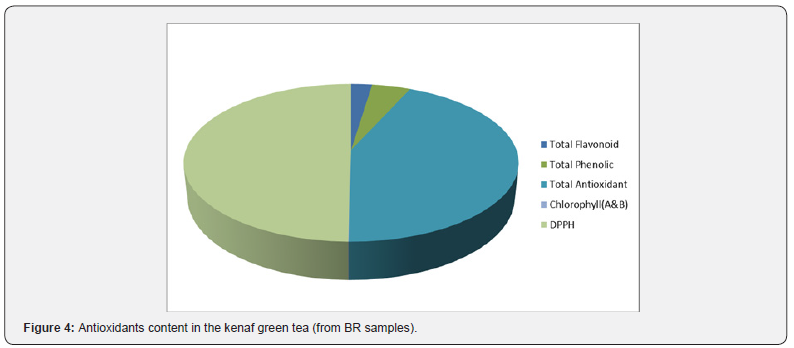
The result of the antioxidant analysis showed that kenaf green tea from BR contained significant amounts of total antioxidants as well as exhibiting high capacity to scavenge 1, 1- diphenyl-2- picrylhydrazyl (DPPH) free radical (Figure 4). Kenaf green tea contained flavonoids- and total phenolic-compounds. These are important bioactive compounds that combat oxidative stress in the body. In addition, kenaf green tea contained the least amount of chlorophyll A & B.
HPLC analysis of Caffeic acid and Caffeine
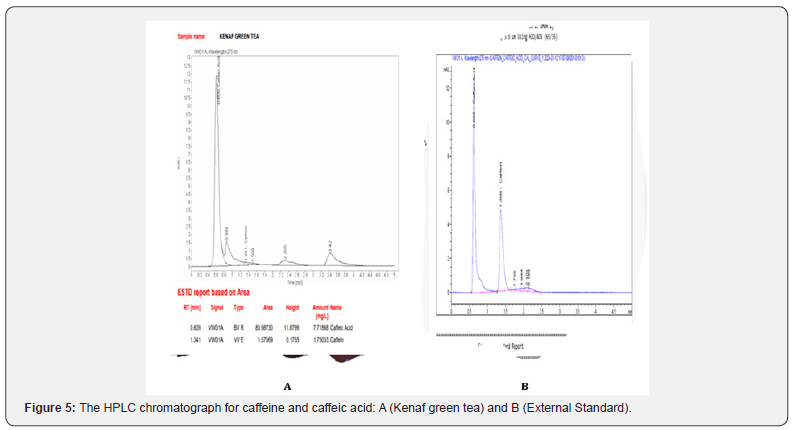
High Performance Liquid Chromatographic scan of kenaf green tea detected a caffeic acid with conspicuous peak at 276nm wavelength as shown in Figure 5A. Kenaf green tea contained 7.72mg/l of Caffeic acid which is another antioxidant. Similarly, caffeine (1.75mg/l) was also detected to be present in kenaf green tea as shown in (Figure 5).
HPLC analysis for Vitamin E
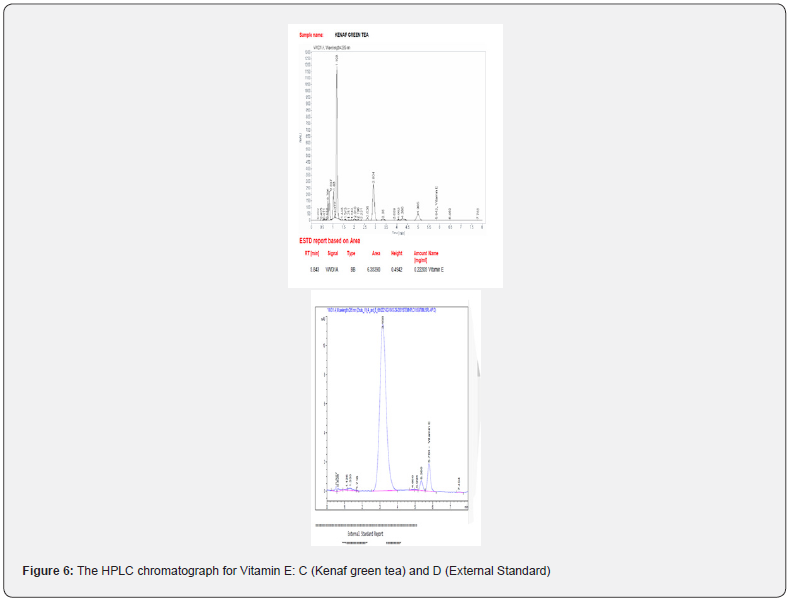
HPLC analysis revealed that kenaf green tea contained vitamin E (Tocopherol) as shown in (Figure 6). The Tocopherol was detected with a peak at 235nm wavelength and RT of 5.435min.
Discussion
The results of this study were at par with the report of [6]. which stated that chemical composition of green tea was complex including minerals and trace elements like calcium, magnesium, chromium, manganese, iron, copper, zinc, molybdenum, selenium, sodium, phosphorus and pigments like chlorophyll. Owing to the great importance of these minerals in green tea, many studies have recommended that their levels in tea leave to be 5% dry weight and 4.5% infusion [5,9]. The chromatogram showed that caffeine and caffeic acid in kenaf green tea formed conspicuous peaks at the same time as the external standard. The findings of this research strongly correlated with the report of [5]. which revealed that fresh leaves contained 3-4% of alkaloids known as methylxanthine such as caffeine, theobromine, and theophylline at 0.4 -10% [10]. Kenaf green tea contained Caffeine, which is known as 1, 3, 7-trimethylpurine-2,6-dione with a chemical formula C8H10NO2. Caffeine stimulates the central nervous system and the body. Caffeine is not inherently a dangerous substance unlike other stimulants. Caffeine helps to speed up the signals being sent to the brain thereby causing better productivity, and alertness/ awareness. However, like other stimulants, overconsumption of caffeine can have negative effects on the body and these effects include jitters, seizures, nausea, insomnia, dysphoria (or fast heart rate). According to the Food and Drug Administration (FDA), 400mg/day of caffeine is considered to be safe and healthy daily amount for healthy adults [11,12].
In addition, green tea contains polyphenols, which include flavanols, flavandiols, flavonoids, and phenolic acids; The major flavonoids of green tea are various catechins, which are found in greater amounts in green tea than in black or Oolong tea, these compounds may account for up to 30% of the dry weight [5].The data obtained from this research study vehemently supported previous studies which emphasized that most of the green teas are rich in polyphenols and antioxidants [10,13,14].The results from this research study also agreed with the reported data by [1]. which emphasized that the flavonoids and phenolic content had a good correlation with antiradical activity of kenaf leaf tea.
Conclusion
Kenaf leaf was found to be rich in total phenols and antioxidants hence, its capacity to scavenge DPPH free radical. It follows that regular intake of green tea like kenaf green tea could protect humans against various health risk diseases due to its antioxidant content.
Acknowledgements
Conceptualization, H.D.M., A.P.G.d.A., C.S., L.N.H.G., L.F.L., V.D.R., G.M.E., O.A.G.C., S.M.B., C.R.P.D., and K.Q.; methodology, H.D.M., A.P.G.d.A., C.S., L.N.H.G., L.F.L., V.D.R., O.A.G.C., S.M.B., C.R.P.D., and K.Q.; software, H.D.M., A.P.G.d.A., C.S., L.N.H.G., L.F.L., V.D.R., O.A.G.C., S.M.B., C.R.P.D., and K.Q.; validation, H.D.M., A.P.G.d.A., C.S., L.N.H.G., L.F.L., V.D.R., G.M.E., O.A.G.C., S.M.B., C.R.P.D., and K.Q.; formal analysis, H.D.M., A.P.G.d.A., C.S., L.N.H.G., L.F.L., V.D.R., O.A.G.C., S.M.B., C.R.P.D., and K.Q.; investigation, H.D.M., A.P.G.d.A., C.S., L.N.H.G., L.F.L., V.D.R., O.A.G.C., S.M.B., C.R.P.D., and K.Q.; resources, H.D.M., A.P.G.d.A., C.S., L.N.H.G., L.F.L., V.D.R., G.M.E., O.A.G.C., S.M.B., C.R.P.D., and K.Q.; data curation, H.D.M., A.P.G.d.A., C.S., L.N.H.G., L.F.L., V.D.R., O.A.G.C., S.M.B., C.R.P.D., and K.Q.; writing—original draft preparation, H.D.M., A.P.G.d.A., C.S., L.N.H.G., L.F.L., V.D.R., O.A.G.C., S.M.B., C.R.P.D., and K.Q.; writing— review and editing, H.D.M., A.P.G.d.A., C.S., L.N.H.G., L.F.L., V.D.R., O.A.G.C., S.M.B., C.R.P.D., and K.Q.; visualization, H.D.M., A.P.G.d.A., C.S., L.N.H.G., L.F.L., V.D.R., O.A.G.C., S.M.B., C.R.P.D., and K.Q.; supervision, H.D.M., A.P.G.d.A., C.S., L.N.H.G., L.F.L., V.D.R., O.A.G.C., S.M.B., C.R.P.D., and K.Q.; project administration, S.M.B. and K.Q.; funding acquisition, S.M.B. and K.Q. All authors have read and agreed to the published version of the manuscript.
Conflicts of Interest
The authors declare no conflicts of interest.
References
- Jin CW, Ghimeray AK, Wang L, Ming LX, Jing PP, et al. (2013) Far infrared assisted kenaf leaf tea preparation and its effect on phenolic compounds, antioxidant and ACE inhibitory activity. Journal of Medicinal Plant Research 7(17): 1121-1128.
- Weber JM, Ruzindana Umunyana A, Imbeault L, Sircar S (2003) Inhibition of adenovirus infection and adenain by green tea catechins. Antiviral Research 58(2): 167-173.
- Omenna EC, Ojo AI (2018) Comparative phytochemical screening of kenaf and jute leaves Journal of Nutritional Health & Food Engineering 8(5): 366-369.
- Naghma K, Hasan M (2007) Tea polyphenols for health promotion. Life Sciences 81: 519-533.
- Seyoum A, Asres K, El Fiky FK (2006) Structure-radical scavenging activity relationships of flavonoids. Phytochemistry 67(18): 2058-2070.
- Chacko SM, Thambi PT, Kuttan R, Nishigaki I (2010) Beneficial effects of green tea: A literature review. Chinese Medicine Journal 5(13): 1-9.
- Osada K, Takahashi M, Hoshina S, Nakamura M, Nakamura S, et al. (2001) Tea catechins inhibit cholesterol oxidation accompanying oxidation of low-density lipoprotein in-vitro. Compound. Biochemical Physiology /Toxicolology. Pharmacology. 128(2): 153-164.
- AOAC (2010) Official Methods of Analysis of the Association of Official Analytical Chemists.18th Edition, Washington DC.
- Belitz HD, Grosch W (1997) Food chemistry. 2nd Edition, Springer Verlag, Berlin.
- Koo MWL, Cho CH (2004) Pharmacological effects of green tea on the gastrointestinal system. European Journal of Pharmacology 500: 177-185.
- Zucconi S, Volpato C, Adinolfi F (2013) European Food Safety Authority;supporting publication. Gathering consumption data on specific consumer groups of energy drink.
- Amit T, Youdim MBH (2004) Neurological mechanisms of green tea polyphenols in Alzheimer’s and Parkinson’s diseases. Journal of Nutritional Biochemistry 15: 506 -516.
- Weinreb O, Mandel S, Zaveri NT (2006) Green tea and its polyphenolic catechins: medicinal uses in cancer and non-cancer applications. Life Sci 78(18): 2073-2080.
- Tsuneki H, Ishizuka M, Terasawa M, Wu JB, Sasaoka T, et al. (2004) Effect of green tea on blood glucose levels and serum proteomic patterns in diabetic (db/db) mice and on glucose metabolism in healthy humans. BMC Pharmacology 4: 18-21.

























