



 AIBM Home



Multidrug Resistant E. coli in Hospital Waste Water: A Potential Concern for Public Health
Sharmin Akther1, Tonmoy Debnath1,2 and Mohammed Mehadi Hassan Chowdhury1*
1 Department of Microbiology, Noakhali Science and Technology University, Bangladesh
2Department of Public Health and Institute of Public Health, Chung Shan Medical University, Taiwan
Submission: June 02, 2017; Published: January 29, 2018
*Corresponding author: Mohammed Mehadi Hassan Chowdhury, Department of Microbiology, Noakhali Science and Technology University, Noakhali-3814, Bangladesh.
How to cite this article: Sharmin A, Tonmoy D, Mohammed M H C. Multidrug Resistant E. coli in Hospital Waste Water: A Potential Concern for Public Health. Adv Biotech & Micro. 2018; 8(1): 555729. DOI: 10.19080/AIBM.2018.08.555729
Abstract
Hospital waste is not only a devastative hazard in environment, but also a potential risk to general people, if the waste is not managed in the right ways. Currently, hospital waste is recognized as a harbour of pathogenic microorganisms. We aimed to identify E. coli from hospital waste water and their antibiotic resistant pattern against commonly used antibiotics. From 10 samples, we identified 10 isolates of E. coli. We have used 8 commonly used antibiotics against the isolated bacteria, and finally it has observed that most of the isolated bacteria showed resistance to antibiotics. Among the 10 isolates, 100%, 80%, 80%, 70%, 30%, 20%, 20% and 10% isolates were resistant to ampicillin, ceftazidime, cefotaxime, tetracycline, chloramphenicol, gentamycin, ciprofloxacin and azithromycin antibiotics respectively. In addition, we didn’t find any isolate which was sensitive to all of the antibiotics that we had used. As resistance of these microorganisms is evolving day by day, proper steps should be taken to prevent it. Moreover, waste water treatment plan should be implemented to dispose of hospital wastes, so that these can’t be microbiological hazard for environmental contamination.
Keywords: E. coli; Hospital waste water; Public health; Environment contamination; Multi-drug resistant bacteria
Introduction
Although the discovery of antimicrobials leads to various expectations, it has been influenced by the emergence of resistant bacterial strains against antibiotics or therapeutics. 20-50% of humans are using antibiotics unnecessarily and 40-80% agricultural usages of antibiotics are highly suspicious [1]. On account of irrational use of antimicrobials in the last few decades, present clinically important bacteria have been converted from susceptible to single and multiple antibiotics resistant which lead a threat in public health sector in Bangladesh [2,3] as well as whole world in general [4].
Hospital waste water can be a potential risk factor for public health and ecological balance, since it contains various hazardous components including pathogenic microorganisms [5]. Moreover, owing to heavy antibiotic use, hospital waste waters contain high numbers of antibiotic resistant microorganisms than domestic wastewaters [6]. Hospital waste effluents carry pathogenic multidrug resistant microorganisms and are responsible for the spread of these organisms to the environment. Sometimes, a treated hospital wastewater can also spread multidrug resistant microorganisms [7]. Hospital waste effluents contaminate aquatic environments causing fish and other sea creatures dangerously effected. In one research, it was found that almost 80 percent of raw chickens contained multidrug-resistant bacteria and these were identical with the specimens collected from hospital patients [8]. Moreover, it has been reported that, the irrigation water system also has been contaminated by these multidrug resistant bacteria which have a chance to enter in our food chain directly.
The presence of multidrug resistant enterobacter and enteric pathogens has been regarded as a serious problem for a community [9-11]. In some research, it had showed that the resistance genes were transferred from environmental bacteria to human pathogen [12,13] that can be a major threat for a community. Sometimes, the animals’ fecal wastes containing bacteriophages can act as the vectors for the horizontal transfer of antibiotic resistance genes [14].
However, the data about environmental contamination with antimicrobial resistant E. coli for human health are limited. In Bangladesh, especially in south part of Bangladesh, multidrug resistance profile of E. coli against antibiotics is not available specially which are isolated from hospital effluents. Therefore, this study is an attempt to get a scenario on antimicrobials resistance pattern of E. coli isolated from hospital wastewater in Noakhali, Bangladesh.
Methods
Preparation and sampling
This cross-sectional study was conducted for a period of 6 months examining the waste water of different hospitals in Noakhali, Bangladesh. Ten untreated hospital waste water samples were collected from over-mentioned hospitals’ main drainage systems at several different locations.
Sample processing, isolation and identification of bacteria
The waste water samples were inoculated on selective and differentiate media including MacConkey agar, EMB agar for the presumptive isolation and identification of E. coli. Then incubate the plates with samples at 35 °C±2 for 24 hours. The obtaining selective colonies on selective and differential agar media were then applied for different biochemical tests including indole test, urease test, triple sugar iron (TSI) test, catalase test, citrate test, coagulase test and oxidase test according to the guideline of the Bergey’s Manual of Determinative Bacteriology [15].
Preparation and application of the disc to the plates
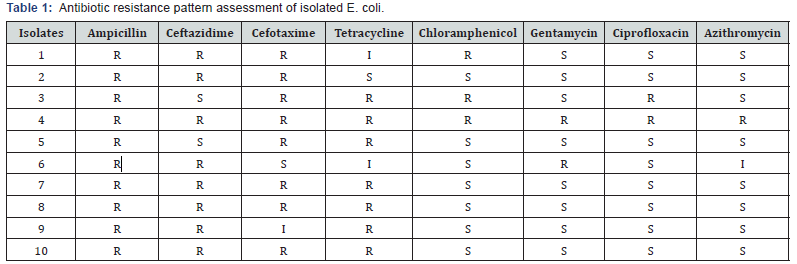
The antibiotic sensitivity pattern was examined by the disc diffusion method [16]. The isolated and identified 10 E. coli isolates were spread on a Mueller-Hinton agar plate by rubbing the cotton bud thoroughly on the surface of the plate. 8 different types of antibiotic discs as ampicillin (10μg), ciprofloxacin (5μg), tetracycline (30μg), chloramphenicol (30μg), ceftazidime (30μg), gentamicin (10μg), azithromycin (15μg), cefotaxime (30μg) antibiotics discs (Table 1) were then placed on the inoculated Mueller-Hinton agar plates and were then incubated for 24 hrs at 35 °C. The sensitivity pattern of the isolates was determined by measuring the zones of inhibition with a calibrated ruler, also interpreted according to Clinical Laboratory standards (CLSI) criteria [17]. The tested organisms were then organized into ‘sensitive’ (S), ‘intermediate’ (I), or ‘resistant’ (R).
Results
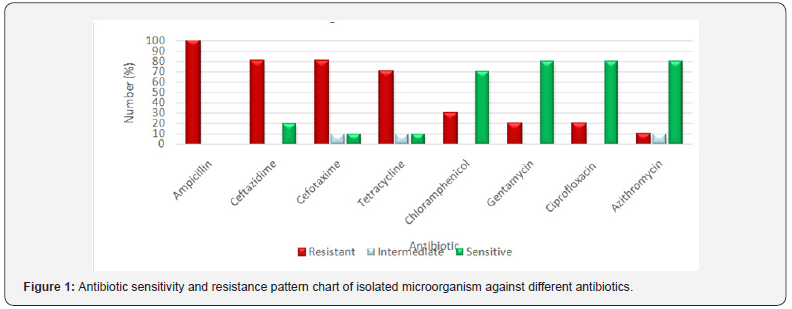
All 10 isolates of E. coli were confirmed from hospital waste samples by cultural and biochemical tests. Among the isolated E. coli; the 100%, 80%, 80%, 70%, 30%, 20%, 20% and 10% isolates were resistant to ampicillin, ceftazidime, cefotaxime, tetracycline, chloramphenicol, gentamycin, ciprofloxacin and azithromycin antibiotics respectively (Figure 1). The 0%, 20%, 10%, 10%, 70%, 80%, 80% and 80% isolates were sensitive to ampicillin, ceftazidime, cefotaxime, tetracycline, chloramphenicol, gentamycin, ciprofloxacin and azithromycin antibiotics respectively, while, the 0%, 0%, 10%, 20%, 0%, 0%, 0% and 10% isolates were in intermediate against ampicillin, ceftazidime, cefotaxime, tetracycline, chloramphenicol, gentamycin, ciprofloxacin and azithromycin antibiotics respectively (Figure 1). Isolate numbered 4 was resistant to all antibiotics (Table 1).
Discussion
Since gram negative bacteria can cause serious public health problem [18,19], it is important to conduct more research in order to create public awareness. Due to irrational apply of antibiotics in last few years, the number of antibiotic resistant bacteria is increasing day by day and the condition is becoming worse. Developing countries [20,21], such as Bangladesh, are especially being affected. Although environmental microorganisms can be clinical microorganisms when they infect animals or humans [8], studies about antibiotics resistance patterns of environmental microorganisms are limited.
In this study, the resistance patterns of E. coli isolates all had different results. Only one isolate showed resistance against all of used antibiotics. We claimed that these highly resistant isolates of E. coli might be responsible for transfer their resistant genes into other highly infectious pathogens present in the waste water [12,13,22]. In addition, the bacteriophages of animal’s fecal wastes samples as well as the fecal wastes in hospitals can become environmental vectors for the horizontal transfer of antibiotic resistance genes [14]. The rapid development of antibiotic resistant pattern of E. coli as well as other microorganisms might create a devastating health problem [2,8], especially in the Noakhali district as well as in Bangladesh in near future.
The presence of multidrug resistance in E. coli is not uncommon recently, and its severity has been expanded from town to village and village to everywhere very rapidly. In previous studies, ampicillin, ceftazidime, cefotaxime, tetracycline, chloramphenicol, gentamycin, ciprofloxacin and azithromycin are commonly used in hospitals as treatment. In contrast, one study was conducted in Mexico on hospitalized diarrheal patients revealed that 73% of E. coli isolates were resistant to ampicillin [23] whereas, we estimated that 100% of E. coli isolates were resistant to ampicillin while 80% isolates were resistant to ceftazidime and cefotaxime. This shows us that the rate of bacteria’s resistance to antibiotics is developing rapidly. This fluctuation may be due to different places and different sources of samples. However, it is thought that the isolates from sewages of waste disposal systems have higher chance to be resistant than other sources.
Another study conducted in Pakistan wherein the E. coli was resistant to cefotaxime (89.7%), ceftazidime (73.8%), gentamycin (59.8%), ciprofloxacin (54.2%), imipenem (43.3%), streptomycin (30%) and kanamycin (19.9%) [24] and our research in accordance with that study with little fluctuations.
Islam et al. [25] reported that all of isolates of E. coli from the liquid hospital waste water were resistant to more than 3 kinds of antibiotics and in our research we also found similar results [25]. This study was revealed a new concern for focusing on a new site of contamination. Large sample volume and molecular techniques are needed to find out more significant result on multidrug resistant E. coli isolated from hospital waste water in future.
Conclusion
The overall implication of these results is that antibiotics resistance of environmental isolates is increasing day by day especially in hospitals waste water. If preventive measures are not implemented urgently, there will be a time when these multidrug resistant environmental isolates will be act as a vector for transferring their resistant genes to other potential infectious pathogens and will lead a microbial outbreak
References
- Wise R, Hart T, Cars O, Streulens M, Helmuth R, et al. (1998) Antimicrobial resistance is a major threat to public health. BMJ 317(7159): 609-610.
- Debnath T, Shukanta B, Tarequl I, Mohammed Mehadi Hassan C (2017) Presence of multidrug resistant bacteria on mobile phones of healthcare workers accelerates the spread of nosocomial infections and regarded as a threat to public health in Bangladesh. Journal of Microscopy and Ultrastructure.
- Chowdhury MMH, Elias M, Mohammed M, Khadizatul K (2015) Indiscriminate uses of antibiotics as a threat to public health demand implementation of effective drug practices and enhancement of public awareness in Bangladesh. European Journal of Scientific Research 133(2): 187-195.
- Levy SB, Marshall B (2004) Antibacterial resistance worldwide: causes, challenges and responses. Nat Med 10: S122-S129.
- Sharpe M (2003) High on pollution: drugs as environmental contaminants. J Environ Monit 5(3): 42N-46N.
- Morinigo M, Cornax R, Castro D, Jimenez NM, Romero P, et al. (1990) Antibiotic resistance of Salmonella strains isolated from natural polluted waters. Journal of Applied Microbiology 68(3): 297-302.
- Rahman M, Huys G, Rahman M, Albert MJ, Kühn I, et al. (2007) Persistence, transmission, and virulence characteristics of Aeromonas strains in a duckweed aquaculture-based hospital sewage water recycling plant in Bangladesh. Appl Environ Microbiol 73(5): 1444- 1451.
- Overdevest I, Willemsen I, Rijnsburger M, Eustace A, Xu L, et al. (2011) Extended-spectrum β-lactamase genes of Escherichia coli in chicken meat and humans, The Netherlands. Emerg Infect Dis 17(7): 1216- 1222.
- Cabrera R, Ruiz J, Marco F, Oliveira I, Arroyo M, et al. (2004) Mechanism of resistance to several antimicrobial agents in Salmonella clinical isolates causing traveler’s diarrhea. Antimicrob Agents Chemother 48(10): 3934-3939.
- Chitnis V, Chitnis S, Vaidya K, Ravikant S, Patil S, et al. (2004) Bacterial population changes in hospital effluent treatment plant in central India. Water Research 38(2): 441-447.
- Danchaivijitr S, Wongchanapai W, Assanasen S, Jintanothaitavorn D (2005) Microbial and heavy metal contamination of treated hospital wastewater in Thailand. J Med Assoc Thai 88(10): S59-S64.
- Kruse H (1999) Indirect transfer of antibiotic resistance genes to man. Acta Vet Scand Suppl 92: 59-65.
- Wegener HC, Aarestrup FM, Gerner SP, Bager F, et al. (1998) Transfer of antibiotic resistant bacteria from animals to man. Acta Vet Scand Suppl 92: 51-57.
- Colomer LM, Imamovic L, Jofre J, Muniesa M (2011) Bacteriophages carrying antibiotic resistance genes in fecal waste from cattle, pigs, and poultry. Antimicrob Agents Chemother 55(10): 4908-4911.
- Vandepitte A (1996) WHO Regional Publications, Eastern Mediterranean Series. WHO Regional Publications, Eastern Mediterranean Series, Alexandria, Egypt.
- Bauer A, Kirby WM, Sherris JC, Turck M (1966) Antibiotic susceptibility testing by a standardized single disk method. Am J Clin Pathol 45(4): 493-496.
- CLSI C (2012) Performance standards for antimicrobial susceptibility testing; twenty-second informational supplement. CLSI/NCCLS Document M100-S22. Clinical and Laboratory Standards Institute, Wayne, Pennsylvania, USA.
- Fish DN, Ohlinger MJ (2006) Antimicrobial resistance: factors and outcomes. Crit Care clin 22(2): 291-311.
- Boucher HW, Talbot GH, Bradley JS, Edwards JE, Gilbert D, et al. (2009) Bad bugs, no drugs: no ESKAPE! An update from the infectious diseases society of America. Clin Infect Dis 48(1): 1-12.
- Neupane S, Pant ND, Khatiwada S, Chaudhary R, Banjara MR, et al. (2016) Correlation between biofilm formation and resistance toward different commonly used antibiotics along with extended spectrum beta lactamase production in uropathogenic Escherichia coli isolated from the patients suspected of urinary tract infections visiting Shree Birendra Hospital, Chhauni, Kathmandu, Nepal. Antimicrob Resist Infect Control 5(1): 5.
- Awasthi TR, Pant ND, Dahal PR (2015) Prevalence of Multidrug resistant bacteria in causing community acquired urinary tract infection among the patients attending outpatient Department of Seti Zonal Hospital, Dhangadi, Nepal. Nepal Journal of Biotechnology 3(1): 55-59.
- Agga GE, Arthur TM, Durso LM, Harhay DM, Schmidt JW, et al. (2015) Antimicrobial-resistant bacterial populations and antimicrobial resistance genes obtained from environments impacted by livestock and municipal waste. PloS one 10(7): e0132586.
- Estrada GT, Cerna JF, Paheco GL, Velázquez RF, Ochoa TJ, et al. (2005) Drug-resistant diarrheogenic Escherichia coli, Mexico. Emerg Infect Dis 11(8): 1306.
- Sabir S, Ahmad AA, Ijaz T, Asad Ali M, Rehman KM, et al. (2014) Isolation and antibiotic susceptibility of E. coli from urinary tract infections in a tertiary care hospital. Pak J Med Sci 30(2): 389-392.
- Islam M, Uddin MS (2008) Role of untreated liquid hospital waste to the development of antibiotic resistant bacteria. J Innov Dev Strategy 2(2): 17-21.

























