

 PBSIJ Home



Abstract
This study examined the role of self-directed learning in shaping the academic performance of students in Colleges of Education. The research aimed to identify the self-directed learning behaviours of these students and assess its impact on their academic outcomes. Descriptive survey research design was employed as the design for the study. The study encompassed all level 300 students in the 46 Colleges of Education in Ghana, with a total population of 17,826 students. A sample of 400 students were selected using a multistage sampling technique. Data collection instrument used was the Self-Rating Scale of Self-Directed Learning (SRSSDL) with a reliability co-efficient of .94. Descriptive statistics (means and standard deviation) and multiple linear regressions were employed to analyse the data on the research objectives. The study found that college students preferred self-directed learning strategies, such as awareness, evaluation and interpersonal skills. However, the study found that self-directed learning did not significantly impact academic performance. Therefore, College management should provide resources for self-directed learning, and explore alternative strategies for self-directed learning.
Keywords:College Education; Academic performance; Self-directed learning; Academic achievement; Self monitoring
Introduction
College education is a critical phase in a student’s academic journey, and academic performance during this period significantly affects future prospects [1]. Academic performance is one of the most essential measures of educational progress, and it is the only aim that the entire educational system must strive for. In other words, society is concerned about the fate of the individual, his successful development and status in the community, and expects to excel in a variety of areas, including cognitive skills and abilities, personality development, emotional and behavioural development, and excellence [2].
Academic performance is a metric used to assess and compare students [3,4] and one of the most important parameters used to predict the future academic status of learners. Assessing students’ academic performance and associated factors are necessary to suitably identify factors that promote students’ success in college education. The academic performance of students in colleges is influenced by a number of factors. Included in the factors is self-directed-learning.
Self-directed learning (SDL) has been one of the predominant issues in the study of how to improve learning [5]. Self-directed learning (SDL) is a critical aspect of adult education and higher learning. It involves individuals taking responsibility for their own learning processes. Studies have shown that students who are more self-directed tend to perform better academically [6]. SDL fosters autonomy and the ability to seek out resources, which are valuable skills for college students.
Self-directed learning required students to plan and manage learning activities, develop solutions or complete projects and personally pursue knowledge and skills. It involves various student-teachers’ activities and resources, such as self-guided reading, participation in study groups, accessing electronic information and reflective writing; teachers’ roles include dialogue with learners, securing resources, evaluating learning outcomes, and promoting critical thinking among students [7]. It is reported that learner autonomy is an important component of self-directed learning, it does not mean learning in isolation from others.
Some determining factors for the success of the learning process have been highlighted as a learning environment, learning context, and the connections learners make during their learning [8]. Although research on self-directed learning has been in place, its context has changed with online learning, because of greater access to technology, and opportunities for more personalized learning experiences and connections to information sources that were not previously available.
Literature Review
Self-Directed Learning
Self-directed learning is a complex concept that should not be tackled from a single viewpoint. The biggest misunderstanding, according to [9], is attempting to encapsulate the essence of self-directed learning in a single definition. [10] also mentions the terminological ambiguity surrounding this topic, which has resulted in communication issues surrounding self-directed learning. According to, researchers in the field of self-directed learning have two choices. One option is to add to the terminological complexity by defining their understanding of the notion, or they can stray from [11] and [12] original definition of self-directed learning in their research.
Individuals that participate in self-directed learning take charge of their own education. Individuals who engage in self-directed learning are free to set goals and define what they want to learn [13]. According to [14], most conceptualisations share the idea of some human influence over either or both the planning (goals) and management (support) of the learning process. further emphasizes that while autonomy is a matter of degree, the ultimate goal of self-directed learning is not necessarily totally independent learning. Self-directed learning is dependent not only on the ability to make learning decisions, but also on the chance to do so. As a result, believes that formal learning should be viewed as a collaborative process between the teacher and the learner.
Reducing self-direction to a matter of external control is unacceptable from a critical view Self-directed learning, in its broadest sense, is a process in which individuals take charge of diagnosing their learning needs, formulating learning goals, identifying human and material resources for learning, selecting and implementing appropriate learning strategies, and evaluating learning outcomes, with or without the assistance of others [15].
Impact of Self-Directed Learning on Student Academic Performance
Researches have been conducted in other to justify whether self-directed learning postures either positive and or negative effect on student academic performance and they all ended up yielding some interesting findings. For example [16], did a study on the learning environment as a mediating variable between self-directed learning readiness and academic performance of a sample of Saudi nursing and medical emergency students. The aim of the study was to establish the relationship between students’ self-directed learning readiness (SDLR) and students’ ac academic performance, and the mediating role of students’ perceptions of the learning environment. In their study, it was proposed that students’ perceptions of their learning environment could enhance their SDLR and thus boost their academic performance (in terms of their GPA).
A descriptive design was used to examine the relationships between the domains of SDLR, which are self-management, desire to learn and self-control and students’ perceptions of the learning environment (SPLE) and students’ GPA. A survey involving one hundred and forty-two (142) Saudi students from nursing and emergency medical services undergraduate programmes in King Saud University was used for the research. The results showed that SDLR level positively influenced students’ academic performance positively, and those students’ perceptions of their learning environment played a significant role in determining their level of SDLR and academic performance. Concluding, they recommended that nursing and emergency medical services educators provide a supportive learning environment in terms of good teaching, clear goals and standards, appropriate assessment, appropriate workload, and emphasis on independence to encourage students to engage in the process of SDL which can, in turn, enhance their academic performance.
Furthermore [17], did a study on the effect of formative testing and self-directed learning on mathematics learning outcomes. The purpose of this research was to determine the effect of formative testing and self-directed learning on mathematics learning outcomes (academic performance in terms of mathematics). The research was conducted at an elementary school in central Jakarta. Seventy-two (72) fourth-grade students who were selected using random sampling participated in the study. Data were obtained through testing and were analysed using a two-line analysis of variance (ANOVA) according to the treatment design and level of self-directed learning. The results showed that, mathematics learning outcomes differ between students who are given formative essay tests and those who are given formative multiple choice tests, there was an interaction effect between formative testing and self-directed learning on mathematics learning outcomes, students with high levels of self-directed learning have better learning outcomes when given formative essay tests than when given formative multiple choice tests and students with low levels of self-directed learning show no difference in mathematics learning outcomes based on whether they are given formative essay tests or multiple choice tests.
Additionally, [18] did a study on academic performance and the practice of self-directed learning, looking at the adult student perspective. Their study set out to examine the self-directed learning characteristics present in the adult students’ study process at the case university and the relationship between the adult students perceived competence level in self-directed learning and their academic performance was also investigated. One thousand, six hundred and ninety-five (1695) adult students in the case uni versity participated in a survey that included both Likert-type and open-ended response items. Eleven indicators of self-directed learning were conceptualized and quantified.
Those indicators included, goal setting, time management, procrastination management, assignment preparation, exam preparation, note-taking capability, research capability, seminar class readiness, technical readiness, online class readiness and stress management. The findings showed that the adult students perceived level of competence in the 11 self-directed learning indicators had a direct or an indirect effect on their academic performance. Based on the findings, the case university has conceptualized some new initiatives in the provision of support in terms of self-directed learning to help its adult students to do well in their studies.
Also, Zhoc, Chung & King [19] did research on emotional intelligence (EI) and self‐directed learning, examining their relation and contribution to better student learning outcomes in higher education. The study aimed to examine the effects of EI on self-directed learning and how EI and self-directed learning contribute to key learning outcomes in higher education, including grade point average (GPA), generic learning outcomes (including social, cognitive and self-growth outcomes) and students’ satisfaction with their university experience.
The study adopted a prospective longitudinal design with five hundred and sixty (560) first-year undergraduate students completing different measures at the beginning and at the end of the academic year. Results of the structural equation modelling showed that EI had a strong effect on self-directed learning, which in turn was positively associated with GPA and various generic learning outcomes that are related to students’ satisfaction with the university experience. Their study provided empirical evidence that students who are more emotionally intelligent are more self-directed, leading to higher achievement in both academic and generic development, which in turn results in higher university satisfaction.
Lastly, Zhou & Li [20] conducted a study seeking to answer the question, can student self-directed learning improve their academic performance? Then went further to answer it using experimental evidence from the instruction of protocol-guided learning in China’s elementary and middle schools. Their study sampled students from two municipal middle schools in Zhenjiang City, Jiangsu Province as research subjects, and used education experiments to find out the role of students’ autonomous learning in improving student performance and observed how to promote students’ autonomous learning through protocol-guided learning as well. A total of six hundred and twelve (612) students from the first grade of two schools in Zhenjiang City, Jiangsu Province, China was selected as the subjects.
After excluding extreme values, a total of one hundred and ninety-six (196) experimental samples and two hundred and one (201) control samples were obtained. By analysing the experi experimental data of the experimental group and the control group, it was concluded that a well-designed protocol-guided learning teaching can become an effective carrier for students’ autonomous learning and by promoting students’ autonomous learning, students’ performance can be effectively improved.
All the studies reviewed consistently finding with all of the outcomes depicting that there is actually a positive effect between learning strategies and academic performance of students, thus, students with a high level of self-directed learning performs well in as much as academic performance is concerned. The results from the various studies also make the assertion that students that do not have a high interest for self-directed learning performs poor in their academics. However, there is limited empirical research of this nature in Ghana, particularly among students in colleges of education.
Current Study
Colleges of Education in Ghana belong to a category of tertiary institutions referred to as professional tertiary institutions. Recently, by government policy, the Colleges of Education were transitioned from diploma awarding institutions to tertiary institutions offering Bachelor of Education programmes. This transition presented another dimension of academic work for students [21]. Under the new system of college education, students must adapt their learning approach, take control of their learning, utilize various strategies, and choose appropriate learning styles to suit their studies [11,22]. In order to be able to learn effectively, students must be able to self-direct their learning [23]. Failure to effectively do these might lead to consequences on the academic performance of the students [24]. This is one of the motivations behind the researcher’s intent to evaluate the role of learning strategies, self-directed learning, and learning styles on the academic performance of students enrolled in Colleges of Education.
Again, in international literature, a lot of studies exist on self-directed learning and there are many scale development studies conducted measuring self-directed learning skills [25-31] Also, in some studies, there have been recommended models for the development of learning of university students [32-35]. A lot of studies have been done on the role of self-directed learning [36- 38] Most of these studies were also done in the universities.
Again, the review of literature revealed studies on self-directed learning [39] learning styles and self-directed learning [40,41], self-directed learning and academic achievement [18,42], [43,44], self-directed learning and learning strategies [45,46] and learning strategies, self-directed learning and performance [47]. Existing literature revealed that there is lack of studies that comprehensively integrate the variables of learning strategies, self-directed learning, learning styles, and academic performance. While existing literature has extensively explored each of these variables individually or in various combinations, there is a notable absence of research that examines the collective impact of all these factors on student outcomes.
In addition, the review also noted that some of the studies focused on nursing students while a study focused on medical students. Studies on adult student’s secondary school students and university students [48] were also realised. However, only a single study on pre service mathematics students was noted.
The gap in the existing literature is evident in the limited focus on specific student populations, such as nursing, medical, adult, secondary school, university, and pre-service mathematics students. While studies have explored self-directed learning and learning styles within these various contexts, there is a notable absence of research that examines the collective impact of these variables on academic performance across diverse student populations. Despite individual studies shedding light on the relationship between self-directed learning, learning styles, and academic outcomes within specific student groups, there is a lack of comprehensive research that integrates these variables across different educational settings and college of education is one of these educational settings ignored. Consequently, there is the need for studies to focus on colleges of education in Ghana to investigate how the combined influence of self-directed learning and learning styles impacts academic performance across diverse student populations.
This is necessary because college of education is dedicated to teacher training and professional development. More importantly, colleges of education play a critical role in shaping the pedagogical approaches and instructional practices of future teachers. By examining the role of self-directed learning on academic performance within this specific educational context, researchers can provide targeted knowledge and recommendations to enhance teacher preparation programmes, improve teaching methodologies, and ultimately contribute to the quality of education in Ghana. Therefore, this current study, therefore, seeks to look at the role of self-directed learning on the academic performance of students in colleges of education.
Materials and Methods
Design and Approach
This study focused on the quantitative approach which entails systematic empirical studies and involves mathematical and statistical works. Quantitative research approach was used due to the fact that it would give the researcher the room to gather numerical data and generalize findings across groups of people and also to help in explaining a phenomenon. Additionally, it enables data to be in numbers and statistics, often arranged in tables, charts, figures, or other non-textual forms. Descriptive survey research design was used in this study. Specifically, the researchers employed the descriptive survey which made it possible to study a portion of the entire population by way of questionnaires. Survey research is a useful and appropriate method to research that has clear benefits in helping to describe and explore variables and constructs of interest.
Study Participants and Sampling
The study’s target population was all Level 300 students from all Colleges of Education in Ghana, as they represented the initial cohort of degree students. These students were distributed across five zones, each zone having a varying number of colleges. In total, the target population encompassed 17,826 level 300 students. The accessible population comprised five colleges chosen through the simple random technique. One college was selected from each zone, resulting in a total of 1,592 level 300 students across all five selected colleges.
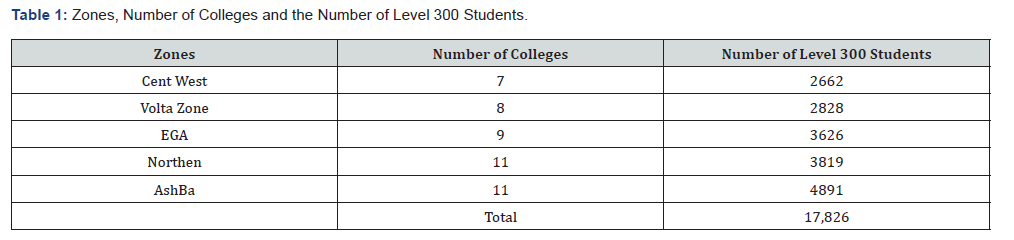
The researchers employed simple random techniques to choose one college from each zone. The technique involved listing all the colleges within each zone on pieces of paper and using a lottery method to randomly select five colleges in total. The selected colleges were Holy Child College of Education, Peki College of Education, Wesley College of Education, Ada College of Education, and NJA College of Education. This process yielded a sample of five colleges that effectively represented the accessible population, consisting of 1,592 level 300 students.
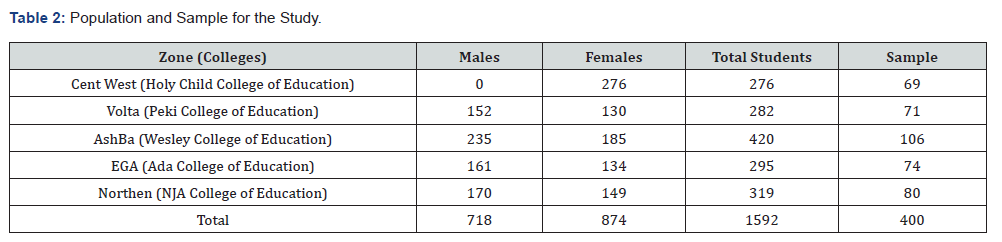
This study relied on the multi stage sampling technique for the selection of the students for the study. The level 300 students were selected because they had been in the college for a while and had gathered some experience in learning. This made them the best suited for research purposes. Further, the simple random technique was employed to select one school from each of the five zones: Holy Child College of Education, Peki College of Education, Wesley College of Education, Ada College of Education, and NJA College of Education. Together, these schools comprised a total of 1,592 level 300 students. Subsequently, utilizing the [49] Sample Size Determination Table, a sample size of 310 students, equivalent to 19% of the accessible population, was determined.
However, following [50] recommendation that a sample size ranging from 5% to 25% of the population is suitable for generalization purposes, the sample size was increased to 400 students, constituting the maximum allowable 25% of the population. Moreover, to ensure representativeness, a proportionate sample was calculated for each college to accurately reflect the total number of students in each institution. Finally, for recruitment purposes, the convenience sampling technique was utilized to select the final students for the study. Table 2 represents the population and sample of the selected colleges from each zone.
Instrument
The data utilized in this study consisted of primary data, gathered through the use of adopted questionnaires as the instrument for data collection.
Self-Rating Scale of Self- Directed Learning (SRSSDL)
The instrument for the research was made up of the Items on the Self-Rating Scale of Self- Directed Learning (SRSSDL). The SRSSDL consisted of 60 items, which are divided into five dimensions in which each dimension has 12 items. The dimensions are (1) awareness of self-directed learning, (2) self-directed learning strategies, (3) self-directed learning activities, (4) evaluation of self-directed learning, and (5) interpersonal skill of self-directed learning. The scale was scored based on agreement or disagreement where Strongly Disagree (SD) =1, Disagree (D) =2, Agree (A) = 3 and Strongly Agree (SA) =4. The internal consistency of the instrument (Cronbach’s alpha coefficient) was 0.94.
The respective reliability coefficients of the five dimensions
are:
i. awareness of self-directed learning (0.79)
ii. self-directed learning strategies (0.89)
iii. self-directed learning activities (0.98)
iv. evaluation of self-directed learning (0.95)
v. interpersonal skill of self-directed learning (0.90)
An introductory letter and ethical clearance were acquired from the Department of Education and Psychology, and the Institutional Review Board in the University of Cape Coast respectively and were delivered to the various principals of the colleges that were selected for the study. Contact was made with the various principals for permission to conduct the survey with the students during school hours. The researchers personally sent the data collection instruments to the study setting. The participants were assured of confidentiality, and voluntary participation will be assured.
The questionnaires were administered by the researchers to the students who agreed to participate in the survey. The questionnaires were administered in English language. The researchers helped participants who would not understand some of the information on the questionnaire by explaining and interpreting when appropriate. After, the participants answered the questionnaires; they were collected by the researchers. Participants took about 25 to 35 minutes to complete the questionnaire. Data collection took approximately 6 weeks with the help of research assistants.
Ample time was given to respondents to respond to the questions. This is to avoid errors and inaccuracies and misrepresentation of the study findings. Again, respondents’ confidentiality was ensured as the information they provided was solely used for academic purposes. The purpose is to make the respondents feel more comfortable and confident to provide all the valuable information required. Moreover, the participants were made aware that responses to the questions were not compulsory and that they may withdraw from the study at any time. However, they were encouraged to fully participate in the survey.
The questionnaire was designed in such a way that respondents’ privacy was respected. All efforts were made to ensure that respondents’ identification or disclosure were not made public. Thus, confidentiality and subject anonymity were strictly preserved at every level of the study. The acquired data was kept confidential. Since the questionnaire did not include any identification information, participants were able to fill them out anonymously. As a result, the researchers achieved a 100% return rate for the completed questionnaires.
Data Analysis
Statistical analyses consisted of both descriptive and inferential analyses of the responses that were provided. Data on the research question was analysed using descriptive statistics (mean and deviation). The hypothesis was tested using multiple regression. This analysis was done to determine the effects the variables have on one another.
Table 3 describes the distribution of the respondents according to sex. It is observed from the table that, the majority of the respondents (220, 55%) were females and the lesser (180, 45%) were males. This result indicates that there were more females in the study than males.

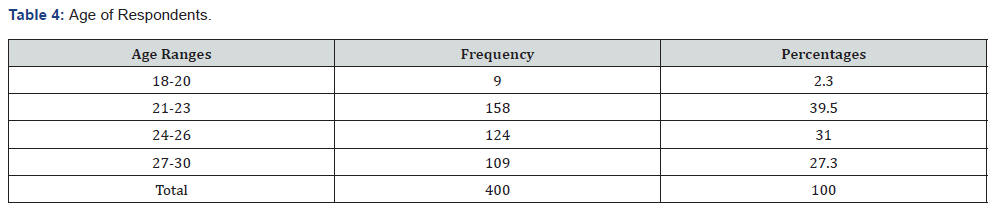
The researchers realised that from the results in Table 4, respondents within the age range of 21-23 were the majority (158, 39.5%) and those within the age range 18-20 were the least (9, 2.3%). From the results, this simply implies that most respondents were seen to be within the age range of 21-23. This appears to be the average age ranges of most college students.
Research Question: What are various forms of self-directed learning endorsed by students in the Colleges of Education?
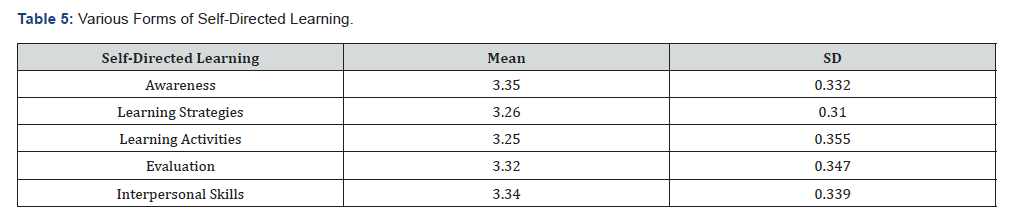
This research sought to examine the various forms of self-directed learning among College of Education students. Using a 4-point Likert scale, a mean score of 2.5 served as the threshold criterion: scores above 2.5 indicated the adoption of self-directed learning, while scores below 2.5 suggested non-adoption. Table 5 offers a comprehensive overview of the self-directed learning forms.
Table 5 presents the various forms of self-directed learning endorsed by students in the Colleges of Education. Across all categories, the mean scores exceed the threshold of 2.5, indicating a high adoption rate of all self-directed learning strategies. Specifically, awareness has the highest mean score of 3.35, suggesting that students demonstrate a strong propensity towards awareness in their learning processes. Following closely are evaluation and interpersonal skills, with mean scores of 3.32 and 3.34 respectively, indicating robust engagement in self-evaluation and interpersonal interactions to facilitate learning. Additionally, learning strategies and learning activities exhibit high mean scores of 3.26 and 3.25 respectively, reflecting students’ proactive involvement in strategic learning approaches and diverse learning activities.
Assumptions for Regression
In order to successfully test the hypothesis for the current study, it was necessary for some assumptions to be considered before the testing of the hypothesis. These assumptions were, tests of normality, test of autocorrelation, homoscedasticity and multicollinearity.
The test of normality was done to ensure that the data used for the analysis was normally distributed. As witnessed from the normal Q-Q Plot, all the points in the chart were scattered around the straight line. This indicated that the data was normally distributed. Again, the test of autocorrelation was done for the data to test the degree of correlation of the same variables between two successive time intervals. The Durbin-Watson test was used to determine the test of autocorrelation. As witnessed from the Model Summaryb table, the Durbin-Watson test had a figure of 1.720. This indicated that the data was in the acceptable range.
In addition, homoscedasticity of the data was also determined. It was noted from the residual statistics, the range between the largest variance and the smallest variance was 1.4782. This indicated that the regression data was homoscedastic as values 1.5 or less are considered appropriate. Lastly, multicollinearity of the independent variables was tested for the regression. The figures realised from the table indicated that there was no multicollinearity between the independent variables as all VIF values were greater than 1 and less than 5.
Research Hypothesis: H0: There is no statistically significant effect of self-directed learning on the academic performance of students in the Colleges of Education.
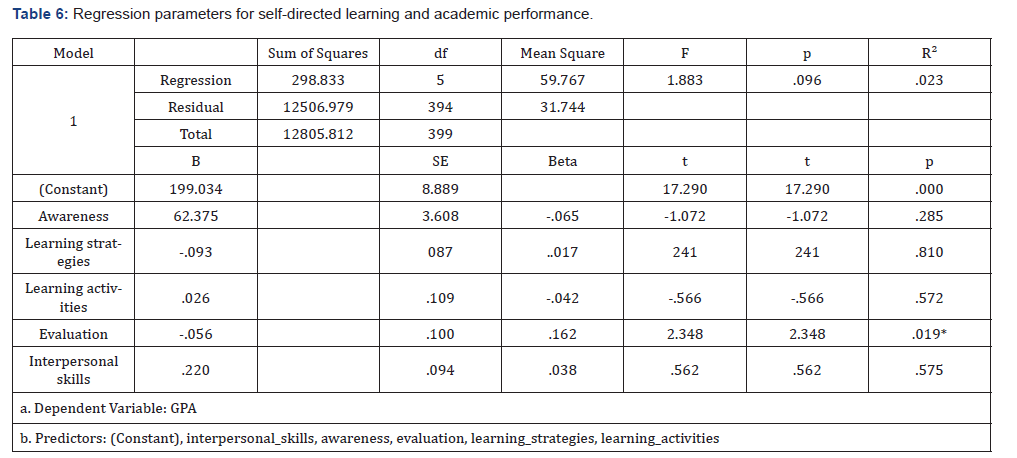
The hypothesis sought to determine the effect of self-directed learning on the academic performance of students in Colleges of Education. Multiple regression was used to analyse the data. The exogenous (predictor) variable was the sub-dimensions of self-directed learning which was measured continuously. The criterion variable was the academic performance, which was measured using students’ test scores. Details of the results are presented in Table 6.
From Table 6, the results of the investigation discovered that the data did fit the model, F (5, 394) = 1.883, p = .096. However, awareness, learning strategies, activities, and interpersonal skills did not have an effect on academic performance. Individually evaluation was found to influence students’ performance, but the overall model was not significant. Therefore, self-directed learning was not found to have an effect on academic performance. The study therefore failed to reject the null hypothesis which states that self-directed learning will not have an effect on academic performance.
Discussion
The research question sought to find out the various forms of self-directed learning among the students in the Colleges of Education. It was found that students in Colleges of Education are highly adopting self-directed learning strategies, with awareness being the most popular. Students demonstrate a strong propensity towards self-awareness, followed by evaluation and interpersonal skills. Learning strategies and activities also show high mean scores, indicating proactive involvement in strategic approaches and diverse activities. In all, students demonstrate a high adoption rate of all self-directed learning strategies.
The findings from the investigation into various forms of self-directed learning among students in Colleges of Education emphasised on their proactive engagement in self-directed learning strategies. Evidently, the results indicate a high level of adoption across all aspects of self-directed learning, suggesting that students are actively involved in shaping their learning experiences. Among the various forms of self-directed learning, awareness emerged as the most prominent aspect adopted by students. This underlines the students’ keen understanding of their own learning processes and the ability to recognize their strengths and weaknesses. Additionally, the emphasis on evaluation and interpersonal skills reflects students’ commitment to critically assessing their learning outcomes and effectively interacting with others in the learning environment.
Furthermore, the high mean scores observed for learning strategies and activities signify students’ proactive approach to their learning journey. It suggests that students are actively seeking out and implementing diverse learning strategies and engaging in a range of activities to enhance their learning experiences. This proactive stance towards learning is indicative of a student body that is motivated and empowered to take control of their own learning process. It is therefore suggested that students in Colleges of Education are highly receptive to self-directed learning strategies and actively embrace various facets of self-directed learning. This positive trend bodes well for their academic and personal development, as it reflects a proactive and empowered approach to learning that can foster lifelong learning skills and success beyond the classroom.
The findings of this study on various forms of self-directed learning among students in Colleges of Education align with existing literature on self-directed learning readiness and its implications for student engagement and academic performance. Example, found that students demonstrated a high level of motivation for self-learning, similar to our findings where students exhibited a strong propensity towards self-awareness, evaluation, and interpersonal skills. Both studies indicate a positive inclination towards self-directed learning among students, highlighting its significance in promoting student autonomy and proactive engagement in the learning process.
Explored the relationship between technology use and self-directed learning, echoing our findings that technology facilitates students’ engagement in self-directed learning activities. While their study did not find a direct effect of technology use on academic performance, it emphasizes the role of technology in supporting students’ self-directed learning efforts, which is consistent with our findings. investigated self-directed learning skills among undergraduate students and identified variations based on demographic and academic factors.
Similarly, this study reveals variations in the adoption of self-directed learning strategies among students, highlighting the influence of individual characteristics on self-directed learning behaviours. focused on factors influencing college students’ self-directed learning with technology, emphasizing the importance of self-directed learning readiness and the effective use of technology tools. This study aligns with these findings, underscoring the significance of self-awareness and the utilization of various learning strategies in promoting self-directed learning among students. Again, examined self-directed learning readiness among medical students and identified cultural and curricular factors influencing SDL. While this study did not specifically address cultural factors, it reinforces the importance of curriculum adjustments and educational strategies to promote self-directed learning effectively.
Despite the alignment with existing literature, this study also identifies discrepancies, particularly in the focus on specific aspects of self-directed learning readiness and its relationship with technology use and academic performance. While existing studies provide relevant views into various dimensions of self-directed learning, there remains a need for further research to address gaps in understanding and promoting self-directed learning effectively. Future studies could explore the impact of cultural and curricular factors on self-directed learning readiness and investigate interventions to enhance self-management skills and leverage technology for self-directed learning in diverse educational contexts. The hypothesis sought to find out the effect of self-directed learning on the academic performance of students in the Colleges of Education. The results indicated that there was no impact of student’s self-directed learning on their academic performance. This meant that self-directed learning does not cause much change in the academic performance of the college students. The results clearly showed that as the college students self-directed their learning, it did not predict their academic performance.
The finding that college students’ self-directed learning did not predict their academic performance raises important questions about the relationship between self-directed learning and academic success. This result is somewhat surprising, as previous research has suggested that self-directed learning is positively related to academic achievement. One possible explanation for this finding is that other factors may play a more important role in determining academic performance than self-directed learning. For example, students’ prior knowledge and ability, motivation, study habits, and environmental factors may all contribute to their academic success, and may be more predictive than self-directed learning.
Another possibility is that the way self-directed learning was measured in this study may not have been sensitive enough to capture its full range of effects on academic performance. The study may have used a narrow definition of self-directed learning or may not have included all relevant dimensions of this construct. Alternatively, the measures of academic performance used in the study may have been insufficient to fully capture the impact of self-directed learning. It is also possible that the relationship between self-directed learning and academic performance may be complex and nuanced and may depend on a variety of individual and contextual factors. For example, self-directed learning may be more important for certain types of courses or assignments or may be more relevant for students with particular learning styles or preferences.
Overall, while the finding that self-directed learning did not predict academic performance is noteworthy, it is important to interpret this result with respect to the study’s limitations and in the context of broader research on the topic. Further research is needed to better understand the relationship between self-directed learning and academic success, and to identify the factors that may moderate this relationship. One recent study conducted aimed to investigate the relationship between SDL and academic performance among college students in China.
The study involved 1,099 students from 14 different colleges and universities in China. Table 1 The researchers used a self-report questionnaire to measure students’ SDL and academic performance. The results showed that SDL did not significantly predict academic performance among college students in China. These findings are consistent with some previous studies that have also found no significant relationship between SDL and academic performance However, other studies have found a positive relationship between SDL and academic performance.
There are several possible reasons why did not find a significant relationship between SDL and academic performance. One possible explanation is that SDL is not the only factor that affects academic performance. Other factors such as intelligence, motiva tion, and study habits may also play a role in determining academic performance. Another possible explanation is that the way SDL was measured in the study may not have been sensitive enough to capture the full range of SDL skills that are relevant to academic performance.
Results from the present study disagreed with who noted that SDL level positively influenced students’ academic performance positively.
The finding again disagreed with) study on the effect of formative testing and self-directed learning on mathematics learning outcomes. Their results indicated that students with high levels of self-directed learning have better learning outcomes. study on the academic performance and the practice of self-directed learning disagreed with the present study as it revealed a direct or an indirect effect on their academic performance. Also, the findings of this study disagreed with the work of which revealed that by promoting students’ autonomous learning, students’ performance can be effectively improved.
Conclusion
i. It was found that students in Colleges of Education are
highly adopting self-directed learning strategies, with awareness
being the most popular. Students demonstrate a strong propensity
towards self-awareness, followed by evaluation and interpersonal
skills. Learning strategies and activities also show high mean
scores, indicating proactive involvement in strategic approaches
and diverse activities.
ii. College of education students strongly favour self-directed
learning strategies, focusing on awareness, evaluation, interpersonal
skills, and activities, indicating a proactive approach
to their education.
References
- Oducado RM (2021) Academic performance and the role of self-directed learning, self-esteem, and grit among nursing students. Jendela Nursing Journal 5(1): 1-9.
- Tabbodi M, Rahgozar H & Makki Abadi MM (2015) The relationship between happiness and academic achievements. European Online Journal of Natural and Social Sciences: Proceedings 4(1): 230-241.
- Almigbal T H (2015) Relationship between the learning style preferences of medical students and academic achievement. Saudi Medical Journal 36(3): 349-355.
- Dryer R, Henning MA, Tyson GA & Shaw R (2016) Academic achievement performance of university students with disability: Exploring the influence of non-academic factors. International Journal of Disability, Development and Education 63(4): 419-430.
- Ainoda N, Onishi H & Yasuda Y (2005) Definitions and goals of “self-directed learning" in contemporary medical education literature. Annals-Academy of Medicine Singapore 34(8): 515.
- Guglielmino LM (2013) Self-directed learning readiness as a predictor of performance in college courses. Contemporary Educational Psychology 38(2): 178-185.
- Ponton M (2005) The relationship between self-efficacy and autonomous learning: The development of new instrumentation. International Journal of Self-Directed Learning 5(2): 50-58.
- Bouchard P (2009) Pedagogy without a teacher: What are the limits? International Journal of Self-Directed Learning 6(2): 13-22.
- Kerka S (1994) Self-Directed Learning: Myths and Realities. Boston: Prentice Hall.
- Van Der Walt JL (2019) The Term “Self-Directed Learning”—Back to Knowles, or Another Way to Forge Ahead? Journal of Research on Christian Education 28(1): 1-20.
- Knowles MS (1975) Self-directed learning: A guide for learners and teachers. New York: Association Press.
- Brookfield SD (2009) Self-directed learning. New York NY: Springer Science and Business Media.
- Loeng S (2020) Self-Directed Learning: A Core Concept in Adult Education. Education Research International 2020.
- Garrison DR (1997) Self-directed learning: Toward a comprehensive model. Adult Education Quarterly 48(1): 18-33.
- Sze Yeng F & Hussain RMR (2010) Self-directed learning in a socio-constructivist learning environment. Procedia-Social and Behavioral Sciences 9: 1913-1917.
- Alotaibi KN (2016) The learning environment as a mediating variable between self-directed learning readiness and academic performance of a sample of Saudi nursing and medical emergency students. Nurse education today 36: 249-254.
- Sumantri, MS & Satriani R (2016) The Effect of Formative Testing and Self-Directed Learning on Mathematics Learning Outcomes. International Electronic Journal of Elementary Education 8(3): 507-524.
- Khiat H (2017) Academic performance and the practice of self-directed learning: The adult student perspective. Journal of further and Higher Education 41(1): 44-59.
- Zhoc KC, Chung TS & King RB (2018) Emotional intelligence (EI) and self‐directed learning: Examining their relation and contribution to better student learning outcomes in higher education. British Educational Research Journal 44(6): 982-1004.
- Zhou L & Li C (2020) Can Student Self-Directed Learning Improve Their Academic Performance? Experimental Evidence from the Instruction of Protocol-Guided Learning in China’s Elementary and Middle Schools. International Society for Ethnology and Folklore, 5(1).
- Newman E (2012) The upgrading of teacher training institutions to college of education: Issues and Prospects.
- Zimmerman BJ (2002) Becoming a self-regulated learner: An overview. Theory into practice 41(2): 64-70.
- Pashler H, McDaniel M, Rohrer D & Bjork R (2008) Learning styles: Concepts and evidence. Psychological Science in Public Interest 9(3): 105-119.
- Zimmerman BJ & Schunk DH (2011) Motivational sources and outcomes of self-regulated learning and performance. Handbook of Self-regulation of Learning and Performance 5(3): 49-64.
- Fisher M, King J & Tague G (2001) Development of self-directed learning readiness scale for nursing education. Nurse Educ. Today 21: 516–525.
- Williamson SN (2007) Development of a self-rating scale of self-directed learning. Nurse Researcher 14(2): 66-83.
- Hendry GD & Ginns P (2009) Readiness for self-directed learning: validation of a new scale with medical students, Med. Teach. 31: 918–920.
- Stockdale SL & Brockett RG (2010) Development of the PROSDLS: A measure of self-direction in learning based on the personal responsibility orientation model. Adult Educ Quart 20: 1–20.
- Shen W, Chen H & Hu Y (2014) The validity and reliability of the self-directed learning instrument (SDLI) in mainland Chinese nursing students. BMC Med Educ 14: 108.
- Cadorin L, Bressan V & Palese A (2017) Instruments evaluating the self-directed learning abilities among nursing students and nurses: a systematic review of psychometric properties. BMC Med Educ 7(1): 229.
- Lopes JB, Cunha AE (2017) Self-directed professional development to improve effective teaching: Key points for a model. Teach. Teacher Educ 68: 262–274.
- Aly M, Willems G, Carels C & Elen J (2003) Instructional multimedia programmes for self‐directed learning in undergraduate and postgraduate training in orthodontics. European Journal of Dental Education 7(1): 20-26.
- Mamary E & Charles P (2003) Promoting self-directed learning for continuing medical education. Med Teach 25(2): 188–190.
- Beach P (2017) Self-directed online learning: a theoretical model for understanding elementary teachers’ online learning experiences. Teacher Educ 61: 60–72.
- Sawatsky AP, Ratelle JT, Bonnes SL, Egginton JS & Beckman TJ (2017) A model of self-directed learning in internal medicine residency: a qualitative study using grounded theory. BMC Med Educ 17(1): 3
- Soliman M, Al Shaikh G (2015). Readiness for self-directed learning among first year Saudi medical students: A descriptive study. Pakistan Journal of Medical Sciences 31(4): 799-802.
- Premkumar K, Vinod E, Sathishkumar S, Pulimood AB, Umaefulam V, et al. (2018). Self-directed learning readiness of Indian medical students: a mixed method study. BMC Medical Education 18(1): 134.
- Tekkol İA & Demirel M (2018) An investigation of self-directed learning skills of undergraduate students. Frontiers in Psychology 9: 2324.
- Khadim S (2019) Correlation between learning styles and readiness for self-directed learning among nursing students. Journal of Health, Medicine and Nursing 62: 115-122.
- Astuti RF, Riyadi R & Ellyawati N (2023) Learning Styles and Self-Regulation: A Case Study of Economic Education Students at Mulawarman University. East Asian Journal of Multidisciplinary Research 2(6): 2487-2494.
- Khalid M, Bashir S & Amin H (2020) Relationship between Self-Directed Learning (SDL) and Academic Achievement of University Students: A Case of Online Distance Learning and Traditional Universities. Bulletin of Education and Research 42(2): 131-148.
- Carson EH (2012) Self-directed learning and academic achievement in secondary online students (Doctoral dissertation, The University of Tennessee at Chattanooga)
- Chou PN, Chen WF (2008) Exploratory study of the relationship between self-directed Learning and academic performance in a web-based learning environment. Online Journal of Distance Learning Administration 11(1): 14-32.
- Tohidi S, Jamshidi F, Ahmadinia H, Shahdoust M & Moonaghi HK (2019) The relationship between self-directed learning and motive of progress and learning strategies in students of Hamedan University of Medical Sciences. Journal of Medical Education 18(1): 22-28.
- Ballad CAC, Labrague LJ, Cayaban ARR, Turingan OM & Al Balushi SM (2022) Self‐directed learning readiness and learning styles among Omani nursing students: Implications for online learning during the COVID‐19 pandemic. In Nursing Forum 57(1): 94-103.
- Roux A (2016) Learning strategies, self-directed learning and performance of pre-service mathematics teachers.
- İlçin N, Toruk M, Yeşilyaprak SS, Karadibak D & Savcı S (2018) The relationship between learning styles and academic performance in TURKISH physiotherapy students. BMC Medical Education 18(1): 291.
- Krejcie RV & Morgan DW (1970) Determining sample size for research activities. Educational and psychological measurement, 30(3): 607-610.
- Amedahe FK, Ahiatrogah PD & Etsey YKA (2002) The impact of supervision and mentorship practices on perceived competence of teacher-trainees and beginning teachers in Ghana. IFE PsychologIA: An International Journal 10(2): 119-135.
- Cadorin L, Bressan V, Palese A, Dal Molin A & Bagnasco A (2017) Self-directed learning competence assessment within different healthcare professionals and amongst students in Italy. Journal of Nursing Education and Practice 12(3): 153-158.