




 OFOAJ Home



Abstract
Historic tidal mills once formed an important component of coastal energy infrastructure throughout the United Kingdom and Europe. Although many have fallen into disuse, remnant tidal creeks, impoundments, sluices and culverts remain. These assets present an opportunity for the deployment of modern low-head renewable energy technologies. This paper evaluates the potential for reinstating tidal impoundment at Tide Mills Creek, Newhaven, United Kingdom, using a range of low-head generation technologies. Unlike the historic tidal mill, the present-day creek is open to natural tidal exchange and does not currently impound water. The study therefore considers a reinstatement scenario in which a tidal barrier and controlled sluice system are introduced to recreate hydraulic head. Annual energy yields were estimated for Very Low Head (VLH) turbines, Hydrostatic Pressure Turbines (HPT), Archimedes Screw Turbines (AST) and breastshot waterwheels using site-specific tidal data. Results indicate that dual VLH turbines could generate approximately 104.6 MWh/year, while dual HPT systems could achieve approximately 101.9 MWh/year. The work demonstrates that abandoned tidal mill infrastructure may provide a practical pathway for coastal renewable energy generation while supporting heritage conservation, flood resilience and habitat enhancement.
Keywords: Tidal mills; Very-low-head hydropower; Tidal impoundment; Renewable energy; Estuarine restoration; Coastal infrastructure
Introduction
Interest in predictable renewable energy resources has renewed attention on tidal energy technologies. While major tidal barrages and lagoons continue to face significant economic and environmental barriers, smaller-scale schemes based on existing hydraulic infrastructure may provide a more practical alternative. Historic tidal mills represent one such opportunity.
Tidal mills operated extensively around the coasts of Britain and Europe from the medieval period until the nineteenth century, using impounded tidal water to drive mechanical equipment. Many former sites retain substantial hydraulic infrastructure despite no longer being used for energy production. Reinstating these systems using modern low-head generation technologies could provide renewable electricity while preserving industrial heritage and supporting wider coastal management objectives.
Tide Mills Creek, located between Newhaven and Seaford on the south coast of England, provides an interesting case study. The original tidal mill ceased operation during the nineteenth century and the present creek is hydraulically open to the sea. However, a substantial culvert connection between the creek and tidal waters remains. This study investigates the extent to which reinstatement of tidal impoundment could support modern low-head hydropower generation.
Site Description
The former Tide Mills tidal mill was established during the eighteenth century and operated until approximately 1883. Today, the site consists of a tidal creek connected to the sea by a concrete culvert system ranging between approximately 1.3 m and 1.7 m in diameter.
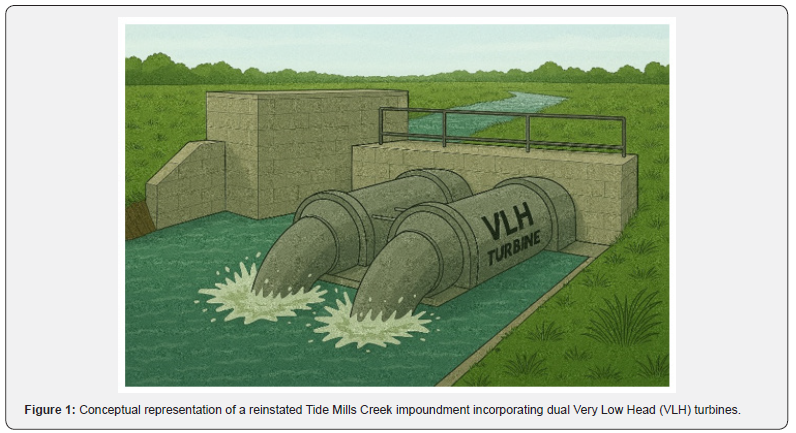
A key distinction must be made between the historic and current conditions. The existing creek is open to natural tidal exchange and therefore does not create sufficient hydraulic head for meaningful power generation. For this reason, the energy assessments presented here are based on a reinstatement scenario in which a low dam and sluice-gate arrangement are installed to recreate a managed tidal impoundment.
Under this concept, water is impounded during flood tides and subsequently released through energy conversion devices during ebb tides, recreating the operating principle of the original tidal mill while employing modern turbine technology (Figure 1).
Methodology
Several low-head technologies appropriate to tidal impoundment systems were assessed:
a) Very Low Head (VLH) turbines
b) Hydrostatic Pressure Turbines (HPT)
c) Archimedes Screw Turbines (AST)
d) Breastshot waterwheels
e) Vertical-axis hydrokinetic turbine concepts
The modelling utilised hourly tidal levels from the Newhaven area and assumed operation through controlled sluice-gate management.
For VLH and HPT configurations, the creek was allowed to fill during flood tide before controlled release through the turbines on the ebb cycle. Archimedes screw systems were modelled using an ebb-generation configuration. The breastshot waterwheel was assessed as a heritage-focused alternative operating under a reduced flow regime.
Energy production was calculated from hydraulic head, discharge rate and device efficiency for a representative annual period.
Results
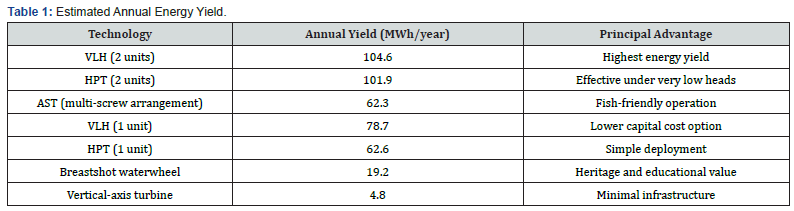
The estimated annual yields are summarised in Table 1.
The dual VLH configuration produced the highest estimated annual generation at approximately 104.6 MWh/year. The dual HPT arrangement demonstrated similar performance, producing approximately 101.9 MWh/year.
Archimedes screw systems delivered lower annual yields but remain attractive due to their proven fish-passage characteristics and established environmental acceptance. Waterwheel solutions generated substantially lower outputs but offer opportunities for heritage interpretation and tourism.
Discussion
The results demonstrate that reinstated tidal mill infrastructure can provide useful quantities of renewable electricity using commercially available low-head technologies. Although the energy yields are modest compared with utility-scale renewable projects, they are significant at the local scale and could support visitor facilities, environmental monitoring infrastructure, educational centres, or community energy schemes.
The principal value of such schemes may extend beyond electricity generation. Reinstated tidal impoundments could contribute simultaneously to:
a) preservation of industrial heritage
b) coastal climate adaptation
c) flood resilience
d) educational and tourism opportunities
e) habitat creation and managed estuarine restoration
The VLH and Archimedes screw technologies are especially attractive because of their relatively low rotational speeds and favourable environmental performance reported in previous studies of fish passage and aquatic ecosystem interactions.
The Tide Mills concept also has wider applicability. Numerous former tidal mill sites remain distributed around the coasts of the United Kingdom, France, Portugal and the Netherlands. Many retain impoundments, sluices, culverts or embankments that could potentially support modern low-head renewable energy systems with minimal civil-engineering intervention [1-7].
Conclusion
This study investigated the feasibility of reinstating a historic tidal mill system at Tide Mills Creek, Newhaven, for renewable electricity generation.
Key findings include:
a) The existing creek is open to natural tidal flow and does not currently function as a tidal mill.
b) Reinstatement of tidal impoundment through sluice-control infrastructure could enable modern very low-head (VLH) hydropower generation.
c) Dual VLH turbines provided the highest modelled energy output (104.6 MWh/year).
d) Dual HPT systems achieved comparable performance (101.9 MWh/year).
e) Archimedes screw systems offered lower yields but potentially superior environmental compatibility.
f) Historic tidal mill infrastructure may provide a practical mechanism for combining renewable energy generation, heritage conservation and coastal resilience.
Future work should include detailed hydraulic modelling, environmental assessment, ecological studies and techno-economic evaluation before implementation.
References
a- Angeloudis A, Falconer RA, Bray S, Ahmadian R (2016) Representation and operation of tidal energy impoundments in coastal hydrodynamic models. Renewable Energy 99: 1103-1115.
- Quaranta E, Bahereni A, Riasi A, Revelli R (2022) The Very Low Head Turbine for hydropower applications in existing hydraulic infrastructures. Sustainable Energy Technologies and Assessments 51: 101924.
- Roome E, Robins P, Ahmadian R, Austin M, Hanousek N, et al. (2024) Assessing hydrodynamic impacts of tidal range energy impoundments in UK coastal waters. Renewable Energy 237: 121601.
- Waters SR (2015) Analysing the performance of the Archimedes screw turbine within tidal range technologies. MSc Thesis, Lancaster University.
- Wolter C, Müller G (2004) The breastshot waterwheel: design and model tests. Proceedings of the Institution of Civil Engineers: Engineering Sustainability 157(4): 203-211.
- Historic England (2018) Mills: Introductions to Heritage Assets. London: Historic England.
- The Tide Mills Project (2026) History of Tide Mills and the former tidal mill complex.

























