




 OFOAJ Home



Abstract
Stability aspects of small fishing vessels were evaluated, they are purse seiner Yana and skipjack pole and line Yora 01. This issue was executed due to unclarity of stability parameters of fishing vessels during design and operation. Most traditional fishing vessels were constructed and operated without defining design parameters or stability parameters in particular at initial design phase. Due to fishermen habit that operate vessels in one day operation in the fishing ground surrounded by the islands makes fishermen do not pay special attention to stability parameters. In addition, the habit of placing all captured fish on the deck would create problem of increase vessels’ height of gravity KG and decrease the important stability parameter of transverse metacenter height GMT. Generally, this parameter will affect all stability parameters. The real parameters of KG and GMT would be achieved by inclining test on the real vessel. The inclining test was executed on both vessels in the waterfront area by following all procedures in standard test. The result of inclining test was used in defining and creating loading scenario which are leaving home port, arriving at fishing ground, leaving fishing ground and arriving at home base again. Additional scenario was included for placing load (captured fishes) on deck. Purse seiner has 3 scenarios of placing 1, 2 and 3 tons on deck while skipjack pole and line has scenario of placing 1, 2, 3, 4 and 5 tons on the deck. The real loading condition of vessels were set and stability parameters for the vessel were determined. Inclining test gives a non-dimensional value of ratio KG/H where this value may be applied at future early design phase of similar fishing vessels. The study showed that placing the cargo of maximum to 3 tons on the deck of purse seiner and 5 tons on the deck of skipjack pole and line would not be a problem for stability parameters. In these scenarios it was resumed that all stability parameters satisfy the rule of stability. In addition, placing the cargo more than the existing scenario then stability parameters should be considered again. Some recommendations were made for future works of the study.
Keywords:Stability parameters; Loading conditions, Inclining test
Introduction
Background
The need of protein resources from the sea depends on any kinds of fishes which is increased recently due to domestic consumption and international market. As a big maritime country, Indonesia plays a great contribution to fulfil fish international demand. Lying at the cross of Asia-Australia continents and Pacific-Indian oceans, Indonesia has a potential of marine resources particularly any kind of fishes such as small pelagic, big pelagic and demersal fishes. Such fishes are caught by different fishing vessels and their fishing gears operated by big national fishing companies and small traditional fishing vessels owned by local private companies. Small private fishing vessels should be considered seriously due to some problems appear during their operation time [1,2]. Among those small private fishing vessels purse seiner (catching small pelagic fishes) and skipjack pole and line (catching big pelagic fishes) have a serious problem of stability parameter. Unlike other transport ships where stability parameters are evaluated at departure and arrival conditions fishing vessels should be considered at 4 loading conditions which are: departure from home base, arrive at fishing ground, leave fishing ground and arrive at home base with difference load conditions [3,4]. In fact, our previous study showed a critical stability condition which should be deeply evaluated when the load (captured fishes) is placed on deck area or before placing them at fish hold [1,5, 6]. In addition, those small private fishing vessels are not provided with detail of stability parameters that may cause a wrong evaluation of stability parameters. A previous work was executed by the author concerning the vertical value of ship’s centre of gravity KG or VCG. By providing the value of KG then the stability parameters of both fishing vessels may be clearly determined [3,4].
The value of KG is obtained from the result of inclining test executed directly on board at empty load conditions. Once the value of KG at empty load condition is determined then the whole load conditions of ship would be arranged then the value of stability parameters are also determined. In fact, the real load conditions all stability parameters are determined by the conditions of cargo and consumables carried at 4 loading conditions. Fishing ground of those two kinds of vessels depends of the migration line of such small and big pelagic fishes. The fishing ground are detected by the fishermen for a long time without using a modern device to trace the line fish migration. In addition, fishermen using a floating platform called rumpon in order to keep the moving fishes stop and stay rest beneath rumpon to be easy to be caught. Otherwise, the vessel is moving around in fishing ground to search until the catching target is fulfilled. Purse seiner fishing vessel is operated at night time when the fishes are staying under rumpon then catching process may be executed by reducing the light and using the circling net. Meanwhile, skipjack pole and line fishing vessel operate at day time starting from dawn to catch small life bait fish then catching operation are continue during the day time at open fishing ground [5,6].
Review of Ship Parameters
Fishing vessel Purse Seiner
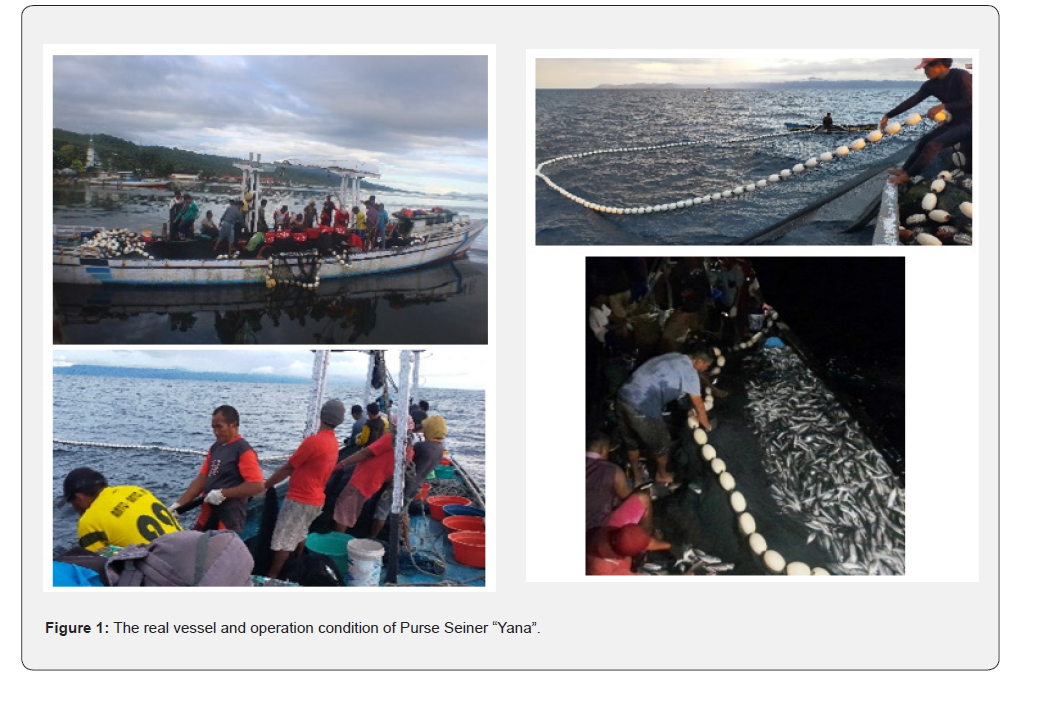
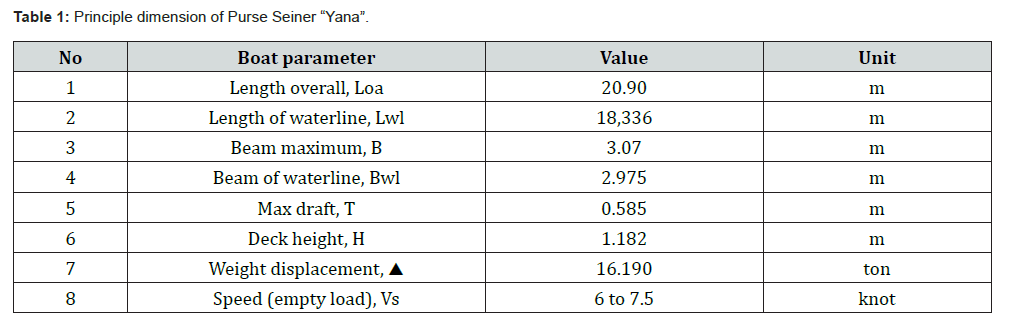
A purse seine fishing boat name Yana was selected in this study. The configuration and dimension of observed purse seiner is presented at Figures 1 & 2 and Table 1.
Fishing Vessel Skipjack Pole and Line
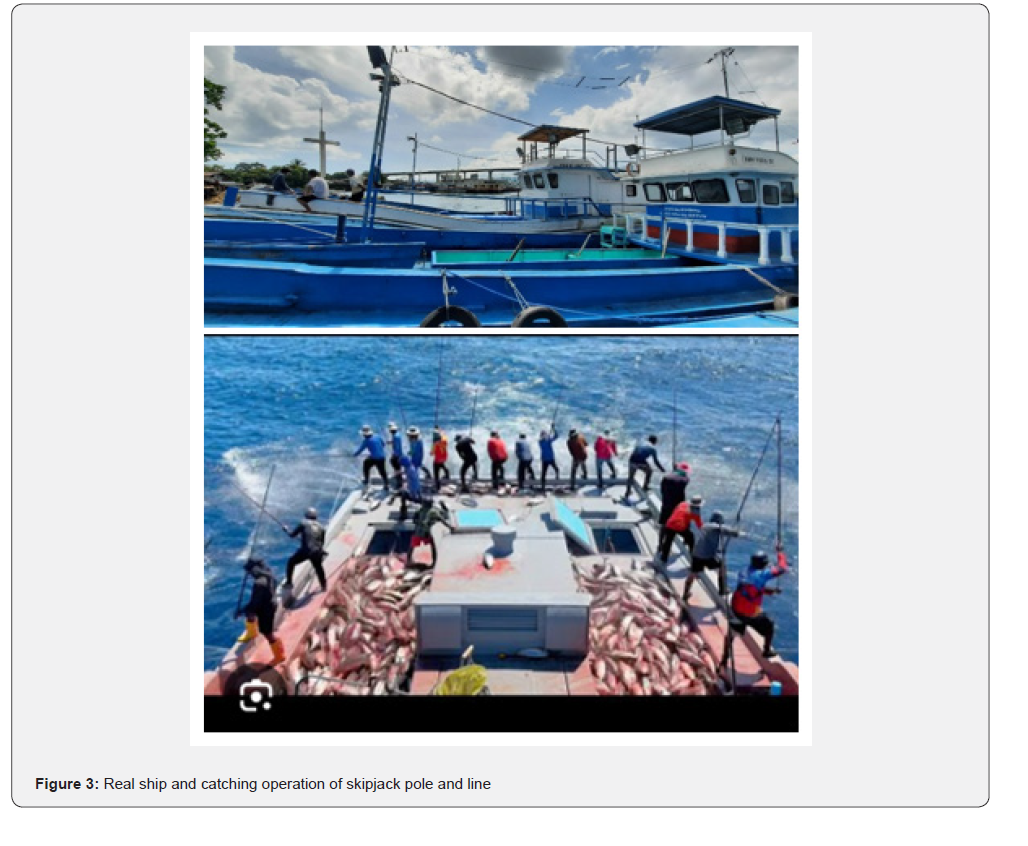
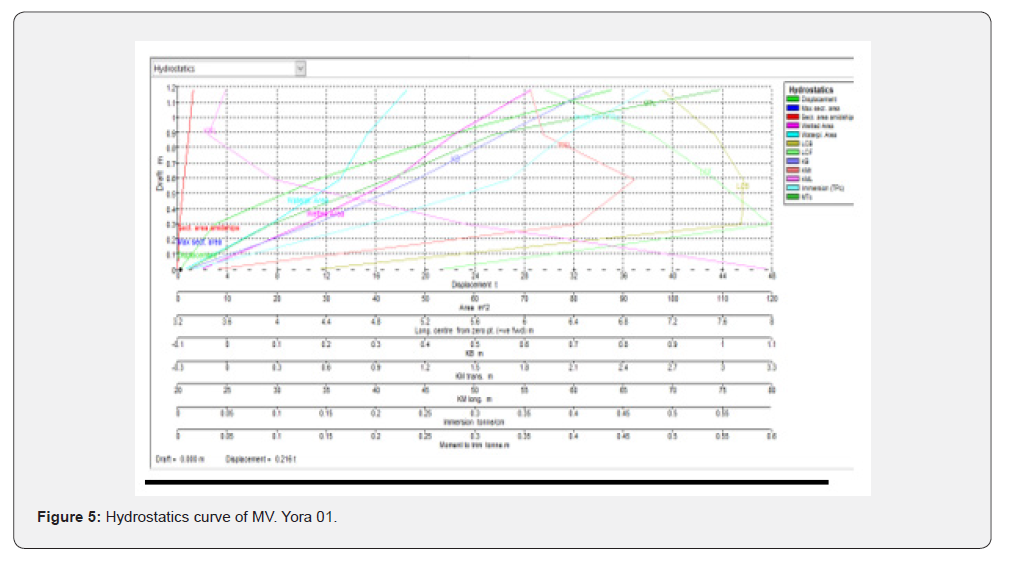
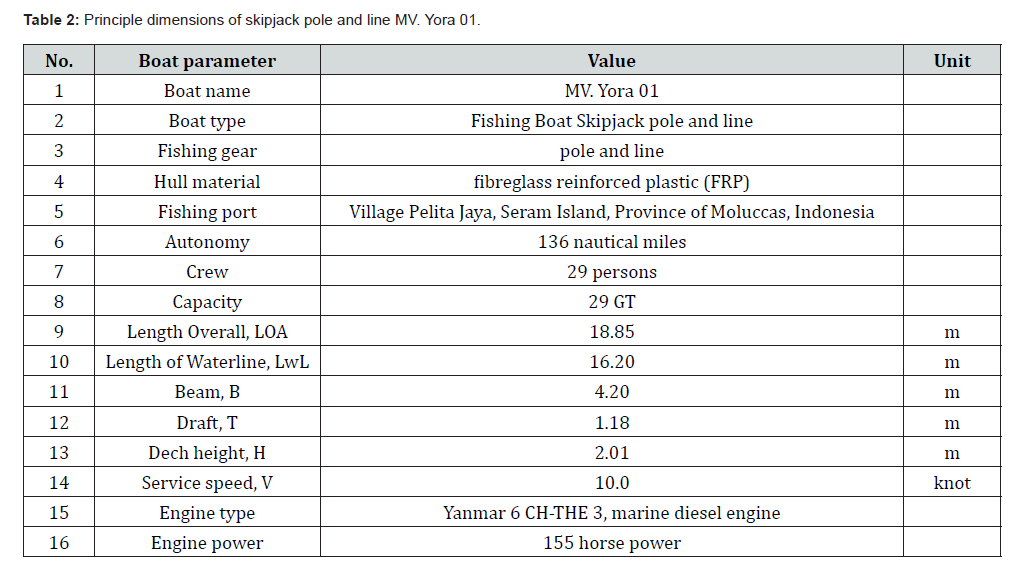
The dimension and configuration of Fishing vessel skipjack pole and line are presented at Figures 3-6 and Table 2.


Stability Parameters
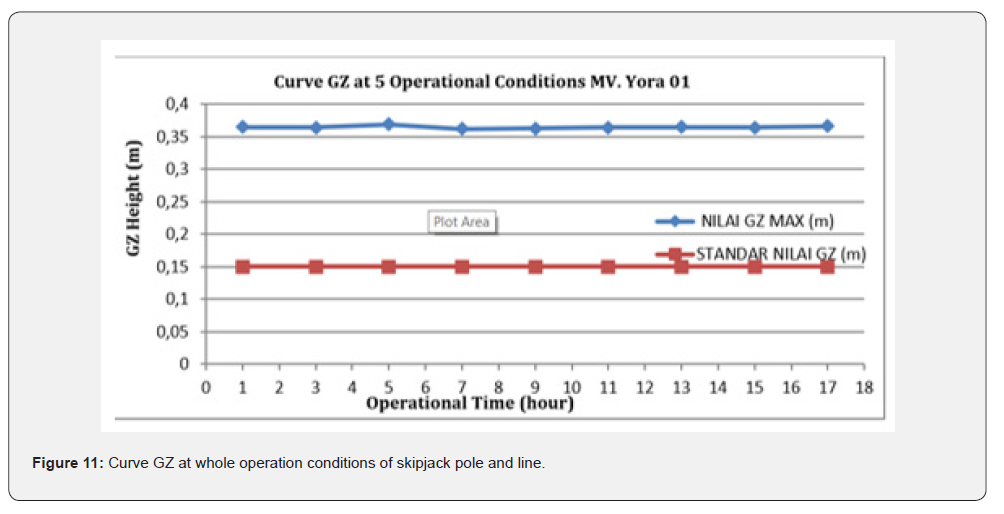
The stability parameters of small fishing vessels are regulated in several rules to ensure the vessels are in good condition during the operation. The stability of fishing vessels should be evaluated at all loading conditions at departure and arrival conditions [3,4]. In addition, Fyson [4], stated that fishing vessels with length are greater than 24 m should fulfil the IMO Regulation 1977 with stability criteria cover large angle of inclination (Figures 7-11).
Stability parameters at initial condition may be determined as follows:
GMT = KB + BMT − KG = KMT − KG (1)
Where:
GMT = Transverse metacentre height
KB = Vertical centre of buoyancy
BMT = Transverse radius of metacentre
KMT = Height of metacentre above baseline
KG = Vertical centre of gravity of the vessel.
The values of KB, BMT and KMT are obtained from hydrostatics properties of the vessels. Once the value of KMT and KG are determined then the value of GMT may be achieved. The value of KG is composed on any detail of vessels’ component such as hull, machinery, propulsion systems, fluids, cargoes, consumables, crew, etc. Those components are determining at design stage. In fact, those components should be verified later at real ship condition which is known as the inclining test. This action would be executed at empty condition of the vessel. From the achievement of value KG then the metacentre value GMT of the vessels may be achieved. The value of GMT may be obtained directly from the inclining test such as:
GMT = (w x d cosφ ) / (w sinφ ) = (w . d ) / (W tanφ ) (2)
where:
W = displacement of the vessel due to the real draft
w = moving weight at a distance from CL of vessel
φ = angle of inclination
The criteria of ship stability parameters for fishing vessels are presented in the Regulation 28 Chapter III (International Conference on Safety of Fishing Vessels, 1977, IMO, London, 1977) [7]. In fact, for the vessels below 24 m in length this reference [8] it is recommended to use the similar criteria also below 24 m for decked vessels. In addition, the regulation issued by Maritime Coastguard Agency [9] for stability criteria of fishing vessels less than 15 m. Fishing vessels should be operated that the minimum stability criteria established by the competent authority will be met in all operation conditions. The following minimum stability criteria are recommended for decked fishing vessels less than 24 m [10-12] which is based on the FAO/ILO/IMO Voluntary Guidelines for the Design, Construction and Equipment of Small Fishing Vessels, 2005. Safety aspects of fishing vessels are regulated in Torremolinos Protocol and The Torremolinos International Convention for the Safety of Fishing Vessels, consolidated edition, 1995, adopted in Torremolinos, Spain 2 April 1993. This protocol stipulated standard requirements of fishing vessels’ stability [3]. Insight report Lloyd’s Register Foundation [4] clarified that the reason of fishing vessels’ accidents caused by the lack of regulation and weak implementation of regulation. Moreover, safety code issued by Implementation Guidelines on Part B of the Code, the Voluntary Guidelines and the Safety Recommendations (FAO UN, 2014) [10] stated one practical code of ship safety is maintaining watertight integrity and ship stability. Regulation of stability for ships above 24 meter in length firmly stated in (International Conference on Safety of Fishing Vessels, 1977, IMO, London, 1977) which is the complete text from Torremolinos International Convention for the Safety of Fishing Vessels, 1977 and The International Conference on Safety of Fishing Vessels, IMO, London, 1977 [3,13]. The concept of ship stability component mostly in order to find component of ship stability [14-17].
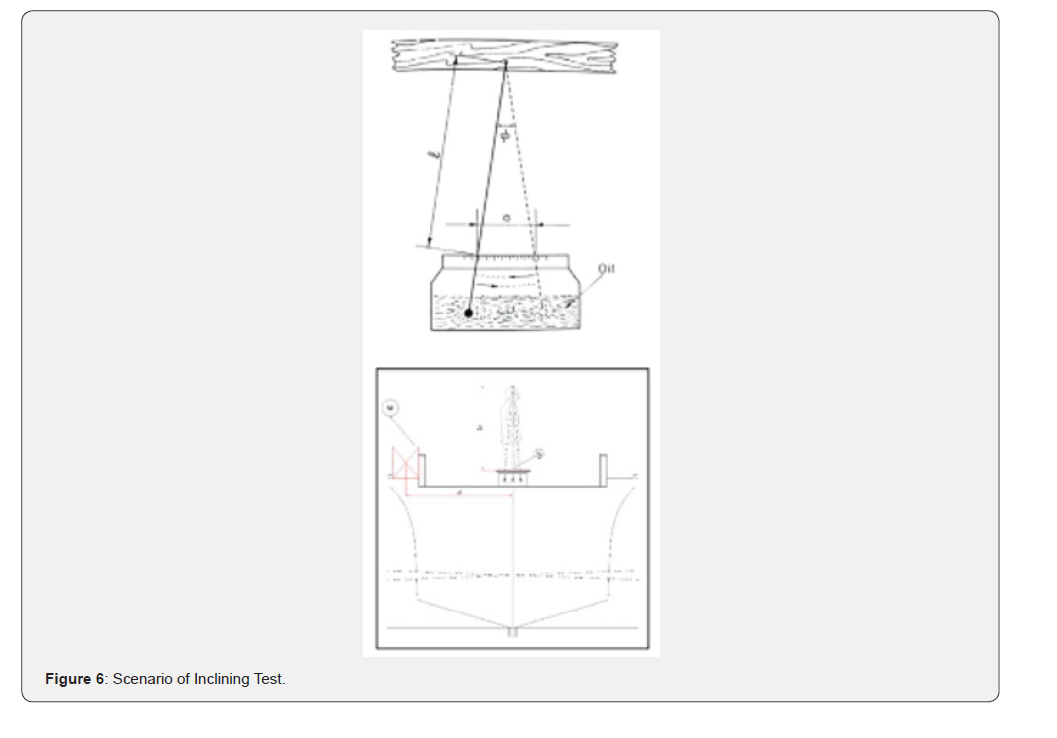
The scenario of inclining test is presented at Figure 1.


The scenario of achievement the value of inclining test is explained as follow:
The value of inclination angle ϕ is obtained from:
φ = a / l (in radians) or φ = 57.3 x (a/l) (in degrees) (3)
Methodology
Preparation and Executing of the Inclining Test
Results and Discussion
Result of the Inclining Test
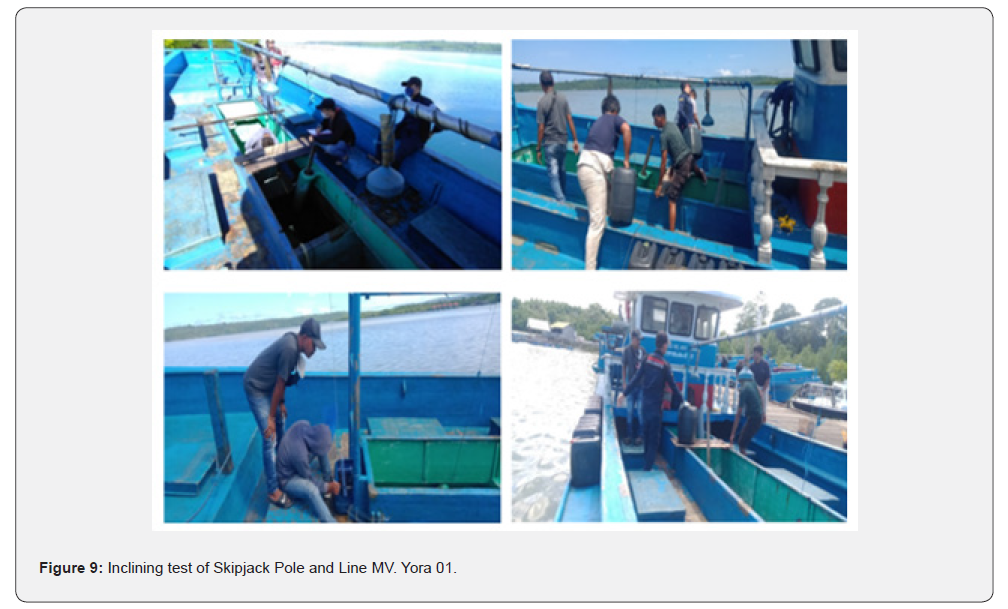
Results of inclining test of the observed fishing boats purse seiner “Yana” are presented at Tables 3 & 4. In this test few crews and researcher were on board. Moving weights were provided by small container filled with water. During the test all internal and external effects. This test there were several scenarios arranged in order to obtain better results. In scenario 1: few crews, additional waters and fishing equipment (circle net) were placing on board. Scenario 2: full crew and equipment were placing on board. In addition, scenario E and F were executed for repeating measurement to achieve an exact value of vessel vertical centre of gravity KG. The test was executed at waterfront area and the test was executed at the condition of without cargo (captured fishes), liquids and consumables.





The results of inclining test for fishing boat skipjack pole and line MV. Yora 01 is presented at Tables 5-7.
The test was executed at vessel empty condition without cargo (captured fish), liquids and consumables. All internal and external effects were avoided during the test.
Resume from the inclining test:
a) An average ratio of KG/H of purse seine fishing vessel is
0.73 or KG = 0.73 H
b) An average ratio of KG/H of skipjack pole and line fishing
vessel is 0.70 or KG = 0.70 where H is deck height of the vessel
c) This value of ratio KG/H may be applied at initial design
stage of the vessel.
Results of Stability Parameters
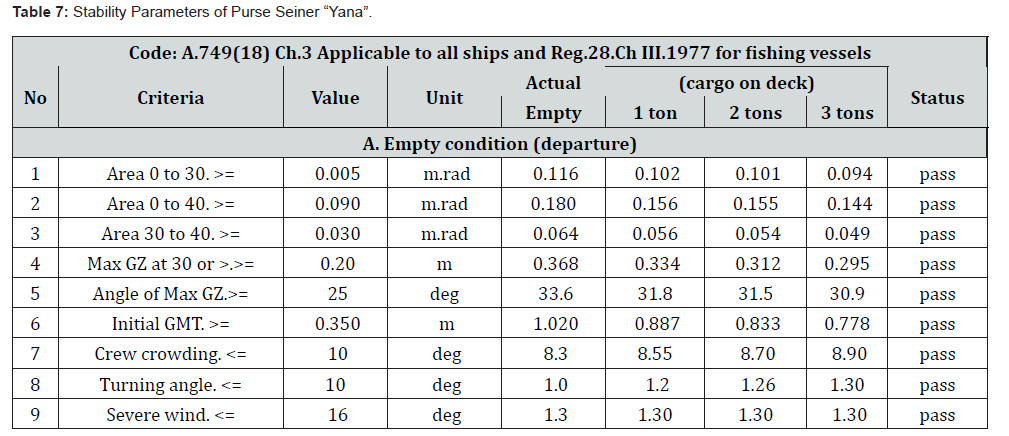
Results of stability parameters of purse seiner fishing vessel Yana is presented at Table 7. In this scenario the vessel at departure condition has no cargo. It was set as an empty condition. Furthermore, catching operation for most purse seiner mostly is executed at rumpon, a certain spot provided by fixed floating platform where fishes stay beneath it. The vessel comes at this spot and wait until the down for catching process. The results of catching are varied. Our experiences found that the results varied from 0.5 to 3 tons. Therefore, in this scenario the loads are varied from 1 to 3 tons. The results of stability parameters purse seiner Yana are presented at Table 7.
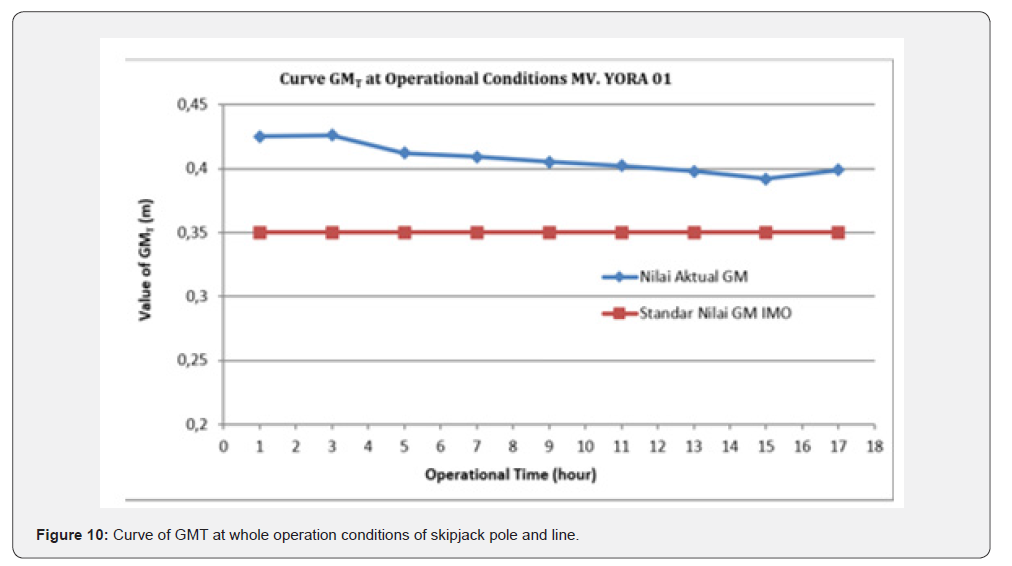
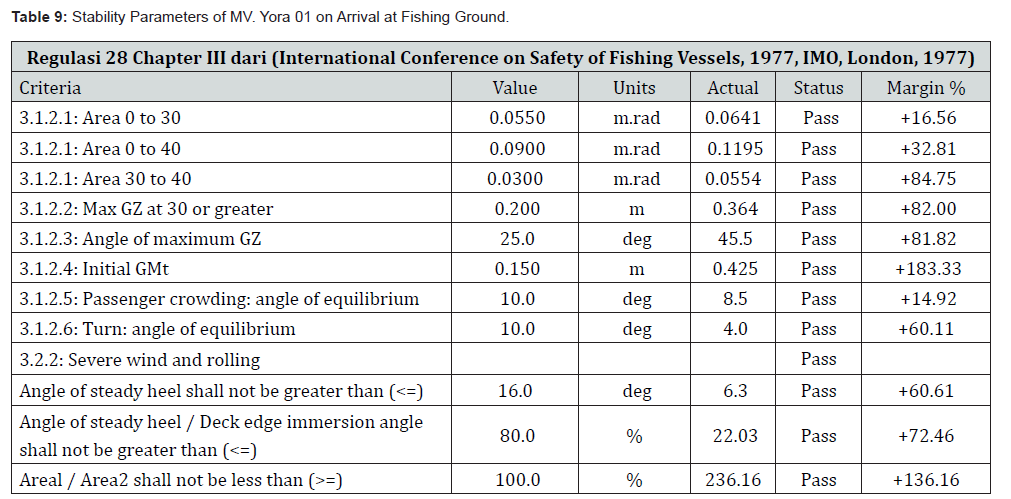
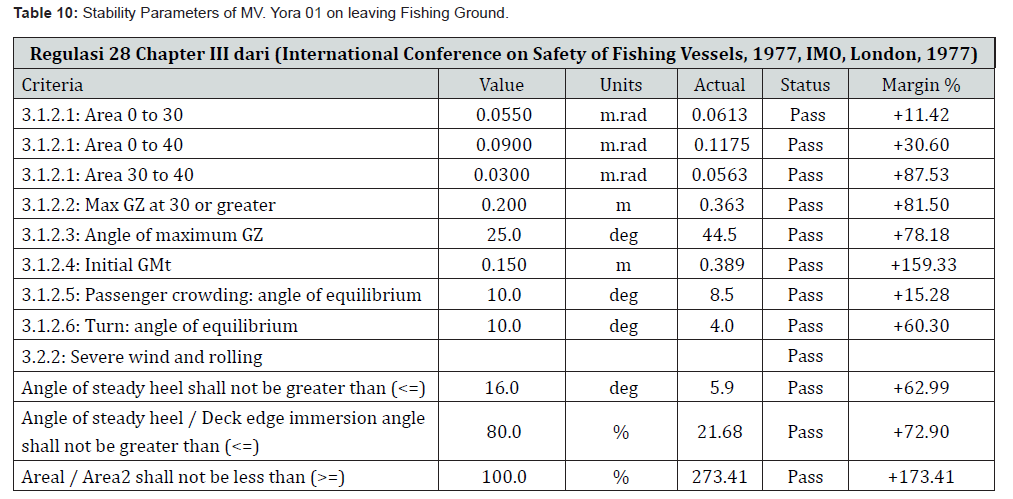
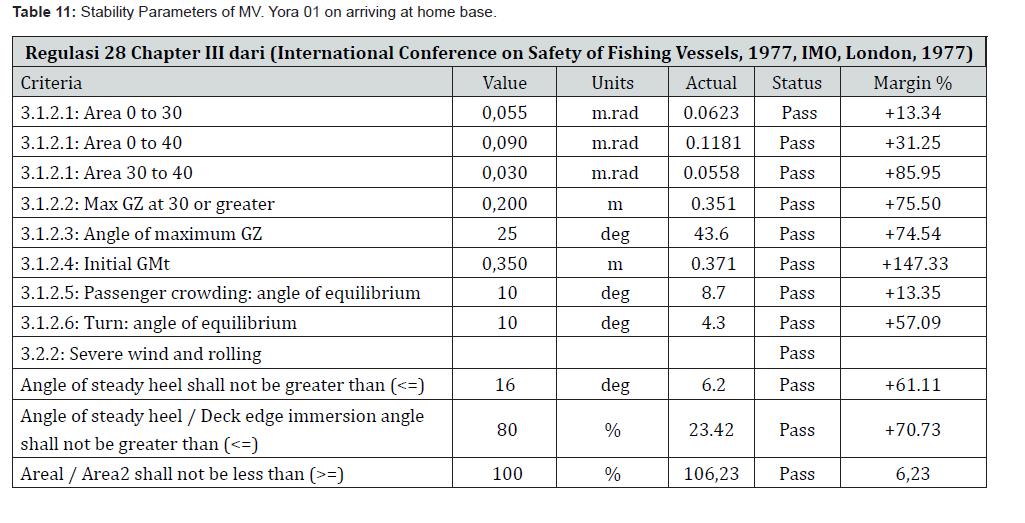
Furthermore, the results of stability parameters of fishing vessel skipjack pole and line MV. Yora 01 are presented at Tables 8-11. Unlike purse seiner, skip jack pole and line operates for hours where it can reach one day time from the early morning until the afternoon. The vessel operates in the fishing ground to search and catch tuna or skipjack tuna fishes. In this case, it can catch the fish at several spots and according to the authors’ experiences the maximum catching can reach 5 tons. The variation of load on the deck during operation was varied from 1 to 5 tons then the load condition when leaving and arriving at home base are presented also. The scenario of catching operation was set for these steps which are departure from home base, arrive at fishing ground, 5 periods of operation at fishing ground, leave fishing ground and arrive at home base. Thus, there are 9 steps of operation with time interval of 2 hours for each step.
Discussion
The result of inclining test KG and GMT give a useful guidance in determining the stability parameters of the vessels in various loading conditions. The parameter vertical centre of gravity KG of empty vessel does not change for ship while other load components such as cargo, liquid, consumable are changing then the parameter of ship stability will change due to operation conditions.
It was found from the inkling test that:
a) Average ratio of KG/H of purse seine fishing vessel is
0.73 or KG = 0.73 H where H is deck height of vessel
b) Average ratio of KG/H of skipjack pole and line fishing
vessel is 0.70 or KG = 0.70
In fact, this value of ratio KG/H may be applied at initial design stage of similar fishing vessel.
Generally, placing the cargo on deck during vessel’s operation may reduce the value of stability due to greater KG or lower GMT. In addition, when ship reach home base the value of stability parameters reduces due to reduce liquids at ship bottom that may increase KG or lower GMT.
Placing the cargo (captured fishes) on the deck of purse seiner at the maximum up to 3 tons would not be problem where at this condition the stability parameters satisfy the regulation. However, an attention should be made when placing cargo more than 3 tons on deck then further evaluation should be made.
Placing the cargo on deck during operation of skipjack pole and line will reduce the value of stability parameters. Furthermore, at the maximum of 5 tons cargo on deck this scenario is still satisfy the regulation of vessel’s stability. However, with reducing of stability parameters particularly GMT when leaving the fishing ground should be considered seriously.
Conclusion and Recommendation
Conclusion
Some points may be withdrawn from this study including:
a) The real value of ratio KG/H = 0.73 obtained from
inclining test (empty condition) for purse seiner and KG/H = 0.70
for skipjack pole and line were used as reference for determining
the whole stability parameters of the observed vessels.
b) These values of ratio KG/H may be used as reference for
new initial design phase or other operational purposes stability
parameter of similar fishing vessel.
c) Generally, loading condition of placing cargo on deck
will decrease stability quality at significant but in the case of
observed fishing vessels of purse seiner and skipjack pole and line
the vessels are still in stable condition.
d) Decreasing of stability parameters of those two observed
vessels due to placing cargo on deck is still be accepted. However,
for the cargo of more than 3 tons on purse seiner and 5 tons on
skipjack pole and line these scenarios should be considered and
evaluated again.
Recommendation
a) It is recommended to use the nondimensional ratio of
KG/H as reference at initial design stage or other operational
purposes for similar fishing vessel.
b) Catching proses at one-night fishing may be doubled
where the first catchment may be placed in fish holds and the
second catchment may be placed on deck. In this scenario, the
stability parameters should be evaluated further.
References
- Hetharia WR (2022) Report of The Research Part A. Ensuring the Safety of Seafarers and Fishers in the Era of Covid-19 and Beyond.
- Hetharia (2019) Report on Fisheries Survey Results in the Waters of Maluku and North Maluku - Period: 2017-2019.
- Pinkster J (2004) Fishing Vessels. Ship Design and Construction, Written by an International Group of Authorities. In: Lamb T, (edtr.), The society of Naval Architects and Marine Engineers, 601 Pavonia Avenua, Jersey City, NJ, 41: 4-57.
- Fyson J (1985) Design of Small Fishing Vessels. In: Published by arrangement with the Food and Agriculture Organization of the United Nations. By Fishing News Book Ltd, Farnham– Surrey – England, FAO 1985, pp. 155-172.
- Hetharia WR, Fretes ERD, Gaspersz F, Tupan J, Feninlambir A (2021) Problems and Technical Solution of Capture Fisheries in Eastern Indonesian Waters. IOP Conference Series, Materials: Science and Engineering 1052.
- Hetharia WR, Fretes ERD, Gaspersz F, Feninlambir A (2025) An Evaluation of Stability Parameter of Small Purse Seiner. IOP Conf. Series: Earth and Environmental Science 1461.
- IMO (1977) International Convention for Safety of Fishing Vessels. Res A 16, See Coast Guard, 1976.
- Van Dokkum K (2003) Ship Knowledge - A Moderen Encyclopedia. DOKMAR, Enkhuizen, The Netherland.
- Malmin KØ (1978) Design of a small fishing vessel in alternative building materials. B.Sc Thesis, NTH.
- Insight Report Lloyd’s Register Foundation (2018) Report Series: No. 2018.3) Lloyd’s Register Foundation Report Series: No. 2018.3 (Insight report on safety in the fishing industry – A global safety challenge).
- Maritime Coastguard Agency (2017) The Code of Practice for The Safety of Fishing Vessels of Less Than 15 metres Length Overall. The Maritime and Coastguard Agency – Spring Place 105 Commercial Road, Southhampton SO15 1EG.
- Gudmundsson A (2009) Safety Practices Related to Small Fishing Vessel Stability. Fishery Industry Officer (Vessels) – Fishing Technology Service Fish Products and Industry Division FAO, Rome. FAO Fisheries and Aquaculture Technical Paper No. 517 Food and Agriculture Organization of The United Nations, Rome.
- Implementation Guidelines on Part B of the Code (2014) The Voluntary Guidelines and the Safety Recommendations Food and Agriculture Organization of the United Nations. In: International Labour Organization International Maritime Organization, Rome.
- Rawson KJ, Tupper EC (1984) Basic Ship Theory. In: (3rd), Longman, New York.
- Biran AB (2003) Ship Hydrostatics and Stability. In: Butterworth-Heinemann An Imprint of Elsevier, Linacre House, Jordan Hill, Oxford, OX2 8DP, pp. 166-170.
- Barrass B, Derrett DR (2006) Ship Stability for Masters and Mates. In: Butterworth Heinemann An Imprint of Elsevier, Linacre House, Jordan Hill, Oxford, OX2 8DP, pp. 286-289.
- Moore CS (2010) Intact Stability - The Principles of Naval Architecture Series. In: The Society of Naval Architects and Marine Engineers, 601 Pavonia Avenue, Jersey City, New Jersey, pp. 59-65.

























