




 ASM Home



Abstract
The rapid adoption of generative artificial intelligence (AI) tools has influenced the way students approach learning, research, communication, and collaboration. This study examines students’ preferred communication methods, their use of AI tools, and perceptions of AI’s contribution to higher-order thinking and team-building skills. A survey-based approach was used to explore students’ experiences and their views regarding the role of AI in academic activities. Communication results showed a strong preference for digital platforms, particularly WhatsApp, email, and Microsoft Teams, while many still rely on in-person meetings. The findings indicate that ChatGPT was the most widely used AI tool among respondents, followed by Gemini and Copilot. Students perceived AI as most beneficial for research and problem-solving activities, while its contribution to critical thinking, coordination, and cooperation was viewed more cautiously. Qualitative responses further revealed that students considered AI most effective when used as a support tool for clarification, feedback, and verification rather than as a replacement for independent learning. The study highlights the importance of promoting responsible AI use that supports, rather than replaces, student engagement, critical thinking, and collaboration.
Keywords:Artificial Intelligence Tools; Higher-Order Thinking Skills; Team-Building Skills; Communication Tools
Introduction
The increasing availability of artificial intelligence (AI) technologies has changed the way students engage with academic work. Generative AI tools such as ChatGPT, Gemini, Copilot, and Claude have become accessible resources that students use for searching information, generating ideas, improving written work, and solving academic problems. This growing adoption of generative AI tools offers new opportunities for learning support, but questions remain regarding their impact on important educational outcomes, particularly higher-order thinking skills and teamwork abilities [1-4].
Higher education institutions increasingly encourage the use of digital technologies to enhance learning experiences. However, the effectiveness of AI depends not only on access to these tools but also on how students use them. AI may support learning by helping students explore concepts, receive feedback, and develop solutions, but excessive dependence on AI-generated answers may reduce opportunities for independent reasoning and critical evaluation. Recent studies examine students’ perceptions and adoption of generative AI tools in higher education and what factors can influence their selections [5-7].
Beyond individual learning, AI technologies may also influence how students communicate and collaborate. Students increasingly rely on digital platforms such as WhatsApp, email, and Microsoft Teams to coordinate academic tasks and maintain group communication. Understanding how these communication patterns develop alongside AI adoption provides insight into the changing nature of student collaboration.
The development of higher-order thinking skills remains an important goal of education. Higher-order thinking includes processes such as analyzing, evaluating, and creating [8]. AI tools may contribute to these skills by supporting idea generation, providing explanations, and encouraging students to consider different perspectives. It is argued in [9], that large language models can act as cognitive support tools when students engage with them critically rather than passively accepting generated responses.
Previous studies have also highlighted AI’s potential to support creativity and independent learning. It is suggested in [10] that AI-based educational tools can encourage exploration and personalized learning when used appropriately by assisting students in brainstorming, reflection, and feedback processes.
On the other hand, although AI has great potential to support learning and teaching, researchers have also raised concerns about excessive dependence on these tools. A very serious issue is related to academic integrity and the possibility that students may rely on AI-generated content without developing their own understanding [11]. This suggests that AI should be viewed as a learning support tool rather than a substitute for student thinking..
Communication and collaboration are also central aspects of higher education. Digital communication tools allow students to share information, coordinate tasks, and participate in collaborative learning activities. While AI offers great efficiency, personalization, and accessibility, it could cause emotional detachment, data privacy risks, ethical challenges, and other issues [12]. Therefore, this aspect of AI could have serious unforeseen consequences.
It is understandable that effective teamwork requires more than technological access and that successful collaboration depends on factors such as communication, trust, shared responsibility, and active participation [13]. Therefore, while AI and digital platforms may support teamwork processes, human interaction remains essential.
Although previous research has examined AI adoption and educational applications, further investigation is needed into how students perceive AI’s influence on both cognitive skills and collaborative abilities [14,15].
This study investigates students’ preferred communication methods, their use of AI tools, and their perceptions of AI’s contribution to higher-order thinking and team-building skills. Specifically, it examines whether students view AI as a tool that enhances research, creativity, problem-solving, communication, and collaboration. The findings contribute to discussions about the role of AI in higher education and provide insight into how these technologies can be integrated effectively into student learning environments. This exploratory study addresses this gap by examining students’ experiences with AI tools, communication practices, and perceived skill development.
Methodology
An online survey was administered to students in two graduate courses in a Canadian university at the end of the Fall 2025 semester. The questionnaire adapted from [16] contained several parts and for this research, we focused on the sections on Communication methods, AI tools selected and their perceived contribution to higher-order thinking and team-building skills. Two open-ended questions followed, asking respondents to describe the approaches they considered most effective and least effective when using AI for learning. These two questions will be analyzed using content analysis.
Results
A total of 51 graduate students completed the online survey which represents a response rate of about 90%.
Communication methods
Table 1 presents the communication platforms used by respondents. The results show that students relied on a combination of digital and face-to-face communication methods, with online messaging platforms being the most common. Only communication tools used by at least 10% of respondents are presented.
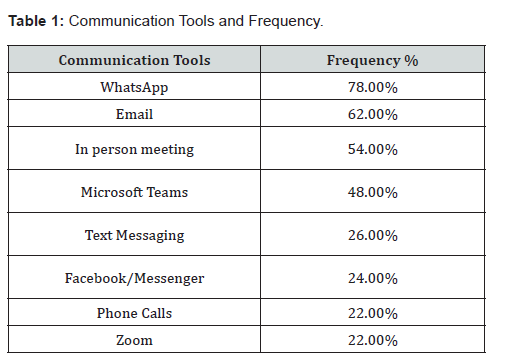
WhatsApp comes up as the most frequently used communication platform, reported by 78% of respondents. This strong preference could suggest that students value communication methods that provide quick access, convenience, and support for group discussions. The popularity of WhatsApp may be linked to its informal nature and suitability for coordinating academic tasks.
Email was the second most used platform (62%). Unlike messaging applications, email remains important for formal communication, sharing documents, and communicating academic information. The continued use of email suggests that students combine informal and formal communication channels depending on their needs. More than half of respondents (54%) reported using in-person meetings, demonstrating that faceto- face interaction remains relevant despite the availability of digital tools. Microsoft Teams was used by 48% of respondents, highlighting its role in supporting online collaboration, particularly for organized group work and document sharing. Other communication methods, including text messaging, Facebook/Messenger, phone calls, and Zoom, were used less frequently. The lower use of Zoom may indicate that students prefer flexible communication platforms rather than scheduled video meetings for routine collaboration.
Taken together, these results indicate that students favour communication platforms that are immediate, accessible, and easy to integrate into daily academic activities. Although digital communication dominated, more than half of respondents still reported meeting in person. This observation is noteworthy because it suggests that face-to-face interaction continues to play an important role in group projects despite the availability of numerous online communication options. These results show some similar patterns as in [17].
Choice of AI tools
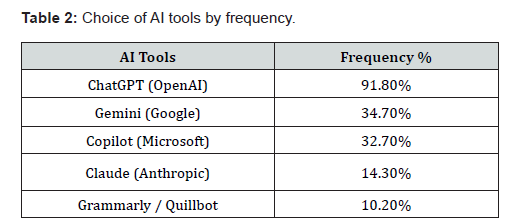
Respondents were given a list of AI tools and were asked to indicate which tools they used. The results about the proportion of users for each tool are presented in Table 2. The dominance of ChatGPT is striking. More than 90% of respondents (91.8%) reported using it, while competing tools such as Gemini and Copilot attracted considerably smaller user groups, with approximately one-third of respondents. The popularity of ChatGPT could perhaps be explained by its accessibility, ease of use, and ability to support a wide range of academic tasks, including research, writing, explanation, and problem-solving.
On the other hand, students familiar with Google or Microsoft environments may also find Gemini and Copilot useful because of their integration with existing services. This pattern suggests that students tend to gravitate toward a single familiar platform rather than regularly switching between multiple AI systems.
Claude was used by 14.3% of respondents, while Grammarly and QuillBot were used by only 10.2%. The lower adoption of specialized writing tools suggests that students may prefer broader AI assistants rather than tools designed for specific purposes. Interestingly, Table 2 suggests that students’ AI usage seems to be concentrated around general-purpose generative AI platforms, with ChatGPT serving as the primary tool for academic support.
Perceived contribution of AI tools towards skills
Respondents were asked to evaluate the extent to which AI tools contribute to the development of higher-order thinking and team-building skills. The higher-order thinking skills are Research, Critical thinking, Problem solving and Creativity and Team-Building skills are Communication, Coordination and Cooperation, based on [18].
A three-point scale was used, where 1 represented “not at all,” 2 represented “moderate,” and 3 represented “a lot.” The mean scores are presented in Table 3.
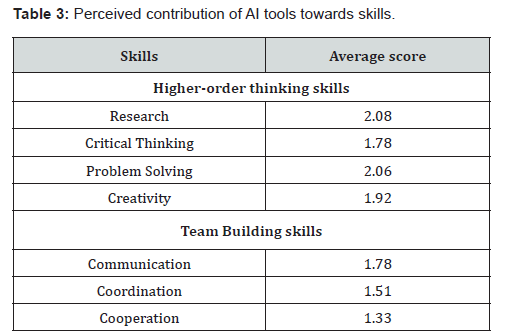
It is interesting to observe the contrast between students’ perceptions of AI contribution to individual learning and its contribution to teamwork. The results indicate that students generally viewed AI tools as providing some moderate support for academic and cognitive activities. Research received the highest average rating (2.08), suggesting that students consider AI somewhat useful for locating information, organizing ideas, and supporting the preparation of academic work. Problem-solving received a similar rating (2.06), indicating that students believe AI can assist them in exploring possible solutions and understanding difficult concepts. Although those results are higher than others, they are barely above the “Moderate” benchmark.
It is interesting to observe the contrast between students’ perceptions of AI contribution to individual learning and its contribution to teamwork. The results indicate that students generally viewed AI tools as providing some moderate support for academic and cognitive activities. Research received the highest average rating (2.08), suggesting that students consider AI somewhat useful for locating information, organizing ideas, and supporting the preparation of academic work. Problem-solving received a similar rating (2.06), indicating that students believe AI can assist them in exploring possible solutions and understanding difficult concepts. Although those results are higher than others, they are barely above the “Moderate” benchmark.
It is interesting to observe the contrast between students’ perceptions of AI contribution to individual learning and its contribution to teamwork. The results indicate that students generally viewed AI tools as providing some moderate support for academic and cognitive activities. Research received the highest average rating (2.08), suggesting that students consider AI somewhat useful for locating information, organizing ideas, and supporting the preparation of academic work. Problem-solving received a similar rating (2.06), indicating that students believe AI can assist them in exploring possible solutions and understanding difficult concepts. Although those results are higher than others, they are barely above the “Moderate” benchmark.
Students’ perceptions of most effective AI use
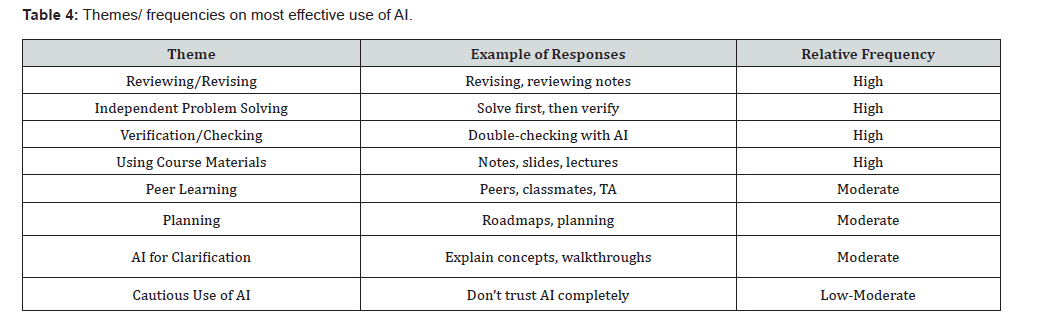
Using an open-ended question, students were asked to describe the approaches they considered most effective when using AI for learning and academic assignments. Responses were analyzed using content analysis to identify common patterns and presented in Table 4. The first column grouped responses into themes, the second column gives some examples of responses in the theme and the corresponding relative frequency of the themes in the third column. Verification emerged as a recurring theme in the responses. Several students emphasized that AI outputs should be checked against course materials and other sources before being accepted.
The findings show that students generally viewed AI as a support tool rather than a replacement for independent learning. The most common theme was the use of AI for reviewing and improving existing work. Many students indicated that AI was useful for checking answers, improving understanding, and receiving feedback after attempting a task themselves.
A second major theme was independent problem-solving before consulting AI. Students reported that they preferred to attempt problems first and then use AI to confirm their understanding or identify alternative approaches. This suggests that students recognize the importance of maintaining their own involvement in the learning process. Therefore, AI is seen as a supplementary resource rather than a final authority and it works best when combined with lectures, notes, discussions with classmates, and guidance from instructors.
Students’ perceptions of least effective AI use
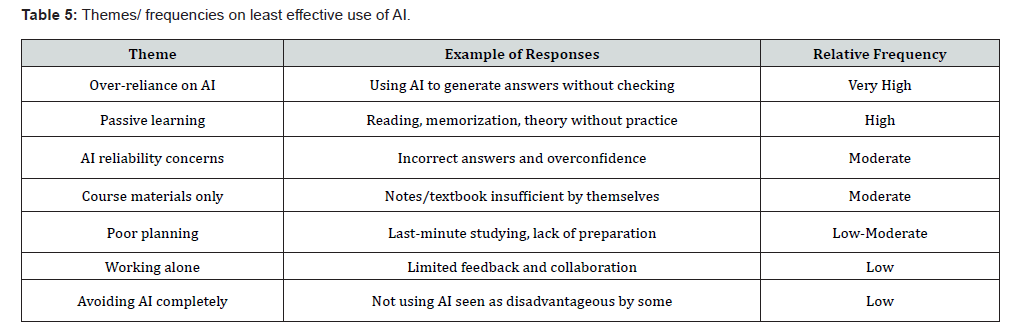
Students were also asked about approaches they considered least effective when using AI. Table 5 shows that the strongest theme was over-reliance on AI. Many respondents expressed concerns that simply copying AI-generated answers or allowing AI to complete tasks without personal involvement reduces understanding and limits learning.
Another common concern was passive learning. Students indicated that reading AI responses, notes, or theoretical information without practicing or applying knowledge was not effective. Some respondents also highlighted concerns regarding AI accuracy, particularly for technical or complex problems.
The results in Tables 4 and 5 suggest that students themselves recognize a difference between productive and unproductive AI use. Effective use involves interaction, reflection, and verification, whereas ineffective use involves replacing personal effort with AIgenerated outputs.
Discussion
The findings provide insight into how students currently understand and use AI within higher education. The results indicate that students have adopted AI tools widely, with ChatGPT being the dominant platform. This aligns with previous research showing that generative AI systems have quickly become common academic resources due to their ability to provide information, explanations, and writing support [9,19]. Students perceive AI as more useful for supporting individual learning tasks than for developing interpersonal skills. Research and problem-solving received the highest ratings, indicating that students value AI primarily as a cognitive support tool. This supports previous studies suggesting that AI can enhance learning by providing feedback, explanations, and alternative perspectives [20]. In contrast, lower ratings for coordination and cooperation suggest that students do not view AI as a replacement for human teamwork. Collaboration requires communication, trust, negotiation, and shared responsibility, which remain strongly dependent on human interaction. This finding supports the argument in [13] that successful teamwork requires social processes that technology alone cannot provide.
The communication results further demonstrate the importance of digital platforms in student collaboration. WhatsApp, email, and Microsoft Teams were the most used tools, suggesting that students combine informal communication methods with more structured academic platforms. These findings are consistent with research highlighting the role of digital communication technologies in supporting flexible and collaborative learning environments [21].
The qualitative findings provide an important perspective on responsible AI use. Students did not generally view AI as a replacement for learning. Instead, they described effective AI use as involving checking, clarification, and feedback. This reflects growing awareness that AI-generated information must be evaluated rather than accepted automatically.
At the same time, concerns regarding over-reliance highlight an important challenge for educators. While AI can improve efficiency and access to information, students must continue to practice independent reasoning and problem-solving. The results suggest that the most beneficial approach is a balanced model in which AI supports student learning while maintaining active engagement.
Limitations
This study has several limitations. First, the findings are based on students’ self-reported perceptions, which may not fully represent their actual behavior when using AI tools. Students may underestimate or overestimate their level of AI usage and its impact on learning. Second, the study focuses on a specific student group, meaning that the findings may not be generalizable to all higher education contexts. Differences in academic discipline, technological experience, and institutional policies may influence how students use AI. Future research could examine AI use through interviews, observations, or longitudinal studies to better understand how students’ interactions with AI develop over time. Further research could also explore how educators can design learning activities that encourage productive AI use while maintaining critical thinking and collaboration.
Conclusion
This study examined students’ use of AI tools, communication practices, and perceptions of AI’s contribution to higher-order thinking and teamwork skills. The findings show that AI has become an important part of students’ academic activities, with ChatGPT emerging as the most widely adopted platform. Students viewed AI as particularly valuable for research, problem-solving, and clarification of concepts.
However, students were less confident about AI’s contribution to critical thinking, coordination, and cooperation. The findings suggest that while AI can support learning processes, it does not replace the human interaction required for effective teamwork and collaboration.
The qualitative responses further demonstrate that students recognize the importance of using AI responsibly. The most effective approaches involved combining AI support with independent thinking, course materials, and peer discussion. In contrast, relying entirely on AI-generated answers was viewed as limiting learning.
AI should be considered a learning support tool rather than a substitute for student engagement. Future educational practices should focus on helping students develop the skills needed to use AI critically, ethically, and effectively.
References
- Zhao Y, Yue Y, Sun Z, Jiang Q, and Li G (2025) Does Generative Artificial Intelligence Improve Students' Higher-Order Thinking? A Meta-Analysis Based on 29 Experiments and Quasi-Experiments. J Intell 13(12).
- Wei Y and Perkins M (2026) Generative AI and student collaboration: A scoping review of group work processes, outcomes, and risks. Int J Educ Integr 22(8).
- Zhou X, Teng D, and Al-Samarraie H (2024) The mediating role of generative AI self-regulation on students' critical thinking and problem-solving. Educ Sci 14(12): 1302.
- Wei X, Wang L, Lee LK, and Liu R (2025) The effects of generative AI on collaborative problem-solving and team creativity performance in digital story creation: An experimental study. Int J Educ Technol High Educ 22(23).
- Johnston H, Wells RF, Shanks EM, Boey T, and Parsons BN (2024) Student perspectives on the use of generative artificial intelligence technologies in higher education. Int J Educ Integr 20(1).
- Oc Y, Gonsalves C, and Quamina LT (2025) Generative AI in higher education assessments: Examining risk and tech-savviness on students' adoption. J Mark Educ 47(2): 138-155.
- Premkumar PP, Yatigammana K, and Sampath K (2024) Impact of Generative AI on Critical Thinking Skills in Undergraduates: A Systematic Review. J Desk Res Rev Anal 2(1): 199-215.
- Anderson LW and Krathwohl DR, (Eds.), (2001) A Taxonomy for Learning, Teaching, and Assessing: A Revision of Bloom's Taxonomy of Educational Objectives. Boston, MA, USA: Allyn & Bacon.
- Kasneci E, Sessler K, Küchemann S, Bannert M, Dementieva D, et al. (2023) ChatGPT for good? On opportunities and challenges of large language models for education. Learn Individ Differ 103(102274).
- Tlili A, Shehata B, Adarkwah MA, and Huang R (2023) What If the Devil Is My Guardian Angel: ChatGPT as a Case Study of Using Chatbots in Education. Smart Learn Environ 10(15).
- DRE Cotton, Cotton PA, and Shipway JR (2024) Chatting and cheating: Ensuring academic integrity in the era of ChatGPT. Innov Educ Teach Int 61(2): 228-239.
- Abdalla S (2025) AI and Its Impact on Communication. J English Lang Teach Appl Linguist 7(2): 88-94.
- Johnson DW and Johnson RT (2009) An educational psychology success story: Social interdependence theory and cooperative learning. Educ Res 38(5): 365-379.
- Crompton H, Burke D, and Cifuentes L (2023) Artificial intelligence in higher education: The state of the field. Int J Educ Technol High Educ 20(22).
- Zawacki-Richter O, Marín VI, Bond M, and Gouverneur F (2019) Systematic review of research on artificial intelligence applications in higher education—Where are the educators? Int J Educ Technol High Educ 16(39).
- Morin D and Hosseinipour A (2026) Autonomous Adoption of AI Tools by Undergraduate Business Students: An Exploratory Study. Int J Learn Teach 12(1): 49-53.
- Morin D (2025) Early Adoption of AI and Digital Communication Tools by MBA Students: Perceptions, Motivations, and Concerns. Ann Soc Sci Manage Stud 12(3): 555838.
- Thomas JDE (2001) Technology Integration and Higher-Order Learning. Proc Adv Technol Educ Conf Banff, AB, Canada.
- Dwivedi YK, Kshetri N, Hughes L, Slade EL, Jeyaraj A, et al. (2023) So what if ChatGPT wrote it? Multidisciplinary perspectives on opportunities, challenges and implications of generative conversational AI. Int J Inf Manage 71(102642).
- Mollick ER and Mollick L (2023) Using AI to Implement Effective Teaching Strategies in Classrooms: Five Strategies, Including Prompts. Wharton School Research Paper.
- Hrastinski S (2008) Asynchronous and synchronous e-learning. EDUCAUSE Quart 31(4): 51-55.

























