




 ASM Home



Abstract
As digital communication and artificial intelligence (AI) become increasingly embedded in higher education, understanding how professional graduate students plan to integrate these tools is essential. This study examines the early perceptions, intentions, and concerns of newly admitted MBA students regarding their use of communication technologies and AI tools during their first semester. Using an online questionnaire administered in weeks two and three of a mandatory managerial analytics course, data were collected from 45 respondents at a Canadian university. Results show that students rely on a mix of traditional and contemporary communication platforms, with email and WhatsApp being equally dominant, while in-person meetings remain surprisingly common. AI usage is already widespread, with 98% of students using ChatGPT and substantial proportions using Copilot and Gemini. Students primarily expect to use AI for writing-related tasks such as summarization, content structuring, brainstorming, and proofreading, motivated largely by a desire to save time and improve work quality. Although 93% anticipate that AI will enhance the quality of their academic output, they simultaneously express concerns regarding accuracy, originality, transparency, and privacy. Students perceive AI as moderately helpful for research, creativity, and problem solving but see limited benefits for critical thinking or team-based skills. Overall, the findings reveal a cohort eager yet cautious in adopting AI, highlighting the need for institutions to develop clear guidance and pedagogical strategies to support responsible and effective use of these tools as students progress through their program.
Keywords:AI Adoption; Digital Communication Tools; MBA Students; Perceptions; Motivations and Concerns
Introduction
Research on digital communication and artificial intelligence (AI) in higher education has expanded rapidly as technology becomes embedded in academic practice. Digital communication tools such as email, messaging platforms, and collaborative systems play a central role in facilitating peer interaction and supporting learning communities [1-3]. Studies consistently show that students prefer tools that offer immediacy, convenience, and social presence, with messaging applications and social media increasingly complementing traditional channels like email [4,5]. These tools not only support task coordination but also foster a sense of belonging essential for collaborative learning in professional programs [6,7].
Parallel to these shifts in communication, AI-powered tools have begun transforming academic work processes. Early research on AI in education focused on intelligent tutoring systems and adaptive learning [8], but recent developments in generative AI— particularly large language models—have greatly expanded their relevance [7,9-12].
Students now use AI for brainstorming, summarizing content, proofreading, and even for producing academic papers. They may also be looking for ways of saving time and improving their productivity [13]. However, the growing reliance on AI raises concerns regarding academic integrity, cognitive offloading, and potential overdependence [14,15].
Overall, the literature highlights a dual transformation driven by digital communication and AI technologies: students increasingly blend social, academic, and AI-mediated tools to manage workload, collaborate, and improve output quality. Yet, empirical evidence from MBA contexts remains limited, underscoring the need for focused studies on how professional graduate students integrate these technologies into their learning practices [11].
The objective of this article is to identify the frame of mind of graduate business students when they embark into their MBA program. Do they intend to use artificial intelligence in their studies, how and for what purpose? By capturing the early days in the MBA, we may be able identify how their approach might evolve over time.
Methodology
This descriptive research aims at capturing the approach of newly admitted MBA students in their first semester of the program to identify how they plan to use AI tools. Their vision might change over time, but how they view them within the first two or three weeks of their program is important.
i. The course
A first semester MBA course was identified to collect data. The managerial analytics course was selected for this study since it is a mandatory course to be taken by all students at the beginning of the MBA program. The author is the instructor of the selected course.
ii. The survey instrument
A questionnaire adapted from previous studies [11,16] was administered online during weeks 2 and 3 of the course. It contains two sections, one about demographics and the second part contains questions about the usage of AI tools, as well as their motivations and concerns.
Results and Analysis
Demographics
A sample of 45 respondents answered the survey distributed online during the second and third weeks of a mandatory course to be taken in the first semester of an MBA program at a Canadian university. We found 35.6% Female respondents and 64.4% Male respondents, with an average age of 30.7, with 33.3% between 25 and 30, 33.3% between 30 and 35, 13.3% between 35 and 40 and 20.1% older that 40 years of age. This age distribution is consistent with the MBA requirement of a minimum of two years of managerial experience.
Means of Communication
Respondents were asked to select which means of communication they plan to use to communicate with other students in the course. The results are in Table 1. We note that the use of WhatsApp is just as popular as email messaging and surprisingly, “In person meetings” are still happening and are in third position of popularity. Next in line are Microsoft Teams (46.7%), Text Messaging (40.0%), Zoom (35.6%) and Facebook / Messenger (26.7%). We expect that the means of communication might evolve over time, but this a snapshot of the beginning of the program.

When asked which Artificial Intelligence tools they are currently using, we find:
The most popular is tool is ChatGPT utilized by 98% of the respondents, followed by Copilot at 44% and Gemini at 28%. Instructors have to be ready with a proper strategy on how to deal with ChatGPT especially, since it is so widely used (Table 2).

Table 3 identifies the types of academic work that the AI tools are and will be used for. It indicates that 63% and 60% of respondents will use AI tools to “Summarize text and notes” and to “Structure and organize content of papers”. “Brainstorming and Idea generation” is also important for 58% of students. “Proofreading” and “Essay writing” are also identified by 56% and 49% of respondents respectively. We can divide the types of work as “Writing papers” and “ Quantitative work and 70% belong to the first category.


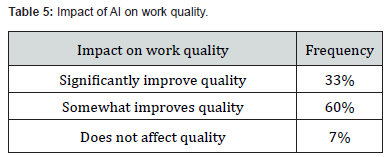
There are possibly many motivations why students want to use AI tools and the most important ones are “to save time”, and “to improve the quality of their work”. Table 4 presents the corresponding percentages. Since the survey was taken at the beginning of the semester, before students really got into the crunch of the semester’s demands, they try to anticipate how AI tools will be used. When asked about the impact of AI tools on the quality of their work, we find in Table 5 that 93% of respondents think that AI tools will improve the quality of their work. Of those, 33% believe that the quality can improve significantly. Only 7% think it will not have any impact. However, even though almost all students believe that AI tools will improve the quality of their work, they face some challenges or worries as presented on Table 6.
The main source of concern is the possible unreliable or inaccurate solutions provided by some AI tools. It is sometimes very difficult for students to assess the accuracy of the answers provided. Because the major goal as was presented in Table 4 is to save time, they might use the AI responses without spending the necessary time to check them. The ethical concern about the originality of their work is shared by 51% of respondents who are worried of being accused of plagiarism when using AI generated text as their own. In general, universities are not properly prepared to deal with artificial intelligence in their code of conduct. There is also a concern about the lack of transparency in AI-generated suggestions, which makes it sometimes impossible to reproduce. This concern is shared by 30% of respondents. Privacy issues and lack of confidence in free version of AI tools are concerns shared by 28% of students. A group of respondents (26%) start to realize that even though they may get the solution to a difficult problem, it does not always improve their understanding and this could hurt them in the long run.

When asked if AI tools help develop some Higher-learning and Team-building skills as defined in Thomas & Morin, 2012, we find in Table 7 the average score, where 1 stands for “Not at all”, 2 for “Moderate” and 3 for “A lot”.

Table 7 reveals that respondents believe that their research skills can be enhanced the most by AI tools at the level 2.47. There is a moderate effect on Problem solving skill and Creativity at 2.02 and 2.09 respectively. Unfortunately, the perceived impact on Critical thinking skills development is below moderate at 1.67. As to be expected, none of the Team-building skills seem to be improved with the use of AI tools. This should worry universities who want to graduate well rounded individuals mastering the academic content but also their Critical Thinking and Problemsolving skills. Team-building skills are also very important and not enhanced by the regular use of generative AI tools.
Conclusion
This study provides an early snapshot of how newly admitted MBA students perceive and intend to integrate digital communication tools and artificial intelligence into their academic practices. The results illustrate that students enter the program already relying extensively on a mix of traditional and contemporary communication platforms, with email and WhatsApp emerging as equally dominant channels. Although digital communication is clearly embedded in their workflow, the continuing importance of in-person interaction highlights that face-to-face collaboration remains a valued component of professional graduate learning.
AI usage, however, represents the most striking pattern in the findings. Nearly all respondents reported using ChatGPT, underscoring the rapid normalization of generative AI within academic environments. Students anticipate leveraging AI primarily for writing-related tasks—such as summarizing, structuring, brainstorming, and proofreading—with the majority expecting it to improve the quality of their work. Their motivations reflect both pragmatic and performance-oriented goals: saving time, enhancing output, and verifying answers. Yet these perceived benefits are accompanied by meaningful concerns. Issues related to accuracy, originality, transparency, and privacy demonstrate that students are aware of the limitations and risks associated with AI-generated content. The recognition that AI may not always support deeper understanding also suggests emerging tensions between efficiency and learning integrity.
Importantly, students do not view AI as a strong contributor to higher-order cognitive development or team-based competencies, aside from modest gains in research, creativity, and problem solving. This distinction underscores that while AI tools may accelerate certain academic tasks, they are not perceived as substitutes for the complex human skills that MBA programs aim to cultivate.
Overall, the findings highlight a cohort entering the MBA program with a clear intention to integrate AI into their academic routines, albeit with caution and uncertainty. As AI becomes further embedded in business education, institutions will need to develop clearer policies, pedagogical strategies, and support systems to help students use these tools responsibly, critically, and effectively. Capturing students’ perspectives at the outset of their studies not only reveals their initial assumptions but also provides a baseline for understanding how their practices and expectations may evolve over time.
References
- Bullen M, Morgan T, & Qayyum A (2011) Digital learners in higher education: Generation myth or reality? Canadian Journal of Learning and Technology 37(1): 1-24.
- Davis FD (1989) Perceived usefulness, perceived ease of use, and user acceptance of information technology. MIS Quarterly, 13(3): 319-340.
- Hrastinski S (2008) What is online learner participation? A literature review. Computers & Education 51(4): 1755-1765.
- Deng L, Tavares NJ (2013) From Moodle to Facebook: Exploring students’ motivation and experiences in online communities. Computers & Education 68: 167-176.
- Junco R (2012) The relationship between frequency of Facebook use, participation, and student engagement. Computers & Education 58(1): 162-171.
- Rambe P, Bere A (2013) Using mobile instant messaging to leverage learner participation and transform pedagogy at a South African university. British Journal of Educational Technology 44(4): 544-561.
- Morin D (2025) The impact of AI in higher education and the consequences for the leaders of tomorrow. In Artificial Intelligence and Care of our Common Home: a Focus on Industries, Finance, Education and Communication. Milan: Vita e Pensiero, pp. 265-283.
- Nkambou R, Bourdeau J, & Mizoguchi R (Eds.). (2010) Advances in intelligent tutoring systems. Springer.
- Krause S, Panchal BH, & Ubhe N (2024) The evolution of learning: Assessing the transformative impact of generative AI on higher education. arXiv.
- McDonald N, Johri A, & Ali A (2024) Generative artificial intelligence in higher education: Evidence from an analysis of institutional policies and guidelines. arXiv.
- Morin D & Hosseinipour A (2025) a. Autonomous adoption of AI tools by undergraduate students: An exploratory study. International Journal of Learning and Teaching. pp. 2377-2905.
- Morin D & Hosseinipour A (2025) b. The unseen force in education: How generative AI is reshaping learning in post graduate programs. INTED2025 Proceedings, pp. 6393-6398.
- Kasneci E, Sessler K, Küchemann S, Bannert M, Dementieva D, et al. (2023) ChatGPT for good? On opportunities and challenges of large language models for education. Learning and Individual Differences 103: 102274.
- Zawacki-Richter O, Marín VI, Bond M, & Gouverneur F (2019) Systematic review of research on artificial intelligence applications in higher education. International Journal of Educational Technology in Higher Education 16: 39.
- Susnjak T (2022) ChatGPT: The End of Online Exam Integrity?
- Thomas JDE and Morin D (2012) The ART (activities, resources, technological supports) in on-site and online learning, and students’ perceptions of acquisition of thinking and team-building skills. In: Dr. Jin Q, (ed.), Intelligent Learning Systems and Advancements in Computer-Aided Instruction: Emerging Studies, IGI Global Publishing, PA., p. 287-304.

























