




 ASM Home



Abstract
Globalization and digital industrial revolution have brought structural change of stakeholders. Some stakeholders who achieve advantageous benefits from innovation of digital technologies have grown greatly. However, other stakeholders take only part of benefits from innovation of digital technologies. This revolutionary change of economies and societies has raised the scale of stakeholders and brought unbalanced growth of stakeholders. The unbalanced growth of stakeholders has raised social requests for corporations beyond market transactions. This article demonstrates that a sustainable scheme of communities appropriately solves the problems brought by structural disparity of stakeholders. This article also develops social welfare investigation to coordinate reform of legislative initiatives and improvement of investment contributions. The digital industrial revolution possibly raises disparity in communities. The revolutionary change of economies and societies has enhanced the importance of sustainable governance to mitigate social problems of disparity. This article demonstrates that the sustainable scheme reduces social losses derived from disparity of communities. In particular, this sustainable scheme is proved to improve welfare of every stakeholder including the disadvantageous stakeholders regarding innovations of digital technologies.
Keywords:Digital Industrial Revolution; Disparity Problems; Multi-Stakeholder; Legislative Initiatives for Social Welfare Losses: Payment Initiatives
Introduction
In the neoclassical theory of economics the fundamental theorems of welfare economics confide that perfect competition of market mechanism brings efficient distribution of resources for societies. Hindman [1] and Paus [2] argue that digital industrial revolutions could not bring optimistic situations in social systems. Institutional investigations such as Coase [3] , Ostrom [4], and Williamson [5,6] explore initiatives to complement failures of traditional market mechanisms. Tanaka [7,8] argues that sustainable governance in region needs the initiatives which participants in communities are expected to contribute their responsibility appropriately. Arow [9] and Tirole [10] explore that theoretical analyses of economics are applicable for investigation of Corporate Social Responsibility (CSR). Tanaka [11] presents the theoretical model which investigates sustainable community governance with multi-stakeholder by developing CSR research.
Evolution of communication technologies triggers sustainable governance involving multi-stakeholders. Sustainable initiatives for communities should not only grow the scale of communities but also solve increasing social needs to proceed with evolutional changes of social structure. Corporation needs to construct cooperative schemes with many stakeholders to achieve sustainability. Decentralized communities seek to construct sustainable cooperation in diversified societies. Theoretical analyses of multi-stakeholder represented by Tanaka [12] explore sustainable social framework for proceeding globalization and innovation of digital technologies. Corporations seek to achieve social needs to create sustainable relationships with enlarging participants including global and virtual communities. Main results which this article obtains are summarized as follows. First, rising evolution of digital technologies remarkably grows the stakeholders who improve digital technologies in daily market transactions and social communications.
Secondly, legislative and regulatory initiatives are effective to mitigate unbalanced social welfare losses derived from the structure change of stakeholders and improve cooperation with many stakeholders. Thirdly, corporations provide payments for stakeholders by considering altruistic and risk coefficients of stakeholder types. The incentives to change the two coefficients are possible to improve sustainability of communities. The organization of this article is described as follows. Section 2 presents a theoretical framework of sustainable governance with three types of stakeholders which are distinguished into inside, outside and external stakeholders. Section 3 exhibits social welfare analyses of digital industrial revolution and sustainable initiatives. While innovations of digital technologies grow outside stakeholders remarkably, disparity problems are proved to raise social welfare losses. Legislative and regulative initiatives reduce rising social welfare losses derived from the unbalanced growth of stakeholders. Section 4 concludes that sustainable scheme integrating multi-stakeholders theoretically explores optimal coordination between innovative investments of digital technologies and legislative initiatives to mitigate disparity problems.
Digital Industrial Revolutions and Sustainable Scheme of Global Communities
In the recent several decades rising innovations of digital technologies have fundamentally changed social and economic structures of global communities. Tanaka [12,13] describes that evolutional development in intelligence and communication technologies has led corporations to communicate with increasing stakeholders. In exploration of global finance Pástor et al. [14] supposes that corporations have communicated not only with domestic markets and residents but also directly with foreign stakeholders such as consumers, governments, financial funds, and environment organizations. Corporations are responsible for contributing to the sustainability of global societies. Environment, Society and Governance (ESG) investments and green finance are promoted by strategies presented by the Global Sustainable Investment Alliance (GSIA) [15,16]. An empirical study has indicated that ESG strategies are expected to move investments toward more sustainable Objectives; Sciarelli et al. [17]. Cassiers et al. [18] and Choudrie et al. [19] discuss that social inclusion to improve equal participation of all stakeholders aims to attain sustainable scheme of governance. The scheme in which corporations promote cooperation with multi-stakeholder is expected to improve sustainable finance.
While evolutional changes of communication have economically enhanced a part of stakeholders to involve in digital technologies, other stakeholders leave without any benefits from uprising digital economies. Many stakeholders raise digital investments to take beneficial network effects of global transactions. But the other stakeholders exhibiting inefficient synergy in global economies cannot invest enough to obtain digital benefits. Because the digital industrial revolution brings different incentives for stakeholders to invest in innovative technologies, development of digitalization brings disparity problems in societies as global market and government failures. An appropriate sustainable scheme seeks to mitigate market and governmental failures in global societies. This article explores the mechanism in which sustainable payment for every stakeholder improves global social welfare.
This article theoretically explores how the sustainable scheme of communities in globalized economies integrates the synergy effect derived from digital industrial revolution. Enhancement of digital technologies promotes global and digital transactions of productions and services but takes different benefits among stakeholders beyond evaluation of economic transactions. When social benefits are concentratedly distributed on only a part of stakeholders, global markets and government failures occur to raise social risks for sustainable communities. Development of global economies requires reconstruction of sustainable schemes to prevent and mitigate social risks in global communities. For example, enlarging global economies have accompanied increasing population of immigrant to derive significant social problems. Payment initiatives for related stakeholders are expected to compliment social welfare losses brought by innovative investments of productions. By using a mathematical model of corporations and stakeholders in economic and social systems, this article theoretically explores payment initiatives to improve sustainability in global communities.
Corporations represent for-profit as well as non-profit organizations.
Both organizations are supposed to perform cooperation
with various stakeholders in markets and social activities for
sustainability of communities. Corporations use social production
x and payment  for stakeholder i<. in sustainable scheme of
governance. Payment presents many means of transactions. ti in
market transactions indicates compensation for stakeholder i .
When stakeholders are agents of governments or residents, the
payment indicates spendings such as tax and subsidies to improve
problems of disparity. When total number of stakeholders is defined
by n , the total amount of payment is denoted by
for stakeholder i<. in sustainable scheme of
governance. Payment presents many means of transactions. ti in
market transactions indicates compensation for stakeholder i .
When stakeholders are agents of governments or residents, the
payment indicates spendings such as tax and subsidies to improve
problems of disparity. When total number of stakeholders is defined
by n , the total amount of payment is denoted by  .
To achieve sustainable communities corporation calculate social
achievements not only by private profit but also by social evaluation
by many stakeholders. Social evaluation of corporation
is defined by total evaluation of stakeholders. It is assumed that
stakeholder i strictly denotes social evaluation by
.
To achieve sustainable communities corporation calculate social
achievements not only by private profit but also by social evaluation
by many stakeholders. Social evaluation of corporation
is defined by total evaluation of stakeholders. It is assumed that
stakeholder i strictly denotes social evaluation by  Becker
[20,21] explores that two types of interest group influence political
decision. Tanaka [22] applies this political theory of interest
groups for sustainable scheme of corporations. All stakeholders
are divided into positive and negative stakeholders. Positive stakeholders
indicate that social evaluation of the corporation rises as
production of corporations enhances and are assumed to obtain
inequality
Becker
[20,21] explores that two types of interest group influence political
decision. Tanaka [22] applies this political theory of interest
groups for sustainable scheme of corporations. All stakeholders
are divided into positive and negative stakeholders. Positive stakeholders
indicate that social evaluation of the corporation rises as
production of corporations enhances and are assumed to obtain
inequality  Employees, regular consumers and business
partners in supply chains represent well-known examples of positive
stakeholders. Negative stakeholder i exhibits a declining
evaluation of the corporation regarding productions. It is defined
to take inequality ∂Vi/∂x< 0.
Social evaluation with ti is supposed to
be increasing function regarding payment . ti.It is mathematically
written by
Employees, regular consumers and business
partners in supply chains represent well-known examples of positive
stakeholders. Negative stakeholder i exhibits a declining
evaluation of the corporation regarding productions. It is defined
to take inequality ∂Vi/∂x< 0.
Social evaluation with ti is supposed to
be increasing function regarding payment . ti.It is mathematically
written by  Tanaka [23] argues that globalization and digitalization
enhance analytical usefulness of multi-stakeholder theory
for social sustainable scheme. Inside stakeholder i(=1, .... , n0)
belongs to positive stakeholders. Inside stakeholders are represented
by major stakeholders, regular customers, and regular
employees. Negative stakeholders are divided into outside and
external stakeholders. Outside stakeholder i(= n0 + 1, .... , n1) has
market or financial transactions with corporations but external
stakeholder i(= n1 + 1, .... , n ) does not obtain any market transactions.
Part-time employees and irregular purchasers are examples
of outside stakeholders. Some independent non-profit organizations
suffered from environmental problems by Corporations and
appear as external stakeholders. Tanaka [13] explores that structural
changes of stakeholders brought by digital industrial revolution
decline global social welfare losses.
Tanaka [23] argues that globalization and digitalization
enhance analytical usefulness of multi-stakeholder theory
for social sustainable scheme. Inside stakeholder i(=1, .... , n0)
belongs to positive stakeholders. Inside stakeholders are represented
by major stakeholders, regular customers, and regular
employees. Negative stakeholders are divided into outside and
external stakeholders. Outside stakeholder i(= n0 + 1, .... , n1) has
market or financial transactions with corporations but external
stakeholder i(= n1 + 1, .... , n ) does not obtain any market transactions.
Part-time employees and irregular purchasers are examples
of outside stakeholders. Some independent non-profit organizations
suffered from environmental problems by Corporations and
appear as external stakeholders. Tanaka [13] explores that structural
changes of stakeholders brought by digital industrial revolution
decline global social welfare losses.
This article assumes that sustainable social scheme provides
appropriate communication methods to each type of stakeholder.
In daily or repeated transactions with corporation, efficient
communication is available for inside stakeholders. Corporation
improves altruistic propensity with inside stakeholders β ( x) as
production x rises. It is expressed exactly that 1 > β ( x) > 0 and
β ' ( x) > 0 hold. Innovation of digital technologies displaces online
methods into traditional communication for all three types
of stakeholder. Stakeholder i (= 1, .... , n) is supposed to contribute
investment i y voluntarily for development of digital technology.
This assumption of independent contribution on innovational
investment is presented by equation  Corporations
provide investment y0 . Although total investment y which
is exhibited by
Corporations
provide investment y0 . Although total investment y which
is exhibited by  enhances efficiency of communication
scheme between corporation and all stakeholders, innovation
of digital technologies is assumed remarkably to raise efficiency
of communication γ ( y) for corporation toward outside and external
stakeholders. Efficiency function γ ( y) holds conditions,
1 > γ ( y) > 0 and γ ' ( y) > 0. From experimental insights, corporations
communicate information intimately in descending order of with
inside, outside and external stakeholders. The efficient communication
among stakeholders is explicitly defined by inequality,
β (x) > γ ( y) > 0, for any x and y. Considering that all stakeholders
share the communication scheme, Tanaka [24] explores cooperatives
investment on innovation for digital technologies.
enhances efficiency of communication
scheme between corporation and all stakeholders, innovation
of digital technologies is assumed remarkably to raise efficiency
of communication γ ( y) for corporation toward outside and external
stakeholders. Efficiency function γ ( y) holds conditions,
1 > γ ( y) > 0 and γ ' ( y) > 0. From experimental insights, corporations
communicate information intimately in descending order of with
inside, outside and external stakeholders. The efficient communication
among stakeholders is explicitly defined by inequality,
β (x) > γ ( y) > 0, for any x and y. Considering that all stakeholders
share the communication scheme, Tanaka [24] explores cooperatives
investment on innovation for digital technologies.
All stakeholders can use legislative or regulative initiatives to communicate with corporations. Social contacts and regulations sometimes bring duties or social penalties. Stakeholder i indicates standard or code αi > 0. When αi ≥ Vi (x , ti ) holds, ϕi (αi −Vi (x , ti )) presents social cost for corporation. The cost function is supposed to bring as similar features as common cost functions exhibited by ϕ′i >0, ϕ′′> i 0.
Two Step Method on Sustainable Initiatives for Digital Investments
Tanaka [24] provides a theoretical framework to explore transformation of communities by evolving digital technologies. Equation (1) presents social net benefits that corporations attempt to maximize with cooperation of stakeholders.

This article explores how payments,t1, ...,tn,improve social welfare by keeping balance with enhancing digital investments y . Differentiation of Equation (1) regarding payments exhibits optimal conditions (2) –(4) for three types of stakeholders.


Comparative investigation of Equations (2)-(4) indicates different payment initiatives for three types of stakeholders. Development in digital technologies brings different effects on three types of stakeholders. Digital investments raise the efficiency of communication facilities in outside stakeholders more than in other stakeholders. Without any risk management of sustainable social scheme, remarkable growth of communication efficiency in outside stakeholders enhances their payments by the largest scale among all stakeholders. The three equations indicate that the sustainable scheme is featured by altruistic coefficients β ( x) ,γ ( y) and risk coefficients dϕi/d(αi−Vi ) . The inequality assumed in the previous section , β ( x) > γ ( y) > 0, brings descending order of (4), (3) and (2). Figure 1 illustrates how the sustainable scheme should improve payment initiatives to mitigate disparity of societies brought by uprising investments in digital technologies. Curve AM depicts marginal evaluation of payments,payments,∂Vi/∂ti in the left side of Equations (2)-(4). The right sides of Equation (2) , (3), (4) indicate marginal social cost of inside, outside and external stakeholders and are depicted by curves HL, EG, and BD.
Equations (2)- (4) indicate effective initiatives to mitigate
social welfare losses derived from disparity issues. Figure 1 illustrates
how payments and investments for digital technologies
make effects on disparity problems. Rising investment for digital
technologies increases γ ( y) and moves downwardly marginal cost
curve EG of outside stakeholders presented by Equation (3). We
explore the sustainable scheme in the two steps. The first step
illustrates the effects of digital investments. The second step depicts
the effects which are derived by payment initiatives of sustainable
scheme. In the first step, intersection point F which exhibits
equilibrium of (3) moves downwardly to point G” on curve AM.
Consequently, enhancing digital technology investment moves
curve EG to E”G” and raises payment  for outside stakeholders
to
for outside stakeholders
to  Without any payment initiative for sustainability, intersection
points for inside and external stakeholders remain as points
C and K. Rising investment on digital technologies increases social
surplus presented by area of trapezoid EE’G”F brought by outside
stakeholders. AS the enhancement of social welfare is estimated to
benefit only outside stakeholders, the digital industry revolution
is expected to cause serious social problems of disparity.
Without any payment initiative for sustainability, intersection
points for inside and external stakeholders remain as points
C and K. Rising investment on digital technologies increases social
surplus presented by area of trapezoid EE’G”F brought by outside
stakeholders. AS the enhancement of social welfare is estimated to
benefit only outside stakeholders, the digital industry revolution
is expected to cause serious social problems of disparity.
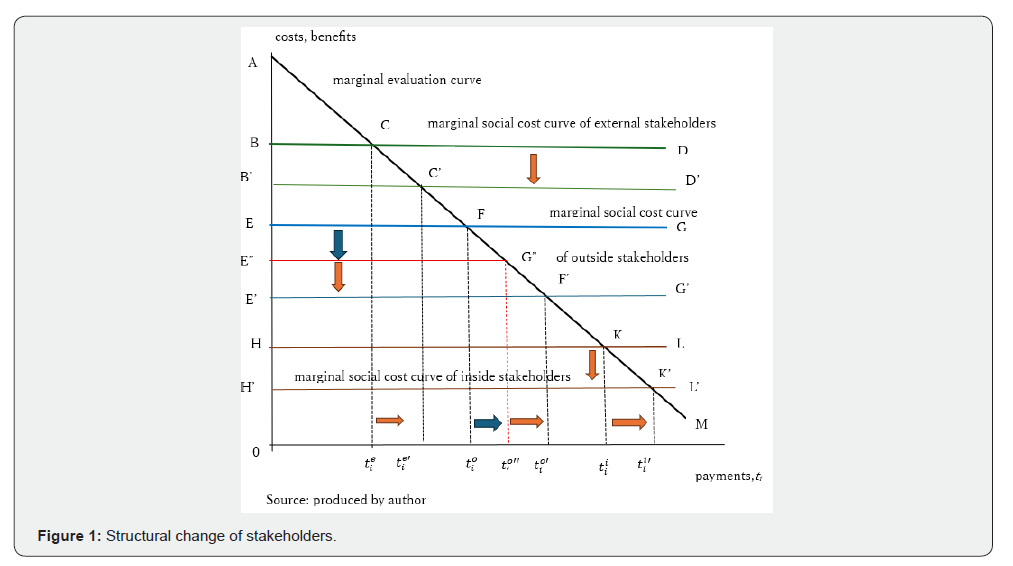
The second step of payment initiatives is effective to prevent communities from diversifying seriously. As enhancing relative influence of outside stakeholders is expected to accelerate disparity of communities, initiatives to improve social benefits of inside and external stakeholders raise importance in sustainable scheme.
Development of digital technologies brings structural change
of stakeholders. This structural change brings uneven influences
on stakeholders. Initiative for every stakeholder needs to improve
evaluated social welfare losses. Equations (2) – (4) make
clear that legislative initiatives and regulations support every
stakeholder to improve social welfare. Standard or code regarding
evaluation of Stakeholder  is effective to reform
problems of disparity. When αi
is raised to α′i , inequality
ϕi ( αi−Vi (x , ti )) <ϕi (α′−Vi (x , ti )) is obtained.
is effective to reform
problems of disparity. When αi
is raised to α′i , inequality
ϕi ( αi−Vi (x , ti )) <ϕi (α′−Vi (x , ti )) is obtained.
Three marginal cost curves BD, EG, and HL possibly move to
B’D’, E’G’, and H’L’ downwardly. In this reform of legislations and
regulations, intersection points C,F, and K changing into points
C’,F’, K’ and payments  for three stakeholders indicate increasing
to
for three stakeholders indicate increasing
to  . Figure 1 distinctly depicts effects of digital
investments and payment initiatives by the blue- and orange-colored
arrows. Rising digital investments lowers marginal social
cost curve of outside stakeholders transfers curve EG to curve
E”G”, surplus of outside stakeholders increases area of trapezoid
EE”F”F. While digital industrial revolution enlarges outside stakeholders
by improving payment system, inside and external stakeholders
fail to receive any appropriate benefits of this revolution.
. Figure 1 distinctly depicts effects of digital
investments and payment initiatives by the blue- and orange-colored
arrows. Rising digital investments lowers marginal social
cost curve of outside stakeholders transfers curve EG to curve
E”G”, surplus of outside stakeholders increases area of trapezoid
EE”F”F. While digital industrial revolution enlarges outside stakeholders
by improving payment system, inside and external stakeholders
fail to receive any appropriate benefits of this revolution.
The previous exploration adds a guiding principle to sustainable scheme. Improving legislative and regulative initiatives enhance social benefits depicted by area of trapezoids, BB’C’C, E”E’F’G”, and HH’K’K for external, outside, and inside stakeholders. Social welfare analysis regarding multi-stakeholder explores causal nexus between digital industrial revolution and disparity problems. While digital industrial revolution has brought advantageous benefits for outside stakeholders to develop in global communities, serious disparity among stakeholders means significant importance of legislative and regulative initiatives for sustainability.
Concluding Remarks
Innovation of digital industrial technologies has reformed social communication scheme. As development of digital communication requires all stakeholders to participate in digital transactions, stakeholders provide various contributions to improve communication according to their digital environments. However, all stakeholders are not equally assured of having access to digital facilities. By reform of communication structure Figure 1 exhibits that outside stakeholders increase social welfare or surplus greater than inside and external stakeholders. Differentiated surpluses among stakeholders indicate unbalanced growth of stakeholders. This article explores that social sustainable scheme presents effective initiatives to mitigate social welfare losses brought by digital industrial revolutions. Evolution of digital technologies improves cooperative contributions of corporations and stakeholders by rising social benefits. Innovation of digital technologies provides synergy effects between corporations and outside stakeholders. However, inside and external stakeholders sometimes could not take enough digital benefits without complemental payments funded by sustainable initiatives. Disparity problems brought by digital industrial revolution are presented by increasing gapes of social welfare losses among stakeholders. The Equations (2) - (4) prove that enhancement of legislative initiatives improve global market and government failures. The legislative initiatives target to raise welfare surplus of all stakeholders. The sustainable scheme in which all stakeholders could participate is possible to lower social losses by evaluating payments appropriately.
References
- Hindman M (2018) The Internet Trap: How the Digital Economy Builds Monopolies and Undermines Democracy. Princeton University Press, Princeton, USA.
- Paus E ed. (2018) Confronting Dystopia: The New Technological Revolution and the Future of Work. Cornel University Press, New York, USA.
- Coase RH (1937) The Characteristics of the Firm. Economica 4(16): 386-405.
- Ostrom E (1990) Governing the Commons: the Evolution of Institutions for Collective Action. New York, Cambridge University Press.
- Williamson OE (1975) Markets and Hierarchies: Analysis and Antitrust Implication. The Free Press.
- Williamson OE (1986) Economic Organization: Firms, Markets and Policy Control. Wheatsheaf Books, Brighton, UK
- Tanaka H (2018) Mechanism of Sustainability and Structure of Stakeholders in Regions. Financial Forum 7(1): 1-
- Tanaka H (2019) Rehabilitation of the Decentralization in the Centralizing Process of Global Communities. Journal of Global Issues and Solutions 19(3).
- Arrow KJ (1973) Social Responsibility and Economic Efficiency. Public Policy 21: 303-317.
- Tirole J (2001). Corporate Governance. Econometrica 69(1): 1-35.
- Tanaka H (2017) Sustainability of Global Communities and Regional Risk Governance. Asia Pacific Journal of Regional Science 1: 639-653.
- Tanaka H(2019) Innovation on the Digital Economies and Sustainability of the Global Communities. Annals of Social Sciences & Management Studies 4(2): 1-10.
- Tanaka H (2019) Sustainable Governance of Marine Stakeholders. Oceanography & Fisheries Open Access Journal 11(1): 1-
- Pástor Ľ, Stambaugh R F, & Taylor L A (2021) Sustainable investing in equilibrium. Journal of Financial Economics 142(2): 550-571.
- Global Sustainable Investment Alliance (2013) Sustainable Investment Review 2012.
- Global Sustainable Investment Alliance (2021) Global Sustainable Investment Review 2020.
- Sciarelli Mauro, Silvia Cosimato, Giovanni Landi, Francesca Iandolo (2021) Socially responsible investment strategies for the transition towards sustainable development: The importance of integrating and communicating ESG. The TQM Journal 33(7): 39-56.
- Cassiers I, Maréchal K, Méda D ed (2018) Post-growth Economics and Society: Exploring the Paths of a Social and Ecological Transition. Routledge, Abingdon, UK.
- Choudrie J, Tsatsou P & Kruria S (2018) Social Inclusion and Usability of ICT–Enable Services. Routledge, Abingdon, UK.
- Becker GS (1983) A Theory of Competition Among Pressure Groups for Political Influence. The Quarterly Journal of Economics 98(3): 371-400.
- Becker GS (1985) Public Policies, Pressure Groups and Dead Weight Costs. Journal of Public Economics 28(3): 329-347.
- Tanaka H (2004) Kigyo no Syakaiteki Sekinin no Keizai Riron (Japanese; Theoretical Analysis for Corporate Social Responsibility). Chikyuu Kankyou Report (Japanese; Global Environmental Policy in Japan) 9: 1-9.
- Tanaka H (2020) Digital Economic and Social Systems to be Featured by Stakeholders. Annals of Social Sciences & Management Studies 5(4): 86-94.
- Tanaka H (2024) Sustainable Investments by Multi Stakeholders to Improve Sustainable Scheme for Medical and Health Services. Scholastic Medical Sciences 2(6): 1-4.

























