




 ARTOAJ Home




Abstract
This article aims to summarize economic studies addressing logging activity in the Amazon. To this end, it cites findings from research on forest management and restoration in the State of Acre, Brazil, covering the period from 1992 to 2025. The results obtained indicate that forest management and restoration activities have proven to be economically viable in this region.
Keywords: Forest Economics; Sustainable Forest Management; Forest Restoration; Amazon
Introduction
Since the 1980s, the government of the State of Acre has sought support from organizations that fund projects focused on the regional forestry sector. In this context, the International Tropical Timber Organization (ITTO) supported five projects in Acre, three of which were submitted by the Technology Foundation of the State of Acre (FUNTAC).
In this context, the State Government of Acre established the Antimary State Forest (FEA)—spanning 76,168 hectares—to serve initially as a site for research activities linked to the ITTO-funded projects, and subsequently as a model area for Sustainable Forest Management (SFM) in the Amazon.
To this end, economic studies were conducted to assess the viability of sustainable forest management (SFM) practices compared to conventional logging in areas slated for land-use conversion. It is worth noting that, in the 1990s, economic analyses of SFM were ex-ante assessments, as this forestry activity had not yet been implemented in Acre—a process that only truly began to take hold from the 2000s onwards.
Given this scenario, this article aims to provide a summary of the key findings from economic studies conducted between 1992 and 2025, which utilized data obtained—either directly or indirectly—from the Antimary State Forest.
Discussion
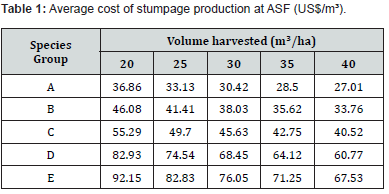
Silva and Braz [1] present, in the Table 1, projected costs of SFM in the ASF, for five cutting volumes and seven interest rates (1% a.a.; 3% a.a.; 5% a.a.; 6% a.a.; 8% a.a.; 10% a.a. and 12% a.a.).
Silva and Braz [1] inform that these costs of logs from SFM were higher than the prices of logs practiced in the Acre market in 1991 (US$ 26.28/m3), when it came from areas deforested for agriculture: the policy in force, in this period, for determining the price of logs considered only the value of stumpage, extraction costs, and freight from the forest to the sawmill.
Using the same harvested volumes adopted by Silva and Braz [1], Silva [2] adds: (a) log transportation, logging, roads, silvicultural treatments, and forest inventory account for 34.75%, 20.86%, 15.26%, 7.03%, and 2.62%, respectively, of the cost of the SFM, on average and (b) SFM practices in Rio Branco in 1991 would increase the lumber production cost calculated at interest rate of 6%, 8%, 10% e 12% a.a., by approximately 19%, which this increase would be passed on to the end consumer (Therefore, this author suggests that this consumer must be aware of the need for forest sustainable use, which even at a high cost but will prevent future scarcity of this resource).
Silva [3] indicates that the average lumber production cost at a sawmill with its current industrial log utilization efficiency (50%) was US$ 196.44, where the average log cost (exploited at rates of 20 m³/ha, 25 m³/ha, 30 m³/ha, 35 m³/ha, or 40 m³/ha, under SFM) was US$ 118.00 per cubic meter of lumber. However, if this efficiency changes to 55% or 60%, the industrial cost would be US$ 185.49 (where the cost of log would be US$ 107.87) or US$ 176.50 (with the log cost being US$ 98.87) per cubic meter of lumber, respectively. Note that the lumber industrial cost in Acre in 1994, for a sawmill using logs originating from deforested areas, was US$ 191.61/m³, while the average lumber market price was US$ 275.86/m³.
Silva, Hoeflich, and Graça [4] used linear programming concepts to address the multiple-use forest management to be implemented in the Antimary State Forest. The results indicated a maximum income of US$ 1,881.64/year. At this value, a 20-year cutting cycle would generate an income of US$ 444.63, occurring in June, July, August, September, and October, managing an area of 5.24 ha. The extractive activity of Brazil nuts, in turn, would generate an income of US$ 1,436.74, operating in January, February, March, and April, and harvesting in 300 ha. It should be noted that a forest management system with a 15-year cutting cycle and latex collection proved unfeasible and were excluded from this analysis.
In the early 2000s, the Brazilian government began implementing the process of forest concessions in public areas in the Amazon. The government of the State of Acre, in turn, was the first to make areas available (the Antimary State Forest), through public bidding, for forest exploitation by private companies, initially in the form of the sale of stumpage and, later, through forest concessions.
In this context, Silva [5] presents new concepts to economically quantify log production in areas of SFM in the ASF using an assumption, summarized in the expression:
Pmm = SPm + Cmf
Where: Pmm = minimum price for stumpage at ASF (US$/m3); SPm = average local price of stumpage from conversion areas (US$/m3); Cmf = cost of production of SFM to be developed at ASF (US$/m3).
This concept was adopted to calculate the cost of SFM in the first calls for bids for forest concessions in the ASF, as well as providing the theoretical basis for the subsequent economic studies presented below.
Silva [5] synthesizes , in Table 2, the composition of the minimum price for the bidding process for the ASF's timber stock.
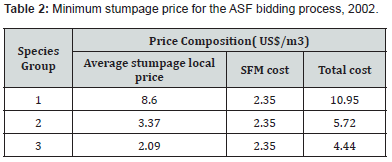
Silva [5] comments that the production cost for SFM (US$ 2.35/m3) is similar to the value charged by Brazilian Institute of Environment and Renewable Natural Resources (IBAMAC) (US$ 2.15/m3), as the replacement fee (for each cubic meter of processed log, the firm should plant six seedlings of forest species or pay IBAMA this amount due for this reforestation activity) when it comes from a conversion area.
Silva and Santos [6], using data from the Antimary State Forest, identified the costs of SFM as considering or not the land factor, were US$ 365.13/ha and US$ 29.50/m3 .or US$ 109.84/ha and US$ 8.86/m3, respectively. It indicates the land increase 217.52% the value of SFM.
Machado, Silva and Oliveira [7] considering forest-sawmill distance of 50 and 100 kilometers, inform that, in Acre, in 2014, the average cost of sawn hardwood and softwood were R$ 344.64/m3 (where the log cost accounted for US$ 178.50/m3) and R$ 279.14/m3 (where the log cost was US$ 102.00/m3). In this period, the local market prices, FOB sawmill, of sawn hardwood and softwood were R$ 1,300.00/m3 and R$ 600.00/m3, respectively.
Silvestre and Silva [8] mention that all sawmills in Rio Branco, in 2016, processed logs originating from the SFM, following sustainability criteria. According to their owners, this is one of the advantages of their firms, as the products sold meet the environmental standards in force in the country.
Silva [9] shows, in Table 3, the Land Expectation Value (LEV) for the situation in which the landowner conducts an SFM and sells the stumpage to an extractor or to a logging firm.
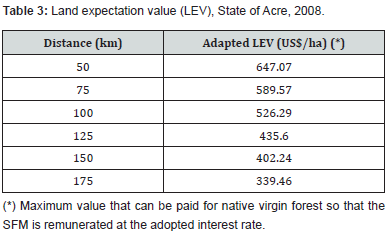
Analyzing these LEVs, Silva [9] points out that, for the average market price of a forest area in Acre (US$ 435.29/ha), it will only be viable to manage the forest and sell its stumpage if this forest must be located at a distance of 125 km or less from the sawmill yards.
Silva [10], considering that the average local timber stock is 12.34 m³/ha, and an average sawmill in Acre consumes 22 m³/day of logs, operates 22 days/month and 12 months/year, projects that this industry processes 5,808 m³ of logs per year or 174,240 m³ over its 30-year cutting cycle and would need an area of 14,119.94 ha to implement its 30-year cutting cycle. On another hand, five sawmills would require an area of 70,599.7 ha for their 30-year cutting cycle, an area slightly larger than that of the ASF.
Felix et al. [11], using the Herfindahl-Hirschman Index, concluded that the log supply by all 14 forests harvested in the Acrean market was highly concentrated in 2018 and 2019 and moderately concentrated in 2020, and that all six local sawmills acting were highly concentrated in the demand for log.
Tanomaru Junior, Vieira and Silva [12], evaluating the proposed ecological restoration for the Antimary State Forest, indicated that the costs for the methods of conducting assisted natural regeneration without enrichment, conducting assisted natural regeneration with enrichment planting, and nucleation were R$ 38,538.60/ha, R$ 20,592.28/ha, and R$ 40,405.48/ha, respectively.
Conclusion
Although the costs of sustainable forest management (SFM) represented the primary obstacle to its implementation in Acre during the 1990s, by the 2010s, all sawmills were profitably processing timber sourced from managed forest areas. In the view of the owners, this procedure distinguished their sawmills from competitors in the market.
Findings regarding the economic radius for sustainable forest management can guide business owners in determining the maximum distance between the forest and their facilities, thereby ensuring the economic viability of SFM. Similarly, such findings can assist the government in establishing a maximum distance for making forests available—through concessions—that ensures the economic viability of SFM.
Identifying the demand for forest areas, as well as the structure of timber supply and demand, is essential for the government to designate areas for forest concessions that meet the needs of the timber sector.
Finally, economic results concerning forest restoration can support the government in drafting calls for proposals (tenders) for the concession of degraded areas intended for forest restoration.
References
- Silva ZAGP da G e, Braz EM (1992) Análise Econômica da Exploração Madeireira em uma Área sob Regime de Manejo para a Produção Florestal Sustentada. Anais of the I Congresso internacional de compensado de madeira tropical 271-286.
- Silva ZAGP da G e (1994) Identification of optimal cutting cycle in forest management and its economic impact on sawmills in the State of Acre. Proceedings of 1994 Symposium on Systems Analysis in Forest Resources The management systems for a lobal forest economy with global resource concerns. 387-400.
- Silva ZAGP da G e (1998) Análisis económico del manejo forestal en el estado de Acre, Brasil. Memoria del Simposio Internacional sobre Posibilidades de Manejo Forestal Sostenible en América Tropical, 344-355.
- Silva ZAGP da G e, Hoeflich VA, Graça LR (2001) Analysis on economic constraints to multiple-use forest management in the Amazon Region. In: Dixon-Gough RW, Mansberger R eds. Transactions in international land management, 2., pp. 117-131. Ashgate Publishing Limited, Aldershot, England.
- Silva ZAGP da G e (2003) Concessão florestal: governo e iniciativa privada interagindo para implementar o manejo florestal sustentável na Amazônia. Paper presented at the III Seminário economia do meio ambiente: regulação estatal e auto-regulação empresarial para o desenvolvimento. UNICAMP, Campinas, Brazil, 13-14 May 2003. (Proceedings not published)
- Silva ZAGP da G e, Santos RA dos (2011) Custo do manejo florestal madeireiro em floresta pública: Estudo de caso no Acre. 2011. Amazônia (Banco da Amazônia) 7: 79-96.
- Machado MPO, Silva ZAGP da G e, Oliveira C (2015) Custo do manejo florestal madeireiro na Amazônia: um estudo de caso no estado do Acre. Simpósio Latino-Americano sobre Manejo Florestal (6): 231-233.
- Silvestre CGP, Silva ZAGP da G. e (2020) Aspectos gerenciais do setor industrial-madeireiro no município de Rio Branco-Acr. Scientia Naturales 2 (2): 600-614.
- Silva ZAGP da G e (2015) Raio econômico como um indicativo para a definição de concessões florestais; um estudo de caso no estado do Acre. In: II Prêmio Serviço Florestal Brasileiro em estudos de economia e mercado florestal: concurso de Monografia sobre o tema: estudos de economia e mercado florestal - coletânea de Monografias premiadas, pp. 205-244. 1. ed. Escola de Administração Fazendária, Brasília, Brazil.
- Silva ZAGP da G e (2022) Economic aspects of the demand for commercial forest land in the state of Acre. Brazil. Forest Policy and Economics 138: 1-8.
- Felix FOMM, Silva ZAGP da G e, Ribas LC, Timofeiczyk Júnior R (2025) Concentration of the Roundwood Market in the Amazon: Case Study in the State of Acre, 2018-20. London Journal of Research in Science: Natural & Formal 25: 45-61.
- Tanomaru Junior R, Vieira G, Silva ZAGP da G e (2023) Áreas alteradas e aspectos econômicos da restauração ecológica sob a ótica do sistema ABC na Floresta Estadual do Antimary. Revista Floresta 53 (1): 10-18.