




 ARTOAJ Home




Abstract
Thirteen soil samples were collected from Ukulinga Research Farm, Pietermaritzburg, South Africa. Entomopathogenic fungi were isolated by baiting the soil samples with waxmoth larvae (Galleria mellonella L). The most abundant pathogenic species were Beauveria bassiana (28 isolates) and Metarhizium anisopliae (4 isolates). Beauveria bassiana was isolated most frequently from larvae baited in soil from maize fields. The 28 B. bassiana strains were evaluated for their virulence on the adults of Sitophilus zeamais, under laboratory conditions. In the first bioassay, strains were applied at a single dose of 2x10⁸ conidia g-1, using kaolin as the carrier. Mortality levels range from 10.0% to 80.0%. The three strains that caused mortality levels >70.0% on S. zeamais were then evaluated in dose response assays on S. zeamais, Ephestia cautella L3 larvae, and Lasioderma serricorne L3 larvae and adults, at doses of 2x10⁵, 2x10⁶, 2x10⁷ and 2x10⁸ conidia g-1. Strain MS-8 consistently caused higher mortality levels on the three insects than other two strains. The same strain achieved the lowest LD50 and LT50 values against the three insects, followed by Strains MS-3 and MS-4. Generally E. cautella L3 larvae was the most susceptible test insect for Strain MS-8, followed by L. serricorne adults, S. zeamais and L. serricorne L3 larvae. The fungal strains MS-3, MS-4 and MS-8 were sequenced, followed by BLAST searches for their identity. Alignments were performed and a Maximum Likelihood tree was developed to infer phylogeny. The Strains MS-3 and MS-4 were identical to each other, but were 99% identical to MS-8. All three sequences had 99% identity with 100% coverage to type material of B. bassiana. A phylogentic analysis of the strain sequences in relation to B. bassiana and several other Beauveria species sequences showed strong bootstrap support (92%) for their membership of the B. bassiana clade.
Keywords: Entomopathogenic Fungus; Beauveria bassiana; Sitophilus zeamais; Lasioderma serricorne; Ephestia cautella
Introduction
The maize weevil, Sitophilus zeamais Motschulsky (Coleoptera: Curculionidae), is an economically important pest of stored grains in tropical regions. Grain infestation by this pest typically begins in the field, but the greatest damage occurs during storage [1,2]. In tropical countries, grain losses ranging from 20% to 90% have been reported as a result of maize weevil infestations [3]. The almond moth, Ephestia cautella Walker (Lepidoptera: Pyralidae), is another major stored-product pest. It occurs in both tropical and temperate regions and attacks grains, nuts, dried fruits, and a wide variety of other stored products [4]. The cigarette beetle, Lasioderma serricorne Fabricius (Coleoptera: Anobiidae), is a cosmopolitan pest distributed throughout tropical and subtropical regions. This insect commonly infests stored food products, including dried fruits, grains, cereal flour, and animal feed [5].
Fumigants and synthetic insecticides are commonly used to prevent insect-related losses during grain storage. However, their use raises concerns regarding insecticide resistance, chemical residues in food products, increasing costs, and environmental pollution [6,7]. Therefore, it is essential to explore alternative control strategies, such as entomopathogenic fungi (EPFs), against stored-product insect pests [8]. Beauveria bassiana (Balsamo) Vuillemin is a promising fungal biocontrol agent due to its generally low toxicity to non-target animals and humans. This fungus occurs naturally in soils worldwide and infects a wide range of insect species, causing white muscardine disease. Several isolates of B. bassiana have been formulated and registered as commercial biopesticides against various insect pests (Feng et al. 1994). However, Batta [9] reported that no commercial EPF products had been registered specifically for the biological control of stored-grain insects.
Considerable genetic variation exists among isolates of B. bassiana. Their pathogenicity and virulence against different arthropods, as well as their enzymatic and molecular characteristics, vary among isolates [10,11]. Selecting highly virulent isolates adapted to local agroecosystem conditions is therefore an important step in developing effective mycoinsecticides [12].
Accurate identification of fungal species can be difficult and, in some cases, impossible based solely on morphological characteristics. Morphological criteria have traditionally been used to identify and classify Beauveria spp. However, distinguishing between Beauveria species remains challenging because of the considerable morphological and genetic variability within the genus [13,14]. Consequently, several molecular techniques have been developed to improve the identification and differentiation of Beauveria isolates [15-18].
Numerous studies have demonstrated the potential of B. bassiana isolates as microbial control agents against stored-product insect pests [19-23]. However, comparative information on the virulence of locally isolated strains across different stored-product pest species and developmental stages remains limited. In particular, evaluating the dose-dependent responses of multiple pest species to selected virulent strains may provide valuable information for identifying promising candidates for fungal biopesticide development. Therefore, the objective of this study was to isolate and identify indigenous entomopathogenic fungi from various soil sources and to evaluate their virulence against S. zeamais adults, E. cautella third-instar larvae, and L. serricorne third-instar larvae and adults.
Material and Methods
Soil samples
Soil samples were collected in the winter season at the beginning of May 2014 at Ukulinga Research Farm, Pietermaritzburg (KwaZulu-Natal Provence) (latitude 29. 67 S, longitude 30.41 E, 809 meters above sea level). Thirteen sampling points ≥ 1 Km apart were selected. The sampling protocol was: (i) the soil surface layer was removed; (ii) at each point five samples were taken in the rhizosphere at a depth of 5-15 cm and 10 -15 m between each sample with a volume of around 500g; these samples were mixed together to form one 2500g composite sample; (iii) the samples were placed in plastic bags and stored in a fridge at 4oC; (iv) the samples were processed within two weeks of collection.
Isolation of fungi
Entomopathogenic fungi were isolated using the bait-trap method with larvae of the wax moth, Galleria mellonella L. (Lepidoptera: Pyralidae) (Zimmermann 1986), which were reared on artificial media according to [24].
Each composite soil sample was sieved through a 0.5 cm mesh to remove roots and other solid materials. For each composite soil sample, three replicates of 200 g were placed into 250 mL glass jars and moistened with distilled water. Five third- or fourth-instar larvae (approximately four weeks after hatching) were introduced into each glass jar using sterile forceps. The jars were then covered with insect netting to facilitate air circulation.
The glass jars were incubated in the dark at 25°C for two weeks. The jars were checked every three days, and dead larvae were removed from the soil and immersed in a 1% sodium hypochlorite solution for 3 min for surface sterilization, followed by rinsing in sterile distilled water for 4 min. The dead larvae were then placed individually in 9 cm Petri dishes containing moist filter paper. The Petri dishes were sealed with Parafilm, incubated at 25°C, and examined every two days until fungal growth was observed. The presence of fungal mycelium on infected wax moth larvae was considered indicative of infection by entomopathogenic fungi. Following sporulation, conidia were collected from the insect surface using a sterile loop and streaked onto potato dextrose agar (PDA) plates containing 0.05 g/L streptomycin and ampicillin. The fungi were identified according to Humber [25].
Insect rearing
The initial insect populations were obtained from the Department of Plant Pathology, School of Agricultural, Earth and Environmental Sciences (SAEES), University of KwaZulu-Natal. S. zeamais and E. cautella were reared on yellow maize grains, while L. serricorne was reared on rice grains. The grains were initially stored at -20°C for one week to eliminate unwanted natural infestations. Approximately ten adults of each insect species, of mixed sexes, were placed in 250 mL glass jars, each containing 100 g of the respective grains. The jars were covered with insect netting to facilitate air circulation and maintained under experimental conditions of 28 ± 2°C and 65 ± 5% relative humidity (RH). The adults were removed from the jars after one week of infestation. Adults of S. zeamais, third-instar (L3) larvae of E. cautella, and both third-instar larvae and adults of L. serricorne were used in the experiments.
First screening bioassay
All 28 Beauveria bassiana strains were used in the initial screening bioassay. Dry conidia of each strain were produced by inoculating Petri dishes containing potato dextrose agar (PDA) with 100 µL of a fungal suspension at a concentration of 10⁸ conidia mL⁻¹, determined using a Neubauer Improved Hemocytometer. The inoculated plates were sealed with Parafilm to maintain adequate moisture and incubated at 25°C in the dark for 15 days. Subsequently, the Parafilm was removed, and the plates were allowed to dry under laminar airflow for five days. Conidia were harvested by gently scraping the surface of the dried culture medium using a sterile scalpel blade. The harvested fungal material was passed twice through a sieve (100 mm in diameter, 110 µm mesh size) to obtain dry conidial powder. The harvested conidia were stored in sterile, sealed bottles at 4°C until further use.
Each strain was formulated using kaolin as a carrier at a concentration of 2 × 10⁸ conidia g⁻¹, determined using a Neubauer Improved Hemocytometer. Thirty adult S. zeamais, less than two days old, were introduced into 250 mL glass jars containing 100 g of maize grain. Three replicates were used for each strain, while the control was treated with kaolin carrier only. Insect mortality was recorded every two days over a period of ten days. Dead insects were examined for fungal outgrowth to confirm that mortality was associated with fungal infection. The experiment was arranged in a randomized complete block design (RCBD).
Multiple screening bioassays
The best three B. bassiana strains that caused mortality levels greater than 70.0% against S. zeamais in the initial screening bioassay were selected for evaluation at different doses in the second bioassay. For each strain, conidia were prepared from an initial stock of 2 × 10⁹ conidia g⁻¹ formulated in kaolin, with the concentration determined using a Neubauer Improved Hemocytometer. The stock formulation was then diluted with kaolin to obtain concentrations of 2 × 10⁸, 2 × 10⁷, 2 × 10⁶, and 2 × 10⁵ conidia g⁻¹. Each dose was replicated three times. The control was treated with the carrier only. For each replicate, 30 adults of S. zeamais, 30 third-instar (L3) larvae of E. cautella, and 30 third-instar larvae and adults of L. serricorne were placed separately into glass jars containing 100 g of rice grain following treatment with the respective formulation. The experiment was arranged as a 3 × 4 × 5 factorial experiment in a randomized complete block design (RCBD).
Identification of fungal strains by sequence analysis
The three best selected B. bassiana strains, MS-3, MS-4, and MS-8, were sent to Inqaba Biotech (South Africa) for bidirectional sequencing of the ITS1 and ITS2 regions. The sequences were examined for quality using FinchTV, and regions of suitable quality were imported into BioEdit [26]. Consensus sequences (approximately 470 bp) were generated and used to perform BLAST searches against type material in the GenBank database for tentative identification. A total of 11 aligned ITS sequences derived from type material of Beauveria/Cordyceps species were downloaded from GenBank. These sequences, together with the consensus sequences of the three strains, were aligned in BioEdit using ClustalW. The aligned sequences were imported into MEGA7 [27]. The most appropriate DNA substitution model for Maximum Likelihood (ML) analysis was determined, and an ML phylogenetic tree was constructed using 1,000 bootstrap replicates.
Statistical analysis
Insect mortality data were corrected relative to the control using Abbott's formula [28]. The corrected mortality data were subjected to analysis of variance (ANOVA). Treatment means were compared using Fisher's least significant difference (LSD) test at a 5% significance level. Probit analysis was performed to estimate the median lethal dose (LD₅₀) and median lethal time (LT₅₀). All statistical analyses were conducted using GenStat for Windows, 17th edition [29].
Results
Soil samples
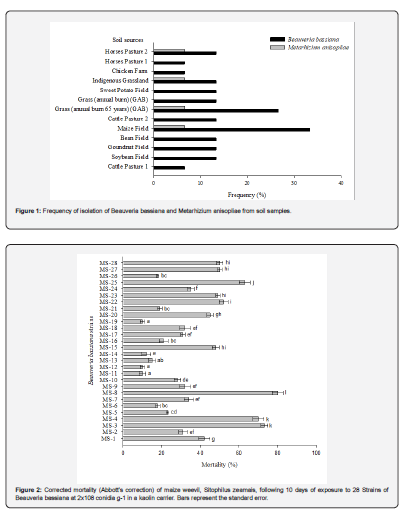
B. bassiana was more frequently isolated than M. anisopliae from the soil samples examined. The highest frequency of B. bassiana isolation was recorded in soil collected from the maize field (33.34%), followed by grassland subjected to annual burning for 65 years (GAB; 26.67%). The lowest isolation frequency (6.67%) was recorded in soil samples collected from Horse Pasture 1, the Chicken Farm, and Cattle Pasture 1 (Figure 1).
First Screening bioassay
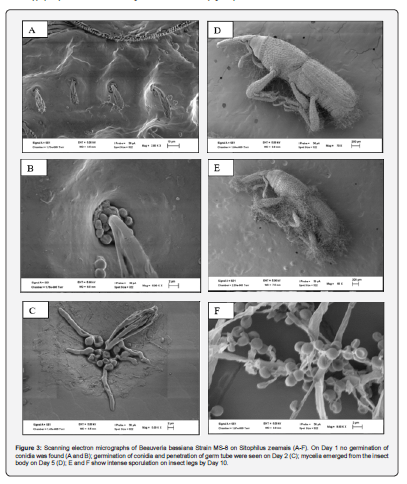
Highly significant differences in pathogenicity against S. zeamais were observed among the 28 tested B. bassiana strains (F = 106.06; P < 0.001).
All tested strains caused mortality in S. zeamais, with mortality levels ranging from 10.0% to 80.0%. Among the 28 strains, three (MS-3, MS-4, and MS-8) caused mortality levels of at least 70.0%, while four strains (MS-22, MS-27, MS-25, and MS-28) caused mortality levels ranging from 50.0% to 63.0%. The remaining 21 strains caused mortality levels below 50.0% (Figure 2).
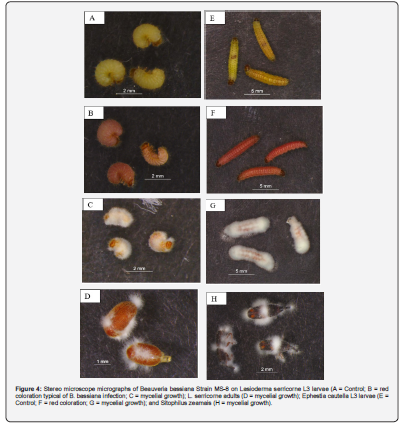
Strain MS-8 caused the highest mortality (80.0%), followed by MS-3 (73.0%) and MS-4 (70.0%) (Figure 2). Scanning electron microscopy (SEM) observations revealed germination of MS-8 conidia and penetration of germ tubes into the cuticle of S. zeamais, followed by fungal outgrowth and sporulation on the insect body (Figure 3).
Multiple Screening bioassays
Highly Significant differences in insect mortality were observed among B. bassiana strains (F(2, 94) = 92.29; P < 0.001), conidial doses (F(3, 94) = 673.76; P < 0.001), and the tested insect groups (F(3, 94) = 88.97; P < 0.001). The interaction between conidial dose and insect group was also significant (F(9, 94) = 4.33; P < 0.001). In contrast, the interactions between strain and dose (F(6, 94) = 1.71; P = 0.128), strain and insect group (F(6, 94) = 1.41; P = 0.217), and strain, dose, and insect group (F(18, 94) = 0.46; P = 0.969) were not significant.
The entomopathogenic activity of Beauveria bassiana strain MS-8 was evidenced by the emergence of fungal mycelia from the bodies of dead insect. Approximately five days after death, mycelial growth was observed emerging from the intersegmental regions and subsequently spreading over the insect body. Third-instar larvae of L. serricorne and E. cautella treated with strain MS-8 exhibited reddish discoloration after death (Figure 4).
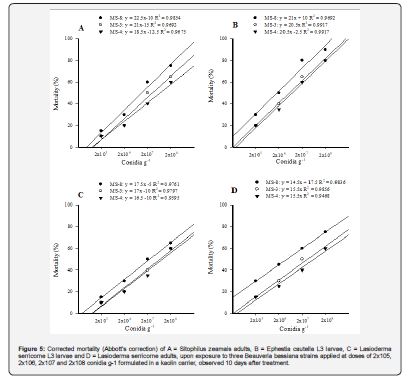
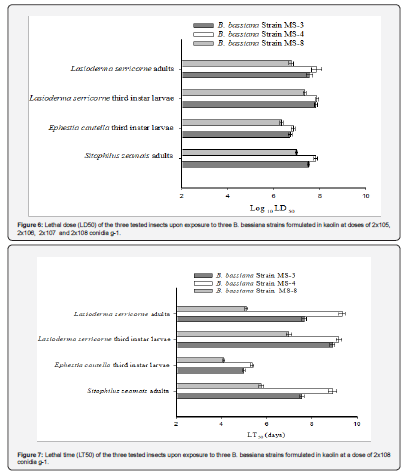
Insect mortality increased with increasing conidial dose across all tested strains and insect groups, with linear dose–response relationships reported (R² > 0.94). Strain MS-8 consistently produced higher mortality than strains MS-3 and MS-4 across the tested doses and insect groups (Figure 5). At the highest dose of 2 × 10⁸ conidia g⁻¹, strain MS-8 caused mortality levels of 90.0%, 76.05%, 75.0%, and 65.0% in third-instar larvae of E. cautella, adults of L. serricorne, adults of S. zeamais, and third-instar larvae of L. serricorne, respectively. Among these insect groups, E. cautella larvae exhibited the highest susceptibility, whereas L. serricorne larvae showed the lowest susceptibility. At lower conidial doses, L. serricorne adults were more susceptible than S. zeamais adults (Figure 5).
Probit analysis was performed separately for each insect group to estimate the median lethal dose (LD₅₀) and median lethal time (LT₅₀). Strain MS-8 consistently exhibited the lowest LD₅₀ and LT₅₀ values, followed by strains MS-3 and MS-4. Across the tested insect groups, the lowest LD₅₀ and LT₅₀ values were reported for E. cautella third-instar larvae, followed by L. serricorne adults, S. zeamais adults and L. serricorne third-instar larvae (Figures 6 and 7).
Identification of fungal strains by sequence analysis
Sequence analysis using BioEdit revealed that B. bassiana strains MS-3 and MS-4 had identical ITS sequences, whereas their sequences shared 99.1% identity with that of strain MS-8. BLAST searches against GenBank revealed sequence identities exceeding 97% with several species within the genus Beauveria. All three strains showed the highest sequence identity (99%) with reference sequences of B. bassiana, although their levels of similarity to other Beauveria species varied (Table 1).
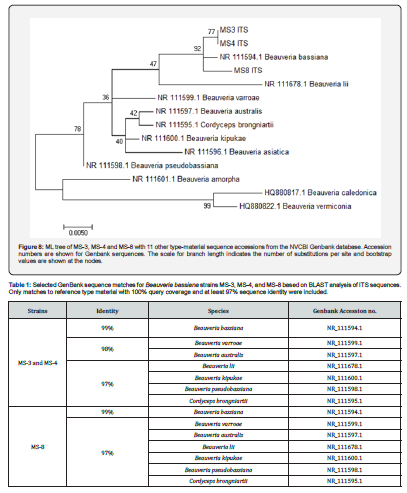
Maximum Likelihood (ML) phylogenetic analysis yielded a tree with a log-likelihood value of −949.1464 (Figure 8). The analysis was performed using the Tamura–Nei substitution model [30] with a discrete gamma distribution comprising five categories to account for variation in evolutionary rates among sites (+G; parameter = 0.0500). The dataset included 14 nucleotide sequences, consisting of the three selected strains and 11 reference sequences retrieved from GenBank. After excluding positions containing gaps or missing data, 452 nucleotide positions were retained for the phylogenetic analysis.
Discussion
The recovery of entomopathogenic fungi from soil samples using G. mellonella larvae as insect baits supports the effectiveness of this method for detecting soil-associated entomopathogenic fungi [31,32]. The suitability of the Galleria-bait method has also been demonstrated in more recent studies involving the isolation of indigenous entomopathogenic fungi from agricultural soils [33,34]. In the present study, B. bassiana was isolated more frequently than M. anisopliae, accounting for more than 80% of the fungal isolates recovered. This finding is consistent with that of Hassan et al. [35], who identified B. bassiana as the predominant entomopathogenic fungus in soil samples collected from selected sites in northern Iraq. Similarly, Asensio et al. [36] reported that B. bassiana was the most frequently isolated entomopathogenic fungus in Alicante Province, Spain, occurring in 32.8% of the soil samples examined. However, differences in the recovery of entomopathogenic fungal species may partly reflect the selectivity of the insect-bait method, particularly the susceptibility of the bait insect to different fungal species.
The virulence of B. bassiana against insect hosts may be influenced by several factors, including host behaviour, developmental stage, nutritional status, and physiological characteristics, as well as variation among fungal strains. Differences in the physiological characteristics of fungal strains and their responses to environmental conditions may also contribute to variation in pathogenicity [37]. In the present study, considerable variation in virulence was observed among the 28 B. bassiana strains evaluated against S. zeamais adults at a dose of 2 × 10⁸ conidia g⁻¹, with mortality ranging from 10.0% to 80.0%. Strains MS-8, MS-3, and MS-4 were the most effective, causing mortality levels of 80.0%, 73.0%, and 70.0%, respectively. These findings are consistent with those of Adane [38], who reported differences in the virulence of B. bassiana strains against S. zeamais, with appreciable mortality observed at conidial concentrations exceeding 1 × 10⁷ conidia mL⁻¹. Similar variation in the efficacy of entomopathogenic fungal isolates has been reported against other stored-product beetles, further emphasizing the importance of selecting highly virulent strains for biological control [39]. Such variation may be associated with differences in fungal infection mechanisms, including the activity of cuticle-degrading enzymes. A study involving Plodia interpunctella larvae reported positive associations between fungal virulence and protease and lipase activities [40]. Furthermore, secondary metabolites produced by B. bassiana may contribute to fungal pathogenesis and interactions with host immune defences [41]. Although these mechanisms were not directly investigated in the present study, they provide plausible explanations for the differences in mortality observed among the tested strains. Overall, the substantial variation in mortality among strains tested under the same experimental conditions highlights the importance of strain-level screening when selecting promising fungal candidates for the biological control of stored-product insect pests.
The dose response bioassays demonstrated that B. bassiana strain MS-8 consistently caused higher mortality than strains MS-3 and MS-4 across the tested conidial doses and insect groups. At the highest dose (2 × 10⁸ conidia g⁻¹), MS-8 caused mortality levels of 90.0%, 76.05%, 75.0%, and 65.0% in third-instar larvae of E. cautella, adults of L. serricorne, adults of S. zeamais, and third-instar larvae of L. serricorne, respectively. Strain MS-8 also exhibited the lowest LD₅₀ and LT₅₀ values, confirming its greater virulence among the three strains evaluated. The highest susceptibility was observed in E. cautella larvae, whereas L. serricorne third-instar larvae were the least susceptible. Kaur et al. [42] reported mortality below 50.0% in Corcyra cephalonica larvae treated with B. bassiana at 2.2 × 10⁸ spores mL⁻¹. In contrast, Zhu et al. [43] reported 100% mortality in second-instar larvae of L. serricorne treated with B. bassiana strain Bb050722 at 1.46 × 10⁸ spores mL⁻¹. Differences between these findings and the present study may reflect variation in fungal strains, insect species or developmental stages, and application methods. In particular, the use of dry conidia formulated with kaolin in the present study, rather than conidial suspensions, may have influenced insect exposure and subsequent mortality.
For adults of S. zeamais and L. serricorne, B. bassiana strain MS-8 exhibited LD₅₀ values of 9 × 10⁶ and 5 × 10⁶ conidia g⁻¹, respectively, with corresponding LT₅₀ values of 5.8 and 5.2 days. Teshome and Tefera [44] reported an LT₅₀ of 4.0 days for S. zeamais treated with B. bassiana strain PPRC-GC at 1 × 10⁸ conidia mL⁻¹. Similarly, Kassa et al. [45]reported an LD₅₀ of 2.04 × 10⁶ conidia mL⁻¹ for S. zeamais exposed to B. bassiana strain PPRC-HH. Although these studies demonstrate the susceptibility of S. zeamais to different B. bassiana strains, direct comparisons of LD₅₀ values are limited by differences in conidial formulation and application units. The present study used dry conidia formulated with kaolin, whereas the cited studies reported concentrations expressed in conidia mL⁻¹. The use of kaolin as a carrier for dry conidia may offer a practical approach for applying B. bassiana to stored grains. However, further investigations are required to determine how this formulation influences conidial viability, distribution within the grain mass, persistence, and insect mortality under different storage conditions.
BLAST analysis indicated that strains MS-3, MS-4, and MS-8 were closely related to B. bassiana, with approximately 99% sequence identity to reference sequences. Strains MS-3 and MS-4 had identical ITS sequences and showed 99.1% identity with MS-8. Nilsson et al. [46] cautioned against relying exclusively on fixed sequence similarity thresholds for fungal identification, while Nilsson et al. [47] highlighted variation in intraspecific ITS divergence among fungi. Phylogenetic analysis further supported the BLAST results by placing all three strains within the B. bassiana clade. Together, these findings support their identification as B. bassiana, although additional molecular markers could provide greater taxonomic resolution.
The effectiveness of B. bassiana against stored-product pests depends not only on strain virulence but also on the formulation used. Meikle et al. [48] reported that an oil-based formulation of B. bassiana reduced populations of the larger grain borer, Prostephanus truncatus, but did not completely prevent grain losses. This finding highlights the importance of selecting highly virulent strains and developing suitable formulations to improve the practical efficacy of fungal biocontrol agents. In the present study, strain MS-8 demonstrated promising potential for further formulation development and evaluation under grain storage conditions.
Conclusion
B. bassiana strain MS-8 emerged as the most promising candidate for the biological control of the tested stored-product pests, exhibiting higher virulence than the other strains evaluated. However, further research is required to optimize mass production, formulation, and storage stability, assess efficacy against a broader range of stored-product pests, and evaluate safety to non-target organisms before its potential development as a commercial mycoinsecticide.
References
- Abebe F, Tefera T, Mugo S, Beyene Y, Vidal S (2009) Resistance of maize varieties to the maize weevil Sitophilus zeamais (Motsch.) (Coleoptera: Curculionidae). African Journal of Biotechnology 8: 5937-5943.
- Bezabih G, Satheesh N, Workneh Fanta S, Wale M, Atlabachew M (2022) Reducing Postharvest Loss of Stored Grains Using Plant-Based Biopesticides: A Review of Past Research Efforts. Adv Agric 2022: 6946916.
- Giga D, Mutemerewa S, Moyo G, Neeley D (1991) Assessment and control of losses caused by insect pests in small farmers' stores in Zimbabwe. Crop Protection 10(4): 287-292.
- Horak M (1994) A review of Cadra Walker in Australia: five new native species and the two introduced pest species (Lepidoptera: Pyralidae: Phycitinae). Australian Journal of Entomology 33(3): 245-262.
- Papadopoulou SC, Buchelos CT (2002) Identification of female adult Lasioderma serricorne (F.) by simple external observation of the abdomen. Journal of Stored Products Research 38: 315-318.
- Pereira C, Pereira E, Cordeiro E, Della Lucia T, Tótola M, Guedes R (2009) Organophosphate resistance in the maize weevil Sitophilus zeamais: magnitude and behavior. Crop Protection 28: 168-173.
- Murugesan P, Krishanan A, Ramasamy P, Chandrasekaran K, Rajendran J, et al. (2024) Biorational Methods for Effective Pest Control Management in Stored Products for Agricultural Sustainability. Entomol Res 54(1): e12697.
- Wang C, Shah FA, Patel N, Li Z, Butt TM (2003) Molecular investigation on strain genetic relatedness and population structure of Beauveria bassiana. Environmental Microbiology 5(10): 908-915.
- Batta YA (2016) Recent advances in formulation and application of entomopathogenic fungi for biocontrol of stored-grain insects. Biocontrol Science and Technology 26(9): 1171-1183.
- Almeida JD, Alves S, Pereira R (1997) Selection of Beauveria isolates for control of the termite Heterotermes tenuis (Hagen, 1858). Journal of Applied Entomology 121(1-5): 539-543.
- Moino A, Alves S, Pereira R (1998) Efficacy of Beauveria bassiana (Balsamo) Vuillemin isolates for control of stored‐grain pests. Journal of Applied Entomology 122: 301-305.
- Cortez-Madrigal H, Alatorre-Rosas R, Mora-Aguilera G, Bravo-Mojica H, Ortiz-Garcia C, Aceves-Navarro L (2003) Characterization of multisporic and monosporic isolates of Lecanicillium (= Verticillium) lecanii for the management of Toxoptera aurantii in cocoa. BioControl 48: 321-334.
- Glare TR, Inwood AJ (1998) Morphological and genetic characterisation of Beauveria from New Zealand. Mycological Research 102(2): 250-256.
- Rizal LM, Hereward JP, Brookes DR, Furlong MJ, Walter GH (2024) Hidden Diversity within Beauveria and Metarhizium Comparing Morphology, Barcoding, Multilocus Phylogenies and Whole-Genome Sequences. Fungal Ecol 67: 101304.
- Kosir JM, MacPherson JM, Khachatourians GG (1991) Genomic analysis of a virulent and a less virulent strain of the entomopathogenic fungus Beauveria bassiana, using restriction fragment length polymorphisms. Canadian Journal of Microbiology 37: 534-541.
- St Leger R, Allee L, May B, Staples R, Roberts D (1992) World-wide distribution of genetic variation among isolates of Beauveria Mycological Research 96: 1007-1015.
- Hegedus DD, Khachatourians GG (1993) Construction of cloned DNA probes for the specific detection of the entomopathogenic fungus Beauveria bassiana in grasshoppers. Journal of Invertebrate Pathology 62(3): 233-240.
- Hegedus DD, Khachatourians GG (1996) Identification and differentiation of the entomopathogenic fungus Beauveria bassiana using polymerase chain reaction and single-strand conformation polymorphism analysis. Journal of Invertebrate Pathology 67(3): 289-299.
- Hidalgo E, Moore D, Le Patourel G (1998) The effect of different formulations of Beauveria bassiana on Sitophilus zeamais in stored maize. Journal of Stored Products Research 34(2-3): 171-179.
- Crespo R, Júrez M, Dal Bello G, Padin S, Fernández GC, and Pedrini N (2002) Increased mortality of Acanthoscelides obtectus by alkane-grown Beauveria bassiana. BioControl 47: 685-696.
- Khashaveh A (2011) The use of entomopathogenic fungus, Beauveria bassiana (Bals.) Vuill., in assays with storage grain beetles. Journal of Agricultural Science and Technology 13: 35-43.
- Sedehi A, Sedaghatfar E, Modarres Najafabadi S (2014) Studies on effect of the Beauveria bassiana on eggs and larvae of Plodia interpunctella. Candian Journal of Basic and Applied Sciences 2: 40-45.
- Wakil W, Kavallieratos NG, Eleftheriadou N, Yaseen T, Rasool KG, et al. (2023) Natural Warriors against Stored-Grain Pests: The Joint Action of Beauveria bassiana and Steinernema carpocapsae. J Fungi 9: 835.
- Metwally HM, Hafez GA, Hussein MA, Hussein M, Salem H, Saleh M (2012) Low cost artificial diet for rearing the greater wax moth, Galleria mellonella (Lepidoptera: Pyralidae), as a host for entomopathogenic nematodes. Egyptian Journal of Biological Pest Control 22: 15-17.
- Humber R (2012) Identification of entomopathogenic fungi. In: Lacey LA (ed.), Manual of Techniques in Invertebrate Pathology. Elsevier, Waltham, USA.
- Hall TA (1999) BioEdit: a user-friendly biological sequence alignment editor and analysis program for Windows 95/98/NT. Nucleic acids symposium series 41: 95-98.
- Kumar S, Stecher G, Tamura K (2016) MEGA7: Molecular Evolutionary Genetics Analysis version 7.0 for bigger datasets. Molecular Biology and Evolution 33(7): 1870-1874.
- Abbott WS (1925) A method of computing the effectiveness of an insecticide. Economic Entomology 18: 265-267.
- Payne RW, Murray DA, Harding SA, Baird DB, Soutar DM (2014) Genstat for Windows, 17th VSN International, Hemel Hempstead, UK.
- Tamura K, Nei M (1993) Estimation of the number of nucleotide substitutions in the control region of mitochondrial DNA in humans and chimpanzees. Molecular Biology and Evolution 10: 512-526.
- Zimmermann G (1986) The Galleria bait method for detection of entomopathogenic fungi in soil. Journal of Applied Entomology 102(1-5): 213-215.
- Keller S, Kessler P, Schweizer C (2003) Distribution of insect pathogenic soil fungi in Switzerland with special reference to Beauveria brongniartii and Metarhizium anisopliae. BioControl 48: 307-319.
- Geremew D, Shiberu T, Leta A (2024) Isolation, morphological characterization, and screening virulence of Beauveria bassiana and Metarhizium robertsii fungal isolates on Galleria mellonella. F1000 Research 12: 827.
- Dwi Sutanto K, Husain M, Rasool KG, Elbashir MI, Mankin RW, Omar AO, Aldawood AS (2024) Isolation, molecular identification, and efficacy of indigenous entomopathogenic fungus isolates against Tribolium confusum (Coleoptera: Tenebrionidae) larvae and adults. Plant Protection Science 60(3): 258-266.
- Hassan W, Assaf LH, Abdullah SK (2012) Occurrence of entomopathogenic and other opportunistic fungi in soil collected from insect hibernation sites and evaluation of their entomopathogenic potential. Bulletin Iraq Natural History Museum 12(1): 19-27.
- Asensio L, Carbonell T, López-Jiménez J, Lopez-Llorca L (2003) Entomopathogenic fungi in soils from Alicante province [Spain]. Spanish Journal of Agricultural Research 1: 37-45.
- Fargues J, Goettel M, Smits N, Ouedraogo A, Vidal C, et al. (1996) Variability in susceptibility to simulated sunlight of conidia among isolates of entomopathogenic Hyphomycetes. Mycopathologia 135(3): 171-181.
- Adane K (2003) Development and Testing of Mycoinsecticides Based on Submerged Spores and Aerial Conidia of the Entomopathogenic Fungi Beauveria bassiana and Metarhizium anisopliae (Deuteromycotina: Hyphomycetes) For Control of Locusts and Grasshoppers. PhD Thesis, Georg-August-Univesity, Gottingen, Germany.
- Wakil W, Kavallieratos NG, Ghazanfar MU, Usman M, Habib A, El-Shafie HAF (2021) Efficacy of different entomopathogenic fungal isolates against four key stored-grain beetle species. Journal of Stored Products Research 93: 101845.
- Golzan SR, Talaei-Hassanloui R, Homayoonzadeh M, Safavi SA (2023) Role of cuticle-degrading enzymes of Beauveria bassiana and Metarhizium anisopliae in virulence on Plodia interpunctella (Lepidoptera, Pyralidae) larvae. Journal of Asia-Pacific Entomology 26(2): 102038.
- Pedrini N (2022) The entomopathogenic fungus Beauveria bassiana shows its toxic side within insects: Expression of genes encoding secondary metabolites during pathogenesis. Journal of Fungi 8(5): 488.
- Kaur S, Thakur A, Rajput M (2014) A laboratory assessment of the potential of Beauveria bassiana (Balsamo) Vuillemin as a biocontrol agent of Corcyra cephalonica Stainton (Lepidoptera: Pyralidae). Journal of Stored Products Research 59: 185-189.
- Zhu Y, Fang L, Chen B, Li ZY (2009) Virulence of Beauveria bassiana against the Instar-Larvae of Lasioderma serricorne (Fabricius). Journal of Yunnan Agricultural University 24: 42-46.
- Teshome A, Tefera T (2009) Susceptibility of Sitophilus zeamais (Mostch.) (Coleoptera: Curculionidae) to Beauveria bassiana and Metarhizium anisopliae. SINET: Ethiopian Journal of Science 32: 21-28.
- Kassa A, Zimmermann G, Stephan D, Vidal S (2002) Susceptibility of Sitophilus zeamais (Motsch.) (Coleoptera: Curculionidae) and Prostephanus truncatus (Horn) (Coleoptera: Bostrichidae) to entomopathogenic fungi from Ethiopia. Biocontrol Science and Technology 12(6): 727-736.
- Nilsson RH, Tedersoo L, Abarenkov K, Ryberg M, Kristiansson E, et al. (2012) Five simple guidelines for establishing basic authenticity and reliability of newly generated fungal ITS sequences. MycoKeys 4: 37-63.
- Nilsson RH, Kristiansson E, Ryberg M, Hallenberg N, Larsson KH (2008) Intraspecific ITS variability in the kingdom Fungi as expressed in the international sequence databases and its implications for molecular species identification. Evolutionary Bioinformatics Online 4: 193-201.
- Meikle WG, Cherry AJ, Holst N, Hounna B, Markham RH (2001) The effects of an entomopathogenic fungus, Beauveria bassiana (Balsamo) Vuillemin (Hyphomycetes), on Prostephanus truncatus (Horn) (Col.: Bostrichidae), Sitophilus zeamais motschulsky (Col.: Curculionidae), and grain Losses in stored maize in the Benin Republic. Journal of Invertebrate Pathology 77(3): 198-205.