




 ARTOAJ Home



Summary
The combined effects of biochar amendment, arbuscular mycorrhizal fungi (AMF), and Rhizobium inoculation on soil properties and growth of Phaseolus vulgaris (bush bean) were evaluated under pot conditions in organic soil. Nine treatments were arranged in a randomised complete block design with five replications, incorporating two biochar feedstocks - Brazilian pepper-derived (BP350) and cypress-derived (Cy350) - both pyrolysed at 350°C and applied at 2% (w/w), individually and in combination with AMF and Rhizobium inoculants. Soil available phosphorus was greatest under BP350 alone, while soil moisture, organic matter, and tissue nitrogen did not differ significantly among treatments. BP350 combined with Rhizobium produced the highest bean fresh weight and nodule count, substantially exceeding Rhizobium inoculation alone and demonstrating that biochar co-application significantly enhances rhizobial symbiosis efficacy. Cy350 combined with AMF produced the highest root colonisation, confirming a synergistic interaction between cypress-derived biochar pore structure and fungal establishment. Biochar feedstock identity emerged as the key determinant of treatment outcomes, with BP350 more effectively supporting phosphorus availability and nodulation, and Cy350 more strongly promoting mycorrhizal colonisation. These findings support the use of feedstock-specific biochars with biological inoculants as a sustainable, low-input strategy for improving soil fertility and legume productivity in organic agricultural systems.
Keywords: Biochar; Arbuscular Mycorrhizal Fungi; Rhizobium; Phaseolus Vulgaris; Organic Soil
Abbreviations: AMF: Arbuscular Mycorrhizal Fungi; N: Nitrogen; P: Phosphorus; RCBD: Randomized Complete Block Design
Introduction
Sustainable crop production requires strategies that improve nutrient-use efficiency while reducing dependence on synthetic fertilizers. Nitrogen (N) and phosphorus (P) are among the most limiting nutrients for plant growth, yet conventional fertilizer use is associated with high economic and environmental costs. Nitrogen fertilizer production is energy intensive and contributes to greenhouse gas emissions, whereas excessive phosphorus application can lead to eutrophication of aquatic ecosystems [1,2]. In addition, phosphate rock, the primary source of phosphorus fertilizers, is a finite resource [3]. Consequently, sustainable approaches that enhance nutrient availability and utilization are increasingly important.
Biochar has emerged as a promising soil amendment due to its ability to improve soil physicochemical properties and support soil biological activity. Produced through the pyrolysis of biomass under limited oxygen conditions, biochar can increase soil pH, cation exchange capacity, water retention, and nutrient availability [4,5]. Its porous structure also provides favorable habitats for soil microorganisms and promotes root growth [6]. Because biochar properties vary with feedstock type, its effects on soil processes and plant performance can differ substantially [5,7].
Arbuscular mycorrhizal fungi (AMF) and rhizobia are key microbial partners that improve plant nutrition. AMF enhances phosphorus uptake through extensive hyphal networks that access soil phosphorus beyond the root depletion zone [8]. Rhizobia form symbiotic associations with legumes and convert atmospheric nitrogen into plant-available forms through biological nitrogen fixation, reducing the need for synthetic N fertilizers [1]. Because phosphorus availability is critical for both AMF function and nitrogen fixation, practices that improve soil P status may strengthen these symbiotic relationships [2].
Biochar may further enhance the effectiveness of AMF and rhizobia by improving soil conditions, increasing nutrient availability, and providing protected habitats for microbial colonization [9,10]. Several studies have reported positive effects of biochar on AMF colonization, rhizobial nodulation, and plant growth. However, most research has focused on the individual effects of these amendments, and less is known about their combined interactions, particularly under organic soil conditions and with different biochar feedstocks.
Phaseolus vulgaris L. (bush bean) is an important grain legume cultivated worldwide for its high nutritional value and ability to form symbiotic relationships with both AMF and rhizobia [11]. Previous studies have shown that biochar can influence soil microbial communities and AMF colonization in organic soils, with responses varying among biochar feedstocks [12,7]. However, the combined effects of biochar, AMF, and rhizobial inoculation on soil properties, plant growth, and symbiotic performance in P. vulgaris remain poorly understood.
Therefore, the objective of this study was to evaluate the individual and combined effects of two biochar types - Brazilian pepper-derived biochar (BP350) and cypress-derived biochar (Cy350), both produced at 350°C and applied at 2% (w/w) - together with AMF and Rhizobium inoculation on soil physicochemical properties, plant growth and nutrient content, and the establishment of AMF and rhizobial symbioses in Phaseolus vulgaris grown in organic soil.
Materials and Methods
Treatments
Biochar
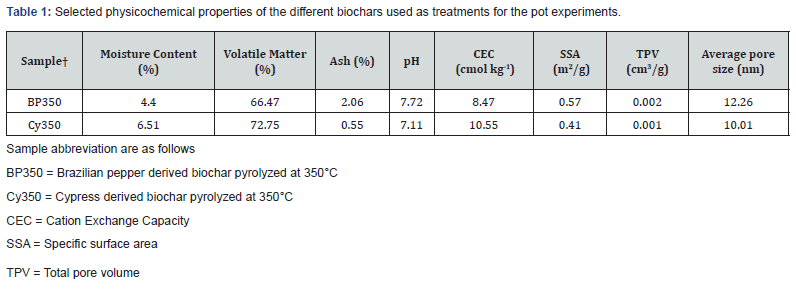
Two biochars were used in this study, derived from Brazilian pepper (Schinus terebinthifolius) and cypress (Taxodium distichum), both pyrolysed at 350°C at the USDA-ARS station in Florence, South Carolina, USA. Each biochar was designated according to its feedstock and pyrolysis temperature; for example, BP350 refers to Brazilian pepper-derived biochar produced at 350°C, and Cy350 refers to cypress-derived biochar produced at the same temperature. The biochars have been characterized in a previous study [13] and selected physicochemical properties are listed in Table 1.
Arbuscular Mycorrhizal Fungi (AMF) and Rhizobium Inoculation
AMF and Rhizobium inoculants were obtained commercially and applied according to the manufacturer’s recommendation. AMF inoculant was placed approximately 2 inches below the soil surface in pots and thoroughly mixed. Rhizobium inoculant was applied by seed coating immediately before sowing.
Experimental Design
The potted experiment was conducted at the Organic Garden shade house (25.7540° N, 80.3801° W) located near the nature preserve at Florida International University (FIU), Miami, FL, USA. Soil was collected from the Organic Garden at FIU. It is classified as a Krome loamy skeletal, carbonatic, hyperthermic lithic Udorthent according to the USDA-NRCS Soil Series Classification Database [12]. The soil had a pH of 7.52 and comprised 9.9% carbon, 0.55% nitrogen, 15.5% organic matter, 76% sand, 22% silt, and 2% clay. The elevated organic matter content is attributed to the incorporation of cover crops and onsite-produced compost from a previous study conducted at the site.
Phaseolus vulgaris (bush bean) was used as the test plant. Prior to packing, soil was homogenised and amended with biochar at 2% (w/w), then lightly packed into 2-gallon pots. AMF inoculant was applied following packing, and Rhizobium-coated seeds were placed thereafter. Four seeds per pot were sown approximately 2.5 cm deep; seedlings were thinned to one per pot after emergence. All pots except T1 (Control) received Miracle Grow (20N:8.7P:16.7K) as a starter fertilizer at the manufacturer's recommended rate at the time of planting. Pots were watered every other day, except on days of rainfall. Soil and plant parameters were measured at the termination of the experiment. Treatments for this study were laid out according to a randomized complete block design (RCBD) and each treatment had five replications. Treatment abbreviations are as follows:
T1 = Control
T2 = BP350
T3 = BP350 and AMF
T4 = BP350 and Rhizobium
T5 = Cy350
T6 = Cy350 and AMF
T7 = Cy350 and Rhizobium
T8 = AMF
T9 = Rhizobium
Soil Parameter
Gravimetric soil moisture content was determined by drying soil samples at 105°C for 24 has [14]. Soil pH was measured in a 1:2 (w/v) soil-to-deionized water suspension using a Denver Instruments glass electrode pH meter [15]. Soil organic matter (SOM) was determined by loss on ignition (LOI) at 550°C for 5 hers in a muffle furnace, calculated as the difference in dry weight before and after combustion [16]. Soil nitrogen and phosphorus were determined using a LECO Trope CN Analyser [20] and a SEAL AQ2 discrete analyser [17], respectively, following standard instrument protocols.
Plant Parameters
Plant parameters were measured following methods adapted from [18,19]. Height was measured from the first cotyledon’s node as a reference point to the uppermost leaf node. The average leaf chlorophyll content was measured using Soil Plant Analysis Development (SPAD) 502 Plus Chlorophyll meter. Yield was recorded from the number of beans and weight (fresh) and per treatment. After uprooting roots were thoroughly washed to remove soil prior to any experiment. All samples were dried at oven at 70°C for 72 hours to estimate shoot and root dry biomass. Plant nitrogen and phosphorus were determined using a LECO TruSpec CN Analyser [20] and a SEAL AQ2 discrete analyser [17], respectively, following standard instrument protocols.
Estimation of Arbuscular Mycorrhizal Fungi (AMF) Root Colonization and Rhizobium Nodule Count
AMF root colonization was assessed using a modified method McGonigle et al. 1990. Twenty-five fine root segments per plant were cleared in 10% KOH at 70°C for 2 h, rinsed with deionised water, and stained with 0.5% Trypan blue in lactoglycerol at 70°C for 30 min.-Stained segments were examined under a compound microscope and scored for the presence of hyphae, vesicles, or arbuscules. The percentage AMF colonization was calculated as:

Rhizobium nodule formation was assessed by visual inspection of each root system at the time of uprooting. Structures were scored as nodules if they exhibited a distinct spherical or ovoid morphology on root hair surfaces.
Statistical Analysis
All data are presented as means with standard errors. One-way analysis of variance (ANOVA) was performed using IBM SPSS Statistics version 28 to assess treatment effects on soil properties, plant productivity, and AMF colonization. Mean separation was carried out using Tukey–Kramer post hoc tests. Differences were considered statistically significant at p<0.05.
Results and Discussion
Effects of Treatments on Soil Parameters
Soil Moisture Content
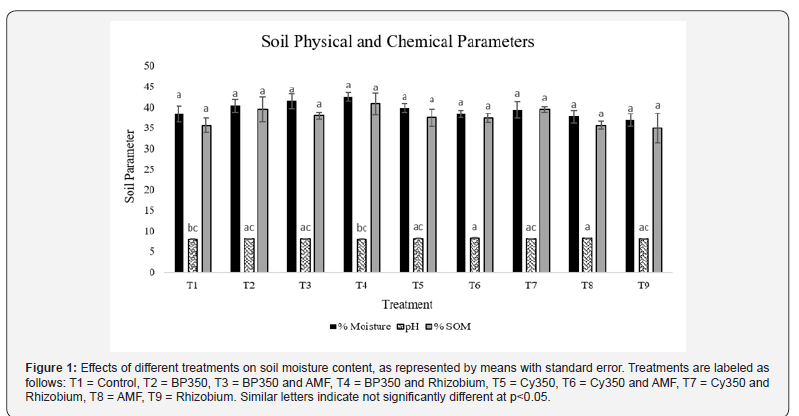
Soil moisture content did not differ significantly among treatments (p>0.05; Figure 1). Numerically, T4 (BP350 and Rhizobium) recorded the highest moisture content (42.47 ± 1.05%), while T9 (Rhizobium only) had the lowest. The absence of statistically significant differences in moisture is consistent with the relatively short experimental duration and the inherently high organic matter content of the soil used, which likely provided a sufficient baseline water-holding capacity that dampened the sensitivity of treatments to biochar-induced differences in soil porosity. Biochar is well recognized for its capacity to reduce bulk density and increase water retention, particularly through its porous architecture and high total pore volume; however, these effects are most pronounced in mineral soils with low initial organic matter, whereas organically rich soils show comparatively modest moisture responses to biochar amendment [6,5].
Soil Organic Matter
Soil organic matter (SOM) did not differ significantly among treatments (p>0.05; Figure 1). Numerically, T4 (BP350 and Rhizobium) recorded the highest SOM (40.78 ± 2.65%), while biochar-only treatments (T2, T5) showed intermediate values. The absence of significant SOM differences across treatments is expected given the short experimental duration; measurable changes in SOM following biochar addition typically require months to manifest statistically, particularly in soils with already elevated baseline organic matter [21]. Biochar can contribute to SOM through the physical protection of native organic carbon within its pore network, reducing microbial mineralization; however, these stabilization effects are more readily detected in long-term field trials than in short-term pot experiments [22]. The numerically higher SOM under T4 likely reflects the combined contribution of Brazilian pepper biochar’s stable carbon fraction and the organic nitrogen released during rhizobial nodule turnover, both of which can supplement the existing soil organic pool [9].
Soil pH
Treatment effects on soil pH were statistically significant (Figure 1). T6 (Cy350 and AMF) recorded the highest pH (8.16 ± 0.13), which was significantly greater than T1 (Control) and T4 (BP350 and Rhizobium). The elevated pH in biochar-amended treatments reflects the inherently alkaline nature of most wood-derived biochars, which arises from the concentration of base cations (Ca, Mg, K) in the ash fraction during pyrolysis [5]. The combination of cypress-derived biochar and AMF in T6 likely amplified this effect through AMF-mediated changes in rhizosphere chemistry, including proton release during ammonium assimilation and organic anion exudation [19]. Notably, T4 (BP350 and Rhizobium) had significantly lower pH than T6; the organic acids produced by Rhizobium sp. during nitrogen fixation and nodule metabolism can acidify the rhizosphere, partially offsetting the alkalizing effect of Brazilian pepper biochar [23]. All treatment pH values remained within the agronomically suitable range (6.5 - 8.5) for Phaseolus vulgaris [24].
Soil Nitrogen and Phosphorus
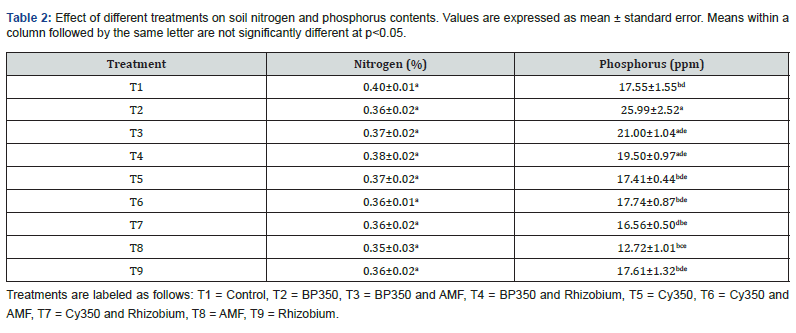
Available soil phosphorus differed significantly among treatments (p<0.05; Table 2). T2 (BP350 alone) yielded the highest soil phosphorus (25.99 ± 2.52 ppm), which was significantly greater than the control T1 (17.55 ± 1.55 ppm), as well as T5 (17.41 ± 0.44 ppm), T6 (17.74 ± 0.87 ppm), T7 (16.56 ± 0.50 ppm), T8 (12.72 ± 1.01 ppm), and T9 (17.61 ± 1.32 ppm. T8 (AMF only) recorded the lowest soil phosphorus (12.72 ± 1.01 ppm), consistent with AMF actively solubilizing and translocating phosphorus from soil pools into root tissues, thereby reducing extractable soil phosphorus [25].
The higher soil phosphorus under T2 compared to T3 suggests that AMF inoculation did not enhance soil P availability when applied alongside Brazilian pepper biochar at this application rate; rather, AMF activity may have led to greater phosphorus uptake into plant tissue, reducing the pool measured by extraction. Brazilian pepper biochar applied at 350°C has been shown to supply phosphorus directly from its ash fraction and to raise soil pH toward the range of maximum P solubility (6.0 - 7.0), two mechanisms that together explain the comparatively high extractable P in T2 [3].
Effects of Treatments on Plant Parameters
Plant Height and Leaf Chlorophyll Content
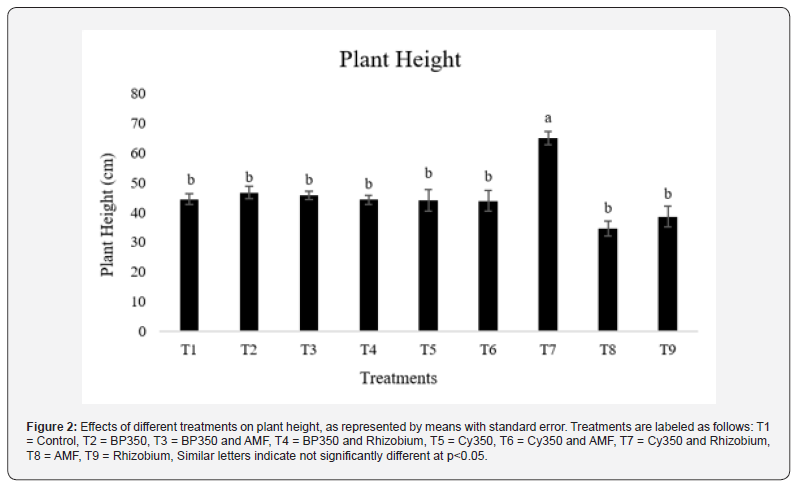
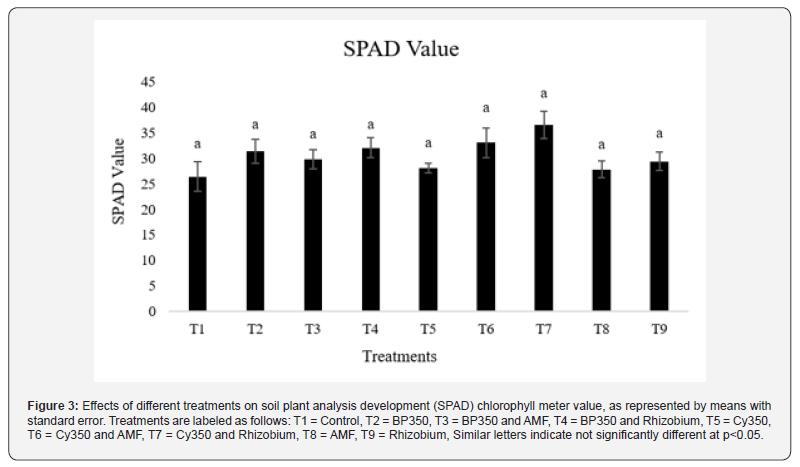
Plant height and SPAD chlorophyll meter values were not significantly influenced by the treatments (p>0.05; Figures 2 and 3). Numerically, T7 (Cy350 and Rhizobium) produced the tallest plants (65.0 ± 2.64 cm) and highest SPAD value (36.58 ± 2.68). The absence of significant effects on vegetative growth parameters is consistent with studies on Capsicum annuum [7] and on wheat and barley [26], where biochar amendments did not significantly alter plant height or chlorophyll content relative to unamended controls under comparable short-term pot conditions. Where differences were numerically apparent, as in the case of T7, the combined contribution of Cy350 biochar’s improved soil structure and active biological nitrogen fixation by Rhizobium may have promoted slightly greater vegetative development, although these differences did not reach statistical significance.
Shoot and Root Dry Mass
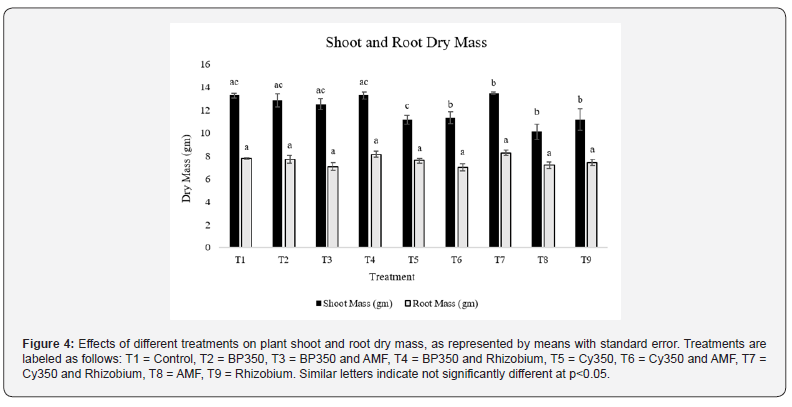
Treatments had a significant effect on shoot dry mass but not on root dry mass (p>0.05; Figure 4). T7 (Cy350 and Rhizobium) recorded the lowest shoot dry mass (11.17 ± 0.36 gm), which was significantly lower than T1 (Control), T6 (Cy350 and AMF), T8 (AMF), and T9 (Rhizobium). Despite its low shoot mass, T7 numerically produced the highest root dry mass (8.27 ± 0.24 gm), resulting in a lower shoot-to-root ratio compared to other treatments. This biomass allocation pattern, in which reduced shoot growth accompanies increased root proliferation, is indicative of nutrient-foraging responses; plants invest proportionally more carbon belowground when aboveground nutrient acquisition is limited [27].
The suppressed shoot development under T7 may reflect high volatile matter content of Cy350 biochar pyrolysed at 350°C, which has been associated with short-term phytotoxicity and nitrogen immobilization that constrains aboveground growth [28]. Competitive nitrogen dynamics between Rhizobium nodulation and soil microbial biomass may have further limited the nitrogen available for shoot growth in T7 during the early stages of symbiosis establishment [2]. The significantly higher shoot mass in T6 (Cy350 and AMF) relative to T7 underscores that AMF inoculation, rather than Rhizobium inoculation, was the more effective biological complement to Cy350 biochar for supporting shoot biomass accumulation in this experiment.
Bean Yield
Treatments had a significant influence on bean yield (Figure 5). In terms of bean number, T7 (Cy350 and Rhizobium) produced the greatest count (14.6 ± 1.04), significantly exceeding T8 (AMF only) and T9 (Rhizobium only) but not T1 (Control). For bean fresh weight, T4 (BP350 and Rhizobium) recorded the highest value (51.15 ± 2.84 gm), which was significantly greater than T5 (Cy350), T6 (Cy350 and AMF), T8 (AMF only), and T9 (Rhizobium only), but did not differ significantly from T1. These findings indicate that the combination of Brazilian pepper biochar at 350°C with Rhizobium inoculation most effectively supported fruit development, likely by improving phosphorus availability (Table 2, T4 = 19.50 ppm) alongside biologically fixed nitrogen delivered through nodule symbiosis.
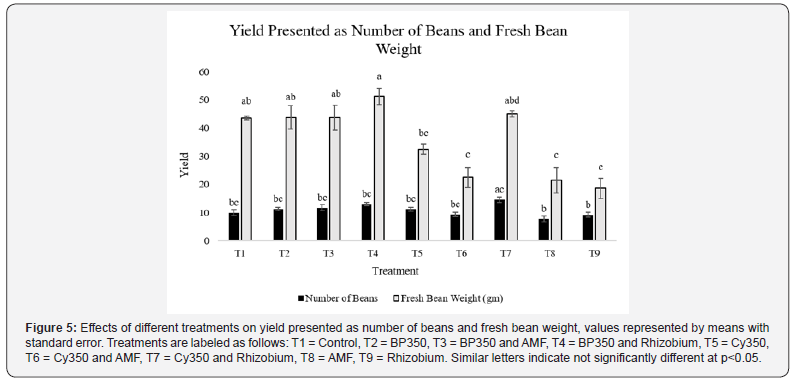
Phosphorus is critical for reproductive organ development and fruit filling in legumes, and co-inoculation strategies that combine biochar-enhanced P availability with nitrogen fixation have been reported to produce additive benefits for legume productivity under P-limited conditions [2]. The lower yield performance of biochar-only treatments (T2, T5) compared to the combined biochar and Rhizobium treatments suggests that the inoculant-mediated nitrogen supply was a limiting factor differentiating yield outcomes.
Plant Tissue Nitrogen and Phosphorus
Plant tissue nitrogen did not differ significantly among treatments (p > 0.05; Table 3). Numerically, T6 (Cy350 and AMF) and T5 (Cy350) had the highest tissue nitrogen contents (6.69 ± 0.52% and 6.64 ± 0.73%, respectively), while T8 (AMF only) recorded the lowest (4.80 ± 0.32%). The absence of significant treatment effects on tissue nitrogen is consistent with background soil nitrogen adequacy and with the relatively short duration of the experiment, which may have been insufficient for Rhizobium symbiosis to substantially augment plant nitrogen nutrition above that supplied by the organic soil. Longer growing periods have been required to detect significant effects of Rhizobium inoculation on legume nitrogen status in comparable pot studies [2].
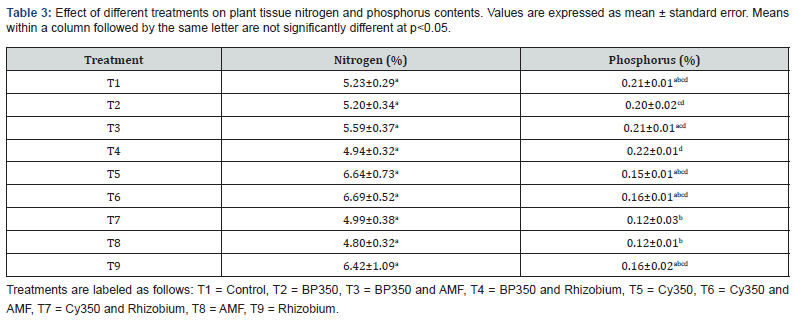
Plant tissue phosphorus differed significantly among treatments (p<0.05; Table 3). T4 (BP350 and Rhizobium) had the highest tissue phosphorus (0.22 ± 0.01%), which was significantly greater than T7 (0.12 ± 0.03%) and T8 (0.12 ± 0.01%) but not from T1 (0.21 ± 0.01%). T7 (Cy350 and Rhizobium) and T8 (AMF only) recorded the lowest tissue phosphorus values. The higher tissue phosphorus in T4 corresponds with its elevated available soil phosphorus (19.50 ppm; Table 2), suggesting effective phosphorus uptake from the BP350-amended soil in the presence of Rhizobium inoculation.
The lower tissue phosphorus in AMF-containing treatments (T8: 0.12%; T3: 0.21%) does not necessarily indicate poorer phosphorus nutrition; rather, AMF-mediated phosphorus translocation tends to shift phosphorus from root tissue storage toward shoot utilisation, a pattern that can suppress root tissue phosphorus concentrations while maintaining adequate shoot nutrition [23]. This interpretation is supported by the comparatively lower root-to-shoot phosphorus ratios observed in AMF-inoculated treatments.
AMF Root Colonisation and Rhizobium Nodule Formation
Arbuscular Mycorrhizal Fungi Root Colonization
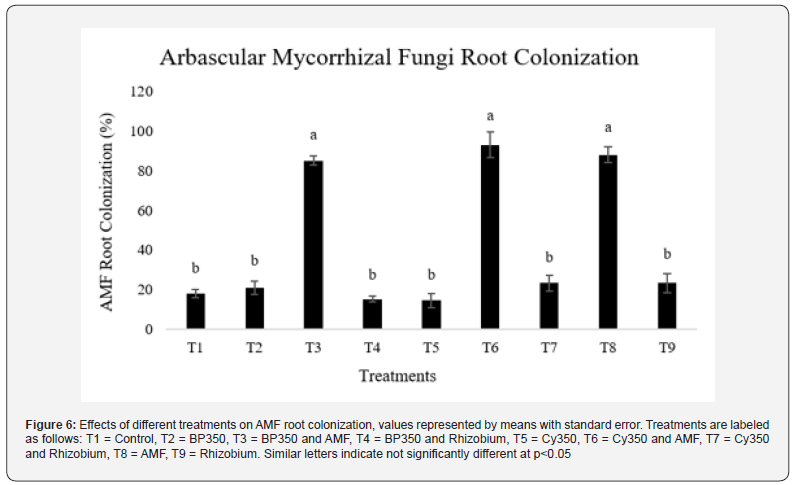
Treatments had a significant influence on AMF root colonization (p<0.05; Figure 6). T6 (Cy350 and AMF) showed the highest colonization (93.0 ± 6.37%), which was significantly greater than T1 (Control), T2 (BP350), T4 (BP350 and Rhizobium), T5 (Cy350), T7 (Cy350 and Rhizobium), and T9 (Rhizobium only). The markedly high colonization in T6 indicates a synergistic interaction between cypress-derived biochar and AMF inoculation, consistent with the well-established facilitating role of biochar’s porous architecture in providing protected microhabitats for AMF hyphae and propagules and in improving the nutrient and moisture conditions conducive to fungal proliferation [10,24]. The pore structure and high surface area of Cy350 biochar would have provided physical refuge from hyphal grazers and created nutrient-enriched microsites from which AMF could access phosphorus unavailable to plant roots [27].
In contrast, the comparatively lower colonisation in T3 (BP350 and AMF) and T4 (BP350 and Rhizobium) suggests that Brazilian pepper biochar was less effective than cypress biochar in promoting AMF establishment at the application rate used. This difference may reflect feedstock-dependent variation in biochar pore size distribution, pH, and ash composition, all of which influence mycorrhizal habitat suitability [7]. Residual native AMF present in the organic farm soil likely contributed to colonization recorded in uninoculated treatments (T2, T5, T7), consistent with observations in comparable organic soil studies where background AMF populations responded positively to biochar-induced improvements in soil structure [28].
Rhizobium Nodule Formation
Nodule formation was restricted exclusively to treatments that received Rhizobium inoculation (T4, T7, and T9), confirming effective symbiosis establishment under all three Rhizobium-inoculated conditions. T4 (BP350 and Rhizobium) produced the highest nodule count (82.0 ± 5.36), followed by T7 (Cy350 and Rhizobium; 47.0 ± 3.68) and T9 (Rhizobium only; 18.33 ± 5.19). Both biochar-amended Rhizobium treatments produced substantially more nodules than T9 (Rhizobium only), indicating that biochar application enhanced the efficacy of Rhizobium symbiosis regardless of feedstock. The greater nodule count in T4 compared to T7 suggests that Brazilian pepper biochar at 350°C was more conducive to Rhizobium nodulation than cypress-derived biochar.
This may be attributed to the higher pH of BP350 (pH =7.72; Table 1), as Rhizobium nodulation is known to be sensitive to soil acidification, with maximum nodulation efficiency occurring between pH 6.5 and 7.5 [22,2]. In contrast, Cy350 biochar has a lower inherent pH, which may have created a slightly less favourable environment for Rhizobium host-recognition signalling. Additionally, biochar pore structure can provide physical protection for Rhizobium cells from predation and desiccation stress, thereby increasing the viable inoculant population available for infection thread initiation [4]. The substantially higher nodule counts in T4 and T7 relative to T9 demonstrate that biochar co-application with Rhizobium inoculation is a more effective strategy for promoting biological nitrogen fixation in P. vulgaris than inoculation alone, supporting the potential of biochar as a carrier or habitat-enhancing agent for beneficial soil bacteria [2].
Conclusion
This study demonstrated that biochar feedstock type and microbial inoculation significantly influenced soil nutrient dynamics and the symbiotic performance of Phaseolus vulgaris grown in organic soil. While soil moisture, organic matter, and tissue nitrogen were unaffected by treatments, available soil phosphorus, plant productivity, nodulation, and AMF colonization responded strongly to specific biochar - inoculant combinations. Brazilian pepper biochar (BP350) increased soil phosphorus availability and, when combined with Rhizobium, produced the greatest bean yield and nodule formation, indicating enhanced rhizobial symbiosis.
In contrast, cypress biochar (Cy350) combined with AMF resulted in the highest root colonization, suggesting a strong positive interaction between this biochar type and mycorrhizal establishment. These findings highlight distinct feedstock-specific effects, with BP350 favoring phosphorus availability, yield, and nodulation, and Cy350 promoting AMF colonization. Overall, the results support the use of feedstock-specific biochars in combination with beneficial microbial inoculants as a sustainable strategy for improving nutrient acquisition and legume productivity in organic systems. Future studies should evaluate these interactions under field conditions and across a full growing season to better understand the mechanisms driving biochar-microbe-plant interactions.
Acknowledgment
The authors would like to thank the members of the Agroecology program at Florida International University, Miami, FL, USA for their help during laboratory analyses.
References
- Poole P, Ramachandran V, Terpolilli J (2018) Rhizobia: From saprophytes to endosymbionts. Nature Reviews Microbiology 16(5): 291-303.
- Jahan N, Mahmud U, Khan MZ (2025) Sustainable plant-soil phosphorus management in agricultural systems: Challenges, environmental impacts and innovative solutions. Discover Soil 2: 13.
- Glaser B, Lehr VI (2019) Biochar effects on phosphorus availability in agricultural soils: A meta-analysis. Scientific Reports 9(1): 9338.
- Lehmann J, Cowie A, Masiello CA, Kammann C, Woolf D, et al. (2021) Biochar in climate change mitigation. Nature Geoscience 14(12): 883-892.
- Tomczyk A, Sokołowska Z, Boguta P (2020) Biochar physicochemical properties: Pyrolysis temperature and feedstock kind effects. Reviews in Environmental Science and Bio/Technology 19(1): 191-215.
- Seyedsadr S, Šípek V, Jačka L, Sněhota M, Beesley L, et al. (2022) Biochar considerably increases the easily available water and nutrient content in low-organic soils amended with compost and manure. Chemosphere 293: 133586.
- Gaffar S, Riquelme C, Jayachandran K (2021a) Investigating the effects of twelve biochars on the growth of Capsicum annuum 'Jalapeño' pepper, microbial population and enzyme activities in soil. Journal of Horticulture 8: 296.
- Smith SE, Read DJ (2008) Mycorrhizal symbiosis (3rd ed.). Academic Press.
- Lehmann J, Rillig MC, Thies J, Masiello CA, Hockaday WC, et al. (2011) Biochar effects on soil biota: A review. Soil Biology and Biochemistry 43(9): 1812-1836.
- Warnock DD, Mummey DL, McBride B, Major J, Lehmann J, et al. (2010) Influences of non-herbaceous biochar on arbuscular mycorrhizal fungal abundances in roots and soils: Results from growth-chamber and field experiments. Applied Soil Ecology 46(3): 450-456.
- Broughton WJ, Hernández G, Blair M, Beebe S, Gepts P, et al. (2003) Beans (Phaseolus spp.)-Model food legumes. Plant and Soil 252(1): 55-128.
- Velez TI, Moonilall NI, Reed S, Jayachandran K, Scinto LJ (2018) Impact of Melaleuca quinquenervia biochar on Phaseolus vulgaris growth, soil nutrients and microbial gas flux. Journal of Environmental Quality 47(6): 1487-1495.
- Gaffar S, Dattamudi S, Baboukani AR, Chanda S, Novak JM, et al. (2021b) Physiochemical characterization of biochars from six feedstocks and their effects on the sorption of atrazine in an organic soil. Agronomy 11(4): 716.
- Gardner WH (1986) Water content. In A. Klute (Ed.), Methods of soil analysis, Part 1: Physical and mineralogical methods (2nd ed.,). Soil Science Society of America Pp: 493-544
- McLean EO (1982) Soil pH and lime requirements. In AL Page, RH Miller, & DR Keeney (Eds.), Methods of soil analysis, Part 2: Chemical and microbiological properties (2nd ed.), American Society of Agronomy pp: 199-224.
- Hiri O, Lotter AF, Lemcke G (2001) Loss on ignition as a method for estimating organic and carbonate content in sediments: Reproducibility and comparability of results. Journal of Paleolimnology 25(1): 101-110.
- SEAL Analytical (2017) AQ2 discrete analyzer: Operator manual. SEAL Analytical.
- Gravel V, Dorais M, Ménard C (2013) Organic potted plants amended with biochar: Its effect on growth and Pythium colonization. Canadian Journal of Plant Science 93(6): 1217-1227.
- Liu X, Zhang F, Zhao Z, Zhu H, Yao Q (2020) Acidic soil inhibits the functionality of arbuscular mycorrhizal fungi by reducing arbuscule formation in tomato roots. Soil Science and Plant Nutrition 66(2): 275-284.
- LECO Corporation (2018) Tru Spec CN carbon/nitrogen analyzer: Instruction manual. LECO Corporation.
- Ernest B, Yanda PZ, Hansson A, Frida M (2024) Long-term effects of adding biochar to soils on organic matter content. Scientific Reports 14: 30565.
- Mason ARG, Bicharanloo B, Salomon M, Mosse J, Poole M, et al. (2025) Enhanced stabilisation of soil carbon via arbuscular mycorrhizal fungi and biochar. Scientific Reports 15: 39631.
- Preston C (2019) Soil pH effects potassium and phosphorus fertilizer availability and management. Nutrien EKonomics.
- Brady NC, Weil RR (2017) The nature and properties of soils (15th ed.). Pearson.
- Li M, Cai L (2021) Biochar and arbuscular mycorrhizal fungi play different roles in enabling maize to uptake phosphorus. Sustainability 13(6): 3244.
- Delroy B, Zhang HY, Bissett A, Powell JR (2025) Arbuscular mycorrhizal fungi inoculation and biochar application enhance soil carbon and productivity in wheat and barley. Science of the Total Environment 972: 179075.
- Lopez G, Ahmadi SH, Amelung W, Athmann M, Ewert F, et al. (2023) Nutrient deficiency effects on root architecture and root-to-shoot ratio in arable crops. Frontiers in Plant Science 13: 1067498.
- Deenik JL, McClellan T, Uehara G, Antal MJ, Campbell S (2010) Charcoal volatile matter content influences plant growth and soil nitrogen transformations. Soil Science Society of America Journal 74(4): 1259-1270.
- Hammer EC, Balogh-Brunstad Z, Jakobsen I, Olsson PA, Stipp SL, et al. (2014) A mycorrhizal fungus grows on biochar and captures phosphorus from its surfaces. Soil Biology and Biochemistry 77: 252-260.
- Bashant R, Gaffar S (2026) Effects of biochar and arbuscular mycorrhizal fungal inoculation on soil phosphorus availability and growth of Pisum sativum (Dwarf Snap Pea). Journal of Environmental and Agricultural Studies 7(3): 26-38.

























