




 AIBM Home



Role of Mycorrhizal Fungi in Sustainable Agroforestry Systems: Implications for Soil Health and Plant Productivity
Sufiya Shabir*
Department of Silviculture and Agroforestry, Faculty of Forestry, SKUAST-K, Benhama Ganderbal, 191201, J&K, India
Submission:July 28, 2026; Published: August 11, 2026
*Corresponding author: Sufiya Shabir, Department of Silviculture and Agroforestry, Faculty of Forestry, SKUAST-K, Benhama Ganderbal, 191201, J&K, India
Abstract
Agroforestry is increasingly recognized as a sustainable land-use strategy that integrates trees with crops and/or livestock to enhance productivity while maintaining ecological integrity. The sustainability of these systems is largely governed by belowground biological interactions, among which mycorrhizal fungi play a fundamental role. Through symbiotic associations with plant roots, mycorrhizal fungi improve nutrient acquisition, enhance water uptake, promote soil aggregation, increase carbon sequestration, and strengthen plant tolerance against environmental stresses. Their extensive hyphal networks facilitate nutrient redistribution between trees and crops, stimulate microbial diversity, and improve nutrient-use efficiency, thereby reducing dependence on synthetic fertilizers. Recent advances in molecular ecology have considerably expanded our understanding of the diversity and multifunctionality of mycorrhizal fungi within agroforestry ecosystems. Growing evidence also suggests that managing mycorrhizal communities can contribute significantly to climate-resilient agriculture by improving soil quality and ecosystem stability. This mini review synthesizes current knowledge on the ecological significance of mycorrhizal fungi in agroforestry systems, emphasizing their role in nutrient cycling, soil carbon sequestration, plant productivity, and stress tolerance. Current research gaps and future perspectives for integrating mycorrhizal technologies into sustainable agroforestry practices are also discussed.
Keywords: Agroforestry; Arbuscular Mycorrhiza; Ectomycorrhiza; Soil Microbiome; Nutrient Cycling; Carbon Sequestration; Soil Health; Sustainable Agriculture
Abbreviations: AM: Arbuscular Mycorrhizae; ECM: Ectomycorrhizae; ErM: Ericoid Mycorrhizae; OM: Orchid Mycorrhizae; AMF: Arbuscular Mycorrhizal Fungi; CMNs: Common Mycorrhizal Networks;
Introduction
The global demand for food, fibre, timber, and other ecosystem services is increasing rapidly due to population growth, urbanization, and changing consumption patterns. At the same time, agricultural production is challenged by declining soil fertility, climate change, biodiversity loss, and unsustainable land-use practices. Intensive cultivation, excessive application of mineral fertilizers, and continuous soil disturbance have substantially contributed to soil degradation, reduced microbial diversity, nutrient imbalance, and increased greenhouse gas emissions, thereby threatening long-term agricultural sustainability Tilman et al., [1]; Foley et al., [2]. These concerns have accelerated the search for environmentally sustainable production systems capable of maintaining productivity while restoring ecosystem functions. Agroforestry has emerged as one of the most promising nature-based solutions for addressing these challenges because it integrates woody perennials with agricultural crops and/or livestock within the same management unit. Such integration improves resource-use efficiency through complementary interactions among plant species and enhances multiple ecosystem services, including soil conservation, biodiversity enhancement, nutrient cycling, carbon sequestration, and climate-change mitigation Nair [3]; Jose [4]; IPCC [5]. Compared with conventional monoculture systems, agroforestry creates structurally diverse environments that favour complex interactions among plant roots, soil microorganisms, and organic matter, thereby improving ecosystem resilience and productivity.
Among the diverse soil microorganisms inhabiting agroforestry systems, mycorrhizal fungi constitute one of the most ecologically important groups because of their intimate and long-standing mutualistic association with plant roots. The term mycorrhiza, derived from the Greek words mykes (fungus) and rhiza (root), describes a symbiosis in which plants supply carbohydrates to fungal partners in exchange for enhanced acquisition of mineral nutrients and water Smith and Read [6]. Fossil evidence indicates that these associations evolved more than 400 million years ago and were instrumental in enabling early land plants to colonize terrestrial habitats, highlighting their evolutionary significance Brundrett [7]; Field et al., [8]. It is estimated that nearly 80-90% of terrestrial vascular plant species establish some form of mycorrhizal association, making this one of the most widespread symbioses in terrestrial ecosystems (Brundrett, 2009). Depending on the fungal partner and host plant, mycorrhizae are classified into several functional groups, including arbuscular mycorrhizae (AM), ectomycorrhizae (ECM), ericoid mycorrhizae (ErM), and orchid mycorrhizae (OM). Among these, AM fungi belonging to the phylum Glomeromycota dominate agricultural ecosystems and associate with the majority of crop species, whereas ECM fungi primarily colonize many temperate and boreal forest trees, including species commonly used in agroforestry systems such as Populus, Quercus, Pinus, and Eucalyptus Bonfante and Genre [9]; Tedersoo et al., [10].
The ecological importance of mycorrhizal fungi extends far beyond nutrient uptake. Their extensive extraradical hyphal networks increase the effective absorptive surface area of plant roots, thereby improving the acquisition of relatively immobile nutrients, particularly phosphorus, while also enhancing nitrogen, potassium, zinc, and copper uptake Smith and Smith [11]; Richardson et al., [12]. Furthermore, mycorrhizal fungi improve plant water relations, regulate phytohormone production, suppress soil-borne pathogens, and enhance tolerance to drought, salinity, heavy metals, and temperature extremes through multiple physiological and biochemical mechanisms Augé [13]; Begum et al., [14]; Chandrasekaran et al., 2019). Consequently, they are increasingly regarded as natural biofertilizers that contribute to sustainable crop production while reducing dependence on chemical inputs.
Agroforestry systems provide favourable conditions for the establishment and persistence of mycorrhizal communities because perennial trees maintain fungal inoculum throughout the year and continuously supply carbon to belowground microbial networks. The coexistence of trees and annual crops facilitates the formation of common mycorrhizal networks (CMNs), through which nutrients, water, and signalling molecules may be exchanged among neighbouring plants. These interconnected fungal networks contribute to greater nutrient-use efficiency, enhanced soil biological activity, improved plant establishment, and increased ecosystem stability under environmental stress Van der Heijden et al., [15]; Simard et al., [16]. In addition, arbuscular mycorrhizal fungi produce glomalin-related soil proteins that bind soil particles into stable aggregates, thereby improving soil structure, reducing erosion, increasing water infiltration, and promoting long-term carbon stabilization Rillig [17]; Lehmann and Rillig [18]. Recent advances in high-throughput sequencing, metagenomics, and functional microbial ecology have significantly improved our understanding of mycorrhizal diversity and their ecosystem functions. These studies demonstrate that fungal community composition is strongly influenced by host plant identity, tree diversity, soil physicochemical properties, land-use history, and management practices Bahram et al., [19]; Tedersoo et al., [10]. Consequently, maintaining diverse and functionally active mycorrhizal communities is increasingly considered essential for improving soil health, enhancing nutrient-use efficiency, and strengthening the resilience of agroforestry systems under future climate scenarios.
Despite substantial progress in mycorrhizal research, several knowledge gaps remain regarding the interactions between different mycorrhizal guilds, agroforestry management practices, and ecosystem functioning. A better understanding of these interactions will facilitate the development of management strategies that maximize the ecological benefits of mycorrhizal symbioses while improving agricultural sustainability. Therefore, this mini review critically examines the current understanding of the diversity and ecological functions of mycorrhizal fungi in agroforestry systems, with particular emphasis on nutrient cycling, soil health, carbon sequestration, plant productivity, and stress tolerance. The review also identifies emerging research priorities and future opportunities for integrating mycorrhizal technologies into sustainable agroforestry management.
Diversity and Ecological Significance of Mycorrhizal Fungi in Agroforestry Systems
Mycorrhizal fungi comprise a diverse group of symbiotic soil microorganisms that establish intimate associations with the roots of most terrestrial plants. These associations represent one of the oldest and most successful mutualistic relationships in terrestrial ecosystems, contributing significantly to plant nutrition, soil fertility, and ecosystem stability. The diversity of mycorrhizal fungi is reflected in their morphological characteristics, host specificity, ecological functions, and evolutionary adaptations. Their occurrence within agroforestry systems depends on several factors, including host plant composition, soil properties, climate, land-use history, and management practices Brundrett and Tedersoo [20]; Genre et al., [21].
Unlike monoculture systems, agroforestry landscapes support a heterogeneous vegetation structure where trees, shrubs, annual crops, and herbaceous plants coexist. This diversity creates multiple ecological niches that favour the establishment of complex mycorrhizal communities with complementary ecological functions. Tree roots act as permanent reservoirs of fungal inoculum, allowing mycorrhizal propagules to persist even during periods when annual crops are absent. Consequently, agroforestry systems generally exhibit greater mycorrhizal diversity and colonization than conventionally managed agricultural fields, contributing to enhanced ecosystem functioning and long-term soil fertility Cardinael et al., [22]; Bainard et al., [23].
5Major types of mycorrhizal associations
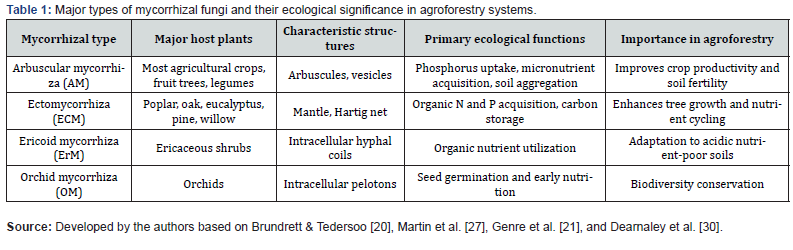
Based on structural characteristics and host specificity, mycorrhizal fungi are broadly classified into four major functional groups: arbuscular mycorrhizae (AM), ectomycorrhizae (ECM), ericoid mycorrhizae (ErM), and orchid mycorrhizae (OM). Although all groups facilitate nutrient exchange between plants and fungi, they differ considerably in their colonization patterns, ecological distribution, and functional significance.
Arbuscular mycorrhizae (AM): Arbuscular mycorrhizal fungi (AMF), belonging to the phylum Glomeromycota, represent the most abundant and widely distributed mycorrhizal group in terrestrial ecosystems. They colonize nearly 72-80% of vascular plant species, including most agricultural crops, fruit trees, grasses, and several agroforestry tree species Brundrett and Tedersoo [20]; Davison et al., [24]. AMF penetrate the cortical cells of plant roots, where they form highly branched structures known as arbuscules, which serve as the principal sites of nutrient exchange between fungal hyphae and host cells. Some species also produce vesicles that function as storage organs for lipids and other reserve compounds Parniske [25]. The ecological success of AMF largely arises from their extensive extra radical hyphal networks, which extend several centimetres beyond the root surface and exploit soil pores inaccessible to plant roots. These hyphae substantially increase phosphorus acquisition while also facilitating the uptake of nitrogen, sulphur, zinc, copper, and water. Consequently, AMF play a central role in improving nutrient-use efficiency, especially in nutrient-deficient tropical and subtropical soils where phosphorus availability is often the primary constraint to crop productivity Smith and Smith [11]; Chen et al., [26].
Ectomycorrhizae (ECM): Ectomycorrhizal fungi are predominantly associated with woody perennial species belonging to families such as Pinaceae, Fagaceae, Betulaceae, Salicaceae, and Myrtaceae. In agroforestry systems, ECM associations are commonly observed in Populus, Quercus, Eucalyptus, Betula, and Pinus species that are frequently incorporated into silvopastoral and agri-silvicultural systems Martin et al., [27]. Unlike AMF, ectomycorrhizal fungi do not penetrate root cortical cells. Instead, they form a dense fungal sheath (mantle) surrounding fine roots and develop an intercellular network known as the Hartig net, which facilitates nutrient exchange between fungal hyphae and root tissues Martin et al., [27]. ECM fungi possess an extensive repertoire of extracellular enzymes capable of degrading complex organic matter, enabling them to access organically bound nitrogen and phosphorus that remain unavailable to most plants. This enzymatic capability makes ECM fungi particularly important in forest soils characterized by slowly decomposing organic matter and limited mineral nutrient availability Lindahl and Tunlid [28].
Ericoid and orchid mycorrhizae: Although less common in agroforestry systems, ericoid and orchid mycorrhizae contribute significantly to biodiversity conservation and ecosystem functioning in specialized habitats. Ericoid mycorrhizae are primarily associated with plants belonging to the Ericaceae, enabling them to survive in acidic, nutrient-poor soils by efficiently utilizing organically bound nitrogen and phosphorus Cairney and Meharg [29]. Orchid mycorrhizae, in contrast, are indispensable for orchid seed germination because orchid seeds lack sufficient nutrient reserves for independent establishment. Fungal partners provide essential carbon and nutrients during early developmental stages, thereby ensuring successful seedling establishment Dearnaley et al., [30]. Although these specialized associations occupy relatively small ecological niches compared with AMF and ECM, they contribute to plant diversity and ecological stability in natural and semi-natural agroforestry landscapes.
Common mycorrhizal networks in agroforestry
One of the most fascinating ecological features of mycorrhizal fungi is their ability to establish Common Mycorrhizal Networks (CMNs), through which multiple neighbouring plants become interconnected by a shared fungal mycelium. These underground networks facilitate the movement of nutrients, water, defence-related signalling molecules, and in certain cases, carbon compounds among interconnected plants Simard et al., [16]. In agroforestry systems, where perennial trees coexist with annual crops, CMNs improve nutrient redistribution and increase overall resource-use efficiency. Deep-rooted trees acquire nutrients from subsoil horizons and return them to the surface through litter-fall and root turnover, while shared mycorrhizal networks facilitate nutrient transfer between tree roots and associated crops. Such interactions enhance phosphorus uptake, improve nitrogen cycling, and promote seedling establishment, particularly under nutrient-limited conditions Teste et al., [31]; Van der Heijden and Horton [32]. Nevertheless, the ecological significance of CMNs remains an active area of investigation. While numerous experimental studies demonstrate nutrient transfer through shared fungal networks, the magnitude and ecological relevance of these transfers under field conditions remain debated. Several researchers argue that although nutrient exchange undoubtedly occurs, its contribution to plant nutrition may vary considerably depending on fungal species, host identity, soil fertility, and environmental conditions Karst et al., [33]. This highlights the need for long-term field experiments that integrate molecular techniques with ecosystem-scale measurements to better understand the functioning of CMNs within agroforestry systems.
Factors influencing mycorrhizal diversity in agroforestry systems
The composition and diversity of mycorrhizal communities are highly dynamic and influenced by numerous biotic and abiotic factors. Tree species diversity is one of the strongest determinants because different host plants selectively recruit distinct fungal communities through variations in root exudates and carbon allocation patterns Bever et al., [34]. Diverse agroforestry systems generally support richer fungal communities than monoculture plantations owing to greater plant diversity and continuous root activity. Soil physicochemical properties, including pH, organic carbon content, moisture, texture, and nutrient availability, also regulate fungal diversity. High phosphorus fertilization frequently suppresses AM colonization because plants reduce carbon investment in fungal partners when phosphorus is readily available Johnson [35]. Conversely, moderate nutrient limitation often strengthens the mutualistic relationship by increasing plant dependence on fungal-mediated nutrient acquisition.
Agricultural management practices likewise influence mycorrhizal communities. Excessive tillage disrupts hyphal networks and reduces fungal propagule density, whereas conservation agriculture, organic farming, residue retention, and diversified agroforestry practices generally enhance mycorrhizal abundance and diversity Brito et al., [36]. These findings emphasize that maintaining diverse fungal communities requires integrated management strategies that minimize soil disturbance while promoting continuous vegetation cover. Collectively, current evidence indicates that preserving mycorrhizal diversity should be considered an essential component of sustainable agroforestry management because diverse fungal communities provide greater functional redundancy, improve nutrient cycling, enhance soil biological activity, and increase ecosystem resilience under environmental stress (Table 1).
Mycorrhizal Fungi and Nutrient Cycling in Agroforestry Systems
Nutrient cycling is a fundamental ecological process that governs soil fertility, plant productivity, and ecosystem sustainability. In agroforestry systems, nutrient dynamics are considerably more complex than in monoculture systems because of the interactions among trees, crops, litter, soil microorganisms, and environmental factors. Among the soil biota, mycorrhizal fungi are recognized as key mediators of nutrient cycling owing to their ability to facilitate nutrient acquisition, influence organic matter decomposition, regulate microbial interactions, and improve nutrient-use efficiency Barea et al., [37]; Van der Heijden et al., [15]. Their contribution extends beyond individual plant nutrition to ecosystem-level nutrient redistribution, making them indispensable for sustainable agroforestry management. Unlike plant roots, which are confined to the rhizosphere, mycorrhizal fungi produce extensive extra-radical hyphal networks that explore a much larger volume of soil. These hyphae penetrate micropores inaccessible to roots and efficiently absorb nutrients located beyond the depletion zone surrounding root surfaces. Consequently, mycorrhizal fungi increase the effective absorptive area of root systems several-fold, thereby enhancing nutrient acquisition under both nutrient-rich and nutrient-deficient conditions Smith & Smith [11]; Parniske [25]. This adaptation is particularly advantageous in agroforestry systems where perennial trees and annual crops compete for available nutrients while simultaneously benefiting from complementary resource utilization.
Phosphorus acquisition
Phosphorus (P) is one of the least mobile and most limiting nutrients in agricultural soils because a large proportion exists in insoluble mineral complexes or organic forms that cannot be directly absorbed by plants. Mycorrhizal fungi play a central role in overcoming this limitation by extending their hyphae into soil microsites where phosphorus is otherwise unavailable to plant roots. These hyphae absorb inorganic phosphate through specialized transport proteins and translocate it efficiently to host plants via arbuscules or Hartig nets, depending on the type of mycorrhizal association Smith et al., [11]; Richardson et al., [12]. In addition to direct phosphorus uptake, mycorrhizal fungi indirectly improve phosphorus availability by interacting with phosphate-solubilizing bacteria and by stimulating rhizosphere processes that mobilize sparingly soluble phosphorus compounds. Such synergistic interactions increase phosphorus-use efficiency while reducing dependence on synthetic phosphate fertilizers Barea et al., [37]. In agroforestry systems, continuous litter deposition from trees further enhances phosphorus cycling by increasing organic matter inputs that are subsequently mineralized through microbial activity. Nevertheless, the magnitude of phosphorus acquisition through mycorrhizal fungi is influenced by soil phosphorus status. Under high phosphorus fertilization, plants frequently reduce carbon allocation to fungal partners, thereby decreasing root colonization and fungal activity. Consequently, excessive fertilizer application may suppress the ecological benefits of mycorrhizal symbiosis, emphasizing the importance of balanced nutrient management within sustainable agroforestry systems Johnson [35].
Nitrogen cycling
Although mycorrhizal fungi are traditionally recognized for phosphorus acquisition, increasing evidence demonstrates their significant role in nitrogen (N) cycling. Nitrogen is an essential component of amino acids, proteins, nucleic acids, and chlorophyll; however, its availability in soil is often constrained by slow mineralization rates and substantial losses through leaching and volatilization. Mycorrhizal fungi improve nitrogen acquisition by absorbing both inorganic forms (ammonium and nitrate) and, in some cases, organic nitrogen compounds such as amino acids and peptides Hodge and Fitter [38]. Ectomycorrhizal fungi possess a particularly diverse array of extracellular enzymes capable of degrading complex organic matter, thereby releasing organically bound nitrogen unavailable to most plants. This characteristic enables ECM-associated tree species to thrive in forest soils with low mineral nitrogen availability Lindahl and Tunlid [28]. In contrast, arbuscular mycorrhizal fungi primarily enhance nitrogen uptake through improved soil exploration and efficient transfer of mineralized nitrogen to host plants. In agroforestry systems incorporating nitrogen-fixing tree species such as Robinia pseudoacacia, Acacia spp., and Albizia spp., mycorrhizal fungi further enhance nitrogen cycling by interacting synergistically with rhizobial bacteria. Such dual symbioses increase biological nitrogen fixation, improve nitrogen-use efficiency, and enhance soil fertility, ultimately benefiting neighbouring non-leguminous crops through nutrient transfer and litter decomposition Barea et al., [37]; Van der Heijden et al., [15].
Micronutrient uptake and nutrient-use efficiency
Beyond nitrogen and phosphorus, mycorrhizal fungi substantially improve the acquisition of essential micronutrients including zinc (Zn), copper (Cu), iron (Fe), manganese (Mn), and sulphur (S). These nutrients are required in relatively small quantities but are indispensable for enzyme activation, photosynthesis, protein synthesis, and numerous metabolic pathways. The fine hyphal network enables fungi to access micronutrients adsorbed onto soil particles that remain inaccessible to plant roots Smith and Read [6]. Improved nutrient uptake frequently translates into greater nutrient-use efficiency (NUE), allowing plants to achieve higher biomass production with lower fertilizer inputs. Enhanced NUE is particularly important under low-input agroforestry systems where external nutrient additions are minimized. Several field studies have demonstrated that mycorrhizal inoculation increases nutrient recovery while simultaneously reducing fertilizer requirements and minimizing nutrient losses to the environment Chen et al., [26]; Begum et al., [14]. Such improvements contribute directly to sustainable agricultural intensification and environmental conservation.
Interaction with soil microbial communities
Nutrient cycling within agroforestry systems is governed not only by mycorrhizal fungi but also by complex interactions among bacteria, actinomycetes, free-living fungi, earthworms, and other soil organisms. Mycorrhizal fungi influence these microbial communities through modifications of root exudation, carbon allocation, and rhizosphere chemistry. Increased carbon inputs into the rhizosphere stimulate microbial activity, thereby accelerating decomposition and nutrient mineralization Johansson et al., [39]. Particularly important are the interactions between arbuscular mycorrhizal fungi and plant growth-promoting rhizobacteria (PGPR). These microorganisms frequently act synergistically, with bacteria increasing phosphorus solubilization and fungal colonization while mycorrhizal fungi improve root growth and provide favourable habitats for bacterial proliferation. Such interactions enhance nutrient availability, improve plant growth, and strengthen soil biological functioning beyond the effects achieved by either microbial group alone Artursson et al., [40].
Nutrient redistribution through tree-crop interactions
A distinctive feature of agroforestry systems is the complementary interaction between deep-rooted trees and shallow-rooted crops. Trees recover nutrients from deeper soil horizons through extensive root systems and subsequently return these nutrients to the surface via litterfall, fine-root turnover, and pruning residues. Mycorrhizal fungi facilitate this nutrient redistribution by improving nutrient uptake from deeper soil layers and transferring nutrients efficiently within the rhizosphere Nair et al., [41]. Moreover, common mycorrhizal networks may contribute to nutrient movement between neighbouring trees and crops, particularly during early crop establishment when root systems remain poorly developed. Although the quantitative importance of this nutrient transfer under field conditions continues to be debated, available evidence suggests that fungal networks enhance nutrient retention within agroforestry systems and reduce nutrient losses through leaching Teste et al., [31]; Karst et al., [33]. Such nutrient conservation improves overall ecosystem nutrient-use efficiency and contributes to the long-term sustainability of diversified production systems.
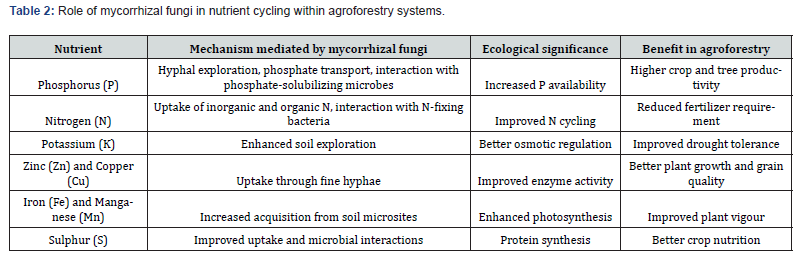
Therefore, mycorrhizal fungi serve as biological connectors linking plants, soil, and microorganisms into an integrated nutrient cycling network. Their multifunctional role extends beyond nutrient acquisition to encompass nutrient conservation, microbial regulation, and ecosystem resilience. Consequently, promoting mycorrhizal diversity through appropriate agroforestry management practices represents an effective strategy for enhancing soil fertility while, reducing dependence on external fertilizer inputs (Table 2).
Mycorrhizal Fungi, Soil Health and Carbon Sequestration
Soil health is increasingly recognized as the foundation of sustainable agricultural production because it determines the capacity of soil to support plant growth, regulate nutrient cycling, maintain biodiversity, and provide essential ecosystem services. In agroforestry systems, soil health is influenced by the combined effects of trees, crops, litter inputs, root dynamics, and diverse soil microbial communities. Among these biological components, mycorrhizal fungi play a central role in maintaining soil quality through their influence on soil structure, organic matter dynamics, microbial diversity, and carbon stabilization (Lehmann et al., 2020) Rillig et al., [42]. Their contribution extends beyond plant nutrition to the regulation of fundamental ecological processes that enhance both soil fertility and ecosystem resilience.
Mycorrhizal fungi and soil aggregation
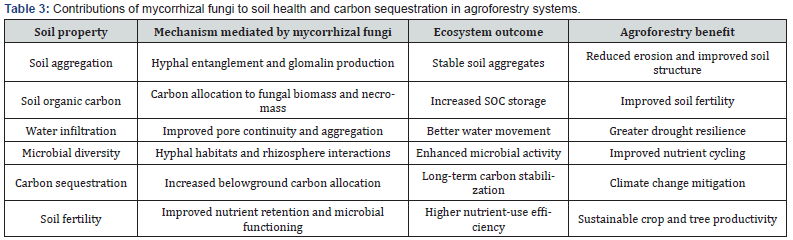
One of the most important contributions of mycorrhizal fungi to soil health is the improvement of soil structure through aggregate formation. Soil aggregates are groups of mineral particles bound together by organic matter, fungal hyphae, root exudates, and microbial products. Stable aggregates improve soil porosity, aeration, infiltration, and resistance to erosion while creating favourable habitats for beneficial microorganisms Rillig [17]. Arbuscular mycorrhizal fungi contribute directly to aggregate stability through two complementary mechanisms. First, their extensive extraradical hyphae physically enmesh soil particles into larger and more stable aggregates. Second, they produce glomalin-related soil proteins (GRSP), which function as natural binding agents that cement mineral particles and organic matter together (Wright and Upadhyaya, 1998). The accumulation of glomalin has been positively associated with improved aggregate stability, reduced soil erosion, and increased water retention in numerous agricultural and forest ecosystems Rillig [17]; Lehmann and Rillig [18].
Agroforestry systems generally exhibit greater aggregate stability than conventional croplands because continuous litter deposition, perennial root systems, and reduced soil disturbance promote the development of abundant mycorrhizal hyphae. Consequently, soils under agroforestry are often characterized by improved physical structure, lower bulk density, enhanced infiltration, and greater resistance to compaction (Cardinael et al., 2018).
Soil organic carbon dynamics
Soil organic carbon (SOC) is one of the most widely used indicators of soil health because it influences nutrient availability, microbial activity, cation exchange capacity, water-holding capacity, and soil structural stability. Maintaining high SOC levels is essential for sustaining long-term agricultural productivity while simultaneously mitigating climate change through carbon storage Lal [43]. Mycorrhizal fungi contribute to SOC accumulation through several interconnected pathways. Host plants allocate a substantial proportion of their photosynthetically fixed carbon to fungal partners, where it is incorporated into fungal biomass and subsequently transferred into soil following hyphal turnover. This fungal-derived carbon contributes to the formation of relatively stable organic matter pools that remain protected within soil aggregates for extended periods Cotrufo et al., [44].
In agroforestry systems, continuous carbon inputs from tree litter, root exudates, and fine-root turnover create favourable conditions for microbial activity and organic matter accumulation. Mycorrhizal fungi accelerate these processes by enhancing nutrient availability, stimulating root growth, and promoting efficient carbon allocation belowground. Consequently, agroforestry systems frequently accumulate greater soil organic carbon than annual cropping systems because perennial vegetation maintains continuous biological activity throughout the year Nair et al., [41]; Cardinael et al., [45]. Recent studies further indicate that mycorrhizal fungi influence not only the quantity but also the quality of soil organic matter. Fungal residues, including chitin-rich cell wall components and microbial necromass, contribute significantly to long-term carbon stabilization by forming organo-mineral complexes that are resistant to microbial decomposition (Lehmann et al., 2020). These findings have shifted the traditional view that plant residues alone determine soil carbon sequestration and emphasize the importance of microbial processes in long-term carbon storage.
Role in carbon sequestration and climate change mitigation
Carbon sequestration has become an important component of climate-smart agriculture because increasing atmospheric carbon dioxide concentrations contribute directly to global climate change. Agroforestry is widely recognized as one of the most effective land-use systems for atmospheric carbon removal because it simultaneously stores carbon in aboveground biomass, belowground roots, and soil organic matter IPCC [5]. Mycorrhizal fungi significantly enhance carbon sequestration by increasing plant productivity, improving nutrient-use efficiency, and promoting belowground carbon allocation. Enhanced nutrient acquisition enables plants to maintain higher photosynthetic rates, resulting in greater biomass production and increased carbon inputs into the soil Averill et al., [46]. In addition, fungal hyphae transport plant-derived carbon into deeper soil layers where decomposition rates are slower, thereby increasing long-term carbon storage. The role of different mycorrhizal guilds in carbon sequestration varies according to their ecological strategies.
Ectomycorrhizal fungi often reduce decomposition rates by competing with saprotrophic microorganisms for nitrogen, thereby slowing organic matter breakdown and increasing soil carbon accumulation. This mechanism, sometimes referred to as the Gadgil effect, has been proposed as one explanation for the relatively high carbon storage observed in ectomycorrhizal forest ecosystems Fernandez and Kennedy [47]. In contrast, arbuscular mycorrhizal fungi primarily promote carbon stabilization through improved soil aggregation and glomalin production rather than by suppressing decomposition. Despite growing evidence supporting the role of mycorrhizal fungi in carbon sequestration, considerable uncertainty remains regarding the magnitude of their global contribution. Carbon storage varies substantially with climate, vegetation type, soil texture, fungal community composition, and land management practices. Therefore, future studies should combine long-term field experiments with isotopic tracing and ecosystem modelling to quantify the relative contributions of different mycorrhizal groups to terrestrial carbon cycling (Lehmann et al., 2020).
Influence on soil microbial diversity and ecosystem functioning
Healthy soils support diverse microbial communities that regulate decomposition, nutrient mineralization, disease suppression, and organic matter turnover. Mycorrhizal fungi contribute significantly to microbial diversity by modifying rhizosphere chemistry through root exudation and carbon allocation. Their hyphal networks create microsites that serve as habitats for bacteria and other fungi, thereby increasing microbial abundance and functional diversity Johansson et al., [39]. Interactions between mycorrhizal fungi and other beneficial microorganisms frequently result in synergistic effects on soil functioning. For example, phosphate-solubilizing bacteria, nitrogen-fixing bacteria, and arbuscular mycorrhizal fungi often coexist within the rhizosphere, collectively improving nutrient cycling and plant growth beyond the contribution of any single microbial group Barea et al., [37]. Such microbial interactions are particularly important in agroforestry systems where continuous organic matter inputs and diverse root systems maintain favourable conditions for complex belowground food webs.
Advances in metagenomics and high-throughput sequencing have revealed that agroforestry systems generally harbour richer microbial communities than conventional agricultural systems. Increased microbial diversity enhances functional redundancy, ensuring that critical ecosystem processes such as nutrient cycling and decomposition continue even under environmental disturbances. Consequently, conservation of mycorrhizal diversity should be considered a key objective of sustainable agroforestry management.
Implications for sustainable soil management
The contribution of mycorrhizal fungi to soil health has important implications for sustainable land management. Agricultural practices that minimize soil disturbance, maintain continuous vegetation cover, diversify cropping systems, and increase organic matter inputs generally promote mycorrhizal abundance and activity. Conversely, intensive tillage, excessive fertilizer application, and prolonged fallow periods frequently reduce fungal diversity and disrupt hyphal networks, thereby limiting ecosystem functioning Johnson et al., [48]; Brito et al., [36]. Integrating mycorrhizal management into agroforestry practices may therefore provide a cost-effective and environmentally sustainable strategy for restoring degraded soils while improving nutrient-use efficiency and reducing greenhouse gas emissions associated with fertilizer production. Such biologically based approaches align closely with the principles of regenerative agriculture and climate-smart land management, emphasizing ecosystem processes rather than external chemical inputs (Table 3).
Conclusion
Mycorrhizal fungi constitute one of the most important biological components of agroforestry ecosystems because of their multifunctional role in maintaining soil fertility, improving plant nutrition, and enhancing ecosystem sustainability. Through mutually beneficial associations with plant roots, these fungi facilitate the uptake of essential nutrients, particularly phosphorus and nitrogen, improve water absorption, and promote efficient nutrient cycling within tree–crop systems. Their extensive hyphal networks not only increase the effective absorptive surface area of roots but also contribute to nutrient redistribution, thereby improving resource-use efficiency and reducing dependence on synthetic fertilizers. Beyond their nutritional functions, mycorrhizal fungi play a pivotal role in improving soil health by enhancing soil aggregation, increasing microbial diversity, stabilizing soil organic carbon, and promoting long-term carbon sequestration. These processes collectively improve soil structure, water-holding capacity, nutrient retention, and biological activity, thereby increasing the resilience of agroforestry systems to environmental stresses and supporting sustainable land management.
In addition, the integration of perennial trees with annual crops creates favourable conditions for the establishment of diverse mycorrhizal communities and common mycorrhizal networks, which further strengthen ecosystem functioning through belowground ecological interactions. Although considerable progress has been made in understanding mycorrhizal ecology, important knowledge gaps remain regarding the functional diversity of indigenous fungal communities, host specificity, long-term ecosystem responses, and the effectiveness of mycorrhizal inoculation under different agroforestry systems and environmental conditions. Future research integrating molecular ecology, soil microbiology, and ecosystem modelling will enhance our understanding of these complex interactions and facilitate the development of site-specific mycorrhizal management strategies. Overall, mycorrhizal fungi should be regarded as indispensable partners in sustainable agroforestry rather than merely beneficial soil microorganisms. Their capacity to improve nutrient-use efficiency, maintain soil health, enhance carbon sequestration, and strengthen ecosystem resilience highlights their significant potential in addressing contemporary challenges related to food security, soil degradation, and climate change. Promoting the conservation and effective management of mycorrhizal communities will therefore be essential for developing resilient, productive, and environmentally sustainable agroforestry systems in the future.
- Tilman D, Cassman KG, Matson PA (2002) Agricultural sustainability and intensive production practices. Nature 418: 671-677.
- Foley JA (2011) Solutions for a cultivated planet. Nature 478: 337-342.
- Nair PKR (1993) An Introduction to Agroforestry. Kluwer Academic Publishers.
- Jose S (2009) Agroforestry for ecosystem services and environmental benefits: An overview. Agroforestry Systems 76: 1-10.
- IPCC (2019) Climate Change and Land: An IPCC Special Report.
- Smith SE, Read DJ (2008) Mycorrhizal Symbiosis (3rd) Academic Press.
- Brundrett MC (2002) Coevolution of roots and mycorrhizas of land plants. New Phytologist 154(2): 275-304.
- Field KJ, Pressel S, Duckett JG, Rimington WR, Bidartondo MI (2015) Symbiotic options for the conquest of land. Trends in Ecology & Evolution 30(8): 477-486.
- Bonfante P, Genre A (2010) Mechanisms underlying beneficial plant-fungus interactions in mycorrhizal symbiosis. Nature Communications 1: 48.
- Tedersoo L, Bahram M, Zobel M (2020) How mycorrhizal associations drive plant population and community biology. Science 367: 1223.
- Smith FA, Smith SE (2011) Roles of arbuscular mycorrhizas in plant nutrition and growth. Annual Review of Plant Biology 62: 227-250.
- Richardson AE, Barea JM, McNeill AM, Prigent-Combaret C (2009) Acquisition of phosphorus and nitrogen in the rhizosphere and plant growth promotion by microorganisms. Plant and Soil 321: 305-339.
- Augé RM (2001) Water relations, drought and vesicular-arbuscular mycorrhizal symbiosis. Mycorrhiza 11: 3-42.
- Begum N, Qin C, Ahanger MA (2019) Role of arbuscular mycorrhizal fungi in plant growth regulation: Implications in abiotic stress tolerance. Frontiers in Plant Science 10: 1068.
- Van Der Heijden MGA, Martin FM, Selosse MA, Sanders IR (2015) Mycorrhizal ecology and evolution: The past, the present, and the future. New Phytologist 205(4): 1406-1423.
- Simard SW, Beiler KJ, Bingham MA (2012) Mycorrhizal networks: Mechanisms, ecology and modelling. Fungal Biology Reviews 26: 39-60.
- Rillig MC (2004) Arbuscular mycorrhizae, glomalin, and soil aggregation. Canadian Journal of Soil Science 84: 355-363.
- Lehmann A, Rillig MC (2015) Understanding mechanisms of soil biota involvement in soil aggregation. New Phytologist 205: 585-587.
- Bahram M, Hildebrand F, Forslund SK (2018) Structure and function of the global topsoil microbiome. Nature 560: 233-237.
- Brundrett MC, Tedersoo L (2018) Evolutionary history of mycorrhizal symbioses and global host plant diversity. New Phytologist 220(4): 1108-1115.
- Genre A, Lanfranco L, Perotto S, Bonfante P (2020) Unique and common traits in mycorrhizal symbioses. Nature Reviews Microbiology 18(11): 649-660.
- Cardinael R (2015) Impact of alley cropping agroforestry on stocks, forms and spatial distribution of soil organic carbon. Agriculture, Ecosystems & Environment 199: 150-160.
- Bainard LD, Koch AM, Gordon AM, Klironomos JN (2012) Growth response of crops to soil microbial communities from conventional and tree-based intercropping systems. Plant and Soil 363: 345-356.
- Davison J (2015) Global assessment of arbuscular mycorrhizal fungus diversity reveals very low endemism. Science 349: 970-973.
- Parniske M (2008) Arbuscular mycorrhiza: The mother of plant root endosymbioses. Nature Reviews Microbiology 6: 763-775.
- Chen M, Arato M, Borghi L (2018) Beneficial services of arbuscular mycorrhizal fungi - From ecology to application. Frontiers in Plant Science 9: 1270.
- Martin F, Kohler A, Murat C (2016) Unearthing the roots of ectomycorrhizal symbioses. Nature Reviews Microbiology 14(12): 760-773.
- Lindahl BD, Tunlid A (2015) Ectomycorrhizal Fungi-Potential organic matter decomposers. New Phytologist 205(4): 1443-1447.
- Cairney JWG, Meharg AA (2003) Ericoid mycorrhiza: A partnership that exploits harsh edaphic conditions. European Journal of Soil Science 54: 735-740.
- Dearnaley JDW, Martos F, Selosse MA (2012) Orchid mycorrhizas: Molecular ecology, physiology, evolution and conservation aspects. Fungal Associations. Academic Press.
- Teste FP, Simard SW, Durall DM (2009) Access to mycorrhizal networks and roots of trees: Importance for seedling survival and growth. Ecology 90(10): 2808-2822.
- Van Der Heijden MGA, Horton TR (2009) Socialism in soil? The importance of mycorrhizal fungal networks for facilitation in natural ecosystems. Journal of Ecology 97: 1139-1150.
- Karst J (2023) The cautionary tale of common mycorrhizal networks. Nature Ecology & Evolution 7: 1680-1688.
- Bever JD, Dickie IA, Facelli E (2010) Rooting theories of plant community ecology in microbial interactions. Trends in Ecology and Evolution 25(8): 468-478.
- Johnson NC (2010) Resource stoichiometry elucidates the structure and function of arbuscular mycorrhizas. New Phytologist 185(3): 631-647.
- Brito I, Goss MJ, De Carvalho M, Chatagnier O, Van Tuinen D (2012) Impact of tillage on arbuscular mycorrhizal fungal communities. Soil Biology & Biochemistry 54: 1-8.
- Barea JM, Pozo MJ, Azcón R, Azcón-Aguilar C (2005) Microbial cooperation in the rhizosphere. Journal of Experimental Botany 56(417): 1761-1778.
- Hodge A, Fitter AH (2010) Substantial nitrogen acquisition by arbuscular mycorrhizal fungi from organic material. Nature 413: 297-299.
- Johansson JF, Paul LR, Finlay RD (2004) Microbial interactions in the mycorrhizosphere and their significance for sustainable agriculture. FEMS Microbiology Ecology 48(1): 1-13.
- Artursson V, Finlay RD, Jansson JK (2006) Interactions between arbuscular mycorrhizal fungi and bacteria and their potential for stimulating plant growth. Environmental Microbiology 8(1): 1-10.
- Nair PKR, Kumar BM, Nair VD (2010) Carbon sequestration in agroforestry systems. Advances in Agronomy 108: 237-307.
- Rillig MC (2021) The role of multiple global change factors in driving soil functions and microbial communities. Science 371: 7496.
- Lal R (2020) Soil organic matter and water retention. Agronomy Journal 112: 3265-3277.
- Cotrufo MF, Wallenstein MD, Boot CM, Denef K, Paul E (2013) The Microbial Efficiency-Matrix Stabilization (MEMS) framework integrates plant litter decomposition with soil organic matter stabilization. Global Change Biology 19(4): 988-995.
- Cardinael R (2017) Revisiting IPCC Tier 1 coefficients for soil organic carbon storage in agroforestry systems. Environmental Research Letters 12: 124020.
- Averill C, Turner BL, Finzi AC (2014) Mycorrhiza-mediated competition between plants and decomposers drives soil carbon storage. Nature 505(7484): 543-545.
- Fernandez CW, Kennedy PG (2016) Revisiting the Gadgil effect. New Phytologist 209: 1382-1394.
- Johnson NC, Graham JH, Smith FA (1997) Functioning of mycorrhizal associations along the mutualism-parasitism continuum. New Phytologist 135: 575-586.

























