




 AIBM Home



Torque Teno Virus as a Viral Indicator of Fecal Contamination in Water and Wastewater Environments in Egypt
Sahar Abd Al-Daim*
Environmental Virology Lab, Water Pollution Research Department, Environment and Climate Change Institute, National Research Centre, 12622 Dokki, Giza, Egypt
Submission:May 11, 2026; Published: May 22, 2026
*Corresponding author:Sahar Abd Al-Daim, Environmental Virology Lab, Water Pollution Research Department, Environment and Climate Change Institute, National Research Centre, 12622 Dokki, Giza, Egypt
Sahar Abd Al-D. Torque Teno Virus as a Viral Indicator of Fecal Contamination in Water and Wastewater Environments in Egypt. Adv Biotech & Micro. 2026; 19(4): 556016.DOI:10.19080/AIBM.2026.19.556016
Abstract
Torque teno virus (TTV), a non-enveloped, single-stranded circular DNA virus belonging to the family Anelloviridae, is highly prevalent in human populations and increasingly detected in environmental matrices. Due to its environmental stability and resistance to wastewater treatment processes, TTV has been proposed as a potential viral indicator of fecal contamination. In this study, the occurrence of TTV DNA was investigated in various environmental matrices collected from different locations in Egypt, including wastewater, surface water, irrigation water, fresh vegetables, and shellfish. Viral DNA was detected using semi-nested polymerase chain reaction (PCR). TTV DNA was identified in surface water (20%), irrigation water (50%), and wastewater treatment plant samples, with detection rates of 75%, 58.3%, and 83.3% in influent, effluent, and sludge samples from Zenin WWTP, respectively, and 50%, 33.3%, and 83.3% in corresponding samples from El-Gabal El-Asfar WWTP. In contrast, all examined fresh vegetable and shellfish samples were negative for TTV DNA. The frequent detection of TTV in treated effluents and sludge highlights the persistence of viral contamination despite conventional wastewater treatment processes. These findings support the applicability of TTV as a viral indicator of fecal pollution in water environments and emphasize the need for incorporating viral indicators into routine water quality monitoring programs to better protect public health.
Keywords: Torque Teno Virus; Wastewater; Irrigation Water; Surface Water; Fecal Indicator
Abbrevations: TTV: Torque Teno Virus; PCR: Polymerase Chain Reaction; DNA: Deoxyribonucleic Acid; WWTP: Wastewater Treatment Plant
Introduction
Waterborne viral contamination represents a significant public health concern, particularly in regions where surface waters and treated wastewater are reused for irrigation or discharged into the environment. Unlike bacterial indicators, viruses exhibit a higher resistance to environmental stressors and wastewater treatment processes, and their presence in water systems may pose health risks even when bacterial parameters comply with regulatory standards. Torque teno virus (TTV) was first identified in a patient with post-transfusion hepatitis of unknown etiology and is classified as a small, non-enveloped virus with a circular, single-stranded negative-sense DNA genome of approximately 3.8 kb [1]. The viral genome contains three open reading frames (ORF1-ORF3) and a highly conserved untranslated region, which is commonly targeted for molecular detection [2]. Although TTV is not currently recognized as a primary causative agent of a specific disease, it establishes persistent infections and exhibits an exceptionally high prevalence in human populations worldwide [1,3].
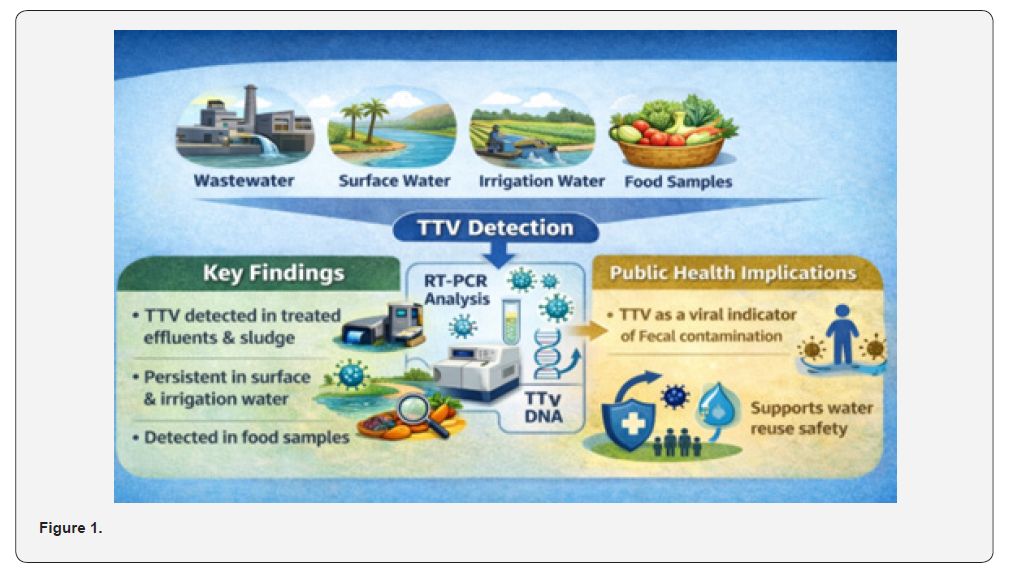
Several studies have reported associations between TTV infection and various pathological conditions, including hepatitis, lymphoproliferative disorders, autoimmune diseases, respiratory infections, and malignancies, particularly in cases of co-infection with other viruses [4-7]. However, the clinical significance of TTV remains incompletely understood. Beyond clinical samples, TTV has been increasingly detected in environmental matrices such as wastewater, rivers, and surface water bodies, supporting fecaloral transmission as a major route of dissemination [8-10]. Due to its high prevalence, environmental stability, and resistance to conventional wastewater treatment processes, TTV has been proposed as a potential viral indicator of fecal contamination in aquatic environments [9,11]. Previous investigations have demonstrated the presence of TTV DNA in treated wastewater effluents, raising concerns regarding the efficiency of current treatment systems for viral removal [8,11]. In Egypt, routine water quality assessment relies mainly on bacterial indicators, while data on viral contamination remain limited. Information regarding the environmental distribution of TTV is particularly scarce. Therefore, the present study aimed to investigate the occurrence of TTV DNA in wastewater, surface water, irrigation water, fresh vegetables, and shellfish collected from different Egyptian locations. By evaluating the environmental prevalence of TTV, this study seeks to provide baseline data for viral fecal pollution assessment and to support the inclusion of viral indicators in water quality monitoring programs (Figure 1).
Materials and Methods
Sample collection
Samples of wastewater (inlet, outlet, and sludge), surface water, irrigation water, fresh vegetables, and shellfish were collected from different locations in Egypt between January 2024 and July 2025. Wastewater samples were obtained monthly from Zenin WWTP (Giza) and El-Gabal El-Asfar WWTP (Cairo). Irrigation and surface water samples were collected from Damanhur villages and Mahmoudia canal, respectively. Fresh vegetable and shellfish samples were collected from local markets.
Virus concentration
Water and wastewater samples (2 L) were filtered through negatively charged nitrocellulose membranes and concentrated using the organic flocculation method as described by Katznelson et al. [12]. Sludge samples (100 g) were processed using beef extract-glycine buffer (pH 9.5), followed by centrifugation and reconcentration according to EPA guidelines [13]. Concentration of viruses from vegetables and shellfish was performed as previously described by Al-Daim [14-16].
DNA extraction and semi-nested PCR
Viral DNA was extracted using the GeneJET Viral DNA and RNA Extraction Kit (Thermo Scientific, Lithuania) according to the manufacturer’s instructions. Semi-nested PCR targeting the 3′-nontranslated region (3′-NTR) of the TTV genome was performed using primers described by Biagini et al. [17]. PCR products were analyzed by agarose gel electrophoresis (1.5%) and visualized under UV illumination [18].
Result
Occurrence of TTV in different environmental matrices
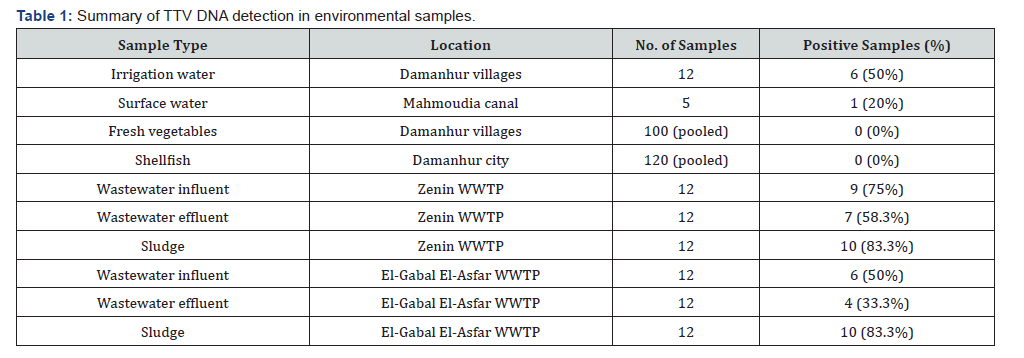
Torque teno virus (TTV) DNA was detected in several environmental water matrices, whereas all examined food-related samples were negative. Irrigation water samples collected from Damanhur villages showed a positivity rate of 50% (6/12). Surface water samples collected from Mahmoudia canal exhibited a lower detection rate of 20% (1/5). In contrast, no TTV DNA was detected in any of the analyzed fresh vegetable or shellfish samples. A total of 100 vegetable samples pooled into 20 composite samples and 120 shellfish samples pooled into 20 composite samples were all negative by semi-nested PCR.
Detection of TTV in wastewater treatment plants
A high prevalence of TTV DNA was observed in wastewater treatment plants. In Zenin WWTP, TTV DNA was detected in 75% of influent samples (9/12), 58.3% of effluent samples (7/12), and 83.3% of sludge samples (10/12). Similarly, El-Gabal El- Asfar WWTP showed detection rates of 50% (6/12) in influent, 33.3% (4/12) in effluent, and 83.3% (10/12) in sludge samples. The consistently higher detection rates in sludge compared with liquid phases indicate viral persistence and accumulation during treatment processes.
Temporal distribution of TTV in wastewater
Monthly monitoring from August 2024 to July 2025 revealed persistent detection of TTV DNA in wastewater samples from both treatment plants, with no clear seasonal pattern. Zenin WWTP showed an overall positivity rate of 72.2% (26/36 samples), while El-Gabal El-Asfar WWTP exhibited a total detection rate of 55.5% (20/36 samples), suggesting year-round circulation of TTV in wastewater systems.
Summary of TTV detection in environmental samples
Table 1 summarizes the prevalence of TTV DNA detected in the different environmental matrices examined in this study
Discussion
The present study demonstrates a high prevalence of Torque teno virus (TTV) DNA in wastewater, irrigation water, and surface water samples collected from different locations in Egypt, confirming the ubiquitous nature of this virus in aquatic environments. These findings are consistent with previous reports indicating widespread environmental circulation of TTV and support its potential role as an indicator of viral fecal contamination. The frequent detection of TTV in wastewater influent and effluent samples observed in this study is comparable to findings reported from Japan, where Haramoto et al. [8] detected TTV DNA in both wastewater and river water, highlighting the persistence of the virus throughout wastewater treatment processes. Similarly, studies conducted in European countries, including Italy and Germany, have reported the presence of TTV in treated effluents, emphasizing the resistance of non-enveloped viruses to conventional wastewater treatment methods [9,11].
In the present study, TTV DNA was detected in treated effluents from both Zenin and El-Gabal El-Asfar wastewater treatment plants, with detection rates ranging from 33.3% to 58.3%. These values are comparable to those reported in European wastewater treatment facilities, where incomplete viral removal has been commonly observed despite compliance with bacterial quality standards [11]. The consistently higher detection rates of TTV DNA in sludge samples in this study further support observations from previous investigations indicating viral adsorption and accumulation in solid phases during wastewater treatment [8,11]. The detection of TTV in surface water and irrigation water samples in this study is in agreement with reports from Brazil, where Diniz-Mendes et al. [9] identified TTV DNA in environmental water samples, suggesting fecal contamination and environmental persistence. The presence of TTV in irrigation water is of particular concern, as it reflects potential viral exposure pathways through agricultural reuse of water, especially in regions experiencing water scarcity.
In contrast, no TTV DNA was detected in fresh vegetable or shellfish samples analyzed in the current study. Similar negative findings have been reported in some environmental investigations, where viral contamination of food matrices was sporadic or below detection limits [10]. Nevertheless, the absence of detectable TTV DNA in these samples should be interpreted with caution, as uneven viral distribution, low viral loads, or methodological limitations may influence detection outcomes. The year-round detection of TTV DNA in wastewater samples from both treatment plants indicates continuous viral circulation without a clear seasonal trend, consistent with previous reports describing persistent shedding of TTV in human populations [1,3]. This continuous presence supports the suitability of TTV as a stable viral marker for long-term monitoring of fecal contamination in water environments. Overall, the findings of this study reinforce previous evidence from Asia, Europe, and South America regarding the environmental persistence of TTV and its resistance to wastewater treatment processes. In regions such as Egypt, where routine viral monitoring is limited, the incorporation of TTV as a complementary viral indicator alongside traditional bacterial parameters could provide a more accurate assessment of water quality and associated public health risks.
Environmental and Public Health Significance
The presence of TTV DNA in environmental waters and wastewater highlights the potential risk of viral exposure associated with water reuse and inadequate wastewater treatment. Incorporating viral indicators such as TTV into water quality monitoring programs could improve risk assessment and support public health protection, particularly in regions facing increasing water scarcity and reliance on reclaimed water.
Conclusion
This study demonstrates the widespread presence of Torque teno virus (TTV) DNA in wastewater, surface water, and irrigation water collected from different locations in Egypt, highlighting the persistence of viral contamination in aquatic environments. The frequent detection of TTV in wastewater treatment plant effluents and sludge indicates that conventional treatment processes may not be sufficient for effective viral removal. The consistent occurrence of TTV across different water matrices, combined with its high environmental stability, supports its suitability as a viral indicator of fecal contamination. In contrast, the absence of detectable TTV DNA in fresh vegetable and shellfish samples suggests a limited contribution of these food products to viral transmission under the investigated conditions, although further large-scale and quantitative studies are warranted. Overall, the findings provide baseline data on environmental TTV distribution in Egypt and emphasize the importance of incorporating viral indicators into routine water quality monitoring programs. The adoption of such indicators could enhance public health risk assessment, particularly in regions facing increasing reliance on wastewater reuse and surface water resources.
- Nishizawa T, Okamoto H, Konishi K, Yoshizawa H, Miyakawa, Y et al. (1997) A novel DNA virus (TTV) associated with post-transfusion hepatitis of unknown etiology. Biochem Biophys Res Commun 241: 92-97.
- Okamoto H (2009) History of discoveries and clinical implications of TT viruses. J Gastroenterol 44: 293-312.
- Poovorawan Y, Chatchatee P, Theamboonlers A (2007) TT virus infection in infants and children. J Med Virol 79: 1174-1180.
- Szládek G, Juhász A, Kardos G, Szoke K, Major T, et al. (2005) Co-infection of TT virus and human papillomavirus in laryngeal carcinoma. Cancer Lett 227: 189-196.
- Garbuglia AR, Iezzi T, Capobianchi MR (2003) Detection of TT virus DNA in lymphomas. J Med Virol 70: 144-149.
- Garcia-Alvarez M, Pessôa R, Wigginton K (2013) Anelloviridae in human disease and the environment. Future Virol 8: 859-873.
- Spandole S, Cimponeriu D, Berca LM, Mihăescu G (2015) Human anelloviruses: an update. World J Gastroenterol 21: 1137-1145.
- Haramoto E, Katayama H, Oguma K, Ohgaki S (2010) Detection of TTV in wastewater and river water in Japan. Appl Environ Microbiol 76: 2626-2632.
- Diniz-Mendes L, De Paula VS, Luz SLB (2008) Detection of Torque teno virus in environmental water samples. J Appl Microbiol 105: 804-810.
- Verani M, Bigazzi R, Carducci A (2006) Viral contamination of surface waters. J Appl Microbiol 100: 834-841.
- Hamza IA, Jurzik L, Stang A, Wilhelm M (2011) TTV as a viral indicator of fecal contamination. Water Res 45: 1140-1148.
- Katznelson E, Mills D, Jamieson J (1976) Improved method for concentration of viruses from water. Appl Environ Microbiol 32: 638-639.
- US EPA (1984) Health Effects Criteria for Viruses. EPA.
- Al-Daim SA (2024) Detection of enteric viruses in fresh vegetables.
- Al-Daim SA (2024) Molecular detection of human enteric viruses in shellfish.
- Al-Daim SA (2024) Virological assessment of aquatic environments.
- Biagini P, Gallian P, Touinssi M (2001) High prevalence of TTV characterized by two PCR systems. J Med Virol 65: 192-198.
- Vaidya SR, Chitambar SD, Gopalkrishna V (2002) Detection of TTV in sewage. J Med Virol 66: 68-72.

























