

 AAPS Home



Exploring Associations between Categories of Qualitative Morphological Traits in Indigenous Cattle through the Use of Multiple Correspondence Analysis
Kefelegn Kebede*, Ilias Ame and Mengistu Urge
School of Animal and Range Sciences, Haramaya University, Haramaya, Ethiopia
Submission: July 15, 2023; Published: August 11, 2023
*Corresponding author: Kefelegn Kebede, School of Animal and Range Sciences, Haramaya University, Haramaya, Ethiopia
How to cite this article: Kefelegn K Ilias A, Mengistu U. Exploring Associations between Categories of Qualitative Morphological Traits in Indigenous Cattle through the Use of Multiple Correspondence Analysis. Arch Anim Poult Sci. 2023; 2(3):555586. DOI: 10.19080/AAPS.2023.04.555586
Abstract
Characterization of cattle breeds based on morphological traits variation is essential for planning breed improvement programs and conservation strategies. This study aimed to use multiple correspondence analysis to evaluate qualitative morphological traits of and identify significant traits. The study found variations in qualitative morphological traits in the Hararghe cattle ecotype populations in the three districts. These findings provide valuable information for the characterization and conservation of cattle ecotypes in Ethiopia. The first two dimensions of the multiple correspondence analysis explained 29% of the total variance among the traits. The bi-dimensional graph showed that the sample cattle population in the Mayyuu district exhibited a clustering effect, in which the presence of curved horn shape, large hump size, absence of navel flap, and varying sizes of large perpetual sheath were predominant; while the cattle population in the Kurfa district clustered together with not pigmented skin, muzzle, eyelid and horn colours, polled horn shape, and medium hump size. Similarly, the values associated with the Jarso district were found to cluster together based on the absence of a horn, straight horn shape, small hump size, and varying sizes of navel flap.
Keywords: Hararghe cattle; Multivariate analysis; Qualitative morphological traits
Introduction
With an estimated 60 million cattle, 60 million sheep and goats, 52 million poultry, 4.5 million camels, 10 million bee colonies, and 7.2 million horses, Ethiopia is endowed with enormous livestock resources and has the highest livestock population in Africa [1]. It is essential that livestock products and byproducts (such as live animals, hides, skins, meat, milk, cheese, honey, and eggs) give the necessary animal protein to help raise people’s nutritional status and also help to obtain foreign currency. However, draught animals are also necessary and provide draft power for ploughing and crop threshing in the country [2].
There are many indigenous breeds of cattle in Ethiopia that are adapted to a wide range of agro-ecological conditions. This diversity can serve as a genetic pool from which selection can be made for suitable strains and lines can be selected [3]. The genetic diversity within and among indigenous cattle breeds, as well as the genes and gene combinations they possess, are valuable for adapting to future changes in market conditions, social needs, advancements in human nutritional knowledge, threats to animal health, and overall climate changes [4]. Breed identification, estimation of their population size, documentation of their common uses, and description of the management systems in which they are maintained are the first pieces of information to be assessed before the improvement and conservation of animal genetic resources [5].
A large proportion of indigenous livestock populations in the developing world have not yet been fully characterized or evaluated at phenotypic and genetic levels [6]. The Harar cattle breed (also not adequately characterized) inhabits the Hararghe area of eastern Ethiopia where they are mainly used for meat, milk, and draught purposes. The breed is known to be one of the small East African zebus of Ethiopia with good potential for milk and meat production [7].
Even though phenotypic characterizations based on qualitative and quantitative morphological traits have been conducted [8–14] in different parts of Ethiopia the characterization work (especially for qualitative morphological traits) remains at a rudimentary level [15]. Especially, in the area of multivariate analysis, so far there are insufficient qualitative morphometric characterization studies conducted. The new direction for livestock classification and characterization is the application of multivariate statistical techniques [16-19]. These techniques are highly powerful in analyzing all morphological traits together and extracting the real variation within and among populations [20]. One of the critically important multivariate statistical tools for qualitative morphological traits is multiple correspondence analysis (MCA).
In many studies investigating breed characterization at the phenotypic level, for the analysis of qualitative morphological traits, contingency table analysis (Pearson’s chi-square) is used. However, contingency tables have drawbacks including not precisely measuring the nature of the correlation between two traits and traits with many categories requiring large tables that are difficult to manage. Again, categories with few observations obfuscate the bivariate correlation and the Chi-square test cannot provide predicted values. Above all contingency tables can only be used to analyze the effect of a single categorical variable on the response.
The current study was thus intended to overcome the limitations of contingency tables by using MCA to evaluate qualitative morphological traits and identify significant traits compared to contingency table analysis. The study will thereby increase and promote the adoption of MCA by researchers in the field and help find the relative closeness of the key correlation factors so that necessary actions can be taken to the development of suitable policies for designing breeding programs and conservation.
Materials and Methods
Study area location
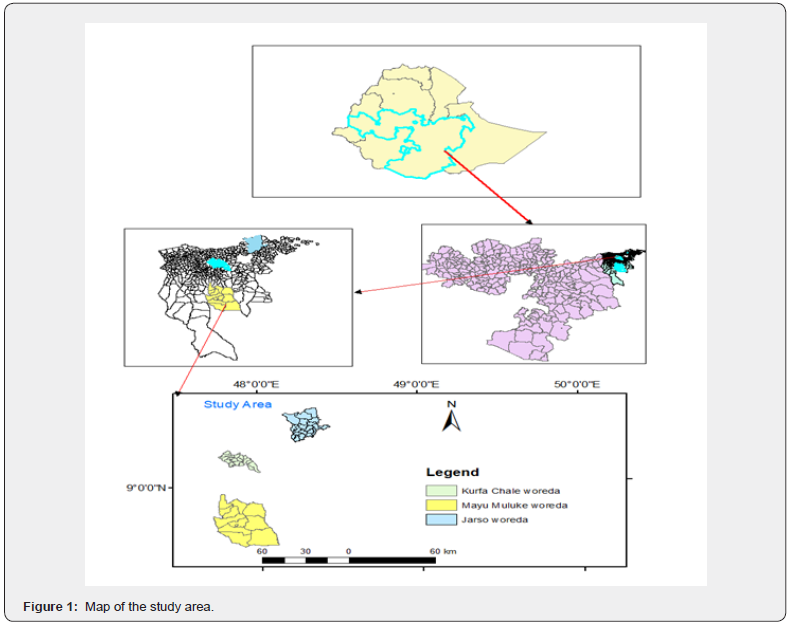
This study was conducted in three districts of the East Hararghe zone of the Oromia Regional State, Ethiopia. The geographic nature of the East Hararghe zone is characterized as 8% high land, 25% midland, and 67% low land with an altitude range from 500-3405 masl and a temperature range from 130C to 280C. The average annual rainfall of the zone is 400-1200 mm (East Hararghe Zone Agricultural Office) (Figure 1).
Sampling techniques for data collection
Discussions were held with the district experts of the rural and agricultural development offices and the farmers’ representatives regarding the distribution of local cattle in the study area dominated by the Hararghe highland cattle population. Purposive selection was employed first, wherein three districts were selected based on the distribution of the Hararghe highland cattle population and their mobility. In the second stage, two kebeles from each district were selected based on their suitability for cattle production, accessibility, and the willingness of farmers to participate in the study. Finally, sample cattle owners were randomly selected using a systematic sampling procedure.
In collecting data on qualitative morphological traits, the format adopted from the standard description list developed by [6] was utilized. Thus, qualitative morphological traits collected in this study were hair coat colour pattern, hair coat colour, skin colour, muzzle colour, eyelid colour, hoof colour, presence of horn, horn orientation, hair length, ear shape, ear orientation, hump size, navel flap, perpetual sheath, head profile and tail length.
Statistical data analysis
SAS-program version 9.4 [21] was used for all statistical analyses in this study.
Exploratory data analysis
To obtain descriptive statistics and chi-square tests, the qualitative morphological traits underwent exploratory data analysis using the PROC FREQ procedures of SAS [21]. The contingency tables (Pearson’s Chi-square) were employed in analysing the data.
Multiple Correspondence Analysis (MCA)
To ascertain potential correlations among more than two categorical traits, MCA was utilized. MCA is a multivariate technique that is specifically designed to explore both inter- and intra-relations of two or more categorical variables by evaluating the proximity and distance among them [22-24]. The objective of MCA is to demonstrate the alterations of groupings in both rows and columns of categorical data that are arranged in a contingency table format, in a graphical representation that is situated in a lower-dimensional space [25]. This technique offers numerous advantages over alternative methodologies such as Chi-square analysis, G-test, Z-test, Fisher Exact test or Log-linear models, as it provides a more comprehensive and detailed understanding of the data and can present results in a visual format [23,26,27]. Using MCA, each level of the categorical traits is represented by a dot in a multi-dimensional space. The proximity of these dots to one another indicates their degree of similarity, based on the respective quadrants in which they are located. Conversely, dots that are situated far apart from each other are unrelated [28].
Results and Discussion
Exploratory data analysis
The table provides information on the coat colour pattern, coat colour type, skin colour, muzzle colour, and eyelid colour of the animals. The traits investigated demonstrated variability in terms of frequencies and percentages, particularly across varying districts (Table 1).
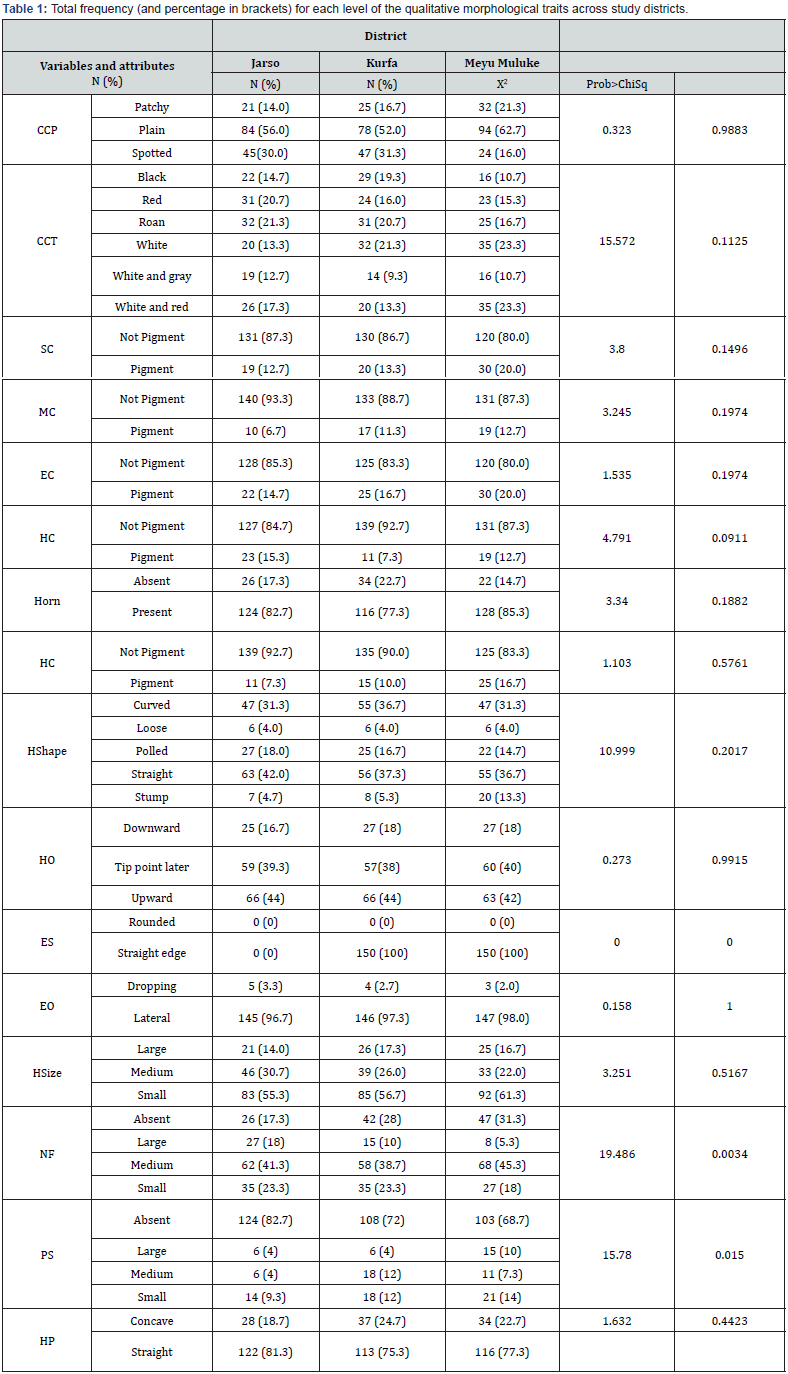
Values before brackets are frequencies while those in brackets are percentages; X2 = chi-square; *Significant at p<0.05; ns (not significant); CCP = coat colour pattern, CCT = coat colour type, SC = skin colour, MC = muzzle colour, EC = eyelid colour, HC = horn colour, HShape = Horn shape, HO = horn orientation, ES = ear size, EO = ear orientation, HSize = hump size, NF = navel flap, PS = perpetual sheath, and HP = head profile.
In all three districts, most observations for CCP were plain, followed by spotted and patchy. These results suggest that plain coat colour pattern is the most common attribute for CCP in all three districts. Similar reports were also found by [29] for local cattle in the Babile district, [30] for local cattle in the west Gojjam zone, and [31] for Begait cattle in Tahtay Adiabo district. Coat colour is used in cattle choice, ownership recognition, and calling [32]. The heterogeneity in the coat colour revealed the presence of several ecotypes within the breed, which need advanced research at a molecular level.
In all districts, white and red were the most common attributes for CCT, followed by roan, black, white and gray. The results suggest that white and red are the most common coat colour types. The high coat colour variability observed in the population implies the existence of heterogeneity within the breed. These multiple coat colour and colour pattern variations come from the preferential selection of the farmers toward animals with different coat colour patterns [33] and uncontrolled mating. In all three districts, the majority of observations for skin colour were not pigmented, suggesting that unpigmented SC is the most common attribute.
Muzzle colour: In all three districts, the majority of observations for muzzle colour were not pigmented.
Eyelid colour: In all three districts, the majority of observations for eyelid colour were not pigmented. The current research output agreed with that of [34] who found that most female cattle’s muzzle colour was pigmented, followed by non-pigmented, which was noted in both sexes in cattle from Gamo Gofa Zone South West Ethiopia. Presence of horn and horn colour: In all three districts, presence of horn was the most common attribute, followed by absent; while the majority of observations for horn colour were not pigmented. The current result was comparable to Arado cattle breed as indicated by [35], who found in the North- western zone of Tigray region and [36] for the Lidia cattle breed. This may be linked to a breed’s character, as well as having an aesthetic appeal for the breed’s owners. Horned cattle are visually attractive and may protect themselves and other groups of animals from attackers [37].
Horn shape and orientation: In all three districts, upward was the most common attribute for HO, followed by tip point later and downward; while upward horn orientation was the most common attribute, followed by tip point later and downward.
Ear size and orientation: In all three districts, all observations for ear size were straight edge; while the majority of observations for ear orientation were lateral, followed by dropping. The current research output agreed with those of [38] for Arsi-Bale cattle, [39] for Malle cattle, and [40] for local animal in the Hadiya zone.
Hump size: In all three districts, small hump size was the most common attribute, followed by medium and large. The current observation for hump size was similar to those of [41,42] for Begait cattle. Bulls with humps are well-structured and often moderate in size, while most cows have smaller humps [30,39].
Multivariate Analysis
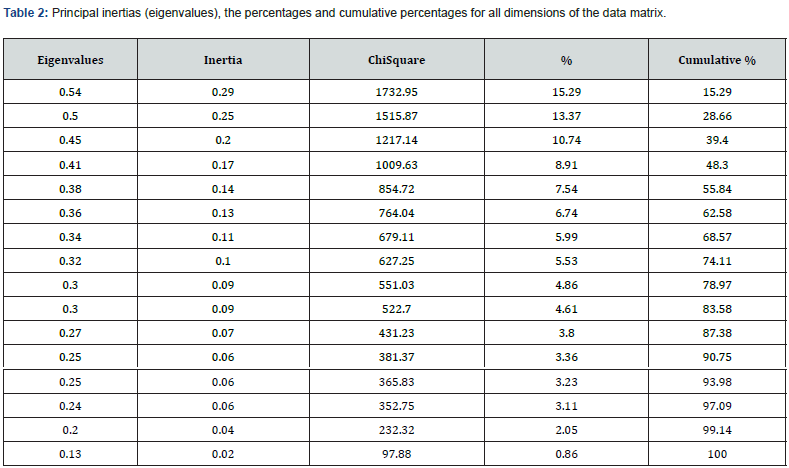
The measure of eigenvalues indicates the level of categorical information accounted for by each dimension. A higher eigenvalue signifies a larger amount of total variance among the traits on that particular dimension. Typically, the first two or three dimensions possess higher eigenvalues than the remaining dimensions. Table 2 provides the eigenvalues and percentages of variance of the dimensions. Furthermore, a steady decrease in eigenvalues is evident. The first principal axis accounted for 15% of the principal inertia, while the second principal axis accounted for 13%. Collectively, the first two principal axes accounted for 29% of the principal inertia. A similar study conducted by [29] revealed that the first two dimensions explained 18% of the total variations (Table 2).
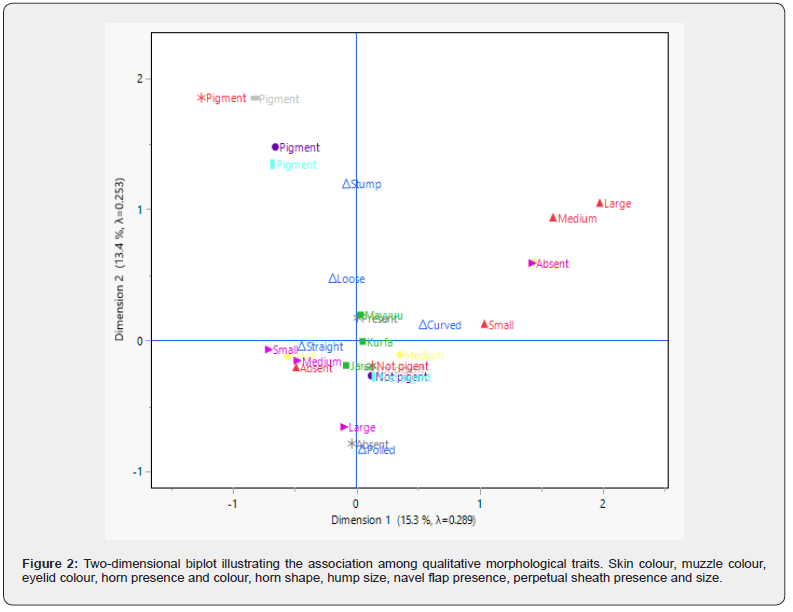
The MCA map was constructed step wisely. For each of the traits, the MCA was applied, and traits were selected using the squared cosine test. All traits with cos2 > 0.2 in at least one of the three first MCA dimensions were maintained. Figure 2 shows a bi-dimensional graph representing the associations among the categories of the analyzed traits. To examine the association between the districts and qualitative traits, the district was included in the analysis as a supplementary variable.
MCA may be elucidated as a visual depiction that generates a resolution wherein most associated categories are situated nearby while uncorrelated ones are positioned at a distance. Categories that are situated in proximity to the mean value are located closer to the origin of the MCA plot, whereas those that are situated further away are positioned at a greater distance. Thus, the dimensions are construed by the placement of the categories on the map, utilizing their loading over the dimensions as critical indicators.
On the dimensions identified Figure 2, it was observed that the cattle population in the Mayyuu district exhibited a clustering effect, in which the presence of curved horn shape, large hump size, absence of navel flap, and varying sizes of large perpetual sheath were predominant. Conversely, the cattle population in the Kurfa district clustered together having non pigmented skin, muzzle, eyelid and horn colours, polled horn shape, and medium hump size. Similarly, the values associated with the Jarso district were found to cluster together based on the absence of horn, straight horn shape, small hump size, and varying sizes of navel flap. Similar results were found when they reported that Neuquen Criollo breed could be characterized in different ecotypes.
Conclusion
Overall, these results of this study provided valuable insights into the distribution of qualitative morphological traits in cattle across the three districts. The use of the MCA method resulted in the identification of systematic relationships among traits and trait categories. In addition, it provided a unique and simplified interpretation of large complex data. Specifically, the aptitude of MCA to handle multidimensional data renders it as a valuable tool for investigating the factors that influence qualitative morphological traits. The outcomes of this investigation illuminate the pattern recognition of these traits and indicate the possibility for further research to consider additional traits and extensive datasets.
Conflict of Interest
Authors declare that there is no conflict of interest.
Acknowledgement
Haramaya University is acknowledged for supporting the research financially. Moreover, the authors are grateful to all farmers in the three districts who made available their animals for this study.
References
- Tegegne A, Feye G (2020) Study of Selected Livestock Innovations in Ethiopia.
- CSA (Central Statistics Agency) (2021) The federal democratic republic of Ethiopia. Agricultural sample survey. Report on livestock and livestock characteristics, Addis Ababa, Ethiopia.
- Bora SK, Tessema TS, Girmay G (2023) Genetic Diversity and Population Structure of Selected Ethiopian Indigenous Cattle Breeds Using Microsatellite Markers. Genet Res (Camb).
- Hoffmann I (2010) Climate change and the characterization, breeding and conservation of animal genetic resources. Animal genetics 41(Suppl 1): 32-46.
- Gizaw D (2013) On-Farm Phenotypic Characterization of Local Jijiga Cattle Breed and their Production System in Jijiga Zone, Somali, Ethiopia.
- Food and Agriculture Organization of the United Nations (FAO) (2012) Cattle descriptors. Draft guidelines on phenotypic characterization of animal genetic resources. FAO, Rome, Italy.
- Mustefa A, Aseged T, Sinkie S, Getachew F, Fekensa T, et al (2023) Phenotypic characterization of Harar and Ogaden cattle breeds of Ethiopia: The first step for conservation. Genetic Resources 4(7): 56–67.
- Mustefa A, Belayhun T, Melak A, Hayelom M, Tadesse D, et al. (2020). Phenotypic characterization of Raya cattle in northern Ethiopia. Tropical Animal Health and Production 53(1):1–11.
- Tadesse D, Ayalew W, Hedge B (2008) On farm phenotypic characterization of cattle genetic resources in south and north Wello zones of Amhara region, north eastern Ethiopia. Ethioipian Journal of Animal Pro-duction 8(1).
- Kebede FG, Ayalew W (2014) On-farm phenotypic characterization of indigenous cattle populations of Awi, east and west Gojjam zones of Amhara region, Ethiopia. Research Journal of Agriculture and Environ- mental Management 3(4):227–237.
- Tenagne A, Mekuriaw G, Kumar D (2016) Phenotypic Characterization of Indigenous Cattle Populations in West Gojjam Administrative Zones, Amhara National Regional State, Ethiopia. Journal of Life Science and Biomedicine (JLSB) 6(6): 127-138.
- Zegeye T, Belay G, Hanotte O (2021) Multivariate characterization of phenotypic traits of five native cattle populations from Tigray, Northern Ethiopia. Tropical Animal Health and Production 53(2): 1–15.
- Churchill RR, Jamima J, Machindra YS, Kanagaraju P, Srinivasan G (2019) Qualitative and morphometric characters of Aseel male chicken. International Journal of Current Microbiology and Applied Sciences 8(1), 1285–1289.
- Zeleke B, Getachew M, Worku K (2017) Phenotypic Characterization of Indigenous Cattle Populations in Gamo Gofa Zone South Western Ethiopia. European Journal of Biological Sciences 9(3): 124 –130.
- Weldegerima TM (2018) Characterization of productive and reproductive performances, morphometric and challenges and opportunities of indigenous cattle breeds of Ethiopia: A review. International Journal of Livestock Production 9(3): 29–41.
- Traore A, Tamboura HH, Kabore A, Royo LJ, Fernandez IVÁN, et al. (2008) Multivariate analyses on morphological traits of goats in Burkina Faso. Archives Animal Breeding 51: 588-600.
- Yakubu A, Akinyemi MO (2010) An evaluation of sexual size dimorphism in Uda sheep using multifactorial discriminant analysis. Acta Agriculturae Scand Section A 60: 74-78.
- Birteeb PT, Peters SO, Yakubu A, Adeleke MA Ozoje MO (2012) Multivariate characterization of the phenotypic traits of Djallonke and Sahel sheep in Northern Ghana. Tropical animal health and production 45: 267-274.
- Aziz MMA, Al Hur FS (2013) Differentiation between three Saudi goat types using Size-free Canonical Discriminant Analysis. Emirates Journal of Food and Agriculture 25(9): 723-735.
- Yakubu A, Ibrahim IA (2011) Multivariate analysis of morphostructural characteristics in Nigerian indigenous sheep. Italian Journal of Animal Science 10(2).
- SAS (Statistical Analysis System) (2016) SAS 9.4; Statistical analysis system. SAS Institute Inc., Cary, NC, USA.
- Chou RJ (1994) Multivariate Analysis and Its Application 194-210.
- Greenacre M (1998) Visualization of Categorical Data 107-112.
- Baspinar E, Mendes M (2002) Iki Yonlu Tablolarda Uyum Analizi Tekniginin Kullanimi the Usage of Correspondence Analysis Technique at the Contingency Tables.
- Ozdamar K (2002) Paket Programlar He Istatistik Veri Analizi II, (Multivariate Statistical Analysis), Kaan Kitabevi 4. Baski, IS- BN 975 6787 02 3.
- Gifi A (1990) Non-linear Multivariate Analysis. John Willey and Sons Ltd. West Sussex, England, pp. 579.
- Kaciak E, Louviere J (1990) Multiple Correspondence Analysis of Multiple-Choice Experiment Data, JMR 4: 455-466.
- Dunteman GH (1989) Principal Components Analysis, Sage Publication, Inc.
- Eshetu M, Annose DA, Tadesse YB, (2016) On-Farm Phenotypic Characterization of Indigenous Cattle and Their Production System in Babile District, East Hararge Zone, Oromiya Region, Ethiopia.
- Tenagne A, Mekuriaw G, Kumar D (2016) Phenotypic characterization of indigenous cattle populations in West Gojjam administrative zones, amhara National regional state, Ethiopia. J. Life Sci. Biomed 6(6): 127–138.
- Gebru T, Yigrem S, Banerjee S, (2017). Some morphometrical, production and reproduction traits of Begait cattle reared in Tigray region of Ethiopia. Wayamba J. Anim. Sci 1571–1585.
- Alebachew H (2017) On-Farm Phenotypic Characterization, Husbandry and Breeding Practices of Indigenous Cattle Breed in Selected Areas of Benishangul-Gumuz, Western Ethiopia.
- Terefe E, Haile A, Mulatu W, Dessie T, Mwai O (2015) Phenotypic characteristics and trypanosome prevalence of Mursi cattle breed in the Bodi and Mursi districts of South Omo Zone, southwest Ethiopia. Trop Anim Health Prod 47(3): 485–493.
- Lorato Y, Ahmed KM, Belay B (2017) Participatory identification of breeding objective traits of Woyto-Guji goat in Loma district, Southern Ethiopia. Int. J. Livest. Prod 8 (8): 131–135.
- Genzebu D (2009) On-Farm Phenotypic Characterization of Arado Cattle Breed in North West Zone of Tigray, Ethiopia. An MSc. Thesis Submitted to School of Graduate Studies, Addis Ababa University.
- Lomillos JM, Alonso ME (2020) Morphometric characterization of the Lidia cattle breed. Animals 10(7): 1180.
- Kugonza DR, Nabasirye M, Hanotte O, Mpairwe D, Okeyo AM (2012) Pastoralists’ indigenous selection criteria and other breeding practices of the long-horned Ankole cattle in Uganda. Trop. Anim. Health Prod 44(3): 557–565.
- Yimamu C, Kebede K (2014) In Situ Phenotypic Characterization and Production System Study of Arsi Cattle Type in Arsi Highland of Oromia Region, Ethiopia. Alemaya University.
- Getaneh D, Banerjee S, Taye M (2019) Morphometrical traits and structural indices of male cattle reared in the South Omo Zone of Southwest Ethiopia. Int. J. Vet. Sci. Res 5 (2): 32–47.
- Woldeyohannes T, Hankamo A, Banerjee S (2019) Morphological characterization and structural indices of indigenous cattle in Hadiya zone, southern Ethiopia. Glob. J. Anim. Sci. Res 7(2): 23–38.
- Ftiwi M, Tamir B (2015) On-farm phenotypic characterization of indigenous Begait cattle in Western Tigray, Northern Ethiopia. J. Anim. Prod. Adv 5 (7): 718–732.
- Lanari MR, Taddeo H, Domingo E, Centeno MM, Gallo L (2003) Phenotypic differentiation of exterior traits in local criollo goat population in Patagonia (Argentina). Archive Tierzh. Dummerstorf 46: 347–356.