




 PBSIJ Home




Abstract
Friendships play a central role in social and emotional development but can be strained by interpersonal conflict. This study examined how Big Five personality traits mediate the relationship between conflict-handling styles and friendship quality among 133 university students in Canada. Participants completed validated online measures of personality, conflict - handling styles, and friendship quality, including the Big Five Inventory, the Rahim Organizational Conflict Inventory–II, and the Friendship Quality Scale. The results showed that constructive conflicting handling styles, including collaborating, accommodating, and compromising, were associated with greater friendship quality, particularly closeness, help, and security, while avoiding and dominating related negatively. Agreeableness and conscientiousness fully mediated these associations, particularly the relationships between accommodating and closeness/security, and between compromising and help/companionship. These findings highlight the important role of personality in conflict resolution and suggest that personality-informed strategies may contribute to strengthen friendship quality in emerging adulthood.
Keywords: Big five personality, Conflict handling styles, Friendship quality, Emerging adulthood
Introduction
Friendships are a crucial aspect of social development and well-being [1], providing individuals with trust, empathy, acceptance, and emotional support [2]. Through friendships, individuals can enhance their social-emotional development by strengthening their essential communication skills. Interacting with peers also provides opportunities to develop cooperation, negotiation and conflict resolution skills, which can help individuals establish and maintain long-term relationships, which are essential for improving mental health, as they can reduce stress, alleviate symptoms of anxiety and depression [3,8]. The presence of supportive friends can reduce feelings of loneliness and social isolation. The quality of these friendships is influenced by various interpersonal factors, including personality traits, conflict-handling styles, and demographic factors such as age and gender [2,9&10]. Understanding how these variables influence friendship quality is essential for gaining deeper insights into the factors and mechanisms that contribute to the development and maintenance of meaningful and lasting relationships [11].
Friendship Quality
Friendship quality is a multi-dimensional construct that reflects the nature and perceived quality of interpersonal relationships, encompassing four interrelated dimensions: closeness, companionship, help, and security [12]. Closeness captures the emotional bond and mutual understanding that develop between friends, whereas companionship reflects the extent to which friends spend time spend time together and engage in shared activities. Help represents the supportive and instrumental aspects of friendship, including the willingness to provide assistance when needed, while security reflects the trust, reliability, and emotional safety that friends experience within the relationship [12].
As core components of meaningful peer relationships, these dimensions provide a comprehensive framework for understanding friendship quality and play a vital role in the development and maintenance of positive and supportive friendships by fostering emotional connection, mutual trust, and reliable support. High-quality friendships are characterized not only by shared activities and feelings of intimacy but also by the sense of safety and assistance that friends provide to one another. The development and maintenance of friendship dimensions are shaped by the interplay between individual personality traits and interpersonal processes, particularly the ways in which people manage and resolve conflicts within their relationships [13].
Personality traits may influence friendship quality by shaping individual’s emotional responses, interpersonal behaviors, and approaches to rational challenges, particularly in situations involving conflict. From a theoretical perspective, agreeableness and conscientiousness may facilitate the development and maintenance of high-quality friendships by promoting cooperative, considerate, and dependable behaviors. Individuals higher in agreeableness tend to demonstrate greater empathy, compassion, and willingness to accommodate others’ needs, whereas those higher in conscientiousness are more likely to exhibit reliability, responsibility, and consistency in their interactions. These personality traits often encourage empathy, reliability, mutual trust, and reciprocal support, thereby strengthening interpersonal closeness and contributing to more positive friendship experiences [14,15].
In contrast, individuals with higher levels of neurotic tendencies might be more prone to emotional instability, anxiety, and heightened sensitivity to stress. Such tendencies may erode trust and emotional stability, waken emotional security, and hinder the maintenance of stable and supportive relationships [16,17]. These associations may be particularly relevant in conflict situations, where emotional regulation and conflict-management strategies can shape how individuals interpret disagreements, communicate their concerns, and respond to relational tension. Less constructive conflict-management strategies, such as avoidance, may exacerbate misunderstandings, diminished trust, and reduced emotional security, whereas constructive strategies, including compromise, and collaborative problem-solving, may help preserve emotional security and strengthen relational bonds. Thus, friendship quality may be shaped by the interplay between relatively stable personality traits and the interpersonal processes individuals employ when navigating relational challenges. While adaptive personality characteristics may facilitate positive friendship experiences, constructive conflict-management strategies may further strengthen these relationships by promoting trust, emotional security, and mutual support.
Big Five Personality
The Big Five personality traits, including openness, conscientiousness, extraversion, agreeableness, and neuroticism, provide a comprehensive theoretical framework for understanding individual differences in behavior, interpersonal relationships, and social interactions [16,18,19]. Within context of friendship, these traits may shape how individuals perceive, approach, maintain, manage, and resolve interpersonal conflicts, making it an important predictor of relational dynamics and serving as a potential mediating factor between conflict-handling styles and friendship quality [20] further highlighted that the Big Five traits, particularly agreeableness and extraversion, were associated with stronger friendship formation and higher levels of relationship satisfaction, suggesting that individual differences in interpersonal orientation and social engagement contribute to positive relational experiences. Similarly, Espinoza et al. [17] found that specific personality facets play a significant role in shaping individuals’ preferred approaches to conflict management, underscoring the role of personality in shaping responses to interpersonal disagreements and challenges.
Taken together, these perspectives suggest that personality and conflict-handling styles are theoretically interconnected in explaining friendship quality. Specifically, personality traits may influence the conflict-management strategies individuals adopt, which, in turn, may be associated with the degree of trust, satisfaction, support, and stability within their friendships. Therefore, integrating the Big Five personality framework with conflict-handling styles provides a more comprehensive understanding of how personality and conflict management approaches contribute to the development, maintenance, and quality of positive, supportive, and resilient friendships.
Agreeable individuals are typically cooperative, compassionate, and considerate, and they often employ accommodating or compromising strategies when managing interpersonal disagreements, which helps foster trust and enhance relational security [15,18,20]. Agreeableness has also been shown to predict higher levels of friendship satisfaction and emotional support [18,21] as well as greater closeness and companionship in friendships, particularly when individuals share similar values and perspectives [14,22]. Past study showed that agreeableness was associated with stronger motives to maintain positive interpersonal relations and greater responsiveness to conflict [15].
Extraverted individuals, characterized by their sociability, assertiveness, and energetic engagement with others, tend to employ both collaborative and competitive strategies when navigating interpersonal conflicts [10]. Their enthusiasm, responsiveness and positive emotional expressiveness enhance feelings of companionship and foster a sense of being understood, even when interacting with friends who differ in personality traits [23]. Research further indicates that extraversion contributes to higher relationship satisfaction and facilitates mutual understanding, as extraverted individuals are more likely to communicate their emotions openly, manage disagreements constructively, and actively engage in reconciliation following conflicts [20].
Neuroticism is typically characterized by heightened anxiety, emotional instability, and a tendency toward negative affectivity. Individuals who score high in neuroticism may be more likely to experience interpersonal stress and heightened sensitivity within their relationships. Consequently, they may perceive disagreements as more threatening and may be more inclined to respond to conflict through avoidance, withdrawal, or other passive coping strategies rather than engaging in direct and constructive conflict resolution [15,24]. These tendencies can increase relational tension and make the management of interpersonal disagreements more challenging within friendships [13,25]. Avoidant responses may also hinder effective and open communication, potentially resulting in misunderstandings, unresolved tensions, and a gradual decline in friendship quality. Empirical studies further indicate that high levels of neuroticism are associated with lower emotional security and diminished trust within interpersonal relationships, as individuals high in this trait may be more likely to interpret neutral feedback as signs of rejection, criticism, or disapproval [26,27] Over time, these perceptual tendencies may undermine companionship and social support, making neuroticism a risk factor for fragile or unstable friendships.
Conscientious individuals tend to be responsible, organized, dependable, reliable, and self-disciplined, which contributes to stable interpersonal relationships [19] and help them manage conflict thoughtfully [15]. Their strong sense of responsibility and self-discipline may lead them to approach disagreements carefully, prioritize problem solving, and adopt compromising or collaborating styles that promote fairness and mutual understanding [15,17]. Conscientiousness plays an important role in how individuals use structured approach to help reduce impulsive reactions and promote stability during disagreements and interpersonal conflicts. Their strong sense of responsibility, self-discipline, and emotional regulation may allow them to address problems calmly and work toward constructive solutions. In friendships, conscientiousness is linked to dependability, trust, and long-term satisfaction, as conscientious individuals are more likely to follow through on commitments and regulate their emotions effectively [19,28]. These characteristics contribute to consistent, supportive relationships in which conflicts may be viewed as opportunities for growth rather than a threat to the friendship [18,29]. Openness is characterized by curiosity, imagination, and cognitive flexibility, which may encourage individuals to engage in open-minded dialogue and to approach conflict as an opportunity to learn from diverse perspectives [22].
Individuals high in openness may be more inclined to adopt collaborative or integrating strategies that emphasize mutual understanding, constructive discussion, and effective problem-solving. This openness to new ideas and perspectives may also enhance companionship and cognitive intimacy within friendships, as individuals high in openness tend to value diverse viewpoints, encourage meaningful exchanges of ideas, and foster emotionally enriching friendships [28]. Research suggests that individuals high in openness tend to adopt flexible and adaptive communication styles, and help sustain friendships over time, allowing conflicts to be addressed in a more constructive and cooperative manner. This cognitive and interpersonal flexibility may help maintain harmony, promote mutual understanding, and support the long-term stability and quality of friendships [10].
Conflict Handling
Conflicts are an inevitable and natural aspect of friendships, often arising from differences in personality traits, personal values, and communication styles. From a theoretical perspective, these variations reflect the diversity in how individuals’ perspectives and behavioral tendencies can lead to misunderstandings or disagreements, particularly when friends interpret situations or express their thoughts and emotions in different ways. Consequently, such differences may create moments of tension within friendships, highlighting the importance of effective communication and constructive conflict management in maintaining healthy and enduring relationships [30].
The capacity to navigate and manage interpersonal conflict in a constructive and thoughtful manner is therefore fundamental to preserving and strengthening the quality of friendships. From a relational perspective, effective and collaborative conflict resolution not only safeguards mutual trust, closeness, and relational stability, but also reinforces a sense of psychological safety and understanding between individuals. In contrast, ineffective, avoidant, or poorly managed conflict can foster misunderstanding, unresolved tension, emotional detachment, and growing interpersonal distance, ultimately increasing the risk of significant relational strain or even the deterioration and dissolution of the friendship, or relationship [17,31].
Rahim [32] model conceptualizes conflict handling through five distinct strategies: accommodating, compromising, collaborating, avoiding, and dominating. The accommodation style involves placing greater emphasis on the needs and concerns of others rather than one’s own interests. While this approach can help preserve interpersonal harmony and reduce immediate tension, it may also result in personal dissatisfaction or unmet needs if an individual consistently suppresses their own preferences or viewpoints. Compromising involves an effort to reach a mutually acceptable middle-ground solutions, where each party makes certain concessions to resolve the conflict. While this approach can facilitate agreement and maintain cooperative relationships, it may not always address the underlying issues or deeper concerns of the individuals involved. Collaborating, on the other hand, involves engaging in open and constructive dialogue to identify solutions that are mutually beneficial to all parties, thereby fostering understanding and strengthening the quality of the friendship quality. In contrast, the dominating style involves asserting one’s own interests and viewpoints at the expense of others, which may result in dissatisfaction, resentment, and increased strain within the relationships. Avoiding style refers to an individual who is not caring about his or her interests in handling conflicts. It consists of physical and emotional evasion of topics, situations and people that evoke conflict.
The Relationship Between Conflict-Handling, Personality, and Friendship Quality
Conflicts are an inevitable part of close relationships. The ability to navigate disagreements constructively determines whether friendships will strengthen or weaken over time. Individuals’ preferred conflict-handling styles such as accommodating, compromising, collaborating, avoiding, or dominating, significantly influence how conflicts unfold and what outcomes of conflicts they produce. Research by Espinoza [17], which involved 810 working adults from Canada, found that personality traits at both the Big Five and facet levels significantly predicted preferred conflict-management styles. Agreeable individuals tended to adopt accommodating and compromising approaches, emphasizing harmony and mutual understanding, whereas those high in neuroticism were more likely to avoid conflicts or respond with greater emotional intensity. Similarly, extraverts were more inclined toward collaborating or competing strategies, which can shape companionship and the provision of support in friendships [10].
The way individuals manage conflicts within their friendships has a direct impact on these aspects of friendship satisfaction [33]. In their study involving romantic partners and friendship dyads in the United States, found that constructive conflict behaviors, such as expressing understanding and demonstrating empathy, were associated with greater satisfaction and emotional closeness. However, personality plays an important mediating role in shaping how individuals approach conflict and how their chosen strategies influence friendship outcomes. Previous research has shown that accommodating and collaborative styles are generally linked to higher friendship quality, particularly in terms of closeness and security, because they emphasize mutual consideration and emotional support. Compromising, although less intensive, has been linked to higher levels of help and companionship, since it fosters shared responsibility and mutual agreement [32]. Conversely, avoiding and dominating strategies are often associated with lower levels of friendship satisfaction due to their tendency to either leave conflicts unresolved or introduce excessive assertiveness, which can weaken trust and emotional security. [34] in a longitudinal study of adolescents in Switzerland, similarly found that individuals who frequently used avoidance or dominance in conflict situations reported lower friendship stability and emotional well-being over time.
Importantly, personality traits predict the likelihood of adopting specific conflict-handling styles [13,35]. Individuals high in agreeableness are more inclined toward accommodating and compromising behaviors, aiming to preserve harmony and emotional connection [17]. Individuals high in conscientiousness often prefer compromising or collaborating, seeking structured, fair solutions that maintain stability. Meanwhile, individuals high in neuroticism may resort to avoiding conflict altogether, potentially compromising the security and openness of their friendships [12]
Those high in extraversion tend to prefer collaborative or even dominating styles, depending on their assertiveness and social confidence [10,23]. Thus, personality not only influences the selection of conflict-handling styles but also moderates the extent to which those strategies effectively contribute to maintaining the different dimensions of friendship quality [2]. In their study of adolescents in Ireland, [2] examined friendship quality alongside gender and emotional variables, finding that personality traits played a significant role in shaping how young people navigated interpersonal conflicts and sustained key aspects of friendships, such as support, trust, and emotional closeness. Similarly, Espinoza et al. [17] reported that among Canadian employees, Big Five personality traits significantly predicted individuals’ preferred approaches to managing conflict. Agreeableness was associated with accommodating and compromising behaviors that tended to enhance relational satisfaction, whereas higher levels of neuroticism were linked to more avoidant strategies that undermined relationship outcomes. These findings underscore that personality traits shape not only the selection of conflict-management styles but also the degree to which those strategies are effectiveness in fostering closeness, trust, and overall friendship quality. Building on this perspective, the present study aims to further explore these dynamics within a non-organizational context.
Rationale
Friendships provide emotional support, promote identity development, and are strongly associated with life satisfaction and mental health [28]. Given the central role of friendships in psychological well-being, it is essential to understand how personality traits mediate the relationship between conflict-handling styles and friendship quality. While past research has examined these variables individually, for example, linking agreeableness and extraversion to higher friendship satisfaction [20], and identifying accommodating and collaborative conflict styles as protective in interpersonal dynamics [33], few studies have integrated personality, conflict-handling styles, and friendship quality within the same framework. Existing research has mainly focused on either personality and relationship quality [16,21] or personality and conflict management [13,17]. However, most of these studies were conducted in organizational or romantic relationship contexts, not friendships quality. This gap highlights the need to investigate how specific conflict-handling approaches, informed by personality traits, contribute to various dimensions of friendship quality, particularly among non-romantic peer relationships. Moreover, while personality is increasingly recognized as a key mediator between social behavior and relationship outcomes few studies have detailed how it explains the link between conflict-handling styles and friendship quality. Personality traits influence emotional regulation, communication patterns, and empathy during conflicts, which in turn determine whether disagreements strengthen or weaken relationships. This suggests that personality helps to translate conflict-handling behaviors into the emotional outcomes that define friendship quality.
Additionally, demographic variables such as age and gender have been shown to shape conflict behaviors and relationship priorities. For instance, found that girls reported higher friendship quality and were more likely to use prosocial and emotionally supportive strategies during conflicts, whereas boys tended to engage in more confrontational or avoidant behaviors. This study aims to fill that gap by investigating how the Big Five personality traits mediate the relationship between conflict resolution strategies and friendship quality among emerging adults, while also considering the potential influence of demographic factors. The findings may provide practical applications for improving interpersonal relationships, helping individuals navigate conflicts more effectively, and maintaining higher quality friendships.
The purpose of this study was to uncover how personality traits mediate the relationship between conflict-handling styles and friendship quality. By focusing on these interactions, the study aimed to provide a deeper understanding of the psychological mechanisms that shape how individuals manage interpersonal conflict and maintain close relationships. Recognizing that conflict is an inevitable aspect of even strong friendships, this research sought to highlight the role of underlying personality traits in shaping conflict-resolution behaviors that either strengthen or undermine friendship bonds. Furthermore, by examining how demographic factors such as age and gender interact with personality, the study addresses important individual differences that may influence friendship dynamics. In doing so, this research contributes to both the theoretical understanding and practical application of conflict management and the development and maintenance of positive social relationships.
Hypothesis
This study was guided by four hypotheses designed to examine the relationships among personality traits, conflict-handling styles, and friendship quality, including the potential mediating effects of individual difference variables.
Hypothesis 1: Significant positive and negative associations were expected among the Big Five personality traits, conflict-handling styles, and friendship quality. Specifically, collaborating, accommodating, and compromising conflict-handling styles were hypothesized to be positively associated with openness, agreeableness, conscientiousness, and extraversion; These conflict-handling styles were also expected to be positively related to dimensions of friendship quality, including companionship, closeness, help, and security; and negatively related to friendship conflict. In contrast, avoiding and dominating/competing conflict-handling styles were hypothesized to be positively associated with neuroticism; and negatively associated with some personality traits such as openness, agreeableness, and conscientiousness.
Hypothesis 2: Conflict-handling styles would be expected to directly predict friendship quality outcomes, even when controlling personality traits. Constructive conflict strategies, particularly collaborating, accommodating, and compromising, would be hypothesized to positively predict closeness, security, and help, while destructive strategies such as avoiding and dominating/competing would be expected to negatively predict these subdimensions of friendship quality.
Hypothesis 3: Personality traits were hypothesized to mediate the relationship between conflict-handling styles and friendship quality. Specifically, it was expected that agreeableness and conscientiousness would act as partial mediators, enhancing the positive effects of collaborative and compromising conflict styles on dimensions of friendship quality such as security and help. Hypothesis 4. Demographic variables specifically gender; age, religion and language were expected to have significant effects on overall friendship quality.
Methodology
Participants
The study recruited a total of 133 undergraduate students (95 female, 37 male, and 1 who preferred not to say) from Brandon University. Participants ranged in age from 16 to 45 years with 66.9% in age 18-25. The sample was predominantly female (70.7%), with 27.8% identifying as male and 0.8% selecting another gender identity. In terms of relationship status, 61.7% reported being single, while others identified as in a relationship (25.6%), married (9.0%), or other (3.8%). Most participants (73.7%) identified with religion as Christian, with smaller representations across other religious affiliations. Geographic representation included students from three locations, with 48.1% from urban, 12.8% from suburban, and 37.6% from rural areas. Participation was voluntary, and students were offered a 1% course credit or the option to enter a lottery for a $25 Amazon gift card as incentives. A priori power analysis conducted using G*Power (assuming a medium effect size, α= .05, power= .80, and ten predictors) indicated a minimum sample size of 118 participants. However, the final sample size of 133 exceeded this requirement.
Measures
Conflict handling style
Participants' preferred conflict-handling styles in peer relationships were measured using the Rahim Organizational Conflict Inventory–II (ROCI-II), Form C. This 28- item instrument includes five subscales: collaborating (e.g., I try to investigate an issue with my friend to find a solution acceptable to us.), accommodating (e.g., I generally try to satisfy the needs of my friend.), avoiding (e.g., I try to stay away from disagreement with my friend.), competing/dominating (e.g., I use my authority to make a decision in my favor.), and compromising (e.g., I negotiate with my supervisor so that a compromise can be reached.) rated on a 5-point Likert scale (1= Strongly Disagree to 5= Strongly Agree). In this study, the accommodating subscale demonstrated strong reliability (α= .82), while collaborating (α= .50), avoiding (α= .59), and compromising (α= .54) showed lower internal consistency.
Big five inventory (BFI)
Personality traits were assessed using the Big Five Inventory, a 44-item measure evaluating openness (e.g., Is curious about many different things), conscientiousness (e.g., Does things efficiently.), extraversion (e.g., Generates a lot of enthusiasm.), agreeableness (e.g., Is generally trusting.), and neuroticism (e.g., Is depressed, blue.). Items were rated on a 5-point Likert scale from 1 (Strongly Disagree) to 5 (Strongly Agree). Previous studies have shown acceptable reliability across traits (α > .70; John & Srivastava, 1999). In this study, extraversion (α= .50) and openness (α= .54) showed moderate consistency, while agreeableness (α= .27), neuroticism (α= .07), and conscientiousness (α=–.09) displayed low reliability.
Friendship quality scale (FQS)
Friendship quality d 23 items and measured using the Friendship Quality Scale [12], which assesses companionship (e.g., My friend and I spend all our free time together.), conflict (e.g., “My friend and I argue a lot”.), closeness (e.g., If my friend had to move away, I would miss him/her.), help (e.g., My friend helps me when I am having trouble with something.), and security (e.g., If my friend or I do something that the other doesn’t like, we can make up easily”). Responses were given on a 5-point Likert scale (1= Not at all true to 5= Really true). Previous research reported good reliability (α= .72 – .86). The current study obtained an overall reliability of α= .59, indicating modest internal consistency.
Procedures
This study employed a quantitative, cross-sectional survey design to examine how personality traits mediated the relationship between conflict-handling styles and friendship quality. Participants were recruited through in-class announcements and campus posters at Brandon University. Interested individuals received information about the study’s purpose, voluntary participation, and confidentiality before completing an electronic consent form.
The online survey, administered via Microsoft Forms, included four sections: demographics, the Big Five Inventory (BFI) for personality traits, the Rahim Organizational Conflict Inventory–II (ROCI-II) for conflict-handling styles, and friendship quality measures assessing closeness, help, security, and companionship.
Four hypotheses were tested. First, correlations examined associations among personality traits, conflict-handling styles, and friendship quality (H1). Second, hierarchical regressions assessed whether conflict-handling styles predicted friendship quality while controlling personality traits (H2). Third, mediation analyses tested whether personality traits mediated the link between conflict-handling styles and friendship quality (H3). Finally, demographic variables (age, gender, and language) were analyzed for their effects on friendship quality (H4). The online survey required approximately 20–30 minutes to complete. However, the minimum time spent on the survey was 25 minutes, and the maximum was 90 minutes. All responses were anonymized and securely stored. Ethical approval for the study (Approval #23481) was obtained from the Brandon University Research Ethics Board prior to data collection.
Data Analysis
Data cleaning was conducted using IBM SPSS Version 29. Item-level responses for the Big Five Inventory (BFI), Rahim Organizational Conflict Inventory-II (ROCI-II), and Friendship Quality Scale (FQS) were examined for missing data and normality. Reverse-scored items in the BFI and FQS were recoded before computing scale scores. Missing values were replaced with participants’ mean subscale scores, and only cases with at least 80% item completion were retained. Skewness and kurtosis values (±1.5) indicated acceptable normality, confirmed through Q-Q plots, histograms, and stem-and-leaf inspections.
Outliers were detected using boxplots and stem-and-leaf plots; values exceeding 2.5 SDs were reviewed. No issues with homogeneity or multicollinearity were found. All predictor variables were mean centered before regression analyses. To identify covariates, demographic variables (e.g., age, gender) were tested against outcomes using one-way ANOVAs and linear regressions; variables with p ≤ .20 were included in subsequent models. Primary hypotheses were examined using hierarchical regression and correlation analyses, with mediation and interaction effects tested via the Sobel test and interaction terms.
Results
Main effects of demographic variables on friendship quality overall score and sub-dimensions
Univariances were conducted to examine the main effects of demographic variables on each of the five sub-dimensions of friendship quality: companionship, conflict resolution, help/guidance, security/trust, and closeness. The models included age, gender, relationship status, race/ethnicity, year of study, religion, language spoken at home, income level, and geographic location. Descriptive statistics, including means, standard deviations, minimum, and maximum values were calculated for all variables and were approximately normally distributed Table 1. Sum and mean scores were computed for all key variables in the study. To reduce multicollinearity in the subsequent regression analyses, all key predictor variables were centered by subtracting the grand mean from each participant’s score. Descriptive statistics (means, standard deviations, minimum, and maximum values) were calculated for the five FQS (friendship quality scores) subscales. All subscales fell within the expected Likert scale range of 1–5. A multivariate analysis of variance (MANOVA) was conducted to examine the main effects of age and gender, as well as their interaction, on the five subscales of friendship quality (FQS_total, FQS_companionship, FQS_conflict, FQS_help, FQS_security, and FQS_closeness). Multivariate tests revealed no significant main effect for gender (Wilks' Lambda= .899, F(10, 234)= 1.284, p= .240), age (Wilks' Lambda= .768, F(20, 389)= 1.615, p= .046), or their interaction (Wilks' Lambda= .861, F(20, 389) = 0.894, p= .595).
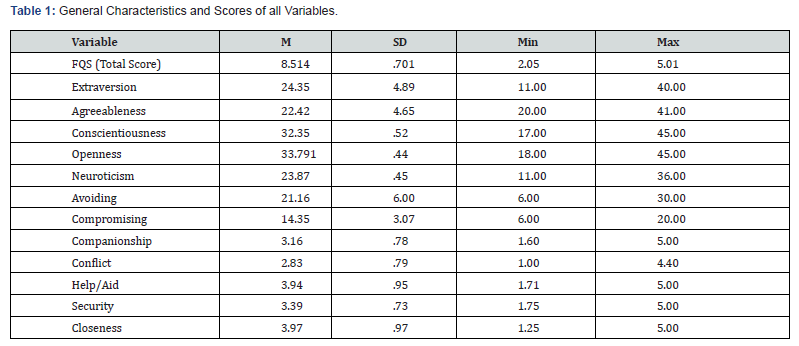
Univariate ANOVAs were conducted for each dependent variable. Gender had a marginally significant effect on FQS_Total (F (2,121)= 2.370, p= .098), a marginally significant effect on FQS_Conflict (F (2,121)= 2.560, p= .081), a marginally significant effect on FQS_Security (F (2,121)= 2.448, p= .091). Age marginally significantly predicted FQS_Companionship (F (4,121)= 2.101, p= .085). There were no significant interaction effects between age and gender on any FQS dimension. Tukey HSD post-hoc comparisons for FQS subscales across demographic groups revealed no statistically significant differences between any group pairs. Confidence intervals crossed zero and p-values were greater than .05 for all comparisons. Relationship status marginally significantly predicted FQS_Companionship (F (5,115)= 2.119, p= .068), significantly predicted FQS_Help (F(5,115)= 2.490, p= .035), significantly predicted FQS_Security (F(5,115)= 2.737, p= .022), and significantly predicted FQS_Closeness (F(5,115)= 3.632, p= .004).
Language speaking marginally significantly predicted FQS_Conflict (F (4,112)= 2.087, p= .087), significantly predicted FQS_Help (F (4,112)= 4.923, p= .001), significantly predicted FQS_Security (F (4,112)= 4.703, p= .002), and significantly predicted FQS_Closeness (F (4,112)= 6.566, p < .001). Social media usage marginally significantly predicted FQS_Friendship Total (F (3,113)= 2.649, p= .052), significantly predicted FQS_Help (F (3,113)= 3.964, p= .010), and significantly predicted FQS_Closeness (F (3,113)= 4.907, p= .003).
Correlation analysis about relationships between Conflict handling Style, personality traits, and friendship quality
Pearson correlation analyses were conducted to examine the relationships between personality traits, conflict-handling styles, and dimensions of friendship quality. As shown in Table 2, several significant associations emerged. Friendship overall score was positively correlated with friendship closeness (r= .879, p< .001), with friendship help (r= .862, p< .001), with friendship security (r= .883, p< .001), and specifically with friendship companionship (r= .804, p < .001); with the following conflict handling styles including collaborating (r= .570, p< .001), with accommodating (r= .449, p< .001), with compromising (r= .294, p< .001), and with avoiding (r= .313, p< .001), with extraversion (r= .227, p< .001), with agreeableness (r= .390, p< .001), with conscientiousness (r= .373, p< .001), and with openness (r= .241, p< .001), and negatively correlated with friendship conflict (r= -.741, p< .001).
Companionship of friendship quality was positively correlated with collaborating (r= .338, p< .001), with accommodating (r= .346, p< .001), with compromising (r= .181, p= .037), with competing (r= .221, p= .011), and with avoiding (r= .363, p< .001), with extraversion (r= .269, p< .001), with agreeableness (r= .173, p= .047), and with conscientiousness (r= .196, p< .001). Conflict of friendship quality was negatively correlated with collaborating (r= -.296, p< .001), with conscientiousness (r= -.212, p= .014), and with openness (r= -.214, p= .013). Closeness of friendship quality was positively correlated with collaborating (r= .607, p< .001), with accommodating (r= .472, p< .001), and with avoiding (r= .298, p< .001), with extraversion (r= .193, p= .026), with agreeableness (r= .469, p < .001), with conscientiousness (r= .396, p= .014), and with openness (r= .222, p= .010). Help of friendship quality was positively correlated with collaborating (r= .608, p< .001), with accommodating (r= .465, p< .001), with compromising (r= .383, p< .001), and with avoiding (r= .311, p< .001), with agreeableness (r= .487, p< .001), with conscientiousness (r= .376, p< .001), and with openness (r= .186, p= .032). Security of friendship quality was positively correlated with collaborating (r= .504, p< .001), with accommodating (r= .423, p< .001), with compromising (r= .264, p= .002), and with avoiding (r= .256, p= .003), with extraversion (r= .199, p= .022), with agreeableness (r= .353, p< .001), with conscientiousness (r= .372, p< .001), and with openness (r= .256, p= .003). Extraversion as one of Big Five Personalities was positively correlated with collaborating (r= .185, p= .033), with compromising (r= .176, p= .043), and with competing (r= .252, p= .003). Agreeableness showed strong positive correlations with accommodating (r= .472, p< .001), with compromising (r= .364, p< .001), and with friendship help (r= .49, p< .001). Conscientiousness showed strong positive correlations with collaborating (r=481, p< .001), with accommodating (r= .243, p< .001), and with compromising (r= .193, p= .026). Openness was positively correlated with collaborating (r= .485, p< .001).
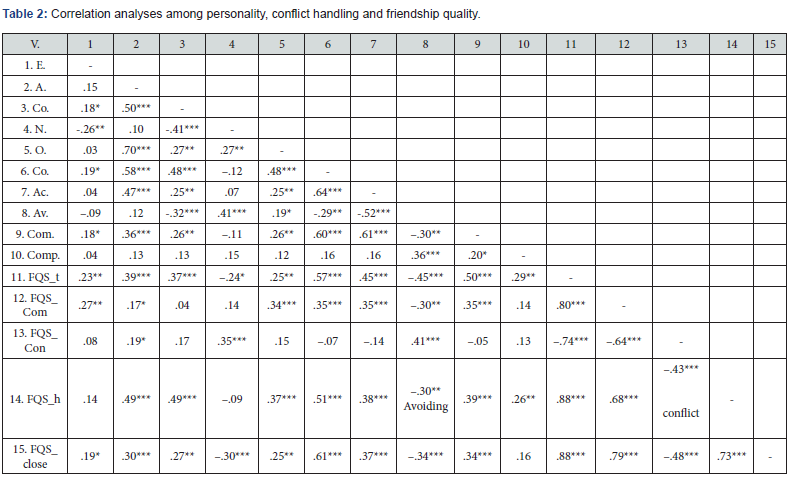
Conflict-handling styles such as collaborating was positively correlated with extraversion (r= .185, p= .033), with agreement (r= .577, p< .001), with conscientiousness (r= .481, p< .001), and with openness (r= .485, p< .001). Accommodating was positively correlated with agreement (r= .472, p< .001), with conscientiousness (r= .243, p= .005), and with openness (r= .279, p= .001). Compromising was positively correlated with extraversion (r= .176, p= .043), with agreement (r= .364, p< .001), with conscientiousness (r=193, p=026), and with openness (r= .258, p= .003). Avoiding was positive correlated with agreement (r= .323, p< .001), with neuroticism (r= .197, p= .023). Competing was positively correlated with extraversion (r= .252, p= .003).
Hierarchical regressions about predictors of conflict-handlings on friendship quality
A series of hierarchical regression analyses were conducted to examine significant predictors of friendship quality outcomes, including conflict-handling styles (collaborating, accommodating, avoiding, compromising, competing). The analyses controlled for potential demographic covariates (age, gender, relation status, occupation, geography, language and social media factors), as well as personality variables (the five traits of Big Five model). Each regression followed a three-step procedure. In Step 1, each conflict-handling style was entered as a predictor along with demographic covariates that met the inclusion criterion (p< .20); In Step 2, the five mean-centered personality traits were added. In Step 3, interaction terms between each conflict-handling style and all five personality traits were tested.
Outcome Variable as Total Friendship Quality
Impacts of collaboration on total friendship quality
In Step 1, collaboration as one of the conflict handling style predictors, was entered into the model along with demographic covariates (gender, age, relation status, language, geography, occupation and social media use). The model was significant, F(8, 116)= 9.522, p< .001, R²= .396, Collaboration significantly predicted total friendship quality (β= .615, p< .001), and geographic location was also a significant predictor (β= .175, p= .025). In Step two, the five personality traits were added. The change in explained variance was marginally significant, ΔR²= .382, F(5, 111)= 2.026, p= .080. Collaboration remained a significant predictor of total friendship quality (β= .519, p< .001), as did geographic location (β= .208, p= .008).
Conscientiousness emerged as a significant predictor (β= .213, p= .027). In Step 3, interaction terms between collaboration and the five personality traits were added. However, this step did not result in a significant improvement in the model fit: ΔR²= .376, F(1, 110)= .000, p= .984. The relationship between the collaborating of conflict handling style and conscientiousness was significant, ΔR²= .132, F(1, 131)= 21.112, p< .001. Collaborating significantly predicted conscientiousness (β= .481, p< .001). The relationship between conscientiousness and total friendship quality was also significant, ΔR²= .132, F(1, 131)= 21.112, p< .001. Conscientiousness significantly predicted total friendship quality (β= .373, p< .001). As can be seen in Figure 1, the relationship between collaborating and total friendship quality dropped from β= .615 (p< .001) to β= .519 (p< .001) when conscientiousness was included in the equation. A Sobel test examining the reduction in the predictive power of collaboration from significant (Step 1) to still significant (Step 2) indicated that conscientiousness partially significantly mediated the relationship between collaborating and total friendship quality (z= 3.598, p= .00032).
Impacts of Accommodating on Total Friendship Quality
In Step 1, accommodating as one of the conflict handling styles predictors, was entered into the model along with demographic covariates (gender, age, relation status, language, geography, occupation and social media use). The model was significant, F(8, 116)= 5.662, p< .001, R²= .281. Accommodating significantly predicting total friendship quality (β= .472, p< .001). In Step 2, the five personality traits were added. The change in explained variance was significant, ΔR²= .324, F(5, 111)= 4.192, p= .002. Accommodating remained a significant predictor of total friendship quality (β= .345, p< .001), and conscientiousness emerged as a significant predictor (β= .288, p= .004). In Step 3, interaction terms between accommodating and the five personality traits were added, however, this step did not result in a significant improvement in model fit, ΔR²= .318, F(1, 110)= .000, p= .985.
The relationship between the accommodating conflict handling style and conscientiousness was significant, ΔR²= .132, F(1, 131)= 8.246, p= .005. Accommodating significantly predicted conscientiousness (β= .243, p= .005). The relationship between conscientiousness and total friendship quality was also significant, ΔR²= .132, F(1, 131)= 21.112, p < .001. Conscientiousness significantly predicted total friendship quality (β= .373, p< .001). A Sobel test examining the reduction in the predictive power of accommodating from significant (Step 1) β= .472 (p < .001) to still significant (Step 2) β= .345 (p< .001) indicated that conscientiousness significantly partially mediated the relationship between accommodating and total friendship quality (z= 2.407, p= .016).
Impacts of avoidance on total friendship quality
In Step 1, avoiding as one of the conflict handling style predictors, was entered into the model along with demographic covariates (gender, age, relation status, language, geography, occupation and social media use). The model was significant, F(8, 116)= 5.662, p= .002, R²= .182. Avoiding significantly predicted total friendship quality (β= .332, p < .001). In Step 2, the five personality traits were added. The change in explained variance was significant, ΔR²= .381, F(5, 111)= 7.141, p< .001. Avoiding remained a significant predictor of total friendship quality (β= .282, p= .002). Georaphic location also significant predictor of total friendship quality (β= .208, p= .008). Extraversion emerged as a significant predictor (β= .192, p= .019), conscientiousness (β= .335, p < .001) emerged as significant predictors. In Step 3, interaction terms between avoiding and the five personality traits were added, however, this step did not result in a significant improvement in the model fit, ΔR²= .381, F(1, 110)= .114, p= .736.
The relationship between the avoiding conflict-handling style and conscientiousness was not significant, ΔR²= -.005, F(1, 131)=.395, p= .531. Avoiding did not significantly predict conscientiousness (β= .055, p= .531). The relationship between the avoiding conflict-handling style and extraversion was not significant, ΔR²= .001, F(1, 131)=1.113, p= .293. Avoiding did not significantly predict extraversion (β= -.099, p= .293). Therefore, neither conscientiousness nor extraversion mediated the relationship between the avoiding conflict handling style and total friendship quality.
Impacts of compromising on total friendship quality
In Step 1, compromising, as one of the conflict handling style predictors was entered into the model along with demographic covariates (gender, age, relation status, language, geography, occupation and social media use). The model was significant, F(8, 116)= 2.755, p= .008, R²= .160. Compromising significantly predicted total friendship quality (β= .275, p= .002). In Step 2, the five personality traits were added. The change in explained variance was significant, ΔR²= .255, F(5, 111)= 5.760, p< .001. Conscientiousness (β= .313, p= .003) emerged as a significant predictor. In Step 3, interaction terms between compromising and the five personality traits were added; however, this step did not result in a significant improvement in model fit, ΔR²= .248, F(1, 110)= .011, p= .917.
The relationship between the compromising of conflict handling style and conscientiousness was significant, ΔR²= -.005, F(1, 131)=5.077, p= .026. Compromising significantly predicted conscientiousness (β= .193, p= .026). Conscientiousness also significantly predicted total friendship quality (β= .373, p< .001). A Sobel test examining the reduction in the predictive power of compromising from significant (Step 1) β= .275 (p= .002) to non-significant to (Step 2) β= .118 (p= .190) indicated that conscientiousness significantly fully mediated the relationship between compromising and friendship quality (z= 2.010, p= .047).
Impacts of competition on total friendship quality
In Step 1, competing, as one of the conflict handling style predictors, was entered into the model along with demographic covariates (gender, age, relation status, language, geography, occupation and social media use). The overall model was not significant, F(8, 116)= 1.559, p= .145, R²= .097. Competition did not significantly predict total friendship quality (β= .091, p= .315). In Step 2, the five personality traits were added. The change in explained variance was significant, ΔR²= .249, F(5, 111)= 7.633, p< .001. However, competing remained a non-significant predictor of total friendship quality (β= .087, p= .329). Agreeableness (β= .249, p= .018) and conscientiousness (β= .319, p= .002) emerged as a significant predictor. In Step 3, interaction terms between competing and the five personality traits were added; however, this step did not result in a significant improvement in the model fit, ΔR²= .243, F(1, 110)= .025, p= .875.
Outcome Variable as Companionship Friendship Quality
Impacts of collaboration on companionship friendship quality
In Step 1, collaboration and demographic covariates (gender, age, relation status, language, geography, occupation and social media use) were entered into the model. The model was significant, F(8, 116)= 4.341, p< .001, R²= .230. Collaboration significantly predicted companionship friendship quality (β= .413, p< .001), and age significantly negatively predicted companionship friendship quality (β= -.172, p= .045). In Step 2, the five personality traits were added. The change in explained variance was not significant, ΔR²= .198, F(5, 111)= 1.585, p= .170. Collaboration remained a significant predictor of companionship friendship quality (β= .342, p= .005), and age continued to negatively predict companionship friendship quality (β=-.198, p= .025). Extraversion emerged as a significant predictor (β= .220, p= .013). In Step 3, the interaction terms between collaboration and the five types of personality traits were added. This step did not result in a significant improvement in model fit, ΔR²= .191, F(1, 110)= .046, p= .830.
The relationship between the collaborating conflict-handling style and extraversion was significant, ΔR²= .027, F(1, 131)= 4.620, p= .033. Collaborating significantly predicted extraversion (β= .185, p= .033). The relationship between extraversion and companionship friendship quality was also significant, ΔR²= .065, F(1, 131)= 10.239, p= .002. Extraversion significantly predicted companionship friendship quality (β= .269, p= .002). A Sobel test examining the reduction in the predictive power of collaboration from significant in Step 1 (β= .413, p< .001) to still significant in Step 2 (β= .342, p= .005) indicated that extraversion partially mediated the relationship between collaborating and companionship friendship quality (z= 2.153, p= .016).
Impacts of accommodating on companionship friendship quality
In Step 1, accommodating (as a conflict-handling style) and demographic covariates (gender, age, relation status, language, geography, occupation and social media use) were entered into the model. The model was significant, F(8, 116)= 4.264, p < .001, R²= .227. Accommodating significantly predicted companionship friendship quality (β= .397, p< .001). In Step 2, the five personality traits were added. The change in explained variance was significant, ΔR²= .230, F(5, 111)= 2.684, p= .025. Accommodating remained a significant predictor of companionship friendship quality (β= .369, p < .001). Extraversion emerged as a significant predictor (β= .227, p= .009). In Step 3, the interaction terms between accommodating and five types of personality were added. The step did not result in a significant improvement in the model fit, ΔR²= .223, F(1, 110)= .004, p= .952.
The relationship between type of extraversion and companionship friendship quality was shown significant, ΔR²= .065, F(1, 131)= 10.239, p= .002. Extraversion significantly predicted companionship friendship quality (β= .269, p= .002). The relationship between type of accommodating of conflict handlings and extraversion was shown not significant, ΔR²= -.006, F(1, 131)= .250, p= .618. Accommodating did not significantly predict extraversion (β= .044, p= .618). A Sobel test indicated that extraversion did not significantly mediate the relationship between accommodating and companionship friendship quality (z= 0.50, p= .309).
Impacts of avoiding on companionship friendship quality
In Step 1, avoidance as a predictor of conflict handling, along with demographic covariates (gender, age, relation status, language, geography, occupation and social media use) was entered into the model. The model was significant, F(8,116)= 4.202, p< .001, R²= .225, with avoidance significantly predicting companionship friendship quality (β= .398, p< .001). In Step 2, all five personality traits were added. The change in explained variance was significant, ΔR²= .284, F(5, 111)= 4.644, p= .032. Avoidance remained a significant predictor of companionship friendship quality (β= .423, p < .001). Extraversion emerged as a significant predictor (β= .279, p< .001), as did conscientiousness (β= .216, p= .034). In Step 3, the interaction term between avoidance and the five types of personality was added, however, this did not result in a significant improvement in the model, ΔR²= .277, F(1, 110)= .004, p= .950.
The relationship between avoidance as a conflict handling style and conscientiousness was not significant, ΔR²= -.005, F(1, 131)=.395, p= .531. Avoidance did not significantly predicted conscientiousness (β= .055, p= .531). Conscientiousness did not mediate the relationship between avoidance and companionship friendship quality. The relationship between avoidance as a conflict-handling style and extraversion was not significant, ΔR²= .001, F(1, 131)=1.113, p= .293. Avoidance did not significantly predict extraversion (β= .055, p= .531). Neither conscientiousness nor extraversion mediated the relationship between avoidance and companionship friendship quality.
Impacts of compromising on companionship friendship quality
In Step 1, compromising as one of the predictors of conflict handlings along with demographic covariates (gender, age, relation status, language, geography, occupation and social media) were entered into the first step. The model was significant, F(8, 116)= 2.058, p= .046, R²= .124, with compromising significantly predicting companionship friendship quality (β= .187, p= .040). In step two, all types of personality traits were added: the change in variance explained was significant, ΔR²= .141, F(5, 111)= 3.088, p=.012. Extraversion emerged as a significant predictor (β= .245, p= .009). Step 3 added the interaction term between compromising and five types of personality, but this did not lead to significant improvement in the model: ΔR²= .137, F(1, 110)= .408, p= .524.
The relationship between type of compromising of conflict handlings and extraversion was shown significant, ΔR²= .024, F(1, 131)=4.183, p= .043. Compromising significantly predicted extraversion (β= .176, p= .043). Extraversion significantly predicted companionship friendship quality (β= .269, p= .002). A Sobel test on the drop in the predictor power of compromising from significant (Step one) to remain significant on the Step two revealed that extraversion significantly partial mediated the relation between compromising and companionship friendship quality (z= 1.743, p= .041).
Impacts of competing on companionship friendship quality
In Step 1, competing as a conflict handling style, along with demographic covariates (gender, age, relation status, language, geography, occupation and social media), was entered into the model. The model was significant, F(8, 116)= 2.146, p= .037, R²= .129, however, competing significantly predicted companionship friendship quality (β= .198, p= .028). In step two, all types of personality traits were added: the change in variance explained was significant, ΔR²= .156, F(5, 111)= 3.401, p= .007. However, competing no longer significantly predicted total friendship quality (β= .150, p= .115). Extraversion emerged as a significant predictor (β= .205, p= .034). In Step 3, the interaction term between competing handling style and the five personality traits was added; however, this did not result in a significant improvement in the model, ΔR²= .149, F(1, 110)= .050, p= .824.
The relationship between competing as a conflict handling style and extraversion was significant, ΔR²= .056, F(1, 131)=8.864, p= .003. Extraversion significantly predicted companionship friendship quality (β= .043, p= .013), and competing significantly predicted extraversion (β= .289, p= .003). A Sobel test examining in the predictive power of competing from significant in Step 1 to non-significant in Step 2 indicated that extraversion significantly fully mediated the relationship between competing and companionship friendship quality (z= 2.214, p= .013).
Outcome Variable as Conflict Friendship Quality
Impacts of collaboration on conflict friendship quality
In Step 1, collaboration along with demographic covariates (gender, age, relation status, language, geography, occupation and social media) were entered into the first step. The model was significant, F(8, 116)= 3.472, p < .001, R²= .193, with collaboration significantly negatively predicted conflict friendship quality (β= -.325, p < .001). Geographic location significantly negatively predicted conflict friendship quality (β= -.227, p= .012). In step two, all types of personality traits were added: the change in variance explained was not significant, ΔR²= .138, F(5, 111)= 1.019, p= .410. Collaboration significantly predicted conflict friendship quality (β= -.276, p= .026). Geographic location significantly negatively predicted conflict friendship quality (β= -.232, p= .013). Step 3 added the interaction term between collaboration and five types of personality, but this step did not lead to significant improvement of the fit of the equation in the model: ΔR²= .131, F(1, 110)= .072, p= .789.
Impacts of accommodating on conflict friendship quality
In Step 1, accommodating as a predictor of conflict handling, along with demographic covariates (gender, age, relation status, language, geography, occupation and social media use) were entered into the first step. The model was significant, F(8, 116)= 2.124, p= .039, R²= .128, however, accommodating did not significantly predict conflict friendship quality (β=-.154, p= .103). In Step 2, all five personality traits were added. The change in explained variance was marginally significant, ΔR²= .106, F(5, 111)= 2.006, p= .083. Accommodating did not significantly predict conflict friendship quality (β= -.105, p= .337). Geographical location emerged as a significant predictor (β= -.200, p= .034). Geographical location emerged as a significant predictor (β= -.200, p= .034). Conscientiousness emerged as a significant predictor (β= -.244, p= .032). In Step 3, the interaction term between accommodating and five types of personality traits, however, this did not result in a significant improvement in the model: ΔR²= .098, F(1, 110)= .007, p= .933.
Impacts of avoidance on conflict friendship quality
In Step 1, avoiding as a predictor of conflict handling style along with demographic covariates (gender, age, relation status, language, geography, occupation and social media) was entered into the model. The model was marginally significant, F(8, 116)= 1.890, p= .068, R²= .115, avoiding did not significantly predict conflict friendship quality (β= -.097, p=.312). Geographical location emerged as a significant predictor (β= -.198, p= .036). In Step 2, five personality traits were added. The change in explained variance was significant, ΔR²= .109, F(5, 111)= 2.434, p= .039. Avoiding did not significantly predict conflict friendship quality (β= -.113, p= .256). Geographical location emerged as a significant predictor (β= -.214, p= .022). Conscientiousness emerged as a significant predictor (β= -.261, p < .001). In Step 3, the interaction term between avoiding and five personality traits did not result in significant improvement in the model fit, ΔR²= .105, F(1, 110)= .466, p= .496.
15.4. Impacts of compromising on conflict friendship quality
In Step 1, compromising as a predictor of conflict handling style, along with demographic covariates (gender, age, relation status, language, geography, occupation and social media) was entered into the model. The model was marginally significant, F(8, 116)= 1.752, p= .094, R²= .108, compromising did not significantly predict conflict friendship quality (β=-.020, p= .824). In Step 2, five personality traits were added, the change in explained variance was significant, ΔR²= .102, F(5, 111)= 2.439, p=.039. Geographical location emerged as a significant predictor (β= -.192, p= .041). Conscientiousness emerged as a significant predictor (β= -.250, p < .028). In Step 3, the interaction term between compromising and five personality traits did not result in a significant improvement in the model fit, ΔR²= .098, F(1, 110)= .452, p= .503.
Impacts of competing on conflict friendship quality
In Step 1, competing as a predictor of conflict handling style, along with demographic covariates (gender, age, relation status, language, geography, occupation and social media) was entered into the model. The model was significant, F(8, 116)= 2.108, p= .040, R²= .129, however, competing did not significantly predict conflict friendship quality (β= .198, p= .028). Geographical location emerged as a significant predictor (β= -.190, p= .041). In Step 2, five personality traits were added. The change in explained variance was marginally significant, ΔR²= .110, F(5, 111)= 2.125, p= .068. However, competing did not significantly predict conflict friendship quality (β= -.114, p= .244). Geographical location emerged as a significant predictor (β= -.209, p= .026). Conscientiousness emerged as a significant predictor (β= -.262, p< .022). In Step 3, the interaction term between competing handling and five personality traits did not result in a significant improvement in the model fit, ΔR²= .102, F(1, 110)= .000, p= 1.000.
Outcome Variable as Closeness Friendship Quality
Impacts of collaboration on closeness friendship quality
In Step 1, collaboration as a predictor of conflict handling style, along with demographic covariates (gender, age, relation status, language, geography, occupation and social media) was entered into the model. The model was significant, F(8, 116)= 10.888, p < .001, R²= .429, collaboration significantly predicted closeness friendship quality (β= .615, p < .001). In Step 2, five personality traits were added, the change in explained variance was still significant, ΔR²= .430, F(5, 111)= 2.641, p= .027. Collaboration significantly predicted closeness friendship quality (β= -.276, p= .026). Geographic location significantly predicted closeness friendship quality (β= .171, p= .024). Conscientiousness emerged as a marginally significant predictor (β= .163, p=.077). Openness also emerged as a marginally significant predictor (β= -.156, p=.058). In Step 3, the interaction term between collaboration and five personality traits did not result in a significant improvement of the fit of the equation in the model, ΔR²= .425, F(1, 110)= .164, p= .686.
Impacts of accommodating on closeness friendship quality
In Step 1, accommodating as a predictor of conflict handling style, along with demographic covariates (gender, age, relation status, language, geography, occupation and social media) was entered into the model. The model was significant, F(8, 116)= 6.752, p < .001, R²= .318, accommodating significantly predicted closeness friendship quality (β= .473, p < .001). In Step 2, five personality traits were added, the change in explained variance was significant, ΔR²= .438, F(5, 111)= 4.749, p< .001. Accommodating significantly predicted closeness of friendship quality (β= .310, p< .001). Agreeableness emerged as a significant predictor (β= .225, p= .030). Conscientiousness emerged as a significant predictor (β= .294, p= .002). In Step 3, the interaction term between accommodating and five personality traits did not result in significant improvement in the model fit, ΔR²= .366, F(1, 110)= .004, p= .953.
The relationship between type of conscientiousness and close friendship quality was significant, ΔR²= .135, F(1, 131)= 8.246, p< .001. Conscientiousness significantly predicted closeness of friendship quality (β= .396, p< .001). The relationship between type of accommodating of conflict handlings and conscientiousness was significant (β= .243, p= .005). A Sobel test revealed that conscientiousness mediated the relation between accommodating and closeness of friendship quality (z= 2.441, p= .007). The relationship between type of agreeableness and closeness of friendship quality was significant, ΔR²= .135, F(1, 131)= 8.246, p< .001. Agreeableness significantly predicted closeness of friendship quality (β= .396, p< .001). The relationship between type of accommodating of conflict handlings and agreeableness was significant (β= .243, p= .005). A Sobel test revealed that agreeableness mediated the relation between accommodating and closeness of friendship quality (z= 2.441, p= .007).
Impacts of avoidance on closeness friendship quality
In Step 1, avoidance as one of the predictors of conflict handlings along with demographic covariates (gender, age, relation status, language, geography, occupation and social media) was entered into the model. The model was significant, F(8,116)= 3.289, p= .002, R²= .185, avoidance significantly predicted closeness friendship quality (β= .274, p=.003). In Step 2, five personality traits were added, the change in explained variance was significant, ΔR²= .321, F(5,111)= 7.560, p< .001. Avoidance significantly predicted closeness friendship quality (β= .192, p= .029). Extraversion emerged as a significant predictor (β= .159, p= .048). Conscientiousness emerged as a significant predictor (β= .278, p= .005). In Step 3, the interaction term between avoiding and five personality traits did not result in a significant improvement in the model fit, ΔR²= .322, F(1,110)= 1.174, p= .281. The relationship between avoidance of conflict handling style and conscientiousness was not significant, ΔR²= -.005, F(1,131)=.395, p= .531. Avoidance did not significantly predicted conscientiousness (β= .055, p= .531). Conscientiousness significantly predicted closeness friendship quality (β= .396, p< .001). Conscientiousness did not mediate the relationship between avoiding of conflict handlings and closeness of friendship quality (Z= .621, p=.267).
Impacts of compromising on closeness friendship quality
In Step 1, compromising as a predictor of conflict handling style, along with demographic covariates (gender, age, relation status, language, geography, occupation and social media) was entered into the model. The model was significant, F(8,116)= 3.725, p< .001, R²= .204, compromising significantly predict closeness friendship quality (β= .298, p < .001). In Step 2, five personality traits were added, the change in explained variance was significant, ΔR²= .379, F(5, 111)= 6.245, p< .001. Agreeableness emerged as a significant predictor (β= .280, p= .008). Conscientiousness emerged as a significant predictor (β= .264, p= .009). In Step 3, the interaction term between compromising and five personality traits did not lead to significant improvement in the model: ΔR²= .381, F(1, 110)= .351, p= .555.
The relationship between compromising of conflict handling style and conscientiousness was significant, ΔR²= -.005, F(1,131)= 5.077, p= .026. Compromising significantly predicted conscientiousness (β= .193, p= .026). Conscientiousness significantly predicted closeness friendship quality (β= .396, p< .001). Conscientiousness fully mediated the relationship between compromising of conflict handlings and closeness friendship quality (Z= 2.059, p= .020). The relationship between type of compromising of conflict handlings and agreeableness was shown significant, ΔR²= .126, F(1,131)= 5.077, p< .001. Compromising significantly predicted agreeableness (β= .364, p< .001). Agreeableness significantly predicted closeness friendship quality (β= .469, p< .001). Agreeableness fully mediated the relationship between compromising of conflict handlings and closeness friendship quality (Z= 3.601, p=.000).
Impacts of competition on closeness friendship quality
In Step 1, competition as a predictor of conflict handlings along with demographic covariates (gender, age, relation status, language, geography, occupation and social media) were entered into the model. The model was significant, F(8,116)= 2.015, p= .051, R²= .122, competition did not significantly predict closeness friendship quality (β= .000, p= .997). In Step 2, five personality traits were added: the change in variance explained was significant, ΔR²= .110, F(5,111)= 8.499, p < .001. however, competition significantly did not predict closeness friendship quality (β= -.114, p= .244). Agreeableness emerged as a significant predictor (β= .333, p= .001). Conscientiousness emerged as a significant predictor (β= .262, p= .010). In Step 3, the interaction term between competing handling and five types of personality did not result in a significant improvement in the model fit, ΔR²= .284, F(1,110)= .001, p= .969. The relationship between competition of conflict handling style and agreeableness was not significant, ΔR²= .011, F(1,131)=.120, p= .120. Agreeableness significantly predicted closeness friendship quality (β= .469, p< .001). Agreeableness did not mediate the relationship between competition of conflict handlings and closeness of friendship quality (Z= -.057, p= .284). The relationship between type of competition of conflict handlings and conscientiousness was not significant, ΔR²= .002, F(1,131)=1.302, p= .256. Competition did not significantly predicted conscientiousness (β=-.099, p=.256). Conscientiousness significantly predicted closeness friendship quality (β= .396, p< .001). Conscientiousness did not mediate the relationship between competition of conflict handlings and conflict friendship quality (Z= - 0.458, p= .323).
Outcome Variable as Help Friend
ship Quality
Impacts of collaboration on help friendship quality
In Step 1, collaboration along with demographic covariates (gender, age, relation status, language, geography, occupation and social media) were entered into the first step. The model was significant, F(8,116)= 11.675, p< .001, R²= .446, with collaboration significantly predicted help friendship quality (β= .645, p< .001). In Step 2, five personality traits were added: the change in variance explained was still significant, ΔR²= .472, F(5,111)= .081, p= .003. Collaboration significantly predicted help friendship quality (β= .566, p< .001). Agreeableness significantly positively predicted help friendship quality (β= .183, p= .048). Conscientiousness emerged as a marginally significant predictor (β= .207, p=.020). Openness also emerged as a marginally significant predictor (β= -.175, p=.028). In Step 3, the interaction term between collaboration and five personality traits did not lead to significant improvement of the fit of the equation in the model: ΔR²= .468, F(1,110)= .103, p= .749. The relationship between type of help of conflict handlings and agreeable was not shown significant, ΔR²= .327, F(1,131)= 65.216, p < .001. Collaboration significantly predicted agreeableness (β= .577, p< .001). Agreeableness significantly predicted help friendship quality (β= .487, p< .001). Agreeableness mediated the relationship between collaboration of conflict handlings and help friendship quality (Z= 4.848, p= .000).
The relationship between collaboration of conflict handlings and conscientiousness was not significant, ΔR²= .002, F(1,131)=1.302, p= .256. Collaboration did not significantly predicted conscientiousness (β= -.099, p= .256). Conscientiousness significantly predicted help friendship quality (β= .396, p< .001). Conscientiousness did not mediate the relationship between collaboration of conflict handlings and help friendship quality. The relationship between type of collaboration of conflict handlings and openness was shown significant, ΔR²= .230, F(1,131)=40.328, p< .001. Collaboration significantly predicted openness (β= .485, p< .001). Openness significantly predicted help friendship quality (β= .186, p< .032). Openness partially mediated the relationship between collaboration of conflict handlings and help friendship quality (Z= 2.067, p= .019).
Impacts of accommodating on help friendship quality
In Step 1, accommodating as one of the predictors of conflict handlings along with demographic covariates (gender, age, relation status, language, geography, occupation and social media) were entered into the first step. The model was significant, F(8,116)= 6.752, p < .001, R²= .318, with accommodating significantly predicted help friendship quality (β= .494, p< .001). In Step 2, five personality traits were added: the change in variance explained was significant, ΔR²= .372, F(5,111)= 4.749, p< .001. Accommodating significantly predicted help friendship quality (β= .310, p< .001). Agreeableness emerged as a significant predictor (β= .225, p= .030). Conscientiousness emerged as a significant predictor (β= .294, p= .002). In
Step 3, the interaction term between accommodating and five personality traits did not lead to significant improvement in the model: ΔR²= .366, F(1,110)= .004, p= .953. The relationship between type of help of conflict handlings and agreeable was significant, ΔR²= .231, F(1,131)= 40.761, p< .001. Accommodation significantly predicted agreeableness (β= .472, p< .001). Agreeableness significantly predicted help friendship quality (β= .487, p< .001). Agreeableness mediated the relationship between accommodation of conflict handlings and help friendship quality (Z= 4.343, p= .000). The relationship between type of conscientiousness and help friendship quality was shown significant, ΔR²= .135, F(1,131)= 21.545, p= .005. Conscientiousness significantly predicted help friendship quality (β= .376, p< .001). The relationship between type of accommodating of conflict handlings and conscientiousness showed significant (β= .243, p= .005). A Sobel test revealed that conscientiousness fully mediated the relation between accommodating and help friendship quality (z= 2.608, p= .005).
Impacts of avoidance on help friendship quality
In Step 1, avoidance as one of the predictors of conflict handlings along with demographic covariates (gender, age, relation status, language, geography, occupation and social media) were entered into the first step. The model was significant, F(8,116)= 3.664, p < .001, R²= .202, with avoidance significantly predicted help friendship quality (β= .334, p< .001). In Step 2, five personality traits were added: the change in variance explained was significant, ΔR²= .349, F(5,111)= 8.206, p< .001. Avoidance significantly predicted help friendship quality (β= .227, p= .008). Occupation emerged as a significant predictor (β= -.149, p= .048). Conscientiousness emerged as a significant predictor (β= .333, p< .001). In Step 3, the interaction term between avoiding and five personalities did not lead to significant improvement in the model: ΔR²= .346, F(1,110)= .516, p= .474.
The relationship between type of avoidance of conflict handlings and conscientiousness was not significant, ΔR²= -.005, F(1,131)=.395, p= .531. Avoidance did not significantly predicted conscientiousness (β= .055, p= .531). Conscientiousness significantly predicted help friendship quality (β= .396, p< .001). Conscientiousness did not mediate the relationship between avoiding of conflict handlings and help friendship quality (Z= .2.441, p=.007).
Impacts of compromising on help friendship quality
In Step 1, compromising as one of the predictors of conflict handlings along with demographic covariates (gender, age, relation status, language, geography, occupation and social media) were entered into the first step. The model was significant, F(8,116)= 4.549, p< .001, R²= .204, with compromising significantly predicted help friendship quality (β= .377, p< .001). In Step 2, five personality traits were added: the change in variance explained was significant, ΔR²= .349, F(5,111)= 6.749, p< .001. Agreeableness emerged as a significant predictor (β= .290, p= .004). Conscientiousness emerged as a significant predictor (β= .318, p< .001). In Step 3, the interaction term between compromising and five types of personality did not lead to significant improvement in the model: ΔR²= .345, F(1,110)= .351, p= .518.
The relationship between type of compromising of conflict handlings and conscientiousness was shown significant, ΔR²= .030, F(1,131)= 5.077, p= .026. Compromising significantly predicted conscientiousness (β= .193, p= .026). Conscientiousness significantly predicted help friendship quality (β= .396, p< .001). Conscientiousness mediated the relationship between compromising of conflict handlings and help friendship quality (Z= 2.029, p=.021). The relationship between type of compromising of conflict handlings and agreeableness was significant, ΔR²= .132, F(1,131)= 20.005, p < .001. Compromising significantly predicted agreeableness (β= .364, p< .001). Agreeableness significantly predicted help friendship quality (β= .487, p< .001). Agreeableness mediated the relationship between compromising of conflict handlings and help friendship quality (Z= 3.614, p=.000).
Impacts of competition on help friendship quality
In Step 1, competition as one of the predictors of conflict handlings along with demographic covariates (gender, age, relation status, language, geography, occupation and social media use) were entered into the first step. The model was not significant, F(8,116)= 1.766, p= .091, R²= .109, competition did not significantly predict help friendship quality (β= -.022, p= .803). Social media significantly predicted (β= .208, p= .026). In Step 2, five personality traits were added, the change in explained variance was significant, ΔR²= .307, F(5,111)= 9.697, p< .001. However, competition did not predict help friendship quality (β= .021, p= .806). Agreeableness emerged as a significant predictor (β= .333, p= .001).
Conscientiousness emerged as a significant predictor (β= .262, p= .010). The Step 3, the interaction term between competing handling and five personality traits did not lead to significant improvement in the model fit, ΔR²= .301, F(1,110)= .011, p= .918. The relationship between type of competition of conflict handlings and agreeable was not shown significant, ΔR²= .011, F(1,131)=.120, p= .120. Competition did not significantly predicted agreeableness (β= -.135, p= .120). Agreeableness significantly predicted help friendship quality (β= .487, p< .001). Agreeableness did not mediate the relationship between competition of conflict handlings and help friendship quality. The relationship between competition of conflict handling style and conscientiousness was not significant, ΔR²= .002, F(1,131)=1.302, p= .256. Competition did not significantly predicted conscientiousness (β= -.099, p= .256). Conscientiousness significantly predicted help friendship quality (β= .376 p< .001). Conscientiousness did not mediate the relationship between competition of conflict handlings and help friendship quality (Z= -1.115, p= .132).
Outcome Variable as Security Friendship Quality Impacts of Collaboration on Security Friendship Quality
In Step 1, collaboration as a predictor of conflict handling style, along with demographic covariates (gender, age, relation status, language, geography, occupation and social media use) was entered into model. The model was significant, F(8,116)= 6.452, p < .001, R²= .308, with collaboration significantly predicted security friendship quality (β= .553, p< .001). In Step 2, five personality traits were added, the change in explained variance was not significant, ΔR²= .274, F(5,111)= 1.446, p= .213. Collaboration significantly predicted security friendship quality (β= .437, p< .001). Geographic location significantly predicted security friendship quality (β= .172, p= .039). Conscientiousness emerged as a marginally significant predictor (β.203, p=.052). In Step 3, the interaction term between collaboration and five types of personality did not result in significant improvement of the fit of the equation in the model: ΔR²= .270, F(1,110)= .407, p= .525.
Impacts of accommodating on security friendship quality
In Step 1, accommodating as a predictor of conflict handling style, along with demographic covariates (gender, age, relation status, language, geography, occupation and social media) was entered into the model. The model was significant, F(8,116)= 4.387, p < .001, R²= .318, accommodating significantly predicted security friendship quality (β= .448, p < .001). In Step 2, five personality traits were added, the change in explained variance was significant, ΔR²= .253, F(5,111)= 3.296, p= .008. Accommodating significantly predicted security friendship quality (β= .338, p < .001). Conscientiousness emerged as a significant predictor (β= .263, p= .012). In Step 3, the interaction term between accommodating and five types of personality did not result in significant improvement in the model fit, ΔR²= .248, F(1,110)= .193, p= .661.
The relationship between type of conscientiousness and security friendship quality was shown significant, ΔR²= .132 , F(1,131)= 21.079, p< .001. Conscientiousness significantly predicted security friendship quality (β= .372, p< .001). The relationship between type of accommodating of conflict handlings and conscientiousness was significant (β= .243, p= .005). A Sobel test revealed that conscientiousness partially mediated the relation between accommodating and security friendship quality (z= 2.439, p= .007).
Impacts of avoidance on security friendship quality
In Step 1, avoidance is a predictor of conflict handling style, along with demographic covariates (gender, age, relation status, language, geography, occupation and social media) was entered into the model. The model was marginally significant, F(8,116)= 1.988, p= .054, R²= .060, avoidance significantly predicted security friendship quality (β= .269, p= .006). In step 2, five personality traits were added, the change in explained variance was significant, ΔR²= .215, F(5,111)= 5.576, p< .001. Avoidance significantly predicted security friendship quality (β= .219, p= .020). Geographic location emerged as a significant predictor (β= .173, p= .049). Conscientiousness emerged as a significant predictor (β= .304, p< .005). In Step 3, the interaction term between avoiding and five types of personality did not result in a significant improvement in the model fit, ΔR²= .208, F(1,110)= .077, p= .782. The relationship between avoidance of conflict handling style and conscientiousness was not significant, ΔR²= -.005, F(1,131)=.395, p= .531. Avoidance did not significantly predicted conscientiousness (β= .055, p= .531). Conscientiousness significantly predicted security friendship quality (β= .372, p< .001). Conscientiousness did not mediate the relationship between avoiding of conflict handlings and security friendship quality (Z= 0.620, p=.268).
Impacts of compromising on security friendship quality
In Step 1, compromising as a predictor of conflict handling style, along with demographic covariates (gender, age, relation status, language, geography, occupation and social media) was entered into the model. The model was marginally significant, F(8,116)= 1.887, p< .001, R²= .115, with compromising significantly predicted security friendship quality (β= .244, p < .008). In step 2, five personality traits were added, the change in explained variance was significant, ΔR²= .184, F(5,111)= 4.678, p < .001. Conscientiousness emerged as a significant predictor (β= .287, p< .008). In Step 3, the interaction term between compromising and five types of personality did not result in a significant improvement in the model fit, ΔR²= .180, F(1, 110)= .547, p= .461.
The relationship between compromising of conflict handling style and conscientiousness was significant, ΔR²= .030, F(1,131)= 5.077, p= .026. Compromising significantly predicted conscientiousness (β= .193, p= .026). Conscientiousness significantly predicted security friendship quality (β= .372, p< .001). Conscientiousness fully mediated the relationship between compromising of conflict handlings and security friendship quality (Z= 2.028, p= 0.021).
Impacts of competition on security friendship quality
In Step 1, competition as a predictor of conflict handling style, along with demographic covariates (gender, age, relation status, language, geography, occupation and social media), was entered into the model. The model was not significant, F(8,116)= 1.025, p= .422, R²= .066, competition did not significantly predict security friendship quality (β= .080, p= .388). In Step 2, five personality traits were added, the change in explained variance was significant, ΔR²= .267, F(5,111)= 6.070, p< .001. However, competition did not predict security friendship quality (β= .078, p= .402). Agreeableness emerged as a significant predictor (β= .230, p= .037). Conscientiousness emerged as a significant predictor (β= .293, p= .008). In Step 3, the interaction term between competing handling and five types of personality did not lead to significant improvement in the model fit, ΔR²= .181, F(1,110)= 1.093, p= .298.
The relationship between type of competition of conflict handlings and conscientiousness was not shown significant, ΔR²= .002, F(1,131)=1.302, p= .256. Competition did not significantly predicted conscientiousness (β= -.099, p= .256). Conscientiousness significantly predicted security friendship quality (β= .372 p< .001). Conscientiousness did not mediate the relationship between competition of conflict handlings and security friendship quality (Z=-.1.115, p= .133).
Discussions
The present study investigated how conflict-handling styles and personality traits influenced friendship quality among emerging adults in Canada. The findings support our hypotheses that personality traits function as psychological mechanisms through which conflict-handling styles influence friendship quality. Rather than viewing conflict-handling styles as isolated behaviors. This study highlights the importance of stable personality characteristics in shaping relational outcomes.
Correlations of conflict handling styles, personality traits, and dimensions of friendship quality.
The present study was conducted to investigate the relationships among the conflict-handling styles, Big Five personality and various dimensions of friendship quality. To accomplish this objective, data were collected from participants and subsequently analyzed using Pearson product-moment correlation technique. The results of the analyses indicated that our hypotheses 1was supported and convinced, revealing both positive and negative correlations among the Big Five personality traits, conflict-handling styles, and friendship quality.
Our findings showed that the overall friendship score was positively correlated with friendship closeness, help, security, and companionship. It was also positively associated with collaborating, accommodating, and compromising conflict styles, as well as with the personality traits of extraversion, agreeableness, conscientiousness, and openness. These results are consistent with those reported in previous studies [36]. Agreeable and conscientious were positively associated with most dimensions of friendship, especially closeness, security and help. This supports findings that agreeable and conscientious individuals tend to cultivate emotionally supportive friendships, they. Neuroticism, by contrast, showed negative associations with closeness and security, in line with previous evidence that neurotic individuals experience less relational satisfaction [25].
Another study Wilson et al. [16] found that personality such as extraversion, agreeableness, conscientiousness was associated with higher friendship satisfaction. These personality traits promote behaviours and interaction styles that support positive, stable, and rewarding relationships. This is also consistent with the findings of Korner & Altmann [21], who reported that agreeableness, extraversion and emotional stability were positively related to
friendship satisfaction, and that individuals who were more extraverted or conscientious tend to experience higher levels of friendship satisfaction because extraverted individuals are typically sociable, energetic and comfortable initiating social interactions. They are more likely to communicate frequently, engage in shared activities, and express positive emotions with friends. These behaviors help strengthen emotional connections and increase opportunities for enjoyable interactions, which can enhance satisfaction in friendships, and reinforce feelings of closeness and belonging [16,37]. Conscientious individuals are responsible, reliable and organized. They are more likely to keep commitments and provide support, trust, and stability in the relationship. In addition, our findings showed that the overall friendship score was negatively correlated with friendship conflict, suggesting that higher levels of conflict are associated with lower perceived friendship quality [38]. Frequent arguments, persistent disagreements or ongoing hostility can significantly disrupt these positive interactions and weaken emotional bonds. As conflict increases, individuals may experience diminished feelings of support, increased mistrust, frustration, emotional insecurity. They may also feel less comfortable within the relationship, which lowers the overall friendship quality [39].
Our results also revealed that companionship as one of dimensions of friendship quality was positively correlated with constructive conflict-handling styles such as collaborating, accommodating, compromising, as well as with certain personality traits including extraversion, agreeable, and conscientiousness. These findings contribute to stronger interpersonal bonds and higher friendship quality, which were consistent with previous studies, which emphasized the buffering effect of mutual understanding during conflict [33, 36]. Previous study showed that the friendship quality (e.g.,closeness, help, and companionship) is positively related to supportive interpersonal traits [40].
As we hypothesized that some conflict handling such as collaborating, accommodating, and compromising were significantly positively associated with several personality traits including conscientiousness, agreeableness, and openness, individuals who have more tendencies to be collaborating with others, be accommodating with others, and be compromising with others were more likely to show the personality traits, including conscientiousness, agreeableness, and openness, these findings were consistent with previous studies [41,42] Furthermore, collaborating and compromising conflict handling were significantly positively associated with extraversion. Our findings showed that avoiding was positive correlated with agreeableness, and neuroticism. The positive correlation between Agreeableness and the Avoiding conflict-handling style may reflect agreeable individuals’ tendency to prioritize interpersonal harmony, engage in conflict management, minimize interpersonal tension and enhance relational satisfaction. Consequently, they may be more likely to withdraw from or postpone conflict rather than engage in direct confrontation, particularly when they perceive confrontation as potentially harmful to the relationship. These findings are consistent with previous studies Antonioni [41], Park & Antonioni [42]. The positive correlation between avoiding and neuroticism suggests that individuals who score higher in neuroticism are more likely to report using an avoiding conflict style more frequently. Neuroticism is associated with or related to greater use of avoidance, which is consistent with previous study Antonioni [41].
Individuals high in neuroticism tend to experience greater anxiety, emotional distress, and sensitivity to interpersonal stress, and they tend to perceive the situation as more emotionally
threatening or stressful. Avoiding the conflict can then function as a way of reducing immediate emotional discomfort, for instance, withdrawing from the interaction, or not expressing disagreement, which is consistent with the previous study Tehrani et al. [13]. Our findings showed that competing was positively correlated with extraversion. Extraversion contains facets such as assertiveness, dominance and social engagement. The competing style requires a person to prioritize their own concerns and actively pursue their preferred outcome, which may increase individuals’ willingness to directly express and pursue their own interests during interpersonal conflict, which is consistent with previous studies Antonioni [41], Park & Antonioni [42].
Predictors for types of conflict-handling styles on friendship quality
Hypothesis 2, concerning the predictive effects of conflict-handling styles on friendship quality, was confirmed and supported. The findings demonstrated that constructive conflict - handling strategies, particularly collaborating, accommodating, avoiding, and compromising, were positively predict total friendship quality, as well as with specific dimensions of friendship quality, including companionship, closeness, security, and help. In contrast, destructive conflict-handling strategies, such as competing or dominating, did not significantly predict conflict, help, closeness, and security friendship quality. These findings suggest that the manner in which individuals navigate and resolve interpersonal conflicts plays a consequential role in shaping the quality and satisfaction derived from their friendships Gordon & Chen [33]. Our findings showed that collaboration, accommodating, avoidance, compromising and competing positively predicted companionship, closeness, help, and security friendship quality, which are consistent with previous studies [43-46].
Previous research has shown that accommodating and collaborative conflict handling styles are generally linked to higher friendship quality, particularly in terms of closeness and security, because they emphasize mutual consideration and emotional support. Collaborating is characterized by a high degree of concern for both oneself and the other party involved in the conflict. Individuals who adopt a collaborative approach are more likely to actively listen to other’s perspectives, openly discuss disagreements, negotiate differences, consider mutual interests, and work toward mutually acceptable solutions that address the desired outcomes of all parties [45]. The collaborating style reflects high levels of both assertiveness and cooperativeness, emphasizing open communication, emotional support, mutual understanding, and reciprocal consideration. These characteristics are particularly relevant to the development and maintenance of high-quality friendships as collaborative conflict management can foster feelings of respect and validation in companionship, while strengthening trust, reliability, emotional intimacy, and perceptions of support, help and security within the friendship.
Our results revealed that accommodating conflict handling positively predicted the dimensions of friendship quality, including companionship, closeness, help and security, which is consistent with previous studies. Accommodating reflects interpersonal responsiveness, consideration, and a willingness to preserve the relationship to maintain harmony. Individuals provide accommodations during conflicts may demonstrate that they are willing to prioritize the friend’s needs and preferences, lower concern for one’s own interests, demonstrate willingness to maintain harmony, continue interaction, and avoid escalation of disagreements, which can increase closeness, support and help, and security in friendship (. Individuals accommodate rather than winning arguments during conflicts can make the relationship feel stable, predictable, and less threatened by disagreement. Accommodation involves attending to the other person's needs and prioritizing their interests. Those interpersonal tendencies overlap with supportive behaviors. Someone who is willing to make concessions for a friend may also be perceived as responsive, caring, and willing to provide assistance. These prosocial and interpersonal behaviors are associated with positive friendship qualities.
However, excessive accommodation could potentially have negative consequences if the person repeatedly suppresses their own needs [45]. Our results revealed that compromising conflict handling positively predicted the dimensions of friendship quality, including companionship, closeness, help and security, which is consistent with previous studies. Compromising conflict handling generally involves some concerns for both one’s own interests and the other’s interests, both parties give up something and gain something to reach an acceptable resolution rather than insisting on one’s own position or completely giving in, friends seek a mutually acceptable middle ground. It can prevent conflict from disrupting the friendship and make companionship stronger, which may help maintain intimacy and reduce interpersonal tension [46]. When individuals are willing to give something up while also expressing their own needs, the interaction can create a sense of reciprocity and mutual understanding. Over time, these may strengthen emotional intimacy and the feeling that the friendship is mutually valued. This is consistent with [43], who found that interpersonal competencies involving effective conflict management were associated with greater friendship closeness and lower friendship discord among adolescent friendship dyads. Compromise can also make friendships feel stable and dependable.
When disagreements occur, a friend who is willing to negotiate rather than escalate the conflict demonstrates that the relationship can withstand differences Compromise requires friends to consider each other's needs and interests rather than focusing exclusively on their own preferences. A person who is willing to negotiate and make reasonable concessions may also be perceived as responsive, cooperative, and willing to support the other person [47]. Unresolved disagreements can create tension and lead friends to withdraw from one another. Compromise can reduce this escalation and facilitate relationship repair, allowing friends to continue interacting, enjoying activities together and supporting companionship. Thus, compromising predicts dimensions of friendship qualities (companionship, closeness, help and security) as particularly successful in accomplishing goals and establishing interpersonal relationships.
Our results showed that avoiding conflict handling significantly positively predicted overall friendship quality, as well as companionship, closeness, helping, and security, which is consistent with previous studies. Avoiding or avoidance involves not confronting, escalating, or continuing a disagreement. In a friendship, this can reduce immediate interpersonal tension and help preserve harmony. Thayer and her colleagues explicitly considered this possibility. They examined nonconfrontation strategies, including avoiding disagreements, and noted that avoidance might sometimes be adaptive because it can preserve interpersonal harmony, particularly in cultural contexts emphasizing relational harmony. At the same time, they recognized the alternative possibility that avoidance could produce more negativity because disagreements remain unresolved. Avoiding unnecessary disagreements may allow friends to continue spending time together rather than interrupting their interaction with arguments or withdrawal. Avoiding can protect emotional harmony and fewer negative interactions and increase greater perceived closeness. Avoidance can reduce unnecessary arguments and allow friends to maintain positive interactions; they may continue to perceive one another as supportive and available. Avoidance do not necessarily indicate poor friendship quality.
Notably, our findings showed that collaboration significantly negatively predicted conflict friendship quality. Individuals with higher scores on collaboration conflict handling which can prevent disagreements were associated with lower scores on conflict friendship quality, involving mor quarrelling, disagreement, irritation or interpersonal tension, which is consistent with previous studies [48]. Greater use of collaborative conflict strategies was associated with lower levels of perceived conflict within the friendship by facilitating constructive resolution and reducing the likelihood that disagreements become enduring characteristics of the relationship. As collaborative conflict-handling increased, conflict-related friendship quality decreased since collaboration emphasizes high concerns for both oneself and the other person. Friends attempt to understand each other’s perspectives, communicate openly, identify underlying concerns and develop mutually satisfactory solutions.
Personality traits as mediators between the effects of conflict handling styles on friendship quality overall score and sub dimensions
Hypothesis 3 which personality traits were hypothesized to mediate the relationship between conflict-handling styles and the friendship quality, was confirmed and supported, as conflict-handling styles such as collaborating, accommodating, and compromising except avoiding and dominating consistently predicted higher friendship quality, including total
friendship quality and sub-friendship quality, such as companionship, closeness, help, and security friendship quality. These findings were consistent with previous studies that personality shapes how individuals maintain, manage and resolve conflicts in friendship. Our results revealed that conscientiousness fully mediated the association between conflict handling styles such as collaborating, accommodating and compromising and friendship quality maybe understood in terms of the behavioral characteristics associated with conscientiousness. Specifically, conscientiousness fully mediated the relationship between accommodating and total friendship quality/ closeness/security of friendship quality.
Conscientiousness fully mediated the relationship between compromising and total friendship quality/ and closeness (e.g., maintain emotional connection, manage disagreements) /help (e.g., friends provide assistance and support) /security (e.g., feeling that friendship is dependable) friendship quality. These findings are consistent with the previous studies which conscientious individuals have strong sense of responsibility, self-discipline, deliberate, goal-directedness, and emotional regulation tend to manage, prioritize problem solving, and help them manage conflict to build up a stable interpersonal relationship toward mutually acceptable outcomes. It’s linked to trust, supportive and long-term satisfaction. Thus, people who use accommodating (e.g., giving greater priority to the other person’s needs than to one’s own interests and useful to preserve harmony), compromising (e.g., concern for one’s own interests and the other person’s interests and be responsible toward the relationship), and collaborating (e.g., involving negotiation, cooperation and consideration of both parties’ interests) strategies may have higher friendship quality because these conflict-handling behaviors are associated with characteristics reflected in conscientiousness, such as organized, dependable, responsible, self-controlled, and concerned with maintaining interpersonal obligations. High-quality friendships depend not only on positive interactions but also on reliability, responsiveness, support, and the ability to manage disagreements constructively.
Our results revealed that agreeableness fully mediated the association between conflict handling styles such as collaborating, accommodating and compromising and friendship quality Specifically, agreeableness fully mediated the relationship between collaborating and help of friendship quality, which is consistent with previous study Wilmot & Ones [49] Collaborating involves trying to understand both people’s concerns and finding a solution that satisfies both sides. It had a strong positive association with help and closeness, reflecting prior evidence that cooperative strategies promote long-term relationship satisfaction.
Our results revealed that agreeableness fully mediated the relationship between accommodating and closeness of friendship quality. Individuals with higher agreeableness may place greater emphasis on maintaining interpersonal harmony and responding to the other person's needs during conflict. Accommodation involves giving greater priority to the other person's needs or wishes during conflict, often at the expense of one's own position. It is strongly associated with motives to maintain positive interpersonal relationships; Agreeable individuals may be more willing to make concessions and regulate their responses in ways that protect the emotional connection between friends. Consequently, accommodation may be associated with greater friendship closeness through the interpersonal characteristics associated with agreeableness.
Our results showed that agreeableness fully mediated the relationship between compromising and closeness (e.g., maintain emotional connection, manage disagreements) /help (e.g., friends provide assistance and support) /security (e.g., feeling that friendship is dependable) friendship quality. Compromising requires individuals to balance their own needs with those of the other person and to make reciprocal concessions. This approach may reduce the likelihood that disagreements will damage the relationship and may communicate a willingness to preserve the friendship despite differences. Through an agreeable orientation characterized by cooperation, interpersonal concern, and relationship maintenance, compromising may therefore be associated with greater closeness, more supportive/helping interactions, and a stronger sense that the friendship is dependable and secure.
These findings are consistent with the previous studies which agreeable individuals have sense of cooperation, compassion and consideration, and they tend to employ compromising and accommodating strategies to manage conflicts and disagreements in the relationship. Individuals higher in agreeableness tend to value empathy, harmony, trust, social integration, and maintain positive relationships. Therefore, conflict strategies that involve cooperation and mutual concession can translate into better friendship quality, particularly closeness, help, and security. Our results showed that extraversion fully mediated the relationship between compromising and total friendship quality/companionship. Extraverted individuals who are sociable, assertive and energetic engagement with others tend to employ collaborative or competitive strategies [10]. Compromising requires individuals to balance their own needs with those of the other person and to make reciprocal concessions.
Our findings revealed that extraversion fully mediated the relationship between collaborating /competing and companionship friendship quality. People who tend to collaborate or compete may report better companionship friendship quality because these interaction tendencies are associated with greater extraversion (e.g,, having broader tendency towards sociability, social engagements, assertiveness, and positive affect), which in turn facilities social interaction and friendship experiences, which may provide greater opportunities to establish and maintain rewarding friendships, these results are consistent with previous studies [50]. Individuals with enthusiasm, responsiveness and positive emotional expressiveness report higher levels of friendship quality and greater social connectedness, enhance feelings of companionship and foster a sense of being understood, even when interacting with friends who differ in personality traits. Extraversion has been consistently associated with higher friendship quality, potentially because extraverted individuals are more socially outgoing and have greater opportunities to engage in rewarding interactions with friends. Thus, the present findings may indicate that competing is associated with companionship primarily insofar as competitive interactions are characteristic of individuals who are more socially engaged and extraverted. In other words, it may be the social orientation underlying competitive interactions, rather than competition itself, that is associated with greater companionship in friendships [51]. Research evidence further indicates that extraversion contributes to higher relationship satisfaction and facilitates mutual understanding, as extraverts
are more inclined to communicate emotions openly, manage disagreements constructively, and actively engage in reconciliation following conflicts. Our findings revealed that openness partially mediated the relationship between collaboration of conflict handlings and help friendship quality. People who tend to collaborate may report better help friendship quality because these interaction tendencies are associated with greater openness (e.g., having more intellectual curiosity, receptiveness to new ideas, imagination, cognitive flexibility, consideration of different ways of helping, and willingness to consider perspectives different from one’s own rather than avoid conflict), which are consistent with previous results. Individuals prefer cooperative conflict-resolution strategies-including collaboration-tend to score higher on openness as influencing interpersonal relationships, including social support, relationship satisfaction and conflict resolution.
Individuals who approach conflicts collaboratively may be more likely to demonstrate the perspective-taking and flexibility associated with openness, which may in turn facilitate supportive interactions and contribute to perceptions of friends as helpful. Openness to experience were more likely to use an integrating conflict-management style [52-56].
Main effects of demographic variables on friendship quality overall score and sub-dimensions
Hypothesis 4, which demographic variables specifically gender; age, religion and language were expected to have significant effects on overall friendship quality, was not supported through multivariate analyses, certain variables such as age, and gender demonstrated marginal effects on specific friendship subdomains. This aligns with prior work by Foody [2] who emphasized how socialization and contextual factors, particularly gender, shape peer relationships and affect aspects like trust and companionship. Although gender effects were marginal in the current data, females reported slightly higher levels of closeness and help in their friendships compared to males, aligning with prior research suggesting that women tend to value emotional intimacy and relational support more strongly in peer relationships.
Applications
This study contributes to the existing literature by providing a more comprehensive understanding of the interplay between personality traits, conflict-handling styles, and friendship quality. By examining personality traits as potential mediating roles of in the relationship between types of conflict-handling styles and friendship quality among university students in emerging adulthood. The study extends existing knowledge of how individual differences may shape the association between interpersonal conflict management and the quality of close friendships. Although previous research has highlighted the importance of constructive conflict resolution in fostering positive interpersonal relationships, the present findings provide further insight into the psychological mechanisms underlying these associations.
Specifically, agreeableness and conscientiousness emerged as significant mediators, fully accounting for the associations of accommodating with closeness and security, and compromising with help and companionship. These findings underscore the importance of considering personality traits when examining how individuals approach to interpersonal conflict relate to different dimensions of friendship quality. It is important to consider the above findings in light of several limitations. First, the results are based on cross-sectional research design, and data was collected using convenient sampling in one university in Canada, which may not accurately represent the entire population of undergraduate students in Canada and may restrict causal interpretation, which may result in sampling bias and selection bias, as it cannot determine the direction of influence between personality, conflict-handling styles, and friendship quality. Second, data was also collected through self-report measures, which may be affected by subjective interpretation, recall bias, mood effects, social desirability, limited causal inference, and self-perception bias. Using peer or behavioral assessments in future research could strengthen validity. The study’s correlational design limits the ability to draw causal conclusions. Observational methods or friend-reported ratings could help clarify whether individuals behave consistently across real interpersonal situations, rather than relying solely on their own descriptions. The sample was drawn from a single Canadian university and was predominantly female, limiting the generalizability of the findings to other populations or cultural contexts.
Additionally, some subscales, particularly from the ROCI-II and BFI, showed low internal reliability, which may have affected measurement accuracy. Future studies could use alternative or revised instruments to address this issue. Improving scale reliability would help ensure that observed associations truly reflect the constructs being measured. Finally, relying solely on quantitative data may overlook the nuanced ways individuals manage friendship conflict. Incorporating qualitative methods could provide deeper insight into how personality influences friendship dynamics. Interviews or open-ended responses could capture context, meaning, and emotional processes that numerical scores may miss, offering a richer understanding of how young adults navigate friendship challenges.
Future research should consider addressing the gender imbalance observed in the present study, as the overrepresentation of female participants may have influenced the generalizability of the findings. Equalizing gender representation could offer more insight into how men and women differ in both personality-driven conflict management and friendship quality. Additionally, longitudinal and dyadic designs could be employed to explore how these patterns evolve over time and within specific friendship contexts. Exploring cultural background, attachment style, or emotional regulation as additional mediators may also deepen our understanding of how personality traits shape conflict experiences and social connection.
Conclusion
In summary, the findings of this study provide evidence that the way individuals manage interpersonal conflict handling is meaningfully associated with the quality of their friendships. Specifically, collaborating, accommodating, compromising, and avoiding except competing were positively associated with several dimensions of friendship quality, including companionship, closeness, help and security, whereas these conflict-handling styles were not significantly associated with conflict within friendships. In contrast, competing did not demonstrate the same position pattern of associations. Overall, the findings suggest that conflict-handling approaches characterized by cooperation, flexibility, and the management or de-escalation of disagreement may be particularly relevant to maintaining supportive and rewarding friendships.
The findings further indicate that personality traits including conscientiousness, agreeableness, openness and extraversion emerged as significant mediating factors, whereas neuroticism did not. These explained individual characteristics shape how people perceive, respond to, and navigate interpersonal conflict. Thus, personality should not be viewed merely as a background characteristic but as an important psychological mechanism through which interpersonal behaviors are translated into friendship outcomes. The results also indicate that individual differences may be more influential in explaining friendship dynamics than selected
demographic characteristics, with demographic factors demonstrating comparatively limited effects. Therefore, these findings highlight the interconnected roles of conflict management and personality in fostering positive friendship experiences. Developing greater awareness of one's personality-related tendencies and adopting conflict responses that promote cooperation, flexibility, and interpersonal understanding may contribute to stronger, more supportive, and more satisfying peer relationships. However, given the cross-sectional nature of the study, these relationships should be interpreted as associations rather than causal effects. Future longitudinal research could further examine how personality and conflict-handling patterns interact over time to influence the development and stability of friendship quality.
References
- Alsarrani A, Hunter RF, Dunne L, Garcia L (2022) Association between friendship quality and subjective wellbeing among adolescents: A systematic review. BMC Public Health 22(1): 2420.
- Foody M, McGuire L, Kuldas S, Norman JO (2019) Friendship Quality and Gender Differences in Association With Cyberbullying Involvement and Psychological Well-Being. Frontiers in Psychology 10.
- Abrams Z (2023) The science of why friendships keep us healthy.
- Holt Lunstad J (2021) Loneliness and social isolation as risk factors: The power of social connection in prevention. American Journal of Lifestyle Medicine 15(5):567-573.
- Holt Lunstad J, Uchino B, Smith T, Hicks A (2007) On the importance of relationship quality: The impact of ambivalence in friendships on cardiovascular functioning. Annals of Behavioral Medicine 33(3): 278-290.
- Markovic A, Bowker CJ (2027) Friends Also Matter: Examining Friendship Adjustment Indices as Moderators of Anxious-Withdrawal and Trajectories of Change in Psychological Maladjustment. Developmental Psychology 53(8): 1462-1473.
- Pezirkianidis C, Galanaki E, Raftopoulou G, Moraitou D, Stalikas A (2023) Adult friendship and wellbeing: A systematic review with practical implications. Front Psychol 14: 1059057.
- Reisman JM, Shorr S (1980) Developmental changes in friendship-related communication skills. Journal of Clinical Child Psychology 9: 67-69.
- Huelsnitz CO, Neel R, Human LJ (2019) Accuracy in Perceptions of Fundamental Social Motives: Comparisons to P berceptions of Big Five Traits and Associations with Friendship Quality. Personality and Social Psychology Bulletin 46(1): 3-19.
- Laakasuo M, Rotkirch A, Berg V, Jokela M (2017) The company you keep: Personality and friendship characteristics. Social Psychological and Personality Science 8(1): 66-73.
- Vater A, Abé S, M (2015) Explaining the Link Between Personality and Relationship Satisfaction: Emotion Regulation and Interpersonal Behavior in Conflict Discussions. European Journal of Personality 29(2): 201-215.
- Bukowski WM, Hoza B, Boivin M (1994) Measuring Friendship Quality During Pre-and Early Adolescence: The Development and Psychometric Properties of the Friendship Qualities Scale. Journal of Social and Personal Relationships 11(3): 471-484.
- Tehrani DH, Yamini S (2020) Personality Traits and Conflict Resolution Styles: A Meta-analysis. Personality and Individual Differences 157: 109794.
- Ilmarinen VJ, Lönnqvist JE, Paunonen SV (2018) Personality and friendship quality: The dyadic effects of agreeableness and other traits. Personality and Individual Differences 131: 1-6.
- Jensen Campbell LA, Graziano WG (2001) Agreeableness as a Moderator of Interpersonal Conflict. Journal of Personality 69(2): 323-362.
- Wilson RE, Harris K, Vazire S (2015) Personality and Friendship Satisfaction in Daily Life: Do Everyday Social Interactions Account for Individual Differences in Friendship Satisfaction? European Journal of Personality 29(2): 173-186.
- Espinoza JA, O’Neill TA, Donia MBL (2023) Big Five Factor and Facet Personality Determinants of Conflict Management Styles. Personality and Individual Differences 203: 112029.
- McCrae RR, Costa PT (1987) Validation of the five-factor model of personality across instruments and observers. J Pers Soc Psychol 52(1): 81-90.
- Roberts BW, Jackson JJ, Fayard JV, Edmonds GW, Meints J (2009) Conscientiousness. In: Leary MR, Hoyle RH (Eds.), Handbook of individual differences in social behavior. New York, NY: Guilford Press, USA, pp. 369-381.
- Harris K, Vazire S (2016) On friendship development and the Big Five personality traits. Social and Personality Psychology Compass 10(11): 647-667.
- Körner R, Altmann T (2023) Personality is Related to Satisfaction in Friendship Dyads, but Similarity is not: Understanding the Links Between the Big Five and friendship Satisfaction Using Actor-partner Interdependence Models. Journal of Research in Personality, 107: 104436.
- Lin C, Jiang X (2022) The Role of Personality Traits and Values in Perceived Friendship Quality: The Dyadic Approach. In Intech Open eBooks.
- Körner R, Schütz A (2022) Friends Know Us Even When They Are Different from Us. Journal of Individual Differences 44(3): 181-189.
- Ozer DJ, Martínez VB (2006) Personality and the prediction of consequential outcomes. Annu Rev Psychol 57: 401-421.
- Pavlou K, Benson V, Hadwin JA (2016) Exploring Links between Neuroticism and Psychoticism Personality Traits, Attentional Biases to Threat and Friendship Quality in 9–11-year-olds. Journal of Experimental Psychopathology 7(3): 437-450.
- Kokkinos CM, Voulgaridou I, Markos A (2016) Personality and relational aggression: Moral disengagement and friendship quality as mediators. Personality and Individual Differences 95: 74-79.
- Lahey BB (2009) Public health significance of neuroticism. American Psychologist 64(4): 241-256.
- Grossmann L, Luyckx K, Prinzie P (2023) The Longitudinal Link Between Personality and Relationship Quality in Emerging Adults: Mediation by Identity? Emerging Adulthood 11(4): 869-883.
- Donnellan MB, Larsen Rife D, Conger RD (2005) Personality, family history, and competence in early adult romantic relationships. Journal of Personality and Social Psychology 88(3): 562-576.
- Canary DJ, Cupach WR, Messman SJ (1995) Relationship conflict: Conflict in parent–child, friendship, and romantic relationships. Thousand Oaks, CA: Sage Publications.
- Doorn MDV, Branje SJT, Meeus WHJ (2009) Developmental trajectories of perceived friendship intimacy and constructive problem solving. Research on Child and Adolescent Psychopathology 37: 251-264.
- Rahim MA (1983) A measure of styles of handling interpersonal conflict. Acad Manage J 26(2): 368-376.
- Gordon AM, Chen S (2015) Do you get where I’m coming from?: Perceived understanding buffers against the negative impact of conflict on relationship satisfaction. Journal of Personality and Social Psychology 110(2): 239-260.
- Schaffhuser K, Allemand M, Martin M (2014) Personality Traits and Relationship Satisfaction in Intimate Couples: Three Perspectives on Personality. European Journal of Personality 28(2): 120-133.
- Berry SD, Willingham JK, Thayer C (2000) Affect and personality as predictors of conflict and closeness in young adults’ friendships. Journal of Research in Personality 34(1): 84-107.
- Demir M, Weitekamp LA (2007) I am so happy ‘cause today I found my friend: Friendship and personality as predictors of happiness. Journal of Happiness Studies 8: 181-211.
- McCrae RR, Costa PT (2008) The Five-Factor Theory of Personality. In: John OP, Robins RW, Pervin LA (Eds.), Handbook of Personality: Theory and Research (3rd edn). Guilford Press, USA.
- Shin H, Gyeong S (2022) Effects of supportive and conflicting interactions with partners and friends on emotions. Front Psychol 13: 1020381.
- Lepore SJ (1992) Social conflict, social support, and psychological distress: evidence of cross-domain buffering effects. Journal of Personality and Social Psychology 63: 857-867.
- Hojjat M, Moyer A (2017) The Psychology of Friendship. Oxford University Press.
- Antonioni D (1998) Relationship between the big five personality and conflict management styles. International Journal of Conflict Management 9(4): 336-355.
- Park H, Antonioni D (2007) Personality, reciprocity, and strength of conflict resolution strategy. Journal of Research in Personality 41(1): 110-125.
- Chow CM, Ruhl H, Buhrmester D (2013) The mediating role of interpersonal competence between adolescents' empathy and friendship quality: A dyadic approach. Journal of Adolescence 36(1): 191-200.
- Cillessen A, Jiang XL, West T, Laszkowski D (2005) Predictors of dyadic friendship quality in adolescence. International Journal of Behavioural Development 29(2): 165-172.
- Rahim MA (2002) Toward a theory of managing organizational conflict. International Journal of Conflict Management 13(3): 206-235.
- Thayer MS, Updegraff AK, Delgado YM (2009) Conflict resolution in Mexican American Adolescents’ friendships” Links with culture, gender, and friendship quality. J Youth Adolesc 37(7): 783-797.
- Tezer E (1999) The functionality of conflict behaviors and the popularity of those who engage in them. Adolescence 34(134): 409-415.
- Bagwell CL, Coie JD (2004) The best friendships of aggressive boys: Relationship quality, conflict management, and rule-breaking behavior. Journal of Experimental Child Psychology 88(1): 5-24.
- Wilmot MP, Ones DS (2022) Agreeableness and Its Consequences: A Quantitative Review of Meta-Analytic Findings. Perspectives of Social Psychology Review 26(3): 242-280.
- Festa CC, Barry CM, Sherman MF, Grover RL (2012) Quality of college students' same-sex friendships as a function of personality and interpersonal competence. Psychological Reports 110(1): 283-296.
- Fletcher DT, Nusbaum ND (2008) Trait competitiveness as a composite variable: Linkages with facets of the big-five. Personality and Individual Differences 45(4): 312-317.
- Manner Baldeon F, Lin G, Li M (2024) Dyadic friendship travel: The role of personal and friendship characteristics on conflict management styles. Journal of Travel Research 63(5): 1219-1238.
- De Wied M, Branje SJT, Meeus WHJ (2007) Empathy and conflict resolution in friendship relations among adolescents. Aggressive Behavior 33(1): 48-55.
- Lepore SJ (1992) Social conflict, social support, and psychological distress: evidence of cross-domain buffering effects. Journal of Personality and Social Psychology 63: 857-867.
- Moberg PJ (2008) Predicting interpersonal conflict resolution styles from personality characteristics. Personality and Individual Differences 45: 126-131.
- Ponti L, Guarnieri S, Smorti A, Tani F (2010) A measure for the study of friendship and romantic relationship quality from adolescence to early-adulthood. The Open Psychology Journal 3: 76-87.