




 PBSIJ Home




Abstract
This article proposes a new communication-theoretical framework for analyzing literary discourse as relational communication. Building upon attachment theory, affective science, value theory, and literary communication research, the study introduces the Relational Communication Theory of Culture (RCTC), which conceptualizes literary texts as symbolic environments through which cultures organize, preserve, and transform relational configurations across historical time.
To operationalize this framework, the study develops the Attachment Communication Index (ACI), integrating three complementary analytical dimensions: affective organization (Ekman's basic emotions), axiological organization (Scheler's hierarchy of values), and symbolic attachment to family, nation, and the sacred. These dimensions were examined through AI-assisted qualitative content analysis of a purposively constructed corpus representing successive generations of twentieth-century Hungarian literature.
Rather than identifying individual authors' psychological attachment styles, the analysis reconstructs historically situated communicative configurations embedded in literary discourse. The findings suggest that affective patterns, value orientations, and symbolic attachment exhibit partially coherent historical organization, forming distinguishable relational communication profiles across literary generations. These profiles cannot be adequately explained solely by literary schools or ideological classifications and appear to constitute an additional dimension of literary communication.
The study is intentionally exploratory and theory-building rather than statistically representative. Its principal contribution lies in demonstrating the feasibility of integrating attachment theory, communication theory, affective science, and AI-assisted qualitative literary analysis within a common analytical framework. More broadly, the article argues that literary communication should be understood not only as the transmission of meaning but also as the symbolic organization of human relatedness across historical time.
Keywords: Literary communication; Attachment theory; Relational communication; Affective science; Max scheler; Paul ekman; AI assisted qualitative analysis; Digital humanities; Communication theory.
Introduction
Literature has traditionally been understood as a privileged medium for representing experience, memory, identity, and cultural meaning. Less attention, however, has been devoted to another fundamental dimension of literary communication: its capacity to organize, preserve, and transform symbolic relational structures across generations. Attachment theory [1,2] has profoundly reshaped developmental psychology and psychological anthropology [3] during the past half-century, while communication theory has developed sophisticated models of symbolic interaction, meaning construction, and cultural mediation. Surprisingly, these traditions have rarely been brought together in a common theoretical framework that explains how literary texts communicate relational organization rather than merely thematic content.
The present article argues that literary communication may be understood not only as the transmission of meanings but also as the symbolic communication of attachment-related relational configurations. To address this possibility, the article proposes the Relational Communication Theory of Culture (RCTC). This integrative communication-theoretical framework combines attachment theory, affective science, value theory, and AI-assisted qualitative literary analysis. Rather than examining individual authors' psychological attachment styles, the study investigates attachment-related communicative configurations embedded within literary discourse. Using AI-assisted affective–axiological content analysis of twentieth-century Hungarian literary texts, the article explores historical variations in emotional organization, value structures, and symbolic attachment to family, nation, and the sacred.
The study has three principal objectives. First, it introduces RCTC as a communication-theoretical framework for analyzing literary communication. Second, it presents the Attachment Communication Index (ACI) as a multidimensional analytical model integrating affective, axiological, and symbolic indicators. Third, it illustrates the framework's explanatory potential through an exploratory analysis of successive Hungarian literary generations. The findings should be regarded as exploratory rather than representative. Their primary purpose is not statistical generalization but theory development and methodological demonstration. Nevertheless, the results suggest that literary communication may preserve historically differentiated relational configurations that themes, ideologies, or aesthetic styles alone cannot adequately describe.
Human relationships are not communicated solely through explicit narratives about family, intimacy, community, or religion. Rather, they are embedded in recurrent emotional organizations, systems of valuation, symbolic orientations, and communicative structures that shape how texts represent proximity and distance, trust and alienation, belonging and transcendence. Literary communication therefore operates not merely as a vehicle of semantic content but also as a medium through which cultures continuously reproduce and renegotiate relational patterns.
Although developmental psychology has demonstrated the central role of attachment organization in shaping interpersonal relationships throughout the lifespan, attachment theory has only rarely been incorporated into communication theory, and even less frequently into theories of literary communication. Conversely, literary scholarship has extensively investigated themes of family, identity, nation, religion, trauma, and memory, yet these dimensions have seldom been analyzed as components of broader relational communication systems. As a consequence, the communicative organization of attachment has remained largely invisible within literary research.
The present article addresses this theoretical gap by proposing a communication-theoretical framework that conceptualizes literary discourse as a form of relational communication. Rather than treating attachment as an individual psychological diagnosis or reducing literary texts to biographical evidence, the proposed framework examines how attachment-related relational organizations become symbolically encoded, communicated, and historically transformed within literary texts. From this perspective, literary works are not simply representations of personal experience but communicative environments in which cultures elaborate, stabilize, and modify relational configurations across generations.
This shift in perspective has important methodological consequences. Instead of inferring the attachment characteristics of individual authors, the analysis focuses on recurrent communicative patterns emerging within literary discourse itself. Emotional organization, value orientation, and symbolic attachment are therefore treated as complementary dimensions of literary communication that can be examined simultaneously. This approach makes it possible to investigate historically recurring relational configurations without reducing literary phenomena to psychological traits or ideological categories.
Why Attachment Matters for Communication Theory
While attachment theory has become one of the most influential paradigms in developmental psychology, its implications extend well beyond early childhood relationships. Since Bowlby's original formulation, attachment has increasingly been understood as a dynamic system that organizes expectations about proximity, trust, emotional regulation, and interpersonal security throughout the lifespan. Internal working models are therefore not static psychological traits but enduring relational organizations that shape how individuals interpret social experience and construct expectations about others. Culture, including religious faith and behavior, may reflect different secondary attachment organizations and may offer emotionally/socially congruent, or emotionally compensatory, human attachment. [4,5] Internal working models resulting from secondary attachment organizations might shape environmental attitudes and health behavior [6,7]. Felsky, in her post-critical approach, sharply criticizes the prevailing "hermeneutics of suspicion" in literary studies, the assumption that the critic's task is to expose the hidden ideologies behind works. Instead, her work Hooked: Art and Attachment [8] can be interpreted as a theory of aesthetic attachment, in which she identifies three "connection mechanisms": identification, attunement, and interpretation. From a communication-theoretical perspective, this observation carries important implications. Communication is not merely the transmission of information but also the continuous organization and negotiation of human relationships. Every communicative act conveys propositional content and relational information simultaneously. Consequently, attachment may be interpreted not only as a developmental construct but also as a fundamental communicative principle governing the symbolic organization of relationships.
This perspective has received comparatively limited attention within literary communication research. Literary studies have extensively analyzed themes of love, family, trauma, identity, religion, and collective memory. However, these motifs have generally been investigated as narrative contents rather than as manifestations of deeper relational organizations. Consequently, literary communication has rarely been examined as a symbolic environment in which cultures encode, preserve, negotiate, and transform attachment-related communicative structures.
The present study proposes that literary texts may be understood as communicative systems in which relational organization becomes culturally observable. This proposition does not imply that literary narratives directly reveal their authors' psychological attachment styles. Nor does it assume that fictional characters accurately represent real interpersonal relationships. Rather, literary discourse is approached as a symbolic communicative medium through which culturally shared relational expectations become narratively elaborated.
Within this framework, attachment is conceptualized neither as an individual diagnosis nor as a biographical explanation of literary production. Instead, it functions as a communication-theoretical construct describing recurrent relational configurations emerging within literary discourse. Such configurations become empirically accessible through their affective and value orientations, and their symbolic attachment structures.
This reconceptualization establishes the theoretical foundation of the Relational Communication Theory of Culture (RCTC). Rather than replacing existing communication theories, RCTC complements them by introducing relational organization as an analytically distinguishable dimension of literary communication. In this sense, literary texts are interpreted not only as carriers of meanings but also as symbolic environments in which cultures continuously reproduce, negotiate, and reorganize communicative patterns of human relatedness.
Relational Communication Theory of Culture (RCTC): A Theoretical Framework
Attachment theory has traditionally been situated within developmental psychology, where its principal objective has been to explain the formation of enduring interpersonal relationships from infancy to adulthood. During the past decades, however, the theoretical scope of attachment research has gradually expanded. Internal working models have increasingly been interpreted not only as mechanisms of emotional regulation but also as cognitive–affective systems organizing expectations, interpretations, and behavioral responses within social interaction. From the perspective adopted in the present study, this development opens a broader theoretical possibility. If attachment organizes relational expectations throughout the lifespan, then communicative practices may be understood as one of the principal cultural environments in which these expectations are expressed, negotiated, reinforced, and occasionally transformed. Communication is therefore not simply the transmission of information about relationships; it is itself one of the primary processes through which relationships become socially organized.
This distinction matters especially for literary communication. Literary texts do not merely describe relational experiences. Through narrative structure, emotional organization, systems of value, symbolic representation, and cultural memory, they continuously construct communicative environments in which particular relational orientations become intelligible and culturally meaningful. Consequently, literary communication may preserve relatively stable relational organizations even when explicit thematic content varies considerably across authors or historical periods. The present framework therefore proposes a shift from an individual-centered interpretation of attachment toward a communication-centered perspective. Rather than asking whether particular authors exhibit secure or insecure attachment, the present study examines how literary discourse organizes symbolic relational configurations that readers access through communication. Attachment is thus treated as a communicative architecture rather than as an individual psychological diagnosis.
This distinction also clarifies literary reception's role. Readers do not simply decode textual meanings. They participate in a communicative process in which they simultaneously reconstruct emotional organization, symbolic values, and relational expectations. Literary communication therefore operates as a relational medium, capable of transmitting not only information and meaning but also culturally shared patterns of attachment organization. Within this perspective, literary texts become particularly valuable empirical material because they preserve communicative structures across historical periods. Unlike experimental interactions or individual interviews, literary corpora provide access to historically extended symbolic environments in which affective organization, value orientation, and relational communication remain simultaneously observable. This historical continuity makes literature uniquely suitable for exploring long-term transformations in communicative configurations.
The Relational Communication Theory of Culture (RCTC) proposed in this article builds on this premise. It argues that literary communication constitutes a distinct symbolic domain in which attachment-related relational organizations become culturally articulated, historically accumulated, and communicatively transmitted. The objective is therefore not to psychologize literature but to expand communication theory by introducing relational organization as an analytically identifiable dimension of literary discourse.
Place of relational theory of literary communication
Despite the extensive development of literary theory, communication research, attachment theory, and affective science, these traditions have largely evolved independently. Literary scholarship has primarily focused on meaning, representation, interpretation, and cultural memory. Communication theory has concentrated on information exchange, symbolic interaction, and media processes. Attachment theory has examined the developmental organization of interpersonal relationships, whereas affective science has investigated the structure and regulation of emotions. Communication, beyond the transfer of information, may also transfer relationship patterns over time, as Carey’s concept of ritual communication shows. Carey’s ritual view of communication is a theoretical paradigm that interprets communication as a participatory ritual that sustains social cohesion and shared symbolic realities over time, rather than as a mechanistic transmission of discrete messages across space.
The present study argues that these perspectives converge around a common but insufficiently theorized phenomenon: the communicative organization of human relationships. Literary communication is proposed here not merely as a medium for representing relationships but as a symbolic system through which cultures organize, preserve, negotiate, and transform relational experience across historical time.
The Relational Communication Theory of Culture (RCTC) is introduced as a middle-range communication theory that integrates these previously separate domains within a common analytical framework.
Foundational assumptions
RCTC rests upon four fundamental assumptions.
Axiom 1
Communication simultaneously organizes information, meaning, and relational configurations.
Every communicative act conveys not only propositional content and symbolic meaning but also organizes expectations concerning human relationships. Relational organization therefore constitutes an analytically distinguishable dimension of communication rather than a secondary consequence of semantic content.
Axiom 2
Literary communication represents a historically persistent form of relational communication.
Unlike everyday interpersonal interaction, literary discourse preserves symbolic relational organizations across generations. Literary texts therefore constitute historically extended communicative environments within which relational configurations remain observable long after their original sociohistorical context has disappeared.
Axiom 3
Relational configurations become empirically observable through the joint organization of affective patterns, value orientations, and symbolic attachment structures.
RCTC proposes that relational communication cannot be reconstructed from emotional indicators, value systems, or symbolic attachments independently. Rather, these dimensions jointly constitute the observable architecture of communicative organization.
Accordingly, the present study integrates:
i. affective organization (Ekman's basic emotions),
ii. axiological organization (Scheler's hierarchy of values),
iii. symbolic attachment (family, nation, and the sacred)
within a common analytical framework.
Axiom 4.
AI-assisted qualitative content analysis provides an exploratory methodology for reconstructing relational communication patterns embedded within literary discourse.
Large language models do not replace literary interpretation. Instead, they function as analytical instruments that can identify recurrent affective, axiological, and symbolic configurations across large textual corpora. Within the present study, AI therefore serves as an exploratory methodological tool rather than an autonomous interpretative agent.
Theoretical propositions
The four axioms generate a series of communication-theoretical propositions.
Proposition 1
Historical literary generations are expected to exhibit distinguishable relational communication configurations.
Proposition 2
Changes in affective organization will tend to co-vary with changes in symbolic attachment organization.
Proposition 3
Secondary symbolic attachment—operationalized here through attachment to family, nation, and the sacred—constitutes a communicative organization rather than merely an ideological orientation.
Proposition 4
AI-assisted affective–axiological analysis enables the exploratory reconstruction of historically situated communication profiles embedded in literary corpora.
Empirical expectations
The present investigation does not seek to verify psychological attachment styles of individual authors. Instead, it examines whether literary communication preserves historically differentiated relational configurations that become observable through integrated affective, axiological, and symbolic indicators.
Accordingly, the study evaluates the following empirical expectations:
H1
Successive literary generations exhibit distinguishable affective–axiological communication profiles.
H2
Indicators of family, national, and sacred attachment display partial historical co-variation.
H3
Literary schools or ideological classifications alone cannot fully explain relational communication profiles.
These expectations are examined through an exploratory AI-assisted qualitative analysis of twentieth-century Hungarian literary texts. Consequently, the objective of the present study is theory development rather than statistical generalization.
Position of the present study
The present article should therefore be understood as an exploratory, theory-building contribution to communication research. It does not propose a comprehensive theory of literature, nor does it seek to explain literary history through attachment theory. Rather, it argues that literary communication possesses a previously underexplored relational dimension that becomes analytically accessible through the integrated examination of affective organization, value structures, and symbolic attachment. In this sense, the Relational Communication Theory of Culture offers a communication-theoretical framework that connects developmental psychology, affective science, value theory, literary studies, and AI-assisted qualitative analysis within a coherent conceptual architecture.
Methodology: AI-Assisted Qualitative Relational Communication Analysis
Research design
The present study adopts an exploratory, theory-building research design situated at the intersection of communication theory, literary studies, affective science, and attachment research. Digital humanities offer a disciplinary framework for literary communications studies. In the terrain of digital text analysis, Franco Moretti, Matthew Jockers, and Ted Underwood are often cited. Franco Moretti is a pioneer of digital literary studies. developed computational and statistical tools for text analysis. According to the concept of “distant reading”, literary research should rely not on the in-depth analysis of a few canonical works, but on the quantitative examination of a large number of texts. Moretti used this approach to explore the evolution, genre cycles, and global patterns of literary systems, using tools such as statistical modeling, network analysis, and mapping. [9] Matthew Jockers' work bridges traditional literary studies and artificial intelligence and has had a major impact on the theoretical and practical development of "distant reading" and algorithmic text analysis. American literary historian Ted Underwood's work includes text mining of large digital libraries, 18th–19th century British literature, and the sociology of cultural differences. Underwood examines literary change by analyzing large data sets, combining historical literary studies with natural language processing.
Rather than testing an established psychological model or validating a predefined quantitative instrument, the investigation aims to explore whether literary communication preserves historically differentiated relational configurations that become observable through the joint analysis of emotional organization, value structures, and symbolic attachment.
Consequently, the study should be understood as an ideographic pilot investigation designed primarily for conceptual development and methodological demonstration. Its objective is not statistical representativeness but the development of a communication-theoretical framework that can generate empirically testable propositions for future research. This distinction is essential. The present investigation does not seek to diagnose individual authors, classify literary movements psychologically, or establish deterministic historical explanations. Instead, it examines recurrent communicative configurations embedded within literary discourse and evaluates whether these configurations exhibit systematic historical organization. Accordingly, the study follows the logic of exploratory qualitative inquiry rather than conventional statistical hypothesis testing. The empirical analyses therefore function as an initial demonstration of the explanatory potential of the proposed Relational Communication Theory of Culture (RCTC).
Corpus construction
The empirical corpus was constructed through purposive sampling representing successive generations of twentieth-century Hungarian literature. Rather than aiming for exhaustive coverage of literary history, the investigation selected author triplets representing historically adjacent literary cohorts. This strategy was intended to identify long-term communicative tendencies while minimizing the influence of individual stylistic variation. For each author, we analyzed four to five shorter literary works—including short stories, novellas, or dramatic excerpts—when possible. In the case of larger novels, complete works were examined using document-level large language model environments capable of processing extended textual corpora.
The analytical objective was not close reading of individual texts but reconstructing stable communicative tendencies and patterns emerging across multiple works by the same author. We then aggregated author-level evaluations into generational profiles, allowing comparison of successive literary cohorts.
This corpus construction strategy resembles collecting multiple qualitative observations from historically comparable communicative environments rather than statistically sampling individual observations. Consequently, interpret the resulting profiles as exploratory reconstructions of literary communication rather than representative estimates of national literary production.
Analytical framework
The analytical framework integrates three complementary dimensions of literary communication.
The first-dimension concerns affective organization, operationalized through Ekman's six basic emotions (joy, sadness, fear, anger, disgust, and surprise). These emotional indicators were not interpreted individually but as components of broader affective configurations reflecting recurrent emotional organization within literary discourse.
The second-dimension concerns axiological organization, operationalized through Max Scheler's hierarchy of values. Literary texts were evaluated regarding the relative salience of sensory, vital, spiritual, and sacred values. Rather than measuring explicit philosophical positions, the analyses examined the dominant value orientations emerging from narrative communication.
The third analytical dimension concerns symbolic attachment organization. Instead of attempting to infer individual attachment styles, the study examined symbolic attachment expressed toward three culturally central relational domains:
i. Family,
ii. Nation,
iii. The sacred.
These domains were selected because they repeatedly emerged throughout Hungarian literary history as major symbolic reference systems organizing collective identity and relational orientation. The integration of affective, axiological, and symbolic dimensions constitutes the Attachment Communication Index (ACI). Importantly, ACI should not be understood as a single numerical score but as a multidimensional analytical framework describing relational communication through complementary indicators.
AI Assisted qualitative analysis
The empirical analyses employed large language models as qualitative analytical assistants rather than autonomous interpretative agents. The researcher developed all theoretical assumptions, analytical categories, coding dimensions, prompt structures, and interpretative principles before initiating AI-assisted analysis. The role of the language models was restricted to the systematic application of predefined analytical criteria across multiple literary texts. Standardized prompts instructed the models to evaluate each text according to identical analytical dimensions. These included the relative intensity of Ekman's six basic emotions, Schelerian value orientations, and symbolic attachment to family, nation, and the sacred. Each dimension was assessed using structured comparative procedures and standardized rating scales to maximize analytical consistency across the corpus.
Longer literary works exceeding the context limitations of ChatGPT language models were analyzed using the Notebook LM program, which can process complete texts. Although the investigation used different technical platforms depending on corpus size, it maintained identical theoretical categories and analytical principles throughout. Importantly, the AI systems did not generate theoretical interpretations or formulate research conclusions. Their function was limited to assisting systematic qualitative coding under explicitly defined analytical instructions. The researcher remained responsible for all comparative evaluations, historical interpretations, theoretical integrations, and communication-theoretical conclusions. Within this framework, artificial intelligence should therefore be understood as an analytical instrument comparable to computer-assisted qualitative data analysis software rather than as an autonomous research agent.
Interpretation of relational communication
The analytical procedure does not interpret literary texts as direct expressions of authors' psychological attachment styles. Such an inference would exceed both the empirical scope of the available material and the theoretical objectives of the present study. Instead, the investigation examines attachment-related communicative configurations emerging within literary discourse itself. Emotional organization, value structures, and symbolic attachment are treated as observable components of literary communication rather than indicators of individual psychological functioning.
This distinction represents one of the central methodological principles of the Relational Communication Theory of Culture. Literary texts are analyzed as symbolic communicative environments in which cultures preserve and transform relational organization across historical generations.
Methodological limitations
Several limitations should be acknowledged.
First, this investigation is an exploratory pilot study rather than a representative survey of Hungarian literary history. The selected corpus was intentionally constructed for theory development and methodological illustration rather than statistical generalization.
Second, AI-assisted qualitative evaluation inevitably depends upon prompt construction, analytical definitions, and interpretative consistency. Although we used standardized analytical procedures throughout the investigation, future studies should examine intercoder reliability, model comparison, prompt robustness, and reproducibility with independent research teams.
Third, the proposed communication profiles should not be interpreted as psychological diagnoses of individual authors or literary movements. They describe symbolic communicative organizations reconstructed from literary discourse under the theoretical assumptions of the Relational Communication Theory of Culture. Finally, historical interpretations remain necessarily provisional. The observed configurations may reflect multiple interacting historical, cultural, institutional, and communicative processes. The present study therefore proposes theoretically informed interpretations rather than definitive causal explanations.
Results
Historical organization of affective communication
The AI-assisted qualitative analyses revealed that affective organization is not randomly distributed across twentieth-century Hungarian literary communication. Rather than fluctuating independently, emotional indicators formed relatively coherent affective configurations that remained comparable within neighboring literary generations while displaying systematic historical variation across the investigated corpus. Importantly, individual emotions proved to be less informative than their mutual organization. Joy, sadness, fear, anger, and disgust rarely changed independently. Instead, successive literary generations exhibited distinctive emotional constellations characterized by stable internal relationships among the affective indicators. These observations suggest that literary communication preserves historically differentiated affective organizations rather than isolated emotional preferences.
To operationalize attachment-related communication patterns, we constructed composite affective markers from the basic emotion profiles. Following attachment-theoretical considerations, we estimated avoidance-related communication by the relative predominance of anger and disgust over joy, and anxiety-related communication by the predominance of fear and sadness over joy. Joy itself was treated as an indicator of communicative integration rather than as a simple positive emotion.
Although these composite indicators do not directly measure psychological attachment styles, they provide theoretically informed estimates of attachment-related affective organization within literary discourse. Across the investigated corpus, these affective configurations displayed substantial historical continuity while simultaneously revealing pronounced differences between successive literary generations.
The findings therefore indicate that emotional organization constitutes a stable structural component of literary communication that extends beyond individual thematic choices or stylistic preferences.
Historical organization of axiological communication
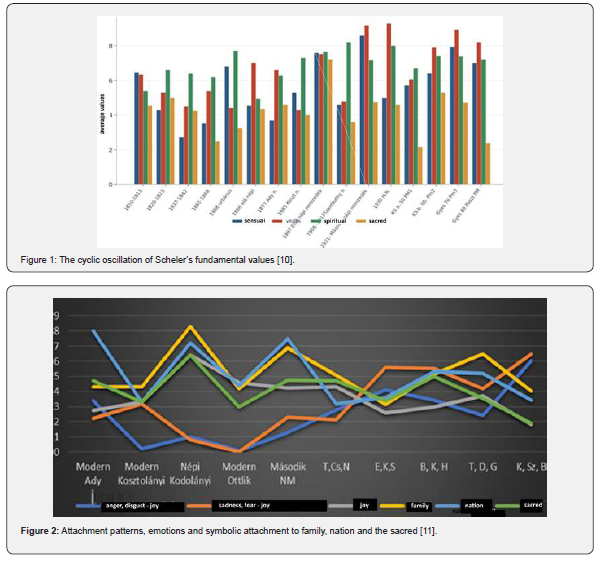
A comparable degree of historical organization emerged from the analysis of Schelerian value orientations, rather than appearing as isolated philosophical preferences; sensory, vital, spiritual, and Holy values formed historically differentiated axiological configurations. Particularly noteworthy was the recurrent inverse relationship between sacred and sensory value orientations. Periods with stronger sensory orientations generally coincided with lower salience of sacred values. In contrast, increases in sacred values were often accompanied by a relative decline in sensory (sensual and hedonist) orientations. Rather than representing deterministic historical laws, these observations suggest recurrent value configurations within literary communication.
The analyses further revealed that different literary traditions displayed distinct axiological organizations. Authors commonly associated with the Hungarian populist literary tradition demonstrated an unusually balanced integration of Scheler's four value domains. Rather than emphasizing a single value orientation, their works articulated sensory, vital, spiritual, and sacred dimensions with comparatively high intensity.
By contrast, other literary traditions displayed more pronounced differentiation among value domains, indicating that literary communication may preserve multiple forms of affective–axiological organization simultaneously within the same historical period. These findings support the proposition that value systems function not merely as thematic contents but as organizing principles of literary communication itself Figure 1.
Historical organization of symbolic attachment
The third analytical dimension examined symbolic attachment toward family, nation, and the sacred. Again, the analyses demonstrated that these relational domains exhibited considerable historical organization.
Although the three attachment dimensions did not change in the same way, substantial historical co-variation emerged across the investigated literary generations. Periods with stronger symbolic attachment to the sacred also showed stronger attachment to family and nation. In contrast, periods marked by weaker sacred attachment often coincided with reductions across the remaining relational domains. These observations suggest that symbolic attachment functions as an integrated relational system rather than as three independent ideological variables. At the same time, the analyses identified meaningful historical deviations from this general tendency. Certain literary generations exhibited partial dissociations between symbolic domains, indicating that family, national, and sacred attachment may occasionally reorganize independently under changing historical and communicative conditions.
Importantly, the present analyses do not identify the psychological attachment styles of individual authors. Instead, they reconstruct symbolic attachment organizations embedded within literary communication itself. Family, nation, and the sacred therefore function as culturally shared relational reference systems rather than as biographical characteristics. Consequently, symbolic attachment should be understood as a communicative organization observable within literary discourse Figure 2.
1947-19535r4. Integrated Relational Communication Profiles
The most important empirical finding emerged when affective organization, axiological orientation, and symbolic attachment were examined simultaneously. Rather than producing unrelated analytical results, the three dimensions converged into relatively coherent relational communication profiles characterizing successive literary generations. Historical literary cohorts differed not only in their dominant emotions or value orientations but also in how they organized relational communication overall. Generations characterized by stronger communicative integration frequently exhibited higher symbolic attachment across family, national, and sacred domains together with more balanced value organizations. Conversely, cohorts displaying elevated avoidance-related and anxiety-related affective configurations often demonstrated weaker symbolic attachment and greater differentiation among value orientations.
These communication profiles should not be interpreted as psychological descriptions of individual writers. Rather, they represent historically situated symbolic organizations reconstructed from literary discourse through the integrated analysis of emotional, axiological, and relational indicators. The consistency of these integrated configurations across neighboring literary generations suggests that literary communication preserves relatively stable relational architectures extending beyond individual texts or authors. Such architectures remain observable despite considerable stylistic diversity, thematic variation, and ideological heterogeneity. Taken together, the empirical analyses provide initial support for a central assumption of the Relational Communication Theory of Culture. Literary communication preserves historically differentiated relational configurations that become observable through the combined analysis of affective organization, value structures, and symbolic attachment. The present findings should therefore be regarded as exploratory evidence supporting the feasibility of reconstructing relational communication profiles from literary corpora using AI-assisted qualitative analysis.
Discussion
Literary Communication as Relational Communication
The principal objective of the present study was not to explain twentieth-century Hungarian literary history, nor to infer the psychological attachment styles of individual authors. Rather, the study explored whether literary communication preserves historically differentiated relational configurations that become empirically observable through the integrated analysis of affective organization, value orientation, and symbolic attachment. The empirical findings suggest that such configurations do indeed exist. Across successive literary generations, affective patterns, Schelerian value orientations, and symbolic attachment indicators did not vary independently. Instead, they formed partially coherent communicative organizations that remained sufficiently stable to permit historical comparison while retaining substantial internal diversity. These observations constitute the primary empirical contribution of the present investigation. From the perspective of the Relational Communication Theory of Culture (RCTC), this finding implies that literary communication should not be understood solely as the communication of meanings, narratives, or ideological positions. Literary texts simultaneously organize relational experience. Family, nation, and the sacred emerge not merely as recurring themes but as symbolic relational systems embedded within literary communication itself.
Importantly, this interpretation does not assume that literary texts directly reflect the psychological characteristics of their authors. Instead, the present analyses reconstruct communicative organizations emerging from literary discourse. Consequently, the object of investigation is neither individual personality nor collective ideology, but historically situated relational communication.
Communication rather than psychological diagnosis
One of the principal methodological implications of the present framework concerns the distinction between psychological attachment and symbolic attachment organization. Attachment theory has traditionally focused on internal working models governing interpersonal relationships. This study extends this perspective by proposing that literary communication constitutes a symbolic environment in which relational organizations become culturally represented and historically transmitted. This extension should not be interpreted as a psychological diagnosis of literary authors. Instead, attachment functions here as a communication-theoretical concept describing recurrent relational configurations observable within literary discourse.
This distinction considerably broadens attachment theory's analytical scope. Rather than asking whether individual writers display secure or insecure attachment, the present framework investigates how literary communication itself organizes symbolic proximity, distance, belonging, trust, transcendence, and collective identity. In this sense, attachment is reconceptualized as a principle of communicative organization rather than an attribute of individual personality.
Interpreting historical communication profiles
The historical communication profiles identified in the present study invite several possible theoretical interpretations. One possible explanatory perspective derives from developmental attachment theory. Internal working models may influence the symbolic organization of narratives through their long-term effects on emotional regulation, relational expectations, and interpersonal representation. From this perspective, literary communication may preserve culturally shared relational organizations extending beyond individual biographies.
A second interpretative perspective originates from cultural anthropology. Scholars such as Kardiner and Mead suggested that primary institutions, child-rearing practices, and cultural environments shape characteristic personality organizations. Without assuming direct historical causality, the present findings appear compatible with the possibility that broader socio-cultural environments influence the relational organization of literary communication. A third interpretative framework may be found in Sorokin's theory of cultural dynamics. The observed historical configurations of affective organization, value orientation, and symbolic attachment display partial correspondence with broader transformations between ideational, idealistic, and sensate cultural orientations. Although the present analyses cannot directly verify such macro-historical theories, they suggest that literary communication may preserve communicative traces of larger cultural transformations.
Importantly, these theoretical perspectives should be regarded as interpretative frameworks rather than empirical demonstrations. The present study neither confirms nor refutes any individual macro-social theory. Instead, it identifies empirical communication patterns that future interdisciplinary research may interpret from multiple theoretical perspectives [12,13].
Methodological contributions
Beyond its substantive findings, the present investigation proposes a methodological contribution.
The study shows that AI-assisted qualitative content analysis can serve as an exploratory communication-theoretical instrument for reconstructing relational configurations within literary corpora. Importantly, artificial intelligence did not replace literary interpretation. The researcher remained responsible for all theoretical concepts, analytical categories, coding principles, and interpretative conclusions. Within this framework, large language models function as systematic qualitative coding assistants that can identify recurring affective, axiological, and symbolic patterns across extensive textual corpora. Their principal contribution lies in increasing analytical consistency rather than generating autonomous interpretations.
The proposed methodology therefore represents a complementary analytical instrument situated between traditional close reading and computational text analysis. Rather than replacing established literary methods, it expands the methodological repertoire available for communication-oriented literary research.
Limitations and future research
Several limitations necessarily qualify the present findings First; the investigation represents an exploratory pilot study based on purposively selected literary corpora. Consequently, the resulting communication profiles should not be interpreted as statistically representative descriptions of Hungarian literary history. Second, the proposed analytical framework still depends on theoretical operationalization. Alternative affective models, value theories, or symbolic attachment dimensions may produce different communication profiles that deserve systematic comparison. Third, the present study investigates literary communication rather than broader cultural communication. Future research should examine whether comparable relational configurations emerge in autobiographical writing, political discourse, journalism, film, or digital communication. Finally, future investigations should evaluate the reproducibility of AI-assisted qualitative coding through multi-model comparison, independent coding teams, intercoder agreement studies, and multilingual corpus analyses. These directions would strengthen the empirical foundations of the Relational Communication Theory of Culture.
Conclusion
The present study should therefore be understood as an exploratory communication-theoretical proposal rather than as a comprehensive explanation of literary history. Its principal contribution is to show that literary communication can be investigated as a historically organized relational system through the integrated analysis of affective organization, value structures, and symbolic attachment. Rather than replacing existing literary theories or attachment research, the Relational Communication Theory of Culture seeks to establish a conceptual bridge between communication theory, affective science, attachment theory, and literary studies. By introducing relational organization as an analytically distinguishable dimension of literary communication, the framework opens new possibilities for interdisciplinary research on culture, communication, and historical meaning-making. The findings reported here invite a broader research program in which literary communication is investigated not only as the transmission of meanings but also as the symbolic organization of human relatedness across historical time.
References
- Bowlby J (1969) Attachment and loss Vol 1: Attachment. London: Hogarth.
- Ainsworth M, Blehar M, Waters E, Wall S (1978) Patterns of Attachment. Hillsdale, NJ: Erlbaum.
- Lazar I (2015) Attached files: Anthropological Essays on Body, Psyche, Attachment and Spirituality. Newcastle upon Tyne, U.K. Cambridge Scholars Publishing, p. 304.
- Kirckpatrick AL (2005) Attachment, Evolution, and the Psychology of Religion. Guilford Press.
- Granqvist P (2020) Attachment in Religion and Spirituality: A Wider View. Guilford Press.
- Lazar I (2000) Mothers and Mother Nature: Attachment, Detachment and Human Ecological Integrity. In: Crabbé P (szerk.) Implementing Ecological Integrity. Restoring Regional and Global Environmental and Human Health (NATO Science series: IV. Earth and Environmental Sciences), pp: 249-260.
- Lazar I (2014) At the Cradle of Psychobiological Risks: Distorted Attachment Organizations in Human Ecological and Evolutionary Contexts in Paulina Watson Social Behavior Evolutionary Pathways, Environmental Influences and Impairments. Nova Publishers, New York.
- Felski R (2020) Hooked: Art and Attachment. The University of Chicago Press.
- Moretti F (2013) Distant Reading. Verso Books
- Lazar I (2026) A digitális irodalomtudomány helye az irodalom affektív-axiológiai elemzésében (The place of digital literary studies in the affective-axiological analysis of literature) in Korszellem és érzelmi jelentésmezők az adatvezérelt forráselemzés tükrében (Zeitgeist and emotional fields of meaning in the light of data-driven source analysis) Gergely Tóth, Károli Könyvek L’Harmattan, Budapest in press.
- Lazar I (2026) Érték, érzelem és a kötődés dinamikája a modernitás magyar irodalmában Sorokin kultúratipológiájának tükrében (Value, emotion and the dynamics of attachment in modern Hungarian literature in the light of Sorokin's typology of culture) in Imre Lázá Kötődésstruktúrák és jelentésvilágok (Attachment structures and worlds of meaning) Károli Könyvek L’Harmattan, Budapest in press.
- Lázár, I (2015) Believers, Prophets and Visionaries: Attachment, Spirituality and Health In: Edith, C Roberts (szerk.) Spirituality: Global Practices, Societal Attitudes and Effects on Health Hauppauge (NY), Amerikai Egyesült Államok : Nova Science Publishers.
- Underwood T (2019) Distant Horizons. The University of Chicago Press.