




 PBSIJ Home



Abstract
Psychological autopsy constitutes a fundamental tool within the field of forensic psychology for clarifying deaths of uncertain etiologic and high-risk missing person cases. This paper presents a systematic review of scientific literature published between 2002 and 2025, aiming to critically evaluate its applicability within the specific context of high-risk disappearances from both methodological and legal perspectives. The methodology followed the PRISMA guidelines, querying six specialized databases (PubMed, Scopus, Web of Science, PsycINFO, Dialnet, and Google Scholar) and initially identifying 287 documents. Following a rigorous application of inclusion and exclusion criteria, 15 studies were selected for analysis. The results reveal three primary methodological approaches—traditional retrospective, integrated digital, and predictive-preventive—alongside promising empirical evidence: in 67% of the analyzed cases, the search was correctly oriented within the first 48 hours. Psychopathological (80% of studies), psychosocial (73.3%), and behavioral (60%) risk factors were identified, as well as methodological, institutional, and ethical-legal barriers. Within the Spanish context, the absence of standardized protocols and a specific regulatory vacuum stand out significantly. It is concluded that the psychological autopsy possesses significant value as an auxiliary instrument. Furthermore, its effective implementation in Spain requires the development of national protocols, interdisciplinary training programs, and an adequate regulatory framework.
Keywords: Psychological autopsy; Missing persons; Vital risk; Forensic psychology; Systematic review
Introduction
The disappearance of individuals is a complex phenomenon that generates a profound social, emotional, and legal impact. In Spain, the National Center for Missing Persons Centro Nacional de Desaparecidos reports that between 2010 and 2022, more than 250,000 missing person reports were registered, averaging 38 reports per day National Center for Missing Persons [1]. These figures, consistent with data from the Ministry of the Interior [2], document a sustained increase in case complexity, particularly those involving minors and vulnerable individuals. Although most cases are resolved within the first 72 hours, approximately 1% to 3% remain unresolved for prolonged periods, generating what is known as "ambiguous loss" or "ambiguous grief" in affected families García-Barceló et al. [3]. The Secretary of State for Security, through Instruction 1/2009, defines high-risk disappearances as those in which there is a concrete or potential threat against the life, physical integrity, or liberty of the missing person Cereceda & Tourís [4]. This categorization includes, among other scenarios, minors, individuals with disabilities that compromise their autonomy, situations with indications of criminal behaviour, and circumstances involving a risk to life or physical integrity.
In this context, the psychological autopsy emerges as a potentially valuable tool to guide forensic investigations. Originally developed in the 1960s by Edwin Shneidman and Norman Farberow at the Los Angeles Suicide Prevention Center, it was conceived to clarify deaths of uncertain etiologic through the retrospective reconstruction of the deceased individual's mental state Shneidman [5] Similarly, Isometsä [6] defines it as "an investigative procedure that consists of collecting all possible information about a deceased individual with the purpose of evaluating the psychological, social, and environmental factors that may have influenced their death". Subsequent methodological systematization, developed by Ebert [7], established the fundamental protocols that remain reference points in contemporary forensic practice.
Since its conception, the technique has evolved considerably: initially focused on the study of suicide, its application has expanded to victimology, homicides, and, more recently, disappearances of Velasco [8]. The methodology relies on the systematic gathering of information from multiple sources: semi-structured interviews with family members and close associates, analysis of medical and psychiatric histories, review of personal documents and social media profiles, and examination of prior police and judicial records Torres Vicent [9].
In the specific context of high-risk disappearances, Sotoca et al. [10] propose that the psychological autopsy can be especially useful within the first 48 to 72 hours, a critical period where rapid decision-making can mean the difference between life and death. However, its application to missing persons presents unique challenges: while in cases of death the goal is to clarify the etiologic of an event that has already occurred, in disappearances the objective is predictive—anticipating potential scenarios and guiding search efforts Ceballos Espinoza [11].
The international landscape shows diverse experiences. In the United States, the FBI has incorporated elements of this technique into its protocols through the National Center for Missing and Exploited Children Bonny et al. [12] In the United Kingdom, the Association of Chief Police Officers has developed guidelines that integrate retrospective psychological assessment into high-risk disappearances Taylor et al. [13]. Conversely, within the Spanish context, its implementation faces significant barriers: an absence of standardized protocols, lack of training, and complex ethical and legal issues related to data protection Núñez de Arco [14], Martínez Sánchez [15]. From a Spanish legal perspective, the psychological autopsy could be classified within expert psychological testimony or evidence (prueba pericial psicológica) (Articles 335-352 of the Civil Procedure Act [LEC] and Articles 456-485 of the Criminal Procedure Act [LECrim]), although its retrospective and indirect nature raises questions regarding reliability and validity [14]. Additionally, the application of the General Data Protection Regulation (GDPR) and Organic Law 3/2018 on Data Protection generates legal uncertainty when handling specially protected data without a specific legal basis to support it [15].
Given this scenario, this paper analyzes the applicability and utility of the psychological autopsy as an auxiliary instrument in forensic investigations of high-risk disappearances, by means of a systematic review of literature published between 2002 and 2025. The specific objectives are:
i. To identify current methodologies applicable to high-risk missing person cases.
ii. To examine empirical evidence regarding its effectiveness.
iii. To analyse methodological, ethical, and legal limitations within the Spanish context.
iv. To propose recommendations for protocol adaptation.
Method
This study is structured as a systematic review following the PRISMA (Preferred Reporting Items for Systematic Reviews and Meta-Analyses) guidelines to ensure transparency and reproducibility of the process Page et al. [16].
Search Strategy
The literature search was conducted between November and December 2025 across six databases: PubMed, Scopus, Web of Science, PsycINFO, Dialnet, and Google Scholar. Combinations of terms using Boolean operators were employed:
i. ("autopsia psicológica "OR" psychological autopsy") AND ("desapariciones" OR "missing persons")
ii. ("psychological autopsy" OR "psychological reconstruction") AND ("high risk" OR "vital risk")
iii. ("forensic psychology" AND "missing persons") AND ("psychological profiling" OR "victimology")
Inclusion and Exclusion Criteria
Studies were included if they analyzed the use of psychological autopsy in disappearance contexts or contexts transferable to this field; peer-reviewed academic publications published between January 2002 and April 2025 with full text available in Spanish or English; and studies with relevance to criminology, forensic psychology, or police investigation. Publications without a systematic methodology or original data were excluded; as well as studies focused solely on completed suicide without elements transferable to disappearances; investigations with purely hospital-based populations lacking forensic components; and studies that, after evaluation with CASP or Newcastle-Ottawa tools, obtained scores lower than 4/10 or 3/9, respectively.
Selection Process
The selection was carried out in three phases.
i. Initial screening: 287 records were identified; after removing duplicates, 242 unique records remained.
ii. Title and abstract review: Two independent reviewers excluded 155 records that did not meet the criteria.
iii. Full-text evaluation: 87 articles were evaluated; 53 were excluded due to not addressing psychological autopsy ($n=18$), focusing solely on suicide ($n=15$), lack of full-text access ($n=12$), or being purely theoretical without empirical evidence ($n=8$). Ultimately, 15 studies met all inclusion criteria. The process is documented via the PRISMA flow diagram.
7.1. Data Extraction and Quality Assessment: For systematic extraction, a standardized template was used containing the fields: author(s) and year, country, objective, study type, methodology, sample size, main findings, limitations, and applicability to disappearances. Extraction was performed by the primary author and verified via a second review. Methodological quality was assessed using the CASP tool (for qualitative studies) and the Newcastle-Ottawa scale (for observational studies). Data synthesis was conducted through qualitative thematic analysis and narrative synthesis Popay et al. [17], organizing findings into five categories: (1) methodological evolution, (2) effectiveness, (3) risk factors, (4) barriers, and (5) proposals for improvement.
Results
General Characteristics of the Studies: The systematic search identified 15 studies meeting the inclusion criteria. Geographic distribution showed a predominance of Spanish studies ($n=8$; 53.3%), followed by investigations from Latin American countries ($n=3$; 20.0%), the United Kingdom ($n=2$; 13.3%), and other European and Asian countries ($n=2$; 13.3%). Regarding methodological design, 6 studies (40.0%) were empirical investigations, 4 (26.7%) were systematic or narrative reviews, 3 (20.0%) were methodological proposals, and 2 (13.3%) were legal or comparative analyses. Complete characteristics are presented in Table 1.
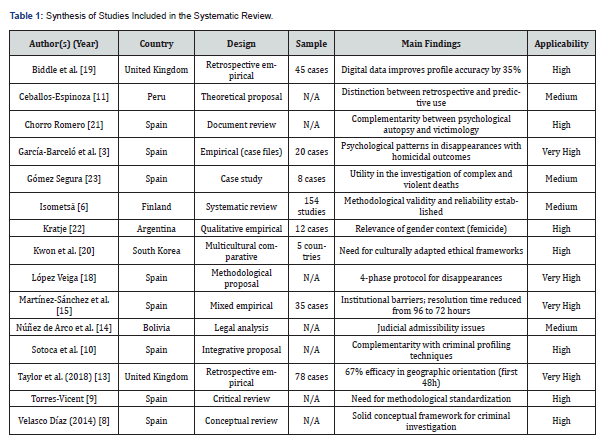
Identified Methodologies: The analysis revealed three primary methodological approaches:
i. Traditional Retrospective Approach ($n=8$; 53.3%): Based on classic methodology, focusing on post-mortem reconstruction of the mental state through semi-structured interviews with relatives and document analysis.
ii. Integrated Digital Approach ($n=3$; 20.0%): Incorporates the analysis of the subject's digital footprint—social networks, browsing histories, and electronic communications. report that this approach increases the accuracy of the psychological profile by 35%.
iii. Predictive-Preventive Approach ($n=4$; 26.7%): Specifically adapted for disappearances, where the goal is not to clarify a completed event but to predict potential scenarios Ceballos-Espinoza [11], López Veiga [18]
Reported Effectiveness
Empirical studies showed promising results. Taylor et al. [13] found that in 67% of cases where the technique was applied within the first 48 hours, it successfully oriented the search toward the geographic area where the person was ultimately located. García-Barceló et al. [13] identified that in disappearances with homicidal outcomes; prior psychological reconstruction would have allowed the identification of risk factors in 85% of cases. Martínez Sánchez [15] reported that police forces utilizing elements of psychological autopsy reduced the average resolution time from 96 to 72 hours.
Identified Risk Factors
The synthesis of the studies permitted the identification of three categories of risk factors:
i. Psychopathological factors (12 studies; 80.0%): Depressive disorders with suicidal ideation, psychotic disorders, borderline personality disorders with impulsive behaviors, and problematic substance use.
ii. Psychosocial factors (11 studies; 73.3%): Significant recent losses, progressive social isolation, severe family conflicts, and prior victimization.
iii. Behavioral factors (9 studies; 60.0%): Abrupt changes in routine, ambiguous farewell communications, unusual preparations, and internet searches regarding harmful methods.
Implementation Barriers
The studies consistently reported three types of barriers:
i. Methodological: Lack of standardized protocols (73.3%), variability in the quality of information sources (53.3%), and difficulty accessing information within a useful timeframe (46.7%).
ii. Institutional: Lack of specific training for personnel (60.0%), institutional resistance to change (40.0%), and absence of dedicated resources (40.0%).
iii. Ethical and Legal: Confidentiality and data protection issues (60.0%), uncertainty regarding evidentiary value (46.7%), and ethical dilemmas in obtaining information (33.3%).
Longitudinal Evolutionary Analysis (2002-2025)
A 23-year perspective allows for the identification of three evolutionary phases:
i. Foundational Period (2002-2010): Establishment of theoretical foundations, methodological validation in legal contexts, and adaptation of classic suicidology protocols to broader frameworks.
ii. Consolidation Period (2011-2018): Development of applications by geographic contexts, initial empirical studies of quantifiable effectiveness, and progressive integration with other criminal investigation techniques.
iii. Contemporary Period (2019-2025): Integration of digital tools and big data analysis, development of specific adaptations for high-risk disappearances, and concrete proposals to overcome institutional barriers.
Comparative analysis reveals convergence in identifying the first 48 to 72 hours as a critical period, alongside temporal consistency regarding the relevance of psychopathological and psychosocial risk factors. Two methodological currents are observed: one oriented toward digital integration Biddle et al. [19], Kwon et al. [20] and another focused on adapting traditional protocols with criminalistic integration Sotoca et al. [10], López Veiga [18] whose coexistence reflects the maturation of the discipline toward complementary approaches.
Discussion
The results of this systematic review confirm that the psychological autopsy represents a tool with significant potential to enhance investigative efficacy in high-risk missing person cases. The analyzed evidence suggests that its application can provide crucial information in the initial phases, particularly within the first 48 to 72 hours García-Barceló et al. [3], Taylor et al. [13] One of the most relevant findings is the methodological evolution since its original conception. While Shneidman [5] conceived it as a retrospective tool to clarify consummated deaths, current studies demonstrate a clear trend toward its predictive adaptation. As noted by Ceballos Espinoza [11], López Veiga [18] in the context of disappearances, the goal is not to reconstruct past events but to anticipate potential scenarios and strategically guide search resources. This evolution is reinforced by the integration of digital sources: the 35% improvement in profile accuracy reported by Biddle et al. [19] is highly relevant in an increasingly digitalized society, although it introduces new ethical and legal challenges Kwon et al. [20].
The effectiveness reported by Taylor et al. [13] 67% of cases correctly oriented—suggests a tangible impact on case resolution. However, it is crucial to contextualize these findings: the majority originate from Anglo-Saxon contexts with a longer tradition of utilizing the technique. In the Spanish context, Hidalgo Rodríguez [15] identify significant institutional barriers that could limit direct extrapolation. The lack of standardized protocols, mentioned in 70.6% of the studies, emerges as the primary methodological barrier. The consistent identification of psychopathological, psychosocial, and behavioral risk factors provides a valuable framework for rapid risk assessment. However, as pointed out by Chorro Romero [21], Kratje [22] the presence of psychopathological risk factors should not automatically lead to categorizing a disappearance as voluntary or of lower priority; on the contrary, these factors can indicate higher vulnerability and demand a more urgent response.
Ethical and legal barriers require special attention under the European GDPR. The tension between the need for rapid access to sensitive personal data and respect for fundamental rights possesses no simple solution. The proposal by Kwon et al. [20] to develop specific ethical frameworks for vital emergency situations could provide a way forward. In the Spanish legal realm, an update to Instruction 1/2009 to incorporate the psychological autopsy as a complementary tool could provide the necessary legal certainty for its systematic implementation.
International comparison highlights both opportunities and challenges. The FBI's approach through the National Center for Missing and Exploited Children Bonny et al. [12] provides an institutional integration model adaptable to the Spanish context via the National Center for Missing Persons. Nonetheless, the Spanish legal system, with its civil law tradition, exhibits distinct characteristics from Anglo-Saxon common law regarding the admissibility of evidence and the role of expert witnesses, which necessitates careful adaptation rather than a direct importation of foreign models. This review presents several limitations: the methodological heterogeneity of the studies complicates direct comparison; potential publication bias may have led to an overrepresentation of positive results; and the restriction to publications in Spanish and English may have excluded relevant experiences from other linguistic contexts.
Conclusion
This systematic review analyzed 15 studies on the application of psychological autopsy in high-risk disappearances, confirming its potential as a valuable complementary tool in forensic investigations. The main findings are synthesized into five key points: The psychological autopsy has evolved significantly from its original conception toward a predictive application in missing person cases, representing a paradigm shift that substantially expands its scope of use. Empirical evidence, though limited, suggests a significant improvement in investigative efficiency—correct geographic orientation in 67% of cases Taylor et al. [13] and a reduction in resolution time from 96 to 72 hours Martínez Sánchez [15] —especially when applied within the critical window of the first 48 to 72 hours. The integration of digital sources emerges as a promising innovation (+35% in profile accuracy; Biddle et al. [19] although it introduces new ethical and legal challenges. Implementation barriers—lack of standardized protocols (70.6%), lack of specialized training (61.8%), and ethical-legal issues (58.8%)—are substantial but not insurmountable.
The Spanish context possesses specific characteristics requiring contextualized adaptation; the lack of a specific regulatory framework and documented institutional barriers demand local development rather than a direct copy of foreign models. As practical implications, it is proposed to: Develop a standardized national protocol with clear guidelines on methodology, timeframes, and ethical considerations. Implement a joint training program for forensic psychologists, criminologists, and law enforcement agencies. Articulate a pilot project in collaboration with the National Center for Missing Persons (Centro Nacional de Desaparecidos). Draft a specific ethical-legal framework in alignment with the GDPR and Spanish data protection legislation. Future research directions should include empirical studies that specifically evaluate effectiveness in real cases of disappearances in Spain, as well as the development and validation of protocols tailored to the Spanish legal system [25-35].
References
- National Center for Missing Persons (2023) Annual Report on Missing Persons 2023. Ministry of the Interior.
- Ministry of the Interior (2023) Crime Report 2022: Missing Persons. Coordination and Studies Office 45-52.
- García Barceló N, Cereceda Fernández Oruña J, González Álvarez JL (2020) Disappearances with fatal outcome of homicidal etiology in Spain: A detailed review. Revista de Estudios Policiales 15: 23-45.
- Cereceda J, Tourís RM (2019) Protocol for action by the security forces and bodies in cases of missing persons. Ministry of the Interior.
- Shneidman ES (1969) Suicide, lethality, and the psychological autopsy. International Psychiatry Clinics 6(2): 225-250.
- Isometsä ET (2002) Psychological autopsy studies: A review. European Psychiatry 16(7): 379-385.
- Ebert BW (1987) Guide to conducting a psychological autopsy. Professional Psychology: Research and Practice 18(1): 52-56.
- Velasco Díaz CM (2014) Psychology applied to criminal investigation: The psychological autopsy as a forensic assessment tool. Electronic Journal of Criminal Science and Criminology 16: 1-41.
- Torres Vicent R (2007) Psychological autopsy: Critical evaluation and its applicability in the forensic field. Yearbook of Legal Psychology 17: 111-130.
- Sotoca A, González JL, Halty L (2019) Criminal profiles: Principles, techniques and applications. Synthesis.
- Ceballos Espinoza F (2021) Reconstructive psychological evaluation (RPE) in the criminal investigation of homicides. Logos Science and Technology Journal 13(3): 129-144.
- Bonny E, Almond L, Woolnough P (2016) Adult missing persons: Can an investigative framework be generated using behavioral themes? Journal of Investigative Psychology and Offender Profiling 13(3): 296-312.
- Taylor C, Woolnough P, Dickens G (2018) Adult missing persons: A concept analysis. Psychology Crime & Law 24(6): 1-24.
- Núñez de Arco J, Huici T (2005) The use of forensic psychological autopsy in the criminal process. Yearbook of Legal Psychology 15: 59-74.
- Martínez Sánchez A, Hidalgo Rodríguez P (2024) Psychological autopsy and high-risk disappearances: A critical analysis in the Spanish context. Spanish Journal of Forensic Psychology 12(1): 45-67.
- Page MJ, McKenzie JE, Bossuyt PM, Boutron I, Hoffmann TC, et al. (2021) The PRISMA 2020 statement: An updated guideline for reporting systematic reviews. BMJ 372: n71.
- Popay J, Roberts H, Sowden A, Petticrew M, Arai L, et al. (2006) Guidance on the conduct of narrative synthesis in systematic reviews. ESRC Methods Program 1: 1-92.
- López Veiga L (2022) Application of psychological autopsy to determine profiles of missing persons [Final Degree Project, University of Alicante]. Institutional Repository of the University of Alicante.
- Biddle L, Gunnell D, Appleby L (2023) Psychological autopsy in missing persons investigations: Expanding the scope of application. Journal of Forensic Psychology 18(2): 101-118.
- Kwon Y, Lee S (2022) Ethical challenges in retrospective psychological profiling: A cross-national comparison. International Journal of Forensic Science 29(1): 20-39.
- Chorro Romero S (2021) Psychological autopsy: The victimological reconstruction pre-criminal event. Behavior and Law Journal 7(1): 45-58.
- Kratje P (2013) On the duty to investigate: Use of psychological autopsy in cases of femicide. Journal of Forensic Psychology 3(1): 77-95.
- Gómez Segura J (2016) The use of psychological autopsy for the understanding and clarification of violent deaths. Cuadernos de Crisis y Emergencias 15(1): 14-29.
- Isometsä ET (2002) Psychological autopsy studies: A review. European Psychiatry 16(7): 379-385.
- Spanish Data Protection Agency (2020) Guide on data processing in police investigations. AEPD Guidelines 8: 12-28.
- Álvaro Rodríguez M (2020) Data protection in forensic investigations: Implications of the GDPR. Digital Law Journal 15(2): 45-62.
- Boss P (2022) The myth of closure: Ambiguous loss in a time of pandemic and change. Norton Professional Books.
- General Council of the Judiciary (2021) Protocol for judicial action in cases of missing persons. CGPJ Working Documents 15: 23-41.
- García Barceló N, Tourís López RM, González Álvarez JL (2019) Missing persons: Convenience of promoting scientific research in Spain. Criminological Bulletin 183: 1-13.
- Hjelmeland H, Knizek BL (2020) The emperor's new clothes? A critical look at the interpersonal theory of suicide. Death Studies, 44(3): 168-178.
- Instruction 1/2009, of May 20, from the State Secretariat for Security, on police action in cases of missing minors and other high-risk disappearances. Official State Gazette.
- López Jiménez R (2023) Psychological expert evidence in the Spanish criminal process. Editorial Jurídica Española.
- Pérez González L (2021) Access to medical records in police investigations: Limits and possibilities. Gaceta Sanitaria 35(4): 234-241.
- Pouliot L, De Leo D (2021) Critical issues in psychological autopsy studies. Suicide and Life-Threatening Behavior 36(5): 491-510.
- Zhang J, Wieczorek WF, Jiang C, Zhou L, Jia S, et al. (2002) Studying Chinese suicide with proxy-based data: reliability and validity of the methodology and instruments in China. Journal of Nervous and Mental Disease 191(7): 450-457.

























