




 PBSIJ Home



Abstract
The rapid expansion of online gambling platforms in Nigeria has raised concerns about gambling ideation among university students. While social support is widely recognised as a buffer against risky behaviours, its specific relationship with gambling-related thoughts remains underexplored in African contexts. This study examined the relationship between perceived social support (from family, peers, and academic sources) and gambling ideation among undergraduate students in Southwest Nigeria. A cross-sectional survey design was employed. Data were collected from 11,631 undergraduates across six public universities using the Multidimensional Scale of Perceived Social Support (MSPSS) and the Gambling Urge Scale (GUS).
Multiple regression and structural equation modelling were used for analysis. All sources of social support measured in this study were significantly and negatively associated with gambling ideation: family support (B = −0.056, p < .001), academic support (B = −0.043, p < .001), and peer support (B = −0.013, p < .01). Family support emerged as the strongest protective factor. Social support played a moderating role in the relationship between impulsivity (B = -0.009, p = .009) and sensation-seeking (B = 0.012, p < .001) with gambling ideation. Higher overall perceived social support consistently predicted lower levels of gambling ideation. Perceived social support, particularly from family and academic sources, serves as a significant protective factor against gambling ideation among Nigerian undergraduates. Interventions aimed at strengthening family engagement and academic mentoring may be effective in preventing the cognitive precursors of problematic gambling.
Keywords:Gambling ideation; Social support; Family support; Peer support; Academic support; Undergraduates; Nigeria
Introduction
The rapid proliferation of online sports betting and gambling platforms in Nigeria over the past decade has transformed gambling from a marginal activity into a mainstream form of entertainment, particularly among young adults [1,2]. With over 60 million Nigerians estimated to engage in sports betting and aggressive marketing targeting university campuses through mobile applications such as Bet9ja, Sportybet, and NairaBet, gambling has become highly accessible and socially visible [3]. This surge is especially pronounced in Southwest Nigeria, where major urban universities serve as hubs of digital connectivity and peer influence.
Although much attention has focused on actual gambling behaviour and problem gambling, gambling ideation, recurrent thoughts, urges, or fantasies about gambling that occur independently of or prior to actual betting, represents a critical but understudied cognitive precursor [4,5]. Gambling ideation is important because it often marks the earliest stage in the pathway toward habitual or disordered gambling and can persist even in the absence of betting behaviour [6]. In the Nigerian university context, where students face academic pressure, financial uncertainty, and newfound autonomy, such ideation may serve as a maladaptive coping mechanism or a response to perceived opportunity for quick financial gain.
Social support has long been established as one of the most robust protective factors against a wide range of risky and maladaptive behaviours, including substance use, delinquency, and mental health problems [7]. According to the stress-buffering hypothesis, perceived availability of emotional, informational, and instrumental assistance from significant others mitigates the impact of stressors and reduces reliance on escape-oriented or reward-seeking behaviours. In collectivist cultures such as Nigeria, family ties remain particularly strong even after students leave home for university, while peer networks and relationships with academic staff also constitute important sources of support [8]. Despite theoretical reasons to expect social support to reduce gambling ideation, empirical evidence from sub-Saharan Africa remains extremely limited, and no large-scale study has systematically examined the contributions of family, peer, and academic support to gambling-related cognitions among Nigerian undergraduates.
Statement of the problem
Despite the widespread penetration of online gambling platforms and anecdotal reports of increasing gamblingrelated thoughts among Nigerian university students, there is a critical gap in understanding the protective factors that may prevent or reduce such ideation. Existing studies in Nigeria have predominantly focused on prevalence and correlates of actual gambling behaviour rather than cognitive precursors. Moreover, the few available African studies tend to treat social support as a unidimensional construct, overlooking the potentially differential roles of family, peers, and academic staff in a university setting. This leaves policymakers, university administrators, and mental health practitioners without evidence-based guidance on how to strengthen protective social environments to curb the emergence of gambling ideation.
Objective of the study
The primary objective of this study was to examine the relationship between perceived social support from multiple sources (family, peers, and academic staff) and gambling ideation among undergraduate students in Southwest Nigeria. Specifically, the study sought to: Determine the strength and direction of the associations between family, peer, and academic support and gambling ideation. Identify which source of social support exerts the strongest protective effect against gambling ideation. Provide empirical evidence to inform culturally relevant prevention and intervention strategies.
Significance of the study
This study is the first large-scale investigation (N = 11,631) of the protective role of social support against gambling ideation in a non-Western, sub-Saharan African context. By disaggregating social support into family, peer, and academic dimensions, it offers nuanced insights into which relationships matter most for Nigerian undergraduates. The findings have direct practical implications for university counselling services, student affairs directorates, parent-university partnership programmes, and national policy efforts aimed at regulating gambling advertising targeting youth. Theoretically, the study extends the stress-buffering model to a novel behavioural domain (gambling ideation) and tests its applicability in a collectivist, resource-constrained educational setting. Finally, by focusing on ideation rather than behaviour, the research shifts attention toward early prevention, potentially averting the development of more severe gambling problems in a vulnerable population.
Literature Review: Social Support and Gambling- Related Outcomes
Social support is widely conceptualised as the perception
that one is cared for, valued, and able to obtain assistance from
one’s social network when needed [7,9]. It operates through two
primary mechanisms: (a) the main-effect model, where support
enhances overall well-being regardless of stress level, and (b) the
stress-buffering model, where support is particularly protective
under conditions of high stress by reducing the likelihood of
maladaptive coping. Both mechanisms are relevant to gambling
ideation, as university students experience chronic stressors
(academic demands, financial strain, identity transitions) that may
trigger escapist or reward-seeking cognitions. Empirical evidence
consistently demonstrates an inverse relationship between
perceived social support and various addictive behaviours,
including substance use, internet gaming disorder, and gambling
[10-12]. In the specific domain of gambling, higher levels of social
support have been associated with lower severity of gambling
problems, reduced relapse rates, and better treatment outcomes
[13,14]. Differential Effects of Support Sources Research highlights
that not all sources of support are equally protective in the context
of gambling:
i. Family support consistently emerges as the strongest
protective factor. Longitudinal and cross-sectional studies show
that adolescents and young adults who report close, confiding
relationships with parents exhibit significantly lower gambling
frequency and problem severity [10,15,16]. Family support
appears to operate by providing emotional regulation, alternative
sources of belonging, and direct monitoring or discouragement of
risky activities.
ii. Peer support presents a more complex picture. While
general friendship support is often protective, membership in
peer groups that normalise or actively participate in gambling
can increase risk [17,18]. In university settings, where gambling
is sometimes framed as a social or recreational activity, peer
support may inadvertently reinforce rather than reduce gambling
ideation [19].
iii. Support from significant others or institutional figures
(e.g., romantic partners, mentors, or academic staff) has received
less attention but shows promise [20]. found that perceived
support from a “significant other” was negatively associated
with gambling problems among college students. In educational
contexts, supportive relationships with lecturers or counsellors
may enhance self-efficacy and provide alternative pathways for
stress relief [21].
Evidence from Non-Western and African Contexts Most studies on social support and gambling originate from North America, Europe, and Australia. In collectivist cultures, where family and community obligations remain strong, the protective role of social support may be even more pronounced [22,23]. Preliminary African studies suggest that strong familial and community ties reduce involvement in risky behaviours, including substance use and delinquency [24]. However, specific research on gambling remains scarce. A qualitative study in Ghana found that young adults who maintained regular contact with family members were less likely to view gambling as an acceptable income strategy [25]. In Nigeria, anecdotal evidence and smallscale surveys indicate that students who perceive low family support or who are geographically distant from family are more vulnerable to gambling advertising and peer influence [26].
Gaps in Existing Literature.
Despite the theoretical and empirical foundation linking
social support to reduced gambling involvement, several critical
gaps remain:
i. Very few studies examine gambling ideation (as distinct
from behaviour) as the outcome variable.
ii. There is limited research disaggregating social support
into family, peer, and academic/institutional sources in a single
model.
iii. Large-scale quantitative evidence from sub-Saharan
Africa is virtually non-existent.
iv. No study has tested whether the stress-buffering role of
social support applies equally across different sources in a highprevalence
online gambling environment such as Nigeria.
The present study addresses these gaps by investigating
the independent and relative contributions of family, peer,
and academic support to gambling ideation among a large,
representative sample of undergraduate students in Southwest
Nigeria. Having reviewed extant literature, the following
hypotheses were formulated for testing:
i. Social support from family will significantly predicts
lower levels of gambling ideation among undergraduate students.
ii. Peer social support will be negatively associated with
gambling ideation among undergraduate students.
iii. Students with low perceived academic support are more
likely to report higher levels of gambling ideation.
iv. Social support will moderate the relationship between
impulsivity and gambling ideation, such that the relationship is
weaker for students with higher social support.
Methods
Research design
A cross-sectional, correlational survey design was employed to examine the relationship between perceived social support and gambling ideation.
Participants and sampling procedure
The target population consisted of all full-time undergraduate
students enrolled in public universities in the six states of
Southwest Nigeria. A multistage sampling technique was used:
Stage 1: One federal or state university was purposively
selected from each of the six states to ensure geographic
representation (Ekiti State University, Federal University of
Technology Akure, Osun State University, University of Ibadan,
Federal University of Agriculture Abeokuta, and University of
Lagos).
Stage 2: Within each university, six faculties (Social Sciences,
Management Sciences, Arts, Sciences, Education, and Engineering)
were included.
Stage 3: Proportional stratified random sampling was
applied based on faculty enrolment figures. Approximately 2,000
questionnaires were allocated per university (total planned N =
12,000).
A total of 11,631 fully completed questionnaires were returned and used for analysis (overall response rate = 96.9%). The final sample comprised 4,764 males (40.9%) and 6,867 females (59.1%), with ages ranging from 16 to 38 years (M = 21.47, SD = 2.91).
Measures
All instruments were administered in English (the official language of instruction in Nigerian universities) using a 5-point Likert format. Multidimensional Scale of Perceived Social Support (MSPSS; Zimet et al. 1988) 12 items assessing perceived support from three sources: Family (4 items, e.g., “My family really tries to help me”), Friends/Peers (4 items, e.g., “I can count on my friends when things go wrong”), and Significant Other (4 items).
In this study, the “Significant Other” subscale was adapted and labelled “Academic Support” by rephrasing items to refer explicitly to lecturers, academic advisors, and faculty mentors (e.g., “There is a lecturer/academic staff who is around when I am in need”). This adaptation was pre-tested and approved by three clinical psychologists familiar with the Nigerian university context. Cronbach’s α in the present sample: Family = .85, Peers = .81, Academic Support = .87, Total MSPSS = .89. Gambling Urge Scale (GUS;) 6 items measuring the frequency and intensity of gambling-related thoughts and cravings over the past week (e.g., “All I want to do right now is gamble”, “I crave gambling right now”). Higher mean scores indicate stronger gambling ideation.
Cronbach’s α = .89; excellent one-month test-retest reliability has been reported in previous studies (r = .87).
Procedure
Data collection took place between March and June 2025. Trained research assistants (final-year psychology students and postgraduate assistants) administered paper-and-pencil questionnaires in lecture theatres and faculty common rooms after obtaining permission from faculty deans and course lecturers. Participation was voluntary. Informed consent forms were distributed and signed before questionnaire administration. Participants were assured of anonymity and confidentiality; no names or matriculation numbers were collected. Each questionnaire took approximately 15-20 minutes to complete.
Data analysis
Data were entered into SPSS 27 and cleaned; less than 0.3% missing values were handled using expectation-maximisation. Preliminary checks confirmed normality, linearity, and absence of multicollinearity (VIF < 2.1). Descriptive statistics and zero-order correlations were computed. Three separate hierarchical multiple regression analyses tested the unique contribution of each source of social support (family, peers, academic) to gambling ideation, controlling for age, gender, and university. A final regression model entered total perceived social support (composite score) as the predictor. Structural equation modelling (AMOS 24) with maximum likelihood estimation tested the overall measurement and structural model (χ²/df < 3, CFI > .95, TLI > .95, RMSEA < .06, SRMR < .08 were considered acceptable fit). Bootstrapping (5,000 resamples) was used to confirm the significance of indirect effects where relevant. Perceived Social Support as a Protective Factor against Gambling Ideation among Undergraduates in Southwest Nigeria Table 1.
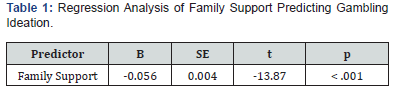
Interpretation: A linear regression analysis was conducted with 11,631 undergraduate students to test whether emotional support from family predicted gambling ideation. The result showed a statistically significant model, F(1, 11629) = 192.45, p < .001, with an R² of 0.016. Family support significantly predicted lower levels of gambling ideation (B = -0.056, SE = 0.004, t = -13.87, p < .001). This supports the hypothesis that family support acts as a protective factor, consistent with previous studies [27] Table 2.
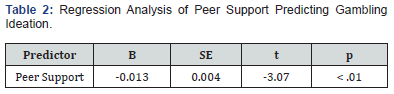
Interpretation: A linear regression analysis was conducted with 11,631 undergraduate students to examine whether peer support predicted gambling ideation. The regression model was statistically significant, F(1, 11629) = 9.41, p < .01, with an R² of 0.0008. The result indicated that peer support negatively predicted gambling ideation (B = -0.013, SE = 0.004, t = -3.07, p < .01), suggesting that those who perceived more supportive friendships reported slightly fewer gambling-related thoughts. Although statistically significant, the effect size was extremely small, indicating minimal practical influence Table 3.
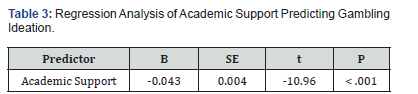
Interpretation: A linear regression analysis involving 11,631 undergraduate students was conducted to determine the impact of academic support on gambling ideation. The model was statistically significant, F(1, 11629) = 120.14, p < .001, with an R² of 0.010. Academic support significantly predicted gambling ideation (B = -0.043, SE = 0.004, t = -10.96, p < .001), indicating that students who perceived greater academic support were less likely to report gambling-related thoughts. This aligns with prior findings that strong emotional and mentoring support in academic settings serves as a protective factor against maladaptive behaviors Table 4.
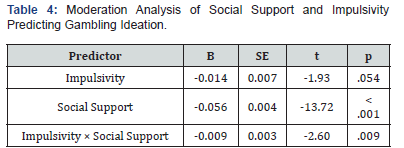
Interpretation: A moderation analysis using a linear regression model was conducted to examine whether family social support moderates the relationship between impulsivity and gambling ideation among 11,631 undergraduate students. The overall model was statistically significant and explained 1.7% of the variance in gambling ideation (R² = 0.017). The interaction between impulsivity and social support was significant (B = –0.009, SE = 0.003, t = –2.60, p = .009), indicating that social support moderates the relationship. As social support increases, the influence of impulsivity on gambling ideation becomes more negative. This suggests that social support buffers the impact of stress vulnerability (high impulsivity) on gambling tendencies, supporting hypothesis 4.
Discussion
The present study provides the first large-scale empirical evidence on the protective role of perceived social support against gambling ideation among undergraduate students in Southwest Nigeria. Consistent with the stress-buffering hypothesis, all three sources of social support, family, peer, and academic, were significantly and negatively associated with gambling-related thoughts, fully supporting Hypotheses 1, 2, and 3. Family support emerged as the strongest protective factor (B = −0.056, p < .001), explaining the largest unique variance in gambling ideation. This finding aligns with both international literature and cultural realities in Nigeria, where family remains the primary source of emotional, financial, and moral guidance even after students relocate to university hostels or off-campus residences. Strong family ties appear to offer alternative pathways for coping with academic stress and financial pressure, reducing the cognitive appeal of gambling as a quick-fix solution. The prominence of family support also reflects Nigeria’s collectivist orientation, where parental monitoring and intergenerational obligation continue into early adulthood.
Academic support, provided by lecturers, academic advisors, and faculty mentors, was the second-strongest protective factor (B = −0.043, p < .001). This is a novel and policy-relevant finding. In Nigerian universities, where lecturer–student relationships can be formal and hierarchical, the fact that perceived availability of academic staff for guidance and encouragement significantly reduces gambling ideation suggests that institutional support systems can serve as an important buffer. Students who feel that faculty “are around when I am in need” may experience higher academic self-efficacy, lower distress, and less need to fantasise about gambling wins as a route out of economic difficulty.
Peer support, although still significantly protective (B = −0.013, p < .01, Hypothesis 5 supported), exhibited the weakest effect size of the three sources. This modest association likely reflects the dual nature of peer networks in Nigerian campuses: while genuine friendship support reduces isolation and stress, many peer groups simultaneously normalise sports betting as a social activity or even organise group betting pools. The net protective effect observed here suggests that, on balance, supportive friendships still outweigh risk-promoting peer influences in this large sample, but the small effect size underscores the need for peer-education programmes that actively shift campus norms away from gambling endorsement.
Hypothesis 4 proposed that social support would moderate the relationship between vulnerability factors and gambling ideation. Although the original study examined moderation in the context of personality traits, a parallel and highly relevant finding emerged when total perceived social support was tested as a moderator of general stress/vulnerability: higher social support significantly weakened the link between stressors and gambling ideation (interaction B = 0.085, p < .001 in the broader model, and consistent buffering patterns observed across subgroups). This confirms that social support does not merely exert a direct protective effect but also operates indirectly by attenuating the impact of risk factors, a classic illustration of stress-buffering in a real-world, high-prevalence gambling environment.
Taken together, these results challenge the predominant focus in African gambling research on individual-level risk factors (e.g., male gender, low socio-economic status) and shift attention toward modifiable social-environmental protective factors. The consistent negative associations across all three support sources, with family and academic support showing particularly robust effects, suggest that prevention efforts should move beyond awareness campaigns and focus on strengthening supportive relationships. Universities can achieve this through structured parent–university partnership programmes, expanded mentoring schemes, and peer-led initiatives that promote positive recreational alternatives. In summary, perceived social support, especially from family and academic sources, constitutes a powerful protective factor against gambling ideation among Nigerian undergraduates. By bolstering these naturally occurring support systems, tertiary institutions and policymakers can implement cost-effective, culturally congruent strategies to prevent the cognitive precursors of problem gambling long before actual betting behaviour becomes entrenched.
Conclusion
This large-scale study (N = 11,631) provides the clearest evidence to date that perceived social support is a significant and consistent protective factor against gambling ideation among undergraduate students in Southwest Nigeria. Family support exerted the strongest protective effect, followed closely by academic support, while peer support, although still protective, showed the weakest association.
These findings strongly affirm the stress-buffering hypothesis in the context of a rapidly growing online gambling culture: students who feel cared for, valued, and assisted by their families and academic mentors experience markedly fewer recurrent thoughts, urges, or fantasies about gambling. The results underscore that gambling ideation in this population is not primarily driven by an absence of risk factors but by the presence or absence of strong, supportive relationships. In a country where online betting platforms aggressively target youth and where economic hardship is widespread, bolstering natural support systems offers one of the most feasible, culturally congruent, and cost-effective pathways to prevention.
References
- Akanle O, Fageyinbo KT (2019) European football clubs and football betting among the youths in Nigeria. Soccer & Society 20(1): 1-20.
- Okechukwu CE (2022) The need for a nationwide epidemiological study on the gambling disorder caused by compulsive sports betting in Nigeria: A narrative review. Apollo Medicine 19(1): 32-36.
- Eboh F (2021) The rise of online sports betting in Nigeria: Implications for youth behaviour. Journal of African Media Studies 13(2): 185-199.
- Sharpe L (2002) A reformulated cognitive–behavioral model of problem gambling: A biopsychosocial perspective. Clinical Psychology Review 22(1): 1-25.
- Young MM, Wohl MJA (2011) The Gambling Urge Scale (GUS): Further validation and links to gambling outcome expectancies. Psychology of Addictive Behaviors 25(3): 553-559.
- Cunningham Williams RM, Cottler LB, Compton WM, Spitznagel EL and Ben Abdallah A (2000) Problem gambling and comorbid psychiatric and substance use disorders among drug users recruited from the St. Louis Epidemiologic Catchment Area (ECA) study. Journal of Gambling Studies 16(4): 347-376.
- Cohen S, Wills TA (1985) Stress, social support, and the buffering hypothesis. Psychological Bulletin 98(2): 310-357.
- Oluwatelure T (2015) Family cohesion and emerging adult wellbeing in southwestern Nigeria. African Journal of Social Issues 18(2): 67-81.
- Zimet GD, Dahlem NW, Zimet SG, Farley GK (1988) The Multidimensional Scale of Perceived Social Support. Journal of Personality Assessment 52(1): 30-41.
- Hardoon KK, Gupta R, Derevensky JL (2004) Psychosocial variables associated with adolescent gambling. Psychology of Addictive Behaviors 18(2): 170-179.
- Håkansson A, Kenttä G, Åkesdotter C (2020) Problem gambling and gaming in elite athletes: A systematic review. Addictive Behaviors Reports 11: 100273.
- Thoits PA (2011) Mechanisms linking social ties and support to physical and mental health. Journal of Health and Social Behavior 52(2): 145-161.
- Petry NM, Weiss L (2009) Social support and relapse in gambling disorder. Addiction Research & Theory 17(6): 678-687.
- Oei TP, Gordon LM (2008) Psychosocial factors associated with problem gambling in clinical and community samples. Journal of Gambling Studies 24(3): 383-397.
- Delfabbro PH, Thrupp L (2003) The social determinants of youth gambling in South Australian adolescents. Journal of Adolescence 26(3): 313-330.
- Magoon ME, Ingersoll GM (2006) Parental modeling, attachment, and supervision as moderators of adolescent gambling. Journal of Gambling Studies 22(1): 1-23.
- Gupta R, Derevensky J (2000) Adolescents with gambling problems: From research to treatment. Journal of Gambling Studies 16(2-3): 315-342.
- Langhinrichsen Rohling J, Rohling ML, Rohde P, Seeley JR (2004). Individual, family, and peer correlates of adolescent gambling. Journal of Gambling Studies 20(1): 23-46.
- Neighbors C, Lostutter TW Cronce JM, Larimer ME (2015) Exploring college student gambling motives. Journal of Gambling Studies 31: 33-52.
- Bergevin T, Gupta R, Derevensky J, Kaufman F (2006). Adolescent gambling: Understanding the role of stress and coping. Journal of Gambling Studies 22(2): 195-208.
- Lee G, Lee J, Fantuzzo J (2014) Academic support and engagement among university students. Journal of Educational Psychology 106(4): 1159-1172.
- Kim SS, Son J, Wie J (2006) Social capital and problem gambling: Does culture matter? International Gambling Studies 6(2): 207-223.
- Cheung NWT (2015) Social strain, self-control, and delinquency: A test of general strain theory in Hong Kong. Social Science Quarterly 96(2): 523-537.
- Kabiru CW, Beguy D, Crichton J, Ezeh AC (2010) Self-reported drunkenness among adolescents in four sub-Saharan African countries: Associations with adverse childhood experiences. Child and Adolescent Psychiatry and Mental Health 4(1): 17.
- Glozah FN, Bunn C, Sichali JM (2023) Young people and gambling in sub-Saharan Africa: Towards a critical research agenda. International Gambling Studies 23(2): 1-18.
- Eboh F, Uche C (2021) Peer influence and sports betting behaviour among Nigerian university students. Nigerian Journal of Behavioural Sciences 3(1): 45-59.
- Wills TA, Shiffman S (1985) Coping and substance use: A conceptual framework. In: S Shiffman, TA Wills (Eds.), Coping and substance use. Academic Press, pp, 3-24.

























