




 PBSIJ Home



Abstract
This study addresses the critical paradox of “homogeneous resources, heterogeneous experiences”—why identical destination assets yield significantly divergent tourist experiences—by proposing the Destination Magnetic Field Theory (DMFT). The root of experiential variance lies in phase resonance; only when the tourist’s multidimensional psychological polarity aligns with the destination’s field can resource potential be transformed into high-quality resonance. Furthermore, the study defines tourist loyalty as the kinetic residual of field-reshaped loyalty and identifies the damping threshold as the critical singularity where environmental resistance leads to experiential collapse. Consequently, we advocate for an alternation in destination governance from empirical intuition to tuning paradigm, where managers optimize systemic “total remanence” by precisely aligning market polarities, activating excitation factors, and regulating flux density. This research provides a rigorous theoretical foundation for transitioning destination management from transient attraction to long-term psychological retention through parametric optimization.
Keywords:Destination magnetic field theory; Tourist experience; Tourist loyalty; Psychological remanence
Introduction
In contemporary tourism economy, destinations compete less through tangible resources and more through the quality and uniqueness of the experiences they create Huang [1]. Despite vast investments in branding, marketing, and infrastructure Bagher [2], a persistent paradox remains: why do individuals exposed to the same destination, within identical environmental and service conditions, experience it so differently? This divergence—where one visitor feels deeply moved while another remains detached— has become one of the most enduring puzzles in tourism management Suhartanto [3].
Traditional theoretical lenses, such as the destination competitiveness framework Crouch & Ritchie [4], Dwyer & Kim [5], destination image theory [Pike & Ryan], and the experience economy Pine & Gilmore [6], emphasize static resources, management and performance. However, these models assume that improved attributes and management levels directly yield better experience, a premise contradicted by increasing evidence of intra-destination experiential variability Croes [7]. Tourist experience, it appears, is not determined solely by “what” a destination provides, but by “how” individuals engage with its underlying systems of meaning and interaction Zhang [8].
Therefore, we suggest the following research question:
RQ: What theoretical mechanism can account for the
emergence of heterogeneous experiences among tourists visiting
the same destination?
In this paper, we put forward a novel theory based on physics concept: Destination Magnetic Field Theory. The Destination Magnetic Field Theory (DMFT) responds to this question by introducing a processual paradigm: destinations are not passive locations but energetic systems that emit, channel, and sustain experiential energy. Natural, cultural, and social components collectively form a field that interacts with tourists’ experience. Moreover, the core argument of the DMFT is that the heterogeneity of tourist experiences does not stem merely from the differences in the resources themselves, but rather from the outcome of either resonance or dissonance between the “destination magnetic field” and the “tourist magnetic field”.
DMFT advances destination management from an attributecentered to a relationship-centered framework. It offers an analytical lens through which destination marketers can understand and design for experiential flow—ensuring that environmental coherence and visitor alignment produce more consistent, meaningful encounters. This paradigm shift transforms destination planning into the orchestration of interactive energies, redefining competitiveness as the ability to generate sustainable experiential differentiation.
Literature Review
Destination competitiveness framework
The “Destination Competitiveness Framework (DCF)” serves as a critical theoretical lens in tourism management, offering explanations for why some destinations achieve greater success than others. Its conceptual roots primarily stem from Porter [9] “Competitive Advantage of Nations” Diamond Model. Foundational contributions in this domain were made by Geoffrey Crouch and Brent Ritchie, as well as Dwyer and Kim. The core proposition of this work is that a destination’s success is not determined solely by its endowed resources (e.g., mountains, historical sites), but rather is driven by a multidimensional, complex system. Among these, the model by Crouch & Ritchie [4,10] is arguably the most theoretically influential, as it astutely differentiates between “comparative advantage” (i.e., innate “endowments”) and “competitive advantage” (i.e., “created” capabilities). Dwyer & Kim [5] built upon this foundation, constructing a “system flow” model that is more focused on empirical measurement. The consensus of these models is that competitiveness is a dynamic process in which “management” transforms “resources” into “advantages,” with the ultimate objective being the sustainable well-being of residents Ritchie & Crouch [10].
Recent research demonstrates that DCF has remained a central theme in tourism scholarship, with notable conceptual expansion toward visitor experience, perceived value, and dynamic competitiveness Xia [11]. provide a computational thirty-year review and show that DCF research has evolved from resourcecentral to integrative approaches that incorporate governance and demand-side factors. Empirically Zhang [8]. utilize csQCA method to find the suitable resource combination for Chinese ancient development. Besides, Chen [12] develops an experience-driven framework demonstrating that experiential quality increasingly shapes competitive outcomes. Similarly, Barrera [13] analyze the role of experiential and behavioral factors—such as expenditure patterns and accommodation choices—in driving destination performance in the Canary Islands. Additional regional studies, such as Khelashvili & Okroshidze [14], Hossain [15], further underscore that competitiveness dynamics are highly contextdependent, influenced by economic conditions and regional development structures. Collectively, the literature reflects a shift toward more dynamic, experience-centric, and context-sensitive understandings of destination competitiveness.
Nonetheless, despite the significant contributions of these classic frameworks, their inherent limitations have become increasingly apparent. First, these models are structurally static “snapshots.” They excel at “describing” the constituent elements of competitiveness but struggle to capture the rapid, dynamic evolutionary processes of competitive advantage in the contemporary digital age. Second, they are often criticized for being “laundry lists” of factors; while comprehensive, they lack a deep elucidation of the weighting and interaction mechanisms among the various dimensions. The most critical limitation is that these frameworks are overwhelmingly “macro-supply” oriented. They place excessive focus on resources, facilities, and management structures, while severely neglecting the “micropsychological” mechanisms on the demand side. They can assess “what” a destination has (resources), but they cannot explain how these resources “act upon” tourists to shape unique “experiences.” Consequently, these macro-frameworks appear inadequate when attempting to explain the micro-phenomenon of “homogeneous resources, heterogeneous experiences.
Tourist experience theory
Tourist experience theory (TET) constitutes one of the central theoretical foundations for explaining tourists’ behavioral responses, satisfaction formation, and loyalty in tourism research. Its intellectual roots can be traced to the experience economy and service experience literature. Pine and Gilmore (1998) introduced the concept of the “experience economy,” arguing that experiences have become a distinct form of economic offering beyond goods and services, with consumers increasingly valuing participatory, immersive, and memorable consumption. This perspective provided a critical theoretical departure for tourism studies, reframing tourism as a value-creation process centered on experience.
Within tourism research, Otto & Ritchie [16] were among the first to systematically conceptualize service experience in tourism contexts. They emphasized that tourist experiences are inherently emotional, subjective, and holistic, and proposed measurement scales to operationalize the concept empirically. Their work marked an important shift from abstract conceptualization toward empirical investigation of tourist experience. Subsequent studies expanded this perspective by moving beyond service quality to a broader experiential lens, highlighting that tourist experience unfolds throughout the entire travel process, encompassing not only core attractions but also transportation, service encounters, environmental ambience, and social interactions Chen [17].
Since the early 2010s, Memorable Tourism Experience (MTE) has emerged as a prominent research stream within tourist experience studies. Tung & Ritchie [18] argued that memorable experiences are those that remain salient in tourists’ long-term memory and carry strong personal meaning, characterized by emotional arousal, self-relevance, and narrative richness. Building on this work Kim, Ritchie & McCormick [19] developed a widely adopted MTE scale, identifying dimensions such as hedonism, novelty, involvement, local culture, and meaningfulness. A substantial body of empirical research has since demonstrated that high-quality tourist experiences not only enhance satisfaction directly but also indirectly influence revisit intentions and wordof- mouth through increased emotional attachment and positive destination image.
In summary, this theory adopts a tourist-centered perspective, emphasizing that experiences are actively constructed psychological processes shaped by individual motivations, values, and cultural backgrounds. Its primary objective is to explain how tourists experience travel and how such experiences translate into subsequent behavioral responses. Traditional tourist experience theory has long centered on the subjective and constructivist nature of travel, exploring how individuals co-create meaning through sensory and cognitive engagement. While these frameworks offer profound insights into the temporal flow of trips and the psychological “peaks” that define holistic evaluations, they remain primarily descriptive. A significant lacuna persists: the inability to quantify the dynamic, bi-directional resonance between a tourist’s latent personality and a destination’s specific resource field. By treating destinations as static backdrops, conventional models fail to explain why identical landscapes exert divergent “gravitational” pulls on different individuals. Furthermore, abstract concepts such as loyalty and experience lack a mathematical derivative to model how a journey might permanently re-polarize a tourist’s dispositional vector.
Methodology and Theoretical Construction
The fundamental axiom: destination magnetic field theory
This study transcends the conventional conceptualization of tourism as a passive, unidirectional perception by redefining the process as a dynamic, bi-directional energy coupling. We formalize this through the Destination Magnetic Field Theory (DMFT). The foundational axiom of DMFT posits that both destinations and tourists act as active “magnetic field sources” endowed with specific psychological and resource-based polarities. Travel behavior is thus interpreted as the result of coupling, resonance, or repulsion between these two magnetic fields across spatial and temporal continuums.
Unlike traditional frameworks that relegate the destination to a “static backdrop,” DMFT asserts that the destination is an evolving energy field, while the tourist is a “source charge” carrying latent psychological energy. Upon entering the geographical field of a destination, these two domains interpenetrate, generating an interactive force that dictates both instantaneous satisfaction and the long-term reconfiguration of the tourist’s behavioral intentions.
Conceptual operationalization and field dimensions The tourist personality field (T)
The tourist personality field serves as the internal kinetic
driver of the interaction. Each individual carries an “initial
magnetic moment” rooted in their personality structure.
Internal Polarity: We utilize the MBTI framework to
operationalize the tourist’s charge. For instance, the Extraversion-
Introversion (E-I) axis determines the field’s conductivity to social
stimuli, while the Sensing-Intuition (S-N) axis dictates whether
the field resonates with tangible sensory landscapes or abstract
cultural narratives.
Selective Susceptibility: This field is inherently selective.
A tourist exhibits high susceptibility toward “phase-matched”
destinations while maintaining a priori indifference or repulsion
toward conflicting resource attributes.
The destination resource field (D)
The destination resource field provides the physical and
symbolic foundation for attraction. To achieve mathematical
congruence with the tourist charge (T), we map the destination’s
Magnetic Moment (D) onto four MBTI-aligned dimensions:
i. Social-flux potency (D_E)
This dimension measures the intensity of energy exchange
between the destination field and its external environment.
High-Flux Spectrum: Characterized by high-interaction,
high-density social environments (e.g., theme parks, festivals). It
attracts extraversion tourists through intense external stimuli.
Low-Flux Spectrum: Characterized by quiet, convergent
psychological spaces (e.g., nature reserves, boutique bookstores).
It attracts introversion tourists by providing restorative
psychological “white space.
ii. Sensory-intuition potency (D_S)
This dimension quantifies the frequency and “bandwidth” of
information transmission within the field.
Sensory Spectrum: Focused on high-frequency, tangible
signals such as vivid visual spectacles or exquisite culinary
textures. It primarily attracts Sensing (S) tourists who rely on
direct sensory data collection.
Intuition Spectrum: Focused on low-frequency, abstract
signals such as historical metaphors, symbolic depth, or narrative
gaps. It attracts Intuition (N) tourists who excel at capturing deepseated
patterns.
iii. Logic-emotion potency (D_F)
This dimension characterizes the “affective orientation” and
“energetic temperature” of the magnetic field.
Logic Spectrum: Manifests as a “cool-toned” field. The
attraction originates from objective facts, technical precision, or
structured knowledge (e.g., science museums). It attracts thinking
tourists seeking intellectual closure.
Emotion Spectrum: Manifests as a “warm-toned” field.
The attraction is generated through signals of humanistic care,
emotional storytelling, or shared value systems. It resonates with
tourists seeking affective empathy
iv. Spatial-order potency (D_J)
This dimension evaluates the topological structure and organization of the magnetic field lines.
Deterministic Spectrum: The field exhibits strong pathdependency and rigorous organizational order with clear linear logic. It caters to the needs of judging tourists for predictability and a sense of control.
Stochastic Spectrum: The field presents a non-linear distribution filled with random fluctuation points and serendipitous discoveries. It attracts perceiving tourists who seek spontaneous exploration and flexibility.
Bi-directional reciprocity and feedback loops
A core tenet of DMFT is that attraction is a reciprocal process. While the destination’s field “polarizes” the tourist’s psychological state, the collective behavior and density of tourists provide reverse feedback that modulates the destination’s field. For example, a surge in high-energy visitors can transform a serene natural field into a high-energy social field, fundamentally altering its original magnetic profile and potentially triggering a phase transition from attraction to repulsion.
Spatial interference
Large-scale destinations are conceptualized as composite
magnetic sources composed of multiple sub-destinations
(secondary poles). The spatial overlap of these sub-fields leads to
interference phenomena.
Constructive Interference: When complementary sub-sites
(e.g., a high-exertion trail paired with a restorative lodge) are
strategically aligned, their magnetic lines superimpose to create
a stabilized, high-attraction zone.
Destructive Interference: Conflictual sub-sites (e.g., a loud
commercial hub adjacent to a solemn cultural monument) cause
field turbulence, resulting in cognitive dissonance and a decay in
the aggregate attraction force.
Seasonal modulation and phase matching
The destination’s magnetic moment is not a static constant but is periodically modulated by seasonal external stimuli. Seasonal shifts reconfigure the energy levels of physical resources (e.g., climate altering the sensory potency D_S). Consequently, peak attraction occurs only when the seasonally-modulated field achieves “phase matching” with the tourist’s preference charge.
The remanence effect: a physical metric for loyalty (B_r)
Remanence is the terminal metric for travel success. Drawing from ferromagnetism, where materials retain magnetization after the external field is removed, DMFT defines loyalty as the permanent re-polarization of the tourist’s psychological vector. This “remanent” intensity, calculated as the time-integral of the attraction force throughout the journey, serves as the primary predictor of post-trip advocacy and repeat-visit intention.
Theoretical propositions
In this theoretical framework, a tourism activity is conceptualized as a dynamic process of energy exchange. Drawing upon classical Magnetic Field Theory, we propose the following five propositions to elucidate the generation, evolution, and outcomes of the tourist experience.
Proposition 1: The Binary Field Coupling Essence of Tourist Experience
The essence of a tourist experience is not a unidirectional perception of a landscape by a subject, but rather a dynamic vector superposition of the destination resource field and the tourist psychological field at a specific spatio-temporal interface. Every destination possesses an intrinsic magnetic moment determined by its resource attributes, while every tourist carries a psychological magnetic moment defined by their inherent traits. The intensity and quality of the experience are determined by the coupling effects of these two independent fields. Consequently, the experience exists neither solely within the destination nor the individual, but emerges within the interaction zone where magnetic field lines intertwine.
Proposition 2: Dynamic Evolution and Mutual Induction of Field Attributes
Magnetic fields within a tourism context are characterized by non-static evolution and a mutual induction mechanism. The state of these fields is driven by both internal maturation and external induction from heterogeneous fields. Crucially, the tourist’s psychological field possesses the capacity to actively reshape the destination’s field attributes. Through behavioral outputs, emotional projections, and feedback loops, tourists intervene in the self-organizing process of the destination field, altering its flux and polarity. This bidirectional induction dismantles the destination-dominant logic, establishing the tourism field as a coevolving ecosystem.
Proposition 3: Determinant Constraints of Phase Congruency on Interaction Efficiency
The peak of a tourist experience is achieved through the phase congruency of the subject and object fields across specific dimensions, polarities, and frequencies. Proposition 3 asserts that when the distribution of the destination field—in terms of social flux potency, sensory-intuition potency, logic-emotion potency, and spatial order potency—aligns with the receptivity of the tourist’s psychological field, constructive interference occurs. This resonance triggers maximum immersion and satisfaction. Conversely, dimensional misalignment or polar repulsion leads to destructive interference, resulting in a significant attenuation of attraction or negative psychological resistance.
Proposition 4: Remanence Representation and Behavioral Drive of Loyalty
This study defines tourist loyalty through the physical concept of Remanence. Upon exiting the physical environment of the destination field, a tourist’s psychological field does not instantaneously revert to its baseline state; instead, it retains a “magnetic memory” or residual magnetization from the highintensity field interaction. The magnitude of this remanence characterizes the depth to which the tourism experience has reshaped the individual’s psychological structure. Higher remanence correlates with stronger behavioral drivers, such as path dependency, revisit intentions, and the momentum for positive word-of-mouth advocacy.
Proposition 5: Phasic Transformation and Heterogeneity across the Tourism Life Cycle
The influence of the magnetic field spans the entire behavioral life cycle of the tourist, undergoing transformations between virtual, physical, and mnemonic field states.
Pre-trip Phase: Tourists engage in long-distance induction with the destination’s virtual field (through digital information), establishing anticipatory pull.
During-trip Phase: Tourists enter the physical destination boundaries, experiencing intense energy exchange with the physical field, generating real-time experience.
Post-trip Phase: Tourists undergo a demagnetization process, where the quality of the interaction dictates the rate of decay and the preservation of remanence. Due to variances in initial magnetic capacity, decoding abilities, and demagnetization rates, different tourists will experience divergent psychological trajectories and thermal residues, even when interacting with the same destination field.
Kinetic Equations of the Tourism Magnetic Field
To quantify the propositions above, we formulate the interaction as a system of kinetic equations, capturing the instantaneous pull, environmental constraints, and long-term psychological residue.
The instantaneous interaction force equation
The real-time coupling force Fi,j(t) between tourist i and destination j at time t is expressed as:
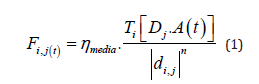
 This represents the scalar product of
the tourist’s psychological vector and the activated destination
field. It captures the superposition effect, where the interaction
strength is maximized only when the “directions” of tourist
needs and destination resources align.
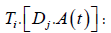
This represents the scalar product of
the tourist’s psychological vector and the activated destination
field. It captures the superposition effect, where the interaction
strength is maximized only when the “directions” of tourist
needs and destination resources align. . defines
the ‘Instantaneous Magnetic Field Intensity’ of the destination,
representing the dynamic activation of the static resource base
(D) by specific temporal factors A(t ) .
. defines
the ‘Instantaneous Magnetic Field Intensity’ of the destination,
representing the dynamic activation of the static resource base
(D) by specific temporal factors A(t ) .
η_media: The induction coefficient of the media, representing how digital information magnetizes the tourist’s expectations.
 The spatio-temporal distance decay, accounting for
the loss of field intensity over distance.
The spatio-temporal distance decay, accounting for
the loss of field intensity over distance.
Environmental crowding and damping function
The negative feedback of environmental flux is captured by the damping function Γ(ρ):

Equation Logic: This function models the transition from constructive to destructive interference. When the actual flux exceeds the critical threshold ρ_c, the exponential decay factor β significantly attenuates the coupling force, explaining the overtourism effect from a field-theory perspective.
The remanence accumulation integral (loyalty)
Tourist loyalty, or the remanence (Br,i), is the time-integral of the interaction force over the entire duration of the trip T:

Equation logic: This characterizes the induction process. A high-quality, high-duration interaction leads to deep magnetization of the tourist’s psychological field. The resulting B_ (r,i) serves as the quantitative proxy for post-trip revisit intention and advocacy.
Global system optimization
From a management perspective, the objective is to maximize the aggregate remanence across the entire tourist population:
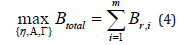
Equation Logic: This optimization goal moves beyond mere “flux maximization” (increasing numbers) toward “remanence maximization” (increasing loyalty), providing a mathematical basis for sustainable destination management.
Discussion
Theoretical contributions
The theoretical model developed in this study transcends metaphorical borrowing, offering a rigorous deconstruction of the tourism experience through the lens of field dynamics. Its contributions to the theoretical landscape are three-fold:
i. From “static resource possession” to “dynamic field interaction”
Traditional tourism theories often treat destinations as inert repositories of attributes. This research shifts the focus toward field theory, positing that a destination is an active source of energy flux. This perspective dismantles the rigid subject-object dichotomy, suggesting an ontological entanglement where the tourist and the environment co-create the experience. By defining the experience as a flux of energy transfer, this study provides a kinetic basis for understanding the volatility and emergent properties of tourism spaces that traditional linear models fail to capture.
ii. The phase congruency paradigm: a non-linear evaluative framework
By introducing the concept of phase congruency, this research provides a sophisticated explanation for the experience paradox—where same destination has totally divergent tourist experience. We argue that satisfaction is the product of constructive interference between the multidimensional polarities of the tourist and the destination. This provides a precise, non-linear coordinate system (Social, Sensory, Logic, and Spatial) to evaluate market-segment alignment, moving beyond the simplistic expectation-performance gap analysis toward a deeper understanding of resonance.
iii. Methodological shift: tourism management as a mathematical optimization problem
The most profound contribution is the formalization of destination management as a constrained multi-objective optimization problem.
Redefinition of the objective function: We propose that the ultimate goal of tourism governance is the maximization of total remanence—the long-term psychological magnetization of the tourist—rather than transient volume.
The tuning paradigm: By categorizing managerial actions as adjustments to decision variables, this study provides a mathematical blueprint for algorithmic governance in smart tourism, bridging the gap between social science theory and systems engineering.
Managerial implications
This research translates complex kinetic equations into a strategic “Tuning Manual” for Destination Management Organizations (DMOs), advocating for a shift toward precision systems engineering:
i. Polarity-driven marketing: achieving “pre-trip magnetization”
Managers must deconstruct the magnetic profile of their destination to identify its primary energy frequency.
Utilizing the media induction coefficient, DMOs should transmit targeted field signals designed to pre-align the tourist’s psychological moment before arrival. The goal is to minimize phase deviation, ensuring that upon entry, the tourist immediately enters a state of phase resonance, thereby maximizing the initial force of attraction.
ii. Adaptive capacity governance: managing the “damping threshold”
Attraction collapse is frequently caused by environmental damping rather than resource failure.
DMOs must transition from monitoring capacity limits to monitoring flux density. Based on the damping function, managers should identify the critical threshold where social flux triggers an exponential decay in experience quality. By dynamically adjusting activity schedules or pricing to smooth these damping spikes, managers can maintain a stable and high-intensity field output.
iii. Life-cycle resilience: mitigating post-trip demagnetization
The management of the “field” does not end at the exit gate; it must address the inevitable process of demagnetization. To combat the decay of the tourism experience in the tourist’s daily life, DMOs must deploy memory anchors and digital induction points. By providing subtle, periodic magnetic nudges post-trip, managers can slow the decay of remanence, effectively extending the half-life of the experience and securing long-term loyalty.
Limitations and Future Prospects
Despite the rigorous theoretical framework of the magnetic field dynamics established herein, certain limitations exist regarding empirical variable mapping and the tracking of dynamic evolution. Currently, the measurement of “Phase Congruency” and “Interaction Induction” within the model remains at the stage of theoretical deduction, lacking high-fidelity validation within large-scale, real-world consumption contexts. Furthermore, the static nature of the equations may not fully capture the complex, time-series fluctuations characteristic of the tourism field during prolonged temporal cycles [20-23].
Conclusion
To address these boundaries, future research should transit from “Logical Modeling” to a “Data-Driven” paradigm. Future inquiry should prioritize the empirical analysis of big data from authentic tourist reviews. By utilizing Natural Language Processing (NLP) and sentiment polarity analysis, researchers can extract perceptual dimensions and emotional intensities from massive textual datasets, thereby achieving a precise quantification of psychological moments” and interaction forces. Moreover, by longitudinal tracking of online dynamic reviews across different trip stages, subsequent studies can more authentically reconstruct the decay patterns of psychological remanence and their logical correlation with revisit intentions, ultimately transforming the magnetic coupling model into an intelligent decision-support system for predicting destination evolutionary trends.
References
- Huang Y, Liang H, Khan A, Lyu J (2024) Balancing constructability and tourist experience: A comprehensive approach to tourist attraction construction. Journal of Destination Marketing & Management 33: 100920.
- Bagheri F, Guerreiro M, Pinto P, Ghaderi Z (2024) From tourist experience to satisfaction and loyalty: exploring the role of a sense of well-being. Journal of Travel Research 63(8): 1989-2004.
- Suhartanto D, Gan C, Andrianto T, Ismail TAT, Wibisono N (2021) Holistic tourist experience in halal tourism evidence from indonesian domestic tourists. Tourism Management Perspectives 40: 100884.
- Crouch GI, Ritchie JRB (1999) Tourism, Competitiveness, and Societal Prosperity. Journal of Business Research 44(3): 137-152.
- Dwyer L, Kim C (2003) Destination competitiveness: Determinants and indicators. Current Issues in Tourism 6(5): 369-414.
- Pine B, Gilmore JH (1998) Welcome to the experience economy. Harvard Business Review July-August, pp. 97-105.
- Croes R, Ridderstaat J, Shapoval V (2020) Extending tourism competitiveness to human development. Annals of Tourism Research 80: 102825.
- Zhang ML, Zhao L, Zhang Y, Liu YF, Luo N (2021) Effects of destination resource combination on tourist perceived value: in the context of Chinese ancient towns. Tourism Management Perspectives 40: 100899.
- Porter ME (1990) The Competitive Advantage of Nations. New York: Free Press.
- Ritchie JRB, Crouch GI (2003) The competitive destination: A sustainable tourism perspective. CABI Publishing.
- Xia H, Muskat B, Karl M, Li Q, Li G (2024) Destination competitiveness research over the past three decades: A computational literature review. Journal of Travel & Tourism Marketing 41(5): 726-742.
- Chen J (2025) Beyond static rankings: A tourist experience–driven approach to destination competitiveness. Tourism Management Perspectives 47: 102630.
- Barrera Martínez AM, Sánchez Medina AJ, Díaz Pérez FM (2025) Destination competitiveness through the lens of tourist experience. Sustainability 17(7): 3262.
- Khelashvili I, Okroshidze L (2025) Exploring the tourism competitiveness of a destination: A case study of Georgia. Sustainability 17(8): 3342.
- Hossain MK, Hanafiah MH, Hamid AB (2023) Economic conditions, tourism destination competitiveness and tourism performance in middle-income countries. Tourism & Management Studies 21(1): 127-139.
- Otto JE, Ritchie JB (1996) The service experience in tourism. Tourism Management 17(3): 165-174.
- Chen Z (2025) Theoretical development of the tourist experience: A future perspective. Tourism Recreation Research 50(2): 199-213.
- Tung VWS, Ritchie JB (2011) Exploring the essence of memorable tourism experiences. Annals of Tourism Research 38(4): 1367-1386.
- Kim JH, Ritchie J, McCormick B (2012) Development of a scale to measure memorable tourism experiences. Journal of Travel Research 51(12): 12-25.
- Gârd Ila JA, Kerekes K (2023) Overtourism, sustainability and destination competitiveness: A systematic literature review. Sustainability 15(4): 3629.
- Huang GI, Karl M, Wong IA, Law R (2023) Tourism destination research from 2000 to 2020: A systematic narrative review in conjunction with bibliographic mapping analysis. Tourism Management 95(104686): 1-19.
- Kuan WS, Park YJ, Lee H (2022) The effect of smart tourism technology (STT) on destination competitiveness and destination image. International Journal of Contemporary Hospitality Management 34(7): 2413-2432.
- Prayag G (2020) Time for a reset: A consumer - based framework for repositioning destination and tourism resilience. Journal of Travel Research 59(5): 896-908.

























