



 OFOAJ Home




Abstract
Among Caribbean countries, Haiti is the least provided by domestic fisheries to meeting nutritional needs. Since Haitian households are among the poorest in the world, the high price for fish hampers per capita consumption increase. The scarcity of fish landings in urban areas, particularly in Port-au-Prince, requires fish supplies from the southern regions, despite being logistically isolated. While the export sectors, specializing in high-value shellfish cope with these transport difficulties, the supply chains dedicated to the domestic market suffer. Moreover, the sector is governed by social logics based on routine habits. That multitude of informal actors aren’t very conducive to economic performance and sanitation.
In order to improve such deficiencies, several recommendations are stated. At first, supply chains should gradually be organized according to economic efficiency and hygiene. By structuring the different categories of actors into legal entities, a sound basis would be laid to the professionalize fishermen, agencies and dealers. Secondly, quality of products should be increased by improving and maintaining the cold chain from catch to the consumer, as well as by disseminating processing and packaging techniques that would be able to guarantee a satisfying quality. To finish, fish species that are not prized by Haitians but whose nutritional qualities are strong, such as large pelagic fish, should be promoted.
Keywords: Artisanal Fishing; Supply Chain; Conservation; Distribution; Social Equity; Food Safety
Introduction
Haiti is facing great poverty and institutions weakness. Three-quarters of the population is living below the poverty line (US$2 per day) [1], and the rural population, which represents 40% of the total population, is the most exposed [2]. In such a context, undernourishment affects almost half of the population1. In addition, nutritional intakes are disparate and incomplete. Protein intake, for example, which are mainly consisting of peas and legumes and sometimes supplemented by imported chicken and beef, is insufficient [3] (FAOSTAT 2019). Fish consumption is very low: around 5 kg per inhabitant per year compared with 8.7 kg per inhabitant per year1 in the neighbouring Dominican Republic and 25.8 in Jamaica. Consequently, increasing the consumption of marine products from Haitian fishing would allow improvement about the food situation, although the recurrent deficiencies within the sector [4,5].
The aim of this work is to present the national fisheries supply chain, to identify the main actors and flows, as well as to analyze major shortcomings, in order to extract recommendations adapted to the actual hard situation. Within the study “Collective Expertise on Haitian fisheries” carried out jointly by the French Institute of Research for Development (IRD) and the Haitian Ministry of Agriculture, Natural Resources and Rural Development (MARNDR), field surveys were carried among the actors of the sector, in collaboration with researchers from the Haiti State University and complemented by documentation work and data collection from the second phase of the artisanal fisheries national census. The added value of this article is plural: first, an updated presentation of the sector has been made using the most recent data, whereas previous studies are getting old [4,5]. Mapping of the main flows has been carried out for the first time, as well as an analysis of the evolution of prices at the national level. Finally, practical recommendations are made for improving the sector, in line with the context and in consultation with all stakeholders. In this way, this paper provides the basic knowledge needed for further research, and to support decision-makers and guide their interventions.
This article is divided into three parts. The first presents the method to collect data. The second presents the Haitian fishing supply chain: actors, main components in terms of flows and price evolution, and the main shortcomings that compromise its effectiveness. Finally, operational recommendations are listed in the third part, in relation to the perception of the sector by stakeholders.
Method
This article presents the main findings of chapter 6.2 (“What strategies to increase the contribution of fishery products to the coverage of the protein needs of the Haitian population?”) of the Collective Expertise on Haitian fisheries jointly carried out by IRD and MARNDR between 2017 and 2020 and commissioned by the Inter-American Development Bank (IDB).
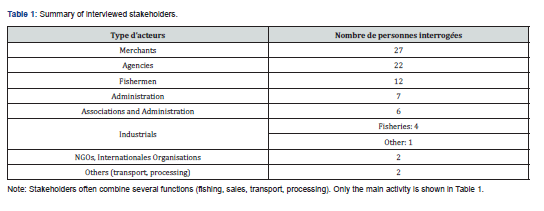
Two field missions were carried out in March 2019 and in September 2019, in order to interview fishing sector stakeholders, and to meet related administrations (MARNDR, Universities, Customs Administration). Semi-directive interviews were carried out within stakeholders, following the method implemented by Brewer [6] in the Solomon Islands and resumed by Pioch & Hardy in Haiti [7]. In total, more than 80 people were interviewed (Table 1), in addition to MARNDR’s focal points and Haiti State University.
These stakeholders were interviewed at fishing landing sites, markets and other work places (commercial infrastructures, administrative offices, etc.) in nine localities: four localities are situated in the West department (Port-au-Prince, Damien, Ganthier and Luly/Arcahaie), three in the South-East department (Cayes-Jacmel, Marigot and Anse-à-Pitre), one in the Nippes department (Miragoane), and one in the North department (Cap-Haïtien). Field visits also took place in other localities, without carrying out semi-structured interviews: Jérémie, Pestel, Dame-Marie, Abricot, Anse d'Hainault (Grande-Anse department) and Belle-Anse (South-East department).
Unpublished information from the second phase of the artisanal fishing national census2, as well as several recent Master’s Thesis related to the fisheries supply chain at the Haiti State University and the University of the Caribbean completed the field data (see Bibliography – end-of-study dissertations).
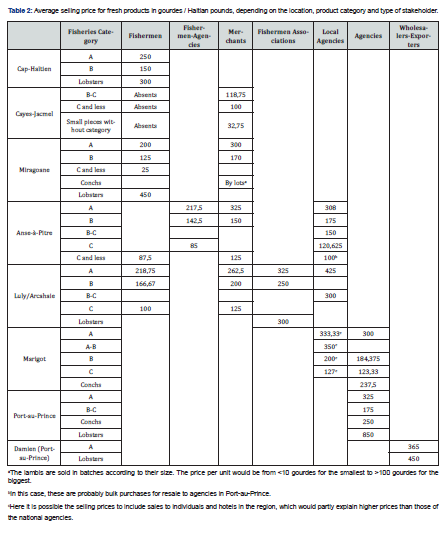
All these data were used to map the fisheries sector as accurately as possible (Figure 1), to map the main product distribution flows (Figure 2), to analyze the evolution of prices (Table 2), to identify the main shortcomings of the sector and to formulate measures to remedy them.
Sector
Actors
While returning from fisheries, several scenarios are in place for the distribution of the products. The first buyers are essentially merchants and larger middlemen (called “fishing agencies”), and less frequently restaurant owners and individuals [8]. The numerous women merchants - who are often the fishermen's wives - play a decisive role in the distribution of artisanal fishing products [4,5]. They buy fishes directly after landing and then sell it at the port or in local markets (Figure 1). Unsold fish are salted and dried for later sale. “Dames Sara” - a type of merchant who provides urban markets with products collected in villages [9,10] - then transport the dried fish directly to markets in other communes or urban centers. Fishing agencies also play a major role in this sector. Most of time, these agencies are just modest intermediaries who have a few cool boxes (known as “igloos”), who hold a regular accountancy and who are able to buy and sell larger quantities than merchants. These middlemen buy the high valued catches: “category 1” fish (demersal fish from the shallow depths, especially reef fish known as “coloured fish” such as colas (Ocyurus chrysurus) and parrot fish (Sparisoma sp.)), “category 2” fish (large “white” fish such as dolphinfish (Coryphaena hippurus), bonito, small tunas) as well as “lobsters” ((Panulirus sp.) and other crustaceans).
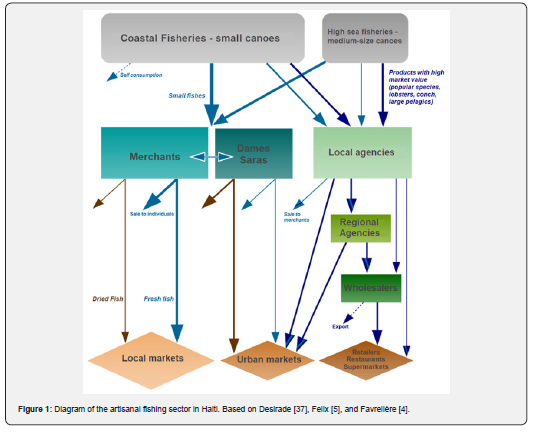
However, due to the increasing scarcity of category 1 fish, the agencies are increasingly including products from lower categories in their business (“category 3”: small sardines, pisquettes3, anchovies, etc.). There are several levels of agencies, and these levels operate differently. Many agencies buy directly from fishermen and resell to local restaurants and hotels or to higher level agencies. The higher-level agencies purchase in the provinces and then transport their products to urban centers and then resell them to fish shops, wholesalers, hotels and restaurants or market vendors. Among the few existing wholesalers, only the largest are exporting abroad. Exports mainly consist of lobsters thar are sent to North America (export products are known as “noble products” in Haiti)4. The exporting wholesalers resell the other products on their offices or to their partners (fish shops, hotels, restaurants).
However, in practice, there are no clear distinctions between types of actors. A person may combine several functions (or equivalent): both fisherman and agency, both merchant and Dame Sara, etc. For example, some agencies were seen to buy locally at the market in Marigot (South-East) from small town-agencies, in order to resell in the same place to other agencies coming from Port-au-Prince! On the other hand, some wholesalers and large agencies do not hesitate to “short-circuit” the sector in order to obtain local supplies directly from fishermen or smaller intermediaries. Therefore, in order to better understand the mechanisms governing relations between actors in this informal, complex and fragmented sector, it must be admitted that the relationships between stakeholders (habits, affinities) often overtakes the structured and rational functioning of the domestic sector. In addition, other actors providing various services are added to the sector: handlers, ice-deliverers, icemakers, transporters (motorbikes, lorries), processors (scaling, gutting, salting, drying), etc. [11].
Distribution flows
Fishing is more developed in the southern part of the country (Figure 2), with the main fishing areas being located in the South, South-East and Grande-Anse departments, as well as near the capital Port-au-Prince. The national market of La Rochelle, the main market in Port-au-Prince, is mainly supplied by south-eastern agencies (Anse-à-Pitre in particular) via the market of Marigot (near Jacmel) [7]. However, agencies in Port-au-Prince no longer hesitate to travel to the most remote towns in to collect their products. Similarly, the larger local agencies regularly travel to the capital on their own. In addition, there are other supply channels to provide the capital: one comes from the departments of Grande-Anse and Sud via the city of Les Cayes, another route comes from the capital’s surroundings, and finally the last route consists of imports (formal or informal). Spanish cooperation (AECID) has been working to develop the sector in the south-east for many years [12], laying the foundations for a more advanced structuring than the rest of the country. For instance, there are Communal Unions of Artisanal Marine Fishermen (UCPM), which bring together most of the local fishing associations. These UCPMs are reunited within a federation.
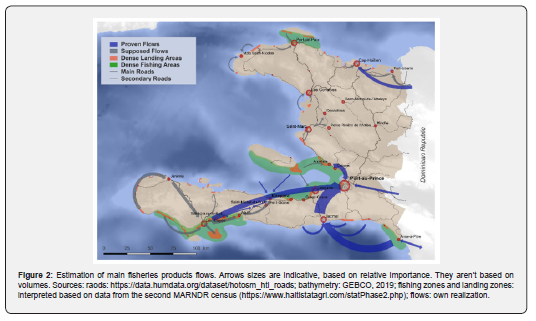
The products transit both by land and by sea. The flows in the northern part of the country appear to be modest. However, little is known about this region. Only Miller and NGO FoProBim [13] already analyzed fishing activity in the Northeast so far. Therefore, methodical fieldwork covering the whole territory would be necessary, in order to complete the mapping initiated in Figure 2.
Price evolution
The fisheries products aren’t categorized according to species. They are categorized according to market value. Concerning categories "A" (or "1") and "B" ("2"), the large number of intermediaries along the distribution chain has an impact on the final selling price. This issue also increasingly concerns lower category products ("C" and less), since agencies supplying urban centers no longer hesitate to include them in their products. Prices are relatively homogeneous in rural areas, and they increase as products go upwards the chain (Table 2). Merchants generally sell their products at lower prices than agencies, because these products are intended for direct sale nearby. And, due to the lack of conservation, they have to be sold quickly.
The large number of intermediaries is a factor of price increase (although their margins are relatively low), in addition to external costs (ice, handling, fuel, transport...). Moreover, the low storage capacity (especially for the cheapest fishes and in remote areas) encourage the stakeholders to sell the fish quickly, which implies that their margin is low. Otherwise, they have to salt and dry the products and sell them at much lower prices. The main charges for fishermen concern fuel and the provision of boats and fishing equipment. They also complain about the lack of customers due to the difficulties in conserving the products. Finally, recurrent fuel shortages immobilize their customers. For intermediaries such as agencies, the main costs are related to the purchase of ice and fuel (when available). In addition, many would like to invest more funds, although the offer is saturated in some coastal rural markets (Cayes-Jacmel, Grand'Anse...). The aim would rather be to capture more of the products, to the detriment of other actors.
Main Issues
A very poor socio-economic context
The socio-economic context is the most limiting factor for fish consumption in Haiti [1]. In a country where 71% of the population earns less than US$2 per day [8], fish is becoming a scarce or even inaccessible commodity. In addition to low incomes, there is a lack of means for conservation and efficient transport, particularly due to poor road infrastructure. Maritime transport is carried out by small motorboats that face frequent fuel shortages. Under these conditions and considering that seafood is perishable, supplying inland markets is difficult, time-consuming and expensive [1]. Moreover, the lack of basic infrastructure (landing docks, clean stalls, etc.) and insufficient electricity supplies further complicate the precarious situation [5,11,14].
As a result, investors are relatively inactive in the national fisheries sector [5,11]. As financing tools are rare for the modest actors of the sector, many do not have the necessary funds to increase their activity.
A poorly exploited resource
The marine space close to the coasts is over-exploited [15] due to the lack of suitable material, but also due to the usual fishing practices that are not favourable to deep-sea fisheries. As a result, the quantity and size of fish is decreasing, and fishermen don’t hesitate to catch smaller and smaller young preys [11]. At the same time, mangrove areas along the coasts are gradually being destroyed [11,16]. These habitats, which are essential to the life cycle of many marine species, are heavily threatened by wood exploitation for construction and cooking fires [17,18].
On the other hand, offshore fishery resources are exploited below their maximum sustainable level. Due to limited technical means and the high cost of fuel, only a small proportion of vessels carry out high seas campaigns. Projects to set up offshore fish aggregation devices (FADs) have been carried out for several decades [19], but their use remains marginal. In Haiti, FADs are generally moored at 3,000-4,000 m depths, i.e. at distances of 10 to 30 km far from the coasts, which limits their use to fishermen with suitable boats. However, in areas where the seabed is very steep, the use of FADs at this depth would considerably reduce the distance and travel time and thus increase their use by local fishermen. If supply is increasing, demand must also be there. However, the population is often reluctant to consume large offshore fishes, because they are associated with diseases in the collective imagination due to their large size. However, tuna and other large pelagic fishes caught around FADs are free of ichthyosarcotoxism5, a risk that can affect reef fishes.
A deficient artisanal sector: product conservation, hygiene, social inequity, lack of organization
The fishes are subject to a progressive alteration of their organoleptic quality as soon as they are caught, since they are not systematically placed in cool boxes [5,8]. Subsequently, refrigerated transport and storage are not widely used. Indeed, resellers are often small intermediaries who have few material and financial resources, which are unable to store the products effectively [4]. The availability of ice is limited, as is the use of isothermal boxes (“igloos”), the only conservation tool. Agencies use these boxes primarily for high-value products, low categories fishes are very rarely kept cold. In addition, the few cold stores in the country are owned by a few wholesalers based in the capital. Some fishermen's communal unions already benefited from such tools, but the current shortage of fuel and lack of maintenance compromised their use. Finally, for large-sized fish from high sea fishing (not yet well integrated into Haitian habits), the absence of cutting makes their conservation even more difficult. When the products are not sold quickly, the merchants are forced to salt and dry them. These conservation processes would cause fishes to lose nutritional value [5] if they are not included in a specific diet. Concerning conservation by, this practice is rare in Haiti [8], because of the increasing lack of wood supply. It should be noted, however, that from a nutritional point of view, salted and dried fish is, for the same weight, much richer in protein, mineral salts and vitamins than fresh fish [20]. When added in small quantities to leguminous, it allows, a better assimilation of vegetable proteins, making protein supplementation possible, thanks to the sulfur amino acids to the lysine that is contained in [20-22].
All along the chain, the most elementary hygiene rules aren’t respected. When catching fishes, fishermen throw them to the bottom of their canoes instead of keeping them cold in adequate storage places. Subsequently, the first treatment measures (scaling, evisceration) are often carried out directly on the ground next to landing and sale places [23]. Moreover, cleanliness of merchants’ stalls is also insufficient [24], as well as within the cool boxes and transport vehicles. Finally, the ice used for preservation is often criticized for the dubious origin of its water.
The current sector is poorly structured, poorly organized and poorly controlled, to the detriment of the fishermen who are though essential actors. Considering that social order is a determining factor in guaranteeing food security [4], the whole sector is harmed. Intermediaries take advantage of fishermen’s precarious situation and lack of education to impose purchase prices making impossible them to have sufficient margins. In the case of agencies, then they have an additional means of pressure: they regularly advance the financial and material resources necessary for the fishermen's campaigns at sea. In return, they benefit from better prices, exclusivity on the best catches, and sometimes they even benefit a share of the fishermen's income from sales.
Finally, it is a poorly designed sector, since it is not structured according to consumers’ demand, as in other Caribbean countries [25]. For fishermen and merchants whose level of education is generally low, fishing is a mean of subsistence which is perpetuated according to the habits with no entrepreneurial consideration.
What are the prospects for the sector?
Acknowledgement of the country's difficult situation
Before listing some options for improving the sector, it is important to replace them in a broader context: the recommendations made in previous studies [5,26] are still valid today. Without repeating these recommendations or questioning the entire sector, it is important to consider the harsh ground reality in Haiti, and to develop a pragmatic approach accordingly. These practical recommendations would have limited but rapid beneficial effects. The major tasks - although necessary - can only be effectively implemented once the country has regained stability (political stability and fuel availability at first).
This position emerged from the visits to the country and from the free and semi-directive interviews conducted in the field with many stakeholders. The most recurrent points emerging from these investigations were thus identified:
a) Before any measures are taken in order to develop the fishing sector, national marine stocks (fish and shellfish) must be secured. The local stakeholders complain about the numerous foreign intrusions, especially illegal intrusion by Dominican Republic fishermen.
b) The establishment of fishing cooperatives was regularly cited as being preferable to fishermen associations. Haitian fishermen generally act by habit and wouldn’t rationalize their practices on their own. The integration of fishermen into commercial organizations such as cooperatives could help them to shift from assistantship to entrepreneurial logic (however, the question of viability arises, as do the experiences so far).
c) The equipment (fishing equipment, storage, transport, conservation, etc.) is largely unsuitable, worn or absent. This has repercussions on the supply chain’s productivity and hygiene.
d) Operating costs are very high for both fishermen and intermediaries, especially for ice and fuel.
e) Finally, most stakeholders questioned agreed that the development of the sector depends on the development of the country. The extremely difficult context in which the sector evolves compromises any attempt of improvement. Fuel - the driving force behind all economic activity - is in chronic shortage, as well as electricity. Moreover, the country is sinking into a political crisis [27]. Fishermen and traders feel abandoned by the government, and they even show sometimes hostility towards MARNDR employees. As long as the country remains stuck in the crisis, the population will be pessimistic about the success of development projects.
Recommendations
Based on previous observations, some recommendations are proposed in accordance to the context:
a) Establishment of fishing cooperatives and generalization of the use of ice in the regions that are suffering most from food insecurity, namely North-West department, Haut-Artibonite region, Gonave Island [2,3] and, to a lesser extent, Grande-Anse department (this department is already the subject of some fishing projects, notably through NGO Food for the Poor). Moreover, fishing is less developed in the north-west of the country and in Haut-Artibonite, with the exception of certain localities: Turtle Island, Port-de-Paix, Saint-Louis-du-Nord, Jean Rabel, Môle Saint-Nicolas and Les Gonaïves (Figure 2). Improvement measures should be integrated into the establishment of cooperatives, such as subsidies for the use of refrigerators (also used for ice blocks production). In this way, the shift towards an entrepreneurial logic could allow the industry to be rationalized [28,29]. A maintenance service could be guaranteed by MARNDR, in order to guarantee the proper use of these refrigerators.
b) Raise awareness among the population and fishermen on the importance of respecting minimum sizes for catches, otherwise marine resources will disappear. Awareness campaigns should be accompanied by the installation of pictorial signs at the main landing points and markets and supported by the distribution of gauging devices indicating minimum catch sizes for common species, as achieved in the Solomon Islands [6] and Vanuatu [30]. Minimum sizes imposition are essential in the short term, assorted with regular controls. However, any binding measures seem actually impossible to put in place, because of the high level of general dissatisfaction [31-39].
c) Hygiene improvement in markets and landing areas. The numerous fishermen's groupings/associations/cooperatives could take charge of the cleaning and maintenance of infrastructures in exchange of subsidies and equipment (new isothermal boxes, fishing equipment). These same groupings/associations/cooperatives could also comply with a "awareness-raising and dissemination of good practices" component. Finally, it is the responsibility of the government to supply drinking water to the landing and processing sites.
d) Impulse a change of mentality towards offshore fishery products. Large pelagic fish are generally shunned by the local population, due to a popular belief stating that large fishes bring diseases. Moreover, the flesh of these large pieces is difficult for Haitians to preserve, since they are not familiar with processing it into slices or fillets. At first, a strategic niche diffusion among the wealthy classes, school canteens and administrations (accompanied by promotional campaigns) could lead to popularization among the working classes through a spill over effect. However, rapid evisceration and maintenance of the cold chain must be observed for these species.
e) In connection with the previous recommendation, it is imperative to generalize the processing practices of fishery products. Some structures (such as the UCPM in Cayes-Jacmel) have already started to sell processed products (slices, fillets, gutted fish, pellets...) successfully before the fuel shortage. These good practices could be integrated in fishermen's groupings/associations/cooperatives, or to specialized structures. The processed products would thus gain added value and quality. Some large fish could become more attractive by being presented this way. In addition, conservation and transport would be facilitated. Finally, this process would generate new jobs.
f) Carry out a study on the availability of ice. As ice is largely manufactured domestically and informally, it is necessary to identify ice flows and determine their origin, as well as the areas where their use is a priority.
g) Carry out an information and promotional campaign to integrate salt-dried fish into the diet in the most remote areas. Small quantities of salt-dried fish powder increase the assimilation of proteins of vegetable origin, due to its protein supplementation capacity. In addition, their low prices make them accessible to most consumers in Haiti.
Finally, it seems important to justify the absence of some necessary recommendations in this paper. First, as things stand at present, the development of a semi-industrial fleet would be uncertain, because of global low development, lack of infrastructure and fuel and electricity shortages. Moreover, semi-industrial fishing would be badly perceived by small-scale fishermen, who would see unfair competition. Such unsuccessful tries already have been carried out in the past by some wholesalers. On the other hand, little mentions about high sea fisheries were made in this work, because the resulting products cannot be handled at their fair value, in the absence of a demand market. And at the same time, their stocks could be severely threatened in the absence of adequate data and management capacity. Poorly managed switches from coastal reefs to FAD fisheries sometimes lead to negative effects, including a decrease in total landings (Failler 2002). There will still be time to effectively manage the use of FADs when situation is more favourable. Furthermore, agencies’ potential decisive role in spreading good conservation and distribution practices was deliberately set aside. Indeed, it appears that the few agencies capable of supporting large-scale measures are also those with the greatest financial and technical resources in the country. For social equity purposes, the latter can’t be the primary beneficiaries of development programmes. Finally, the distribution of refrigeration equipment has often been criticized by local actors because of the short duration of its positive effects. In the absence of local maintenance capacity, this equipment deteriorates rapidly, before to be abandoned. Moreover, this energy-consuming equipment is not adapted to the uncertainties linked to fuel and electricity recurrent shortages.
Conclusion
Domestic fisheries don’t allow to meet the nutritional needs of the Haitian population. Marine resources must be managed in order not to compromise stocks: there is little room for progress about coastal fisheries, while offshore fisheries won’t be able to develop in short term. However, it is still possible to increase the availability of national fish products by improving distribution channels. On the other hand, fisheries supply chain suffers from chronic shortcomings in line with the country's socio-economic situation. Production is deficient, conservation is rudimentary, processing techniques are almost non-existent, and distribution is slow and incomplete. The products are expensive while their overall quality is low. In addition, the sector brings together many informal actors who operate without coordination. The numerous intermediaries bring little added value to the products because of their poor ability to preserve and add value to the products. Mountainous rural areas are neglected, and the urban poor do not have the financial means to buy this type of food.
This work emphasizes some major obstacles in the domestic fishing sector: context, conservation, hygiene, social inequity and disorganization. In addition, the main flows were analyzed, as well as the price evolution. Many measures could improve the supply chain efficiency, but they are compromised by the country's underdevelopment and by chronic fuel and electricity shortages. Nevertheless, certain concrete actions can be undertaken in line with the hard context: it is for example possible to initiate a change in mentalities, in order to shift from the usual practices towards more rational ones. Beyond such an initiative, sector’s formalization represents considerable work, which would only be effective once the country is stable. However, it is essential to maintain support and development efforts by adapting these efforts the current situation.
Declaration
Funding
This work was supported by Interamerican Development Bank-funded “Collective expertise on Haitian Fisheries” jointly carried out by French Institute for Research on Development (IRD) and Haitian Ministry of Agriculture, Natural Resources and Rural Development (MARNDR).
Authors' contributions
Grégoire Touron-Gardic: Conceptualization, Methodology, Investigation, Formal analysis, Writing - original draft, Writing - review & editing; Pierre Failler: Conceptualization, Writing - review & editing; Asmine Desirade: Investigation, Writing - review & editing; Moramade Blanc: Investigation, Writing - review & editing; Gilbert David: Writing - review & editing, Supervision.
References
- FAO (2013) Country Programme Framework (CPP Haiti 2013-2016).
- Action Against Hunger (2017) Who feeds Haitians? p. 44.
- CIRAD (2016) Haitian agricultural sectors: a domestic market to be reconquered.
- Favreliere P (2008) Diagnosis of the fishing sector: Department of South-East Haiti.
- Felix M (2012) Supply Chain Analysis for Fresh Seafood in Haiti.
- Brewer T (2011) Coral reef fish value chains in Solomon Islands: Market opportunities and market effects on fish stocks. ARC Center of Excellence for Coral Reef Studies report to Solomon Islands Ministry of Fisheries and Marine Resources and Secretariat of the Pacific Community p. 46.
- Pioch S, Hardy PY (2018) Artificial Habitats adapted to small coastal fishing: Mission report in Haiti, South and South-East Department.
- MARNDR (2010a) Investment Plan for the Growth of the Agricultural Sector - Production and Development of Supply Chains - Annex 4 - Aquaculture and Fisheries Component.
- Stam T (2012) From Gardens to Markets - A Madam Sara Perspective.
- World Bank (2016) Haiti artisanal fisheries development program.
- MARNDR (2015b) Environmental and Social Management Plan (ESMP) - Fisheries Sector Modernization Program (HA-L1096). Port-au-Prince.
- AECID (2015) Report on the pelagic fish market in Haiti. Port-au-Prince.
- Miller J (2018) Identification of Potential Opportunities in the Fisheries Sector of the Three Bays National Park: Feasibility Study of Mariculture.
- Gordon A, Plumblee J, Higdon G, Vaughn D (2017) Engineering Sustainable Aquaculture in Rural Haiti: A Case Study. International Journal for Service Learning in Engineering, Humanitarian Engineering and Social Entrepreneurship 12(2): 15-33.
- MARNDR (2010b) National Programme for the Development of Maritime Fisheries in Haiti 2010-2014. p. 28.
- FEWS NET / USAID (2014) Haiti food security in brief. Port-au-Prince.
- FAO (2011) Coastal fisheries of Latin America and the Caribbean.
- Inter-American Development Bank (2017) Haiti artisanal fisheries development program.
- Vallès H (2016) A Snapshot View of the Moored Fish Aggregating Device (FAD) Fishery in South Haiti. In: 68th Gulf and Caribbean Fisheries Institute. Panama City, pp. 427-435.
- Jardin C, Crosnier J (1975) A taro, a fish, a papaya. Cahiers d'outre-mer 119: 319.
- Kayser C (1970) Physiology, history, functions of nutrition. Edited by Flammarion. Paris: Flammarion.
- David G (1988) The market for fishery products in Vanuatu. Notes and documents of oceanography. Port-Vila 18: 116.
- MARNDR (2015a) Annex to the Environmental and Social Management Plan (ESMP) - Fisheries Sector Modernisation Program (HA-L1096).
- Samapundo S, Climat R, Xhaferi R, Devlieghere F (2015) Food safety knowledge, attitudes and practices of street food vendors and consumers in Port-au-Prince, Haiti. Food Control. Elsevier Ltd 50: 457-466.
- Hackshaw L (2015) Evaluating and developing a market-driven value chain that provides high quality fresh fish products. United Nations University.
- Breuil B (2000) Definition of a policy and development of an action plan for fisheries and aquaculture (Phase II Action Programme for the fisheries and aquaculture sector).
- Hauge WI (2018) Haiti: A Political Economy Analysis.
- David G (2011) The Blue Side of Vanuatu: The Blue Revolution and the First Years of Independence. Journal de la Societe des Oceanistes 133(2): 353-366.
- Purcell SW, Crona BI, Lalavanua W, Eriksson H (2017) Distribution of economic returns in small-scale fisheries for international markets: A value-chain analysis. Marine Policy. Elsevier Ltd 86: 9-16.
- Cillaurren E, David G, Grandperrin R (2001) Vanuatu Coastal Fisheries Atlas - A 10-year review for development. IRD Edition. Paris: IRD Editions.
- Failler P (2002) Some socio-economic characteristics of fishing in Martinique. In: Blanchet G, Gobert B, Guérédrat JA (edn.) Fishing in the Antilles. IRD Editio. IRD Editions, pp. 141-155.
- Laurent D (1993) Ciguatera or itch - Traditional remedies in the South Pacific. IRD Edition. Edited by IRD Editions. Paris.
- Taylor FGR (1985) Distribution of the dinoflagellate Gambierdiscus toxicus in the eastern carribean. In: Tahiti: Proceedings of the fifth international coral reef congress. Tahiti pp. 423-428.
- Brutus M (2019) Socio-economic and environmental impacts of the use of Fish Aggregating Devices (FADs) on fishing in the South Department. Case studies: Tiburon and Chardonnières, State University of Haiti, Faculty of Agronomy and Veterinary Medicine p. 81.
- Celange RMM (2020) Analysis of production and distribution systems of fishery products (fish and seafood) in the commune of Dame Marie. Department of Grande-Anse, State University of Haiti, Faculty of Agronomy and Veterinary Medicine p. 87.
- Delouis E (2019) Contribution to the analysis of the socio-economic situation of marine fishing operators in the locality of Luly (3rd section of the mudflats, Arcahaie commune, West, Haiti), University of the Caribbean, Faculty of Agronomic and Environmental Sciences, p. 107.
- Desirade A (2020) Study and analysis of the maritime fishing products sector from the commune of Belle-Anse, State University of Haiti, Faculty of Agronomy and Veterinary Medicine p. 85.
- Jacques RAC (2019) Socio-economic and Environmental Impacts of the Use of FADs (Fish Aggregating Devices) on Fishing in the Department of Grand'Anse. Case Studies: Irois and Anse -d'Hainault, State University of Haiti, Faculty of Agronomy and Veterinary Medicine pp. 128.
- Roseme E (2018) Diagnosis of fishing activities in the commune of Anse-à-Pitres (Southeast, Haiti), University of the Caribbean, Faculty of Agronomic and Environmental Sciences p. 91.