




 OFOAJ Home



Abstract
Specimens of the mushroom coral Fungia fungites from Suakin and Port Sudan were examined to document two anomalous skeletal fusion and several deformity patterns. Measurements were taken with a tape accurate to 0.1 cm. Both specimens show two firmly fused discs separated by irregular cleavage lines. The larger Suakin specimen (≈113 cm²) displays unequal discs and slight growth overlap near the attachment scar, whereas the Port Sudan specimen (≈50 cm²) has nearly equal discs with multiple attachment scars. Septa remain vertically arranged in all discs. Deformed corals suggest larval settlement in confined microhabitats influencing disc shape and skeletal development in this species.
Keywords:Mushroom corals; Developmental anomalies; Red Sea; Sudan
Introduction
Fungia fungites (L., 1758) is a solitary, free-living mushroom coral. Unlike colonial reef-building corals, it develops from a single polyp [1]. Juveniles initially remain attached during a stalked stage but later detach and live independently on sandy reef areas and rubble [2]. The species feeds on prey from bacteria to mesozooplankton [3].
Morphological and ecological characteristics of F. fungites and related taxa were extensively studied by Hoeksema [4] through analyses of type specimens and skeletal structures. Septo-costal ornamentation was examined using scanning electron microscopy, while photographic methods documented related taxa.
Earlier classifications recognized 30 species within Fungia. Phylogenetic studies integrating molecular data with morphological characters reduced it to a single valid species fungites within the genus [5,6]. Phylogenetic analyses place it within a clade including Halomitra pileus, Halomitra clavator, and Danafungia scruposa. Recently, findings by Yutaro et al. [7] suggests F. fungites may constitute a species complex exhibiting notable phenotypic variation among populations.
Material
Two developmental anomalies were obtained from antique merchants. One from Suakin (Figure 1) and the second from Port Sudan (Figure 2). Measurements were by a tape accurate to 0.1 cm. In addition, several out of hundreds deformed F. fungites were collected from both locations for teaching and museum display.
Results and Discussion
The Suakin specimen of F. fungites (Figure 1 a & b), approximately 113cm2, is firmly joined. The cleavage line is not straight and led to formation of a large and a small disc. In the small disc the attachment scar is slightly raised probably due to growth overlap. The septa, above and underneath the disc are clearly vertical.
The Port Sudan specimen of F. fungites (Figure 2), approximately 50cm2, is also firmly joined. The cleavage line is not straight, and the two discs are almost equal. One disc has 4 and the other have 2 attachment scars. The septa were clearly vertical.
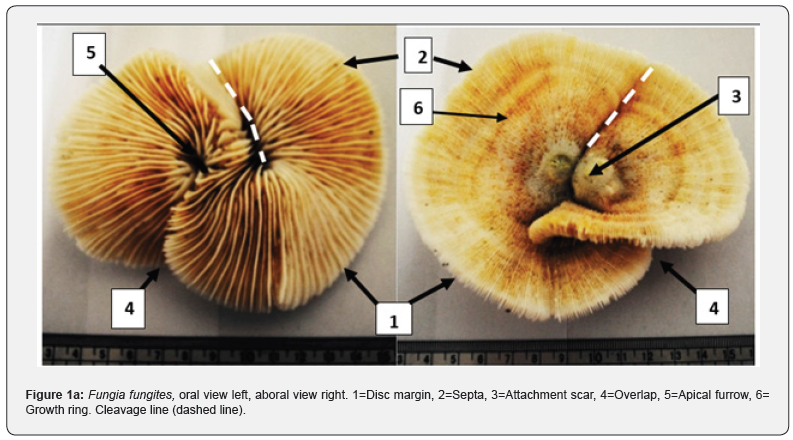
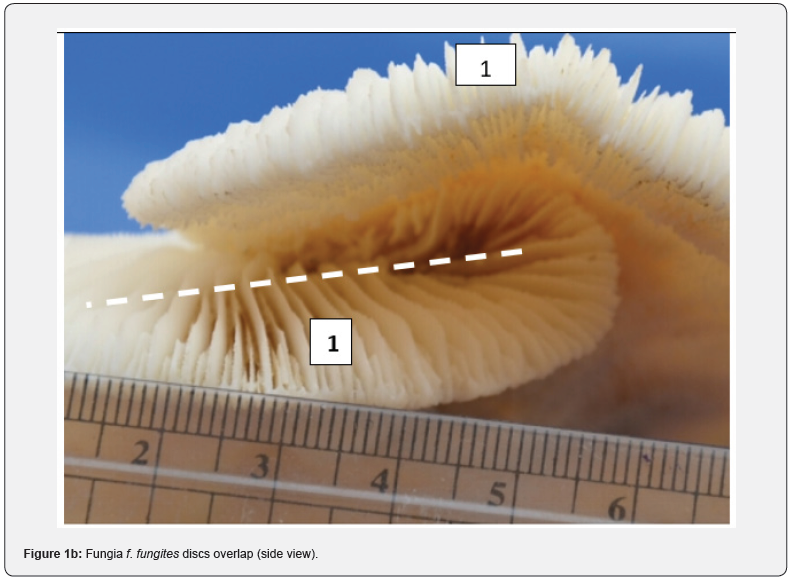
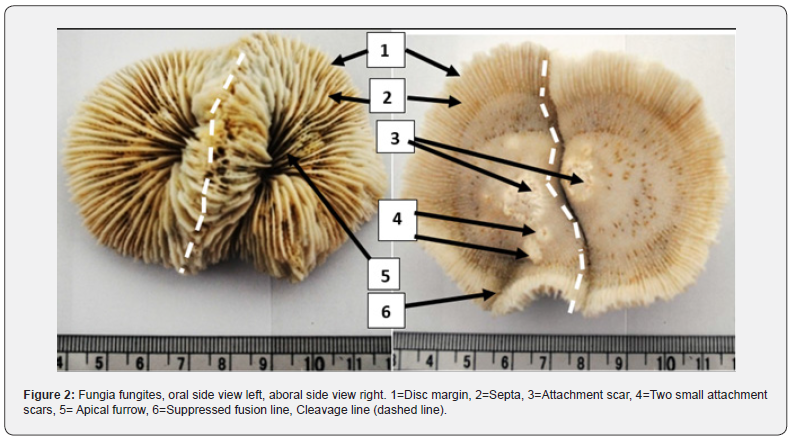
The occurrence of two fused polyps in mushroom corals is rare but not unknown. Fused individuals of Fungia (Danafungia) scruposa (Klunzinger, 1879, valid name=F. fungites); Heliofungia actiniformis (Quoy & Gaimard, 1833), Ctenactis echinata (Pallas, 1766) and juveniles of Herpolitha limax (Esper, 1797) were documented by Hoeksema (1989 and in Fungia granulosa (Klunzinger, 1879, valid name= F. fungites) was photographed and displayed at www.marinelifephotography.com [8]. The differences in measurements of Suakin and Port Sudan specimens (Table 1) is in harmony with their differences in sizes.
The examined Fungia fungites specimens from Suakin and Port Sudan show rare skeletal fusion and morphological variation. Irregular cleavage lines and firmly fused discs suggest developmental anomalies during early growth. The unequal discs and overlapping growth in the Suakin specimen indicate postcleavage skeletal interaction, whereas multiple attachment scars in the Port Sudan specimen may reflect fusion of regenerating polyps. Similar fused conditions have been reported in Heliofungia actiniformis, Ctenactis echinata, and Herpolitha limax [9] and may be linked to developmental processes and environmental constraints [10,11].
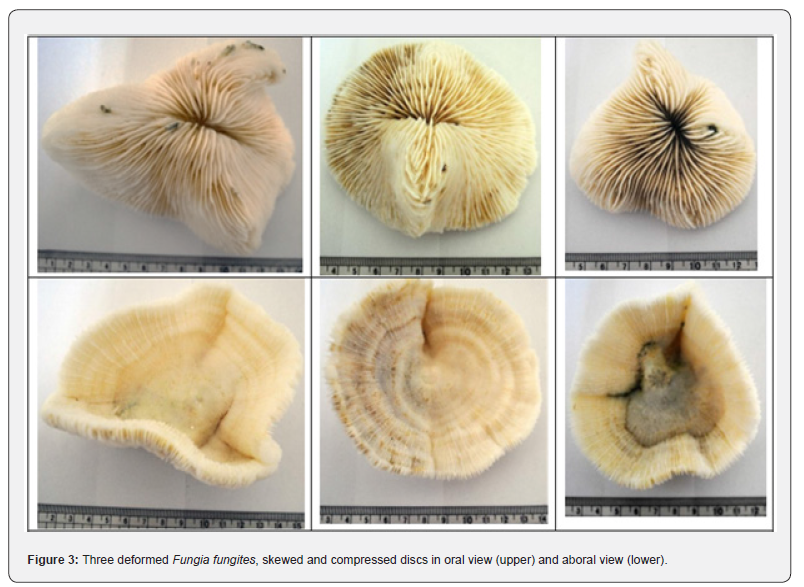
Deformity in F. fungites were observed in many specimens (Figure 3). This is probably due to settlement of the tiny larvae in a narrow confinement. As the larvae start to secrete its hard carbonate exoskeleton and grow, the confinement shaped the disc growth, attachment and morphology. This is apparent from several compressions and attachment points observed in discs. The deformed discs are either round-distorted or oval- distorted but the septa are clearly vertical.
The observed disc deformities are likely a consequence from larval settlement in confined microhabitats influencing skeletal growth and disc morphology. Disc deformity in mushroom corals has been reported by Hoeksema [4], Hoeksema and Moka [9], Arrigoni et al. [12] and Eyal-Shaham et al. [13].
Acknowledgement
I am grateful to the late Dr. Moamer E. Ali who commented on the work which is dedicated to his memory.
References
- Ali ME, Elhag AE (2016) Coral diversity and similarity along Sudanese Red Sea Fringing reef. International J of Advanced Research 4(4): 720-727.
- Bemert G, Ormond R (1981) Red Sea Coral Reefs. In: (1st). Routledge, London pp. 258.
- Alamaru A, Bronstein O, Dishon G, Loya Y (2009) Opportunistic feeding by the fungiid coral Fungia scruposa on the moon jellyfish Aurelia aurita. Coral Reefs 28(4): 865.
- Hoeksema BW (1989) Taxonomy, phylogeny and biogeography of mushroom corals (Scleractinia: Fungiidae). Zool Verh Leiden 254: 1-295.
- Gittenberger A, Reijnen BT, Hoeksema BW (2011) A molecularly based phylogeny reconstruction of mushroom corals (Scleractinia: Fungiidae) with taxonomic consequences and evolutionary implications for life history traits. Contrib Zool 80: 107-132.
- Hoeksema BW, Cairns S (2019) World List of Scleractinia. Fungia fungites (Linnaeus, 1758). World Register of Marine Species.
- Yutaro O, Kenji I, Hoeksema BW, Naoko D, Tachikawa H, et al. (2020) Fungia fungites (Linnaeus, 1758) (Scleractinia, Fungiidae) is a species complex that conceals large phenotypic variation and a previously unrecognized genus. Contribution to zoology Bijdeagen tot de dierkunde 89(2): 188-209.
- (2026) www.marinelifephotography.com.
- Hoeksema BW, Moka W (1989) Species assemblages and ecomorph variation of mushroom corals (Scleractinia: Fungiidae) in the Flores Sea, Indonesia. Netherlands Journal of Sea Research 23(2): 149-160.
- Hoeksema BW, Lane DJW (2014) The mushroom coral fauna (Scleractinia: Fungiidae) of Brunei Darussalam and its relation to the Coral Triangle. Raffles Bulletin of Zoology 62: 566-580.
- Oku Y, Iwao K, Hoeksema BW, Dewa N, Tachikawa H, et al. (2020) Fungia fungites (Linnaeus, 1758) (Scleractinia, Fungiidae) is a species complex that conceals large phenotypic variation and a previously unrecognized genus. Contributions to Zoology 89(2): 188-209.
- Arrigoni R, Berumen ML, Mariappan KG, Beck PSA, Hulver AM, et al. (2020) Towards a rigorous species delimitation framework for scleractinian corals based on RAD sequencing: the case study of Leptastrea from the Indo-Pacific. Coral Reefs 39(4): 1001-1025.
- Shaham EL, Eyal G, Zvi BO, Sakai K, Harii S, et al. (2020) A unique reproductive strategy in the mushroom coral Fungia fungites. Coral Reefs 39(6): 1621-1630.

























