




 OFOAJ Home



Abstract
Fossil invertebrates in amber inclusions and vertebrate animal remains are essential for the study of the evolution of life in a geologic context and have been used for centuries in alternative traditional medicine and folklore. In this context, sharks are components of medical folk tradition and a scientific question relevant in biomedicine. As addressed in this article, fossil shark teeth from different species, locations and epochs are common findings and have been used in palaeoichthyology and alternative traditional medicine based on their potential health beneficial properties and belief-based explanations. Although these folk traditions are not based on modern scientific evidence, ongoing research approaches shark teeth potential in novel biomedical applications.
Keywords:Alternative medicine; Biomedicine; Fossil; Palaeoichthyology; Shark tooth; Traditional medicine
Introduction
Fossils provide information of living organisms with different preserved remains. Accordingly, as stated by the National Park Service (https://www.nps.gov/subjects/fossils/what-is-a-fossil. htm#:~:text=Fossil%20(noun):,much%20more%20narrow%20 and%20specific) fossils are scientifically defined as the “evidence of life preserved in a geologic context”.
Sharks represent important animals in human history ranging from sacred guardians in indigenous cultures to feared sea monsters in Western mythology [1]. Sharks are also components of medical folk tradition and a scientific question relevant in biomedicine for their unique immune system [2]. Shark fossils are mainly composed of teeth with signatures left by ancient organisms providing information about the history of life on sea and oceans on Earth through evolution and extinction processes relevant in palaeoichthyology [3].
Fossil Shark Teeth
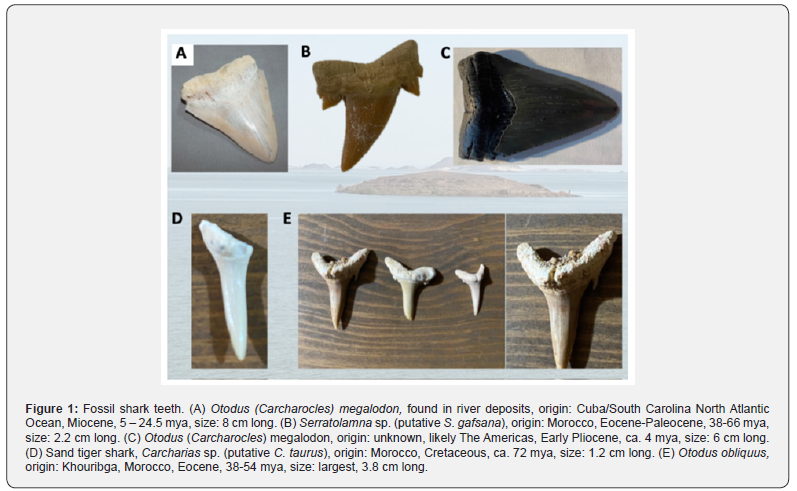
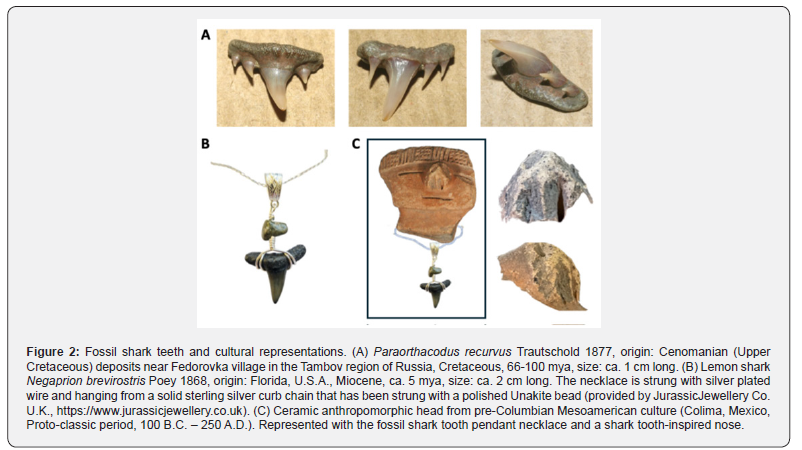
As shown in these samples, fossil shark teeth represent multiple species (i.e., Otodus (Carcharocles) megalodon in Figures 1A & 1C, Serratolamna sp. in Figure 1B, Carcharias sp. in Figure 1D, Otodus obliquus in Figure 1E, Paraorthacodus recurvus in Figure 2A, and Negaprion brevirostris in Figure 2B) from different geographic origins (The Americas, Morocco and Russia) and epochs (Pliocene-Miocene-Eocene-Paleocene-Cretaceous; ca. 4-100 mya).
The Otodus (Carcharocles) megalodon (Elasmobranchii: Lamniformes: Otodontidae) (https://en.wikipedia.org/wiki/ Megalodon) is an extinct transoceanic super predator associated with cosmopolitan distribution and body length estimated of 14.2 to 24.3 m [4-6] (Figures 1A & 1C). Serratolamna (Elasmobranchii: Lamniformes: Serratolamnidae) is an extinct genus of mackerel sharks no larger than 1.5 m found in North Africa including Moroccan Eocene (e.g., [7]) (Figure 1B). Sand tiger sharks (https://en.wikipedia.org/wiki/Sand_tiger_shark), Carcharias spp. (Elasmobranchii: Lamniformes: Otodontidae) (Figure 1D) are composed of mostly extinct species except for Carcharias taurus critically endangered with a length between 2.2 and 2.5 m. The Otodus obliquus (Elasmobranchii: Lamniformes: Carchariidae) (Figure 1E) are also extinct large (estimated 8-9 meters) macro-predatory sharks distributed worldwide [8,9]. Paraorthacodus recurvus Trautschold 1877 (Elasmobranchii: Synechodontiformes: Paraorthacodontidae) (Figure 2A) are considered medium-sized sharks with ca. 1-2 m and smaller than modern cow sharks [10]. The lemon shark Negaprion brevirostris Poey 1868 (Elasmobranchii: Carcharhiniformes: Carcharhinidae) (Figure 2B) can grow to 3.4 m in length is currently a threatened species [11].
Medical Implications
Fossils have a role in alternative traditional medicine based on the potential health beneficial properties of some compounds and belief-based explanations (e.g., [12-15]. In this context, fossil shark teeth have been used for centuries in alternative traditional medicine in different ancient cultures and folklore associated with multiple countries [16,17]. In medieval European cultures, fossil shark teeth were known as glossopetrae or tongue stones mainly from Megalodon were believed to be the petrified tongues of dragons or serpents often mounted in silver or gold pendants as protective amulets as illustrated in Figure 2A. In pre-Columbian cultures, shark teeth were also represented in sculptures with protective capacity (Figure 2B). Fossil shark teeth and representations were worn to detect or cure poison in food and drink, treat fevers and assist in childbirth. For medical interventions, shark teeth were crushed into powders or brewed with herbs to create therapeutic compound concoctions used to treat ailments such as sore throats and diphtheria, diseases of the bladder and urinary tract, musculoskeletal sprains and fractures and calcium deficiency.
Although these folk traditions are not based on modern scientific evidence, research interests address the composition of fluorapatite [Ca5(PO4)3 F] in shark teeth to approach potential novel methods for bio-friendly functional materials in interventions such as controlled tooth replacement and biopatites for bone filler applications in humans [18-20].
Conclusion
The study of fossil shark teeth provides information not only on palaeoichthyology but also on applications in alternative traditional medicine and folklore in ancient cultures. Based on this information and evidence, ongoing and future research directions would advance in the development of new biomedical interventions.
Acknowledgment
The study was partially supported by University of Castilla La Mancha 2025-AYUDA-38326-Vaccines for the control of tick infestations in sub-Saharan Africa (ZENDAL)-01110DO064. Fossils and art pieces belong to author´s KGJ Colección, Ciudad Real, Spain.
References
- Mojetta AR, Travaglini A, Scacco U, Bottaro M (2018) Where sharks met humans: The Mediterranean Sea, history and myth of an ancient interaction between two dominant predators. Regional Studies in Marine Science 21: 30-38.
- Walsh CJ, Luer CA, Bodine AB, Smith CA, Cox HL, et al. (2006) Elasmobranch immune cells as a source of novel tumor cell inhibitors: implications for public health. Integr Comp Biol 46(6): 1072-1081.
- Clack JA (1998) Palaeoichthyology. Trends Ecol Evol. 13(8):333-334.
- Miller HS, Avrahami HM, Zanno LE (2022) Dental pathologies in lamniform and carcharhiniform sharks with comments on the classification and homology of double tooth pathologies in vertebrates. PeerJ 10: e12775.
- Cooper JA, Hutchinson JR, Bernvi DC, Cliff G, Wilson RP, et al. (2022) The extinct shark Otodus megalodon was a transoceanic superpredator: Inferences from 3D modeling. Sci Adv. 8(33): eabm9424.
- Tyabji Z, Jabado RW, Sutaria D (2018) New records of sharks (Elasmobranchii) from the Andaman and Nicobar Archipelago in India with notes on current checklists. Biodivers Data J 6: e28593.
- Gajić A, Hanjalić J, Davidov B (2014) Frequency, taxonomy and morphology ofdifferent shark taxa of lower Paleogene and upper cretaceous from Morocco. North Africa Pluralidade 3: 54-68.
- Ehret DJ, Ebersole J (2014) Occurrence of the megatoothed sharks (Lamniformes: Otodontidae) in Alabama, USA. PeerJ 2: e625.
- Condamine FL, Romieu J, Guinot G (2019) Climate cooling and clade competition likely drove the decline of lamniform sharks. Proc Natl Acad Sci USA. 116(41): 20584-20590.
- Sokolskyi T, Guinot G (2021) Elasmobranch (Chondrichthyes) assemblages from the Albian (Lower Cretaceous) of Ukraine. Cretaceous Research 117: 104603.
- Nam DH, Adams DH, Reyier EA, Basu N (2011) Mercury and selenium levels in lemon sharks (Negaprion brevirostris) in relation to a harmful red tide event. Environ Monit Assess. 176(1-4): 549-559.
- de la Fuente J (2025) Fossil amber in biomedicine. Am J Biomed Sci Res 27(6): 1019-1021. AJBSR.MS.ID.003629.
- de la Fuente J (2025) Paleopharmaceuticals from fossil amber. Hektoen International. A Journal of Medical Humanities. Winter. Section Anthropology.
- de la Fuente J (2026) Natrolite pseudomorph fossil wood in Ugandan alternative medicine. Journal of Medicinal Plants and Herbs (JMPH). In press.
- Goshu K, Tamire G, Degefe G, Hussein I, Yazezew D (2022) Ethnozoological study of traditional medicinal animal parts and products used among indigenous people of Assosa District, Benishangul-Gumuz, Western Ethiopia. International Journal of Ecology 2022(1): 1-9.
- van der Geer A, Dermitzakis M (2008) Fossil medicines from “snake eggs” to “Saint’s bones”; an overview. Calicut Medical Journal 6(1): e8.
- Duffin CJ (2017) Fossil shark's teeth as alexipharmics. In: Wexler P (Ed) In Toxicology in the Middle Ages and Renaissance, chapter 12, Academic Press, pp. 125-133.
- Ogaard B (199) Effects of fluoride on caries development and progression in vivo. J Dent Res 69(2): 813-823.
- Mikami T, Kato R, Miyamoto N, Kato T (2026) Liquid-crystalline biomineral nanofibers: 1D inorganic materials with a high aspect ratio and anisotropic self-assembled nanocomposites. Adv Mater 38(6): e14457.
- Álvarez LM, Vigo E, Valencia RC, Iglesias OV, González P, et al. (2017) In vivo evaluation of shark teeth-derived bioapatites. Clin Oral Implants Res 28(9): e91-e100.

























