




 OFOAJ Home



Abstract
This publication addresses the issue of clarifying the distribution range of the pelagic fish species Notolepis coatsi. This species was first discovered for the Kyiv Peninsula area (Maritime Antarctic). The potential use of N. coatsi as prey for the flying seabird Sterna vittata in the coastal waters of Antarctica is considered.
Keywords:Ichthyofauna; Marine Birds; Food Web; Marine Ecology; Antarctica
Introduction
Fish have a major role in the food webs of the Southern Ocean and Antarctic coastal water as the basis of most top predators’ diets (other fish, birds, and mammals) [1-3], second only to the Antarctic krill (Euphausia superba Dana, 1850) [4,5]. Flying birds, penguins, and pinnipeds transfer most of the energy from marine ecosystems to terrestrial ones in the form of feces, regurgitation and their own remains [4]. Therefore, the study of Antarctic food webs as a whole and their individual links is of priority [6]. Our study is devoted to the fish → flying bird link, namely the Antarctic jonasfish (Notolepis coatsi Dollo, 1908) → Antarctic Tern (Sterna vittata Gmelin, 1789).
In general, the Antarctic ichthyofauna is poor and numbers only about 300 marine species [7,8]. Notolepis coatsi is one of the most widespread marine species south of the Antarctic Polar Front [9]. This species is recorded in the Maritime Antarctic from the South Orkney Islands and Scotia Sea to Anvers Island [10,11], as well as near almost the entire coast of Continental Antarctic [11], for example in the Weddell Sea [12,13], the Lazarev Sea [14], the Cosmonaut Sea [15], the D’Urville Sea [16], and the Ross Sea [17]. Only 14 species of benthic notothenioids were found in the coastal water of the Kyiv Peninsula area [18], although researchers suggested the possibility of the existence of 34 species of fish in the coastal water of this region of the Maritime Antarctic [19]. Notolepis coatsi is absent from both of these lists. In addition, no pelagic fish species were caught, which can be explained by the predominance of benthic ichthyofauna at shallow depths in the coastal zone, where their diet is dominated by various benthic invertebrates, smaller benthic fishes, and algae [20,21].
Sterna vittata is a common species of the Antarctic and Sub- Antarctic seas [1], although it is found off the coast of South America [22], Africa [23] and other regions of the Southern Hemisphere. It is a common species in the Maritime Antarctica, that breeds in the Kyiv Peninsula area. There is a large number of observations of these birds in our study region, but there are no scientific publications on their ecology and nutrition. Studies by other scientists from other regions of Antarctica indicate that the specie’s diet can include different groups of marine hydrobionts [24-26]: mainly small fish and crustaceans, rarely mollusks and algae.
Results and Discussion
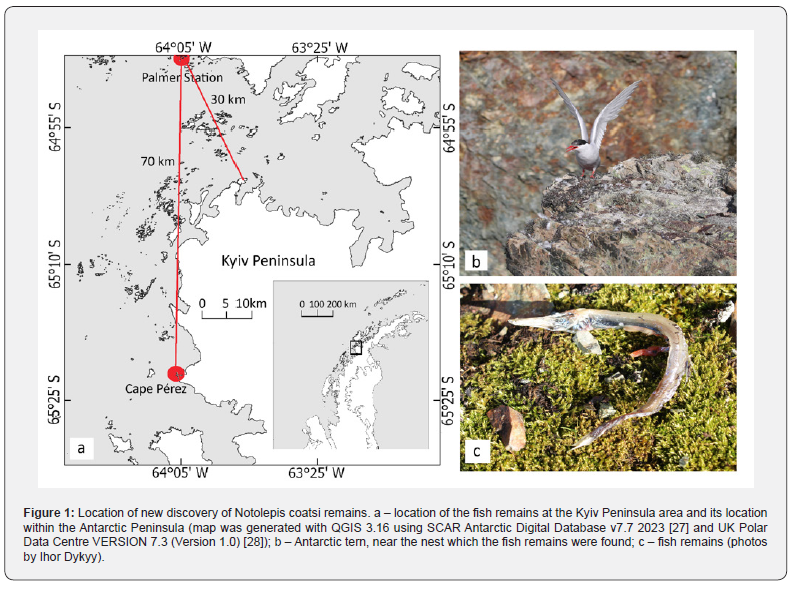
The remains of an unknown fish were discovered among stones with moss on a rocky hill in the coastal zone of a small bay of Cape Pérez within the southwestern part of the Kyiv Peninsula at coordinates 65°24’31”S 64°05’51”W on 25 February 2020 (Figure 1a). These fish remains were found in the middle of a small colony of three nests of S. vittata (Figure 1b), two meters from one of the nests. The fish had been lying on the moss under the sun for several days, as it showed visible signs of decomposition (digestion) and had already dried out (Figure 1c) [27,28]. An elongated trace of dried mucus was visible near its head, which very much resembled a bird’s belch. Most likely, this was the prey of an adult S. vittata, which it hunted, ate, and then regurgitated for some reason (possibly due to the size of the fish, which reached 180 mm in length). We consider it unlikely that this fish was brought for the chicks, as it is too large for them and birds most often carry prey for their chicks in their beaks (our visual observations). In addition, these remains were located under a stone canopy, so they could not have accidentally fallen from above or been lost by other birds.
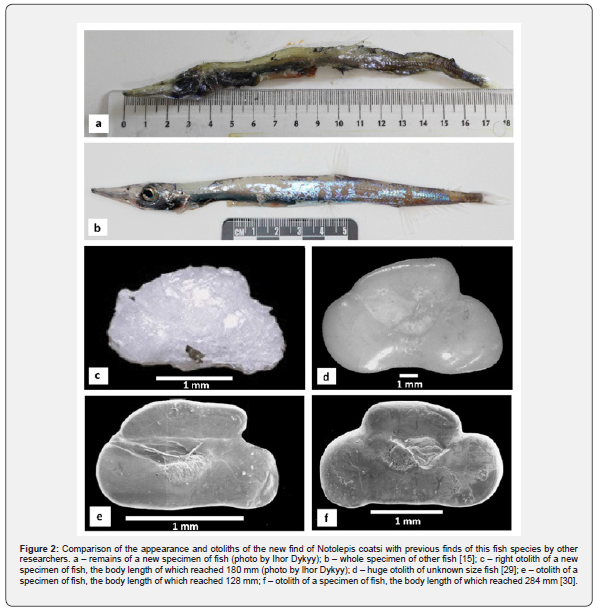
Further analysis of the found fish specimen in the laboratory using an identifier [7] was complicated by the fact that parts of the fins were completely destroyed, which did not allow the use of a number of morphometric features for identification. However, the belonging of this fish based on morphological similarities to representatives of the Family Paralepididae of the Order Aulopiformes was not in doubt [7,15] (Figure 2a & 2b). Further analysis of the otoliths of this fish specimen showed it belongs to the species N. coatsi [29]. Although it is worth noting a certain difference of the otolith from the original (Figure 2c & 2d), this can be explained by the high individual and age variability of the otoliths [7,30,31] (Figure 2d, 2f). This identification was confirmed by other researchers when checking the determination of the otoliths (see Acknowledgement).
Notolepis coatsi is a very common species in the oceanic and coastal waters of Antarctica, but findings of this species in the Maritime Antarctic coastal zone are limited to the south by the coastal waters of Anvers Island [11]. The closest place to where the new specimen was discovered was in the Palmer Station area [32]. This is 30 km from the Kiev Peninsula and about 70 km north of Cape Pérez (Figure 1a). This species can potentially be found further south along the Antarctic Peninsula, but it is rare in the coastal zone. This is due to the ecological features of this fish species. This is because representatives of this species can make significant vertical migrations from the surface to depths of over 2000m [7], with juveniles staying in shallower areas [30]. Recently discovered specimens of N. coatsi reached 180 mm, while the maximum size of representatives of this species reaches 380 mm [7]. In addition, many fish species migrate to the surface at night [33], and S. vittata, although characterized by predominantly diurnal behavior, has evidence of its ability to feed at night [25]. During the breeding season, these birds feed mainly near the coast in the algae zone up to 200 m from the shore, including bays [25,34]. An important point is that in the coastal areas of Cape Pérez, depths can reach more than 100 m. Therefore, the most likely sequence of events may be the following: in the evening hours, S. vittata hunted a small specimen of N. coatsi in the coastal zone near the water surface and regurgitated it near the nest. Although it is worth noting that N. coatsi is not a typical prey for S. vittata [1].
Conclusion
This publication presents data on the first discovery of the pelagic fish species N. coatsi in the coastal water of the Kyiv Peninsula region. In addition, the potential existence of a link in the marine food web where S. vittata uses N. coatsi as prey is noted. This review proves the need for further study of the ichthyofauna of this region Maritime Antarctic, especially regarding the poorly studied group of pelagic fish species.
Acknowledgement
The authors express their gratitude to the National Antarctic Scientific Center of Ukraine (Ministry of Education and Science of Ukraine) for funding and organizing the Ukrainian Antarctic Expeditions. The authors acknowledge Natural Earth, SCAR (Antarctic Digital Database) and UK Polar Data Centre for providing access to map databases for non-commercial use. We are very grateful to Julia Hampton for inviting us to submit a paper to Oceanography & Fisheries Open Access Journal. We also wish to thank Dr. Mario La Mesa and Dr. Leonid Manilo (†) for checking otolith identification.
Conflict of Interest
All authors declare that they have no conflicts or competing interests and that the study was conducted according to the requirements of their national research committee..
References
- Ainley DG, Ribic CA, Fraser WR (1992) Does prey preference affect habitat choice in Antarctic seabirds? Marine Ecology Progress Series 90: 207-221.
- Daneri GA, Carlini AR (1999) Spring and summer predation on fish by the Antarctic fur seal, Arctocephalus gazella, at King George Island, South Shetland Islands. Canadian Journal of Zoology 77(7): 1157-1160.
- Casaux R, Baroni A, Ramón A (2006) The diet of the Weddell Seal Leptonychotes weddellii at the Danco Coast, Antarctic Peninsula. Polar Biology 29: 257-262.
- Oro BE (2002) The role of fish in the Antarctic marine food web: differences between inshore and offshore waters in the southern Scotia Arc and west Antarctic Peninsula. Antarctic Science 14(4): 293-309.
- Kock KH, Oro BE, Belchier M, Collins MA, Duhamel G, et al. (2012) The role of fish as predators of krill (Euphausia superba) and other pelagic resources in the Southern Ocean. CCAMLR Science 19: 115-169.
- Williams R (1985) Trophic relationships between pelagic fish and euphausiids in Antarctic waters. In: Siegfried WR, Condy PR, Laws RM (eds) Antarctic nutrient cycles and food webs. Springer, Berlin, Heidelberg.
- Gon O, Heemstra PC (1990) Fishes of the Southern Ocean. In: JLB Smith Institute of Ichthyology, Grahamstown.
- Nelson JS, Terry C, Grande TC, Wilson MVH (2016) Fishes of the World. In: (5th Edn), John Wiley & Sons, USA.
- Pakhomov EA, Perissinotto R, Froneman PW (1999) Predation impact of carnivorous microzooplankton and micronekton in the Atlantic sector of the Southern Ocean. Journal of Marine Systems 19(1-3): 47-64.
- Collins MA, Xavier JC, Johnston NM, North AW, Enderlein P, et al. (2008) Patterns in the distribution of myctophid fish in the northern Scotia Sea ecosystem. Polar Biology 31: 837-851.
- De Broyer C, Koubbi P, Griffiths HJ, Raymond B, D’Acoz UC et al. (eds.) (2014) Biogeographic atlas of the Southern Ocean. In: Scientific Committee on Antarctic Research, Cambridge.
- White MG, Piatkowski U (1993) Abundance, horizontal and vertical distribution of fish in eastern Weddell Sea micronekton. Polar Biology 13: 41-53.
- Zabroda P, Pshenichnov L, Marichev D (2020) Benthic wildlife underwater video recording during longline survey in Weddell Sea. Ukrainian Antarctic Journal 2: 75-83.
- Flores H, Putte VDAP, Siegel V, Pakhomov EA, Franeker VJA, et al. (2008) Distribution, abundance and ecological relevance of pelagic fishes in the Lazarev Sea, Southern Ocean. Marine Ecology Progress Series 367: 271-282.
- Mou J, He X, Liu K, Huang Y, Zhang S, et al. (2024) Benthic biodiversity by baited camera observation on the Cosmonaut Sea shelf of East Antarctica. Diversity 16(5): 277.
- Moteki M, Koubbi P, Pruvost P, Tavernier E, Hulley PA (2011) Spatial distribution of pelagic fish off Adélie and George V Land, East Antarctica in the austral summer 2008. Polar Science 5: 211-224.
- Donnelly J, Torres JJ, Sutton TT, Simoniello C (2004) Fishes of the eastern Ross Sea, Antarctica. Polar Biology 27: 637-650.
- Trokhymets V, Savytskiy O, Zinkovskyi A, Gupalo O, Dykyy I, et al. (2022a) Species composition, distribution and relative abundance of the inshore fish community off the Argentine Islands, Bellingshausen Sea. Polar Biology 45: 845-855.
- Manilo LG (2006) Ichthyofauna and morphological characteristics of mass fish species of coastal waters of Argentine Islands (Antarctica). Proceedings of the Zoological Museum 38: 5-22.
- Zinkovskyi AV, Dykyy IV, Trokhymets VM (2021) Allocation of the diet of the Argentine Islands’ inshore ichthyofauna. Biosystem Diversity 29: 67-72.
- Trokhymets V, Zinkovskyi A, Dykyy I, La Mesa M (2022b) Feeding ecology of an inshore population of Notothenia coriiceps from the Argentine Islands, Bellingshausen Sea. Polar Biology 45: 1623-1634.
- Carlos CJ, Daudt NW, van Grouw H, Neves T (2017) The second and third documented records of Antarctic Tern Sterna vittata in Brazil. Bulletin of the British Ornithologists 137(4): 320-324.
- Connan M, Teske PR, Tree AJ, Whittington PA, McQuaid CD (2015) The subspecies of Antarctic Terns (Sterna vittata) wintering on the South African coast: evidence from morphology, genetics and stable isotopes. Emu 115(3): 223-236.
- Favero M (1995) Antarctic Terns Sterna vittata feeding on stranded krill at King George Island, South Shetland Islands, Antarctica. Marine Ornithology 23(2): 159-160.
- Higgins PJ, Davies SJJF (eds) (1996) Handbook of Australian, New Zealand & Antarctic Birds. In: Volume 3, Snipe to pigeons. Melbourne, Oxford University Press.
- Jażdżewski K, Konopacka A (1999) Necrophagous lysianassoid Amphipoda in the diet of Antarctic tern at King George Islands, Antarctica. Antarctic Science 11(3): 316-321.
- Gerrish L, Ireland L, Fretwell P, Cooper P (2023) High resolution vector polygons of the Antarctic coastline (7.7). In: UK Polar Data Centre, Natural Environment Research Council, UK Research & Innovation.
- Gerrish L (2020) Vector polygons of the Sub-Antarctic coastline – VERSION 7.3 (Version 1.0) [Data set]. In: UK Polar Data Centre, Natural Environment Research Council, UK Research & Innovation.
- Dollo L (1908) Notolepis coatsi, New pelagic fish collected by the Scottish National Antarctic Expedition. Preliminary note. Proceedings of the Royal Society of Edinburgh, Section B (Biological Sciences) 28(1): 58-65.
- Williams R, McEldowney A (1990) A guide to the fish otoliths from waters off the Australian Antarctic Territory, Heard and Macquarie Island. In: ANARE Res, notes 75.
- Reid K (1996) A guide to the use of otoliths in the study of predators at South Georgia. In: British Antarctic Survey, Cambridge.
- Sidell BD (1991) Palmer Station, Antarctica. In: Palmer Station, science sitrep.
- Nelson JS, Terry C, Grande TC, Wilson MVH (2016) Fishes of the World. In: (5th Edn), John Wiley & Sons, USA.
- Sagar PM (1991) Aspects of the breeding and feeding of Kerguelen and Antarctic Terns at the Kerguelen Islands. Notornis 38: 191-198.

























