




 OFOAJ Home



Abstract
Sea cucumbers are vital marine creatures that are ecological bioindicators of heavy metal pollution in addition to being a valuable food source. The concentrations of seven heavy metals (As, Cd, Pb, Hg, Cu, Zn, and Fe) in the flesh and internal organs of Theletona ananas, which were collected from Sabah, Malaysia, were examined in this study. We assessed the possible non-carcinogenic risks of eating this species using human health risk assessment models such as Estimated Daily Intake, Target Hazard Quotient, and Estimated Weekly Intake. The findings showed that both tissue types had elevated levels of arsenic above the safety threshold, suggesting possible health risks, especially for regular users. Lead levels also needed attention, even though the concentrations of other metals like Cu, Zn, and Fe stayed within safe bounds. The study emphasizes the ecological function of sea cucumbers in sediment bioturbation, nutrient recycling, and environmental health monitoring in addition to the food safety viewpoint. The results support integrated approaches that strike a balance between seafood safety, conservation, and sustainability and highlight the necessity of routine monitoring of metal contamination in marine organisms. These revelations support both public health protection and well-informed fisheries management.
Keywords:Sea cucumber; Heavy metals; Human health risk; Bioindicator; Marine pollution
Background
Marine invertebrates known as sea cucumbers are prized for their ecological, therapeutic, and nutritional value. Sea cucumbers are benthic organisms that are essential to the health of sediments and the cycling of nutrients in marine environments. Sea cucumbers are harvested in large quantities for human consumption and are regarded as delicacies in many regions of the world, including Southeast Asia. However, the bioaccumulation of potentially hazardous metals in marine organisms has sparked serious worries about food safety and ecosystem health due to growing urbanization, industrialization, and human pressures.
Because of their toxicity, persistence, and capacity to biomagnify through the food chain, heavy metals like arsenic (As), cadmium (Cd), lead (Pb), mercury (Hg), copper (Cu), zinc (Zn), and iron (Fe) are especially dangerous. According to several studies, sea cucumbers are good bioindicators of marine pollution because they can accumulate significant concentrations of these metals, which reflect the quality of their surroundings [1-3]. Consuming seafood can expose people to major health risks due to the excessive accumulation of toxic metals like As and Pb, even though essential trace metals like Cu, Zn, and Fe are essential for physiological processes [4,5].
By improving sediment oxygenation, encouraging nutrient cycling, and sustaining biodiversity in benthic habitats, sea cucumbers perform the roles of ecological engineers in addition to being dietary resources [6]. They are useful for environmental monitoring because of their capacity to bioaccumulate metals, but this same trait also raises questions regarding their safety as food sources. The patterns of metal accumulation in sea cucumbers depend on several variables, such as geographic location, speciesspecific biology, environmental contamination, and physiological conditions [7,8]. Evaluating ecological effects and public health hazards requires an understanding of these dynamics.
This study sought to determine the concentrations of seven metals (As, Cd, Pb, Hg, Cu, Zn, and Fe) in the edible tissues of Theletona ananas due to the paucity of research on heavy metal contamination in sea cucumbers from Malaysian waters, specifically in Sabah. To assess the possible risks connected to eating sea cucumbers, the study also used human health risk assessment models such as Estimated Daily Intake (EDI), Target Hazard Quotient (THQ), and Estimated Weekly Intake (EWI). To help guide conservation and sustainable fisheries management plans, the ecological effects of metal buildup and the function of sea cucumbers in maintaining the health of the marine environment were also investigated.
Materials and Methods
Sampling and metal analysis
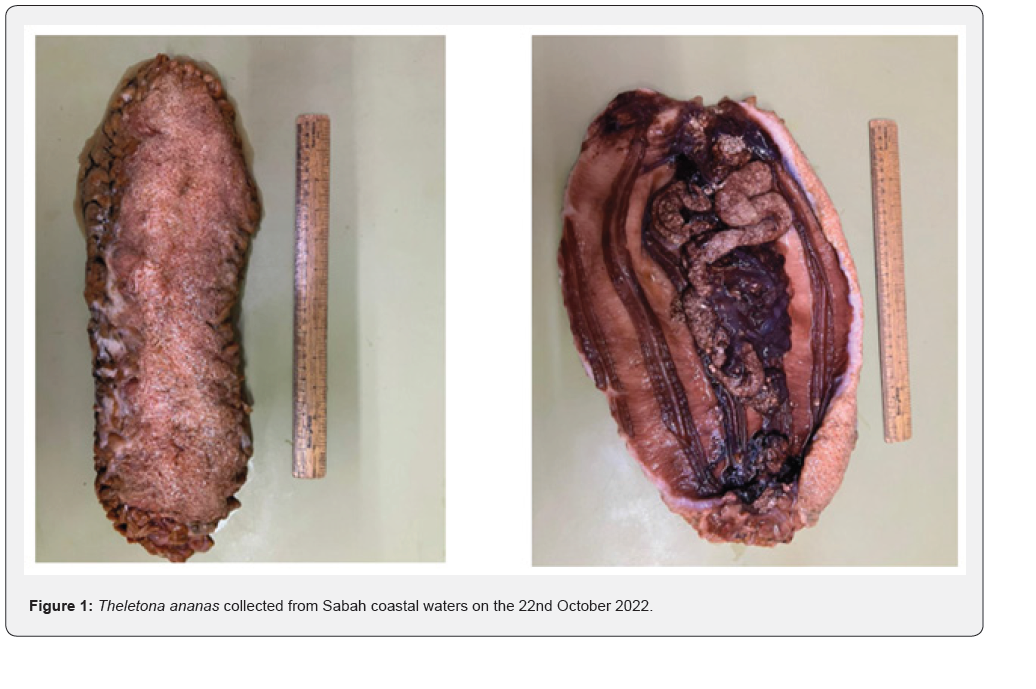
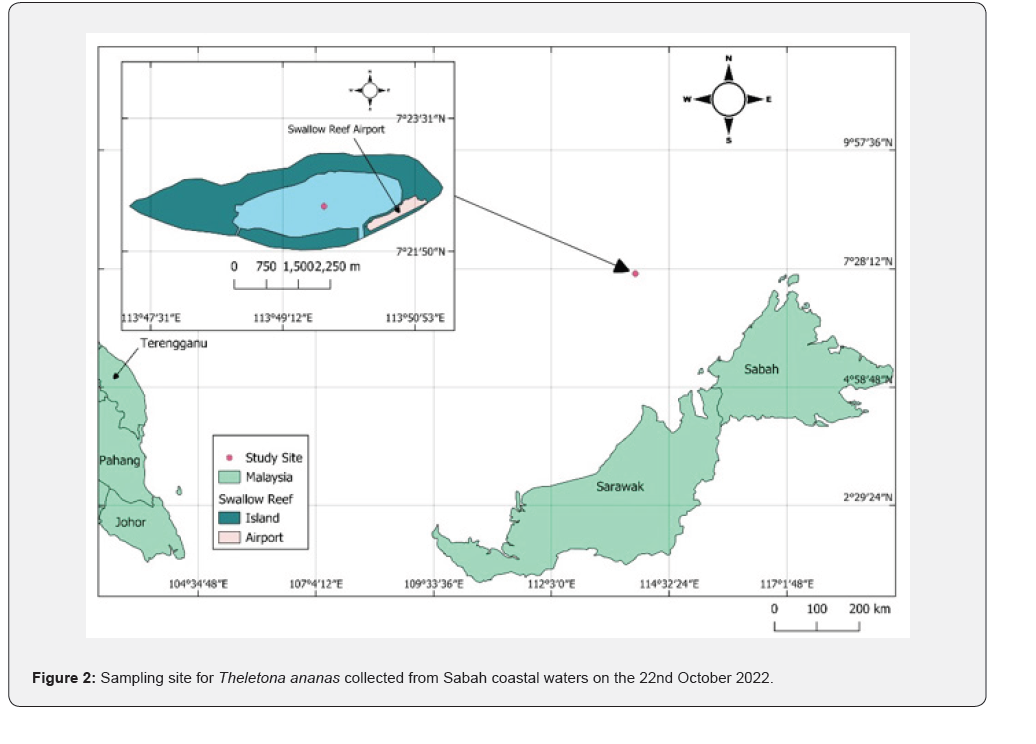
The sample of T. ananas (Family: Stichopodidae) (Figure 1) was collected from Sabah coastal water on 22nd October 2022 (Figure 2). The sea cucumber was 63cm in length and 550-1400g freshwater weight.
Okamoto & Fuwa [9] employed the Teflon bomb digestion method for biological and sediment samples due to its low contamination level. First, a 25 mL Teflon beaker was filled with 0.05g of the homogenized sample after it had been weighed. Then, in a 3:3:1 ratio, an acid mixture was made of Suprapur 30% hydrochloric acid (HCL), Suprapur 65% nitric acid (HNO3), and EMSURE 48% hydrofluoric acid (HF). A fume hood was used to create the acid mixture. As a precaution, two millilitres of this acid were added to the Teflon beaker while it was in a perchloric fume hood. To prevent acid leakage during the digestion process, the Teflon beakers were then tightly sealed [10].
To aid in digestion, all Teflon bombs were baked for eight hours at 100°C. Teflon bombs were allowed to cool to room temperature after the heating process. Every acid-digested solution was moved into a separate centrifuge tube. Deionized water was added to the centrifuge tube for dilution until it reached the 10 mL mark. To avoid contamination, every piece of equipment and glassware was acid-washed before being used with a different sample.
The Elan 6000 model of inductively coupled plasma mass spectrometry (ICP-MS) was used to analyze the potential toxic metals (PTMs), which include Cu, cadmium (Cd), iron (Fe), lead (Pb), zinc (Zn), arsenic (As), and mercury (Hg). The detection and quantification limits for the ICP-MS instrument used in the sample detection stated according to [11]. All aqueous solutions were prepared using de-ionized water or Milli-Q water. Before being used, every piece of glassware and plastic was cleaned (acidwashed) in a 10% nitric acid solution. The metal concentrations in the samples were ascertained using Inductively Coupled Plasma Mass Spectrometry, ICP-MS ELAN 9000.
First, the acid-washed Teflon digestion vessels were filled with 0.05 g of the homogenized fish tissue sample. Each vessel was then filled with 1.5 ml of Suprapur nitric acid, manufactured by Merck KGaA in Germany, and digested using a closed Teflon bomb digestion system that was specially made in Japan [12]. To fully digest the fish tissues, the prepared samples would subsequently be baked at 100°C for 8 hours. The samples were processed and digested together with blanks and the standard reference material, Dolt Fish liver SRM1946, National Research Council Canada-Conseil National de Researches Canada, Canada. Following digestion, the samples were put into centrifuge tubes and diluted with 10 millilitres of Milli-Q water. The samples were prepared for the measurement of metal concentrations for seven metal elements (As, Zn, Cu, Fe, Cd, Hg, and Pb) using Inductively Coupled Plasma Mass Spectrometry, or ICP-MS [13].
Using DOLT Fish liver SRM1946 as a standard reference material, the methodological procedures of the heavy metal analysis are evaluated for implementation accuracy to guarantee the validity and precision of the analytical method in the digestion of samples. The detection limit for each heavy metal as well as the observed value and recovery percentage from the heavy metal analysis conducted for this study is displayed in Table 1.

Calculations of human health risk assessments a) Estimation of Target Hazard Quotient (THQ)
To calculate the THQ, the first step was to estimate the Estimated Daily Intake (EDI) for each metal. EDI represents the intake of a particular metal based on body weight (BW) and sea cucumber (similarly like fish) consumption rate, and is calculated as follows:

Where
a) Mc = Metal concentration in fish muscle (mg/kg wet
weight)
b) CR = Fish consumption rate, fixed at 100 g/person/
day for Malaysian adults based on a survey involving 2675
respondents (Malay: 76.9%, Chinese: 14.7%, Indian: 8.4%)
c) BW = Body weight of 62 kg for Malaysian adults, as
reported by Nurul Izzah et al. [14]
Subsequently, the THQ for each metal was calculated as follows:

where:
ORD = Oral Reference Dose, an estimate of daily contaminant
exposure that is unlikely to cause adverse health effects over
a lifetime [15]. In this study, the ORD values used for the seven
metals were as follows, based on USEPA and relevant sources, as
shown in Table 2.
These values were derived from the USEPA Regional Screening Levels and other internationally recognized standards.
b) Evaluations of Provisional Tolerable Weekly Intake (PTWI) and Estimated Weekly Intake (EWI)
A comparison between the corresponding Provisional Tolerable Weekly Intake (PTWI) values set by the Joint FAO/ WHO Expert Committee on Food Additives (JECFA) and the Estimated Weekly Intake (EWI) values for the seven metals was made to evaluate the possible health risks to humans from eating fish [16]. The PTWI, which is measured in micrograms (μg) per body weight, is the highest quantity of a contaminant that can be consumed weekly for the duration of a lifetime without posing significant health risks. Table 2 displays the PTWI values (in μg/ week) for an adult weighing 62 kg. Estimated Weekly Intake (EWI) was calculated using equation (3).

After that, the determined EWI values for each metal were contrasted with the corresponding PTWI values for an adult weighing 62 kg. Consuming contaminated sea cucumber could pose a health risk if the EWI was higher than the PTWI. This thorough method offers a solid evaluation of the health risks associated with exposure to the chosen metals through sea cucumber consumption by assessing both non-carcinogenic risk (via THQ) and weekly intake safety (via PTWI comparison).

Results
The concentrations of metals (Cd, Cu, Fe, Hg, Pb, Zn, and As) in both the flesh and internal parts of the T. ananas collected from Sabah waters were analysed on a dry weight (DW) and wet weight (WW) basis, along with their respective EDI, THQ, EWI, and percentage of PTWI are shown in Table 3.
Metal Concentrations in Sea Cucumber
Iron had the highest concentration of any of the seven metals examined in the internal parts (180 mg/kg DW; 19.8 mg/kg WW) and the flesh (386 mg/kg DW; 42.46 mg/kg WW). Zn came next, with a concentration of 37.03 mg/kg DW (4.07 mg/kg WW) in the flesh and a higher concentration of 70.18 mg/kg DW (7.72 mg/kg WW) in the internal parts. Additionally, notable discovery were the concentrations of Cu, which were 6.02 mg/kg DW (0.662 mg/ kg WW) in the internal parts and 7.71 mg/kg DW (0.848 mg/kg WW) in the flesh.
Mercury (Hg), on the other hand, had the lowest concentrations, measuring 0.0272 mg/kg DW (0.003 mg/kg WW) in the flesh and 0.0339 mg/kg DW (0.0037 mg/kg WW) in the internal parts. Intermediate concentrations of As, Pb, Cd were found. Cd levels were specifically 0.02 mg/kg DW (0.0022 mg/kg WW) in internal parts and 0.19 mg/kg DW (0.0209 mg/kg WW) in flesh. Compared to internal parts (0.72 mg/kg DW; 0.0792 mg/kg WW), flesh had higher Pb concentrations (4.24 mg/kg DW; 0.4664 mg/kg WW). Concentrations showed a similar trend, with internal parts having lower levels than flesh (12.6 mg/kg DW; 1.382 mg/kg WW) (6.67 mg/kg DW; 0.737 mg/kg WW).

Note: CF= 0.11.
Target Hazard Quotient (THQ) and Estimated Daily Intake (EDI)
Iron had the highest estimated intake from consumption of both flesh (68.5 μg/kg bw/day) and internal parts (31.9 μg/kg bw/day) based on the calculated EDI values. Zn came in second with 6.57 flesh and 12.5 internal parts, and Cu came in first with 1.3679 flesh and 1.0681 internal parts. Cd (0.0337 flesh; 0.0035 internal parts), and Hg (0.0048 flesh; 0.006 internal parts) had the lowest EDIs.
According to the associated THQ values, none of the metals in the internal components or flesh were higher than the safety threshold value of 1. As in flesh had the highest THQ (7.43) and internal parts had the highest THQ (3.94), both of which were well above the safe limit and suggested that exposure to arsenic might not be carcinogenic. Although it was still below the threshold of concern, Pb in flesh also displayed a comparatively high THQ of 0.215. Other metals like Cu (0.034 flesh; 0.027 internal), Zn (0.022 flesh; 0.042 internal), Fe (0.098 flesh; 0.046 internal), Hg (0.016 flesh; 0.02 internal), and Cd (0.0337 flesh; 0.0035 internal) continued to have much lower THQ values.
The percentage of PTWI and the estimated weekly intake (EWI)
With values of 479.4 μg/kg bw/week for flesh and 223.6 μg/ kg bw/week for internal parts, Fe once again had the highest exposure considering EWI. Zn (45.9 flesh; 87.2 internal) and Cu (9.58 flesh; 7.48 internal) came next. The EWI for As was higher than the PTWI limits, at 15.6 μg/kg bw/week for flesh and 8.28 μg/ kg bw/week for internal. As was the most concerning component, accounting for 1.59% of flesh and 0.84% for internal part for PTWI. The contributions of Pb were likewise comparatively high, at 0.404% for flesh and 0.069% for internal. The percentage PTWI for the following metals stayed extremely low: Cu (0.0044 flesh; 0.0034 internal), Zn (0.011 flesh; 0.02 internal), Fe (0.138 flesh; 0.064 internal), Hg (0.014 flesh; 0.017 internal), and Cd (0.0653 flesh; 0.0068 internal).
Summary of Risk Assessment Findings
Iron, Zn, and Cu had the highest concentrations, but the corresponding THQ and %PTWI values were still within acceptable bounds. Consuming sea cucumbers, especially the flesh, may pose a health risk because As continuously surpassed the THQ threshold of 1. Although it did not surpass THQ=1, Pb showed elevated values that should be interpreted with caution. THQ and %PTWI values for all other metals (Hg, Cd, Cu, Zn, and Fe) were significantly below levels of concern. As contamination in sea cucumber flesh is a significant non-carcinogenic hazard that should be carefully considered in dietary risk assessments, according to these findings, even though the majority of metals pose negligible health risks.
Discussion
Heavy Metal Contamination in Sea Cucumbers
Sea cucumbers are increasingly valued for their nutritional and medicinal properties as well as their emerging significance in environmental monitoring, despite their susceptibility to heavy metal pollution. Significant amounts of heavy metals, such as Fe, Zn, As, Cu, Hg, Pb, Mn, Cr, Ni, and Cd, can be bioaccumulated by a variety of sea cucumber species [1-4,8,17]. Anthropogenic sources that introduce these contaminants into marine ecosystems, including industrial effluents, agricultural runoff, and maritime activities, are primarily responsible for this bioaccumulation [1,7,18,19]. There have been reports of speciesspecific contamination patterns, with different heavy metal levels in species like Holothuria scabra, Holothuria tubulosa, and Eupentacta fraudatrix based on physiological characteristics and environmental factors [3,4,7].
According to human health risk assessments using the EWI and THQ indices, regular intake, especially of arsenic, may have negative health effects, but infrequent consumption poses negligible risks [5,17,20]. Research has also shown that sea cucumbers exposed to heavy metals have immune-related effects that impact their physiology and the reliability of their bioindicators [20,21].
Sea cucumbers’ ecological contributions to marine ecosystems
Sea cucumbers are essential ecological engineers that greatly enhance the resilience and health of marine ecosystems in addition to their function in bioaccumulation. Bioturbation, which improves sediment structure, aeration, and nutrient redistribution, is one of their most important ecological roles [6,22]. By releasing nitrogen and phosphorus, sea cucumbers aid in nutrient recycling, promoting benthic productivity [6]. This has consequences for preserving biodiversity and reducing ocean acidification [23].
Additionally, their sediment reworking promotes a wide variety of benthic organisms by preventing eutrophication and improving oxygenation [24,25]. In contaminated or degraded habitats, where they support resilience and sediment quality, their ecological contributions are particularly important [26,27].
Consequences for Future Research, Environmental Monitoring, and Seafood Safety
The results highlight the significance of sea cucumbers for environmental monitoring and food safety. Continuous surveillance is necessary because certain species have elevated levels of lead and arsenic [1,8,17,28].
Apostichopus japonicus and Holothuria leucospilota are two species of sea cucumbers that are frequently used in monitoring programs because they are efficient bioindicators of metal contamination [18,29,30]. The use of structures inspired by sea cucumbers in nanotechnology and energy storage has also been investigated in creative studies [26,31]. The development of depuration methods to lower metal content, seasonal and spatial variability, and the differentiation between organic and inorganic forms of arsenic should be the main topics of future research [32- 34].
Sea Cucumbers in Sustainable Solutions and Emerging Technologies
The use of sea cucumber-inspired designs has been extended beyond environmental monitoring in recent research. Advanced materials for energy storage, flexible electronics, and biomedical applications have been inspired by the morphology and physiology of sea cucumbers [26,31,35]. By using the mechanical characteristics and adaptability of sea cucumbers, these biomimetic techniques create next-generation technologies that are more sustainable and perform better
Sea cucumbers also support nature-based solutions by improving the resilience of seagrass beds and the health of sediments, offering ecosystem services that complement mitigation, and adaptation plans for climate change [22]. Coastal resilience, fisheries sustainability, and biodiversity conservation can all greatly benefit from incorporating their ecological roles into marine management plans.
The development of depuration methods to lower metal content, seasonal and spatial variability, and the differentiation between organic and inorganic forms of arsenic should be the main topics of future research [32-34].
Sea Cucumbers in Sustainable Solutions and Emerging Technologies
The use of sea cucumber-inspired designs has been extended beyond environmental monitoring in recent research. Advanced materials for energy storage, flexible electronics, and biomedical applications have been inspired by the morphology and physiology of sea cucumbers [26,31,35] By using the mechanical characteristics and adaptability of sea cucumbers, these biomimetic techniques create next-generation technologies that are more sustainable and perform better.
Sea cucumbers also support nature-based solutions by improving the resilience of seagrass beds and the health of sediments, offering ecosystem services that complement mitigation, and adaptation plans for climate change [22]. Coastal resilience, fisheries sustainability, and biodiversity conservation can all greatly benefit from incorporating their ecological roles into marine management plans.
Conclusion
The dual importance of sea cucumbers as a food source and a reliable bioindicator of heavy metal pollution in marine environments is highlighted by this study. The results show that some sea cucumber tissues contain alarming amounts of lead and arsenic, which may be harmful to regular consumers’ health. However, the consistently low concentrations of the majority of other metals confirm that sea cucumbers are safe to eat in moderation. Ensuring food safety and public health requires routine monitoring of heavy metal accumulation, especially in commercially consumed species.
In addition to being consumed by humans, sea cucumbers provide vital ecological services like nutrient recycling, sediment bioturbation, and biodiversity enhancement. The growing biomimetic applications in cutting-edge technologies and their use in environmental monitoring highlight the sea cucumbers’ diverse significance for environmental sustainability and innovation. To ensure the sustainable use of these valuable marine organisms, future research should prioritize integrated approaches that strike a balance between food safety, conservation, and technological innovation.
References
- Bhuyan MS, Bat L, Senapathi V, Kulandaisamy P, Sekar S, et al. (2024) A review on sea cucumber (Bengali: Somuddro Sosha) as a bioindicator of heavy metal contamination and toxicity. Marine Pollution Bulletin 199.
- Aydin M, Tunca E, Şahin ÜA (2017) Effects of anthropological factors on the metal accumulation profiles of sea cucumbers in near industrial and residential coastlines of İzmir, Turkey. International Journal of Environmental Analytical Chemistry 97(4): 368-382.
- Chahrour F, Baaloudj A, Dermeche S, Kerfouf A (2021) Trace metals (Cu, Cd, Pb, Zn, and Ni) concentrations in the sea cucumber Holothuria tubulosa (Gmelin, 1791) of the Algerian west coast. Egyptian Journal of Aquatic Biology and Fisheries 25(3): 619-633.
- Ardiansyah A, Rasyid A, Siahaan EA, Pangestuti R, Murniasih T (2020) Nutritional value and heavy metals content of sea cucumber Holothuria scabra commercially harvested in Indonesia. Current Research in Nutrition and Food Science 8(3): 765-773.
- Elvevoll EO, James D, Toppe J, Gamarro EG, Jensen IJ (2022) Food safety risks posed by heavy metals and persistent organic pollutants (POPs) related to consumption of sea cucumbers. Foods 11(24).
- Purcell SW, Conand C, Uthicke S, Byrne M (2016) Ecological roles of exploited sea cucumbers. Oceanography and Marine Biology 54: 367-386.
- Dolmatova LS, Slinko EN, Kolosova LF (2020) Variations in the heavy metal contents in tissues of the sea cucumber Eupentacta fraudatrix in the coastal waters of the Sea of Japan: The influence of physiological and anthropogenic factors. Oceanology, 60(4): 446-457.
- Montero N, Atzori M, Marras B, Bettoschi A, Nurchis P, et al. (2021) Trace metal levels in the edible tissues of sea cucumbers (Holothuria tubulosa and Holothuria polii) from Sardinia (Western Mediterranean). Italian Journal of Food Safety 10(3).
- Okamoto K, Fuwa K (1984) Low-contamination digestion bomb method using a Teflon double vessel for biological materials. Analytical Chemistry 56(9): 1758-1760.
- Poong JH, Tee LS, Tan E, Yip TH, Ramli MH, et al. (2020) Level of heavy metals in bamboo sharks Chiloscyllium sp. in straits of Malacca, Malaysia. Malaysian Journal of Analytical Sciences 24(4): 546-557.
- Lee S, Bi X, Reed RB, Ranville JF, Herckes P, et al. (2014) Nanoparticle size detection limits by single particle ICP-MS for 40 elements. Environmental science & technology 48(17): 10291-10300.
- Mohammed E, Mohammed T, Mohammed A (2017) Optimization of an acid digestion procedure for the determination of Hg, As, Sb, Pb and Cd in fish muscle tissue. MethodsX 4: 513-523.
- Ong MC, Gan SL (2017) Assessment of metallic trace elements in the muscles and fins of four landed elasmobranchs from Kuala Terengganu Waters, Malaysia. Marine pollution bulletin 124(2): 1001-1005.
- Nurul IA, Wan RWM, Tengku RTM, Cheong YL, Siti FD (2016) Fish Consumption Pattern among Adults of Different Ethnics in Peninsular Malaysia. Food Nutr Res 60: 32697.
- USEPA (2021) Human Health Risk Assessment. Regional Screening Level (RSL) - Summary Table as of November.
- JECFA (2012) Proceedings of the Summary and Conclusions of the Seventy-Third Meeting of the JECFA. JECFA/73/SC 2010, Geneva, Switzerland, Italy.
- Karadurmuş U, Köşker AR, Durmuş M, Aydın M (2025) Proximate analysis of sea cucumbers (Parastichopus regalis Cuvier, 1817) from Türkiye, and health risk assessment of the metal/metalloid contents. Journal of Food Composition and Analysis 140.
- Hosseini M, Soleimani M, Moradi H (2022) The potential application of sea cucumber (Holothuria leucospilota) as a bioindicator of heavy metals contamination: A case study from Chabahar Bay, Oman Sea, Iran. International Journal of Environmental Science and Technology 19(9): 8341-8350.
- Marrugo NJ, Pinedo HJ, Marrugo MS, Navarro FE, Díez S (2021) Sea cucumber as bioindicator of trace metal pollution in coastal sediments. Biological Trace Element Research 199(5): 2022-2030.
- Jiang J, ZhGou Z, Dong Y, Jiang B, Chen Z, et al. (2016) The in vitro effects of divalent metal ions on the activities of immune-related enzymes in coelomic fluid from the sea cucumber Apostichopus japonicus. Aquaculture Research 47(4): 1269-1276.
- Li L, Tian X, Yu X, Dong S (2016) Effects of acute and chronic heavy metal (Cu, Cd, and Zn) exposure on sea cucumbers (Apostichopus japonicus). BioMed Research International.
- Watkins HV, Munger RB, Côté IM (2023) Effects of sea cucumber fishing on tropical seagrass productivity. Ecosphere 14: e4543.
- Lee S, Ford AK, Mangubhai S, Ferse SC, Wild C (2018) Effects of sandfish (Holothuria scabra) removal on shallow-water sediments in Fiji. PeerJ 6: e4773.
- Shan E, Li Y, Meng L, Yang Z, Yuan X (2025) Water temperature influences holothurian bioturbation and benthic habitat with special reference to the impact of ocean warming. Marine Environmental Research 210.
- Turk CS, Dereli H, Karaduman FR, Culha M (2016) Assessment of trace metal contamination in the sea cucumber (Holothuria tubulosa) and sediments from the Dardanelles Strait (Turkey). Environmental Science and Pollution Research 23(12): 11584-11597.
- Wang M, Yu Y, Ren Y, Wang J, Chen H (2023) Effect of antibiotic and/or heavy metal on nitrogen cycle of sediment-water interface in aquaculture system: Implications from sea cucumber culture. Environmental Pollution 325.
- Xing J, Chia FS (1997) Heavy metal accumulation in tissue/organs of a sea cucumber, Holothuria leucospilota. B Morton (Ed.), Hydrobiologia 352(1-3): 17-23.
- Sumiyani R, Muliani N, Ratna C, Rachmaniah O (2023) Heavy metals contamination in sea cucumber (Phylloporus spiculatus) at Kenjeran, Surabaya, Indonesia: Cracker product of small-medium sized enterprise. AIP Conference Proceedings 2667.
- Mohammadizadeh M, Bastami KD, Ehsanpour M, Afkhami M, Mohammadizadeh F, et al. (2016) Heavy metal accumulation in tissues of two sea cucumbers, Holothuria leucospilota and Holothuria scabra in the northern part of Qeshm Island, Persian Gulf. Marine Pollution Bulletin 103(1-2): 354-359.
- Mohsen M, Wang Q, Zhang L, Sun L, Lin C, et al. (2019) Heavy metals in sediment, microplastic and sea cucumber Apostichopus japonicus from farms in China. Marine Pollution Bulletin 143: 42-49.
- Lu Z, Wang N, Zhang Y, Xue P, Guo M, et al. (2018) Metal-organic framework-derived sea-cucumber-like FeS₂@C nanorods with outstanding pseudocapacitive Na-ion storage properties. ACS Applied Energy Materials 1(11): 6234-6241.
- Song Z, Li H, Wen J, Zeng Y, Ye X, et al. (2020) Consumers' attention on identification, nutritional compounds, and safety in heavy metals of Canadian sea cucumber in Chinese food market. Food Science & Nutrition 8(11): 5962-5975.
- León VM, Moreno GR, Besada V, Martínez F, Ceruso C, et al. (2021) Sea snail (Hexaplex trunculus) and sea cucumber (Holothuria polii) as potential sentinel species for organic pollutants and trace metals in coastal ecosystems. Marine Pollution Bulletin 168.
- Rehan I, Félix PM, Morgado V, Bettencourt da Silva RJN, Palma C (2023) Metrologically sound comparison of trace-metal levels in sea cucumber tissues from different species and habitats. Chemosphere 323.
- Ma H, Wang G, Sheng X, Tan D, Guo Q, et al. (2025) Sea cucumber physiology of liquid metal flexible electronics with high mechanical stability and curvature conformity via electroplating. ACS Applied Materials and Interfaces.

























