



 OFOAJ Home



Abstract
A fossil record survey was conducted around Villa Rosita in Tuxpan, Veracruz, Mexico (20° 57’ 52” N, 97° 25’ 50” W) in October 2024. The study was carried out beside the Cruz Naranjos Road along the bypass highway of the same city, in a location known as the San Rafael or El Mesón Terrace. Fieldwork was conducted on a vacant plot with dimensions of 7.25 m in length and 11.87 m in height, to identify the fossilized organisms present at the site. These fossils are the result of a marine transgression during the Miocene epoch. The study area was divided horizontally into three terrace levels: upper, middle, and lower terrace. Horizontal 60×60 cm quadrants were placed on each level, from which fossils were extracted and photographed for species-level identification. The San Rafael terrace has been excavated, exposing clayey-sandy, sandy, and sandstone strata. The results revealed a diverse fossil assemblage, mainly comprising mollusks, gastropods, and foraminifera, contributing to a better understanding of the sediment composition and the presence of marine organisms from the Miocene, according to the literature. This finding highlights the San Rafael terrace as a site of paleontological and geological significance in the region.
Graphical Abstract
Graphical representation of the San Rafael (El Mesón) terrace in Tuxpan, Veracruz, showing its geographic location and fossil diversity. The Miocene-aged terrace includes representative specimens of bivalves (e.g., Aequipecten muscosus, Lyropecten antillarum, Barbatia cancellaria), gastropods, and echinoderm fragments preserved within the Tuxpan-Veracruz Formation (Figure 1).
Keywords:Fossils; Mollusks; Bivalves; Miocene and fragments
Introduction
Tuxpan comprises a succession of terrigenous rocks with sediments that accumulated during the early to middle Miocene in various littoral sub environments [1,2]. Numerous outcrops are distributed across the coastal plain of the Gulf of Mexico, extending from the Tampico region in Tamaulipas to the Misantla region in Veracruz. Most of these outcrops contain abundant fossils, predominantly bivalves and gastropods [3], as well as remains of echinoids, various types of annelids, bryozoans, crustaceans [2], and other macroinvertebrate groups, along with remains of cartilaginous fish and aquatic mammals, possibly sirenians. The presence of mollusks in the Miocene deposits of Tuxpan was first reported by Dumble [4] in the early 20th century and, to date mollusks have not been extensively studied, having only been mentioned in reports by Dickerson & Kew [5]. Among this diversity, echinoids are represented by various species, including exocyclic and endocyclic forms. Buitrón-Sánchez & Solís-Marín [6] listed several echinoid species found in the Tuxpan Formation and other lithostratigraphic units from the Paleogene–Neogene in Veracruz, although without precise age or locality data for the species. The Tuxpan strata consists of yellow clays and sandy clays, blue sandy shales, and calcareous sandstone bands. The layers are mostly flat and show little disturbance, even near volcanic necks. In a previous study, Dumble [4] mentioned molds of a wide variety of bivalves and gastropods, suggesting that the fauna postdates the San Fernando beds and is probably of Miocene age. Fossil completeness and depositional variation in this region have also been discussed by Paul [7] and Kidwell & Holland [8].
Study Area
The San Rafael terrace is an alluvial structure primarily formed by fluvial sediments that were deposited during the Miocene. The presence of these terraces in the basin suggests a depositional cycle associated with variations in sea level and climate across different geological periods. It is also significant due to the presence of fossil remains and potential archaeological vestiges [9]. The fossils belong to the Miocene period [10]. It is located in the municipality of Tuxpan, Veracruz, Mexico, at coordinates 20°57’52” N, 97°25’50” W (Figure 2).


Methodology
Initially, two terraces were planned for sampling; however, due to adverse weather conditions a few days before, it was only possible to work on Terrace 2 (Figure 3), while Terrace 1 could not be sampled (Figure 4).
The width of the terrace was divided into three sections (upper, middle, and lower), spanning a total length of 7.25 meters. The work began by placing a quadrant at the start of the corresponding transect, beginning at the lower part of the terrace. The area covered by the quadrant was marked and removed to allow for the collection of samples (both fossils and sediments). Using a pickaxe, the substrate was excavated, and photographs were taken of specimens that could not be collected due to the degree of fossilization. The quadrants were placed vertically, starting at the lower part and progressing upward along the terrace, then proceeding to the right, repeating the same procedure (Figure 5).


The samples were stored in sealed bags, each labeled with a black marker indicating the corresponding quadrant number (1, 2, 3, 4, 5…). Random sampling was also performed, and photographic evidence was taken of the larger fossils that could not be removed due to being embedded in the sediment. These were later identified in the laboratory. The samples were transported to the laboratory for sorting, cleaning, and fossil identification (Figure 6).

Results
Upper Terrace A. Bivalve a.1
Mineralized remains (n/d); equilateral valve fragmented on the left section, no muscle impressions present, visible bisal notch, radial structure visible on the reverse side of the valve (Figure 7).
B. Bivalve b.1
Mineralized remains (4.8×4.3 cm); inequilateral valve fragmented in the upper left section, with radial and prosogyral structures, and probable growth lines.
C. Bivalve c.1
External mold remains, equilateral valve fragmented on the right section (3.5×3 cm), visible bisal notch, with radial structure, orthogyral, and growth lines.
D. Bivalve d.1
External mold remains (2×1.9 cm), equilateral valve with prosogyral and radial structure.
E. Bivalve e.1
External mold remains (2×1.8 cm), equilateral valve fragmented at both lower ends, with radial and orthogyral structures (Figure 7).
Middle Terrace A. Bivalve a.2
Mineralized remains, with visible radial structures.
B. Antiquatonia sp. b.2
External mold remains (3.2×2.3×3.1 cm), with radial structure and slightly visible growth lines.
C. Gastropod c.2
External mold remains (3.4×2.2×1.7 cm), with visible longitudinal lines (Figure 8).


Lower Terrace A. Bivalves a.3
External mold remains (1.5×1.9, 2.2×1.6 cm), with visible radial structures (Figure 9).
B. Bivalve b.3
Mineralized remain (0.8×0.7 cm), with radial structure.
C. Bivalve c.3
Mineralized remain; inequilateral valve (1.6×1.5 cm), with distinct radial structure.
D. Bivalve d.3
Mineralized remain; inequilateral valve (1.8×1.8 cm), with radial structure.
E. Bivalve e.3
Mineralized remain (3.6×3 cm), inequilateral valve with radial structure.
F. Bivalve f.3
Mineralized remains (1.6×2.5 cm), inequilateral valves superimposed and fused due to mineralization, radial structure present on all.
G. Bivalve g.3
Mineralized remain (6.2×4 cm); left valve fragmented in the upper right section, with growth lines and slight monomyarian muscle impression, with opisthogyral orientation.
H. Bivalve h.3
External mold remains (0.6×0.4 cm); valve with radial structure.
I. Bivalve i.3
Mineralized remain (1.8×0.8 cm); inequilateral valve with radial structure and prosogyral orientation.
J. Bivalve j.3
Mineralized remain (1.4×1 cm); valve fragmented at the central zone with radial structure.
K. Sedimentary rock k.3
Mineralization was observed in the sediment; the mineral sheen was visible to the naked eye (likely quartz) (Figure 9).
Discussion
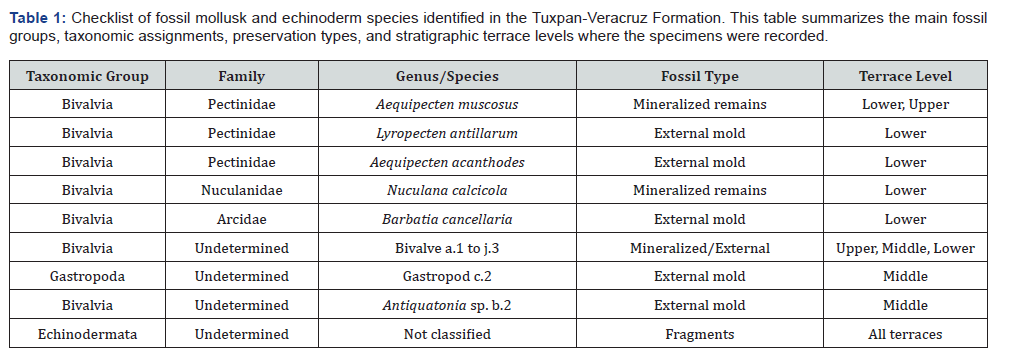
A total of 20 quadrants were sampled from the San Rafael or El Mesón terrace [4] on October 29, 2024. Different types of fossils were found, especially in the lower terrace quadrant, with fewer fossils found in the upper terrace. Notable fossil groups included bivalves, gastropods, and some echinoderms. In the middle terrace, a higher concentration of foraminifera was observed. Fossil identification was carried out using the ‘Illustrated Catalog of Bivalve Mollusks of the Gulf of Mexico’ [11]. These observations are consistent with broader taphonomic principles and fossil record completeness [12,13] (Table 1). These results align with discussions on fossil record quality and temporal fidelity [7,8].
Bivalve Fossils
Bivalves are mollusks that inhabit exclusively aquatic environments. They have a bilaterally symmetrical, laterally compressed body enclosed in a shell composed of two valves (bivalve). Shell shapes vary greatly and may be convex, rounded, ovoid, elliptical, cuneiform, or triangular.
Gastropod Fossils
Gastropods are a broad group of invertebrates, commonly known as snails. They include dioecious and hermaphroditic species, and can be marine, freshwater, or terrestrial. Their shells typically consist of a single, conical piece, although in some species the shell may be internal, reduced, or absent [1].
Echinoderm Fossils
Echinoderms are a highly diverse and well-defined group of invertebrates. Their forms vary greatly: echinoids can be spheroidal, discoidal, or heart-shaped; asteroids (starfish), ophiuroids (brittle stars), and holothuroids (sea cucumbers) show star-like or cylindrical forms. The echinoderm specimens found in the terraces could not be clearly classified into specific classes [6].
Three families of bivalve mollusks were identified: Pectinidae, Nuculanidae, and Arcidae. The most abundant was Pectinidae, represented by three genera: Lyropecten, Argopecten, and Aequipecten - the latter being the most frequent. Only one species was identified from each of the Nuculanidae and Arcidae families. Seven taxa were identified at the species level, with Aequipecten muscosus being the most abundant, followed by Lyropecten antillarum and Aequipecten acanthodes. The least common species were Nuculana calcicola and Barbatia cancellaria [5].
Conclusion
The checklist of identified taxa contributes to regional biodiversity records and can support comparative studies within the Gulf of Mexico and Caribbean domains. Continued exploration and sampling may reveal additional taxa and improve temporal resolution. Overall, this study reinforces the geological and paleontological significance of the Tuxpan- Veracruz Formation. The vertical distribution of specimens suggests paleoenvironmental variability and possibly fluctuating energy conditions during sediment deposition. Furthermore, this research confirms the paleontological relevance of the San Rafael terrace and provides foundational data for future biostratigraphic and paleoenvironmental reconstructions in Southeastern Mexico. The findings are consistent with previous studies that recognized the paleontological richness of the Tuxpan Formation, yet this work adds new details by documenting specific preservation types, stratigraphic distribution, and taxonomic associations. Notably, members of the Pectinidae family such as Aequipecten muscosus, Lyropecten antillarum, and Aequipecten acanthodes were among the most abundant, with mineralized remains and molds well preserved within silty-sandstone matrices. The fossil survey conducted in the San Rafael or El Mesón terrace of Tuxpan, Veracruz, reveals significant insights into the palaeoecological and sedimentary dynamics of this Miocene-aged region. The stratigraphic analysis and fossil identification across the upper, middle, and lower terraces highlight a diverse assemblage of mollusks, particularly bivalves and gastropods, and less frequently, echinoderms.
References
- Gío AR (1982) Tuxpan Formation. In: Gío-Argáez R, Krutak PR (Eds.), Eighth International Symposium on Ostracoda: Applications of Ostracoda to Economic and Scientific Problems. University of Houston and Institute of Geology, UNAM. pp. 44-48.
- Vega FJ, Feldmann RM, Villalobos JL, Gío AR (1999) A new decapod fauna from the Miocene Tuxpan Formation, Eastern Mexico. Journal of Paleontology 73(3): 407-413.
- Perrilliat MC (1994) Bivalves of the Tuxpan Formation (Middle Miocene), State of Veracruz, Mexico. Revista Mexicana de Ciencias Geológicas 11(2): 232-242.
- Dumble ET (1911) Tertiary deposits of northeastern Mexico. Science, New Series, 33(841): 232-234.
- Dickerson RE, Kew WSW (1917) The fauna of a medial Tertiary formation and the associated horizons of northeastern Mexico. In: Proceedings of the California Academy of Sciences, Series 4, 7(5): 125-156.
- Buitrón SB, Solís MFA (1993) Biodiversity in fossil and recent echinoderms of Mexico. Revista de la Sociedad Mexicana de Historia Natural 44: 209-231.
- Paul CRC (1998) Adequacy, completeness and the fossil record. In: Donovan SK, Paul CRC (Eds.), The adequacy of the fossil. Wiley pp. 1-28.
- Kidwell SM, Holland SM (2002) The quality of the fossil record: Implications for evolutionary analyses. Annual Review of Ecology and Systematics 33(1): 561-588.
- Pérez M, Ramírez S (2018) Paleontological studies in the northern Gulf of Mexico region: Implications for prehistoric archaeology. Arqueología Mexicana 26(4): 57-68.
- INEGI (2013) Geological and geographical information of Mexico. Instituto Nacional de Estadística y Geografí
- García CA, Reguero MA (2007) Illustrated catalog of bivalve mollusks of the Gulf of Mexico and the Caribbean Sea. National Autonomous University of Mexico.
- Kidwell SM (2001) Preservation of species abundance in marine death assemblages. Science 294(5544): 1091-1094.
- Allmon WD, Martin RE (2014) Insights from the fossil record on the nature of species and the completeness of the fossil record. Annual Review of Ecology, Evolution, and Systematics 45: 379-398.

























