




 OFOAJ Home



Ichthyodiversity and Conservation Status in River Khowai in Tripura: Reconnaissance Taxonomic Report
Devashish Kar*
Department of Life Science, Assam University, India
Submission:September 03, 2024; Published: September 26, 2024
*Correspondence author: Devashish Kar, Micro-Centre for Human and Water Studies, Silchar, Assam, INDIA-788005; formerly Assam University, Department of Life Science, Silchar, Assam, India-788011
How to cite this article: Devashish K. Ichthyodiversity and Conservation Status in River Khowai in Tripura: Reconnaissance Taxonomic Report. Oceanogr Fish Open Access J. 2024; 17(5): 555972. DOI: 10.19080/OFOAJ.2024.17.555972
Abstract
Fish faunal exploration at different study points in River Khowai in the province of Tripura in the North-Eastern (NE) Biodiversity (BD) hotspot, revealed the occurrence of 15 ichthyospecies under 15 genera, 3 sub-families, 7 Families and 4 Orders. These include 1 species under Osteoglossiformes; 10 species under Cypriniformes; 3 species under Siluriformes; 1 species under Anabantiformes. Detailed taxonomic studies indicated highest number of species among the Cypriniformes and lowest among the Osteoglossiformes and Anabantiformes. Distrubution and conservation status of each species have been discussed in the present contribution.
Keywords: Ichthyofauna; Biodiversity; Taxonomy; River Khowai; Tripura; North-Eastern Himalayan biodiversity hotspot
Introduction
Fish forms c 50% of the total number of vertebrates in the world. They live almost in all conceivable aquatic habitats. c 21,723 living species of fish have been recorded out of c 39,900 species of vertebrates [1-3]. Of these, c 8411 are freshwater species and c11,650 are marine. India is one of the Mega biodiversity countries in the World [4]. In India, there have been reports c 2500 species of fishes; of which, c 930 live in freshwater (FW) and c 1570 are marine [3,5-8]. This bewildering ichthyodiversity of this region has been attracting many ichthyologists both from India and abroad. Concomitantly, NE region of India has been identified as a `Hotspot’ of Biodiversity in the Eastern Himalayan stretch by the World Conservation Monitoring Centre [9] This prolific diversity of this region could be assigned to certain reasons, notably, the geomorphology and the tectonics of this zone. The hills and the undulating terrains of this area gives rise to large number of torrential hill streams, which lead to big rivers; and, finally, become part of the Ganga-Brahmaputra-Barak-Chindwin-Kolodyne-Gomati-Meghna system [6,8,10-15].
There are numerous lentic and lotic water bodies in India. And, the province of Tripura. situated in the North-Eastern Himalayan belt, is a hotspot of fish diversity contained in many wetlands and rivers of various kinds including rheophilic hill streams and plain water rivers and streams. However, the aquatic life has been influenced by human interventions. A little detailed survey of literature on Fish taxonomic works revealed that, Menon [16] had dealt with an appraisal of Satpura Hypothesis of Distribution of the Malayan Fauna and Flora to Peninsiular India.
Concomitant to above, Kar [5-8,10,11-15,17-20], Kar et al. [21], Kar et al. [22] have been doing a big number of studies in North-East (NE) India on different aspects of fish and their habitats. Kar et al. [23] had carried out a detailed study on fish՚ biodiversity in North-East India with particular reference to Barak drainage, Mizoram, and Tripura. Very recently, Kar & Khynriam [18,21,24-26] and Kar et al. [6,24] did extensive works on the fish systematic and diversity and other related parameters in many water bodies in NE India.
Notwithstanding the above, some of the other significant works on the fishes and water bodies in India in general and NE India, in particular are those of Ghosh et al. [27], Jayaram [1-3,28], Sen [29], Kar et al. [6,24], Menon [30,31], Yadava et al. [32], Nath et al. [33,34], Sinha [35], Sen [36], Sen & Khynriam [37], Arunachalam et al [38], Das et al. [39], Dey et al. [40], Lalramliana et al. [41,42], Lokeshwor et al. [43], Khynriam & Sen [37].
In addition to above, Bailey RG [44] had dealt with the fishes of River Nile in the Republic of Congo. Bailey [45] had dealt with changes in the Fish and Fisheries Ecology of a large man-made lake in Tanzania for the period from 1965-94. Bailey & Hickley [45] had exported on a recent collection of Nothobranchius virgatus Chambers, a new killifish from southern Sudan. Didem et al [46] reported on a New Record for occurrence of Symphodus bailloni (Osteichthuyes: Perciformes: Labridae) in the Western Black Sea Coast of Turkey. Kullander et al. [47] had reported on a new species of cyprinid fish from Myanmar. Kevin W Conway et al. [48], had reported a new species of Psilorhynchus from the Ataran River Basin, Myanmar, with comments on the generic name Psilorhynchoides. Wikramanayake, and Moyle [49] worked on the ecological structure of Tropical Fish Assemblages in wet-zone streams of Sri Lanka.
The River Khowai is said to have originated from the Atharomura hill ranges in the province of Tripura. It has a typical and quite long stretch of rheophilic characteristics with some amount of cascade type of microhabitat in the upstream region and mainly riffles and pools as microhabitats in the mid-stream region. It is mainly laminar flow in the terminal downstream region. The substratum mainly consists of boulders, cobbles and gravels in the hilly stretch of the river; while, it is mainly fines in the downstream plain water stretch of the river.
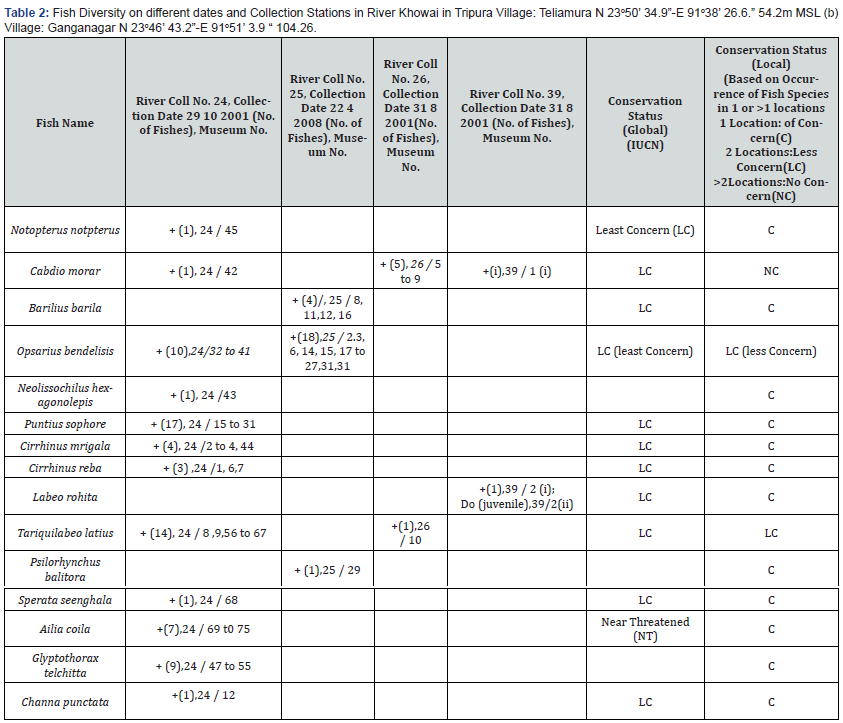
The River Khowai is one of the main rivers in Tripura. Fishes were collected from River Khowai from the following sites (Table 1). Fishes collected from River Khowai on different dates and sampling stations have been mentioned in (Table 2).

Material and Methods
Fish samples had been collected through experimental fishing using cast nets (diameter 3.7m ‒ 1.0m), gill nets (vertical height 1.0m ‒ 1.5m; length 100m ‒ 150m), drag nets (vertical height 2.0m), triangular scoop nets (vertical height 1.0m) and by using different types of traps. The technique of Camouflaging was also used to catch the fishes. Fishes had been preserved at first in concentrated formaldehyde in the field itself and then in 10% formalin. Fishes have been identified after standard literature [1,3,28,30,31,50-55], and Fishbase.org. [56]. The arrangement of classification, followed here, is that of Greenwood et al. [57], and Jayaram [1-3]; Kar & Khynriam et al. [18].
Systematic list of fishes
Order (I): Osteoglossiformes
Family (A): Notopteridae
Genus (i): Notopterus Lacepede 1800
Species (1): Notopterus notopterus (Pallas, 1769)
Order (II): Cypriniformes
Family (B): Danionidae
Sub-family(a): Chedrinae
Genus: (ii) Cabdio Hamilton 1822
Species (2): Cabdio morar (Hamilton, 1822)
Genus (iii): Barilius Hamilton, 1822
Species (3) Barilius barila (Hamilton, 1822)
Genus (iv): Opsarius McClelland, 1838
Species (4): Opsarius bendelisis (Hamilton, 1807)
Family(C): Cyprinidae
Sub-family (b): Torinae
Genus (v) Neolissochilus Rainboth, 1985
Species (5): Neolissochilus hexagonolepis (McClelland, 1839)
Genus: (vi): Puntius Hamilton, 1822
Species (6): Puntius sophore (Hamilton, 1822)
Genus (vii) Cirrhinus Cuvier, 1817
Species (7): Cirrhinus mrigala (Hamilton, 1822)
Genus (viii) Cirrhinus Cuvier, 1817
Species (8): Cirrhinus reba (Hamilton, 1822)
Genus: (ix)Labeo Cuvier, 1816
Species (9) Labeo rohita (Hamilton, 1822)
Genus (x)) Tariqilabeo Kuhl van Hasselt, 1823
Spercies (10): Tariqilabeo latius (Hamilton, 1822)
Family(D): Psilorhynchidae
Genus (xi): Psilorhynchus McClelland, 1839
Species (11): Psilorhynchus balitora (Hamilton, 1822)
Order (III): Siluriformes
Genus (xii): Sperata Holly, 1939
Species (12): Sperata seenghala (Sykes, 1839)
Family (E): Ailiidae
Genus (xiii): Ailia Gray, 1830
Species (13): Ailia coila (Hamilton, 1822)
Family (F): Sisoridae
Sub-family(c): Sisorinae
Genus (xiv): Glyptothorax Blyth, 1860
Species (14): Glyptothorax telchitta (Hamilton, 1822)
Order (IV): Anabantiformes
Family (G): Channidae
Genus (xv): Channa Scopoli, 1777
Species (15): Channa punctata (Bloch, 1793)
As already mentioned, Fishes collected from River Khowai on different dates and sampling stations have been mentioned in (Table 2).
Systematic account
Phylum: Chordata
Class: Actinopteri
Order: Osteoglossiformes
Family: Notopteridae
Genus: Notopterus lacepede, 1800,
Notopterus Lacepede, 1800, Hist.nat. Poiss., 2:190 (Type species: Gymnotus notopterus Pallas, by absolute tautonomy); Roberts, 1992, Ichthyol.Explor. Freshwaters, 2 (4):361-383 (revisioin); Talwar and Jhingran, 1991, Inland Fishes 1: 62; Jayaram, 1999, FW Fishes of the Indian Region: 20; Menon, 1999, Rec. Zool. Surv. India Occ Paper No. 175: 9
Generic characters: Body oblong, laterally compressed; cranio-dorsal profile straight or slightly concave. Abdomen with 25-28 pre-pelvic double serrations. Head compressed. Mouth wide, cleft of mouth extending upto or beyond posterior border of eyes. Eyes moderate, dorso-lateral. Gill membranes partly united. Dorsal fin small, tuft-like, inserted near middle of body with 8-10 rays. Anal fin very long, low, ribbon-like, with 100-135 rays; confluent with the caudal fin. Pelvic fins rudimentary. Caudal fin small. Scales small. Lateral line complete, more or less arched with about 180 scales.
Material examined: River Khowai in Tripura; Coll., 29 10 2001; 1 ex; Museum No.24/45; Coll. Professor D. Kar and Party. First Report.
Key to species: Abdomen with 25 to 28 pre-pelvic double serrations.
Notopterus notopterus (Pallas, 1769)
Distribution: Throughout India including Rani Meghna Beel around Kaliganj in Karimganj District (first report by Professor D. Kar and Party); River Khowai in Tripura (First Report by Professor D. Kar and Party); also in other water bodies India, Bangladesh, Indonesia Malaya, Nepal, Pakistan, Thailand, West Africa, etc.
IUCN status: Least Concern (LC).
Order: Cypriniformes
Family: Danionidae
Sub-family: Cyprininae
Genus: cabdio hamilton 1822
Cabdio Hamilton, an account of fishes found in the river Ganges: 333, 392.
Generic characters: Body elongate. Abdomen rounded. Head moderate rounded anteriorly. Snout obtuse. Mouth small, inferior. Eyes lateral. Lips thin. Lower jaw without any lip and with a sharp crescent bony edge. Barbel absent. Dorsal fin inserted behind pelvic fins. Caudal fin forked. Lateral line much decurved. Scales of moderate size; eye, 17.2 to 25.3 % HL.
Material examined
a) River Khowai in Tripura; Collection, 29 10 2001; 1 Ez.; Museum Nos. 24/42; Coll. Professor D. Kar and Party; First Report.
b) River Khowai in Tripura; Collection, 31 8 2001; 5 Ex., Museum Nos. 26/5,
c) 26/6, 26/7, 26/8, 26/9; Coll. Professor D. Kar and Party; First Report.
d) River Khowai in Tripura; Collection, 31 8 2001; 1 Ex., Museum No.39/ 1(i); Coll.: Professor D. Kar and Party; First Report.
Key to species: Lateral line scales 38 to 42. Anal fin with 10 to 12 rays. 2.5 to 3 rows of scales between lateral line and pelvic fin base.
Cabdio morar (Hamilton, 1822)
Distribution: Throughout Northern India, including river Barak at Lakhipur and at Khangbor (First reports by by Prof. D Kar and Party); River Khowai in Tripura (First Report by Professor D. Kar and Party); also in Bangladesh, Nepal, Pakistan, etc.
IUCN Status: Least Concern (LC)
Genus Barilius Hamilton, 1822
Barilius Hamilton, 1822, Fish Ganges, 266, 384 (type species: cyprinus barila hamilton).
Generic characters: Body moderately elongate and compressed. Abdomen rounded. Head sharply pointed; might have “peral organs” and tubercles. Mouth anterior or obliquely directed upwards. Eyes large and superior in the anterior half of the head, not visible from below the ventral surface. Upper jaw longer than lower. Characteristic muscular pads present in front of the bases of the pectoral fins. Dorsal fin inserted opposite the inter-space between pelvic and anal fins, nearer to caudal-fin base than to the tip of the snout. Caudal fin forked. Scales moderate. Lateral line concave. The body usually covered with vertical bands.
Material examined: River Khowai in Tripura; Collection, 22 4 2008; 4 Ex.; Museum Nos.25/8, 25/11,25/12, 25/16; Coll. Professor D. Kar and Party; First Report.
Key to species: Body with 14 or 15 short vertical bars extending from back to lateral line.
Barilius barila (Hamilton, 1822)
Distribution: Throughout North East India: River Barak at Thingkal, NE India (first report by Prof. D. Kar and Party); River Khowai in Tripura (first report by Prof. D. Kar and Party); also in Bihar, Delhi, Jammu and Kashmir, Madhya Pradesh, Mysore, Orisa, Rajasthan, Uttar Pradesh, West Bengal. Bangladesh, Myanmar and Nepal.
IUCN Status: Least Concern (LC).
Genus: opsarius mcclelland, 1838
Opsarius McClelland, 1838. Journal of the Asiatic Society of Bengal 7: 944.
Generic characters: Body long, mouth widely cleft and horizontal with symphysial knob received into a corresponding depression in the apex of the upper jaw. Back straight, dorsal fin placed opposite to anal fin, both fins situated near the caudal extremity.
Material examined
a) River Khowai in Tripura; Collection, 29 10 2001; 10 Ex.; Museum Nos. 24/32, 24/33, 24/34, 24/35, 24/36, 24/37), 24/38, 24/39, 24/40,24/41; Coll. Professor D. Kar and Party; First Report.
b) River Khowai in Tripura; Collection, 22 4 2008; 18 Ex.; Museum Nos.25/2,25/3, 25/6,25/14, 25/15, 25/17,25/18, 25/19,25/20, 25/21, 25/22, 25/23, 25/24), 25/26), 25/27, 25/28, 25/30, 25/31; Coll. Professor D. Kar and Party; First Report.
Key to species: Anal fin short with 7-8 branched rays. Each scale usually with a black spot.
Opsarius bendelisis (Hamilton, 1807)
Distribution: Throughout India, including river Barak at Karong,Tamenglong, Vangai, Thinghmun-Patpuihmun, Thingkal, Liben (Joining Barak), North-East India, (first reports by Professor D. Kar and Party); River Khowai in Tripura (first reports by Professor D. Kar and Party); also in Bangladesh, Bhutan, Myanmar, Nepal, Pakistan, Sri Lanka, and Thailand.
IUCN Status: Least Concern (LC).
Order: Cypriniformes
Family: Cypronidae
Sub-family: Cyprininae
Genus: Neolissochilus Rainboth, 1985
Neolissochilus Rainboth, 1985, Beaufortia 35 (3): 26 (Type species: BarbusstracheyiDay, 1871, by original designation).
Generic characters: Body deep anteriorly. Trunk and peduncle are smoothly tapering from anterior end to posterior end. Abdomen rounded. Head broad. Snout blunt. Mouth oblique,terminal to horizontal or inferior. Species with horizontal mouth often have the lobe of the snout overhanging the upper lip. Mouth smoothly rounded when the lower jaw is blunt. Eyes in the upper half of head; visible both from dorsal and ventral surfaces. Lips thick. Cheeks with many tubercles. Labial fold interrupted. Scales large and heavy.
Material examined: River Khowai in Tripura; Coll., 29 10 2001; 1 ex; Museum No.24/43; Coll. Professor D. Kar and Party; First Report.
Key to species: Mouth nearly truncate. Edge of lower jaw sharp.
Neolissochilus hexagonolepis(McClelland, 1839)
Distribution: Throughout NE India including River Barak at Jaisuo in NE India (first report by Prof. D. Kar and Party); River Khowai in Tripura (First Report by Professor D. Kar and Party); also, in Northern India, Darjeeling, and Eastern Himalaya. South and South-Eastern Asia.
IUCN Status: Near Threatened (NT).
Genus: Puntius Hamilton, 1822
Puntius Hamilton, 1822, Fish Ganges :310, 388 (Type species, Cyprinus sophore, Hamilton-Buchanan, by subsequent designation); Jayaram, 1991, rec.Zool. Surv. India Occ. Paper No.135: 1-178 (revision); Talwar and Jhingran, 1991, Inland Fishes 1: 250; Jayaram, 1999, FW Fishes of the Indian Region: 108; Menon, 1999, Rec Zool.Surv. India., Occ. Paper No. 175: 65; Nath and Dey, 2000. Fish and Fisheries of NE India (Arunachlal Pradesh): 39; Vishwanath, 2002, Fish and Fisheries of NE India, NATP Pub.: 69.
Generic characters: Body short to moderately long, deep, compressed. Abdomen round. Head short. Snout obtuse, conical or pointed; sometimes, may be with tubercles. Mouth arched, anterior or inferior. Upper jaw may be protractile. Eyes moderate to large, dorsolateral; they are not visible from below ventral surface. Lips thin, cover the jaws; without any horny covering. Jaws simple without any tubercle at the symphysis. Barbels four, two or may be absent. Dorsal fin short inserted nearly opposite to pelvic fins. Anal fin short. Caudal fin forked. Scales small, moderate or large.
Material examined: River Khowai in Tripura; Collection, 29 10 2001; 17 Ex.; Museum Nos. 24/15, 24/16, 24/17, 24/18, 24/19, .24/20, 24/21, 24/22, 24/23, 24/24, 24/25, 24/26, 24/27, 24/28, 24/29, 24/30, 24/31, Coll. Professor D. Kar and Party: First Report.
Key to Species: Pre-dorsal scales 8-10. Presence of a black spot-on dorsal fin and on caudal peduncle.
Puntius sophore (Hamilton, 1822)
Distribution: Almost through India, including River Barak at Lakhipur; Rupairbala Anua in Cachar Assam (First Reports by Professor D.Kar nd Party), River Khowai in Tripura (First Report by Professor D.Kar nd Party) . Also, found in Bangladesh, Myanmar, Nepal, Pakistan, Sri Lanka, etc.
IUCN Status: Least Concern (LC)
Genus: Cirrhinus Cuvier, 1817
Cirrhinus (Oken), Cuvier, 1817, V.KI. Fische. IN: Isis order Encyclopadische Zeituny, 8: 113 (type species, Cyprinus cirrhosus Bleeker, by monotypy), -Banarescu, 1983, Rev.Roum. Biol. (Zool).28 (1): 13-17 (revision).
Generic characters: Body moderate, elongate, compressed. Abdomen rounded. Head short. Snout obtusely rounded, with thin skin covering it. Mouth wide, transverse. Eyes moderately large. Upper lip fringed or entire, not continuous with lower. Lower jaw sharp with a small tubercle at the symphysis. Barbels four, two or none. Dorsal fin inserted ahead of pelvic fins. Anal fin short. Scales of varying sizes. Lateral line complete.
Material examined: River Khowai in Tripura; Collection, 29 10 2001; 4 Ex.; Museum Nos. 24/2, 24/3,24/4,24/44; Coll. Professor. D. Kar and Party; First report.
Key to species: Lateral line scales 40 to 45. Dorsal fin with 15 or 16 rays.
Cirrhinus mrigala (Hamilton, 1822)
Distribution: Almost throughout India including River Monu in Tripura (First Report by Professor. D. Kar and Party); River Khowai in Tripura (First Report by Professor. D. Kar and Party); Salchapra Anua, in Cachar, Assam; also in Bangladesh, Darjeeling, and Eastern Himalaya. South and South-Eastern Asia, etc. IUCN Status: Least Concern (LC).
Material examined: River Khowai in Tripura; Collection, 29 10 2001; 3 Ex.; Museum Nos.24/1, 24/6, 24/7; Coll. Professor. D. Kar and Party; First report.
Key to species: Lateral line scales 34 to 38. Dorsal fin less than body height.
Cirrhinus reba (Hamilton, 1822)
Distribution: Almost throughout India, including River Monu in Tripura ((First Report by Professor. D. Kar and Party, River Khowai in Tripura ((First Report by Professor. D. Kar and Party), also in Bangladesh, Pakistan, Punjab, etc. IUCN Status: Least Concern (LC).
Genus: Labeo Cuvier, 1816
Labeo cuvier, 1816, Regne Animale, 2 (ed.1): 194 (Type species, Cyprinus niloticus Forskal, by subsequent designation); Jayaram and Dhas,1998, Occ.Papers Zool. Surv.India, No. 183: 1-143; Talwar and Jhingran, 1991, Inland Fishes I: 193; Jayaram, 1999, FW Fishes of the Indian Region: 132; Menon, 1999, Rec.Zool. Surv. India Occ. Paper No., 175: 125; Nath and Dey, 2000, Fish and Fisheries of NE India (Arunachal Pradesh): 45; Vishwanath, 2002, Fish and Fisheries of NE India, NATP Pub: 611.
Generic characters: Body of moderate size; sometimes, could be much big in size; elongated, abdomen rounded. Head quite large. Snout more or less swollen, rounded or truncated; often projecting beyond mouth.; covered by a groove across and with or without tubercles; generally overhanging the mouth. Mouth usually semilunar and inferior. Eyes moderately large, generally placed at the commencement of the posterior half of the haead. Lips thick, fleshy and fringed; continuous at the angle of the mouth forming a labial fold. Post-labial groove may be continuous or discontinuous. Barbels may be present or absent. Dorsal fin inserted above anterior to origin of pelvic fins with 11 to 26 rays. Anal fin short with 7 or 8 rays. Caudal fin deeply forked or emarginated. Lateral line complete.
Material examined: River Khowai in Tripura; Collection, 31 8 2001; 2 Ex.; Museum No.39/ 2(i), 39/ 2(ii); Coll. Professor. D. Kar and Party; First report.
Key to species: Presence of generally 6 to 6.5 scales between lateral line (Ll) and pelvic fin base
Labeo rohita (Hamilton, 1822)
Distribution: Salchapra Anua, Rupairbala Anua in Cachar district, Assam (First Report by. Prof. D. Kar and Party), River Khowai in Tripura (First Report by. Prof. D. Kar and Party); other parts of North and North-East India, also in Afghanistan, Bangladesh, Myanmar, Nepal, Pakistan. IUCN Status: Least Concern (LC).
Genus: Tariqilabeo Kuhl van Hasselt, 1823
Tariqilabeo Kuhl van Hasselt, 1823, Algem-Konst.Letter- Bode,2, p:132 (Type species, Tariqilabeo oblongus (Crossocheilus oblongus) Kuhl and van Hasselt, by monotypy); Mukerji, 1934, J.Bombay nat. Hist. Soc., 37 (1): 49-54; Banarescu, 1986, Trans Mus. Hist. natn. Gr.Antipa. 28: 142-154; Kottelat, 1987, Jap. J. Ichthyol., 33 (4): 371; Talwar and Jhingran, 1999, Inland Fishes 1: 413; Jayaram, 1999, FW Fishes of the Indian Region: 152; Menon, 1999, Rec. Zool. Surv., India, Occ. Paper No. 175: 139.
Generic Characters: Body more or less elongate. Ventral profile horizontal or slightly curved. Abdomen rounded. Head small. Snout obtusely pointed. Mouth inferior. Eyes large. Post-labial groove generally present. Rostral cap thick; its margin fimbriate. Presence of a pair of rostral and maxillary barbels only; latter may be absent. Dorsal fin inserted midway between pectoral and pelvic fins; considerably nearer to tip of snout than base of caudal fin with 10 or 11 rays and without any spine. Anal fin short with 7 rays. Caudal fin deeply forked. Lateral line scales 33 to 46.
Material examined
a) River Khowai in Tripura; Collection, 29 10 2001; 14 Ex.; Museum Nos. 24/8, 24/9, .24/56, 24/57, 24/58, 24/59, 24/60, 24/61, 24/62, 24/63, 24/64, 24/65), 24/66), 24/67; Coll. Professor. D. Kar and Party; First report.
b) River Khowai in Tripura; Collection, 31 8 2001; 1 Ex; Museum No. 26/10; Coll. Professor. D. Kar and Party, First report.
Key to species: Presence of 37-39 Ll scales. Diameter of eye 21.3 to 23.8 % of HL.
Tariqilabeo latius (Hamilton, 1822)
Distribution: Almost throughout NE India, including Salchapra Anua in Cachar, Assam (First Report by Professor D. Kar and Party); River Monu in Tripura ((First Report by Professor D. Kar and Party); River Khowai in Tripura ((First Report by Professor D. Kar and Party); also in Arunachal Pradesh, Bangladesh, Nepal. IUCN status: Least Concern (LC). Family: Psilorhynchidae
Genus: Psilorhynchus McClelland, 1839
Psilorhynchus McClelland, 1839, Asiatic Researches, 19: 300, 428 (Type species: Cyprinus sucatio Hamilton, by subsequent designation).
Generic characters: Body spindle-shaped, arched dorsally and flattened ventrally; anteriorly depressed. Ventral surface markedly flattened. Snout flat obtusely pointed anteriorly. A shallow depression may be present on the cheek. Mouth small, inferior, transverse. Eyes large, dorsolateral in the posterior half of the head; not visible from below ventral surface. Lips entire, fleshy, continuous at the angle of mouth; reflected off from both the jaws; and, with glands and folds. Presence of a distinct lateral groove on either side passing along the sides of the snout. The upper jaw overhangs the mouth. Absence of barbels. Dorsal fins inserted ahead of pelvic fins with 10-12 rays. Pectoral fins simple with four-six rays. Anal fin short with seven rays. Caudal fin forked; upper lobe longer. Scales relatively large along the lateral line. Lateral line complete with 32-34 scales.
Material examined: River Khowai in Tripura; Coll.: 22 4 2008; 1 Ex.; Museum No.25/29; Coll. Professor. D. Kar and Party; First report.
Key to species: Pectoral fin with six-seven simple rays. Lateral line scales 30-34.
Psilorhynchus balitora (Hamilton, 1822)
Distribution: Throughout North-East India, including: River Khuolzangvadung in Dima Hasao District, Assam (first report by Prof. D. Kar and Party), River Khowai in Tripura ((first report by Prof. D. Kar and Party); also in North and West Bengal, Jamuna River;Bangladesh, Myanmar, and Nepal. IUCN Status: Least Concern (LC).
Order: Siluriformes
Family: Bagridae
Genus: Sperata Holly, 1939
Sperata Holly, 1939, Zool. Anzeiger 125:14, 1939 (replacement name for Macrones Dumeril, 1856; therefore, taking the same type species Bagrus lamarii Valenciennes, 1840 (Type species: Sperata vittatus (Bloch) in error); Ferraris and Runge, 1999, Proc.Acad. Nat. Sci. Philad. 51 (10): 400 (Revision); Jayaram, 2006, Catfishes of India: 23; Ferraris, 2007, Zootaxa, 1418: 106. Macrones Dumeril, 1856, Ichthyologie analytique: 484 (Type species Bagrus lamarrii Valenciennes, 1840, by original designation; preoccupied by Macrones Newman, 1841, Insecta (Coleoptera). Aoria Jordan, 1856, Proc Acad. Nat. Sci. Philad. 70: 341 (substitute name for Macrones Dumeril, 1856, preoccupied by Aoria baly, 1863. Insecta, Coleoptera).
Generic characters: Dorsal profile arched. Head large elongate, slightly depessed. Snout spatulate or rounded. Mouth moderately wide. Presence of a distinct inter-neural shield in between basal bone of dorsal fin and occipital process. Presence of 4 pairs of barbels; one each maxillary and nasal and two mandibular. Gill membranes free from each other and also from isthmus. Rayed dorsal fin generally with 7 rays and a robust spine. Adipose dorsal fin low with slightly convex margin. Pectoral fins with 9 or 10 rays and a spine. Pelvic fins generally with 6 rays. Anal fin short with 11 to 15 rays. Caudal fin deeply forked. Presence of a large round or ovoid dark spot near the posterior margin of the adipose fin.
Material examined: River Khowai in Tripura; Coll., 29 10 2001; 1 ex; Museum No.24/68; Coll. Professor D. Kar and Party: First Report.
Key to species: Snout spatulate. Pectoral fin with 8 or 9 rays.
Sperata seenghala (Sykes, 1839)
Distribution: Many large rivers in India, notably,River Barak; Haors in Assam, notably, Chatla Haor,Bakri Haor (First Report by Professor D. Kar and Party); River Khowai in Tripura (First Report by Professor D. Kar and Party); also in Rivers Brahmaputra, Ganges and their tributaries; also in Bangladesh, Myanmar, Nepal, Pakistan, Sri Lanka etc.
IUCN status: Least Concern (LC)
Family: Ailiidae
Genus: Ailia Gray, 1830
Ailia Gray, 1830, Zool Miscellany, Pl. 85 (Type species: malapterus (sic) (Ailia) bengalensis Gray= Malapterus coila Hamilton-Buchanan, by monotypy); Hora, 1941, Rec. Indian Mus., 43: 110-112; Jayaram, 2006, Catfishes of India: 117; Ferraris, 2007, Zootaxa, 1418: 356 (Ailichthys).
Generic characters: Body short compressed. Abdomen rounded. Head short, greatly compressed. Mouth moderately wide. Eyes small lateral. Presence of 4 pairs of barbells: one pair each maxillary and nasal; and two pairs mandibular; all these barbels are usually longer than head. Rayed dorsal fin absent. Adipose dorsal fin small, short and posteriorly free. Pectoral fins with 13 to 16 rays and a spine. Pelvic fins with six rays; may sometimes be vestigial or absent. Caudal fin forked.
Material examined: River Khowai in Tripura; Coll., 29 10 2001; 7 ex; Museum No.24/69; 24/70, 24/71, 24/72, 24/73, 24/74, 24/75; Coll. Professor D. Kar and Party: First Report.
Key to species: Pelvic fins absent. Rayed dorsal fin also absent. Anal fin long with 48 to 90 rays.
Ailia coila (Hamilton, 1822)
Distribution: Almost throughout India, Beels in Assam like Rani Meghna Beel (First Report by Professor D. Kar and Party); River Khowai in Tripura (First Report by Professor D. Kar and Party); other parts of North-East (NE) India, different parts of rest of India, Bangladesh, Nepal, Pakistan, etc.
IUCN Status: Near threatened.
Family: Sisoridae
Glyptothorax Blyth 1860
Glyptothorax Blyth 1860, J.Asiatic Society Bengal, 29 : 154 (Type species G.trilineatus Blyth); Hora, 1923, ec.Indian Mus, 25: 8; Prashad and Kukherji, 1929, Rec. Indian Mus.31: 164, 183, 185 (Burmese species); Hora and Gupta, 1941, Bull Raffles Mus,17 : 33 (Malayan speciies); Menon, M.A.S.. 1954; Rec.Indian Mus.,62: 30; Li, 1986, Indo-Pacific Fish Biology: 521-528; Jayaram, 2006, Catfishes of India: 256; Ferraris, 2007, Zootaxa, 1418: 387.
Generic characters: Head small, depressed, covered with thick skin; mouth conical but not pointed. Upper jaw longer. Lips thick, fleshy. Mouth inferior, transverse, narrow. Eyes dorsal, small not visible from below ventral surface of head. Presence of an adhesive organ on the ventral surface of thorax; which may be with or without pit or depression. Presence of 4 pairs of barbels: one pair each of maxillary and nasal; and, two pairs of mandibukar. Maxillary barbels with broad bases. Mandibular barbels inserted at different levels. Rayed dorsal fin inserted anteriorly above half of pectoral fins with 5 to 7 rays and a spine, Adipose dorsal fin short, posteriorly free. Pectoral fins inserted laterally with 6 to 11 rays and a flat, strong serrated spine. Anal fin short with 7 to 14 rays. Caudal fin deeply forked.
Material examined: River Khowai in Tripura; Coll., 29 10 2001; 9 ex; Museum Nos.24/47, 24/48, 24/49, 24/50, 24/51, 24/52, 24/53, 24/54, 24/55; Coll. Professor D. Kar and Party. First Report.
Key to species: Nostrils separated from the snout by a distance equal to eye diameter.
Glyptothorax telchitta (Hamilton 1822)
Distribution: Almost throughout India, including River Barak in Manipur, Rivers Tuirial, Kolodyne, Mat, Serlui in Mizoram (First Reports by Professor D. Kar and Party); River Khowai in Tripura (First Report by Professor D. Kar and Party); also, in other parts of North-East (NE) India, different parts of rest of India, Bangladesh, Nepal, Pakistan, etc.
IUCN Status: Least concern
Order: Anabantiformes
Family: Channidae
Genus: Channa Scopoli, 1777
Channa Scopoli, 1777, Introd. Hist. Nat.: 459 (Type species, Channa orientalis Bloch and Schneider, by subsequent designation).
Generic characters: Body elongated, sub-cylindrical anteriorly. Abdomen rounded. Head large depressed with plate-like scales. Snout somewhat obtuse. Mouth reasonably large; opening moderate to wide; may extend to below orbit. Eyes lateral, moderate; in the anterior part of the head. The lower jaw protrudes beyond the upper. Gill openings wide. Membranes of two sides connected beneath the isthmus. Dorsal fin long; inserted almost above the pectoral fins with 29-55 rays and no spine. Anal fin long with 21 to 36 rays. Both dorsal and anal fins are free from caudal fin. Caudal fin rounded; scales small; cycloid or ctenoid; scales on the head are more extensive than those on the body. Lateral line abruptly curved or almost interrupted with 37 to 110 scales.
Material examined: River Khowai in Tripura; Collection, 29 10 2001; 1 Ex; Museum No. 24/12; Coll. Professor. D. Kar and Party: First report.
Key to species: Dorsal fin with 28-33 rays. A number of dark blotches on flanks; some with many black spots on body and also on dorsal and caudal fins. Ventral side of body usually white or pale yellow.
Channa punctata (Bloch, 1793)
Distribution: Wetlands in Assam including Sat Beel (first report by Professor D. Kar and Party), River Khowai in Tripura (first report by Professor. D. Kar and Party), also in other parts of North-East India and rest of India; Bangladesh, China, Malaya, Myanmar etc.
IUCN Status: Least Concern (LC)
Discussion
The river Khowai is said to have originated from the Atharomura hill ranges in Tripura. An overall look into the habitat characteristics of the river Khowai reveals that the microhabitat of the river consists mainly of riffles and pools with some number of cascades in the upstream region; whereas, it is mostly riffle-pool type of microhabitat in the mid-reach region. The downstream plain water stretch mainly consists of run-sheet type of microhabitat. The foregoing account reveals the occurrence of both rheophilic hill stream as well as plain water fishes commensurating with the hillstream rheophilic portion and plain water downstream portion of the River Khowai. However, the River Khowai does not seem to harbour the highly rheophilic ichthyospecies. Occurrene of many plain water forms of fishes indicate that the river Khowai has a sufficiently long mid-reach and plain water stretch [59].
Concomitant to above, with regard to preference of the people to Khowai river fishes, species like Notopterus notopterus, Ailia coila, Sperata seenghala, Cirrhinus mrigala: Cirrhinus reba, Labeo rohita seem to be highy commercially important having high market value. Barilius barila, Opsarius bendelisis, Neolissochilus hexagonolepis,Tariquilabeo latius, Glyptothorax telchitta seemed to be preferred by the hill tribes being rheophilic species and found in the vicinity of the tribal villages in the hills. Further studies on the feeding and breeding biology of the fishes could throw more light on the biology of the fishes.
Acknowledgement:a
The author expresses his heartfelt gratitude to Zoological Survey of India, Shillong, or their kind help in the identification of the fish species.
References
- Jayaram KC (1999) The Freshwater Fishes of the Indian Region, xvii +551, Narendra Publishing House, Delhi.
- Jayaram KC (2003) Ecostatus and Conservation Strategies for Mahseer fishes of India with special reference to Deccan species: pp. 3-12. In: Kar D, Dey SC, Datta NC (Eds.), Welfare Biology in the New Millennium, pp. xx + 97, Allied Publishers Pvt. Ltd. Bangalore.
- Jayaram KC (2010) The Freshwater Fishes of the Indian Region, xxiv + 614, Narendra Publishing House, New Delhi.
- Mittermeier RA, Mittemeier CG (1997) Megadiversity: Earth’s Biologically Wealthiest Nation. In: McAllister DE, Hamilton AL, Harvery B (Eds.), Global Freshwater Biodiversity. Sea Wind, Cemex, Mexico City 11: 1-140.
- Kar D (2003) Peoples’ Perspective on Fish Conservation in the Water bodies of South Assam, Mizoram and Tripura: pp. 325-328. In: Mahanta PC, Tyagi LK (Eds.), Participatory Approach for Fish Biodiversity Conservation in North-East India. v + 412, National Bureau of Fish Genetic Resources (ICAR), Lucknow.
- Kar D (2007) Fundamentals of Limnology and Aquaculture Biotechnology, pp. xiv + 609, Daya Publishing House, New Delhi.
- Kar D (2005) Fish Biodiversity and Habitat Parameters of rivers in Barak drainage (Assam), in Mizoram and in Tripura. Himalayan Journal of Environmental Zoology 19 (1): 41-45.
- Kar D (2019) Wetlands diversity and their fishes in Assam, India. Transylv Rev Syst Ecol Res 21(3): 1-94.
- WCMC (1998) Freshwater Biodiversity: A Preliminary Gobal Assessment. A Document prepared for the 4th Meeting of the Conference of the Practices to the Convention of Biological Diversity, World Conservation Monitoring Centre.
- Kar D (2000) Fish Genetic Resources in the Principal rivers and wetlands in North-East India with special emphasis on Barak valley (Assam), in Mizoram and in Tripura. Proc. National Project Initiation Workshop of the NATP-ICAR World Bank-aided project on Germplasm Inventory, Evaluation and Gene Banking of Freshwater Fishes’: National Bureau of Fish Genetic Resources (NBFGR), Lucknow, 1: 12.
- Kar D (2013) Wetlands and Lakes of the World, pp.xxx + 687, Springer (London)., Print ISBN 978-81-322-1022-1.
- Kar D (2021a) Community Based Fisheries Management: A Global Perspective, pp. xiii + 590, Elsevier (Academic Press) USA.
- Kar D (2021b) Fish and Their Habitats in North-East India Biodiversity Hotspot. J Oceanography and Fisheries 13(2): 555856.
- Kar D (2021c) Unique Oxbow Wetlands in Assam, India. Oceanography & Fisheries Open access Journal 14(3): 1-8.
- Kar D (2021d) Wetlands, Fishes and Pandemics with Special Reference to India. Sustainability in Environment 6(3): 136-142.
- Menon AGK (1978) An Appraisal of Satpura Hypothesis of Distribution of the Malayan Fauna abd Flora to Peninsular India. Zoologiana 1: 18-23.
- Kar D (2015) Epizootic Ulcerative Fish Disease Syndrome, xix + 293, Elsevier, (Academic Press), USA, ISBN: 9780128025048.
- Kar D, Khynriam D (2022) Fishes in the Upstream Rheophilic Stretch of River Barak at Karong. Sustainability in Environment ISSN 2470-637X (Print) ISSN 2470-6388 (Online) 7(3): 77-96.
- Kar Devashish (2024a) Fishes of River Kopili in the Assam Province of Eastern Himalayan Biodiversity Hotspot (Research Article). Oceanogr Fish Open Access Journal 17(4): 1-18.
- Kar Devashish (2024b) Distribution and Conservation Status of Ichthyospecies of River Monu in Tripura: First Detailed Taxonomic Report. Oceanogr Fish Open Access J 17(4): 1-22.
- Kar D, Khynriam D (2023) A Pioneering Study on Taxonomic Diversity of Fishes in the Headwaters of River Barak in Assam, Manipur and Mizoram, Northeast, India. Oceanogr Fish Open Access J 15(5): 1-14.
- Kar Devashish, Das Bubul (2024) Taxonomic Study of the Riverine Fishes of Karbi Anglong in North East India of the Eastern Himalayan Biodiversity Hotspot. Oceanogr Fish Open Access Journal 17(3): 1-9.
- Kar D, Sen N (2007) Systematic List and Distribution of Fish Biodiversity in Mizoram, Tripura and Barak drainage in North-East India. ZOOs’ Print Journal 22(3): 2599-2607.
- Kar D, Khynriam D (2020) On a recent pioneering taxonomic study of the fishes from rivers Diyung, Vombadung, Khuolzangvadung, Tuikoi and Mahur in Dima Hasao district of Assam. Transylv Rev Syst Ecol Res 22(3): 83-106.
- Kar D, Khynriam D, Das B, Das S (2020) A recent taxonomic study of the fish from the Jinam River in Dima Hasao Biodiversity Hotspot region of Assam (India). Transylv Rev Syst Ecol Res 22(2): 87-102.
- Devashish Kar, Dimos Khynriam (2024) Further Report on the Systematic, Distribution and Conservation of Ichthyospecies in the Headwaters of River Barak (Assam, Manipur and Mizoram), North East, India. Oceanogr Fish Open Access J 17(1): 1-18.
- Ghosh SK, Lipton AP (1982) Ichthyofauna of the NEH Region with special reference to their economic importance. ICAR Research Complex, NEH Region, Shillong. Spl Bull 1: 119-126.
- Jayaram KC (1981) The Freshwater Fishes of India, Pakistan, Bangladesh, Burma, Sri Lanka: a Handbook, xxii +475, Zoological Survey of India, Calcutta.
- Sen TK (1985) The Fish Fauna of Assam and the neighbouring North-Eastern States of India. Records of Zoological Survey of India, Occasional Paper No. 64: 1-216.
- Menon AGK (1974) A Checklist of the Fishes of the Himalayan and the Indo-gangetic Plains, pp. viii + 136, Inland Fish. Soc. India, Barrackpore.
- Menon AGK (1999) Checklist: Freshwater Fishes of India, xviii + 366, Occasional Paper No. 175, Zoological Survey of India, Calcutta.
- Yadava YS, Chandra R (1994) Some threatened carps and cat fishes of Brahmaputra River System: pp. 45-55. In: Threatened Fishes of India, pp. 384, Natcon. Publication No. 4, UP.
- Nath P, Dey SC (1997) Fish and Fisheries of North-East India, Vol. I: Arunachal Pradesh: 1-140.
- Nath P, Dey SC (1989) Two new Fish species of thr genus Amblyceps Blyth from Arunachal Pradesh, India. J. Assam Science Society 32(1): 1-6.
- Sinha M (1994) Threatened coldwater fishes of North-Eastern Region of India: pp. 173-176. In: Threatened Fishes of India, pp. 384, Natcon. Publication No. 4, UP.
- Sen N (2000) Occurrence, Distribution and Status of Diversified Fish Fauna of North-East India: pp. 31-48. In: Fish Diversity of North-East India (Eds.) Ponniah, A.G.andSarkar,U.K., pp. 228, National Bureau of Fish Genetic Resources, ICAR, Lucknow.
- Khynriam Dimos, Sen N (2014) Taxonomic Study on Nemacheilinae Loaches of North-East India. Rec zool Surv India Occ Paper No. 358: 1-37.
- Arunachalam M, Raja M, Nandagopal S, Mayden RL (2013) Garra palarivica, a new cyprinod fish Cypriniformes: Cyprinidae from Kerala, Western Ghats, Peninsular India. International J of Zoology Research 3(1): 62-68.
- Das BK, Boruah P, Devashish Kar (2015) Ichthyofaunal Diversity of Siang River in Arunachal Pradesh, India. Proc. Zool. Soc 70: 52-60.
- Dey S, Manorama M, Ramanujam SN (2015) New Records of three species of Fish in the upper reaches of the Btrahmaputra and Surma-Meghna River basins, Meghalaya, India. Journal of Threatened taxa 7(12): 7922-7926.
- Lalramliana, Beihrosa Solo, Samuel Lalronunga, Lalnuntleuanga (2018) Hemimyzon indicus, a new species of balitorid fish from the Kaladan basin, Mizoram, North-east India (Teleostei: Balitoridae).
- Lalramliana, John Daniel Marcus Knight, Denis Van Lalhlimpuia, Mahender Singh (2018) Integrative taxonomy reveal a new species of snalehead fish, Channa stiktos (Teleostei: Channidae), from Mizoram, North-east India. Vertebrate Zoology 68(2): 165-175.
- Lokeshwar Y, Voshwanath W, Kosygin L (2013) Schistura paucireticulata, a new loach from Tuirial River, Mizoram, India (Teleostei: Nemacheilidae). Zootaxa 3683(5): 581-588.
- Bailey RG (1994) Guide to the Fishes of River Nile in the Republic of Sudan. Journal of Natural History 28(4): 937-970.
- Bailey RG, Hickley P (1986) A recent collection of Nothobrabchus virgatus Chanbers, a new killifish from southern Sudan. Revue fr. Aquariol. p. 12.
- Didem, Gokturk, F Saadet Karakulak, Nuran Unsal, Abdullah E Kahraman (2012) A New Reccord for occurrence of Symphodus bailloni (Osteichthuyes: Perciformes: Labridae) in the Western Black Sea Coast of Turkey. Scientific World Journal 2012: 615318.
- Kullander Sven O, Ralf Britz (2008) Puntius padamya, a new species of cyprinid fish from Myanmar (Teleostei: Cyprinidae). Electronic Journal of Ichthyology 2: 56-66.
- Kevin W Conway, Maurice Kottelat (2007) A new species of Psilorhynchus (Teleostei: Psilorhynchidae) from the Ataran River Basin, Myanmar, with comments on the generic name Psilorhynchoides. Zootaxa 1663: 47- 57
- Wikramanayake ED, Moyle PB (1989) Ecological structure of Tropical Fish Assemblages in wet-zone streams of Sri Lanka. Journal of Zoology (London) 281: 503-526.
- Day F (1873) Report on the Freshwater Fish and Fisheries of India and Burma, pp. 22,23,35,36.
- Day F (1878) The Fishes of India, being a Natural History of the Fishes known to inhabit the Seas and Freshwaters of India, Burma and Ceylon, xx + 778, 195 pls, Text and Atlas in 4 parts, WM Dawson and Sons Ltd. London.
- Day F (1885) Relationship of the Indian and African Freshwater Fish Fauna. J Linn Soc Zool 18(107): 308-317.
- Shaw GE, Shebbeare EO (1937) The Fishes of Northern Bengal. J Royal Asiatic Soc Bengal Science, p. 137, 6 pls.
- Misra KS (1959) An aid to the Identification of Commercial Fishes of India and Pakistan. Rec. Indian Mus 57(1-4): 1-320.
- Talwar PK, Jhingran AG (1991) Inland Fishes of India and Adjacent Countries, Vol. I & II, pp. 1158, Oxford and IBH Co., Pvt. Ltd. New Delhi.
- org.
- Greenwood PH, Rosen DE, Weitzman SH, Myers GS (1966) Phyletic studies of teleostean fishes with a provisional classification of living forms, Bulletin of American Museum of Natural History 131: 339-456.
- Day F (1889) The Fauna of British India, including Ceylon and Burma: Fishes I & II: pp. 509, 548.
- Dudgeon D (1995) The Ecology of rivers and streams in Tropical Asia: pp. 615-657. In: Cushing CE, Cummins KW, Minshall GW (Eds.), Ecosystems of the World 22: River and Stream Ecosystems. Elsevier Press. UK.

























