




 OFOAJ Home



Abstract
Italian cultural heritage is actually subjected to a high anthropic pressure leading to a widespread worsening in the state of conservation of historical, archeological and artistic goods especially in seaboard areas. This paper aims to link the cultural heritage still existing on the landward sides of Calabrian coastal region with the widespread presence of coastal towers and littoral castles scattered along the regional seaboard areas. Really, the seaboard landscape of the region could be an ideal pattern where the natural features of coastal zone and its cultural heritage could interact for the social and economic growth of local people. By this way, the protection of historical defensive coastal system, located along Calabrian coastline, could become part of an overall coastal landscape planning, where these valuable archeological goods could be inserted into an effective revaluation of the regional cultural heritage.
Keywords:Coastal towers; Cultural heritage; Integrated coastal zone management; Calabria
Introduction
On 2022 year, is the fiftieth anniversary of a serious slash done by Lazlo Toth on a world-famous masterwork, named “La Pietà” by Michelangelo Buonarroti into Saint Peter’s Cathedral in Rome. This mad act has caused a tremendous outcry and from such event followed a long question about the debated issue related to the protection of Italian cultural heritage. Really, just some days after this offensive event, Time’s magazine published an article entitled: “Can Italy be saved by itself?”. The famous art reviewer Robert Hughes, author of the paper, wrote that “La Pietà”, just injured, could be considered a negative symbol of the whole Italian cultural heritage, reminding the touristic slogan “Visit Italy, before Italian destroy it”. So, he reported that most of the Italian cultural heritage was in a bad state of conservation, exposed to robbery, cementation, unauthorized building and destruction in the name of progress [1]. Such debated issues are especially clear in coastal zones which are transitional regions of great economic, social, cultural and environmental importance [2,3]. In particular, coastal landscape is an important mode of human significance informed by social, cultural and political issues [4], leading to new speculations at local and global levels [5]. These sensitive areas, in the middle between land and sea and extended from the edges of littoral plains to the outer borders of continental shelfs [6], bring on valuable feed resources for mankind through agricultural and fishing activities. Indeed, many coastal areas are actually subjected to an important and growing tourist flows, housing the 70% of world population [7]. However, the connection between mankind and sea is, nowadays, the source of conflictual relationships, causing in these last decades a growing decay of natural resources. Really, in the Mediterranean basin the deterioration of coastal areas is caused by human pressures linked to driving forces of terrestrial origin, affecting the environmental conditions of littoral regions. In these last years, Nature Based Solutions (NBS) are promoted to solve such environmental and societal problems through the integration between scientific and cultural fields [8]. Calabria is the southernmost region of Italian peninsula, so representing the tip of Italian peninsula. The special geographic position of this region, surrounded, on its western side, by the Tyrrhenian Sea and, on its eastern one, by the Ionian Sea, shows a long coastline of 715.7Km, as the 9.7% of the whole Italian coastal boundary. The geo-morphological features of the regional coastline are very differentiated in rocky coasts and sandy beaches, as the 55% and 45% respectively [9]. Such diversified outline has caused, in time, the biological evolution of many coastal ecosystems and, therefore, the development of great marine biodiversity. In Calabria, the main elements of coastal landscape are:
a) the natural features of coastal ecosystem
b) the relationships between man and environment
c) the cultural heritage, expression of mankind by local
people
At the same time, the Calabrian coastal region keeps up, until now, a rich cultural heritage made by archeological goods, that could attract potential and sustainable coastal tourism. In particular, along Calabrian coastline, an important coastal defensive system was settled, established by Don Pedro de Toledo, Viceroy of Neaple’s kingdom, to protect the Southern Italian seaboard areas from Turkish and Saracen raids. Such grand public work reinforced and, whereas necessary, built a set of castles and towers, so defending the littoral borders through a special kind of “marble barrier” made by fortifications, all located in strategic points of fundamental importance for the sighting and the defense of coastal regions [10]. Furthermore, in this geographical and orographic context the historical defensive coastal system often represents the harmonized and diffused entities located in coastal landscapes giving distinctive character about history and culture. The coastal towers and the littoral castles constituted a defensive, sighting and communication system along the Calabrian coastline. Really, natural goods have received by scientific literature a great attention more than the cultural ones. Instead, it is necessary to consider that both resources shared many features such as their transience and deterioration on time. Indeed, a lot of cultural goods are not renewable while natural ones, through correct and sound management, could be recovered [11]. So, this paper aims to deepen the connections between the regional natural and cultural heritages together with the widespread presence of coastal towers and littoral castles along Calabrian seaboard areas.
Materials and Methods
To reach the target of this study, regarding the complexity of coastal areas, it is necessary to identify the spatial distribution of cultural heritage sites and, at the same time, to know in which context they are inserted. In particular, it is necessary to identify the areas where are located the cultural heritage sites and to value their state of conservation. This common effort allows to develop an integrated approach that, coming from a local context, is aimed to the improvement and to the revaluation of cultural goods.
Based on the above, this study has been performed along the coastal areas of Calabrian region. The information and the data regarding the regional cultural heritage, represented in this study by historical defensive coastal system, such as castles and towers, have been deduced by literature [12-14] and subsequently their geographical position have been detected with topographic maps integrated with orthographic photos released by Calabria Region on 2006 year. Furthermore, these data have been processed through Geographic Information System (Quantum GIS 17.0) [15], overlapping all the cartographic elements with digital images released by Google Earth Maps on 2022 year. In particular, the methodology, used for determining whether the heritage sites were in bad, poor and/or in good conditions has been based on a visual survey of the archeological goods and, afterwards, on an indepth observation of the external and internal structures of these historical buildings. To visualize the locations of cultural heritage sites, their geographical coordinates have been considered. So, it has been used an integrated approach of photointerpretation but also an in-depth reference work of many historical textbooks [16,17] for the following reasons:
a) specific and detailed data are, very often, not available
in literature
b) the information is uncertain and inaccurate; as for
instance, it is well known the place names of cultural goods but it
is unknown their correct locations
c) the geographical coordinates, if present, are by different
datum systems and, therefore, it is necessary to standardize them
Finally, this paper has been performed in a wide coastal region, extended from its seaward side to the landward one, characterized by high natural and cultural values, all directed towards a sustainable development of the regional seascape.
Results
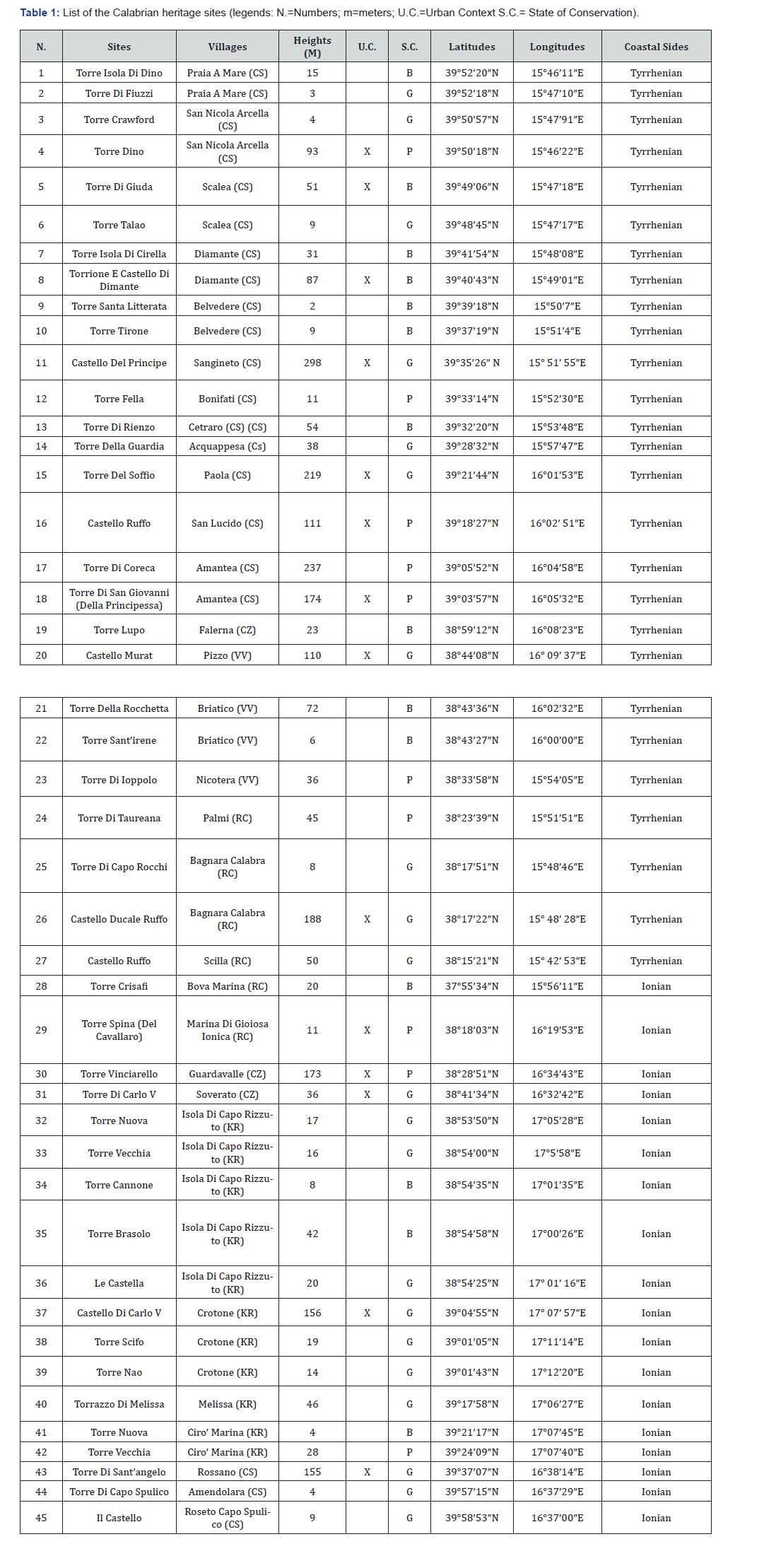
The conservation of landscape goods in littoral regions are one of the driving forces in a process of coastal management [18]. By this way, Calabrian coastal regions hold an important cultural heritage mainly located in seaboard areas and in strategic points on closed reliefs, to control and defend the regional coastline against barbarian invasions coming from the sea. In this direction, it has been planned a survey program aimed to assess the widespread distribution of coastal towers and littoral castles in the Calabrian region. The resulting data of this research highlights the presence of 45 heritage sites of which 27 on the Tyrrhenian Sea and 18 on the Ionian one (Table 1).
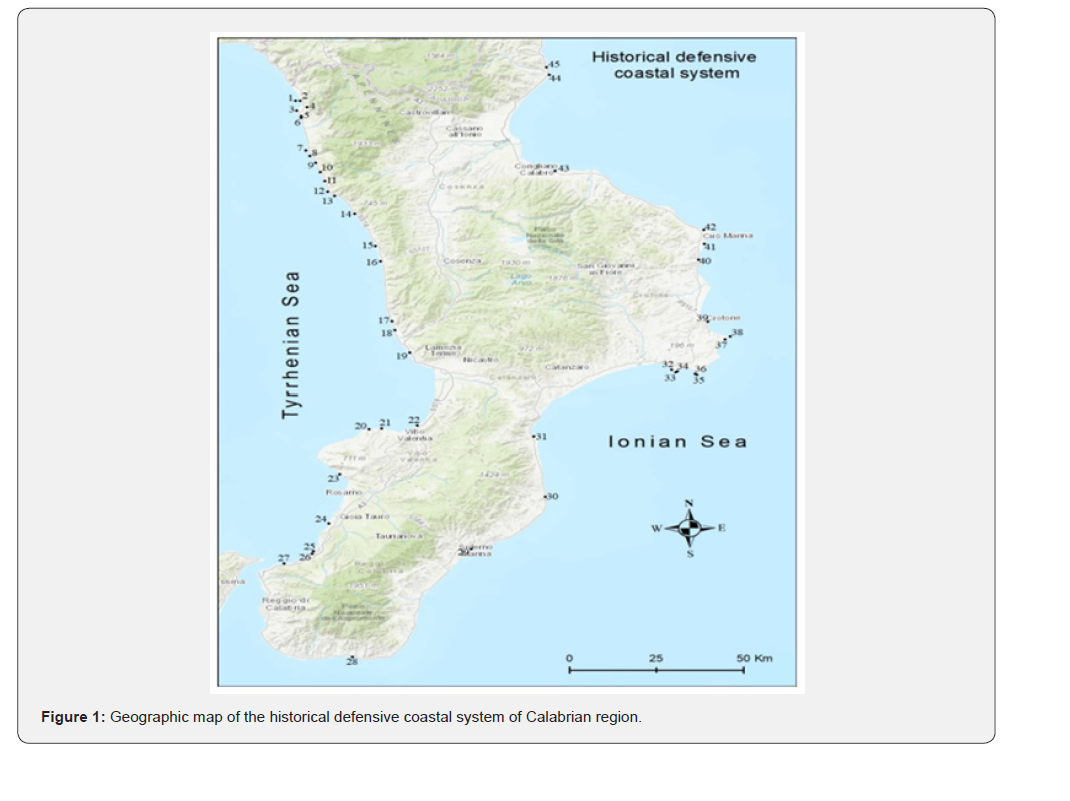
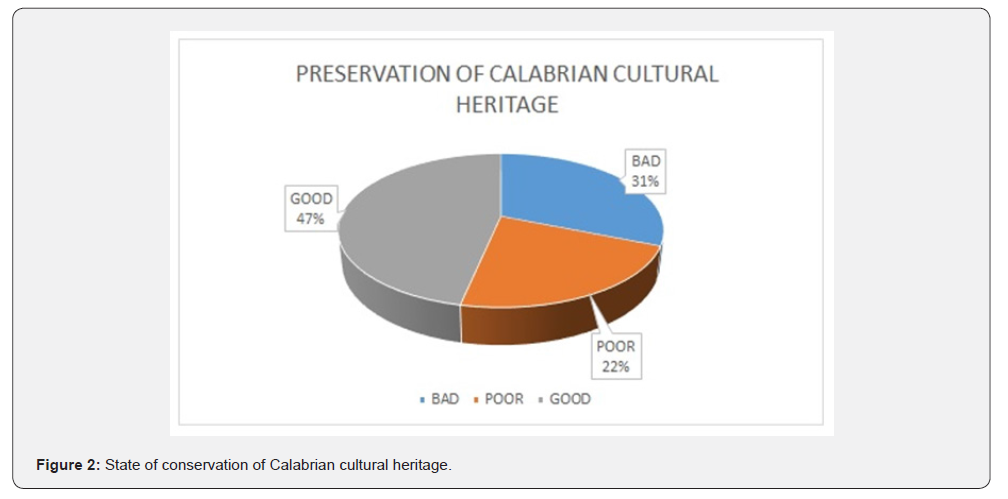
The geographic layout of the Calabrian historical defensive coastal system shows a great number of these archeological goods on the western side of the regional coastline more than the eastern one (Figure 1). However, the state of conservation of these archeological goods, deduced by personal observations on field and by literature [14], are quite good, being 14 in bad conditions, as the 31% of the whole, 10 in poor ones, as the 22% of the whole and 21 in a good state of conservation, as the 47% of the whole (Figure 2).
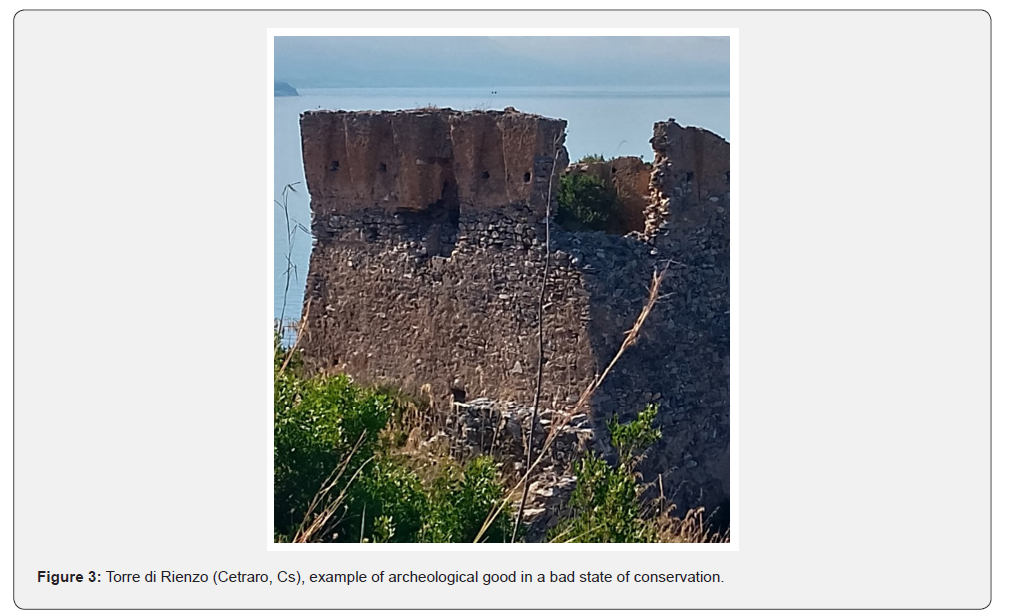
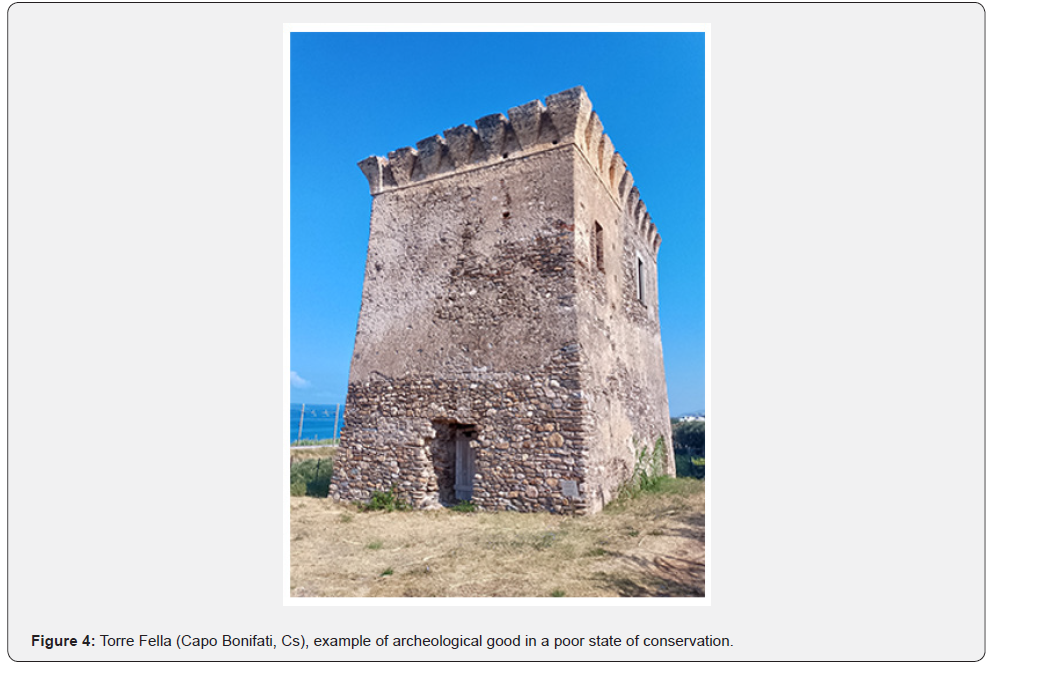
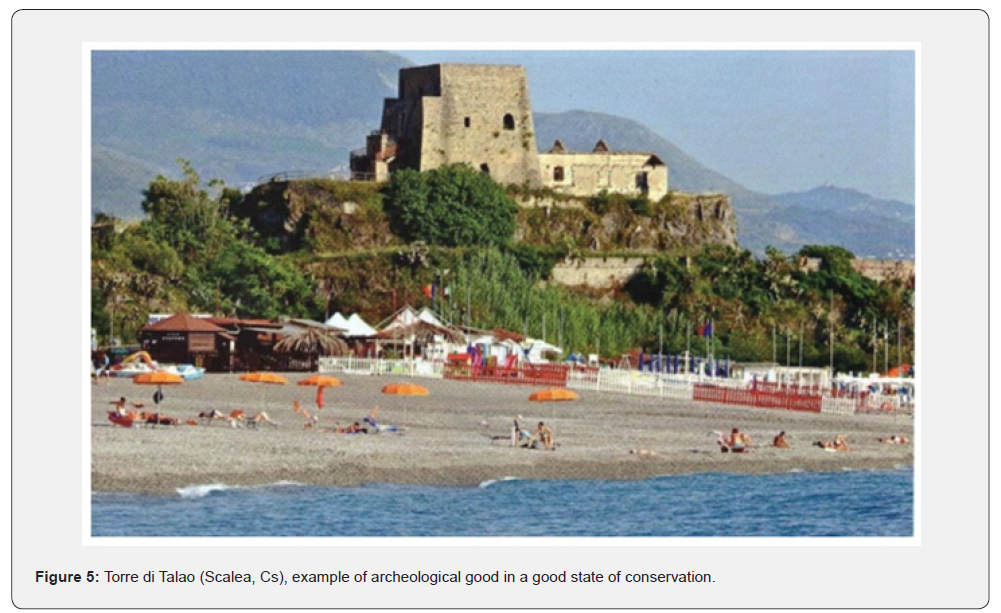
For instance, it is shown the three stages of conservation, distinguished into bad, poor and good conditions, through the examples of some coastal towers located along Calabrian Tyrrhenian coastline (Figures 3-5).
Case study: the coastal tower of Crawford (San Nicola Arcella, Cs., Italy)
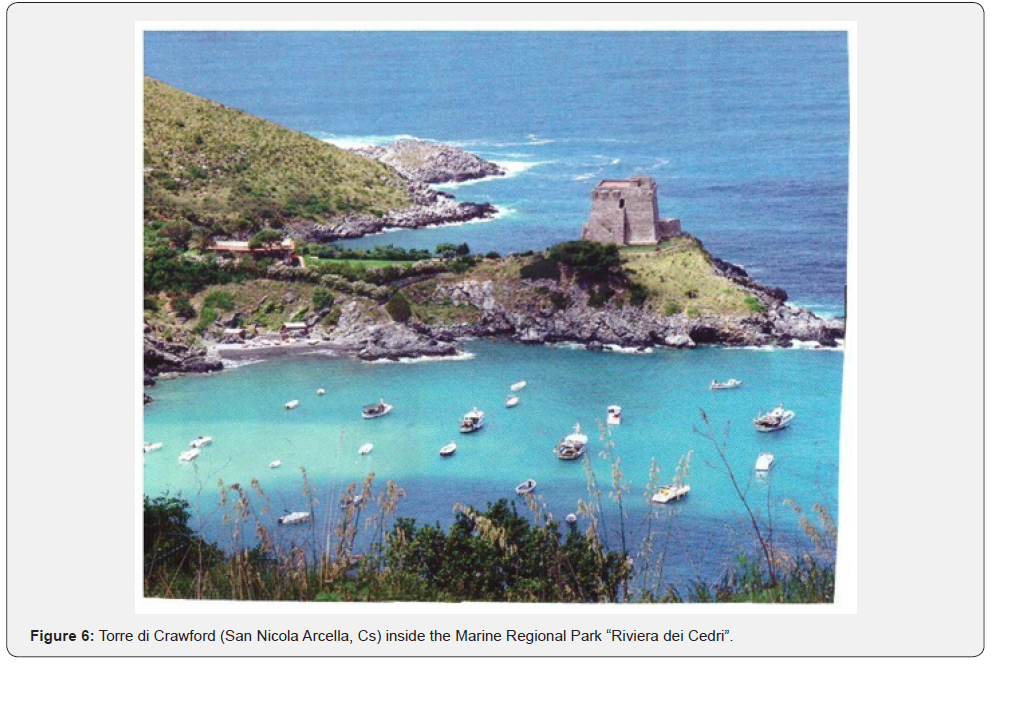
In this direction, archeological Calabrian coasts are of great importance because many of these valuable goods are located in coastal areas that could be potentially in-volved in the realization of ICZM process, as for instance the Crawford’s tower of San Nicola Arcella (Cs), located along the Calabrian Tyrrhenian coast and placed in the middle of Marine Regional Park “Riviera dei Cedri” (Figure 6).
So, on the landward side of this important coastal region it appears a log pyramidal tower on a square basis in good and pristine conditions, built in the 16th century as a part of the coastal defensive system against the Saracen invasions [14]. Indeed, on the seaward side, in the shallow waters just beneath this coastal tower, it is widespread a large meadow of Posidonia oceanica, priority habitat with the code 1120*, according to the Habitat Directive 92/43 [19]. Therefore, the whole littoral zone is a Special Area of Conservation (SAC), named “Fondali Isola di Dino-Capo Scalea” and classified as IT9310035, within Rete Natura 2000. In conclusion, this coastal area could become an ideal pattern where it should be possible to overlap the protection of coastal ecosystem and the safeguard of an important cultural heritage site.
Discussions
Robert Hughes, in his article published on Time, highlighted the lack of a public sensitivity, as a kind of social indifference and a widespread ignorance about the important historical and artistic heritage of Italian landscape. By this way, he stated: “How is it possible to save the national heritage when people is not able to recognize it as its own culture?”. After fifty years, although Italian legislation launched an important set of rules to protect its national cultural heritage, there is, until now, a lot to do for the protection of the cultural heritage actually widespread along Italian coastlines [20].
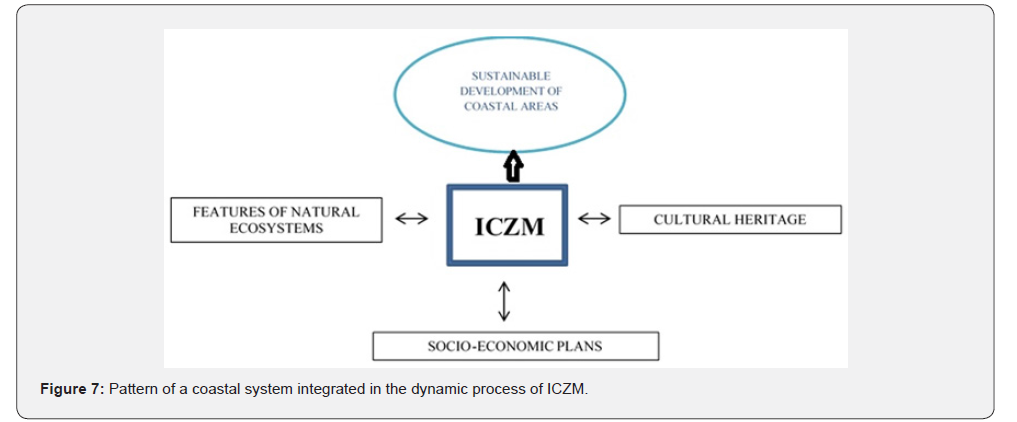
This study shows how the historical defensive coastal system is inserted, especially along the Calabrian Tyrrhenian side, in a concrete “continuum”, that has profoundly changed the coastal landscape losing the identity of the places. So, it appears along the regional coastline an almost obsessive repetition of second homes and shopping centers where coastal towers and littoral castles, decontextualized from the surrounding territory on which they stood, have been partly deserted or closed and made hardly usable. At the same time, the local communities have lost their memory and sense of identity, struggling to recognize those places that, until a few decades ago, constituted a sign of belonging. To date, the authors hold that there are no infallible solutions favoring the integration of cultural resources in the processes of socioeconomic development. However, the excellent management of many cultural sites by Third Sector organizations and the commitment of voluntary associations, to sensitize communities and stakeholders on cultural heritage, is an example of the extraordinary possibilities, promoting new forms of involvement of energies and skills widespread in Italy [21]. So, the authors believe that the ICZM process can represent a possible bottomup strategy to combine the protection and the use of cultural and natural heritage on one hand and the need for economic development of local people on the other. This could favor a return to a living neo-ecosystem, which is the product of a co-evolution process between human settlements and environment, that has occurred over time throughout history [22]. Coastal system could become a typical land-scape model where the process of an Integrated Coastal Zone Management (hereafter, ICZM) takes on a central position to merge all the ecological, social and cultural features of coastal areas for their sustainable development, leading to favorable conditions for the economic growth of local people [19]. In the middle of this dynamic process, ICZM is the only way to integrate all the different kind of knowledge into an effective and sound coastal management (Figure 7). Really, the protection and, whereas necessary, the recovery of these important heritage sites should be inserted within the process of ICZM, not only to improve the cultural legacy of coastal regions, but also to supply social and economic chances to local people for a sustainable development of coastal regions (Figure 7).
By this way, the suggested model aims to realize a feasible coordination between planning and managerial activities involved in coastal management [23]. Really, ICZM process is still a dream that cannot come true in the Calabrian region where institutions, policy makers and stakeholders are not fully engaged in it. In fact, the management of Natura 200 and cultural heritage sites are, actually completely fragmented between politicians, administrators and scientific advisors. In this critical context, an effective spatial planning of coastal landscape is a real challenge for ICZM process requiring big efforts from all the different actors involved in coastal management [24]. So, a new kind of environmental and cultural tourism should be encouraged in the coastal region. Therefore, it is necessary to incorporate cultural heritage sites into Natura 2000 network enabling an effective ICZM process in the Calabrian landscape. Within ICZM, the conservation of cultural goods could represent the driving force of the process [25]. In particular, in the Calabrian seaboard areas, the main elements of coastal regions are:
a) the natural features of coastal ecosystems and the
relationships between man and environment
b) the cultural heritage sites resulting from the different
kinds of artistic expression by mankind
By this way, Calabrian coasts hold a rich cultural heritage made by many archeological sites, mostly located in coastal regions where are placed 37 coastal towers and 8 castles. This important coastal defensive system was realized in the course of Neapolitan realm during the Angevin era in the fifteenth century to oppose against the invasions by Saracen and pirate ships coming from Mediterranean Sea [26]. By this way, the political and administrative authorities should be engaged in the protection and in the implementation of the regional cultural heritage, according to the following guidelines [18]:
a) Plan and organize recovery actions for the tourist
enhancement of coastal regions, using the cultural heritage as a
potential source of economic growth for local people
b) Insert social and economic programs within ICZM
process so to make littoral areas of fundamental importance for
the sustainable development of coastal regions
Therefore, it is established a new pattern of territorial structure, at a landscape level, whereas the coastal regions become cultural expression coupling natural values with human being [27-29]. So, it is suggested to include the regional cultural heritage sites into Natura 2000 network to allow an effective ICZM process in the Calabrian region.
Conclusion
In the coastal landscape, where natural and human factors interact, is essential to preserve the biological resources according to a novel ecosystem approach through Nature Based Solutions aimed to solve some of the upcoming environmental problems endangering littoral areas. At the same time, it is necessary to protect and enhance the cultural heritage still existing in coastal regions. There are evidence that implementation deficit in the coastal areas are more pronounced as in other environmental policy fields. So, ICZM process could represent a solution to resolve the large problems in terms of formal transposition and to allow practical application of EU environmental policy.
Then, it is hoped to melt in the same landscape unit historical goods into an overall process of ICZM planning so to integrate policy actions with timely efforts for the evaluation of coastal heritage sites. In conclusion, the coastal management of Calabrian littoral areas calls a global view extended from the protection of coastal ecosystems to the improvement of cultural heritage sites, remnants of historical times.
Author Contributions
Conceptualization, N.C. and G.T.; methodology, G.P.; validation, N.C. and G.T.; investigation, N.C. and G.T.; data curation, N.C., G.P. and G.T.; writing, N.C., G.P. and G.T.; review and editing, N.C., G.P. and G.T., supervision, N.C.
References
- De Sanctis RP (2012) The invisible sea. Landscape and decay in the upper Tyrrhenian of Cosenza. In Calderone A. (edited by) Culture and Religion of Waters. Proceedings of the interdisciplinary conference "Here the freshwater murmurs …» Messina 29-30 marzo 2011. Giorgio Bretschneider Editore, Roma, Italia, pp. 413-424.
- Van der Weide J (1993) A system view of Integrated Coastal Management. Ocean and Coastal Management 21(1-3): 129-148.
- Clark JR (1997) Coastal zone management for the new century. Ocean and Coastal Management 37(2): 191-216.
- Daniels S, Cosgrove DE (1988) The iconography of landscape: Essays on the representation, design and use of past environments. Cambridge University Press, Cambridge.
- Olwig KR (2013) Heidegger, Latour and the reification of things: the inversion and spatial enclosure of the sub-stantive landscape of things – the Lake District case. Geografiska Annaler 95(3): 251-273.
- Agardy MT (1993) Accommodating Ecotourism in Multiple Use Planning of Coastal and Marine Protected Areas. Ocean and Coastal Management 20(3): 219-239.
- Ray GC (1976) Critical Marine Habitats. Gland, Switzerland. IUCN Publ p. 37.
- Sowinska ŚB, García J (2022) What are Nature-based solutions (NBS)? Setting core ideas for concept clarification. Nature-Based Solutions 2: 100009.
- Coastal studies (2006) Coastal dynamics and defense, integrated management of the coastal strip. Number 10. The state of the Italian coasts. Nuova Grafica Fiorentina, Florence, Italy, pp. 113.
- Samà F, Torre SG (2010) A defense garrison in the Mediterranean. Rubettino Editore, Soveria Mannelli, Italy, pp. 194.
- Khakzad S, Pieters M, Van Balen K (2015) Coastal cultural heritage: A resource to be included in integrated coastal zone management. Ocean and Coastal Management 118: 110-128.
- Bevilacqua F (1993) Calabria Verde. Abramo Editore, Catanzaro, Italy, pp. 263.
- (2007) Regional Agency for the Protection of Calabria. Calabria. Report on the state of the environment. Rubbettino Editore, Soveria Mannelli, Italy, pp. 215.
- Mollo F (2018) Archaeological guide of ancient Calabria. Rubbettino Editore, Soveria Mannelli, Italy, pp. 750.
- Hugentobler M (2008) Quantum GIS. In: Shekhar S, Xiong H (eds.), Encyclopedia of GIS, Springer US, pp. 935-939.
- Placanica A (1999) History of Calabria: from Antiquity to the present day. Donzelli Editore, Rome, Italy.
- Carafa R, Calderazzi A (1999) Fortified Calabria. Reconnaissance and Filing of the Territory. Mapograf Editore, Vibo Valentia, Italy.
- Goodhead T, Aygen Z (2007) Heritage management plans and integrated coastal management. Marine Policy 31(5): 607-610.
- Rende F, Scalzo A, Cellini E, Minutolo L, Burgassi M, et al. (2008) Analysis of the Information System for Posidonia and other phanerogams in Calabria and Campania (SINPOFAC) aimed at identifying the state of health of marine phanerogams present along the Calabrian coasts. In: Carboni D, Bonora L, De Vincenzi M (eds.), Second International Symposium: Mediterranean coastal monitoring: problems and measurement techniques Naples, Italy, pp. 575-582.
- Cantasano N, Caloiero T, Pellicone G, Aristodemo F, De Marco A, et al. (2021) Can ICZM Contribute to the Mitigation of Erosion and of Human Activities Threatening the Natural and Cultural Heritage of the Coastal Landscape of Calabria? Sustainability 13(3): 1122.
- Volpe G (2021) Cultural tourism and "bottom-up management" of cultural heritage: an alliance for sustainable development. In: Tagarelli G, Torchia F (eds.), Tourism, Landscape and Cultural Heritage. Perspectives of protection, enhancement and sustainable development. Aracne Editore, Rome 1: 71-90.
- Magnaghi A (2020) The territorial principle. Bollati Boringhieri Publisher, Turin, Italy.
- Sanò M, Medina R (2012) A system approach to identify sets of indicators: Applications to coastal management. Ecological Indicators 23: 588-596.
- Ramieri E, Bocci M, Markovic M (2019) Linking Integrated Coastal Zone Management to marine Spatial Planning: The Mediterranean experience. In: Zaucha J, Gee K (eds.), Maritime Spatial Planning. Palgrave Macmillan Cham, Switzerland pp. 271-294.
- Forrest C (2006) Integrated Coastal Zone Management: A Critical Overview. WMU Journal of Maritime Affairs 5(2): 207-222.
- Donato E (2003) Archeology of the elevations and study of coastal defense in medieval Upper Tyrrhenian Calabria. Archeology of Architecture 2: 267-273.
- Vallega A (1993) A Conceptual Approach to Integrated Coastal Management. Ocean and Coastal Management 21(1-3): 149-162.
- Vallega A (2001) Focus on integrated coastal management - comparing perspectives. Ocean and Coastal Management 44: 119-134.
- Naveh Z, Lieberman AS (1994) Landscape ecology. Theory and Applications, (2nd), Springer, New York, United States of America, pp. 360.

























