




 OFOAJ Home



Abstract
In the present study, an attempt has been made to investigate the food and feeding habits of spiny eel, Mastacembelus armatus from different water bodies of Beed district in Maharashtra. Crustaceans formed the main item of gut contents forming 58.5%. Aquatic insects were next in the order of dominance forming 14.8% in the gut contents. Unidentified matter formed 13.2% of the gut contents, fishes 9.7% and fish Scales formed 3.8 % of the gut contents of Mastecembelus armatus.
Keywords:Mastacembelus armatus; Food-feeding; Gut content analysis
Introduction
Food is the basic prerequisite for growth, development, survival and existence of all organisms. Ross [1] identified that in aquatic environments food is the main factor and that its partition defines fundamental groups within the community, which get together in guilds according to the trophic similarity. It plays an important role in the growth, migration and spawning behaviour of the fish. As the nature of food depends upon the nature of several biotic and abiotic factors, the problem is interesting from specific, as well as ecological point of view [2]. The study of the food and feeding habits of freshwater fish species is a subject of continuous research because it constitutes the basis for the development of a successful fisheries management. Freshwater fishes consume a wide variety of foods. The identification of stomach contents allows us to know about food consumption, feeding and assimilation rates, cannibalism and even habitat segregation [3]. The food and feeding habits of fishes vary with time of day, size of fish, and season of the year. Fishes are also known to change the food habits as they grow, accompanied by correlative changes in the digestive system.
The food of young ones is generally different from that of the adult. Young ones with small and short intestine prefer zooplankton, and are able to digest rotifers, cladocerans another microscopic animals easily. The phytoplankton and algae are not easily digested.
The food of fishes according to Schaperclause [4] may be of three groups such as main, occasional and emergency food. A classification was also made by Nikolskii [5] based on the relationship between fishes and their food and categorized them according to the extent of variation in the types of food consumed. Das & Moitra [6] also classified fishes according to the food consumed.
Mastacembelus armatus, commonly known as ‘Spiny eel’ or ‘zig-zag eel’ or ‘tire-track spiny eel’ is fish found in muddy waters, especially in ponds and lakes. It is a popular table fish due to delicious taste and high nutritive value. It has good popularity as an aquarium fish and recently reported from India to other countries [7]. Body is eel like and greenish olive along back and yellowish beneath. A distinct streak of elongated spots runs along the lateral line from eye to the base of tail.
Methodology
For the present study, a total of 50 live specimens of Mastacembelus armatus were collected from June 2021 to May 2022. The samples were collected from water bodies with help of local fishermen once in every month. Just after collection 10% formalin solution was injected into the guts of all fishes. The specimens were finally preserved in 10% formalin. Individual food items were separated in petridishes. The food items were identified under microscope. Gravimetric method [8] was followed for the estimation of the percentage composition of different food items.
Results and Discussion
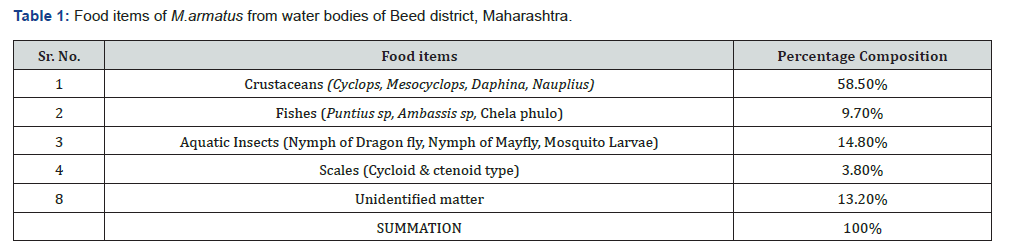
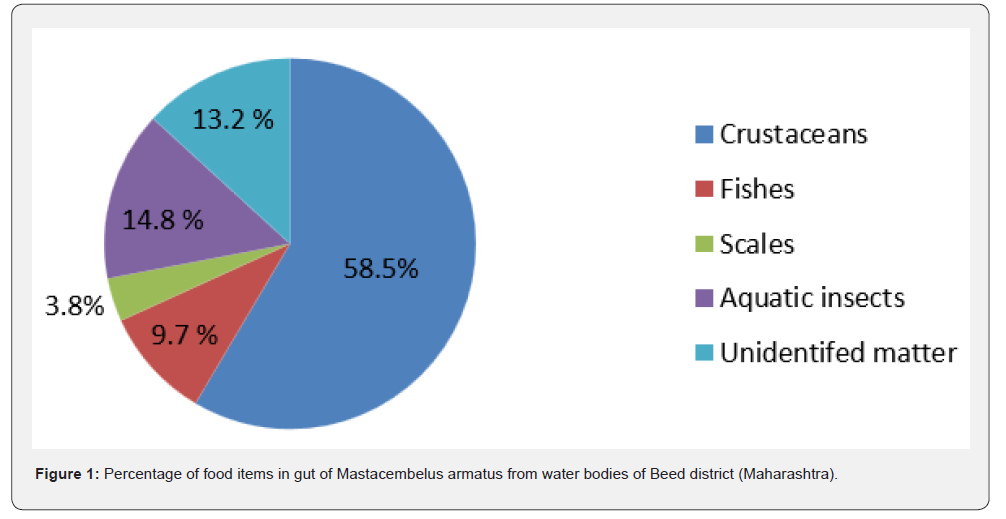
Different food items and their percentage composition found in the gut of Mastecembelus armatus are depicted in Table 1. Crustaceans formed the main item of food contents forming 58.5%. Das & Moitra [9] also pointed out that Mastecembelus armatus mainly feeds on crustaceans. During present investigation the major crustacean forms observed in the diet were Cyclops, Mesocyclops, Daphnia and Nauplius. Aquatic insects were next in the order of dominance forming 14.8% of the gut contents and were represented by Nymph of Dragon fly, Nymph of Mayfly and Mosquito Larvae. Unidentified matter formed 13.2% of the gut contents. Fishes (Puntius sp, Ambassis sp, and Chela phulo) formed 9.7% of the gut contents of Mastecembelus armatus. Scales (Cycloid & Ctenoid type) formed 3.8 % (Table 1 & Figure 1). Intensity of feeding was high in early maturity and was relatively lower in fish with ripening gonads. These findings corroborate with Serajuddin et al. [10]. Mastecembelus armatus from river Ganga feeds on a variety of food items like teleosts, insects, molluscs, crustaceans, annelids and digested organic matter of animal origin which indicates its carnivorous feeding habit [11].
Studies on the food and feeding of different Indian freshwater fishes have been made by different workers. Sakhare and Chalak [12] studied food and feeding of Catla catla from water bodies around Ambajogai city (Maharashtra) and reported rotifers as the main item of gut content. Arthi et al. [13] studied food and feeding habits of Ompak bimaculatus and Ompak malabaricus of River Amaravathy (Tamil Nadu) and found both species omnivorous feeding mainly on vegetable matter and fish. Saikia et al. [14] reported food and feeding habit of Channa punctatus from the paddy fields of Sivasagar district (Assam) and categorized fish as carnivorous. Sakhare [15] studied food and feeding habit of airbreathing fish Channa striatus from water bodies of Beed district where present investigation was carried out.
Jesu et al. [16] studied the food and feeding habits of Mystus montanus from river Tambaraparani and categorized the fish as an omnivorous bottom feeder. Padmakumar et al. [17] studied the food and feeding behaviour of Horabagrus brachysoma and reported this fish as omnivorous. Choudhuri [18] described the food and feeding strategy of Puntius conchonius and concluded that availability of certain food items made the fish euryphagous and availability of limited food items made it stenophagous. Anna Mercy et al. [19] reported Puntius melanampyx as omnivorous bottom feeder.
References
- Ross ST (1986) Resource partitioning in fish assemblages: A review of field studies. Copeia 2: 352-388.
- Bhuiyan AS, Afroz S and Zaman T (2006) Food and feeding habit of the juvenile and adult snake head, Channa punctatus (Bloch). Journal of Life and Earth Science 1(2): 53-54.
- Gomos A, Yilmaz M, Polat N (2002) Relative importance of food items in feeding of Chondrostoma regium Heckel, 1843, and its relation with the time of annulus formation. Turkish Journal of Zoology 26: 271-278.
- Scaperclause W (1933) US Department of Interior. Fish Wildl Serv Fish leaf 31: 261.
- Nikolskii GV (1963) The ecology of fishes, translated from Russian. In: Birkett L, (edt.), Academic Press, London, New York, USA, pp. 352.
- Das SM, Moitra SK (1963) Studies on the food and feeding habits of some freshwater fishes of India. Ichthyologica 2(182): 107-116.
- Gupta S, Banerjee S (2016) Food, feeding habit and reproductive biology of tire-track spiny eel (Mastaembelus armatus): A review. Journal of Aquaculture Research and Development 7(5).
- Hynes HBN (1950) The food of freshwater stickleback (Gasterosteus aculeatus and Pygosteus pungitius) with a review of the methods used in studies of food of fishes. Journal of Animal Ecology 19(1): 36-58.
- Das SM, Moitra SK (1955) Studies on the food of some common fishes of Uttar Pradesh, India. The surface feeders, the mid feeders and bottom feeders. Proceedings of the National Academy of Sciences, India 25: 1-6.
- Serajuddin M, Khan AA, Mutsafa S (1998) Food and feeding habits of the spiny eel, Mastacembelus armatus. Asian Fisheries Science 11(998): 271-278.
- Absar A, Vaisakh G, Dharms NJ, Kripal DJ, Jeetendra K, et al. (2020) Food and feeding biology of commercially important freshwater eel, Mastacembelus armatus (Lacepede,1800) from the Ganga river, India. Oceanorgraphy and Fisheries open Access Journal 11(4): 555819.
- Sakhare VB, Chalak AD (2014) Food and feeding of Catla catla (Hamilton) from water bodies around Ambajogai city, M.S., India. Ecology, Environment & Conservation 20(2): 783-785.
- Arthi T, Najarajan S, Sivakumar AA (2011) Food and feeding habits of two freshwater fishes, Ompak bimaculatus and malabaricus of river Amaravathy, Tamil Nadu. The Bioscan 6(3): 417-420.
- Saikia AK, Abujam SKS, Biswas SP (2012) Food and feeding habit of Channa punctatus (Bloch) from the paddy field of Sivasagar district, Assam. Bulletin of Environment, Pharmacology and Life Sciences 1(5): 10-15.
- Sakhare VB (2021) Food and feeding habit of air-breathing fish Channa striatus (Bloch) from water bodies of Beed district, Maharashtra, India. In: Sakhare VB, Chalak AD, Jetithor SG, (Eds.), Hydrobiology and Fisheries. Discovery Publishing House (P) Ltd., New Delhi, India, 2: 1-19.
- Jesu A, Raj A, Haniffa MA, Seetharaman S, Singh SP (2004) Food and feeding habits on endemic catfish Mystus montanus (Jerdon) in river Tambaraparani. Indian Journal of Fisheries 51(1): 107-109.
- Padmakumar KG, Bindu L, Sreerekha, PS and Joseph Nitta (2009) Food and feeding behaviour of the golden catfish, Horabagrus brachysoma (Gunther). Indian Journal of Fisheries 56(2): 139-142.
- Choudhuri Sagarika (2010) Food and feeding strategy of an indigenous ornamental fish- Puntius conchonius. Fishing Chimes 29(10): 72-74.
- Anna MTV, Raju TK, Eapen J (2002) Food and feeding habits of Puntius melanampyx (Day)-An endemic ornamental fish of the Western Ghats. In: Boopendranath, MR, Meenakumari B, Jose J, Sankar, TV, Pravin, P, Leela E, (Eds.), Riverine and reservoir Fisheries of India. Society of Fisheries Technologists, Cochin, India, pp. 172-175.

























