

 OFOAJ Home



Marine Environment Conservation
Shivakumar M* and Gangadharagowda
1Biodiversity & Conservation Research Group, Universidad de Las Palmas de Gran Canaria, Spain
2Instituto Portugûes de Malacologia, Portugal
Submission: February 23, 2019; Published: March 21, 2019
*Correspondence author: Cosme M, Biodiversity & Conservation Research Group, IU-ECOAQUA, Universidad de Las Palmas de Gran Canaria, Crta. Taliarte s/n, 35214 Telde, Spain
How to cite this article:Cosme M, Otero F F, Tuya F, Abreu A D, Haroun R. Marine Habitats in an Emerging Eco-Touristical Small Oceanic Island: A Methodological Strategy to Marine Spatial Planning. Oceanogr Fish Open Access J. 2019; 9(4): 555766. DOI: 10.19080/OFOAJ.2019.09.555766
Abstract
Accurate mapping of marine benthic communities, through acoustic technologies such as the Side-Scan Sonar (SSS), is highly demanded as critical baseline biological database to promote smart management of unknown tropical coastal environments, where rapid anthropogenic development is often occurring. In this study, SSS methodological protocol was developed to describe subtidal marine seabed’s (3 to 30 m depth) in four areas around Principe Island (Republic of São Tomé and Príncipe, Gulf of Guinee, Africa). A list of 6 habitats, within three main typologies (sandy bottoms, rocky reefs and biogenic seabed’s), was generated using a post-processing software and then corroborated with SCUBA diving and video transects. Sandy bottoms with ripple marks and small biogenic areas (rhodolith seabeds and Scleractinian corals) predominated in the north, east and south of the island. The southwestern sites concentrated most of the biogenic seabed’s, with greater variability and richness of the habitat and should be considered for future conservation purposes, according to Marine Spatial Planning policies. In the eastern zone of Principe Island, with an important local fishermen community, it is foreseen the implementation of sustainable marine resources management policies to support long-term exploitation. Geo-referenced habitat maps elaborated through SSS are an efficient tool for marine management and conservation.
Keywords: Cartography; Habitat mapping; Rhodoliths; Side Scan Sonar; Tropical
Introduction
Continental shelves, despite concentrating most of the diverse marine habitats, are poorly known [1]. These ecosystems provide a wide variety of resources and ecosystem services, even surpassing the global national product [2]. The lack of an integral framework of Marine Spatial Planning (MSP) and growing anthropogenic activities prevailing over conservation [3,4], has produced a massive loss of these marine habitats [5-7]. For the implementation of management plans and further conservation strategies [7,8] is key to understand the patterns of marine habitats connectivity, along with patterns of biodiversity distribution. The use of acoustic tools to provide this information [9] is increasing, particularly via side-scan sonar (SSS) strategies. SSS is one of the most complete and demanded tools, due to its efficiency in the creation of accurate marine habitat maps [10,11]. Habitat maps can positively influence the establishment of global MSP policies, managing effectively the marine habitats and the requirements of adjacent populations especially in emerging eco-touristic islands with limited resources, and helping to resolve conflicts derived from multi-use of coastal areas [6].
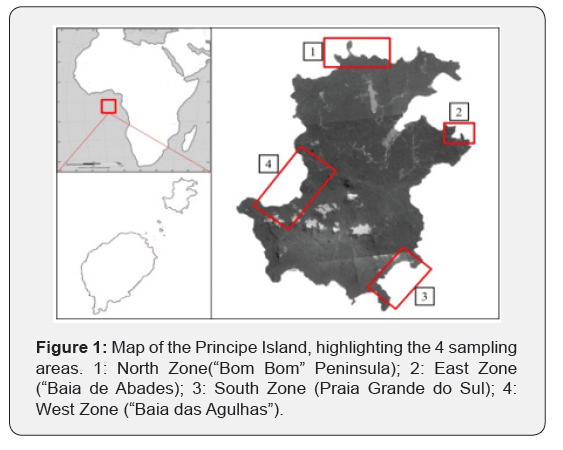
In this study, SSS was used, for the first time, to describe the major tropical underwater habitats of the small island of Principe (13,600 Ha) (Democratic Republic of São Tomé and Príncipe), located near the equator within the Gulf of Guinea (eastern Atlantic Ocean) (Figure 1). Despite being understudied in terms of marine biodiversity, since 2012, the island has been part of the UNESCO World Network of Biosphere reserves, due to the presence of key habitats (coral and rhodoliths seabeds), to enhance sustainable development actions and promote social wellbeing. Rhodolith seabeds are well-known as one of the ‘‘big four’’ benthic communities (coral reefs, kelp forests and seagrass meadows), which underlines the worldwide importance of these habitats [12]. This kind of habitat is made by free-living red algae that form a calcareous three-dimensional structure [13,14] acting as “ecosystem engineers”, transforming a soft substrate into a structurally complex habitat with the function of “nursery” and “hotspot” [15-17]. Likewise, sand ripples were classified according to the visual ripple size in big, medium and small.
The study areas were selected according to their potential as future Marine Protected Areas (MPAs) and their geographical situation within the Príncipe Biosphere Reserve. The four areas delineated were: the “Bom Bom” Peninsula in the north, the “Baia de Abades” in the east, the “Baia das Agulhas” in the southwest and the “Baia de Praia Grande do Sul” in the southeast. The acquisition of data were made through a CM2 Towfish digital SSS (C-Max, United Kingdom), operating at 780 kHz, between 3 and 30 m depth, following predefined transects, ranging between 600 and 1000 m long. Data recorded were processed with the SonarWiz6 (Chesapeake Technology Inc, USA) software, which performs an automatic pre-classification of the different morphologies of the seabed. For the specific identification of pre-classified habitats, underwater transects using a video camera (Sony HDR-AS50) were performed. All the processed and geo-referenced data were exported as GeoTiff images with a resolution of 0.5 m per pixel, to a geographic information system (QGis) [18] to create habitat maps and to estimate cover of each habitat type (Figure 2).
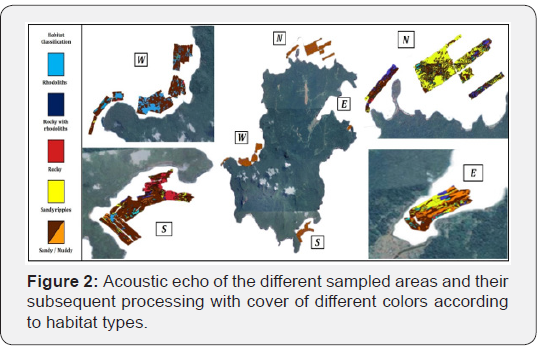
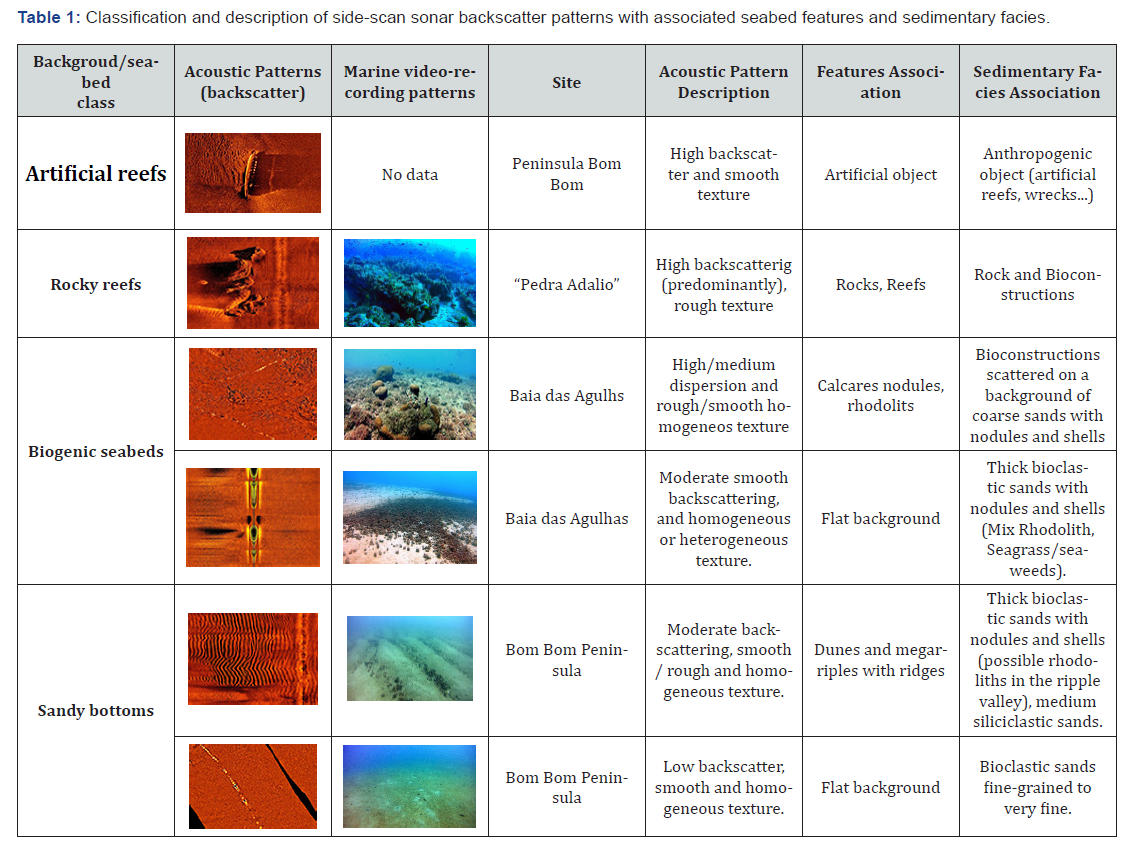
A total of 691 Ha of marine seabeds were mapped. We identified a total of 6 habitats, grouped into four main categories: sandy bottoms, rocky reefs, biogenic bottoms and artificial reefs (Table 1). Rhodolith seabeds constituted the main biogenic bottoms, with also some colonies of scleractinian corals. In the northern zone (“Bom Bom” peninsula), sandy seabeds with forming-ripples, interspersed with isolated rhodolith patches, were predominantly recorded (158.37 Ha). Also, large concentrations (5.4 ind/ m2) of sea snails (Persististrombus latus) appeared over the sand. In the center of the eastern side (25 m depth), a big rocky reef (called “Pedra Adalio”, 0.07 Ha) appeared surrounded by a sandy bottom interspersed with uniform rhodoliths seabeds (10.46 Ha). The western side of the peninsula included several rocky reefs (4.24 Ha), interspersed with the fuselage of two airplane wrecks lying on the sandy seabed.
The eastern zone of the island (“Baia de Abades”) included sandy bottoms with ripples (10.83 Ha). Its turbid waters and the acoustic records confirmed the accumulation of sludge and silt together with organic sediments (e.g. coconuts, branches, and large leaves), probably originated from the mouth of two rivers flowed into the bay. In the southern zone (“Praia Grande do Sul”), sandy bottoms (88.30 Ha) were found, interspersed with many rocky reefs of various sizes (21.09 Ha). In the western part of the bay, shallow sandy bottoms mixed with isolated dead rhodoliths (14.02 Ha). Finally, in the western zone (“Baia das Agulhas”), rhodolith seabeds dominated. In the shallow depths, they appeared mostly epiphyted by brown and red macroalgae (e.g. Galaxaura sp., Dictyota sp.), from the center towards the western part of the bay (58.38Ha). This uniform layer of colonized rhodoliths disappeared following the bathymetrical gradient. Between 8 to 15 m, rhodoliths appeared interspersed with isolated colonies of scleractinian corals (Montastrea sp.). Likewise, in the southwest part of the bay, a nearly uniform rhodolith seabed, interspersed with isolated rocky reefs, spread from 5 to 30 m.
Preliminary Conclusion
The geo-referenced habitat maps created denote the efficiency of SSS acoustic methods for the characterization of marine biogenic habitats (rhodolith beds or scleractinian corals). Globally, three main habitats were identified (sandy bottoms, rocky reefs, and rhodolith seabeds) with the southwest part of the island (“Baia das Agulhas”) concentrating the large proportion of rhodolith seabeds (interspersed with corals). Due to its key role, as nursery and biodiversity hot spot, “Baia das Agulhas” should be considered for the potential development of an MPA in Principe Island. Nevertheless, preliminary studies should be accomplished to understand the role of environmental conditions (e.g. freshwater contribution, sediments, water turbulence, etc.) in marine habitats distribution in this area. The habitat characterization around the “Baia de Abades” showed the potential effects of local fishermen communities and the nearest mangrove forests and rivers. Future coastal management policies will require global ecosystem approach to preserve marine habitats and the sustainable economic development of local livelihoods.
Isolated rocky reefs at the north and the south of the island (“Bom Bom” peninsula and “Praia Grande do Sul”) provided new promising sites for eco-tourism activities (e.g. scuba diving) and/ or marine resources exploitation. Likewise, the creation of accurate habitat maps can positively influence the establishment of global MSP policies, managing effectively the marine habitats and the local communities’ requirements, especially in emerging eco-touristic islands with limited resources, and helping to resolve potential conflicts derived from multi-use of coastal areas.
Acknowledgement
This paper is an-output of the BIO-Príncipe 2016 Scientific Expedition, with the local efforts of Estrela Matilde and Yodiney do Santos (Foundation Principe Trust). In addition, we thank the boat crew of “Bom Bom Resort” for their support during the SSS campaing. F. Otero-Ferrer and R. Haroun have benefited from research funds provided by the ERA-Chair project EcoAqua (Grant # 621341).
References
- Spalding MD, Fox HE, Allen GR, Davison N, Ferdaña ZA, et al. (2007) Marine ecoregions of the world: a bioregionalization of coastal and shelf areas. Bioscience 57: 573-583.
- Costanza R, D’Arge R, DeGroot R, Farber S, Grasso M, et al. (1997) The value of the world’s ecosystem services and natural capital. Nature 387: 253-260.
- Agardy T, Bridgewater P, Crosby MP, Day J, Dayton P, et al. (2003) Dangerous targets? Unresolved issues and ideological clashes around marine protected areas. Aquat Conserv Mar Freshw Ecosyst 13: 353-67.
- Douvere F (2008) The importance of marine spatial planning in advancing ecosystem-based, sea use management. Mar Policy 32: 762-771.
- Che Hasan R, Ierodiaconou D, Laurenson L (2012) Combining angular response classification and backscatter imagery segmentation for benthic biological habitat mapping. Estuar Coast Shelf Sci 97: 1-9.
- Li D, Tang C, Xia C, Zhang H (2017) Acoustic mapping and classification of benthic habitat using unsupervised learning in artificial reef water. Estuar Coast Shelf Sci 185: 11-21.
- Moura RL, Secchin NA, Amado-Filho GM, Francini-Filho RB, Freitas MO, et al. (2013) Spatial patterns of benthic megahabitats and conservation planning in the Abrolhos Bank. Continental Shelf Research 70: 109-117.
- Brown CJ, Collier JS (2008) Mapping benthic habitat in regions of gradational substrata: an automated approach utilising geophysical, geological, and biological relationships. Estuarine Coast Shelf Science 78: 203-214.
- Mulhearn PJ (2001) Mapping seabed vegetation with side scan sonar. In: DSTO: Aeronautical and Maritime Research Laboratory, Commonwealth, Australia.
- Durán R, García-Gil S, Vilas F (2000) Aplicación del Sonar de Barrido Lateral a la cartogarfía de fondos marinos: Ejemplo de la Ría de Pontevedra (Galicia, NO España). J Iber Geol 26: 45-66.
- Schultz JJ, Healy CA, Parker K, Lowers B (2013) Detecting submerged objects: The application of side scan sonar to forensic contexts. Forensic Sci Int 231: 306-316.
- Jørgensbye HIØ, Halfar J (2017) Overview of coralline red algal crusts and rhodolith beds (Corallinales, Rhodophyta) and their possible ecological importance in Greenland. Polar Biology 40: 517-531.
- Foster MS (2001) Rhodoliths: Between Rocks and Soft Places. J Phycol 37: 659-667.
- Bonacorsi M, Pergent-Martini C, Clabaut P, Pergent G (2012) Coralligenous “atolls”: Discovery of a new morphotype in the Western Mediterranean Sea. C R Biol 335: 668-672.
- Squeo FA, Arancio G, Gutierrez JR, Letelier L, Arroyo MTK, et al. (2008) Flora Amenazada de la Región de Atacama y Estrategias para su Conservación. Ediciones Universidad de la Serena. La Serena, Chile.
- Gagnon P, Matheson K, Stapleton M (2012) Variation in rhodolith morphology and biogenic potential of newly discovered rhodolith beds in Newfoundland and Labrador (Canada). Bot Mar 55: 85-99.
- Queiroz EV de, Araújo PV do N, Hammill E, Amaral RF do (2016) Morphological characteristics of rhodolith and correlations with associated sediment in a sandstone reef: Northeast Brazil. Reg Stud Mar Sci 8: 133-140.
- QGIS Development Team (2016) QGIS geographic information system. Open Source Geospatial Foundation Project.