




 OFOAJ Home



Proximate analyses of Nile tilapia (Oreochromis niloticus) and Black tiger prawn (Penaeus monodon) from Sri Lankah
Amal D Premarathna1,2*, Kumara AMCP2, Jayasooriya AP3, Dilan A Satharasinghe3,4, and Pathirana E2
1Department of Veterinary Pathobiology, University of Peradeniya, Sri Lanka
2Ocean University of Sri Lanka, Sri Lanka
3Department of Basic Veterinary Sciences, University of Peradeniya, Sri Lanka
4Universiti Putra Malaysia, Malaysia
Submission: April 18, 2018; Published: June 18, 2018
*Correspondence author: Amal D Premarathna, Department of Veterinary Pathobiology, Faculty of Veterinary Medicine and Animal Science University of Peradeniya, Sri Lanka.
How to cite this article: Amal D P, Kumara AMCP, Jayasooriya AP, Dilan A S, Pathirana E. Proximate analyses of Nile tilapia (Oreochromis niloticus) and Black tiger prawn (Penaeus monodon) from Sri Lanka. Oceanogr Fish Open Access J. 2018; 7(5): 555723. DOI:10.19080/OFOAJ.2018.07.555723
Abstract
Fish and crustacean are important sources of animal proteins and other essential nutrients required in the human diet. They are widely accepted for their high palatability, high protein content and tender flesh. Therefore, analysis of nutritional profiles such as protein content, lipids, ash content, nitrogen free extract and crude fiber is often necessary to ensure that they meet the dietary requirements and commercial specifications. In this study, proximate analyses were done for flesh of brackish water shrimp species Penaeus monodon and fresh water fish species Oreochromis niloticus. Analyses were done using methods recommended by the Association of Analytical Chemists. Percentage of protein content was high values in Penaeus monodon (9.31±0.63) compared to Oreochromis niloticus (7.85±0.79). Moisture content consisted in Penaeus monodon, Oreochromis niloticus showed values of 87.64±0.12 and 89.51±0.43 respectively. The highest lipid content was present in Penaeus monodon (0.23±0.22%) while the lowest value was shown by Oreochromis niloticus (0.07±0.16%). Comparatively, the percentage of total carbohydrate content is the highest in Brackish water shrimp than fresh water fish Nile tilapia. In conclusion, as it was expected, a high content of protein was found in Black tiger prawn, of the compared to the existing related to that of fresh water fish. The study revealed high protein content and a high fat content in the meat of Penaeus monodon. Information on the nutrient composition of Penaeus monodon is needed to encourage the processing, utilization and marketing of this commonest species of Sri Lanka. It can then be inferred that the shrimps (Penaeus monodon) could be employed as a supplement of protein and minerals, so as to balance human nutrition. Hence the consumption of shrimps (Penaeus monodon) would help as a good source of nutrients.
Keywords: Oreochromis niloticus; Penaeus monodon; Proximate composition
List of Abbreviations: ANOVA: Analysis of Variance; SEM: Standard Error of Mean
Introduction
According to Ke et al. crustacean muscle meat contributes mainly for protein, which accounts for around 82.9% moisture, 16.0 % protein, 0.86 % fat, and 1.7 % ash. The analysis of fatty acids has become increasingly important, because more people have become aware of their nutritional and health implications. Lovern [1] compared oils from special parts of fish and marine animals and found that large amounts of fatty acids are associated with phospholipids, glyceryl ethers (alkoxydiglycerides) and wax esters, depending on the source of oils and lipids. Seafood lipids are rich in polyunsaturated fatty acids such as EPA and DHA. These fatty acids have a peculiarity of health benefits, including prevention of sudden cardiac death [2] and chemopreventive effects of cancer [3]. Also crabs or prawn, among numerous other invertebrates are considered as an essential shell fishery product [4]. Recommendations to eat fish and other nutritionally rich seafood sources are included in most national dietary guidelines [5]. Both fin fish and shell fish species are available in Sri Lankan markets and among them fin-fish species are more popular. Inland fishery is also one of the economically important fishery sectors throughout the world. Crabs and prawns are more popular among shell fish species. It is valuable in the diet because, apart from the supply of good quality proteins and vitamins A and D, it also contains several dietary minerals such as Ca, Fe etc. which are beneficial to man [6]. Brackish water shrimp such as Penaeus monodon species is commonly available in Sri Lankan markets, mainly along the costal belt of Sri Lanka. The Penaeus monodon fishery industry based on either capture or culture fishery. And tiger prawn is one of the major income sources in Sri Lanka. Especially, in the early 1990s this species was extensively farmed along northwestern coastal belt and earned a profit through export market. Also, P. monodon is one of the most important marine crustacean species and is subjected to intense fishery exploitation and aquaculture practice worldwide [7]. Nutritional values of aquatic protein sources have been reported in many studies [6,8-10]. However, most of the studies are based on the nutritional components of individual species which do not provide comparative analysis of the common food sources. Therefore, the major aim of this study was to investigate and to comparatively analyse the major components of nutrients in two commonly consumed fishery-based protein sources in Sri Lanka.
Methodology
Sample collection
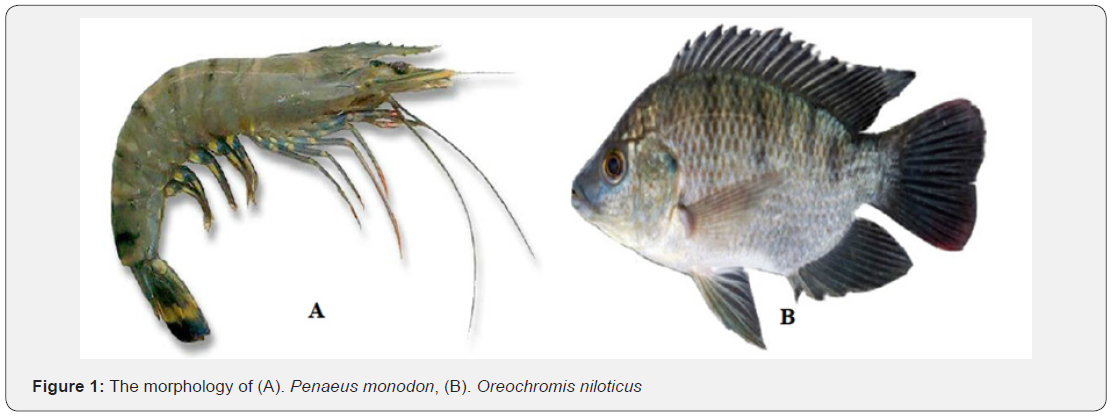
Mature Penaeus monodon (n=5) and Oreochromis niloticus (n=5) were collected from Negombo and Dambulla inland fishing areas of Sri Lanka and were transported to the laboratory in separate polythene bags stored in cool (4 °C) condition (Figure 1).
Sample preparation and storage
Fish and shrimp meat were sampled separately and homogenized samples (50g for each type) were stored at -20 °C until further analysis. Prior to proximate analysis, each sample was dried at 60 °C using a drying oven (Yamato, Japan), until a constant weight was reached.. Samples were then ground into powder using a grinder (MX-151SG1, Panasonic, China). Finally, samples were packed airtight and stored at -20 °C until further analysis of proximate compositions.
Analysis of biochemical status
The moisture and dry matter content: The moisture and dry matter contents were justified by the difference in weight between wet and dried tissue which represented the weight of water and dry matter in the body tissue and was expressed as percentages.
Protein content: The protein contents were determined by calculating nitrogen amount using micro-Kjeldahl method described by Pearson [11]. The percentage nitrogen was converted to crude protein by multiplying the nitrogen content by a factor of 6.25.
Lipid assay content: The total lipid contents were estimated using modified Bligh and Dyer method [12]. Cleaned fat extracting beakers placed in drying oven for one hour at 100 °C. After that the beaker was removed and placed in a desiccator to cool and was weighed. The weighed (1g) and finely ground sample was placed in an asbestos thimble and placed it in the Soxhlet apparatus. Added 310ml of acetone into the fat extraction beaker which was dried and weighed earlier and fix the beaker to the Soxhlet. After that the beaker was heated to 45 hours (heating point 55 °C) while cool water was running through the apparatus. After the extraction was completed, thimble and fat extracted beaker were removed from the apparatus and the beaker was kept in a vacuum oven (80 °C) until dried to a constant weight. After that the beaker was keep in a desiccator to cool and was weighed accurately.
The ash content: The ash content was determined by using the method described by Pomeranz & Meloan. Ash contents of the samples were determined by incinerating the weighed test material (1gm of dry weight in a Muffle furnace at 600 ºC for a period of 4 hours). The residues were weighed and the percentages were calculated. Triplicates were maintained for each experiment. Dry matter, ash, crude fat, and crude protein content were measured according to the AOAC.
Statistical analysis
Mean values were calculated for each group and the data were subjected to one way analysis of variance (ANOVA) using Graph pad prism version 4.0 to determine the statistical differences among groups.
Results
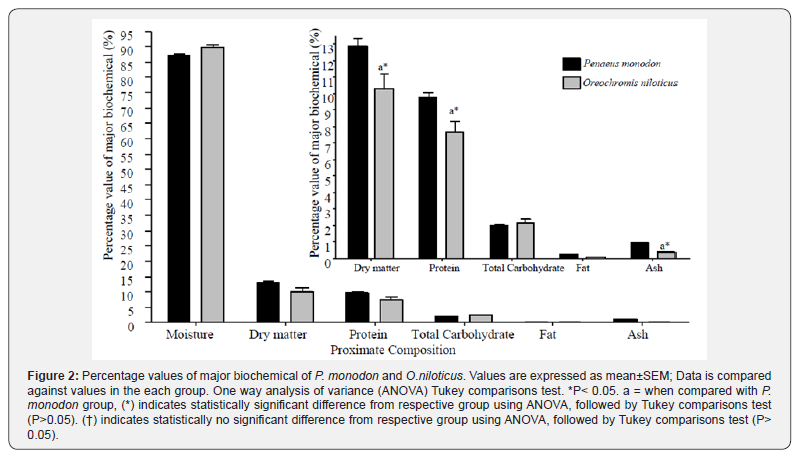
The proximate compositions for the three types of samples and (Mean±SE) are given in Table 1.
Values are expressed as mean ±SEM; Data is compared against values in the each group. One way analysis of variance (ANOVA) Tukey comparisons test. *P< 0.05. a = when compared with P. monodon group, (*) indicates statistically significant difference from respective group using ANOVA, followed by Tukey comparisons test (P>0.05). (†) indicates statistically no significant difference from respective group using ANOVA, followed by Tukey comparisons test (P> 0.05) (Figure 2).
Discussion
Biochemical composition of organisms vary according to different factors such as season, size of the animal, stage of maturity, availability of food, and etc. [10]. Among many nutrients, protein, fat and mineral compositions gain much attraction due to their importance for a healthy life. Animal protein is vital in the diet because of the various functions it performs. Among sources of animal protein, seafood and related sources are important dietary source of proteins with high biological values [13,14]. According to the results of the present study, the percentage of protein content is the highest in brackish water shrimp species Penaeus monodon (9.31±0.63) and this value was significantly different from that of Oreochromic niloticus (P< 0.05>; Table 1). The quantity of protein in shrimps is largely influenced by the extent of fat and water content. The highest percentage of protein content was reported from the Penaeus monodon which is a very popular food source in Sri Lanka. Although, Oreochromis niloticus species is not more popular among the communities and it has been shown less percentage of protein contents (7.85±0.11%). Fats are essential in the diets as they increase the palatability of foods by absorbing and retaining their flavors [15]. Fats are important in the structural and biological functioning of the cells and they help in the transportation of nutritionally essential fat soluble vitamins [16]. In this study, the lowest fat content was recorded from Oreochromis niloticus samples (0.07±0.16%) and all recorded fat contents for two food sources were significantly different from each other (P< 0.05>) (Table 1). However, in general Penaeus monodon is more popular within the society due to its rich flavor compared to marine crabs. Brackish water shrimp (Penaeus monodon) (0.23±0.22%) showed equal percentage of total fat content compared to Portunus pelagicus [17]. Comperativily, the percentage of total carbohydrate content is the highest in Brackish water shrimp (Penaeus monodon) (1.90±0.36%) than fresh water fish Nile tilapia (Oreochromis niloticus) (1.69±0.24%). The ash content of a sample is the reflection of the amount of minerals contained in the sample. That indicates the high Ash composition in Penaeus monodon samples (0.89±0.17%). Recorded percentage of ash contents for two food sources were significantly differ from each other (P< 0.05) (Table 1). Overall results indicated that the brackish water and freshwater protein food sources (Penaeus monodon and Oreochromic niloticus) are low in ash components. The present study indicated that Oreochromic niloticus are not inferior in terms of nutritional values when compared to Penaeus monodon shrimp species. The latter species are very common in the coastal region than in the inland areas of the country. However, culture programs have been launched for Penaeus monodon in inland reservoirs to boost the production for the local community. However, due to the high nutritional value of these edible marine crabs and brackish water shrimps species, it is worthwhile to improve the capture and culture fishery industry for them. These types of studies are important because most of the analyses are based on commercially popular food sources. Generally, it is a common practice that most protein rich animal food sources are expensive at the markets and are not available for less privileged people. Current study indicated the utility of less popular shrimps groups such as Penaeus monodon species will be advantageous for consumption from a nutritional point of view.

Values are expressed as mean±SEM; Data is compared against values in the each group. One way analysis of variance (ANOVA) Tukey comparisons test. *P< 0.05. a = when compared with P. monodon group, (*) indicates statistically significant difference from respective group using ANOVA, followed by Tukey comparisons test (P>0.05). (†) indicates statistically no significant difference from respective group using ANOVA, followed by Tukey comparisons test (P> 0.05).
Conclusion
According to the results obtained in this study, shrimp meat contains a higher protein content and fat content with relatively balanced nutritional composition when compared to freshwater fish. The most widely available dietary source of shrimps, such as Penaeus monodon. It can then be inferred that the Penaeus monodon is a suitable supplement of protein and mineral matter so as to balance human nutrition. Hence the consumption of shrimps would help as a good source of nutrients in human. Many fish, particularly at the higher end of the food chain, contain dangerous amounts of mercury and are not recommended as frequently eaten foods. Out of the two types of samples, shrimp meat is of high nutritional value and is suitable as a source of animal protein.
Consent for Publication
The authors declare that they have no competing interests.
Availability of Data and Materials
The dataset(s) supporting the conclusions of this article is included within the article.
Author Contribution
AD and AMCP, conceived the study and conducted the laboratory experiments; analyzed, interpreted experimental results and manuscript preparations. E, AP and DA contributed to the contributed with critical revision of the manuscript and interpretation of data. All authors read and approved the final manuscript.
Acknowledgment
The authors wish to thank the laboratory technicians and all other members of non-academic staff for providing us with a pleasant environment and facilities to complete this research project. Faculty of Fisheries & Marine Science, Ocean University of Sri Lanka, Tangalle, Sri Lanka is also appreciated. Support given by Dr. MP Kumara by support is also highly appreciated.
References
- Lovern JA (1962) The lipids of fsh and changes occurring in them during processing and storage. In: Heen E, Kreuzer R (Eds.), Fish in Nutrition. Fishing News Ltd., London, UK, England.
- Leaf A, Xiao YF, Kang JX, Billman GE (2003) Prevention of sudden cardiac death by n-3 polyunsaturated fatty acids. Pharmacology and Therapeutics 98: 355-377.
- Akihisa T, Tokuda H, Ogata M, Ukiya M, Lizuka M, et al. (2004) Cancer chemopreventive effects of polyunsaturated fatty acids. Cancer Lett 205(1): 9-13.
- Nalan G, Dlua K, Yerlikayaa P (2003) Determination of Proximate Composition and Mineral Contents of Blue Crab (Callinectes sapidus) and Swim Crab (Portunus pelagicus) Caught off the Gulf of Antalya, Food Chem 80: 495-498.
- http://www.who.int/whr/2003/en/
- Abulude FO, Lawal LO, Ehikhamen G, Adesanya WO, Ashafa SL (2006) Chemical composition and functional properties of some prawns from the Coastal Area of Ondo State, Nigeria. Electron J Environ Agric Food Chem 5(1): 1235-1240.
- Hulata G (2001) Genetic manipulations in aquaculture: a review of stock improvement by classical and modern technologies. Genetica 111(1-3): 155-173.
- Omotoso OT (2005) Chemical composition and nutritive significance of the land crab, Cardisoma armatum (Decapoda), African journal of Applied Zoology and Environmental Biology 7: 68-72.
- Anas MUM, Edirisinghe EMRKB, Jayasinghe JMPK (2009) Lipid composition and fatty acid profiles of wild caught and fattened mud crab, Scylla serrata, in Sri Lanka Sri Lanka J Aquat Sci 14: 75-85.
- Dinakaran GK, Soundarapandian P, Saunak KC (2009) Proximate composition of palaemonid prawn Macrobrachium idea. Current Research Journal of Biological Sciences 1(3): 78-82.
- Pearson D (1976) Chemical analysis of foods, (7th edn), Churchill Livingstone, London, pp. 7-11.
- Hanson SWF, Olly J (1965) Application of Bligh and Dyer method of lipid extraction to tissue homogenates. Biochemical Journal 89: 101- 102.
- Sidhu JS, Commandeur HR, Volberda HW (2003) On the conceptualization and measurement of exploration orientation and its impact on innovation. In Best paper proceedings of the Academy of Management. Seattle, WA: Academy of Management.
- Sioen I, Matthys C, De Backer G, Van Camp J, De Henauw S (2007) Importance of seafood as nutrient source in the diet of Belgian adolescents. J Hum Nutr Diet 20(6): 580-589.
- Aiyesanmi AF, Oguntokun MO (1996) Nutrient Composition of Dioclea reflexa Seed: An Underutilized Edible Legume. La Riv Ital Delle Sostanze Grasse, LXXIII: 521 -523.
- Martin DW, Mayes PA, Rodwell VW (1981) Harpers review of biochemistry, (18th edn), Large Medical Publications, Ls. Altos, California, USA, pp. 565 - 572.
- Premarathna AD, Rajapakse RPVJ, Pathirana E, Senaratne VP, Karunarathna SC, et al. 2015. Nutritional Analysis Of Some Selected Fish and Crab Meats and Fatty Acid Analysis of Oil Extracted From Portunus Pelagicus. Ijst R 4(7): 197-201.

























