




 OAJS Home



Abstract
Despite the emergence of new pharmacologic alternatives to traditional bariatric surgery, the global obesity epidemic continues to escalate. Semaglutides, while effective for some, are costly, require weekly injections, and often cause side effects that lead many patients to discontinue treatment and subsequently regain much or all of the weight they lost. Both bypass and restrictive bariatric procedures carry significant risks, side effects, and long-term lifestyle adjustments, and most patients ultimately reach a weight-loss plateau. Endoscopic visceral lipectomy, though not yet clinically validated or widely adopted, offers the potential for a more permanent solution one that might help patients achieve a lower, more sustainable weight plateau without the same tradeoffs. Clinicians can work together to tailor combinations of pharmacologic and surgical strategies to best support the health of individual patients. Earlier intervention may help future generations.
Continued development of new medications and research into alternative surgical approaches should be encouraged. However, the widespread availability of highly addictive, calorie-dense, nutrient-poor junk and ultra-processed foods-paired with increasingly sedentary lifestyles and the pervasive use of addictive social media-continues to drive the epidemic beyond our current capacity to control it. Meaningful progress will require coordinated efforts among governments, schools, and food manufacturers to improve labeling, reduce the caloric density of snack foods, promote physical activity, limit screen time, decrease youth exposure to junk-food advertising, and foster healthier eating and exercise habits. The author reflects on the critical question of when-and how early-we should intervene to reverse the tightening spiral of obesity.
Keywords:Obesity; Metabolic Syndrome; Diabetes; Bariatric; Semaglutides; Bypass; Visceral Lipectomy
Global Burden of Obesity
In 2022, 43% of adults worldwide, or 2.5 billion people, were obese and 16% or 890 million were obese. What is more alarming is that in 2022, 390 million children and adolescents, aged 5-19 years were overweight and 90 million were obese [1]. McKinsey forecasts those costs to reach $17 Trillion by 2035. Estimates by the World Obesity Federation predict that of obesity-related disease cost will reach 3% of the global GDP.
Although obesity is generally more severe in affluent Western societies, it transcends geographic and socioeconomic boundaries. If current trends persist over half of the world’s population will be overweight or obese by 2035 [2]. A greater proportion of each successive generation of children is overweight or obese and less healthy. The onset of obesity and associated type 2 diabetes is sooner in each generation. Life expectancy is not just shortened; the quality of life is compromised earlier in subsequent generations. Children are less healthy than their parents. Clearly, a global framework and coordinated effort must be made to stem this downward spiral.
Multitude of Contributing Factors
If more calories are consumed than burned, the extra calories are stored as fat. Many factors have affected and continue to affect this basic equation which should be in balance.
i.Covid confinement
ii.Lack of emphasis of physical fitness and gym in school
iii.Increasing screen time of our youth with addictive social media
iv.Highly addictive, high calorie junk food and its pervasive advertising in the media
v. The normalization of obesity in media, movies and
advertising
vi. The lowering of physical fitness standards in our military
and first responders
vii. Super-sizing and enlarging food proportions in our fastfood
chains
viii. Measurements for stated clothing sizes are slowly
and deceptively creeping up for each size among many garment
manufacturers
ix. “Politically correct” speech eliminating the social
pressure that formerly served to encourage dieting and exercise.
x. Obesity is socially contagious.
True Cause of the Obesity Mortality
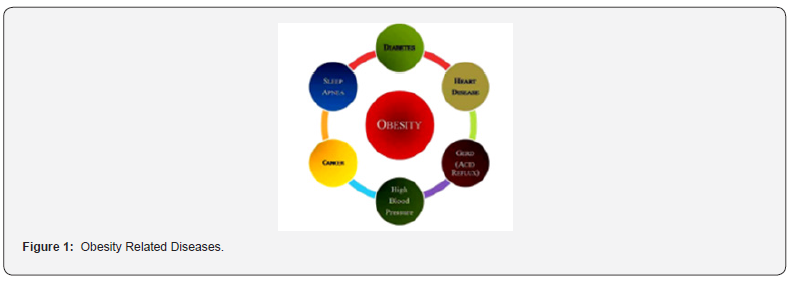
Subcutaneous fat is unsightly but doesn’t affect your health. It is the visceral fat inside your abdomen which causes all of the morbidity associated with obesity. It causes GERD and sleep apnea simply because of bulk and secretes noxious cytokines directly into the portal circulation. These cause high blood pressure, heart disease, type 2 diabetes, autoimmune diseases, and cancer. Visceral adiposity is tightly correlated with coronary heart disease [3] and mesenteric fat thickness was found to be an independent determinant of metabolic syndrome and identified subjects with increased carotid intimal media thickness [4]. Visceral fat causes metabolic syndrome and all the morbidities of obesity [5,6] (Figure 1).
Semaglutides
Semaglutides help many patients to control their appetites
and lose weight. However, they do not work for all patients and
have significant drawbacks, side effects and complications [7].
a) mandatory weekly expensive injections
b) 10-15% of patients can’t tolerate their side effects and
take them less than one month
c) 35-50% of patients stop taking them after a year
because of side effects (delayed gastric emptying), complications
(cholecystitis, pancreatitis, ocular), or expense.
d) 2/3 of the patients stopping semaglutides regain all or
more than the weight lost after cessation.
e) 44% of the weight lost is muscle which is rarely regained.
Semaglutides starve visceral fat to reduce their cytokine secretions, but the fat cells remain there, ready to actively secrete again when the drugs are stopped.
Current Bariatric Surgery Options
Restrictive or bypass procedures work by making the
patient eat less or have the food transit the bowel without being
fully digested. The most common procedures, listed in order of
increasing weight loss and length of time until a weight-loss
plateau is reached are: Adjustable Gastric Band, Gastric Visceral
Sleeve, and Roux-en-Y Bypass. All also work by starving the visceral
fat rather than removing it. They have significant complications
and sequelae.
i. Surgical risks of cutting into the stomach or bowel,
rearranging the body’s alimentary plumbing or leaving behind a
foreign body.
ii. Adverse nutritional consequences and untoward
sequelae with lifestyle-compromising outcomes.
iii. Patients eventually encounter a weight loss plateau and
gain back lost weight.
iv. Patients require indefinite surgical follow-up and
regular lab testing.
v. Invasive and expensive.
On the Horizon
Visceral fat removal has been shown to result in marked metabolic improvement in all lower animals [8]. New technology has documented metabolic improvement in cats [9], dogs and baboons [10,11]. Baboons, with an average weight of 35 kg., the closest animal model to the human biliary system and liver, where visceral fat’s noxious cytokines have their maximal effect, lost 15% of their body weight within 6 weeks from removal of only 430 grams of visceral fat. However, none of the technologies employed for these pilot studies have been deemed safe enough for human visceral fat removal.
A specialized twin cannula aspiration device under development, EVL®, may enable the safe, endoscopic removal of visceral fat in patients with metabolic syndrome and type 2 diabetes as an outpatient procedure [12]. Since visceral fat does not grow back, the effect will be permanent. There will be a fewer number of visceral fat cells and their secreting mitochondria remaining to fabricate resistin, angiotensin and the interleukins which cause type 2 diabetes, hypertension, and cancers, autoimmune and vascular disease. It is anticipated a single procedure will suffice in most patients, but the procedure may be repeated until an ideal weight is obtained.
Initial patients will simply get their “muffin tops” eliminated and their “beer bellies” flattened and be closely followed to document metabolic improvement. It is anticipated that up to four liters of visceral fat can be removed in a minimally invasive outpatient endoscopic procedure and result in a weight loss of 7-10 times that amount of body fat (60 to 80 lbs.) in keeping the visceral-subcutaneous fat ratio [13]. If this proves to be the case, we will then have a less invasive bariatric surgical option without the draw backs of restrictive or bypass surgery, and one that will be permanent.
Ideal Time for Intervention
While physicians must treat the old, young, thin, or morbidly obese patients as they present themselves, we can follow the course of obesity as a disease with both nature and nurture components. An obese mother will deliver an overweight child with an abundance of visceral fat who is predisposed to type 2 diabetes [14]. Without intervention, that predisposed teenager is likely to become obese at an earlier age and be even more obese than her mother (nature). And any teenage female can overindulgence on high calorie foods and live a sedentary life so that she too becomes obese (nurture) and also delivers an offspring even more disposed to type 2 diabetes as well.
The ideal time for intervention is the female teenager who is overweight, whether or not she is predisposed to type 2 diabetes. If we control diet and encourage exercise, we may not have to intervene pharmacologically or surgically at all; that should be our paramount goal. But if we do have to intervene, a permanent, least invasive solution would be ideal. Currently endoscopic visceral lipectomy raises the hope of fulfilling the need for a single outpatient procedure which provides a permanent solution to undo the curse of having been born with an excess of visceral fat and predisposition for type 2 diabetes and obesity. Of course, men should not be neglected both for the sake of their own health but also because at least to some degree, obesity is socially contagious, including to their children (nurture), and the best time to avert a problem is before it has occurred when they too are teenagers, but it is maternal obesity that has been shown to affect their offspring directly (nature).
A Multipronged Approach is Required
On a national level, advertising of snack foods in places designed to reach children should be restricted. School lunch foods should be healthy meals; exercise, gym, and physical fitness should be part of the mind, body, moral education and discipline everyone should experience. Physical standards for our military and first responders should be maintained without compromise for both entry and continued service. National programs for fitness and a healthy weight should be instituted. Perhaps “sin taxes” may be appropriate to be levied on unhealthy “junk” food.
Treating physicians should use all of their options – first attempting counseling, diet and exercise, adding a GLP-1 if needed, and resorting to bariatric surgery if and when needed. If EVL® proves as effective as animal studies suggest, it will provide a gentler, less invasive and permanent bariatric option for surgeons.
A Multipronged approach would include:
a) Emphasizing physical fitness and exercise in school and
afterwards
b) Maintaining physical fitness standards for military and
first responders
c) Limiting advertising of junk food designed to reach
children
d) Stopping supersizing of food and clothing and
encouraging portion control.
e) Utilizing all available options – surgical, pharmacologic,
behavioral, educational, and governmental to address the
problem.
Unless we attack the problem from all sides with a concerted and coordinated, multipronged approach earlier and with new technologies we will continue to lose this battle.
Disclaimer
The views expressed are exclusively those of the author, derived from his own professional experience and research, and do not reflect those of any identifiable institute or specific patient data.
Conflicts of Interest
Dr. Cucin serves as C.E.O. of BioSculpture Technology, Inc., a U.S. medical device manufacturer that is developing the EVL® device..
References
- Ahmed SK, Mohammed RA (2025) Obesity: Prevalence, cause, consequences, management, preventative strategies and future research directions. Metabolism Open 27: 100375.
- Ng M, Fleming T, Robinson M, Thomson B, Graetz N, et al. (2014) Global, regional and national prevalence of overweight and obesity in children and adults during 1980-2013: a systemic analysis for the Global Burden of Disease Study 2013. Lancet 384: 766-781.
- Fujimoto WY, Bergstrom RW, Boyko EJ, Chen KW, Leonetti DL, et al. (1999) Visceral adiposity and incident coronary heart disease in Japanese American men. The 10-year follow-up results Japanese American Community Diabetes Study. Diabetes Care 22(11): 1808-1812.
- Liu KH, Chan YL Wing BC, Chan JCN, Chu CWW et al. (2006) Mesenteric Fat Thickness Is an Independent Determinant of Metabolic Syndrome and Identifies Subjects with Increased Carotid Intima-Media Thickness. Diabetes Care 29(2): 379-384.
- Bergman RN, Kim SP, Catalano KJ, Hsu IR, Chiu JD, et al. (2006) Why Visceral Fat is Bad: Mechanisms of the Metabolic Syndrome. Obesity 14(1): 16S-19S.
- Yang YK, Chen M, Clements RH, Abrams GA, Aprahamian CJ, et al. (2008) Human mesenteric adipose tissue plays unique role versus subcutaneous and omental fat in obesity related diabetes. Cell Physiol Biochem 22(5-6): 531-538.
- Sorli C, Harashima SI, Tsoukas GM, Unger J, Karsbøl JD, et al. (2017) Efficacy and safety of once-weekly semaglutide monotherapy versus placebo in patients with type 2 diabetes (SUSTAIN 1): a double-blind, randomized, placebo-controlled, parallel-group, multinational, multicenter phase 3a trial. Lancet Diabet Endocrinol. 5(4): 251-260.
- Marcadenti A, de Abreu-Silva EO (2015) Different adipose tissue depots: Metabolic implications and effects of surgical removal. Endocrinol Nutr. 62(9): 458-564.
- Xia L, Hua J, Dray X, Khashab MA, Liang S, et al. (2011) Endoscopic visceral fat removal as therapy for obesity and metabolic syndrome: a sham-controlled pilot study. Gastrointest Endosc 74(3): 637-644.
- Kulkarni T, Slaughter G, Ego-Osuala C, Kochunov P, Bastarrachea RA, et al. (2014) Hyperglycemic Challenge and Distribution of Adipose Tissue in Obese Baboons. Int J Diabetol Vasc Dis Res 2(1): 102.
- Andrew MS, Huffman DM, Rodriquez-Ayala E, Williams NN, Peterson RM, et al. (2018) Mesenteric Visceral Lipectomy using Tissue Liquefaction Technology reverses insulin resistance and causes weight loss in baboons. Surg Obes Relat Dis 14(6): 833-841.
- Cucin R (2018) Uncoiling the Tightening Obesity Spiral. Clin Res Diabet and Endocrinol 1: 2.
- Cucin R (2017) McKinsey’s Obesity Prevalence Projections May Be Low! A New Approach, Endoscopic Visceral Lipectomy EVL May Offer a Solution. BAOJ Diabet 3: 27.
- Jovanovic L (1993) Am J Perinatol 10: 432-437.

























