




 OAJGGM Home



Abstract
Diacylglycerol oil is a functional dietary lipid. Randomized controlled trials have reported that diacylglycerol, particularly the 1,3-isomer, suppresses body-fat, and especially visceral-fat, accumulation and enhances weight loss under energy-restricted diets, effects relevant to the cardiometabolic health of older adults (its influence on blood lipids being less consistent across studies). As such products enter everyday cooking, systematic data on their behaviour and safety during deep-frying remain scarce. The objective of this study was to define an evidence-based safety margin for a palm-based diacylglycerol oil under accelerated frying, using the acid-value discard limit of China’s national standard GB 2716-2018 as a fixed, verifiable benchmark, with conventional palm oil as the reference frying medium. Under conditions more severe than routine catering, the palm-based diacylglycerol oil retained a substantial safety margin on the regulated acid-value indicator throughout the permitted use period, remaining within the same compliance range as conventional palm oil. The findings define a usable safety boundary for diacylglycerol-based frying oils and support their application, as a functional frying oil with fat-reducing value, in diets containing fried foods, including those of older adults.
Keywords:Diacylglycerol; Frying stability; Acid value; Edible oil safety; Functional lipid; Body fat; Older adults
Abbreviations: DAG: Diacylglycerol; TAG: Triacylglycerol; AV: Acid value; p-AnV: p-anisidine value; FFA: Free fatty acid; HPLC: High-performance liquid chromatography; RID: Refractive index detector; MFDS: Ministry of Food and Drug Safety (South Korea); 3-MCPD: 3-monochloropropane-1,2-diol
Introduction
Against the backdrop of population ageing, dietary strategies to improve the metabolic health of older adults are receiving growing attention. Diacylglycerol (DAG) oil has attracted interest for its distinctive metabolic properties. At comparable fatty acid composition, several randomized double-blind controlled trials have reported that dietary DAG, predominantly the 1,3-DAG isomer, suppresses the accumulation of body fat, particularly visceral fat: in the double-blind controlled trial of Nagao et al., long-term intake of DAG oil significantly suppressed visceral fat accumulation in healthy men [1]; and in the randomized controlled trial of Maki et al. in 131 overweight or obese subjects, replacing triacylglycerol oil with DAG oil within an energy-restricted diet enhanced the reduction of body weight and body fat [2]. Some studies have additionally observed improvements in postprandial triacylglycerol and in the blood lipids of insulin-resistant subjects [3,4], although other studies have not reproduced this lipid effect, indicating heterogeneity of the metabolic benefits across populations and endpoints; the evidence is relatively consistent for the body-fat endpoint, which is the basis on which the present study frames DAG oil as an edible oil with fat-reducing value. As a natural constituent of edible oils and fats (2%–10%), DAG has ample animal and human evidence supporting the safety of its consumption [5,6]. The subjects of the above trials were mostly middle-aged or overweight adults; no randomized controlled evidence specific to older adults is yet available, and the implications for the diet of older adults must be inferred in light of the elevated metabolic risk associated with ageing.
Deep-frying is one of the most common and thermally demanding cooking methods worldwide. At high temperature, moisture from food hydrolyses glycerides and releases free fatty acids, while oxidation and polymerization further degrade the oil [7]. Epidemiological studies suggest that frequent consumption of fried foods is associated with an increased risk of chronic diseases such as cardiovascular disease and metabolic syndrome, and older adults are more sensitive to changes in dietary fat quality [8,9]. For older consumers who regularly eat fried foods, the safety of the frying medium is therefore as important as the nutritional value of the oil itself.
DAG oil raises a specific question here: the proportion of free hydroxyl groups in its molecule is higher than in conventional triacylglycerol (TAG), so it is theoretically more prone to hydrolysis under prolonged heating [7]; whether this constitutes a safety concern within the actual use period remains unsettled. GB 2716-2018 specifies an acid-value discard limit of 5 mg KOH/g for frying oils, providing a fixed and verifiable safety benchmark [10]. Using this benchmark, the present study examined the change in acid value of a palm-based DAG oil under accelerated frying conditions, with conventional palm oil—a widely accepted frying medium—as the reference. The aim is not to argue that it is superior to conventional oils, but to define an evidence-based boundary for the safe use of DAG-based frying oils and to consider the implications for the dietary safety of older adults.
Materials and Methods
Materials and reagents
A palm-based DAG oil (DAG content approximately 40%, produced by INNOBIO Corporation Limited, Dalian, China) was used as the test sample, and conventional palm oil (24 °C slip-melting-point grade, COFCO Jiajia (Tianjin) Co., Ltd., Tianjin, China) as the reference frying medium; both contained a tocopherol-based antioxidant system. Production process parameters are outside the scope of this paper. Anhydrous diethyl ether, anhydrous ethanol, sodium hydroxide, glacial acetic acid, phenolphthalein, isooctane and p-anisidine (all analytical grade) were obtained from Tianjin Kemiou Chemical Reagent Co., Ltd., Tianjin, China.
A palm-based DAG oil (DAG content approximately 40%, produced by INNOBIO Corporation Limited, Dalian, China) was used as the test sample, and conventional palm oil (24 °C slip-melting-point grade, COFCO Jiajia (Tianjin) Co., Ltd., Tianjin, China) as the reference frying medium; both contained a tocopherol-based antioxidant system. Production process parameters are outside the scope of this paper. Anhydrous diethyl ether, anhydrous ethanol, sodium hydroxide, glacial acetic acid, phenolphthalein, isooctane and p-anisidine (all analytical grade) were obtained from Tianjin Kemiou Chemical Reagent Co., Ltd., Tianjin, China.
Accelerated frying protocol
A total of 2.8 kg of oil was placed in a fryer and maintained at approximately 190 °C (185–195 °C). Potato slices were blanched in warm water for 3 min, surface-dried, and fried in batches of 3 min each. Every 2 h, 200 g of oil was withdrawn for determination of acid value and p-anisidine value, and 200 g of fresh oil was added, constituting a limited-replenishment regimen that accelerates degradation relative to routine catering. Frying was continued for 8 h, the maximum period for which frying oil is used continuously without replacement under current catering practice.
Analytical methods
Acid value
The acid value (AV) was determined according to GB 5009.229 [11]. A portion of the dehydrated sample of mass m (weighed to the nearest 0.0001 g) was placed in a 250 mL conical flask; 50 mL of an ethanol–diethyl ether mixture (1:1, v/v) and three to four drops of phenolphthalein indicator were added, and the flask was shaken thoroughly to dissolve the sample. The solution was titrated from an alkali burette with standard sodium hydroxide solution (c = 0.1 mol/L). The end point was taken as the first appearance of a faint pink colour persisting without visible fading for 15 s, and the volume of standard solution consumed, V (mL), was recorded. A blank determination was carried out in parallel, consuming V0 (mL).
The acid value, expressed as potassium hydroxide in mg/g, was calculated as follows:

where V is the volume of standard solution consumed by the sample (mL); V0 is the volume consumed by the blank (mL); c is the concentration of the standard sodium hydroxide solution (mol/L); 56.1 is the molar mass of potassium hydroxide (g/mol); and m is the mass of the sample (g).
p-Anisidine value
The p-anisidine value (p-AnV) was determined according to GB/T 24304 (identical with ISO 6885) as a supplementary indicator of secondary oxidation [12]. Test samples were prepared according to ISO 661 and the p-anisidine reagent was prepared according to GB/T 24304. A portion of sample of mass m (weighed to the nearest 0.001 g, chosen so that the solution concentration fell within the working range of the spectrophotometer) was dissolved in 5–10 mL of isooctane and made up to volume in a 25 mL volumetric flask to give the test solution of volume V (mL).
Unreacted solution: 5 mL of the test solution was pipetted into a stoppered test tube, 1 mL of acetic acid solution was added by pipette, and the tube was stoppered and shaken thoroughly. The tube was kept in the dark at 23 °C ± 3 °C for 8 min. Within 2 min the solution was transferred to a clean, dry spectrophotometer cuvette. Timing was started from the addition of the acetic acid solution, giving a total reaction time of 10 min ± 1 min; the spectrophotometer was zeroed against isooctane at 350 nm and the absorbance A0 was measured.
Reacted solution: 5 mL of the test solution was pipetted into a stoppered test tube, 1 mL of p-anisidine reagent was added by pipette, and the tube was stoppered, shaken thoroughly and kept in the dark at 23 °C ± 3 °C for 8 min. Within 2 min the solution was transferred to a clean, dry cuvette. Timing was started from the addition of the p-anisidine reagent, giving a total reaction time of 10 min ± 1 min, and the absorbance A1 was measured as described above. A blank was determined in parallel, in which the test solution was replaced by an equal volume of isooctane and all other operations were identical to those for the reacted solution, giving the absorbance A2. The p-anisidine value was calculated as follows:

where V is the volume in which the test portion was dissolved (mL), V = 25 mL; m is the mass of the sample (g); Q is the mass concentration of the sample in the measured solution (g/mL), Q = 0.01 g/mL; A0 is the absorbance of the unreacted solution; A1 is the absorbance of the reacted solution; A2 is the absorbance of the blank; and 1.2 is the correction factor for the dilution of the test solution with 1 mL of reagent or acetic acid solution.
Glyceride composition by HPLC
A 0.1 g portion of the palm-based DAG sample was dissolved in 10 mL of n-hexane–isopropanol (25:1, v/v) and mixed thoroughly; 1 mL of the mixture was filtered through a 0.45 μm syringe filter and analysed by HPLC. The composition of the esterification products was determined by HPLC with refractive index detection (HPLC-RID). Chromatographic conditions: silica column (4.6 mm × 150 mm, 5 μm); mobile phase n-hexane–isopropanol (25:1, v/v); flow rate 1 mL/min; column oven temperature 38 °C; refractive index detector temperature 38 °C; injection volume 20 μL. Relative quantification was performed by peak-area normalization.
Compliance benchmark
Samples were taken at 0, 2, 4, 6 and 8 h. Results were compared against the acid-value discard limit of 5 mg KOH/g for frying oils in GB 2716-2018 [10]. Although total polar compounds are commonly used to evaluate frying oils, intact DAG is itself counted as a polar compound, which systematically overestimates the polar-compound content of DAG oil; this indicator is therefore not appropriate for such a matrix [13]. Acid value was accordingly used as the primary compliance indicator.
Results
Glyceride composition
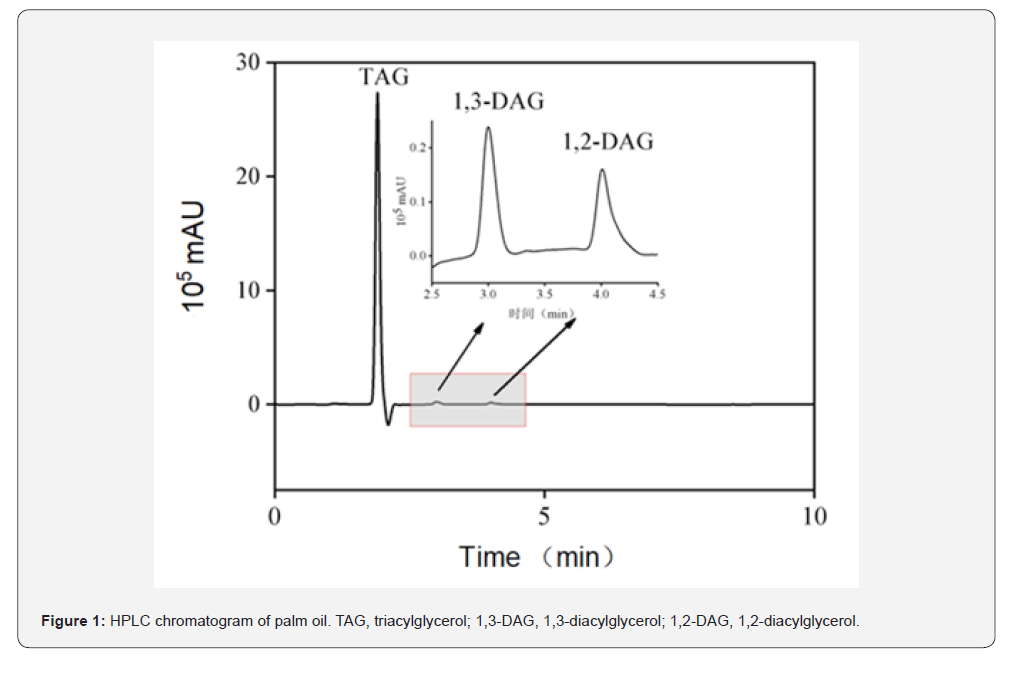
The glyceride composition was profiled by HPLC-RID. Figure 1 shows the chromatogram obtained, in which triacylglycerol (TAG), 1,3-diacylglycerol (1,3-DAG) and 1,2-diacylglycerol (1,2- DAG) were resolved.
Acid value
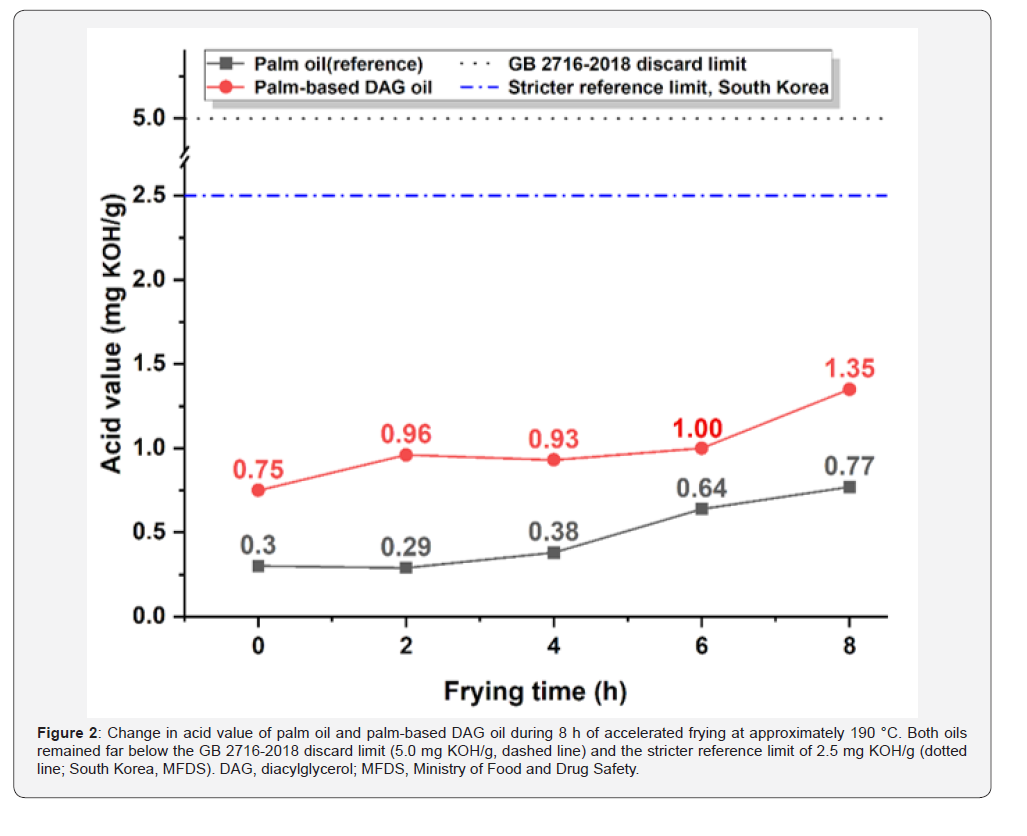
The acid value of both oils increased with frying time (Figure 2). At 8 h, palm oil rose from 0.30 to 0.77 mg KOH/g and the DAG oil from 0.75 to 1.35 mg KOH/g. The DAG oil had a higher initial value and a steeper rise, consistent with its greater degree of hydrolysis. Throughout the 8 h period, both oils remained well below the 5 mg KOH/g discard limit of GB 2716-2018, the DAG oil reaching at most about 27% of the limit, and both remained below the stricter reference limit of 2.5 mg KOH/g adopted for used frying oil by South Korea [14].
p-Anisidine value
The p-anisidine value increased markedly over the same period (Table 1), reaching 83.82 for palm oil and 136.32 for the DAG oil at 8 h. GB 2716-2018 sets no limit for p-anisidine value (the 2018 revision removed the carbonyl-value indicator); this indicator was therefore used only for cross-comparison of the degree of oxidation between the two oils and not as a compliance criterion.
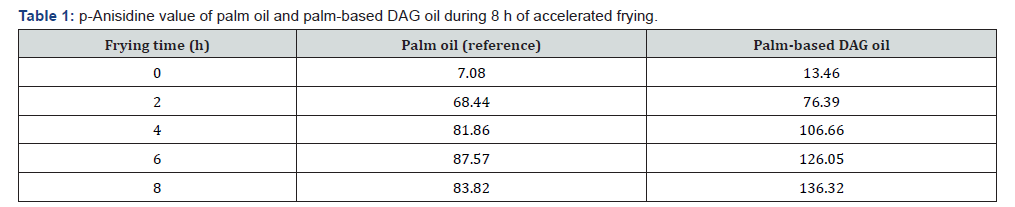
Abbreviation: DAG, diacylglycerol. The p-anisidine value is dimensionless.
Discussion
The rise in acid value of both oils follows the basic chemistry of deep-frying: moisture from food hydrolyses glycerides and releases free fatty acids [7]. The faster hydrolysis of the DAG oil stems from its structure—a higher proportion of free hydroxyl groups. The key question is not whether it hydrolyses faster than TAG (it does), but whether the absolute level reached within the permitted use period is safe. This study shows that even under a limited-replenishment regimen more severe than routine catering, the acid value of the DAG oil remained below 1.4 mg KOH/g throughout 8 h, about one-quarter of the national discard limit—an ample safety margin.
The parallel rise in p-anisidine value reflects secondary oxidation in both oils, with higher late-stage values for the DAG oil. Two points balance this observation. First, palm oil—an accepted frying medium—showed an equally steep oxidation trend, indicating that the dominant factor is the severity of the accelerated, limited-replenishment protocol rather than any property specific to DAG. Second, the controlled comparison by Shimizu et al. of DAG-type and TAG-type cooking oils under deepfrying found no substantial difference in p-anisidine value, iodine value, or oxidized fatty acid content [13], and subsequent work on volatile aldehyde emission likewise showed no disadvantage for DAG oil [15]. Because GB 2716-2018 sets no p-anisidine-value limit, the compliance judgement continues to rest on acid value.
These results are consistent with existing evidence on the frying safety of DAG oil: a subchronic toxicological evaluation of heated DAG oil prepared by frying found no toxic effects [5], and DAG-based blend oils used for frying have shown acceptable thermo-oxidative stability [16].
For older consumers, the practical implication is clear: fried foods are a common part of the daily diet, and the safety of the frying medium forms part of overall dietary exposure. Within the use period permitted by GB 2716-2018, the palm-based DAG oil— even under deliberately stringent conditions—retained an ample margin on the regulated indicator and stayed within the same compliance range as an accepted conventional frying oil. Together with the reported metabolic properties of DAG [1-4], this supports the feasibility of using it as a functional frying oil in foods aimed at older adults.
This study has several limitations. The accelerated, limitedreplenishment protocol is more severe than routine catering and used a single frying substrate, so absolute values under routine conditions would differ. Only acid value and p-anisidine value were measured: total polar compounds were not used, for the methodological reason noted above [13], and processing contaminants such as 3-monochloropropane-1,2-diol (3-MCPD) esters and glycidyl esters fell outside the scope of this study and require separate evaluation. In addition, the fat-reducing and metabolic benefits of DAG cited here derive from studies in general adult populations (mostly overweight or metabolically abnormal individuals); no randomized controlled evidence specific to older adults is yet available, and some metabolic effects remain debated in the literature, so extrapolation to the diet of older adults should be made with caution.
Conclusion
Under frying conditions more severe than routine catering, the acid value of the palm-based DAG oil increased over time but remained far below the GB 2716-2018 discard limit throughout the permitted use period, within the same compliance range as conventional palm oil. This result defines a usable safety boundary for DAG-based frying oils and supports their application, as a functional edible oil with fat-reducing value, in diets containing fried foods, including those of older adults. Further validation is still needed under routine use conditions, across a wider range of frying substrates, and for processing contaminants.
Acknowledgement
The authors thank the analysts who performed the acid-value and p-anisidine-value determinations.
References
- Nagao T, Watanabe H, Goto N, Onizawa K, Taguchi H, et al. (2000) Dietary diacylglycerol suppresses accumulation of body fat compared to triacylglycerol in men in a double-blind controlled trial. J Nutr 130(4): 792-797.
- Maki KC, Davidson MH, Tsushima R, Matsuo N, Tokimitsu I, et al. (2002) Consumption of diacylglycerol oil as part of a reduced-energy diet enhances loss of body weight and fat in comparison with consumption of a triacylglycerol control oil. Am J Clin Nutr 76(6): 1230-1236.
- Ai M, Tanaka A, Shoji K, Ogita K, Hase T, et al. (2007) Suppressive effects of diacylglycerol oil on postprandial hyperlipidemia in insulin resistance and glucose intolerance. Atherosclerosis 195(2): 398-403.
- Devi PBLA, Gangadhar KN, Prasad RBN, Sugasini D, Rao YPC, et al. (2018) Nutritionally enriched 1,3-diacylglycerol-rich oil: Low calorie fat with hypolipidemic effects in rats. Food Chem 248: 210-216.
- Morita O, Tamaki Y, Kirkpatrick JB, Chengelis CP (2008) Safety assessment of heated diacylglycerol oil: Subchronic toxicity study in rats. Food Chem Toxicol 46(8): 2748-2757.
- Morita O, Soni MG (2009) Safety assessment of diacylglycerol oil as an edible oil: A review of the published literature. Food Chem Toxicol 47(1): 9-21.
- Choe E, Min DB (2007) Chemistry of deep-fat frying oils. J Food Sci 72(5): R77-R86.
- Gadiraju TV, Patel Y, Gaziano JM, Djoussé L (2015) Fried food consumption and cardiovascular health: A review of current evidence. Nutrients 7(10): 8424-8430.
- Julibert A, Bibiloni MdM, Mateos D, Angullo E, Tur JA (2019) Dietary fat intake and metabolic syndrome in older adults. Nutrients 11(8): 1901.
- National Health Commission of the People's Republic of China, State Administration for Market Regulation (2018) GB 2716-2018 National Food Safety Standard: Vegetable Oils. Standards Press of China, Beijing, China.
- National Health and Family Planning Commission of the People's Republic of China (2016) GB 5009.229-2016 National Food Safety Standard: Determination of Acid Value in Foods. Standards Press of China, Beijing, China.
- General Administration of Quality Supervision, Inspection and Quarantine of the PRC, Standardization Administration of China (2009) GB/T 24304-2009 Animal and Vegetable Fats and Oils: Determination of Anisidine Value (identical with ISO 6885). Standards Press of China, Beijing, China.
- Shimizu M, Moriwaki J, Nishide T, Nakajima Y (2004) Thermal deterioration of diacylglycerol and triacylglycerol oils during deep-frying. J Am Oil Chem Soc 81(6): 571-576.
- Park JM, Kim JM (2016) Monitoring of used frying oils and frying times for frying chicken nuggets using peroxide value and acid value. Korean J Food Sci Anim Resour 36(5): 612-616.
- Katsuta I, Shimizu M, Yamaguchi T, Nakajima Y (2008) Emission of volatile aldehydes from DAG-rich and TAG-rich oils with different degrees of unsaturation during deep-frying. J Am Oil Chem Soc 85(6): 513-519.
- Lee YJ, Khor YP, Kadir NSA, Lan D, Wang Y, et al. (2023) Deep-fat frying using soybean oil-based diacylglycerol-palm olein oil blends: Thermo-oxidative stability, 3-MCPDE and glycidyl ester formation. J Oleo Sci 72(5): 533-541.

























