




 OAJGGM Home



Abstract
Informal caregivers constitute the foundation of dementia care worldwide, yet their own health needs often remain peripheral within healthcare systems that continue to focus primarily on the person living with dementia. Prolonged caregiving can expose family caregivers to substantial psychological, physical, social, and economic challenges, with these consequences potentially becoming less visible in cultural contexts where caregiving is strongly associated with familial duty and responsibility. This commentary argues for a broader conceptualization of dementia care in which informal caregivers are recognized as “secondary patients” with legitimate and interconnected healthcare needs. Such recognition does not medicalize caregiving or diminish the primacy of the person living with dementia; rather, it acknowledges that dementia affects a caregiving dyad whose well-being is interdependent. The proposed Secondary Patient Framework advocates a shift from reactive, crisis-driven caregiver support toward integrated family-centered dementia care encompassing routine caregiver assessment. Psychological support, resilience and skills building, education, respite, and community resources. Reframing informal caregivers as legitimate recipients of healthcare may help address their longstanding invisibility within dementia services and promote more equitable, culturally responsive, and sustainable models of care that support both people living with dementia and families who care for them.
Keywords:Dementia; Informal Caregivers; Secondary Patients; Family-Centered Care; Caregiver Burden; Caregiving Dyad; Caregiving Well-Being
Dementia Care Beyond the Patient
Dementia has become one of the most significant public health challenges of the 21st century, with profound implications extending far beyond the individual living with the disease. The World Health Organization estimates that approximately 57 million people worldwide were living with dementia in 2021, with nearly 10 million new cases occurring annually. More than 60% of those affected reside in low- and middle-income countries (LMICs), where health and social care systems often face substantial resource constraints, resulting in a heavy reliance on families to provide long-term care (World Health Organization WHO [1]. As global populations continue to age, the demand for informal caregiving is expected to increase considerably, making family caregivers an indispensable component of dementia care worldwide.
Unlike many chronic conditions, dementia progressively diminishes an individual’s ability to perform everyday activities, communicate effectively, make decisions, and maintain independent living. Consequently, family members frequently assume responsibility for medication management, behavioral symptom management, personal care, financial decision-making, emotional support, and continuous supervision over extended periods. These responsibilities often span several years and intensify as the disease progresses, fundamentally reshaping caregivers’ physical, psychological, social, and economic lives. Indeed, the World Health Organization estimates that approximately half of the global economic cost of dementia is attributable to unpaid care provided by family members and other informal caregivers, underscoring the indispensable contribution of caregivers to health systems worldwide.
Despite the indispensable role, contemporary dementia care remains overwhelming patient-centered. Clinical assessment, treatment planning, rehabilitation, and follow-up are primarily directed towards the person living with dementia, while caregivers are commonly viewed as providers of care rather than individuals whose own health and well-being require systematic attention. This imbalance persists despite compelling evidence that caregiver health directly influences care quality, treatment adherence, institutionalization decisions, and the overall well- being of people living with dementia patients. Recent evidence from informal caregivers of people living with dementia in Pakistan further demonstrates the close relationship between caregiver burden and perceived stress, while highlighting the potential protective roles of resilience and perceived social support Hayat [2].
This patient-centered paradigm is particularly problematic in collectivist societies, where caregiving is frequently regarded as a moral obligation, cultural expectation, and familial responsibility rather than a shared healthcare responsibility. Consequently, the substantial psychological, physical, and social consequences experienced by informal caregivers often remain overlooked or normalized. This commentary argues that dementia care must evolve beyond an exclusive focus on the diagnosed individual and formally recognize informal caregivers as secondary patients whose health needs warrant routine clinical attention. Such a shift represents an essential step towards developing truly familycentered dementia care that acknowledges the interdependence of patient and caregiver well-being.
The Invisible Patient: The cost of Informal Caregiving
The remarkable dependence of dementia care on informal caregivers presents an important paradox. Although family caregivers constitute the cornerstone of long-term dementia care, they remain largely invisible within healthcare systems. Their contribution is routinely acknowledged in clinical guidelines and policy documents, yet their own physical and psychological health is seldom regarded as an integral component of dementia care. Instead, caregivers are primarily viewed as extensions of the healthcare workforce individuals expected to provide continuous care, coordinate services, and support treatment decisions rather than as people who themselves experience significant health consequences arising directly from the caregiving role Brodaty & Donkin [3].
A substantial body of research has consistently demonstrated that providing long-term care for a person living with dementia is associated with considerable psychological, physical, social, and economic consequences. Dementia caregivers report significantly higher levels of depression, anxiety, chronic stress, sleep disturbances, social isolation, and reduced quality of life than noncaregivers, while prolonged caregiving has also been associated with increased physical morbidity and elevated mortality risk Pinquart & Sorensen [4], Schulz & Sherwood [5]. Importantly, these consequences are not transient responses to caregiving demands but often persist throughout the progressive course of dementia, reflecting the cumulative burden of years of continuous caregiving responsibilities.
Despite this extensive evidence, caregivers rarely undergo routine psychological assessment, systematic health monitoring, or structured support within dementia care pathways. Clinical consultations remain predominantly focused on the cognitive, behavioral, and functional needs of the person living with dementia, whereas caregiver distress is frequently addressed only after it becomes severe enough to impair caregiving capacity or precipitate healthcare crisis. Consequently, healthcare systems often respond reactively than proactively overlooking opportunities for early identification and prevention of caregiver distress.
This disconnect raises a fundamental conceptual question: if dementia caregiving can produce clinically significant psychological and physical consequences, why are informal caregivers not recognized as legitimate recipients of healthcare? Unlike family members who provide occasional assistance, dementia caregivers experience prolonged exposure to chronic stressors that frequently require psychological adaptation, behavioral adjustment, and continuous emotional investment. Their health and well-being are not merely collateral concerns, but essential determinants of the quality, continuity, and sustainability of dementia care itself.
Recognizing caregivers as secondary patients does not imply that they share the diagnosis of dementia or diminish the needs of the individual living with the disease. Rather, it acknowledges that the consequences of dementia extend beyond the diagnosed person to profoundly affect those who provide ongoing care. This perspective reframes caregivers from passive supporters to active recipients of healthcare whose psychological well-being, physical health, and adaptive functioning deserve systematic recognition within dementia care. Such reconceptualization represents an important step towards truly family-centered dementia care where supporting caregivers is understood not as an optional adjunct to treatment but as a fundamental component of highquality dementia care.
Why Collectivist Societies Make Caregivers Even More Invisible
Although informal caregiving is a universal feature of dementia care, the caregiving experience is profoundly shaped by cultural values and social expectations. In many collectivist societies, including those across South Asia, East Asia, the Middle East, and parts of Africa, caring for older family members is widely regarded as a moral obligation, an expression of filial responsibility, and an essential component of family identity rather than an individual choice Knight & Sayegh [6], World Health Organization [1]. These deeply embedded cultural values often strengthen family cohesion and encourage sustained caregiving even in the face of considerable adversity. However, they may also unintentionally obscure the health needs of caregivers by normalizing the substantial psychological and physical demands associated with long-term dementia care.
Unlike individualistic societies, where formal care services are more frequently integrated into dementia care pathways, collectivist societies continue to rely heavily on unpaid family caregivers as the principal source of long-term support. Cultural expectations frequently encourage caregivers to prioritize the needs of the person living with dementia above their own, while seeking external assistance may be perceived as neglecting familial responsibilities or failing to fulfil cultural and religious obligations Knight & Sayegh [6]. Consequently, caregiver burden and psychological distress often remain hidden, not because caregivers experience fewer challenges, but because acknowledging personal suffering may conflict with prevailing social expectations regarding duty, sacrifice, and family commitment.
These cultural expectations intersect with traditional gender roles, further increasing the invisibility of caregivers. Across many collectivist societies, women particularly spouses, daughters and daughters-in-law continue to provide most of the dementia care while simultaneously managing household responsibilities and other caregiving roles. This cumulative burden may contribute to chronic psychological distress, physical exhaustion, and social isolation, yet these experiences are frequently regarded as expected consequences of fulfilling familial obligations rather than legitimate health concerns requiring professional attention Brodaty & Donkin [3]. As a result, caregivers often delay seeking psychological support until distress becomes severe, reinforcing a cycle in which caregiver needs remain largely unrecognized within healthcare systems.
Importantly, recognizing these cultural influences should not be interpreted as criticism of collectivist values. Family solidarity, intergenerational reciprocity, and shared responsibility represent significant strengths that contribute to the sustainability of dementia care in many parts of the world. Rather, the challenge lies in ensuring that these values do not inadvertently render caregivers invisible within healthcare systems. A resilienceoriented, family-centered approach should therefore seek to preserve the strengths of collectivist caregiving while simultaneously acknowledging caregivers as individuals whose health and well-being deserve systematic recognition, assessment, and support.
Viewed from this perspective, the concept of the secondary patient becomes particularly relevant in collectivist societies. While cultural norms encourage caregivers to remain resilient and self-sacrificing, healthcare systems must recognize that prolonged caregiving carries measurable psychological and physical consequences regardless of cultural context. Integrating caregiver assessment into routine dementia care therefore represents not only a clinical necessity but also a culturally responsive strategy for strengthening families, sustaining informal care, and improving outcomes for both caregivers and people living with dementia.
Reframing Informal Caregivers as Secondary Patients
The evidence presented this far suggests that dementia caregiving should no longer be conceptualized solely as a supportive role performed alongside the healthcare system. Rather, it should be recognized as a prolonged health experience that may substantially influence caregivers’ psychological, physical, and social well-being. This perspective calls for a fundamental reconsideration of how healthcare systems define those who require care. While the person living with dementia remains the primary patient, the family caregiver frequently experiences sustained health consequences that justify recognition as a secondary patient within dementia care.
Importantly, recognizing caregivers as secondary patients does not imply medicalizing the caregiving experience or equating caregiver distress with a diagnosis of dementia. Instead, it acknowledges that prolonged exposure to caregiving demands constitutes a significant health determinant capable of producing clinically meaningful outcomes, including depression, anxiety, chronic stress, sleep disturbances, physical morbidity, and reduced quality of life Pinquart & Sorensen [4], Schulz & Sherwood [5].
Reframing caregivers as secondary patients also broadens the goals of dementia care. Current healthcare models primarily seek to optimize outcomes for the person living with dementia, with caregiver support often regarded as an adjunct to patient care. A secondary patient framework instead recognizes the caregiver as an individual with independent healthcare needs while acknowledging that caregiver and patient well-being are inherently interconnected. Supporting caregivers is therefore not merely a strategy for improving patient outcomes; it is a legitimate healthcare objective.
Adopting this perspective would encourage a shift from episodic, crisis driven support towards proactive and preventive care. Routine screening for caregiver burden, psychological distress, resilience, sleep problems, and perceived social support could become a standard component of dementia services rather than optional additions provided only when difficulties become severe. Such an approach is particularly relevant in collectivist societies, where caregivers may be reluctant to seek professional help because cultural expectations encourage endurance, selfsacrifice, and prioritization of family needs over personal wellbeing.
Ultimately, recognizing informal caregivers as secondary patients represents more than semantic change. It challenges the traditional boundaries of patient-centered care and advances a more inclusive, family-centered model of dementia care. By integrating caregivers into routine clinical assessment and support pathways, healthcare systems can move beyond responding to caregiver crises and instead foster long-term adaptation, resilience, and well-being for the entire caregiving dyad.
Translating the Secondary Patient Framework into Practice and Policy
Recognizing informal caregivers as secondary patients has important implications for the future organization of dementia care. As shown in (Figure 1), if caregivers are acknowledged as individuals whose health is directly influenced by the caregiving role, healthcare systems must move beyond reactive approaches that provide support only after caregiver distress becomes overwhelming. Instead, caregiver well-being should become an integral component of routine dementia care, with prevention and early intervention receiving the same priority as the management of dementia-related symptoms.
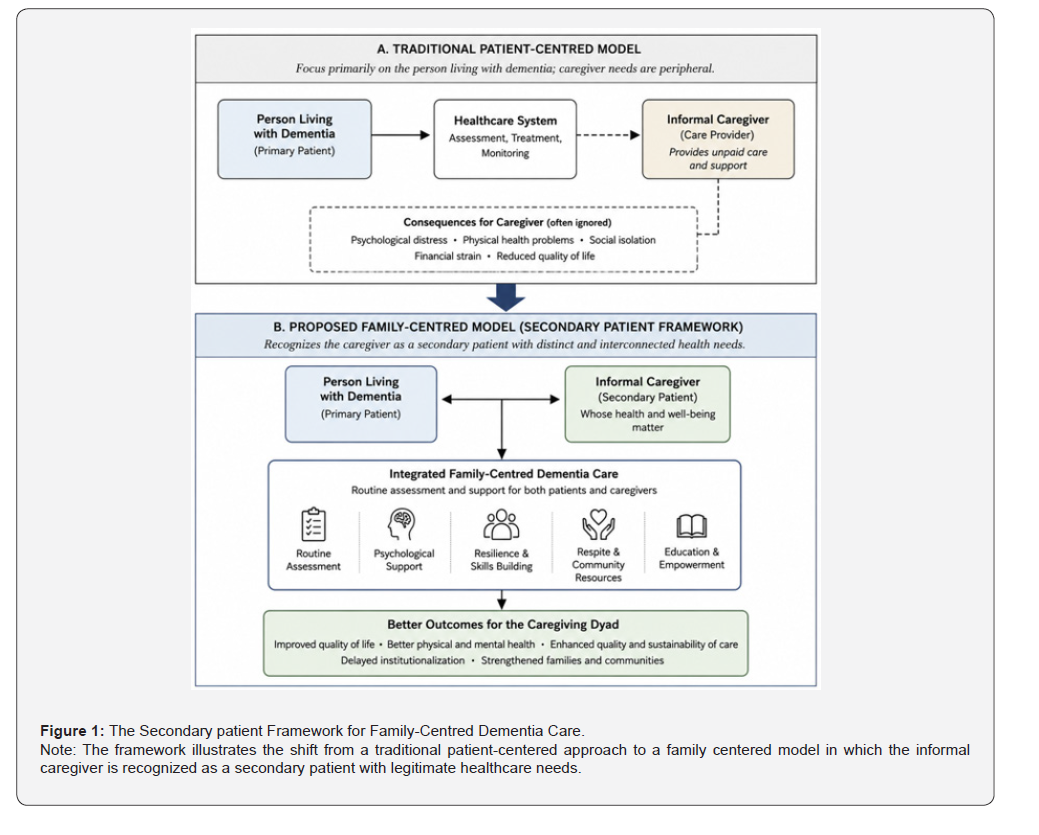
One immediate implication is the incorporation of routine caregiver assessment into clinical practice. Dementia services should include regular screening for caregiver burden, psychological distress, depressive symptoms, resilience, perceived social support, sleep disturbances, and overall quality of life using validated assessment tools. Such assessments should not be viewed merely as measures of caregiving capacity but as indicators of caregiver health that require systematic monitoring throughout the progression of dementia Brodaty & Donkin [3], Alzheimer’s Association [7]. Early identification of caregiver difficulties would facilitate timely referral to psychological services, caregiver education programmes, respite care, and community-based support before distress progresses to burnout or health deterioration.
Equally important is the need to shift from burden focused interventions towards approaches that strengthen caregivers’ adaptive resources. Contemporary evidence increasingly demonstrates that resilience, perceived social support, adaptive coping strategies, and caregiver self-efficacy are associated with more favorable psychological outcomes among dementia caregivers Dias [8], Teahan [9]. Consequently, interventions should not focus exclusively on reducing stress but should also enhance caregivers’ adaptive capacities through resilience training, psychoeducation, peer support programmes, family counseling, and community engagement. Such strengthbased approaches complement rather than replace traditional psychosocial interventions, providing a more comprehensive model of caregiver support.
The proposed framework is particularly relevant for lowand middle-income countries and other collectivist settings, where healthcare systems depend heavily on unpaid family caregiving while formal long-term care services remain limited. In these contexts, supporting caregivers is not simply a matter of improving individual well-being but a strategy for strengthening the sustainability of dementia care itself. Policies that formally recognize caregivers within national dementia strategies, expand access to caregiver education and respite services, and integrate caregiver assessment into primary healthcare could substantially improve outcomes for both caregivers and people living with dementia World Health Organization [1].
Finally, recognizing caregivers as secondary patients requires a broader transformation in professional education and healthcare culture. Physicians, psychologists, nurses, and allied health professionals should be trained to view caregivers not solely as partners in delivering care but also as individuals whose own health requires ongoing attention. This family centered perspective acknowledges that optimal dementia care cannot be achieved by focusing exclusively on the person living with dementia. Rather, sustainable, high-quality care depends upon recognizing and supporting the health and well-being of both members of the caregiving dyad.
A Call for Family- Centered Dementia Care
The growing prevalence of dementia demands a corresponding evolution in how healthcare systems conceptualize and deliver care. Although considerable progress has been made in recognizing the psychological burden experienced by informal caregivers, they continue to occupy a largely peripheral position within dementia care pathways. This commentary argues that such an approach is no longer sufficient. As the evidence increasingly demonstrates, caregivers experience substantial psychological, physical, and social consequences that extend well beyond the traditional expectations of family caregiving. Their health and well-being are inextricably linked to the quality, continuity, and sustainability of care provided to people living with dementia.
Reframing informal caregivers as secondary patients offers an opportunity to move beyond a narrowly patient centered model towards a genuinely family centered approach to dementia care. This perspective does not diminish the importance of the person living with dementia; rather, it acknowledges that dementia affects an interconnected caregiving dyad in which the health of one individual inevitably influences the well-being of the other. Recognizing caregivers as legitimate recipients of healthcare encourages a more comprehensive model that integrates routine caregiver assessment, preventive psychological support, resilience-building interventions, and sustained access to social and community resources throughout the course of the disease.
The need for such a transformation is particularly pressing within collectivist societies, where caregiving is deeply embedded in cultural values of family responsibility, reciprocity, and intergenerational solidarity. While these values represent important social strengths, they may also contribute to the normalization of caregiver distress, delaying recognition of caregivers’ own health needs and limiting help-seeking behaviors. Healthcare systems operating within these contexts should therefore preserve the strengths of family caregiving while simultaneously ensuring that cultural expectations do not obscure the physical and psychological well-being of caregivers.
Ultimately, improving dementia care requires moving beyond the traditional question of “How can we better support people living with dementia?” to the broader question of “How can we better support families living with dementia?”. This shift reflects more than a change in terminology; it represents a necessary evolution in dementia care philosophy. By recognizing informal caregivers as secondary patients and integrating their health needs into routine clinical practice, healthcare systems can promote more equitable, sustainable, and person- and familycentered models of care that benefit both caregivers and those living with dementia.
References
- World Health Organization (2025) Dementia.
- Hayat SZ, Saad M, Bukhari SR, Naz N (2026) A buffering role of perceived social support and resilience between caregiver burden and perceived stress among informal caregivers of dementia elderly patients. BMC Geriatrics 26: 673.
- Brodaty H, Donkin M (2009) Family caregivers of people with dementia. Dialogues in Clinical Neuroscience 11(2): 217-228.
- Pinquart M, Sörensen S (2003) Differences between caregivers and non-caregivers in psychological health and physical health: A meta-analysis. Psychology and Aging 18(2): 250-267.
- Schulz R, Sherwood PR (2008) Physical and mental health effects of family caregiving. American Journal of Nursing 108(9 Suppl): 23-27.
- Knight BG, Sayegh P (2010) Cultural values and caregiving: The updated sociocultural stress and coping model. The Journals of Gerontology: Series B 65B (1): 5-13.
- Alzheimer's Association (2025) 2025 Alzheimer's disease facts and figures. Alzheimer's & Dementia 21(4): e70235.
- Dias R, Santos RL, Sousa MFB, Nogueira MML, Torres B, et al. (2015) Resilience of caregivers of people with dementia: A systematic review of biological and psychosocial determinants. Trends in Psychiatry and Psychotherapy 37(1): 12-19.
- Teahan Á, Lafferty A, McAuliffe E, Phelan A, O'Sullivan L, et al. (2018) Resilience in family caregiving for people with dementia: A systematic review. International Journal of Geriatric Psychiatry 33(12): 1582-1595.

























