



 OAJGGM Home



Abstract
Societies across the world are beginning to see that aging is not a singular process that is entirely genetic, programmed, or obligatory. We see social media, research articles, podcasts, magazines and movies all demonstrating a deepened interest into the processes of aging. Across all of these mediums, a person is likely to be exposed to many approaches by which we can “control aging” - many of which contract one another in cycles not unlike a popularity contest. The discussions abound seem to turn a blind-eye to two important considerations in recommending anti-aging approaches. First, that there is no one singular process that defines aging for all, and not that unify each human’s experience. Second, while worldwide beliefs about and expectations for aging are changing for the better, there are many biases that have deeply impacted the choices that we have made, and those that we continue to make, contributing to our own aging experience. This paper will detail some of the primary biases that influence aging and offer strategies to reduce the deleterious impact of biases on our impression of aging, and ultimately our lived experiences.
Keywords:Aging; Lifespan; Leg strength; Cortical atrophy; Dementia
Introduction
Through storytelling, songs, print and social media, it is apparent that humans have had an uncomfortable relationship with aging that may have reached a nadir. We may be reversing this trend toward a more comfortable and fact-based relationship with how we age. Age is seemingly in a transition from stigma to badge of honor. Our impressions on aging are evolving in the medical and social circles. The rate of publications focused on aging is clearly on the rise. Perhaps even more notably, the consideration of healthspan is emerging as a frontrunner, over our prior valuation of lifespan. Both conversations have a common throughline of controlling, limiting, mitigating or hacking the processes – without really understanding what the processes of aging are.
What may be most notable and central in the discussions of aging, healthspan and lifespan is the discussion of “squaring the curve” or “living long and dying fast”. While many have addressed this concept, proposing that healthspan is more valuable than lifespan, it is well-covered by Srinivasan in his 2015 article, “When Life Span Exceeds Health Span” [1].
As with any popular topic, there has been profiteering and misinformation, controversy and conflict surrounding scientific discoveries related to aging. In sharp contradiction to my youth and young adulthood watching morning news broadcasts focus on “escape velocity” stories (focused on lifespan), we are now more likely to hear about success stories regarding the number of participants in a senior games or people over 80 completing a marathon (focusing on healthspan).
As stated in the 2025 article entitled, “The Age of Aging”, “(there is) a worldwide awakening – a pivot (regarding age). This awakening is not an overnight sensation but is rather a dynamic process that is in evolution as we speak. In pop culture and science alike, we are doing well by blaming less on aging while simultaneously we are pushing the boundaries of possibilities within older age.” [2].
We must begin with the understanding that for centuries, we have given the physiology of aging too much power – thinking of aging as a singular process that is both obligatory and unmalleable. As a result, we continue to err on the side of escaping or even hacking aging, rather than accepting “it”. Accepting aging deserves its own course-correction though, as this could invite us to believe in the historical trappings that give the processes of aging too much power and too much credit. How did we get “here”, giving so much power to aging? How and can we “take some back”?
How Did We Get Here?
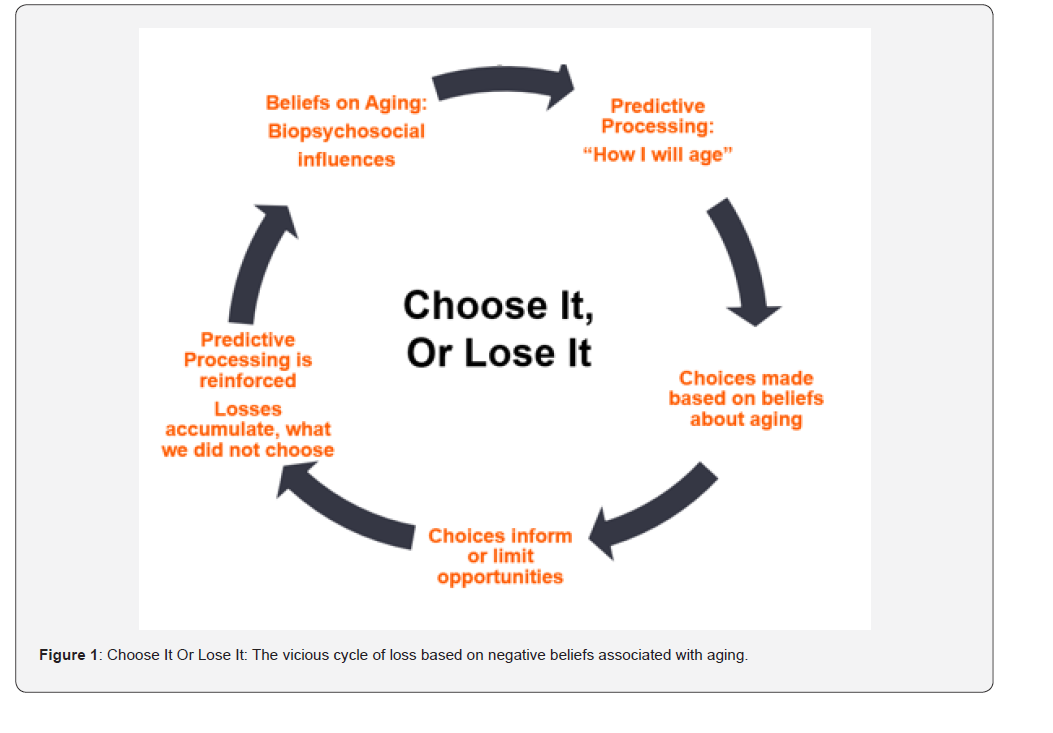
We come by our thought processes quite innocently and, according to much of what we read in behavioral economics, we come by these thoughts quite uniformly. Our natural cognitive biases can influence perception and prediction, ultimately leading to choices that negatively impact aging… leaving the result to be blamed on the process of aging (Figure 1), rather than what might be more accurate, blaming the choice itself.
How Our Biases Can (not will) Affect Aging
Confirmation Bias, influencing Predictive Processing
Relevance and definition: Confirmation bias causes individuals to direct increased attention and allocate greater perception for those outcomes that they expect based on past experiences (predictive processing) or predict based on thought patterns (bias) [3].
Examples:
Life expectancies – what we expect and predict to happen [4].
Life events – what we experience (including our perception)
[4-7].
Genetics – what we have seen in our relatives and therefor
expect/predict for ourselves.
Examples:
W.N., a 77-year-old female, widowed for the past 3 years, moves from a second-story home to a first-story home. Since her husband passed, W.N. has been grocery shopping regularly (nearly weekly) with her daughter. After being in the new residence for 18 months, she begins to experience difficulty getting out of her daughter’s car, the same car that she has owned for years. W.N. says to herself, “I must be getting older.”
Outside of a new medical event, what else could be a likely cause? Is it possible that the loss of strength is naturally-occurring, yet is being combined with confirmation bias in the form of an internally-applied stereotype?
What if W.N. is merely experiencing a loss of naturallyoccurring, daily leg strength opportunities – the stairs. How much of W.N.’s predictable (use it or lose it) loss in leg strength will be blamed on aging? Could some of these losses be mitigated by finding a way to replace that strength stimulus in her single level home?
P.B. is a 69-year-old male, retired for the past 14 months. Prior to retiring, P.B. was supervising a team of 11 and learning new software programs every 4-6 months. Now, just over a year after retirement, he has been found to be more forgetful with everyday tasks, medical appointments, and exhibits new word-finding difficulties.
Are these changes due to aging? When cognitive stimuli are reduced, should a person exhibit these changes? When a person retires from full-time work, it may be considered natural and predictable that they may have less of a need-to-know what time it is, day of the week it is, to divide attention (dual task), and to meet timelines. They may also have fewer life-demands to meet new people or learn new processes than they would have at work. How much do these changes impact their rate of cortical atrophy, their opportunities to form new memories? Could some of these losses be mitigated by finding a way to replace the cognitive stimuli?
Similar to W.N., is it possible that P.B.’s cognitive experiences are also naturally-occurring, as a function of reduced cognitive stimuli, being combined with confirmation bias in the form of an internally-applied stereotype?
In each of these cases, a person could begin to change their predictive processing. They might begin to watch-for and more increasingly notice weakness or cognitive errors, because of their recent experiences. They may even reduce their participation in life events because they are ashamed or fearful of leaving the home or interacting with others.
M.S. is an 8-year-old male, fun-loving boy with aspirations of being a Major League Baseball player. As he plays catch with his 52-year-old grandfather, M.S. is silently forming definitions and expectations of what old looks like and predictions of what he himself should be able to do at that age. Over his ensuing decades, M.S. is likely to redefine what age “old” is and continue predictive processing about what his own life experience will be.
What will society (cultural contacts, social media, press) do over his lifetime to erode or expand his expectations of aging? How will his own health experiences cause his expectations to pivot? Where can he build redundancies to mitigate bio-psychosocial influences? For all of the trappings and problems that come with social media, is it possible that technology can elevate our impression of aging over the next few generations, celebrating wins and increasing all of us to aspirations that we might not have otherwise heard about?
If some of the losses that are correlated with aging are not actually caused by aging, then by extension, there is some capacity remaining for mitigation, controllability, or perhaps even reversal of a trend. There is a significant societal sea change that impacts our biopsychosocial experiences (and in turn the epigenetic influences on subsequent generations) when we understand that aging is not the same for everyone and that choice3, experiences, environment, (our own) investments toward wellness and our beliefs will all make a difference – no matter how late we start [7,8].
Consider for a moment what you believe, what you have said, and what you have heard about aging. Be willing to hold these beliefs loosely in regard to the themes surrounding:
a) Strength gains and frailty [9-11]
b) Capacity to improve balance/expectations for fall
frequency
c) Aging in place
d) Involvement in recreational sports
e) “Time to retire”
f) Life roles and responsibilities
g) Multidirectional health benefits of an extended family
living arrangement
h) Cognitive decline vs. reductions in cognitive stimuli
i) Features, expectations and amenities of/for senior living
communities
Summarizing implications on aging: Our beliefs influence what we attend to, our perception of interactions, and our choices regarding what is safe or appropriate.
Analogy: Confirmation bias on aging is like looking through a powerful telescope to peer into our future. We see exactly what we are looking-for and focused on…yet we miss what happens outside of this singular focus.
One caveat remains in this discussion of confirmation bias as related to aging. That is the less common but not rare experience of “The Invincible Mindset Paradox”. Should an individual hold unearned or undeservingly optimistic views on their health and aging experience, they may not adhere to routing preventative practices or even strong medical advice. An example of this could be assumed in an individual that states, “Both of my parents lived to be 100, I really don’t have anything to be worried about.” [9].
Status Quo Bias or “The End of History” Bias
Relevance and definition. The tendency to project stability over a future period in one’s life, as though the largest amount of change has already been experienced [3].
Example: “That was a challenging past 5 years, I am looking forward to some peace and consistency now that I have retired.
Summarizing implications on aging: Some individuals could be tempted to reduce their investment in life skills if their future feels relatively pre-determined.
Analogy: Putting money in the bank as safekeeping for a few years may make it difficult to keep up with the cost of living.
Nostalgia Bias
Relevance and definition: Overvaluing past conditions (society, environment) in terms of safety, prosperity, morality, peace or other [3].
Examples:
Valuing paleo and keto-based dietary approaches because they feel more natural
Overestimating physical capacities possessed in one’s youth
Values on “the good old days” – parenting, healthcare, technology
Summarizing implications on aging: Seeing the state of the world as more desirable in the past or seeing younger generations as having undesirable attributes may lead to unhealthy ruminations.
Nostalgia bias can lead to choices that are incompletely informed. A common sentiment summarized as, “We should simply eat like our ancestors used to. They didn’t die of cancer or have dementia.”, is clearly a leap of logic that misses several steps.
Analogy or theme: “This is how our ancestors (and prehistoric predecessors) did it” is a common theme that can be seen referring to diet, hygiene, medical interventions, immunizations, education and parenting.
Recency Bias
Relevance and definition: Overvaluing near-past occurrences and conditions to assume that either: all future events will now be consistent with these experiences, or that this event was a bestever in class representation (vacation, movie, meal) [3].
Example:
Summarizing implications on aging: Our most recent interactions may be overvalued and cause us to pivot from a previously healthy and consistent approach. Reading one story from an unscientific source can cause us to make an uninformed change.
Analogy or theme: “My knee just started to hurt. My knee will likely hurt from now on.”
Additional biases that undoubtedly play a role in most people’s aging experiences, yet are beyond the scope and depth intended here include [3]:
a) Choice Bracketing – grouping decisions about
retirement, aging in place, or even activities to give-up, based on
societal expectations of age. Example – moving households and
stopping bike commuting and retiring in the same year.
b) The Illusion of Explanatory Depth – overestimating our
understanding of aging, simplifying it as “all based on genetics” or
“a singular process”.
c) The Illusory Truth Effect – believing myths about aging
because of the frequency that we have heard these untruths.
Example, “If you live long enough, you will have dementia…it is
just a matter of when it starts, based on your genetics.”
Solution-Focused: How do we take (some) control back from aging?
Accept less about aging. Challenge (yourself and societal expectations) more.
As the CEO of the International Council on Active Aging, Colin Milner has been quoted as saying, ““In my mind, we have one life, and we have two choices: do we get the most out of it, no matter our circumstances, or do we not?” [10].
The science is proving that our healthspan can be positively influenced by our actions in physical activity, nutrition, sleep, rest, play, social connections and novel experiences. The good news is that you, today, could make a no-cost (free) change for the positive in any one of these arenas – a choice that you can make better than anyone can make for you that has been proven to be effective in aging [11-15]. According to Levy & Slade (2026), “...(this) study demonstrated for the first time that participants who had assimilated more positive age beliefs were more likely to show improvement in both cognitive and physical function” [11].
While you are making those personal changes, investing in yourself, consider one more arena of change that you can impact – societal beliefs. Be willing to push-back when you see or hear ageism, large or small.
Finally, on the topic of society’s shifting perceptions of aging, consider the benefit of two final levers that you can pull for yourself, patients, clients, customers and family members:
a) Consume stories that provide hope and celebrate accomplishments in later years. Subscribe to one or all of these uplifting and informative podcasts: Age Better (Barbara Hannah Grufferman), Growing Bolder (Marc Middleton), Ageist (David Harry Stewart), Feel Better Live More (Dr. Rangan Chatterjee).
b) Identify your personalized opportunities to function better (starting now, for now and for later years, by reading and applying the principles outlined in Scott Fulton’s book, Function: Turn Your Blind Spots Into Strengths [12].
c) Employ the Fresh Start Effect. This can be a powerful behavioral change agent that you can wield to your advantage. Giving yourself permission or a reason to make a pivot can be more easily adopted if tied to an event, date, or occasion. Examples of a Fresh Start can include retirement, first grandchild, after a medical event, near-miss (medical or car accident), or after moving to a new residence. New habits that can be adopted, “because of” this Fresh Start could include choices about processed or sugary foods, exercise or movement habits, alcohol, smoking or regular bedtime [3].
d) Employ the Endowment Effect. We tend to work harder to preserve what we have earned or built. Be prideful about the gains that you have made – or even the decisions to live differently. Much like “The Ikea Effect” (also a named principle), when we have built something – improved strength, lost body fat, improved blood pressure, improved endurance – we are more likely to act in a manner that values what we now have [3].
The Bright Side: Identity, Growth Mindset, & Predictive Processing
Prediction influences choices, actions and expectations. That does not have to be a bad thing.
If we believe that “Growth Mindset” can influence how we approach a present-day dilemma, then we should be able to accumulate this outlook for our long-term benefit [11-15].
If we believe that “perception matters”, influencing us at the cellular level and beyond (immune health, mental health, physical performance, and beyond); then here again is an opportunity for us to impact aging positively – at any age [8,11-17].
If we believe that a placebo effect…and a nocebo can be effective, then we can make individual choices regarding our own aging and expect that giving people one of many options to choose from will be better than condemning or regulating people into choosing the current-based fad, life hack or promotion [8,18].
Redefine Yourself: Self talk for the 1% wins that become a new identity of aging
“Hard habits die old.”. Re-read that. It is not the saying that you have come to be accustomed to hearing, “Old habits die hard.”. This is a theme of programmed resilience, of fitness in the mind and body is grounded in chapter 6 of the book, “The Brain That Chooses Itself”: Practical Strategies to Improve Your Healthspan” [8] and is cited directly in many articles [16,19] Push yourself to learn and do something new, something challenging…on a regular basis – you have permission to continue The Age of Aging for yourself, and empower others to do so as well. Small changes add up to become cues that we soon seek-out and eventually become identities.
What is wrong with setting a healthspan goal to reach 90 with fitness and fun, not frailty? As Michelangelo was paraphrased to say, “The danger is not in setting goals too high, but in setting goals too low – and reaching them.” If you do not have a positive outlook on your future, your future will not have a positive outcome. Psychologist Ellen Langher has more research and quotes than what could possibly fit into this article, yet a few of the most salient include:
“The more we realize that most of our views of ourselves, of others, and of presumed limits regarding our talents, our health, and our happiness were mindlessly accepted by us at an earlier time in our lives, the more we open up to the realization that these too can change. And all we need do to begin the process is to be mindful.” [13].
“It is not primarily our physical selves that limit us but rather our mindset about our physical limits.” [17].
“Most of the deterioration we experience is a function of our minds.” [18].
A simple mantra, spoken aloud or in silence may be helpful in your efforts to improve by 1% each day. This might be read as, “I am going to choose myself today (invest in myself) in three ways.”. An individual could choose two or three tomorrow. They might be the same, or different, but by invest in ourselves daily, we become (identity), a person that might be hear to say, “I am a person that invests in myself. In small ways, consistently.”. This mantra-example is a form of loss aversion and is an oxytocinergic experience – helping someone else even when that “someone” is your future self! [8,16,19].
These small choices could be simple: movement snacks [19], regular bedtime [8] 30 different plants per week in my diet [8], set a “move goal” on your smartwatch and try to build a streak of meeting it, learn one new word in a foreign language per day, have a three-minute phone call or in-person conversation with five different people per week.
When you have healthy options like these to choose from and the autonomy to make a choice…that choice will be more effective because you believe in it. This has a basis in the placebo effect among many other principles [20-22].
Reverse biases by countering them with small, albeit real, actions. Soon you may start to see the Baader-Meinhof effect coming into play. You may hear about others doing the same thing – investing regularly in themselves, not “being selfish”, but respecting their brain and bodies for future use.
Conclusion
Beliefs frame our experiences by shaping what we see and what we look for. Beliefs therefore impact our perception and encoding – our memories. Our memories frame predictive processing, influencing the choices that we make by limiting the possible options that we have by drawing only from what we believe is possible and what has worked in the past. Our options from which to choose can become further constrained both by physiologic processes (what we are capable-of) and by our predictive processing (what we think we are capable-of). These choices influence what stimuli we are exposed to, decisions about running, walking on a slippery surface, attempting a new skill, route-finding without an app, taking an adventure or vacation, meeting new people. This list ultimately informs what we use, and what we lose, perhaps equally as powerful as “the process of aging” itself, on our aging experience.
References
- Srinivasan M (2015) When life span exceeds health span. J Gen Intern Med 30(3): 267-268.
- Studer M (2026) The Age of Aging: are we in the “Decade of Healthspan”? J Fam Med Prev Med 3(1): 11-16.
- Milkman K (2026) Choiceology Glossary. static1.squarespace.com.
- Alexopoulos GS (2026) Decline of Aging: Aesthetics and Ethics of Care. Am J Geriatr Psychiatry 34(4): 694-700.
- Mastrotheodoros S, Boks MP, Rousseau C, Meeus W, Branje S (2023) Negative parenting, epigenetic age, and psychological problems: prospective associations from adolescence to young adulthood. J Child Psychol Psychiatry 64(10): 1446-1461.
- Korous KM, Surachman A, Rogers CR, Cuevas AG (2023) Parental education and epigenetic aging in middle-aged and older adults in the United States: A life course perspective. Soc Sci Med 333: 116173.
- Lynn S, Satyal MK, Smith AJ, Tasnim N, Gyamfi D, et al. (2022) Dispositional mindfulness and its relationship to exercise motivation and experience. Frontiers in sports and active living 4.
- Studer M (2024) The Brain That Chooses Itself.
- Chipperfield JG, Perry RP, Pekrun R, Barchfeld P, Lang FR, et al. (2016) The paradoxical role of perceived control in late life health behavior. PLOS ONE 11(3).
- Dazen C (2024) Aging redefined: Colin Milner inspires a fresh vision for healthy living at Passavant. Lutheran SeniorLife.
- Fulton S (2026) Function: Turn Your Blind Spots Into Strengths.
- Levy BR, Slade MD (2026) Aging Redefined: Cognitive and Physical Improvement with Positive Age Beliefs. Geriatrics 11(2): 28.
- Langer EJ (2014) Mindfulness, 25th anniversary edition. In: Da Capo Lifelong Books.
- Zare BI (2025) You’re Not Too Old and It’s Not Too Late: Weekly Practices for Meaning, Mindfulness and New Possibilities at Midlife and Beyond. In: Hollister, CA: MSI Press.
- Levy B (2022) Breaking the Age Code: How Your Beliefs About Aging Determine How Long & Well You Live. In: New York, NY: William Morrow.
- Studer M (2025) On Resilience: Psychological, Physical, and Physiologic – Leveraging the Challenged Life Matrix to Explain and Manage Unintentional Stressors. J Psychol Neurosci 7(4): 1-15.
- Langer EJ (2009) In: Random House Digital.
- Roll R (2024) Harvard’s Dr. Ellen Langer On The Mind-Body Connection, The Power of Mindfulness, & Why Age Is Nothing But a Mindset. The Rich Roll Podcast.
- Studer M (2025) Exercise in Disguise: Reversing and preventing frailty with CAMMO. Ann Gerontol Geriatr Res 1(1): 1005.
- Studer M (2025) Practical Applications in Lifespan and Healthspan: Debunking the myths, fads, trends and gimmicks - and adding choice! Journal of Rehabilitation Practices and Research. J Rehab Pract Res 6(1): 168-173.
- Geers AL, Rose JP, Fowler SL, Rasinski HM, Brown JA, et al. (2013) Why does choice enhance treatment effectiveness? Using placebo treatments to demonstrate the role of personal control. J Pers Soc Psychol 105(4): 549-566.
- Beecher HK (1955) The powerful placebo. Journal of the American Medical Association 159(17): 1602.

























