




 OAJGGM Home



Abstract
Background/Aims
Delirium is a geriatric syndrome characterized by alteration of multiple cognitive functions, during acute clinical condition, with consequences
of health outcomes and costs. According to some studies in the Emergency Department the prevalence is 40%. Our aim was to estimate the
prevalence and features of Delirium in ED.
Methods
After a careful knowledge and systematic review of International and National literature on medical databases, we have used the 3D-CAM scale.
Results
We analyzed 100 subjects in the ED in time frame Sept-Dec 2023. Average age 86 years. In 47% of cases the 3D-CAM was administered with
physical examination. The Delirium prevalence was 48%. The triggering causes include infections (70%), cardiorespiratory problems (20%),
pain, anemia, dehydration (10%); an overlap with dementia occurred in 62% of cases. Pharmacological treatment was implemented in 52%.
Quetiapine and Haloperidol were the most used drugs (31% - 23%), Promazine (19%). Benzodiazepines (6-10%), soft restraints reach 40%.
The 67% of delirium patients were hospitalized vs 46% of non-delirium, with an average hospital stay of 26 days vs 18. Regarding outcomes we
detected that patient with Delirium noted an increase in hospitalization days, greater probability of developing complications (40%), greater
number of laboratory- radiological tests (41), residual worsen autonomy, access to rehabilitation or residential facilities (30%), death in 13%.
Conclusion
Through knowledge and use of 3D-CAM it is possible to recognize and carefully manage Delirium in the ED, improving the approach to elderly
patients. Prevention and management of Delirium in the ED is highlighted as Best Practice in International Geriatric Guidelines.
Introduction
Older Adults in the Emergency Department
Evidence from the literature indicates that older adults account for a substantial proportion of Emergency Department (ED) presentations. This patient population is characterized by a high burden of frailty, multimorbidity, and functional and cognitive impairment. In the absence of effective community-based and primary care triage, acute decompensation of frail older patients frequently translates into emergency presentations, thereby requiring hospital-level care. As a result, EDs are increasingly challenged by the management of complex geriatric patients with significant comorbidities, disabilities, and cognitive deficits, often exceeding the structural and organizational capacities of traditional emergency care models.
Despite this growing demand, the implementation of a tailored geriatric approach within the ED - integrating the principles of Comprehensive Geriatric Assessment (CGA) - remains limited. This shortfall is primarily attributable to time constraints intrinsic to the ED environment and to insufficient geriatric training and cultural preparedness among emergency care providers.
Several studies have reported a high prevalence of delirium in the ED setting, with rates reaching up to 40%. Delirium has been consistently associated with adverse clinical outcomes, including prolonged hospital length of stay, functional decline, deterioration in cognitive performance, increased risk of falls, higher incidence of medical and hospital-acquired complications, and increased mortality, with delirium recognized as an independent predictor of death. Moreover, delirium is associated with increased healthcare utilization and higher healthcare-related costs.
Delirium and Frailty
Delirium is an acute geriatric syndrome, typically transient, potentially reversible, and characterized by a fluctuating course, with disturbances in attention, cognitive function, and level of consciousness. Its etiology is multifactorial. Diagnosis is primarily clinical and is supported by laboratory tests and imaging studies aimed at identifying the underlying cause. Management focuses on correction of the precipitating factors and the implementation of supportive, non-pharmacological measures; pharmacological treatment should be considered only when strictly indicated.
Frailty is a multidimensional geriatric syndrome characterized by a reduction in physiological reserve and impaired homeostatic mechanisms, resulting in increased vulnerability to internal and external stressors. In older adults, frailty is associated with a higher risk of adverse outcomes, including functional decline, hospitalization, institutionalization, and mortality. In the Emergency Department (ED) setting, frailty is highly prevalent and frequently under-recognized, yet it plays a pivotal role in shaping clinical presentation, care complexity, and outcomes.
The relationship between frailty and delirium is increasingly recognized as bidirectional and synergistic. Frailty, characterized by reduced physiological reserve and impaired homeostatic mechanisms, predisposes older adults to delirium in response to acute stressors such as infection, surgery, or hospitalization. Conversely, delirium may accelerate or exacerbate frailty by delaying functional recovery, promoting immobility, worsening nutritional status, and contributing to persistent cognitive and functional decline. Together, these geriatric syndromes can initiate and perpetuate a vicious cycle of vulnerability, leading to progressive functional deterioration, increased risk of adverse events, higher rates of institutionalization and rehospitalization, and increased mortality.
Aim
After evaluating the prevalence of delirium using the 3D-CAM scale, we aimed to stratify patients according to their degree of frailty. Frailty was calculated as the sum of three domains: disability, comorbidity, and polypharmacotherapy. The objective of the study was to demonstrate a possible correlation between frailty and delirium.
PICO Framework
P – Population
Elderly patients presenting to the Emergency Department (ED), aged 75 years or older.
I – Intervention
Identification of delirium using the 3D-CAM scale and qualitative assessment of frailty, considering disability (defined as reduced autonomy and impaired ambulation), comorbidity, and polypharmacotherapy.
C – Comparison
The two subgroups, Delirium Positive and Delirium Negative, were analyzed and compared to evaluate the correlation between the two geriatric syndromes.
O – Outcomes
Assessment of the correlation between delirium and frailty. Frail patients showed a higher likelihood of developing delirium in the ED. Appropriate assessment of elderly patients in the ED may improve their clinical management.
Methods
Delirium was objectively assessed using the 3D-CAM scale. The 3D-CAM, a modified and validated version of the Confusion Assessment Method (CAM), demonstrates excellent sensitivity and specificity for the detection of delirium and can be administered using brief mental status tests focused on attention and orientation. The 3D-CAM was developed and validated by the American Delirium Society and is designed as a short, structured diagnostic assessment for delirium. Validation studies have shown strong psychometric and performance characteristics.
Frailty was qualitatively analyzed through evaluation of:
a) Disability, defined as reduced autonomy in Activities
of Daily Living (ADL; red flag if score <4/6), level of ambulation
(independent, requiring aids, bedridden), and social support
(family, caregivers, institutionalization).
b) Comorbidity, defined as the presence of four or more
chronic diseases.
c) Polypharmacotherapy, defined as a history of at least
five medications.
Subsequently, a correlation analysis was performed using qualitative data. Correlation analysis was performed using descriptive comparisons between frailty and delirium status.
Disability
a) ADL score ≤ 4/6
b) Ambulation with or without aids, or bedridden status
c) Social support (family, caregivers, or living alone)
Frailty
a) Disability
b) Comorbidity, defined as the presence of ≥4 chronic
conditions
c) Polypharmacotherapy, defined as a history of ≥5
medications
Results
The study included 100 patients presenting to a metropolitan Emergency Department. The mean age was 86 years; 40% were male and 60% female. All patients were admitted to the medical area of the ED. After application of the 3D-CAM scale, delirium was identified in 48% of cases.
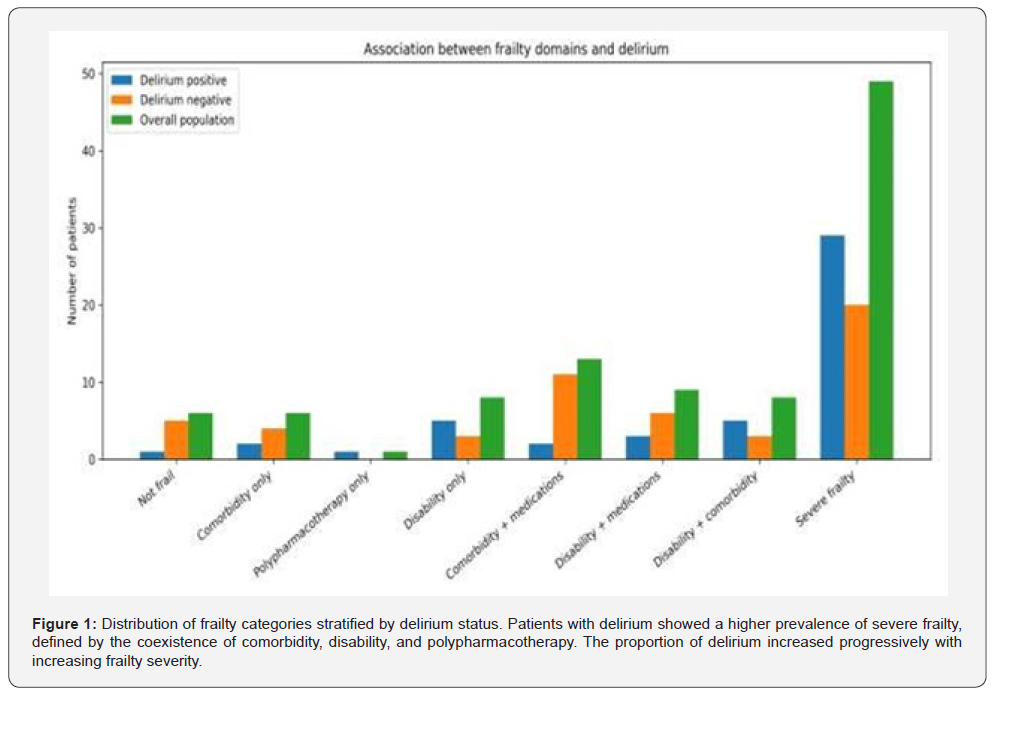
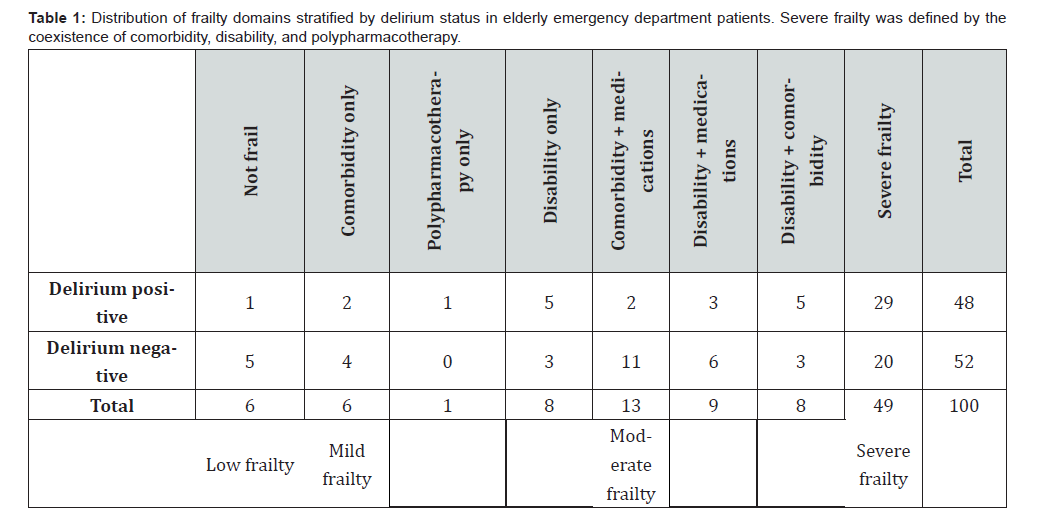
Analysis of comorbidity, disability, and polypharmacotherapy allowed identification of frailty status. In 49% of cases, patients exhibited severe frailty, characterized by the coexistence of comorbidity, disability, and polypharmacotherapy. In 30% of cases, at least two of the three characteristics were present, defining a condition of moderate frailty. In the remaining 15% of patients, at least one of the three characteristics was present [1- 13].
The Delirium Positive subgroup showed a higher degree of frailty compared with the overall population. Specifically, 60% of patients in this subgroup exhibited severe frailty, characterized by comorbidity, disability, and polypharmacotherapy, while 20% presented two of these characteristics, consistent with moderate frailty. Overall, 80% of Delirium+ patients demonstrated a moderate-to-severe degree of frailty.
Correlation analysis revealed that severe frailty (defined by comorbidity, disability, and polypharmacotherapy) was more prevalent among patients who developed delirium. From graphical analysis, it can be inferred that patients with higher degrees of frailty had a greater probability of developing delirium. Furthermore, the percentage of patients affected by delirium increased progressively with increasing levels of frailty (Table 1) (Figure 1).
Discussion
Frailty represents a key determinant of vulnerability in older adults presenting to the Emergency Department and appears to be closely intertwined with the development and progression of delirium. The reduced physiological reserve and impaired resilience that characterize frailty render patients less able to compensate for acute insults, increasing both the likelihood of delirium and the severity of its clinical course. Conversely, delirium may accelerate the frailty trajectory by promoting immobility, functional decline, nutritional deterioration, and persistent cognitive impairment.
This bidirectional relationship between frailty and delirium may initiate a self-perpetuating cycle of decline, ultimately leading to adverse clinical outcomes such as prolonged length of stay, increased risk of in-hospital complications, rehospitalization, institutionalization, and mortality. In this context, systematic identification of frailty in the ED - potentially through brief, validated screening tools - could improve risk stratification, facilitate early delirium prevention strategies, and inform clinical decision-making. Integrating frailty assessment into emergency care pathways may thus represent a crucial step toward improving outcomes for older adults with complex care needs.
Conclusion
The concept of frailty shifts attention toward the overall complexity of the elderly patient. Delirium represents a marker of frailty. Our analysis demonstrated that patients with higher levels of frailty had a greater probability of developing delirium, with delirium prevalence increasing alongside frailty severity.
Frailty and delirium are highly prevalent and interrelated geriatric syndromes among older adults presenting to the Emergency Department and are major determinants of adverse clinical outcomes. Their bidirectional interaction increases patient vulnerability, contributing to functional decline, prolonged hospitalization, and increased mortality, while both conditions often remain under-recognized in emergency care settings.
Early identification of frailty and systematic delirium screening using brief, validated tools such as the 3D-CAM may improve risk stratification and guide timely, targeted interventions. Integrating geriatric principles into Emergency Department workflows represents a key strategy to improve quality of care and outcomes for this growing patient population.
Limitations
This study is limited by its relatively small sample size and single-center design, which may restrict the generalizability of the findings. Frailty was assessed using a pragmatic, nonvalidated approach based on disability, comorbidity, and polypharmacotherapy, chosen for feasibility in the Emergency Department but limiting comparability with studies using standardized frailty instruments. Additionally, the analysis was descriptive and did not adjust for potential confounders; therefore, the association between frailty and delirium should be interpreted as correlational rather than causal.
At the time of data collection, standardized frailty assessment tools such as the Clinical Frailty Scale (CFS) were not yet routinely adopted in our Emergency Department. The systematic implementation of validated frailty scales has only been introduced more recently, in line with growing awareness of geriatric assessment in emergency care.
References
- Di Bari M, Balzi D, Marchionni N (2008) The elderly patient in the Emergency Department: problems and possible solutions.
- Gower LEJ, Gatewood MOK, Kang CS (2012) Emergency Department Management of Delirium in the Elderly. West J Emerg Med 13(2): 194-201.
- Zhang Q, Li S, Chen M, Yang Q, Cao X, et al. (2021) Delirium screening tools in the emergency department: a protocol for systematic review and meta-analysis. Medicine (Baltimore) 100(8).
- Bellelli G (2020) Delirium, Department of Medicine and Surgery, University of Milano-Bicocca; Geriatrics Unit, San Gerardo Hospital, Monza.
- (2008) British Geriatrics Society – Clinical Frailty Scale.
- Mauro Di Bari, Daniela Balzi, Niccolò Marchionni (2007) The Elderly Patient in the Emergency Department: Problems and Possible Solutions.
- Lynn EJ, Gower DO, Medley OKG, Christopher SKM (2007) Emergency Department Management of Delirium in the Elderly.
- Chen F, Libo L, Wang Y, Liu Y, Fan L, et al. (2022) Delirium prevalence in geriatric emergency department patients: A systematic review and meta-analysis. Am J Emerg Med 59: 121-128.
- Han JH, Zimmerman EE, Cutler N, Schnelle J, Morandi A, et al. (2009) Delirium in older emergency department patients: recognition, risk factors, and psychomotor subtypes. Acad Emerg Med 16(3): 193-200.
- Fong TG, Tulebaev SR, Inouye SK (2009) Delirium in elderly adults: diagnosis, prevention and treatment. Aging Brain Center, Institute for Aging Research, Hebrew seniorLife, Boston, MA, USA, Nat Rev Neurol 5(4): 210-220.
- Antonelli IR, Cesari M, Leosco D, Pedone C, Ungar A, et al. (2019) Geriatrics Manual. In: Edra, USA, pp. 592.
- Marcantonio ER, Ngo LH, O’Connor M, Jones RN, Crane PK, et al. (2014) 3D-CAM: Derivation and Validation of a 3-Minute Diagnostic Interview for CAM-defined Delirium Ann Intern Med 161(8): 554-556.
- (2020) Delirium - Giuseppe Bellelli, Department of Medicine and Surgery, University of Milano-Bicocca, Geriatrics Unit, San Gerardo Hospital, Monza.

























