




 OAJGGM Home



Abstract
Background
Alzheimer’s disease (AD) is the most prevalent form of dementia worldwide, representing a growing public health concern as populations age. While biological mechanisms have been extensively studied, less is known about how sociodemographic determinants - such as residence, education, and socioeconomic context - affect the onset and distribution of AD in Spain. This study explores the association between sociodemographic factors and AD diagnosis among patients in primary health care centers in the province of Salamanca.
Methods
A cross-sectional, observational, and retrospective study was conducted using data from the Medora 4 electronic health records system of the Castilla y León Regional Health Service (SACYL). A total of 760 patients with a confirmed diagnosis of AD between 2009 and 2019 were randomly selected from an initial cohort of 1,623 individuals (95% confidence level, 2.59% margin of error). Variables analyzed included age, sex, place of residence (urban/rural), educational level, occupation, depressive symptoms, and family history of dementia. Data were analyzed with descriptive and inferential statistics using chi-square and Kruskal–Wallis tests (p < 0.05).
Results
Among the 760 participants, 70% were women (n = 535) and 30% men (n = 225), with a mean age above 65 years. AD prevalence was significantly higher among urban residents (50.8%) than rural residents (49.2%) (p = 0.016). Women were disproportionately affected in both environments, especially in rural areas (74.1% vs. 66.1% in urban areas). Depression was recorded in 40.3% of patients, more frequently among women, though no significant association was observed with AD onset. Advanced age and female sex were confirmed as predominant risk factors.
Conclusion
This study reveals a significant urban – rural disparity in AD prevalence in Salamanca, Spain, and confirms the higher vulnerability of older women. The findings underscore the need for targeted prevention and early detection strategies within primary care, particularly in urban settings where prevalence is higher. Understanding these sociodemographic determinants is crucial for designing equitable, community-based dementia care policies.
Keywords:Alzheimer’s disease; Dementia; Sociodemographic factors; Primary health care; Urban–rural disparities; Aging population; Spain
Introduction
The aging of the global population has become one of the most transformative demographic trends of the twenty-first century. According to the World Health Organization (WHO), life expectancy has increased by more than 20 years since 1950, and by 2050 the number of people aged 65 and over is projected to double, reaching 1.6 billion worldwide [1]. This demographic shift is particularly pronounced in Southern Europe, where population aging is accelerated by declining fertility rates and improved survival [2].
Alzheimer’s disease (AD) represents the leading cause of dementia and accounts for 60-70% of all dementia cases globally [3]. The disease is characterized by the accumulation of beta-amyloid plaques and tau protein tangles, leading to progressive neuronal loss, cognitive decline, and loss of functional independence [4]. Although the biological mechanisms are well established, the social and environmental determinants of AD are receiving increasing attention, especially in aging societies where demographic, economic, and healthcare disparities coexist [5].
In Europe, the prevalence of AD among people aged 65 years and older is estimated at approximately 4.5%, with an expected increase to 16.5 million cases by 2050 [6]. In Spain, prevalence rises sharply with age: from around 1% in individuals aged 65-69 to nearly 40% in those aged 90 or older [7]. The Spanish National Statistics Institute reports that 24.7% of the population in Castilla y León is aged 65 or above - one of the highest proportions in the country [8].
Sociodemographic determinants - such as education level, occupational background, income, and access to healthcare - have been recognized as influential factors in cognitive aging and dementia risk [9,10]. Urban–rural differences in lifestyle, pollution exposure, and healthcare access may further modulate disease onset [11]. Yet, few studies have examined these determinants in medium-sized provinces like Salamanca, which combines an aging rural population with an increasingly urbanized capital area [12].
This study therefore aimed to identify the sociodemographic characteristics associated with AD diagnosis in Salamanca’s primary health care network, comparing rural and urban populations. The findings contribute to a better understanding of the social distribution of AD and provide evidence to inform regional dementia prevention policies.
Methods
Study design and setting
A cross-sectional, observational, descriptive, and retrospective study was conducted to analyze the sociodemographic determinants of Alzheimer’s disease (AD) in the province of Salamanca, Spain. The study population comprised patients registered in Medora 4, the electronic health records system of the Castilla y León Regional Health Service (SACYL). Data collection covered the period from January 2019 to January 2020.
Salamanca, located in north-western Spain, is a province with approximately 330,000 inhabitants, of whom nearly 26% are aged 65 years or older [8]. The region combines a densely populated urban capital with numerous small rural municipalities, which provides a unique opportunity to compare sociodemographic and healthcare factors affecting AD diagnosis across different environments.
Population and sample
The target population consisted of 1,623 individuals diagnosed with AD within the Medora 4 database between 2009 and 2019. Using a simple random sampling technique stratified by health area, a sample of 760 patients was selected, ensuring a 95% confidence level and a 2.59% margin of error. Of these, 386 (50.8%) were residents of urban areas and 374 (49.2%) lived in rural areas.
Urban health centers included Alamedilla, Elena Ginel, Garrido Norte, Garrido Sur, San Bernardo, and Capuchinos. Rural centers encompassed Alba de Tormes, Aldeadávila de la Ribera, Béjar, Calzada de Valdunciel, Cantalapiedra, Ciudad Rodrigo, La Fuente de San Esteban, Fuenteguinaldo, and Ledesma.
Eligibility criteria Inclusion criteria:
a) Patients of any sex and age with a confirmed diagnosis of
Alzheimer’s-type dementia according to ICD-10 codes (F00).
b) Registered in the Medora 4 system and belonging to any
of the aforementioned health areas.
Exclusion criteria:
a) Patients who died during the study period.
b) Missing essential data in medical records (e.g., age, sex,
residence).
c) Diagnosis of other dementia types or severe psychiatric
disorders.
Variables
The variables included in the analysis were grouped as
follows:
a) Sociodemographic variables: age, sex, residence
(urban/rural), educational level (no schooling, primary,
secondary, higher), and previous occupation (manual, nonmanual,
professional).
b) Clinical variables: year of AD diagnosis (before 2014
/ after 2014), presence of depressive symptoms (before or after
diagnosis), family history of dementia, consumption of alcohol
or tobacco, and number of emergency department visits since
diagnosis.
c) Outcome variable: confirmed diagnosis of Alzheimer’s
disease.
Data collection procedures
Data extraction was performed manually by reviewing anonymized patient records within the Medora 4 system. All personal identifiers were removed to ensure compliance with the Spanish Data Protection Act (Ley Orgánica 3/2018) and the General Data Protection Regulation (EU 2016/679). Each variable was coded numerically for statistical processing and verified by double data entry to minimize errors.
Statistical analysis
Descriptive statistics were calculated for all variables. Quantitative variables were summarized as medians and interquartile ranges (IQR) due to non-normal distribution (assessed with the Shapiro–Wilk test). Categorical variables were expressed as frequencies and percentages.
Associations between categorical variables were assessed using the Chi-square (χ²) test, and between non-normally distributed quantitative variables using the Kruskal–Wallis test. Statistical significance was set at p < 0.05.
All analyses were performed using STATA version 16.0 (StataCorp, College Station, TX, USA). To improve interpretability, additional stratified analyses were performed by age group (65– 74, 75–84, ≥85 years) and educational level.
Results
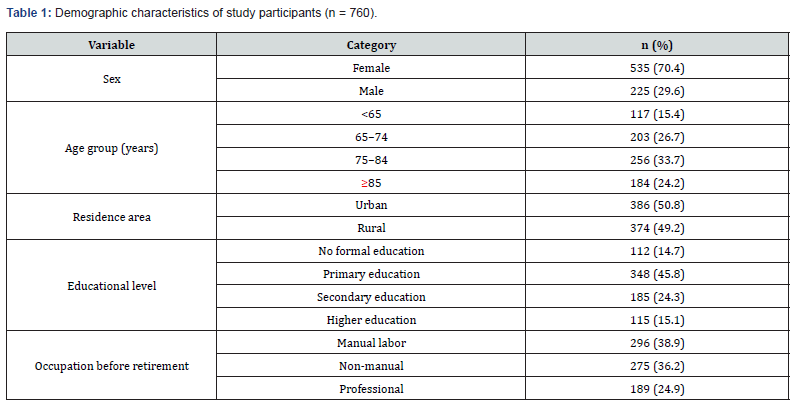
A total of 760 patients with a confirmed diagnosis of Alzheimer’s disease (AD) were included in the analysis. The median age was 78 years (IQR = 72–85). The sample was predominantly female (70.4%, n = 535) and consisted mainly of older adults aged 75 years or above (57.9%).
Distribution by sex, age and residence
Table 1 summarizes the main demographic features. Overall, women represented a higher proportion of AD cases in both urban and rural environments. The female-to-male ratio was 2.3 : 1.
When stratified by residence, urban dwellers accounted for 50.8% of cases and rural residents for 49.2%. The difference in prevalence between these two settings was statistically significant (χ² = 5.82, p = 0.016) (Table 2).
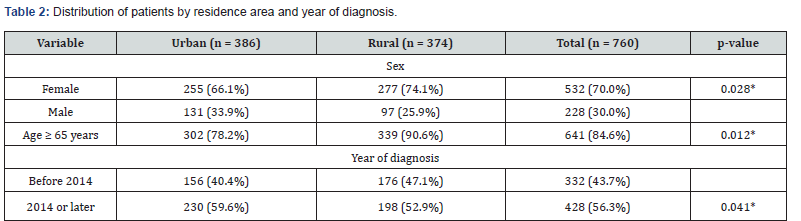
Statistically significant difference at p < 0.05.
Age distribution also revealed a progressive increase in AD frequency with advancing age, particularly among women. In rural areas, 74.1% of patients were women compared with 66.1% in urban areas. Among women, 58.6% were aged ≥65 years, while only 11.4% were younger than 65 years.
Depressive symptoms and family history
Depressive symptoms were reported in 40.3% of the total sample (306 patients), more frequent among women (30.1%) than men (10.2%). However, the association between depression and AD diagnosis timing was not statistically significant (χ² = 2.14, p = 0.14) (Table 3).
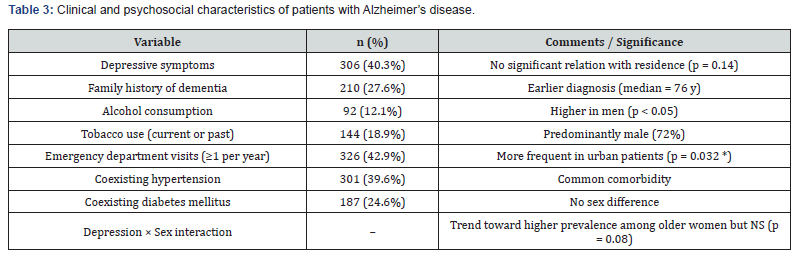
NS = Not significant.
Regarding family history, 27.6% of patients had at least one first-degree relative diagnosed with dementia, but no urban–rural differences were found (p = 0.21). Patients with a family history were on average diagnosed 1.8 years earlier than those without (median age = 76 vs. 78 years).
Summary of key findings
a) Urban residence was significantly associated with higher
AD prevalence (p = 0.016).
b) Female sex and advanced age remained dominant nonmodifiable
risk factors.
c) Depression was common but not statistically related to
diagnosis year or residence.
d) Family history correlated with slightly earlier onset.
e) Emergency service utilization was higher in urban than
rural settings, suggesting differences in healthcare access and
disease management patterns.
Discussion
This study analyzed the sociodemographic determinants of Alzheimer’s disease (AD) among patients in primary care centers across the province of Salamanca, Spain. Using realworld data from the Medora 4 electronic health record system, it revealed significant differences in AD prevalence by residence, sex, and age. The results confirm that older adults and women are disproportionately affected and that the prevalence is higher among urban than rural residents.
Urban–rural disparities
The finding of a greater AD prevalence in urban areas is consistent with other European studies suggesting that urban living may increase exposure to environmental and lifestylerelated risk factors for cognitive decline [13,14]. Higher levels of air pollution, noise exposure, sedentary behavior, and psychosocial stress in cities may contribute to neurodegenerative processes [15,16]. A recent Spanish population-based study also observed a higher dementia incidence in urban regions compared with rural ones, even after controlling for education and comorbidities [11,12].
However, these results should be interpreted cautiously. The apparent “protective effect” of rural living could also reflect diagnostic underreporting due to barriers in healthcare access, fewer specialized resources, and lower awareness of cognitive symptoms among rural populations [16]. Differences in healthcare-seeking behavior and the availability of neurologists or neuropsychologists across regions could influence diagnostic rates rather than true disease prevalence [17].
The Salamanca region presents both of these realities: a relatively large urban center with advanced diagnostic capacity and numerous small rural communities with limited access to memory units or geriatric specialists. Thus, our results may also reflect the unequal geographic distribution of healthcare infrastructure.
Sex and age differences
As in most epidemiological studies, women represented the majority of AD cases (70% of our sample). This aligns with global evidence linking female sex to higher lifetime risk of AD [18]. Several hypotheses explain this pattern: women live longer than men, experience abrupt estrogen loss after menopause, and may exhibit different neurobiological resilience and cognitive reserve trajectories [19,20].
Moreover, recent neuroimaging studies suggest that women show more rapid hippocampal atrophy once AD pathology begins, possibly due to interactions between hormonal, inflammatory, and metabolic factors [21]. Beyond biological causes, social roles and education also play an important part - historically, older women in Spain had fewer educational opportunities, potentially lowering their cognitive reserve and resilience against dementia [17].
Age remains the strongest predictor of AD. Our results corroborate the exponential increase in prevalence after age 75, consistent with European and global estimates showing that AD prevalence doubles approximately every five years after 65 years of age [3,6].
Education and occupation
Education level and occupation are recognized determinants of cognitive reserve - the ability to tolerate neuropathology without manifesting clinical symptoms [17]. In our sample, lower educational attainment was more common among rural residents and was associated with earlier diagnosis, though not statistically significant. This supports the notion that reduced access to education and cognitively stimulating activities may accelerate symptom onset [21].
Occupational complexity and lifelong engagement in intellectually demanding tasks have been linked to delayed dementia onset [22]. Hence, public policies promoting adult education, digital literacy, and community participation in older adults could have protective effects, particularly in rural regions.
Depression and comorbidity
Depressive symptoms were recorded in 40% of patients. Although the relationship was not statistically significant, depression is a frequent comorbidity in AD and may act both as a risk factor and a prodromal manifestation of neurodegeneration [23]. Depressive symptoms can reduce cognitive performance and are associated with hippocampal volume reduction, which may accelerate the onset of AD [24].
Comorbid conditions such as hypertension and diabetes were present in roughly 40% and 25% of the sample, respectively. These findings mirror previous reports from Spanish cohorts, confirming the contribution of vascular and metabolic risk factors to AD pathogenesis [24,25]. Preventive control of these conditions should remain a cornerstone of primary care dementia strategies.
Implications for primary care
The results of this study hold practical implications for the
design of dementia prevention and care strategies in Spain.
Primary care is the first point of contact for older adults and
plays a decisive role in early detection, referral, and long-term
management of AD. Given the significant urban–rural and sex
differences identified, interventions should be tailored to context:
a) In urban settings, prevention programs should address
modifiable lifestyle factors such as physical inactivity, social
isolation, and exposure to air pollutants.
b) In rural areas, policy efforts must prioritize improving
diagnostic accessibility, telehealth support, and caregiver
education to reduce underdiagnosis.
At a broader level, these findings reinforce the importance of Spain’s National Alzheimer’s Plan (Plan Nacional de Alzheimer y otras Demencias 2019–2023), which advocates equitable access to diagnostic and support services across territories (26). Integrating primary care data into dementia surveillance systems, as demonstrated in this study, can help identify regional disparities and inform resource allocation [9,10,25].
Comparison with international research
Comparable trends have been reported in other European and Asian populations. Studies in France and Italy show that urban residence is associated with a 10–20% higher risk of dementia after adjusting for education and comorbidity [26]. Research in China and South Korea has found similar gradients linked to socioeconomic development, suggesting that modernization and environmental exposure may outweigh traditional protective factors of rural living [27].
Our results contribute to this international body of evidence by providing population-based data from a medium-sized Spanish province, using real-world primary care records rather than specialized memory clinic data [9,10,15]. This approach broadens the understanding of how demographic and geographic factors influence disease distribution in community contexts.
Public health significance
Understanding the social determinants of dementia is essential for achieving the WHO’s Global Action Plan on the Public Health Response to Dementia (2017–2025), which emphasizes early diagnosis, equity, and community-based care [28]. In this framework, primary care professionals - particularly nurses - play a key role in screening, education, and follow-up of both patients and caregivers.
From a practical standpoint, our results underscore the need for interdisciplinary community strategies that include health professionals, social workers, and local institutions to reduce risk exposure and promote cognitive health in older adults [28,29].
Limitations
This study has several limitations that should be acknowledged. First, its cross-sectional and retrospective design does not allow causal inferences regarding the relationships between sociodemographic factors and AD onset. Although associations were identified, temporality and directionality cannot be determined.
Second, data were derived from the Medora 4 system, which, while comprehensive, may include missing or inconsistent records due to differences in data entry across health centers. Some clinical and psychosocial variables - such as detailed socioeconomic status or cognitive test results - were not systematically recorded, which may have limited the analysis.
Third, although the sample was statistically representative of the AD population in Salamanca, findings may not be generalizable to other Spanish provinces or countries with different healthcare systems, demographic compositions, or environmental exposures.
Finally, potential confounding factors - including genetic predisposition (e.g., APOE genotype), diet, or physical activity - were not available in the dataset. Future longitudinal studies integrating clinical, genetic, and lifestyle data would be valuable to deepen understanding of these relationships.
Conclusion
Alzheimer’s disease remains a major health challenge in aging societies. In this population-based study from Salamanca, Spain, AD was more prevalent in women, older adults, and urban residents. These sociodemographic patterns highlight the influence of environment and social determinants beyond biological factors.
To address this growing burden, primary care must strengthen early detection, promote brain health, and coordinate communitybased support for patients and caregivers. Tailoring dementia strategies to local sociodemographic realities - particularly addressing urban–rural disparities - should become a priority for regional and national health policies.
Future research should integrate electronic health record data with social, environmental, and behavioral indicators to develop predictive models of dementia risk at the community level.
Declarations
Ethics approval and consent to participate
The study was conducted according to the principles of the Declaration of Helsinki and approved by the Castilla y León Regional Health Ethics Committee (SACYL). As the study used anonymized retrospective data, individual consent was not required.
Acknowledgement
The authors thank the Salamanca Primary Health Care Centers and the SACYL Medora 4 data system for providing access to anonymized clinical records, and colleagues from the University of Salamanca for their academic guidance.
References
- (2015) World Health Organization. World report on ageing and health. Geneva: WHO.
- Eurostat (2023) Ageing Europe: looking at the lives of older people in the EU. Luxembourg: Publications Office of the European Union.
- (2023) Alzheimer’s Disease International. World Alzheimer Report 2023: Continuum of care for dementia. London: ADI.
- Serrano RA, Alberca R, Pousa LS (2000) Enfermedad de Alzheimer y otras demencias. Madrid: Médica Panamericana.
- Lopez BFJ, Beltrán LEA, Hurtado NB, Alvarez IVM, Moraila MAL, et al. (2018) Current Diagnosis of Alzheimer's Disease. Rev Med Clin 2(2): 58-74.
- Niu H, Álvarez AI, Grima GF, Ontoso AI (2017) Prevalence and incidence of Alzheimer’s disease in Europe: a meta-analysis. Neurología 32(8):523-532.
- Vega S, Bermejo PF (2002) Prevalence of dementia in adults aged over 60 years in rural Spain. Med Gen 48: 794-805.
- (2023) Instituto Nacional de Estadística (INE) Basic demographic indicators. Madrid: INE.
- Ponjoan A, Olmo GJ, Fages E, et al. (2020) Use of real-world primary care data to understand Alzheimer’s disease. Alzheimers Res Ther 12(1): 60.
- Robres MP, Loras SPT, Catalán MC (2021) Alzheimer’s disease: a demographic overview. Rev San Investig 2(12): 207-215.
- Larrañaga CA (2023) Urbanization and dementia risk in Spain: a population-based cohort study. BMC Geriatr 23(1): 456.
- Muñoz U, Aguilar I, Serrano GC (2024) Rural–urban differences in dementia diagnosis in Spain. Front Aging Neurosci 16: 1326.
- Tzivian L, Dlugaj M, Winkler A, Weinmayr G, Hennig F, et al. (2016) Long-term air pollution and cognitive decline in older adults: results from the Heinz Nixdorf Recall study. Environ Health Perspect 124(9): 1361-1368.
- Peters R, Ee N, Peters J, Booth A, Mudway I, et al. (2019) Air pollution and dementia: a systematic review. J Alzheimers Dis 70(s1): 145-163.
- Muñoz LF, García GP, Llanes FA (2022) Regional variations in dementia prevalence and healthcare use in Spain. Aging Clin Exp Res 34(11): 2781-2793.
- Prince M, Bryce R, Ferri C (2021) World Alzheimer Report 2021: Journey through the diagnosis of dementia. London: ADI.
- Stern Y (2012) Cognitive reserve in ageing and Alzheimer’s disease. Lancet Neurol 11(11): 1006-1012.
- Subramaniapillai S, Almey A, Rajah MN, Einstein G (2021) Sex and gender differences in cognitive and brain reserve. Front Neuroendocrinol 60: 100879.
- Podcasy JL, Epperson CN (2016) Considering sex and gender in Alzheimer disease and other dementias. Dialogues Clin Neurosci 18(4): 437-446.
- Ferretti MT, Iulita MF, Cavedo E, Chiesa PA, Dimech AS, et al. (2018) Sex differences in Alzheimer disease - the gateway to precision medicine. Nat Rev Neurol 14(8): 457-469.
- Rieker PP, Bird CE (2005) Rethinking gender differences in health: why we need to integrate social and biological perspectives. J Gerontol B Psychol Sci Soc Sci 60(Spec No 2): 40-47.
- Staff RT, Hogan MJ, Whalley LJ (2020) Occupational complexity and risk of Alzheimer’s disease: a systematic review. BMC Geriatr 20(1): 123.
- Babulal GM, Chen S, Williams MM, Trani JF, Bakhshi P, et al. (2018) Depression and Alzheimer’s disease biomarkers predict cognitive decline. J Alzheimers Dis 66(3): 1213-1221.
- Lyketsos CG, Carrillo MC, Ryan JM, Khachaturian AS, Trzepacz P, et al. (2011) Neuropsychiatric symptoms in Alzheimer’s disease. Alzheimers Dement 7(5): 532-539.
- Livingston G, Huntley J, Sommerlad A, Ames D, Ballard C, et al. (2020) Dementia prevention, intervention, and care: 2020 report of the Lancet Commission. Lancet 396(10248): 413-446.
- (2019) Ministry of Health. National Plan for Alzheimer's and other Dementias 2019-2023. Madrid: Government of Spain.
- Dufouil C, Kivimaki M, Shipley M (2023) Socioeconomic status and dementia: evidence from 1.4 million individuals. Neurology 100(5): 512-522.
- Wang Y, Dong Z, Zhang H (2024) Urban–rural differences in cognitive impairment and associated factors among older Chinese adults. Int J Geriatr Psychiatry 39(2): e7891.
- World Health Organization (2017) Global action plan on the public health response to dementia 2017–2025. Geneva: WHO.

























