




 JOJUN Home



Abstract
Background: Prostatic bladder outlet obstruction (BOO) is frequently associated with de-trusor overactivity (DO) and reduced quality of life (QoL). Transurethral resection of the prostate (TURP) and pharmacological treatments (antimuscarinics, β3-agonists, α1-antagonists) are commonly used to alleviate BOO-related symptoms, yet comparative outcome data are limited. Surgery is the most invasive option for the treatment of male BOO causing irreversible functional and anatomical changes. To maximize the treatment effect and minimize the expected complications, appropriate selection of the surgical indication is crucial.
Methods: In this retrospective pilot study, we analyzed urodynamic parameters and International Prostate Symptom Score (IPSS/QoL) questionnaires in 19 men with non-neurogenic DO and BOO treated at two Swiss tertiary care hospitals between January 2019 and May 2022. Patients underwent either TURP (n=10) or pharmacological therapy (n=9). Results: Both groups showed a reduction in maximum detrusor pressure (p=0.01) and an increase in maximum cystometric capacity (TURP: p=0.04; pharmacological treatment: p=0.02). Bladder compliance improved in the pharmacological treatment group (p=0.03) only. TURP was associated with significant improvements in IPSS (p=0.03), QoL (p=0.04), incontinence (p=0.03), post-void residual volume (p=0.04), maximum flow rate (p=0.03) and reduced medication use (p=0.01).
Conclusions: Our pilot data indicates that both TURP and pharmacological treatment may improve urodynamic outcomes in men with non-neurological DO and BOO. Given the small sample size and retrospective design, prospective randomized trials are needed to further explore this clinical topic.
Keywords:α1-Antagonists; Antimuscarinics; Detrusor overactivity; Non-neurogenic male LUTS; Urodynamics
Keywords:BOO: Bladder Outlet Obstruction; BOOI: Bladder Outlet Obstruction Index; BPH: Benign Prostatic Hyperplasia; DO: Detrusor Overactivity; ICS: International Continence Society; IPSS: International Prostate Symptom Score; KSA: Cantonal Hospital Aarau; KSBL: Cantonal Hospital Baselland; LUTS: Lower Urinary Tract Symptoms; MCC: Maximum Cystometric Capacity; pDetmax: Maximum Detrusor Pressure; pDet Qmax: Maximum Detrusor Pressure During Maximal Flow; PFS: Pressure-Flow Study; PSA: Prostate-Specific Antigen; PVR: Post-Void Residual; Qmax: Maximum Flow Rate; QoL: Quality of Life; TURP: Transurethral Resection Of Prostate; UDS: Urodynamic Study; UUI Urinary Urge Incontinence; VV: Voided Volume
Introduction
Bladder outlet obstruction (BOO) is one of the most common urological problems in aging men and is most often caused by benign prostatic hyperplasia (BPH). BOO is de-fined as obstruction during voiding, characterized by increasing detrusor pressure and reduced urinary flow rate and is usually diagnosed by invasive pressure-flow studies [1]. The extent of BOO is independently associated with the prevalence of detrusor overactivity (DO) [2,3]. DO is characterized by involuntary detrusor contractions during the storage phase and is often associated with overactive bladder syndrome. It may present with or without urgency urinary incontinence (UUI), usually with increased daytime frequency and nocturia [1]. Many affected patients additionally exhibit elevated bladder storage pressures, which may potentially impair upper urinary tract function [4].
These patho-physiological changes frequently result in lower urinary tract symptoms (LUTS), which are highly prevalent in older men and can markedly impair quality of life (QoL) [1,5]. To preserve urinary tract function and improve QoL in men with non-neurogenic DO and BOO, guidelines recommend either surgical or pharmacological treatment [5]. Among surgical options, transurethral resection of the prostate (TURP) is a wellestablished procedure aimed at reducing BOO and improving LUTS regardless of the presence of DO [6,7]. Conversely, further authors reported that DO did not improve following surgery, as as-sassed by long-term follow-up of urodynamic parameters [8,9]. Similarly, additional studies have noted that TURP can negatively affect storage symptoms, despite an improvement in voiding function [10,11]. Importantly, the effect of TURP on DO itself has not been sufficiently investigated. Moreover, the persistence of storage symptoms and worsening of urinary incontinence post-TURP in patients with high maximum detrusor pressure (pDetmax) remains a key concern among practicing urologists [9,12].
Incontinence can substantially diminish QoL, potentially offsetting the initial therapeutic gains. Be-cause TURP is an irreversible procedure [13], the risk of such complications often prompts consideration of less invasive alternatives, particularly pharmacological treatment with antimuscarinics, β3-agonists, α1-antagonists, and/or 5α-reductase inhibitors. Antimuscarinics and β3-agonists, in particular, have demonstrated efficacy in alleviating storage symptoms and improving quality of life (QoL) [14,15], and several studies have indicated additional benefits from combining them with α1-antagonists [16,17]. However, in some patients with non-neurogenic lower urinary tract symptoms (LUTS), pharmacological treatment may not be effective [18]. Nonetheless, comparative evidence directly guiding the choice between surgical intervention and continued pharmacological therapy is limited.
Many men with BOO and DO are already receiving pharmacological treatment when further therapeutic decisions are required. In such cases, urologists may choose to continue medication or proceed to TURP. However, both clinicians and patients often lack clear guidance in making this decision, due to conflicting evidence and limited comparative data on which approach yields better outcomes. Against this background, our objective was to retrospectively investigate the therapeutic effects of both treatment strategies on the QoL and urodynamic parameters in this patient group, with the aim of supporting evidence-based treatment decisions in clinical practice. To achieve this, we conducted a retrospective pilot study as a preliminary step toward a prospective trial designed to more definitively address this clinical question.
Materials and Methods
Study Design
We conducted an exploratory retrospective pilot study enrolling patients with non-neurogenic LUTS exhibiting impaired QoL while undergoing pharmacological treatment with antimuscarinics, β3- agonists, α1-antagonists, and/or 5α-reductase inhibitors. These patients were referred for urodynamic studies (UDS) to evaluate their storage and voiding function between January 2019 and May 2022 at two tertiary care hospitals in Switzerland: Cantonal Hospital Aarau (KSA) and Cantonal Hospital Baselland (KSBL). Data was collected from the institutional clinical information system of the respective hospitals. Ethics committee approval was obtained in accordance with local regulations (Ethikkommission Nordwest- und Zentralschweiz, BASEC-Nr. 2022-01972).
Patient Selection
Using data from the institutional clinical information system of KSA and KSBL, 1079 patients were screened for eligibility to this study. To be included, patients had to be male and diagnosed with DO at baseline, characterized by high detrusor storage pressures (pDetmax) of >30 cmH2O. Moreover, patients had to have an equivocal or obstructed micturition profile characterized by a bladder outlet obstruction index (BOOI) of 20-40 or >40, in accordance with the guidelines of the International Continence Society (ICS) [15].
BOOI was calculated by subtracting the double maximum flow rate (Qmax) from the pDetmax (BOOI = pDetQmax – 2*Qmax). BOOI is a critical metric in urology for diagnosing, assessing severity, and guiding the management of BOO. Patients were excluded from the study population if their datasets were incomplete at the time of examination (see procedure). Further exclusion criteria comprised any neurological dysfunction affecting disease his-tory, conditions causing BOO other than BPH, prior history of prostate surgery, bladder stones, acute or chronic urinary tract infections, and malignancies of the prostate, bladder, or rectum (Figure 1).
Procedure
19 patients qualified for this retrospective analysis as their patient records featured a complete dataset of the required workups and interventions as displayed in Figure 1. These records comprised a standard urological workup, which included assessment of their medical history, digital rectal examination, prostate-specific antigen (PSA) testing, urine sediment analysis, urine culture, and flexible cystoscopy with urine cytology to evaluate for other potential urological conditions contributing to LUTS.
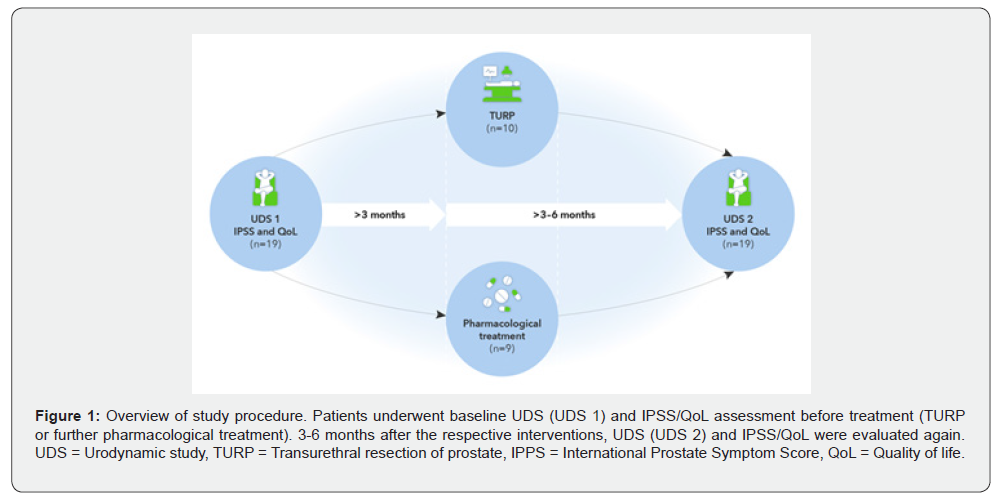
Those patients with non-neurogenic LUTS with high detrusor storage pressures and BOO had undergone a baseline UDS assessment (UDS 1) and completed the first IPSS/ QoL questionnaire. 14 of 19 patients were already receiving pharmacological treatment at baseline. In 5 patients the therapy was discontinued prior to UDS 1, due to ineffectiveness or reported side effects. Due to the exploratory and retrospective nature of this study, a standardized protocol for medication administration was not implemented. Patients were treated exclusively with oral antimuscarinics and/or mirabegron for DO, as well as alphablockers with or without dutasteride for the management of BOO.
Patients who continued on pharmacological treatment had their medications adjusted and formed the pharmacological treatment group, while those referred for surgery underwent underwent TURP. Afterwards, patients underwent another UDS (UDS 2), to check if the high detrusor storage pressures had decreased and completed a second round of IPSS/QoL. The presence of patient-reported in-continence also had to be assessed when recording medical history prior to UDS 1 and 2. No incontinencespecific questionnaires needed to be utilized. The allocation to either TURP or pharmacological therapy was decided through shared decision-making between the patient and the consultant urologist, based on UDS 1. Both options were discussed without predefined allocation criteria, focusing on reducing DO and BOO. Owing to the retrospective study design, no further details regarding the decision-making were available.
Urodynamic Testing
As the gold standard for assessing bladder function, in particular DO and BOO, invasive UDS was used in this study [4,12]. The UDS at baseline (UDS 1) and after treatment (UDS 2) comprised both free uroflowmetry and invasive UDS. Filling cystometry was used to evaluate bladder storage function. Detrusor storage pressure (pDetmax) was recorded as an indicator of DO. The first occurrence of DO (1st DO) was noted and defined as the initial involuntary detrusor contraction observed during bladder filling. Bladder compliance was calculated as the change in bladder volume divided by the corresponding change in de-trusor pressure, and the maximum cystometric capacity (MCC) was determined as the bladder volume at which the patient reported a strong desire to void or at which urinary leakage occurred.
Following the filling phase, a pressure-flow study (PFS) was conducted to assess voiding function. Parameters analyzed included detrusor voiding pressure (pDetmax), the detrusor pressure at the time of maximum urinary flow (pDetQmax), Qmax, and the voided volume (VV). Post-void residual (PVR) was measured by emptying the bladder using a hydrophilic male Nelaton catheter prior to initiating UDS. A specialized neu-ro-urologist conducted all UDS in a sitting position using a multichannel water-filling urodynamic system (Sedia®, Givisiez, Switzerland). The urodynamic testing procedure was performed in accordance with the standards of the International Continence Society (ICS) [19].
IPSS and QoL Assessment
Symptom severity and QoL were assessed using the International Prostate Symptom Score (IPSS) with its 7 questions covering frequency, nocturia, weak urinary stream, hesitancy, intermittence, incomplete emptying, and urgency, as well as 1 additional question on QoL. IPSS results were evaluated according to the American Urological Association [20].
Statistical Analysis
Statistical analysis was performed using SPSS software (IBM Corp. Released 2016. IBM SPSS Statistics for Windows, Version 24.0. Armonk, NY: IBM Corp.). Given the small sample size of this retrospective pilot study, nonparametric testing was employed. The Mann-Whitney U test for independent variables was utilized to analyze differences in urodynamic parameters between the TURP and pharmacological treatment group. The Wilcoxon signed-rank test for dependent variables was utilized to analyze differences in urodynamic parameters before and after the intervention for the TURP and pharmacological treatment group, respectively.
For binary categorical variables, McNemar’s test (with-ingroup) and Fisher’s exact test (between-group) were applied. All tests were two-sided, and statistical significance was considered at p < 0.05. In addition to p-values, effect sizes with 95% confidence intervals (CIs) were calculated. For Wilcoxon signed-rank tests, rank-biserial correlations (RBC) were reported; for Mann– Whitney U tests, Cliff’s delta (δ); and for categorical outcomes, odds ratios (OR) with exact 95% CIs. As an exploratory sensitivity analysis, multivariable models were applied: per-mutation-based ANCOVA for continuous outcomes and logistic regression for binary outcomes, adjusting for age, prostate volume, and PSA.
Results
Patient Characteristics
We identified a small sample size of 19 patients who fitted the inclusion criteria and completed UDS as well as the IPSS/ QoL questionnaire before and after the respective treatment intervention. Of those 19 patients, 10 underwent TURP, while 9 continued a pharmacological treatment (Figure 1). At baseline (UDS 1), detrusor storage pressure (pDetmax) in 18 patients were >40 cmH2O, while 1 patient had a pDetmax of >30 cmH2O. Further baseline data, clinical results, and urodynamic parameters before and after the respective treatments in both groups are de-tailed in Table 1. Only PVR was significantly higher in the TURP group compared to the pharmacological treatment group (p=0.03). Incontinence events were more prevalent in the TURP group, with 7 out of 10 patients (70%) reporting such events, compared to 3 out of 9 patients (33%) in the pharmacological treatment group. However, this difference was not statistically significant at baseline (p=0.12). All other parameters exhibited differences, though these were not statistically significant.
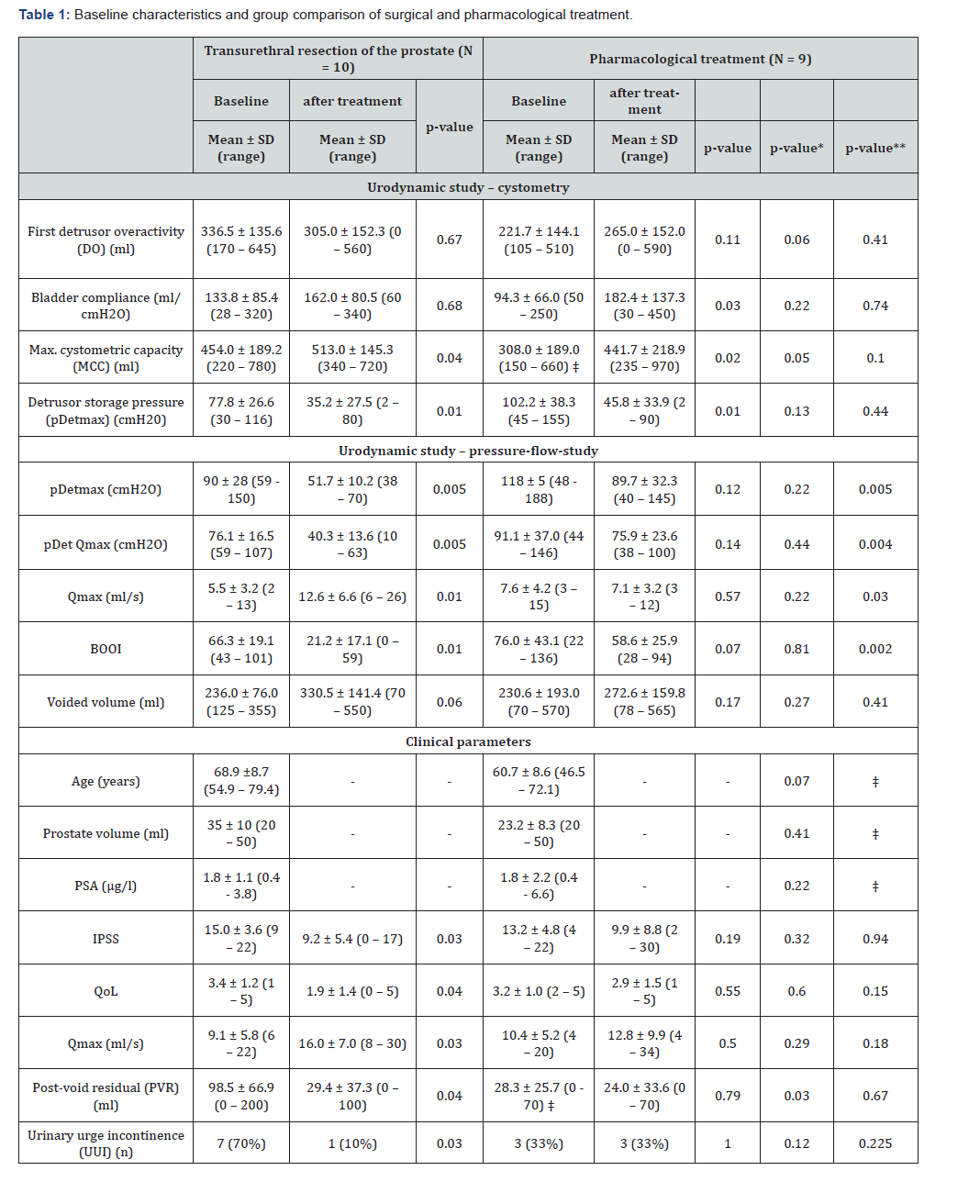
*Pertains to the statistical difference between values at baseline (surgical vs pharmacological), ** pertains to the statistical difference between values after treatment (surgical vs pharmacological), ‡ values not measured. SD= Standard deviation, PSA= Prostate-specific antigen, Qmax= Maximum flow rate, Pdetmax= Maximum detrusor pressure during voiding, PdetQmax= Maximum detrusor pressure during maximal flow, BOOI= Bladder outlet obstruction index. #Additional table of effect sizes is presented in Supplementary Table 1.
In exploratory multivariable models adjusted for age, prostate volume, and PSA, the re-duction in BOOI following TURP remained robust (adjusted effect −37.7; 95% CI −57.2 - −20.0; permutation p = 0.002; see Suppl. Tab. 1). For detrusor voiding pressure (pDetmax), IPSS, QoL, and Qmax, adjusted analyses did not yield statistically significant be-tween-group differences. However, the point estimates were consistent in direction with the unadjusted findings, albeit with wide confidence intervals reflecting the small sample size. For UUI, multivariable logistic regression models were limited due to low event counts. Therefore, we primarily report McNemar’s test and exact odds ratios. Regarding prior pharmacological treatments at UDS 1, 14 out of 19 patients were treated with α1-antagonists (n=12) or a combined therapy that included 5α-reductase inhibitors (Dutasteride, n=2). Among these 14 patients, 5 were additionally receiving an antimuscarinic drug (Trospium chloride, n=3; Fesoterodine, n=1) or a β3-agonist (Mirabegron, n=1).
Urodynamic Parameters
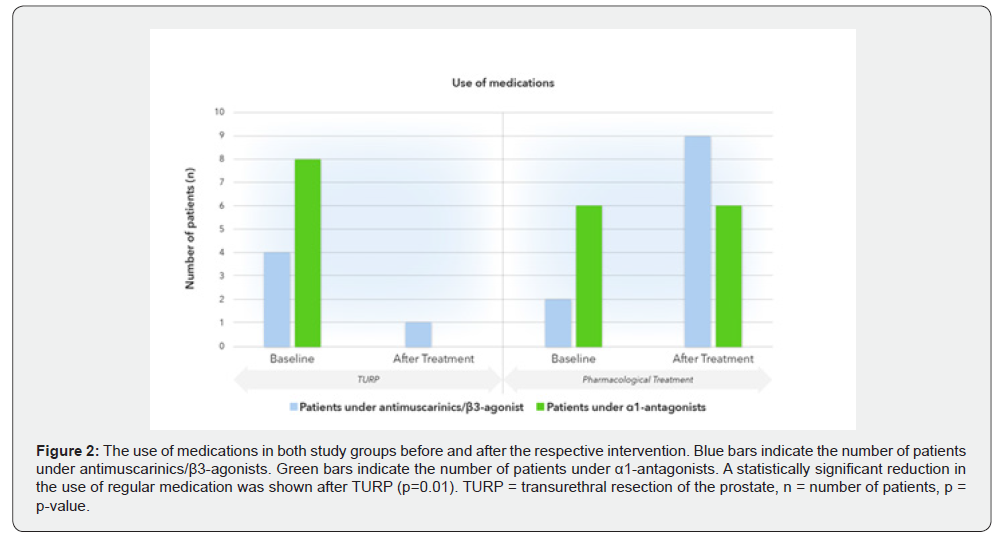
Results from UDS 1 and 2 were used to compare changes in urodynamic parameters after the respective treatments (TURP vs. pharmacological treatment, Table 1, Suppl. Table 1). DO, particularly high detrusor storage pressures (pDetmax), decreased significantly in both groups (p=0.01 each), with a more pronounced decrease observed under pharmacological treatment. Furthermore, MCC increased significantly in both groups (TURP p=0.04; pharmacological treatment p=0.02). We also observed a significant increase in bladder compliance (p=0.03) in the pharmacological treatment group, while no significant change was observed after TURP (p=0.68). In the PFS, the BOOI decreased and Qmax increased significantly after TURP (p=0.01). These findings are strengthened by effect size calculation for Max detrusor pressure amplitude (pDetmax) and BOOI reduction after TURP being -0.93 -1.00 to -0.64, 95% CI) and -0.96 (-1.00 to -0.78, 95% CI), respectively. Medication use also declined significantly after TURP (p=0.01) (Figure 2).
IPSS and QoL
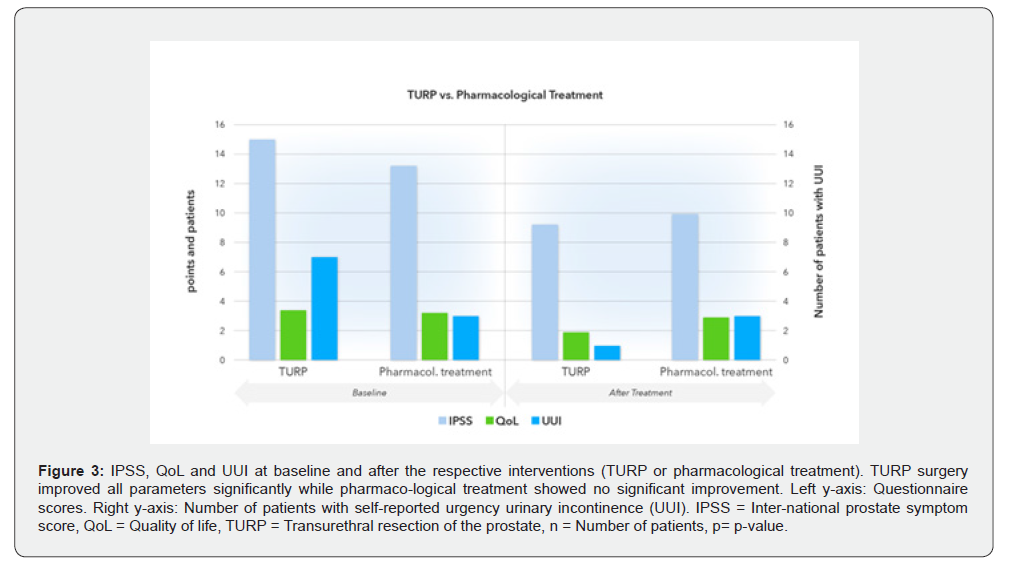
Both the IPSS and QoL improved significantly following TURP (p=0.03 and 0.04, respectively) with a mean IPSS reduction of 6 points (40%) and a QoL reduction of 1 point (33.3%) (Figure 3). In contrast, pharmacological treatment did not produce measurable improvement, remaining unchanged compared to baseline. After TURP, pre-interventional UUI resolved in 6 out of 7 patients who had reported UUI at baseline (p=0.03, 86%). However, no change in UUI was observed under pharmacological treatment. PVR also decreased significantly after TURP (p=0.04) but remained unchanged with pharmacological treatment.
Discussion
This pilot study is exploratory in nature and represents the first attempt to investigate clinical and functional outcomes comparing surgical (TURP) and pharmacological treatments for prostatic BOO in non-neurological patients with high detrusor storage pres-sures. Both treatment approaches have previously been reported to be effective in alleviating LUTS [16,21,22]. Since there are no head-to-head studies in this patient population, clinicians and patients often struggle when trying to determine the potentially best option. Our retrospective pilot study showed that both TURP and continued adjusted pharmaco-logical treatment appeared to significantly reduce DO, in accordance with published literature [22].
The observed improvements in detrusor storage pressure (pDetmax) and MCC in both groups were consistent with previous reports [16,21,23]. Although bladder compliance did not play a role in therapeutic decision-making, we calculated it to better delineate any pre-existing structural changes in the bladder. Bladder compliance in both groups fell within normal ranges before and after each respective therapy (>20 mL/cmH2O), which may be attributed to the expected normal bladder compliance in our relatively healthy and non-neurological patient subset. Nonetheless, we observed a significant increase in blad-der compliance after pharmacological treatment compared to TURP. Our results following TURP contrast with findings from other studies that reported significant improvements in bladder compliance after the procedure [23,24].
This discrepancy may be attributed to the older age of patients in the TURP group, who are more likely to exhibit structural changes in the detrusor muscle [25]. However, given the retrospective design, small sample size, and potential selection biases, these findings have to be interpreted with the utmost caution.
In our dataset, voiding parameters (pDetmax, pDetQmax, Qmax, and BOOI) improved significantly after TURP compared to pharmacological treatment. BOOI demonstrated the strongest treatment effects, with large effect sizes with RBC at −0.96. This supports the clinical relevance of these parameters, reinforcing TURP as the intervention with the most robust impact on detrusor pressure and outlet obstruction. Importantly, exploratory multivariable models adjusting for age, prostate volume, and PSA confirmed the robustness of these findings for TURP, supporting that the observed changes were not simply due to baseline disparities.
Interestingly, PVR reduced significantly after both procedures, which may indicate that the use of detrusor-sedating medication in such patients does not in-herently lead to increased PVR, as is generally assumed, and that alpha blockers improve voiding function [14,21]. Besides improvements in the urodynamic parameters, TURP also ameliorated incontinence for 6 out of 7 affected patients in our cohort. This finding contrasts with previous reports describing a risk of worsening incontinence after TURP in patients with BOO and DO [12]. Possible explanations for this discrepancy include patient characteristics (cohort of neurologically healthy individuals), the surgical technique, and the relatively short follow-up period. Nevertheless, the number of affected patients was very small, and chance findings cannot be excluded. TURP also significantly improved IPSS and QoL in our patient cohort. On the other hand, there was no effect on incontinence, IPSS, and QoL in the cohort with pharmacological treatment. Thus, the data of this retrospective pilot study may suggest limited efficacy of pharmacological treatment on the QoL of patients with previously restricted QoL due to persistent LUTS and urodynamically proven DO and BOO.
Strengths and Limitations
Exploratory multivariable analyses confirmed that the reduction in BOOI after TURP remained robust after adjustment for age, prostate volume, and PSA, indicating independence from potential confounding. In contrast, effect estimates for voiding parameters (pDetmax, IPSS, QoL, and Qmax) were attenuated after adjustment and did not remain statistically significant, which is expected given the small sample size and baseline heterogeneity. These findings support prioritizing BOOI as robust objective endpoints for future trials and underline the need for larger randomized RCTs with prespecified covariate adjustment. This study has several important limitations. First, it is retrospective in nature and subject to selection bias, as no randomization or matching was performed.
This undermines comparability of groups and limits interpretability of results. Moreover, most patients were already receiving pharmacological therapy at baseline, and the decision to continue medication or to proceed with TURP could not be reconstructed in detail. Second, to en-hance comparability, we limited our dataset to patients exhibiting the aforementioned clinical and functional characteristics, which inevitably led to a very low patient sample for this pilot study. Third, pharmacological regiment were not standardized but varied individually, reflecting real-world practice. Finally, the relatively short follow-up period restricts conclusions about long-term outcomes. Taken together, these factors constrain the generalizability of our findings.
Conclusions and Future Directions
Our study suggests that TURP improves both QoL and urodynamic parameters compared to pharmacological therapy. These results should be interpreted with caution due to the study’s limitations. Given that this analysis was conducted as an explorative pilot study, we strongly advocate for an appropriately powered and sampled randomized controlled trial to either support or refute our preliminary conclusions. Future study designs of randomized controlled trial could incorporate objective primary outcomes, such as BOOI or symptom-based measures, such as the IPSS/QoL. Assuming 1:1 randomization with 80% power and a two-sided alpha level of 0.05, as well as an expected attrition rate of 10%, we calculated the required sample size based on the observed standard deviations in our cohort.
Accordingly, 70 patients would be required to detect a reduction ≥20 in BOOI and 102 patients to detect a ≥3 points difference in IPSS. A pragmatic design could combine these approaches in a single study, with an interim analysis at n = 70 and appropriate adjustments for alpha spending. The followup period should range from 6 to 12 months to capture both the immediate and sustained effects of treatment on symptoms and urodynamic parameters. Furthermore, patients should ideally discontinue pharmacological therapy prior to entering the study, as heterogeneity in prior medication use complicates interpretation.
Supplementary Materials:
Supplementary Table 1: Complete variables with effect sizes – additional details related to Table 1.
Author Contributions:
Conceptualization: Stephan Kiss and Mirjam Bywater; methodology: Stephan Kiss and Mirjam Bywater; software: Maciej Kwiatkowski; validation: Stephan Kiss and Maciej Kwiatkowski; formal analysis: Stephan Kiss and Maciej Kwiatkowski; investigation: Lujza Brunaiova and Stephan Kiss; resources: Stephan Kiss; data curation: Lujza Brunaiova and Stephan Kiss; writing-original draft preparation: Stephan Kiss and Lujza Brunaiova; writing-review and editing: Stephan Kiss, Lujza Brunaiova, Maciej Kwiatkowski, Lukas Prause, Mirjam Bywater and Stephen Wyler; visualization: Lujza Brunaiova and Stephan Kiss; supervision: Stephan Kiss and Maciej Kwiatkowski; project administration: Stephan Kiss; funding acquisition: no funding. All authors have read and agreed to the published version of the manuscript.
Institutional Review Board Statement
The study was conducted in accordance with the Declaration of Helsinki, and approved by the Ethics Committee in Switzerland: Ethikkommission Nordwest- und Zentralschweiz, BASEC-Nr. 2022-01972, Dec 16th 2022.
Informed Consent Statement
Informed consent was obtained from all subjects involved in the study.
Data Availability Statement
The raw data supporting the conclusions of this article is available by the authors on request.
Disclaimer/Publisher’s Note
The statements, opinions and data contained in all publications are solely those of the individual author(s) and contributor(s).
References
- EJ McGuire, JR Woodside, TA Borden, RM Weiss (1981) Prognostic value of urodynamic testing in myelodysplastic patients. J Urol 126(2): 205-209.
- Matthias Oelke, Joyce Baard, Hessel Wijkstra, Jean J de la Rosette, Udo Jonas, et al. (2008) Age and bladder outlet obstruction are independently associated with detrusor overactivity in patients with benign prostatic hyperplasia. Eur Urol 54(2): 419-426.
- Mi Mi Oh, Hoon Choi, Min Gu Park, Seok Ho Kang, Jun Cheon, et al. (2011) Is there a correlation between the presence of idiopathic detrusor overactivity and the degree of bladder outlet obstruction? Urology 77(1): 167-170.
- Abrams P (1999) Bladder outlet obstruction index, bladder contractility index and bladder voiding efficiency: three simple indices to define bladder voiding function. BJU Int 84(1): 14-15.
- Christian Gratzke, Alexander Bachmann, Aurelien Descazeaud, Marcus J Drake, Stephan Madersbacher, et al. (2015) EAU Guidelines on the Assessment of Non-neurogenic Male Lower Urinary Tract Symptoms including Benign Prostatic Obstruction. Eur Urol 67(6): 1099-1109.
- Ger E P M Van Venrooij, Harm H E Van Melick, Mardy D Eckhardt, Tom A Boon (2002) Correlations of urodynamic changes with changes in symptoms and well-being after transurethral resection of the prostate. J Urol 168(2): 605-609.
- Lori B Lerner, Kevin T McVary, Michael J Barry, Brooke R Bixler, Philipp Dahm, et al. (2021) Management of Lower Urinary Tract Symptoms Attributed to Benign Prostatic Hyperplasia: AUA GUIDELINE PART II-Surgical Evaluation and Treatment. J Urol 206(4): 818-826.
- Rintaro Machino, Hidehiro Kakizaki, Kaname Ameda, Takashi Shibata, Hiroshi Tanaka,, et al. (2002) Detrusor instability with equivocal obstruction: A predictor of unfavorable symptomatic outcomes after transurethral prostatectomy. Neurourol Urodyn 21(5): 444-449.
- Tufan Tarcan, Hashim Hashim, Sachin Malde, Sanjay Sinha, Arun Sahai, et al. (2024) Can we predict and manage persistent storage and voiding LUTS following bladder outflow resistance reduction surgery in men? ICI-RS 2023. Neurourol Urodyn 43(6): 1447-1457.
- Tanaka Y, et al. (2006) Is the short-term outcome of transurethral resection of the prostate affected by preoperative degree of bladder outlet obstruction, status of detrusor contractility or detrusor overactivity? Int J Urol 13(11): 1398-404.
- Amanda L Lewis, Grace J Young, Lucy E Selman, Caoimhe Rice, Clare Clement, et al. (2020) Urodynamics tests for the diagnosis and management of bladder outlet obstruction in men: the UPSTREAM non-inferiority RCT. Health Technol Assess 24(42): 1-122.
- Myong Kim, Myungchan Park, Myungsun Shim, Seung-Kwon Choi, Sang Mi Lee, et al. (2016) Effect of preoperative urodynamic detrusor overactivity on post-prostatectomy incontinence: a systematic review and meta-analysis. Int Urol Nephrol 48(1): 53-63.
- Myong Kim, Chang Wook Jeong, Seung-June Oh (2019) Effect of urodynamic preoperative detrusor overactivity on the outcomes of transurethral surgery in patients with male bladder outlet obstruction: a systematic review and meta-analysis. World J Urol 37(3): 529-538.
- Dong Gil Shin, Hyeon Woo Kim, Sang Jin Yoon, Sang Hoon Song, Young Ho Kim, et al. (2019) Mirabegron as a treatment for overactive bladder symptoms in men (MIRACLE study): Efficacy and safety results from a multicenter, randomized, double-blind, placebo-controlled, parallel comparison phase IV study. Neurourol Urodyn 38(1): 295-304.
- Tomonori Yamanishi, Hirotaka Asakura, Narihito Seki, Shoji Tokunaga, et al. (2017) Efficacy and safety of combination therapy with tamsulosin, dutasteride and imidafenacin for the management of overactive bladder symptoms associated with benign prostatic hyperplasia: A multicenter, randomized, open-label, controlled trial (DIrecT Study). Int J Urol 24(7): 525-531.
- A Athanasopoulos, K Gyftopoulos, K Giannitsas, J Fisfis, P Perimenis, et al. (2003) Combination treatment with an alpha-blocker plus an anticholinergic for bladder outlet obstruction: a prospective, randomized, controlled study. J Urol 169(6): 2253-2256.
- Ji Youl Lee, Hyun Woo Kim, Seung Ju Lee, Jun Sung Koh, Hong Jin Suh, et al. (2004) Comparison of doxazosin with or without tolterodine in men with symptomatic bladder outlet obstruction and an overactive bladder. BJU International, 2004. 94(6): 817-820.
- Jens Rassweiler, Dogu Teber, Rainer Kuntz, Rainer Hofmann (2006) Complications of transurethral resection of the prostate (TURP)--incidence, management, and prevention. Eur Urol 50(5): 969-979.
- Carlos D'Ancona, Bernard Haylen, Matthias Oelke, Luis Abranches-Monteiro, Edwin Arnold, et al. (2019) The International Continence Society (ICS) report on the terminology for adult male lower urinary tract and pelvic floor symptoms and dysfunction. Neurourol Urodyn 38(2): 433-477.
- MJ Barry, FJ Fowler, MPO'Leary, RC Bruskewitz, HL Holtgrewe, et al. (1992) The American Urological Association symptom index for benign prostatic hyperplasia. The Measurement Committee of the American Urological Association. J Urol 148(5): 1549-1557.
- Paul Abrams, Steven Kaplan, Hendrik J De Koning Gans, Richard Millard (2006) Safety and tolerability of tolterodine for the treatment of overactive bladder in men with bladder outlet obstruction. J Urol 175(3 Pt 1): 999-1004.
- Yao-Rui Zhao, Wen-Zhan Liu, Michael Guralnick, Wen-Jie Niu, Yong Wang, et al. (2014) Predictors of short-term overactive bladder symptom improvement after transurethral resection of prostate in men with benign prostatic obstruction. International Journal of Urology 21(10): 1035-1040.
- Subhranshu Sahu, Kalpesh Parmar, Santosh Kumar, Shantanu Tyagi, Subhajit Mandal, et al. (2021) Effect of Transurethral Resection of the Prostate on Urodynamic Parameters in Patients with Benign Prostatic Enlargement with Upper Urinary Tract Dilatation. Urol Int 105(9-10): 846-851.
- Wendy W Leng, Edward J McGuire (2003) Obstructive uropathy induced bladder dysfunction can be reversible: bladder compliance measures before and after treatment. J Urol 169(2): 563-566.
- Ruud Bosch, Paul Abrams, Marcio Augusto Averbeck, Enrico Finazzi Agró, Andrew Gammie, et al. (2019) Do functional changes occur in the bladder due to bladder outlet obstruction? - ICI-RS 2018. Neurourol Urodyn 38(Suppl 5): S56-S65.

























