




 JOJUN Home



Abstract
Introduction: End-stage renal disease (ESRD) and its treatment by hemodialysis lead to complex metabolic disturbances, including thyroid dysfunction. These disorders, often neglected, can worsen patients’ prognosis. The aim of this study was to assess the prevalence and characteristics of dysthyroidism in chronic hemodialysis patients in Niger.
Methodology: This was a descriptive and analytical cross-sectional study over a 6-month period. The study population consisted of all chronic haemodialysis patients presenting with dysthyroidism during the study period. Epidemiological, clinical, therapeutic and evolutionary variables were studied.
Results: We followed 101 cases of chronic hemodialysis patients over a 6-month period, 19 of whom presented with dysthyroidism, a frequency of 18.81%. There was a predominance of males (52.89%) and a sex ratio of 1.37. The mean age was 43.69 years, with extremes of 18 and 75 years. The 30-45 age group was the most represented (45.54%). Hemodialysis duration between 1 and 5 years was the most represented in 75%. Frustrated hypothyroidism was the most common type of dysthyroidism in 15.80% of cases.
Conclusion: Dysthyroidism is common in chronic hemodialysis patients and can have a significant impact on their general health. Our study revealed that fruste hypothyroidism is the most prevalent form of dysthyroidism in this population, underlining the importance of regular screening for early and appropriate management.
Keywords:Dysthyroidism; Hemodialysis; HNABD; Niamey
Abbreviations: RCFT4: Free Thyroxine; RIA: Radioimmunoassay
Introduction
Dysthyroidism is a hormonal disturbance frequently observed in chronic hemodialysis patients. They are represented by biological hypothyroidism, exceptionally by hyperthyroidism [1]. Hypothyroidism in this case is primary, defined by clinical euthyroidism associated with biological hypothyroidism: free triiodothyronine (FT3) is often low, free thyroxine (FT4) is often normal, and ultra-sensitive thyroid stimulating hormone (TSHus) may be elevated [2]. FT3 is the biologically active hormone, and is often low in HDC, reflecting “low T3 syndrome”[3]. Dysthyroidism in chronic hemodialysis is represented by hypothyroidism, currently termed “euthyroid disease syndrome” [4].
Endocrine dysfunction is serious, representing a powerful risk factor for cardiovascular morbidity and mortality [5]. African studies have found a prevalence ranging from 18% to 35% [4,6,7]. In Niger, no study has investigated thyroid hormone disorders in chronic Hemodialysis patients, hence the interest in initiating this work to study the clinico-biological profile and risk factors associated with dysthyroidism in chronic haemodialysis patients at HNABD.
Methodology
This was a descriptive and analytical cross-sectional study over a 6-month period from June 1 to November 31, 2024. The Nephrology and Hemodialysis Department of the Amirou Boubacar Diallo National Hospital served as the study setting, and samples were analyzed at the Niamey Radioisotope Institute. The study population consisted of chronic haemodialysis patients followed at the HNAB nephrology department in Ny during the study period. Chronic haemodialysis patients who had undergone hormonal check-ups and had an exploitable record were included in the study. The sample was simple random. The prevalence of dysthyroidism in hemodialysis patients had not been previously assessed.
Blood samples for the determination of thyroid hormones FT4, FT3 and pituitary hormones TSHus were taken before patients were connected for dialysis in EDTA tubes (can also be done in dry tubes) and sent to the Niamey Radioisotope Institute (IRI). Blood levels of thyroid hormones were assayed: FT4, FT3 using the radioimmunoassay (RIA) method, based on competition between an antigen to be assayed and the same antigen labelled by an isotope against a limited number of antibody sites; TSH us using the immuno-radiometric (IRMA) sandwich method, in which the antigen is taken between the two labelled and unlabelled antibodies. Standards FT4 between 7 and 18 pmol/l, FT3 between 2 and 4.25pmo/l, TSHus between 0.25 and 5μU/ml.
Data was collected based on medical records and direct interviews with patients using a pre-established survey form. SPSS software version 22.0 was used to create the database. Data recording and analysis were performed using SPSS (Statistical Package for Social Sciences) version 22.0 and Épi Info 7.2.3 software. Graphs were generated using Microsoft Office Excel 2013. Quantitative variables were expressed as mean ± standard deviation and qualitative variables as headcount and percentage. Fisher’s Exact Test was used for comparison of categorical variables. A p≤0.05 value was considered statistically significant. Confidentiality and medical secrecy were respected during data analysis. Informed consent was obtained from each patient included in the study.
Results
Frequency
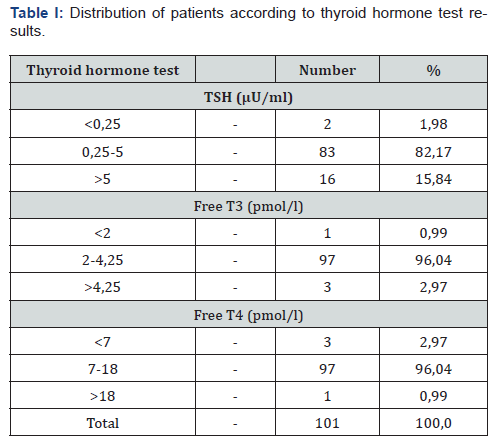
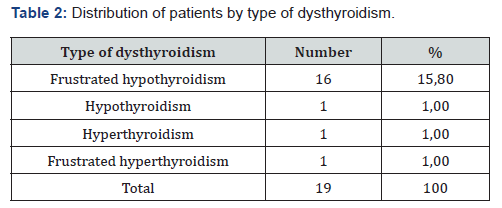
During the study period, 253 patients were on chronic hemodialysis, of whom 101 were included. Of these, 19 presented with dysthyroidism, a frequency of 18.81%. Among patients with dysthyroidism, males accounted for 57.89% (n=11). The mean age was 43.69±11.80 years, with extremes ranging from 18 to 75 years. The initial etiology of CKD in our study was chronic glomerulonephritis in most cases (51.50%). Asthenia was the main sign of hypothyroidism in 58.40% of cases (n=59). 7 patients had a goiter (6.9%). Most patients with goiter (85.71% or n=6) were classified as stage 1. Almost all patients had a normal free T3 and free T4, i.e. 96.04% of cases (n=97). 15.80% (n=16) had Frustra hypothyroidism (Table 1). Less than a quarter of patients (15.80% or n=16) had frustrated hypothyroidism (Table 2).
Analytical Results
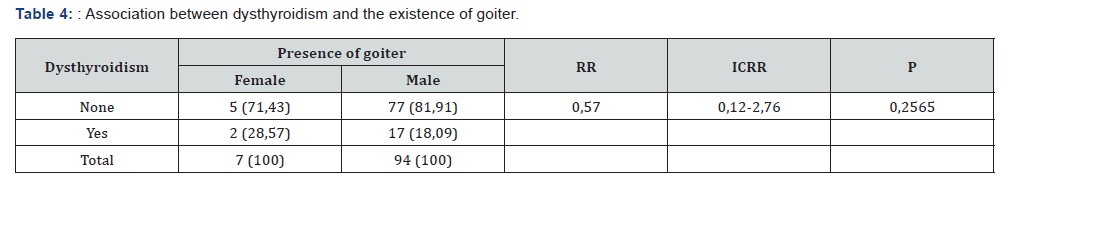
On univariate logistic analysis, there was a statistically significant association between dysthyroidism and male sex (p<0.05) (Table 3). On the other hand, the presence of a goiter was not associated with dysthyroidism. (Table 4).

Discussion
This is a descriptive and analytical cross-sectional study of 101 chronic hemodialysis patients who underwent thyroid hormone assessment over a 6-month period. In our study, we documented 19 cases of dysthyroidism in chronic hemodialysis patients, corresponding to a frequency of 18.81%. This prevalence is comparable to that reported in the African literature, although variations exist depending on the populations studied, diagnostic methods and screening protocols used. In Senegal, a study conducted by Diouf B et al [8] in 2017 reported a dysthyroidism prevalence of 21% in chronic hemodialysis patients, with a predominance of subclinical hypothyroidism. Similarly, in Morocco, Benabdellah N et al [9] in 2019 observed a 24.5% frequency of thyroid disorders in hemodialysis patients at a nephrology center in Casablanca, highlighting the importance of systematic screening for hormonal abnormalities in these patients.
In Côte d’Ivoire, Kouadio KY et al [10] in 2015 reported a 17% prevalence of thyroid disorders in chronic hemodialysis patients at Treichville University Hospital, with cases predominantly of frank hypothyroidism and low T3 syndrome. These results are like our own, suggesting common factors linked to the environment, nutrition and comorbidities frequently associated with chronic renal failure in sub-Saharan Africa. In our series, male sex predominated in 54.89% of cases. This male predominance had also been found by Aloui A et al [11] in Tunisia in 2016, who found 69.56%. On the other hand, Najoua Z et al [12] in Morocco in 2010 reported a clear female predominance, with a frequency of 61.76%. Da Costa et al [13] in 2016 also found a female predominance, with 61% of cases. The male predominance found in our study could be explained by the fact that chronic kidney disease is more common in men than in women.
In our study, the average age of patients was 43.69±11.80 years. The 30-45 age group was the most represented, with 45.54% of cases. Our result is like that of Najoua Z et al [12] in Morocco in 2010, who found an average age of 43.4 ± 13.5 years. Indeed, the low life expectancy in our developing countries could justify the relatively young age of our patients. Most of our patients undergo two haemodialysis sessions per week, thus creating a situation of under-dialysis, a determining factor in the onset of thyroid disorders. In our study, 6.9% of patients had a goiter. Our result is superior to that of Azouaou L et al [5] in Algeria in 2016, who found 0.05% of cases, and Najoua Z et al [12] in Morocco in 2010, in whom the clinico-echographic examination did not reveal any cases of goitre. However, according to the literature, goiter is frequently found in this chronic renal failure population [14-17]. The most common type of dysthyroidism in our study was fructal hypothyroidism in 15.80% of cases. This is like the findings of Najoua Z et al [12] in Morocco in 2010 and Zoccali C et al [6] in Italy in 2006, who found 28% and 20% respectively. Recently, it has been demonstrated that thyroid hormone levels decrease with decreasing glomerular filtration rate (GFR); the prevalence of hypothyroidism rises from 7% if GFR is 90ml/min to 17.9% if GFR < 60ml/min [18]. Indeed, the most common thyroid disorder in HDC is primary hypothyroidism [19,20]. Reduced FT3 (low T3 syndrome) is frequently observed in dialysis patients with clinical euthyroidism [17,20,21].
Conclusion
Dysthyroidism is common in chronic hemodialysis patients and can have a significant impact on their general health. Our study revealed that fruste hypothyroidism is the most prevalent form of dysthyroidism in this population, underlining the importance of regular screening for early and appropriate management. The pathophysiological particularities of thyroid disorders in chronic renal failure make their diagnosis sometimes complex, necessitating cautious interpretation of hormone assays. However, recognition and management of thyroid disorders could help to limit certain complications, notably cardiovascular and metabolic, in dialysis patients. In the future, further studies will be needed to better understand the clinical implications of dysthyroidism in this population and define the best therapeutic strategies. Systematic endocrine monitoring integrated with nephrological follow-up appears to be a promising approach to improving the quality of life and prognosis of hemodialysis patients.
References
- Cakanya G, Ndayikunda A, Lowé W, Ndizeye Z (2023) Etude des facteurs associés à la mortalité des patients atteints d’insuffisance rénale chronique terminale sous hémodialyse en Afrique de l’Est - Etude de cas au Burundi. Rev d'Épidémiologie Santé Publique.
- Kaptein EM, Quion-Verde H, Chooljian CJ, Tang WW, Friedman PE, et al. (1988) The thyroid in end-stage renal disease. Medicine (Baltimore) mai 67(3): 187‑1
- Surks MI, Ortiz E, Daniels GH, Sawin CT, Col NF, et al. (2004) Subclinical thyroid disease: scientific review and guidelines for diagnosis and management. JAMA 291(2): 228‑2
- Kaptein EM (1996) Thyroid hormone metabolism and thyroid diseases in chronic renal failure. Endocr Rev févr 17(1): 45‑
- Azouaou L, Mazari N, Bezzi L, Boudraa A, Boulahlib B, et al. (2016) Les troubles thyroïdiens chez les hémodialysés chroniques. Néphrologie Thérapeutique 12(5): 330.
- Zoccali C, Mallamaci F, Tripepi G, Cutrupi S, Pizzini P (2006) Low triiodothyronine and survival in end-stage renal disease. Kidney Int août 70(3): 523‑52
- Jmal L, Danguir S, Amira Z, Bourouba F, Guidara R, Dhieb A, et al. (2017) Les dysthyroïdies chez les hémodialysés chroniques : fréquence et facteurs associé Ann Endocrinol 78(4): 343.
- Diouf B, Ndiaye M, Seck S, Cisse M, Faye M, Lemrabott A (2017) Troubles de la fonction thyroïdienne chez les patients en hémodialyse chronique à Rev Afr Néphrol 20(2): 45‑50.
- Benabdellah N, El Ouafi N, Housni B (2019) Prévalence des anomalies de la fonction thyroïdienne chez les patients hémodialysés chroniques à Casablanca. Pan Afr Med J 32: 150.
- Kouadio K, Yapo A, Konan A, N’cho K, Koffi A (2015) Dysfonction thyroïdienne chez les patients en hémodialyse chronique au CHU de Treichville, Abidjan. Cah Santé 25(3): 125‑12
- Aloui A, Ben Nacef I, Chargui S, El Younsi F, Khiari K, et al. (2016) Les dysthyroïdies en hémodialyse chronique. Ann Endocrinol 77(4): 411.
- Najoua Z, RhouZbiti H, Ezaitouni F, Ouzeddoune N, Bayahia R, Benamar L (2010) Les dysthyroïdies chez l’hémodialysé chronique. Pan Afr Med J 7: 3.
- Da Costa ABBA, Pellizzari C, Carvalho GA, Sant’Anna BC, Montenegro RL, et al. (2016) High prevalence of subclinical hypothyroidism and nodular thyroid disease in patients on hemodialysis. Hemodial Int 20(1): 31‑3
- Carrero JJ, Qureshi AR, Axelsson J, Yilmaz MI, Rehnmark S, et al. (2007) Clinical and biochemical implications of low thyroid hormone levels (total and free forms) in euthyroid patients with chronic kidney disease. J Intern Med déc 262(6): 690‑
- Kaptein EM, Quion-Verde H, Chooljian CJ, Tang WW, Friedman PE, et al. (1988) The thyroid in end-stage renal disease. Medicine (Baltimore) mai 67(3): 187‑1
- Kutlay S, Atli T, Koseogullari O, Nergizoglu G, Duman N, et al. (2005) Thyroid disorders in hemodialysis patients in an iodine-deficient community. Artif Organs avr 29(4): 329‑3
- Lim VS (2001) Thyroid function in patients with chronic renal failure. Am J Kidney Dis Off J Natl Kidney Found 38(4 Suppl 1): S80-S84.
- Chonchol M, Lippi G, Salvagno G, Zoppini G, Muggeo M, et al. (2008) Prevalence of subclinical hypothyroidism in patients with chronic kidney disease. Clin J Am Soc Nephrol CJASN. sept 3(5): 1296‑1
- Iglesias P, Díez JJ (2009) Thyroid dysfunction and kidney disease. Eur J Endocrinol avr 160(4): 503‑5
- Lo JC, Chertow GM, Go AS, Hsu CY (2005) Increased prevalence of subclinical and clinical hypothyroidism in persons with chronic kidney disease. Kidney Int mars 67(3): 1047‑10
- Kaptein EM (1996) Thyroid hormone metabolism and thyroid diseases in chronic renal failure. Endocr Rev févr 17(1): 45‑

























