




 JOJUN Home



Plasma Concentration of Bupivacaine During Continuous Intravesical Infusion in a Sheep Model
Paddy Dewan*
Paediatric Urology Unit, Sunshine Private Hospital, Parkville, Australia
Submission:April 14, 2025;Published:May 05, 2025
*Corresponding author:Paddy Dewan, Paediatric Urology Unit, Sunshine Private Hospital, Parkville Victoria, 3052, Australia, Email: paddy@paddydewan.com
How to cite this article:Paddy D. Plasma Concentration of Bupivacaine During Continuous Intravesical Infusion in a Sheep Model. JOJ Urology & Nephrology, 2025; 9(2): 555760.DOI:10.19080/JOJUN.2025.09.555760.
Abstract
Introduction
The systemic absorption of intravesical local anaesthetic is of concern because of their potential side effects and toxicity, especially after multiple instillations or continuous infusion. This study investigates the bladder absorption of Bupivacaine in a sheep model.
Method and Material
To investigate plasma concentration of Bupivacaine following intravesical infusion, 0.5% Bupivacaine was instilled into the bladders of seven male sheep at a rate of 0.2ml/kg/hr, via a suprapubic catheter. Serum samples were taken regularly throughout a 48-hour period and analysed with gas chromatography.
Result
None of the measurements were within the toxic plasma reading, as they were recorded from 1.0 to 646.0 ng/ml, around ½ the known toxic level.
Conclusion
Intravesical Bupivacaine can be safely and continuously infused into the bladder, even after it had been traumatised by the insertion of a suprapubic catheter, when given in the recommended intrathecal dose. However, further research is encouraged to investigate any significant difference that may occur with more extensive surgery on the bladder, and further work should be conducted into how and where the Bupivacaine acts within the bladder tissue.
Keywords:Bladder tumor; Holmium laser; Transurethral resection of bladder tumor; Moses 2.0; Urothelial carcinoma
Abbreviations: Intravesical bupivacaine; Animal study; Plasma concentration
Introduction
The use of local anaesthetic for topical anaesthesia in the urinary tract has been studied extensively since the early 1950s [1-7]. and has usually been used to minimise urethral sensations or to treat bladder spasms. The end effect being improved pain management, often leading to decreased hospitalization. The systemic absorption of intravesical local anesthetic is of concern because of their potential systemic side effects [8,9]. Animal and human studies to assess the systemic absorption of topical anesthetic from the bladder after a single instillation, and when used for topical urethral anesthesia during flexible cystoscopy, indicate that the use of appropriate dosages, while avoiding forceful injection, lead to the safe and effective application [10,11]. Previous studies attempted to expand clinical applications of urinary tract local anaesthesia by applying the drug to traumatised bladder mucosa. These data suggested minimal absorption of local anesthetic after a single instillation into a bladder, even when the mucosal surface has been partly denuded [2,12,13]. However, the plasma concentration of local anesthetic, following multiple intravesical instillations or continuous intravesical infusion, has not been widely studied. The aim of our study was to investigate plasma concentration of Bupivacaine following an intravesical infusion in an animal model. These data can potentially expand the clinical application of urinary tract local anaesthesia and improve the care of patients suffering from intractable post-operative bladder spasm.
Methods and Masterials
Subjects
Seven healthy male cross-bred wethers (age ranging from three months to two years) were selected for a study using a protocol that was reviewed and approved by the Animal Experimentation Ethics Sub-Committee of the Veterinary School, University of Melbourne, Australia. The choice of males only sheep was to have consistency of urethral anatomy; and the age range was a supply issue.
Local Anaesthetic Solution
The local anaesthetic solution consisted of Bupivacaine hydrochloride 0.5% (Bupivacaine 4.44 g/L). In this report, doses and concentrations are expressed in base equivalents, unless specified otherwise.
Procedures
Intravenous access was established with a central venous catheter introduced into jugular vein. The catheter was advanced five centimetres from the incision site and secured with two stay sutures of 3/0 PDS. A three-way tap was connected to the central venous catheter to facilitate administration of medication and withdrawal of blood samples. Each animal was shaved, prepared and cover with sterile drapes. Under general anaesthetic, the urinary bladder was identified, and a two-centimetre incision was made in its external surface. Through the incision, a Foley catheter was passed into the bladder, the catheter secured by inflating the 5ml balloon, and further secured with a purse-string suture of 3/0 PDS to the bladder wall after the visceral incision had been closed. The drainage end of the urinary catheter was tunnelled under the abdominal wall to the animal’s right flank and secured with a staysuture of 3/0 PDS. The abdominal contents were checked and replaced before closure of the abdominal wall with 0/0 PDS, and 3/0 PDS. The animal was returned to its pen after recovery from the general anaesthesia.
Intravesical Bupivacaine infusion and monitoring of animals
Intravesical Bupivacaine infusion, running at 0.2ml/kg/hr, was administered through the suprapubic catheter for 48 hours, starting at the end of the procedure that resulted in insertion of the catheter. High levels of Bupivacaine in the circulation are known to cause cardiac and neurological toxicity; therefore, the animals were constantly monitored, including general inspection, blood pressure, and heart rate during this period. The infusion would have been discontinued if there were any concerns about the animals’ welfare.
Blood Samples
Pilot Study
The initial study group consisted of two subjects, one as a control (infused with normal saline) and one with an intravesical Bupivacaine infusion. One serum sample was withdrawn from each animal prior to the commencement of the infusion, then at intervals of 30 minutes during the first six hours, hourly up to 12 hours, then at 24 hours, 36 hours, and 48 hours. Further postinfusion samples were taken at 60 and 72 hours, which were 12 and 24 hours after cessation of the drug. This preliminary study provided a guide for the absorption characteristics of intravesical Bupivacaine and aided the design of the subsequent study.
Further Study
The second phase of study consisted of five animals that had undergone insertion of central venous catheter, suprapubic cystostomy, and laparotomy as described above. Serum specimens were collected from each animal prior to the infusion, and then at five-minute intervals during the first sixty minutes after commencement of the infusion, and at one hour, eight hours, 12 hours, 24 hours, 36 hours, and 48 hours. Two more blood samples were taken at 12 and 24 hours after cessation of the infusion. Blood samples were centrifuged, refrigerated, and sent for Bupivacaine level analysis. The suprapubic catheter was removed after blood sampling had been completed, and all animals were sacrificed according to the regulations at the Veterinary School, University of Melbourne, Australia.
Assays
Gas Chromatography
Plasma (0.5ml) was added to a borosilicate glass tube containing 0.05ml Bupivacaine, 1000 ng/ml (internal standard). After the addition of 0.05ml of three molar Sodium Hydroxide and 6ml of Hexane, the tube was capped and vortex mixed for thirty seconds and centrifuged at 1000g for five minutes. Approximately 5ml of the hexane layer was transferred to another borosilicate glass tube and evaporated to dryness under a stream of nitrogen in a water bath at 4°C. The residue was reconstituted in 0.025ml methanol and the entire sample was injected into the gas chromatograph. The gas chromatograph uses a BPX-50 column at 270°C and a nitrogen selective detector. The method was linear to at least 5000ng/ml, with a limit of quantitation of 1ng/ml and a coefficient of variation of 4.8% at 50ng/ml [14,15].
Results
Pilot Study
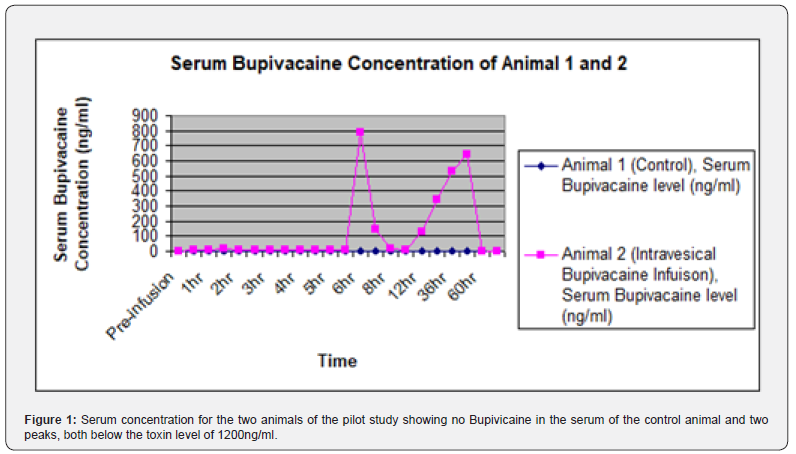
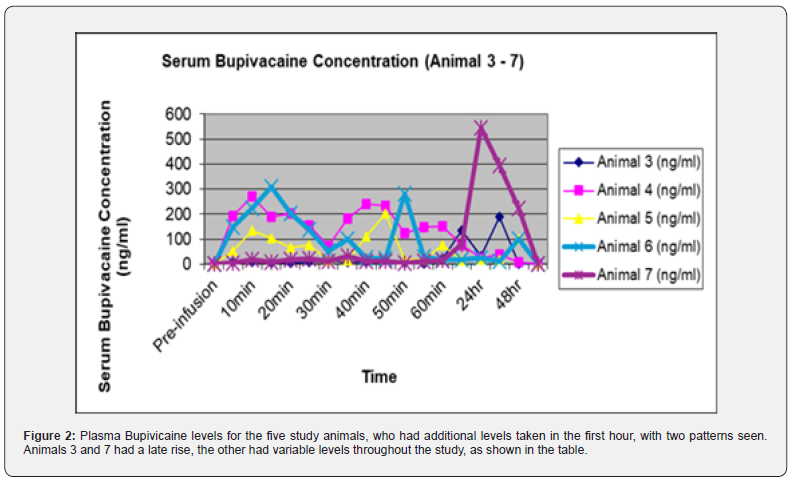
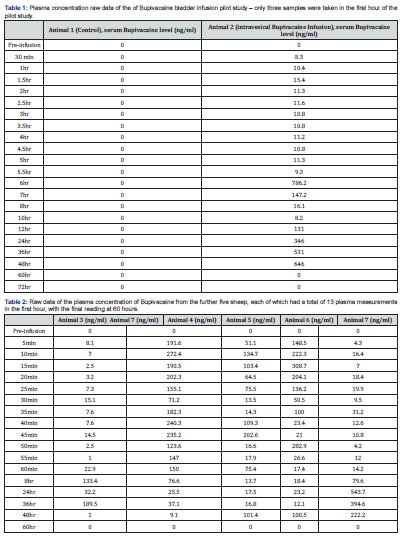
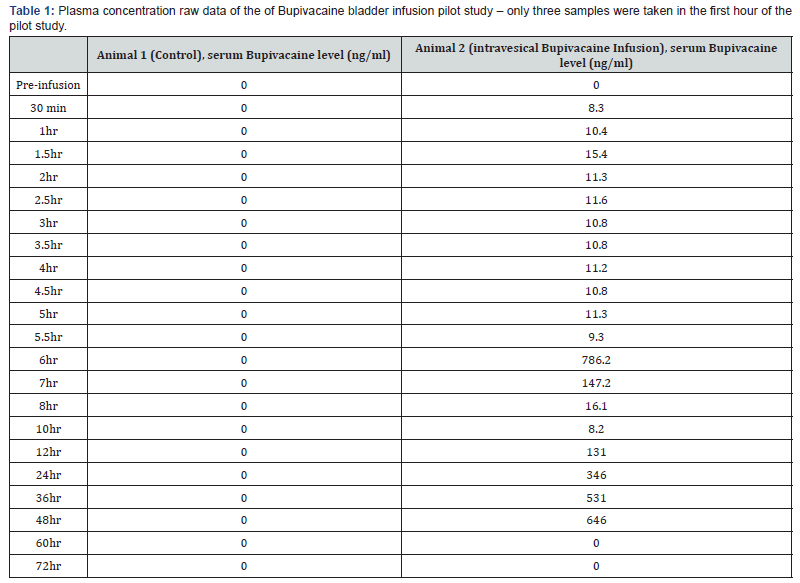
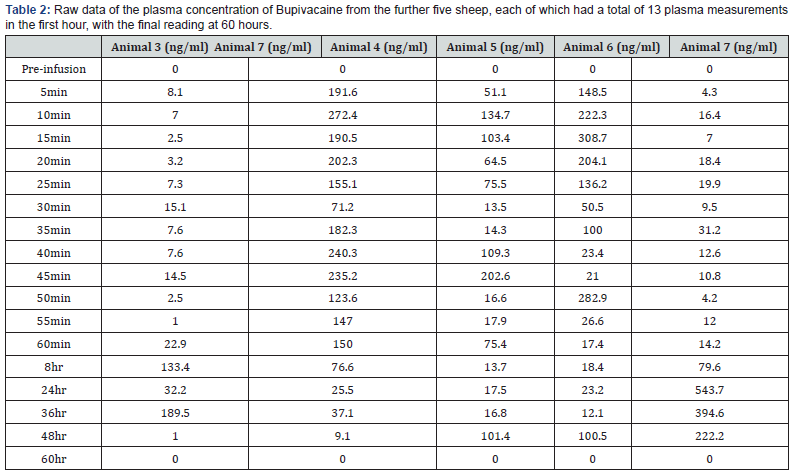
One hour after Bupivacaine infusion, the serum level stabilised for six hours, but then was noted to peak at 6, 24, 36, and 48 hours after commencement of Bupivacaine infusion (Appendix: Table 1). Table 2 (Appendix) shows the results from further studies aimed at evaluating the rate of the rise of Bupivacaine blood levels. Thirty minutes after commencement of infusion, the plasma concentration of Bupivacaine seemed to reach a more stable level in each animal. Figure 1, Figure 2, and Figure 3 show the serum Bupivacaine levels over time. Animal three, four, and six, overall, had higher Bupivacaine absorption rates compared to animal five and seven. Also, these three animals seemed to share similar pattern of serum Bupivacaine concentration and they were grouped together. The other two shared a similar pattern and grouped together. Overall, general anaesthesia and postoperative recovery were uneventful in all animals, and there were no clinical signs of systemic toxicity.
Discussion
Absorption of local anaesthetic relies on the capacity of the agent to diffuse through tissue planes. This process is complex influenced by the concentration and lipid solubility of the drug, together with the permeability characteristics of the tissue planes to be crossed. Absorption of local anaesthetic agents into the bloodstream usually occurs after initial diffusion through the tissue into which it has been injected [13]. A number of studies have reviewed the efficacy and serum levels of different modes of administration of Bupivacaine, including per-peritoneal, [16,17] intercostal, [18] intradermal [19] and incisional infusions [20]. Although lignocaine has a fast onset, it is a short acting local anaesthetic agent with a high tissue penetration rate compared to other local anaesthetic drugs [10,21,22,23]. It may not be an ideal agent for patients who have extensive bladder operations and require a great deal of post-operative analgesia, since the systemic threshold toxicity can easily be reached [9,23]. Bupivacaine, in comparison, is long acting, and minimal tissue penetration [21,22,24]. Birch and Miller demonstrated that a single instillation of Bupivacaine in twelve patients undergoing a transurethral procedure, resulted in ‘generally undetectable’ serum Bupivacaine levels [12]. The absorption profile of intravesical Bupivacaine appears to be biphasic. A rapid initial absorption phase is followed by a much slower phase. The initial absorption is believed to occur predominantly by uptake into blood vessels from the traumatised bladder tissue. The late absorption phase has been suggested to be due to slow uptake of local anaesthetic from the intact bladder urothelium [10,21,25]. In our study, the rapid phase of absorption occurred in the first 30 minutes, probably because of the bladder trauma caused by the cystostomy through which the catheter was inserted. Overall, the serum levels of Bupivacaine following intravesical infusion were relatively low, compared to epidural, spinal, and caudal administration [21,26,27], and well below the estimated threshold concentration of systemic toxicity for 2000 to 4000 ng/ml [28,29].
This is probably due to the transitional cell epithelium of bladder, like intact skin constituting a significant barrier to the uptake of topically applied local anaesthetics. Therefore, we conclude that intravesical Bupivacaine infusion can be safely administered even into a traumatised bladder, if used within the recommended dosage for intrathecal infusion. However, the trauma to the bladders in this study may not be equivalent to patients undergoing bladder surgery. Every operation involving the urinary tract is individualised, particularly the degree of trauma. Obviously, a bladder undergoing radical augmentation will have a larger denuded area post-operatively than one into which a cystectomy catheter has been inserted. Therefore, it is difficult to conclude that intravesical Bupivacaine is safe for all patients with post-operative bladder spasm but given that the doses used are equivalent to intrathecal administration it is likely to be low risk. In addition, our attempts to determine absorption rate and pharmacokinetics of intravesical Bupivacaine in sheep were not entirely successful. Despite the same methods, very individual patterns of serum levels of Bupivacaine were recorded in all six sheep! Different absorption rates may be expected for different animals for all subjects in this study, systemic absorption rate is influenced by a combination of factors, including the maximum in the plasma concentration-time curve [peak time (tmax) and peak concentration (Cmax)], metabolism, and systemic disposition of the agent [30,31]. However, the extent of the differences is difficult to explain. Accurate determination of the extent and rate of intravesical absorption of Bupivacaine is only possible if quantitative data of the above measures on this drug are available [27,32], which they were not in our laboratory. Nevertheless, using the data from our study as a guide, further research to investigate the systemic absorption and disposition in a human model could be refined.
Conclusion
The systemic uptake of local anaesthetic into the general circulation is of concern because of the potential to produce side effects and toxicity. Nevertheless, estimated threshold concentrations associated with systemic toxicity are known to be much higher than the highest serum Bupivacaine level seen in this study. Hence, intravesical Bupivacaine infusion may be safely administered to suppress bladder spasm when administered within the recommended intrathecal doses. However, further research to investigate the relevance of bladder surgery to intravesical Bupivacaine and systemic absorption, metabolism, and disposition in a human model may expand its clinical applications.
References
- Thrasher JB, Peterson NE, Donatucci CF (1991) Lidocaine as a topical anesthetic for bladder biopsies. J Urol 145(6): 1209-1210.
- Thrasher JB, Kreder KJ, Peterson NE, Donatucci CF (1993) Lidocaine as topical anesthesia for bladder mappings and cold-cup biopsies. J Urol 150(2 Pt 1): 335-336.
- Persky L, Davis HS (1953) Xylocaine as a topical anesthetic in urology. J Urol 70(3): 552-554.
- Haines JS, Grabstald H (1949) Xylocaine; a new topical anesthetic in urology. J Urol 62(6): 901.
- Wallace E, Twomey M, Victory R, O’Reilly M (2018) Intravesical Baclofen, Bupivacaine, and Oxycodone for the relief of Bladder Spasm. Journal of Palliative Care 29(1): 49-51.
- Pournajafian A, Ghodraty MR, Shafighnia S, Rokhtabnak F, Khatibi A, et al. (2020) The Effect of Intravesical Diluted Bupivacaine on Catheter-Related Bladder Discomfort in Young and Middle-Aged Male Patients During Postanaesthetic Recovery. Turk J Anaesthesiol Reanim 48(6): 454-459.
- Greenland JE, Lynch TH, Wallace DMA (1991) Optical Urethrotomy under Local Urethral Anaesthesia. British Journal of Urology 67(4): 385-388.
- Chiang DT, Pout K, Dewan PA (2004) Intravesical bupivacaine: a survey of Australian and New Zealand surgeons. ANZ J Surg 74(8): 700-701.
- Clapp CR, Poss WB, Cilento BG (1999) Lidocaine toxicity secondary to postoperative bladder instillation in a pediatric patient. Urology 53(6): 1228.
- Campbell D, Adrini J (1958) Absorption of local anesthetics. J Am Med Assoc 168(7): 873-877.
- Henry R, Patterson L, Avery N, Tanzola R, Tod D, et al. (2001) Absorption of alkalized intravesical lidocaine in normal and inflamed bladders: a simple method for improving bladder anesthesia. J Urol 165(6 Pt 1): 1900-1903.
- Birch BR, Miller RA (1994) Absorption characteristics of lignocaine following intravesical instillation. Scand J Urol Nephrol 28(4): 359-364.
- Heffernan JP, Matthews RD, Sands JP, Nolan JF (1993) Perioperative serum bupivacaine levels after topical bladder anesthesia for bladder biopsy. Anesth Analg 77(2): 402-403.
- Burm AG, van Kleef JW, de Boer AG (1982) Gas chromatographic determination of bupivacaine in plasma using a support coated open tubular column and a nitrogen-selective detector. Anesthesiology 57(6): 527-529.
- Van Zundert A, Burm A, Van Kleef J, Spierdijk J, Van der Aa P, et al. (1987) Plasma concentrations of epidural bupivacaine in mother and newborn: 0.125% versus 0.375%. Anesth Analg 66(5): 435-441.
- Thomas JM, Schug SA (1999) Recent advances in the pharmacokinetics of local anaesthetics. Long-acting amide enantiomers and continuous infusions. Clin Pharmacokinet 36(1): 67-83.
- Mungroop TH, van Samkar G, Geerts BF, van Dieren S, Besselink MG, et al. (2017) Serum levels of bupivacaine after pre-peritoneal bolus vs. epidural bolus injection for analgesia in abdominal surgery: A safety study within a randomized controlled trial. PLoS One 12(6): e0178917.
- Hunter C, Kendall MC, Chen TH, Apruzzese P, Maslow A (2024) Serum Levels of Bupivacaine After Bilateral Ultrasound-Guided Deep Parasternal Intercostal Plane Block in Cardiac Surgery with Median Sternotomy. J Cardiothorac Vasc Anesth 38(11): 2675-2683.
- Collins JB, Song J, Mahabir RC (2013) Onset and duration of intradermal mixtures of bupivacaine and lidocaine with epinephrine. Can J Plast Surg 21(1): 51-53.
- Vallant N, Xilas E, Upadhyaya M (2025) Continuous Incisional Infusion of Local Anaesthetic (CIILA) Reduces Postoperative Opioid Usage in Children. J Pediatr Surg 60(3): 162025.
- Covino BG (1986) Pharmacology of local anaesthetic agents. Br J Anaesth 58(7): 701-716.
- Smith C (1994) Pharmacology of local anaesthetic agents. Br J Hosp Med 52(9): 455-460.
- Scott DB (1981) Toxicity caused by local anaesthetic drugs. Br J Anaesth 53(6): 553-554.
- Sekimoto K, Tobe M, Saito S (2017) Local anesthetic toxicity: acute and chronic management. Acute Med Surg 4(2): 152-160.
- Covino BG (1984) Pharmacodynamic and pharmacokinetic aspects of local anesthetics. Ann Chir Gynaecol 73(3): 118-122.
- Bertrix L, Foussat C, Moussa M, Takvorian P, Cortambert F, et al. (1989) Anesthésie caudale en chirurgie pédiatrique. Etude pharmacocinétique et intérêt clinique [Caudal anesthesia in pediatric surgery. Pharmacokinetic study and clinical significance]. Chir Pediatr 30(1): 47-51.
- Burm AG, Vermeulen NP, van Kleef JW, de Boer AG, et al. (1987) Pharmacokinetics of lignocaine and bupivacaine in surgical patients following epidural administration. Simultaneous investigation of absorption and disposition kinetics using stable isotopes. Clin Pharmacokinet 13(3): 191-203.
- Fink BR (1973) Acute and chronic toxicity of local anaesthetics. Can Anaesth Soc J 20(1): 5-16.
- Scott DB (1984) Toxicity due to local anaesthetics. Ann Chir Gynaecol 73(3): 153-157.
- Mayumi T, Dohi S, Takahashi T (1983) Plasma concentrations of lidocaine associated with cervical, thoracic, and lumbar epidural anesthesia. Anesth Analg 62(6): 578-580.
- Tucker GT, Mather LE (1979) Clinical pharmacokinetics of local anaesthetics. Clin Pharmacokinet 4(4): 241-278.
- Burm AG, Van Kleef JW, Vermeulen NP, Olthof G, Breimer DD, et al. (1988) Pharmacokinetics of lidocaine and bupivacaine following subarachnoid administration in surgical patients: simultaneous investigation of absorption and disposition kinetics using stable isotopes. Anesthesiology 69(4): 584-592.

























