




 JOJUN Home



Advantages of Laparoscopic Kidney Harvesting in the Living Donor: Experience of a Novice Renal Transplant Team
Yao Evrard Kouamé1,3,4*, Fofana Abroulaye2, Yeo Donafologo Daouda1, Adebayo Tawakaltu Bolasade1,4, and Coulibaly Noel1,4
1Department of Urology, Treichville University Hospital, Abidjan, Ivory Coast
2Department of Urology, Cocody University Hospital, Abidjan, Ivory Coast
3Department of Surgery, Abidjan military Hospital, Abidjan, Ivory Coast
4Department of Surgery & specialities, University of Felix Houphouët Boigny, Abidjan, Ivory Coast
Submission: January 06, 2025;;Published:January 17, 2025
*Corresponding author:Yao Evrard Kouame, Department of urology, Treichville University Hospital, Abidjan, Ivory Coast, Email: evrardkouameyao@gmail.com
How to cite this article: Yao Evrard K, Fofana A, Yeo Donafologo D, Adebayo Tawakaltu B, Coulibaly N. Advantages of Laparoscopic Kidney Harvesting in the Living Donor: Experience of a Novice Renal Transplant Team. JOJ Urology & Nephrology, 2025; 9(2): 555758.DOI:10.19080/JOJUN.2025.09.555758.
Abstract
Background
The trans-peritoneal laparoscopic approach has been exclusive for all donor nephrectomies since renal transplantation began in Côte d’Ivoire. Certain conditions, such as the donor’s warm ischaemia time, influence the prognosis of the graft. The aim of this study is to report the results of laparoscopic kidney harvesting.
Methods
We conducted a retrospective descriptive study of the first 3 years of kidney transplantation in Côte d’Ivoire. We included all patients who underwent laparoscopic kidney harvesting for kidney donation by our team.
Results
We selected 13 cases. The median age was 31 years with extremes from 21 to 51 years. The median duration of the operation was 4 hours 18 minutes. The median duration of ischaemia was 7 minutes. The presence of a variation in the renal pedicle did not significantly influence the duration of warm ischaemia. The conversion rate was zero.
Conclusion
For our first experience, the duration of warm ischaemia was high compared with data in the literature.
Keywords: Duration; Warm ischemia; Kidney transplantation
Abbreviations: CO2: Carbon dioxide; CTAFU: Transplantation Committee of the French Association of Urology
Introduction
Living donor renal transplantation is the gold standard of renal transplantation. Since its introduction in Cote d’Ivoire in 2012, the transperitoneal laparoscopic route has been the sole route performed for all donor nephrectomies. In absolute terms, warm ischaemia time should be reduced as much as possible to ensure protection of the kidney units [1]. The aim was to report the results of this technique in our first renal transplantation missions.
Methods
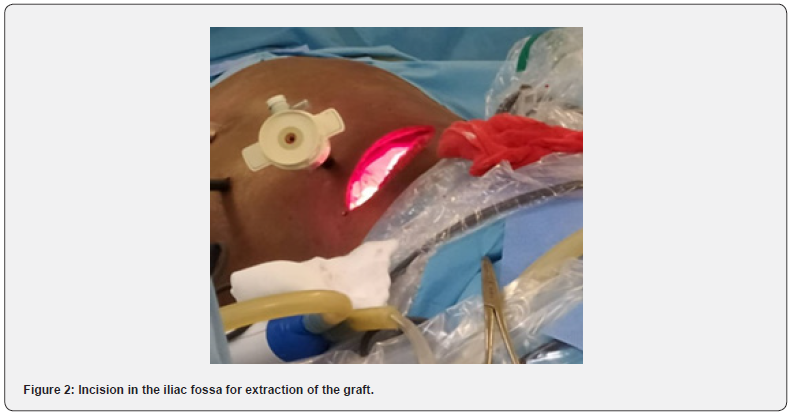
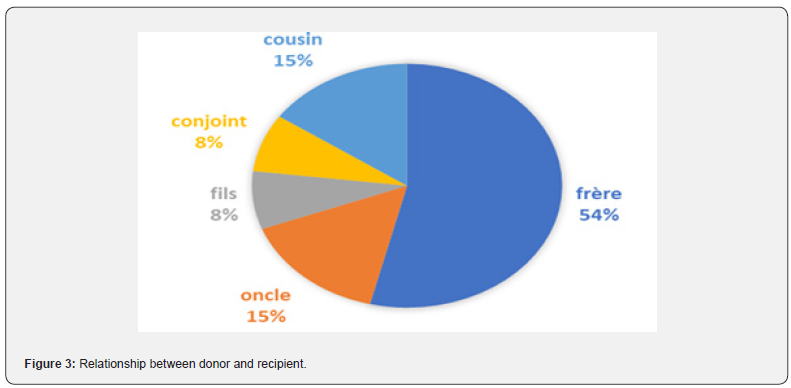
We conducted a descriptive and retrospective study from January 2012 to December 2015. We included all patients who underwent laparoscopic kidney harvesting operated by our team. Data were collected from the medical record drawn up for each patient on admission. A standardized survey form was completed and then recorded in an Excel spreadsheet. The following variables were studied: age, laterality of sampling, conversion rate, duration of procedure, duration of warm ischaemia. Qualitative data were expressed as a proportion. Quantitative data were expressed as a median. The Fischer exact test was used to compare the medians, with a 5% risk of error. Sampling was carried out by the same team using a laparoscopic transperitoneal approach. The patient was in the lateral decubitus position and contralateral to the sampling. The first trocar was placed below the end of the twelfth rib on the anterior axillary line after an ‘open coelio’. This allowed the pneumoperitoneum to be created by intraperitoneal insufflation of CO2 through an optical trocar. The renal pedicle and ureter were then dissected (Figure 1). The specimen was extracted by the assistant’s hand, introduced in a watertight manner by extending the trocar incision by 5 mm in front of the iliac wing. Once the assistant’s hand had grasped the graft, the vascular clamps were applied and the graft sectioned and extracted (Figure 2, 3).

Results
We selected 13 cases. The median age was 31 years with extremes of 21 to 51 years (Table 1, 2). Concerning the donorrecipient relationship, 54% were related to a brother (Table 3).
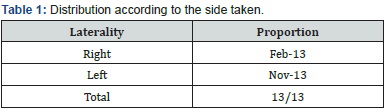
Concerning the laterality of the sample, the left side was the preferential side. The conversion rate was zero.
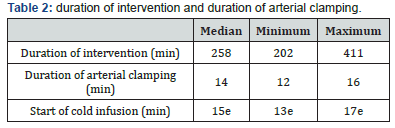
The median duration of the procedure was 4 hours 18 minutes.
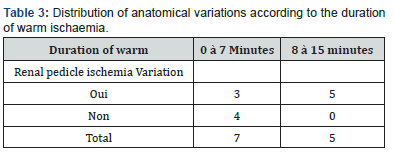
P=0,081 The presence of a variation in the renal pedicle does not significantly influence the duration of warm ischemia.
Discussion
Overall, our donor population was young. Branchereau in Nantes also found a young population with a relatively higher average age. In his study, the mean age of the laparoscopic donor was 40±11.2 years. Siblings were also the most common family relationship [2]. Wiedemann in Paris found a spousal relationship to be the most common family relationship at 53.3% [3]. With regard to the laterality of the kidney to be removed, our team preferred the left kidney for anatomical reasons. This attitude is similar to that of the CTAFU, which recommends that in cases of modal vascularization of both kidneys with no relative difference in function or urological anomaly, the left kidney should be preferred because it has a longer vein [4]. The mean operating time in the Benoit study was 153.4 ± 37.6 min and 120 min in Champy et al. [1-5]. This difference between their mean operating time and ours is due to the lack of transplantation experience of our team in these first procedures. In fact, this procedure was only introduced in 2012 thanks to a legal decree allowing it to be performed in Ivory Coast [6]. The duration of warm ischaemia is associated with unfavorable long-term graft survival after renal transplantation [7]. It is thought to cause destruction of the nephron units. It should be as short as possible. Pradère emphasised a mean duration of warm ischaemia of 3.5 minutes, i.e. half the median time of ischaemia in our study [8]. The experience of the harvesting team could partly justify a shorter ischaemia time. Vascular pedicle variations in transplants are frequent. They can reach 25% as in Jeffrey’s series [9]. He finally concluded that vascular variations should not be a contraindication, as they have little impact on clinical outcomes in either donors or recipients. Furthermore, the benefit of minimally invasive harvesting for a patient undergoing surgery for an altruistic reason could be the main motivation for choosing a laparoscopic approach over a lumbotomy [10].
Conclusion
In this first experience, we have found that we are able to successfully perform laparoscopic kidney harvesting. This technique was made possible thanks to our experience of laparoscopic kidney surgery for procedures other than kidney transplantation (kidney cancer, kidney cyst, etc.). Furthermore, the ischaemia time was relatively long compared with the literature.
References
4 J Branchereau, T Prudhomme, T Bessede, G Verhoest, R Boissier, et al. (2021) French recommendations of the Transplantation Committee of the French Association of Urology (CTAFU): Nephrectomy for kidney donation. Progress in Urology 31(1): 50-56.
6 N Coulibaly, C Ackoundou-N’Guessan, YF NGuessan, Y Aye, MC Guei, et al. (2016) Surgical aspects and preliminary results of kidney transplantation in Ivory Coast 1(6).

























