




 JOJMS Home



Abstract
The advancement of the next generation energy storage and conversion technologies has increased the demand for new materials with tunable structures, high stability, and multifunctional properties. Metal-organic frameworks (MOFs) are a class of porous crystalline materials composed of metal ions and organic linkers that have emerged as promising candidates due to their structural versatility and chemical tailor ability. This review provides an overview of recent progress in harnessing MOFs and their derivatives for energy related applications, including batteries, supercapacitors, and fuel cells. Emphasis is placed on material design strategies, structure property relationships, and performance optimization. Furthermore, challenges associated with scalability, conductivity, and long-term stability are discussed, along with emerging opportunities such as machine learning driven MOF design and green synthesis pathways for sustainable implementation in future energy systems.
Keywords:Metal-organic frameworks; Energy storage; Super-capacitors; Fuel cells; MOF derivatives; Sustainable energy materials
Abbreviations:MOFS: Metal-Organic Frameworks; DFT: Density Functional Theory; Ml: Machine Learning
Introduction
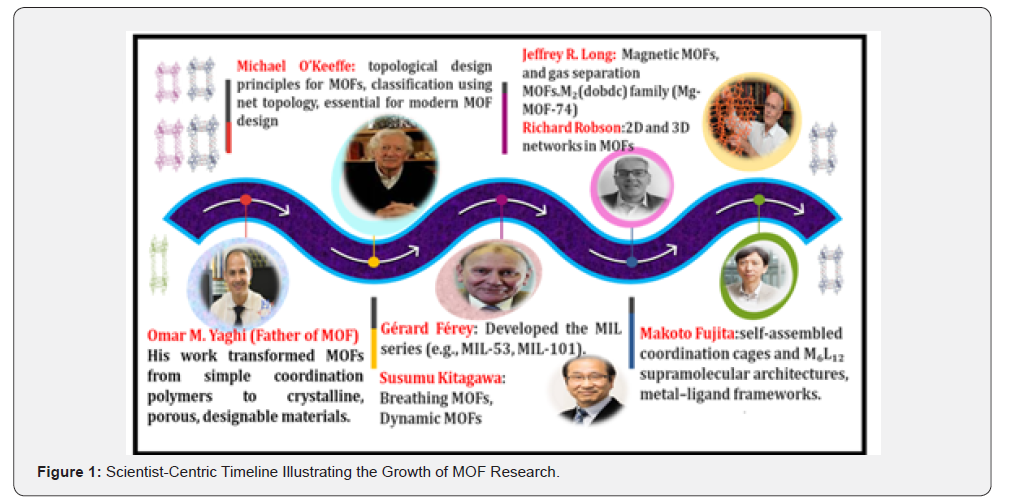
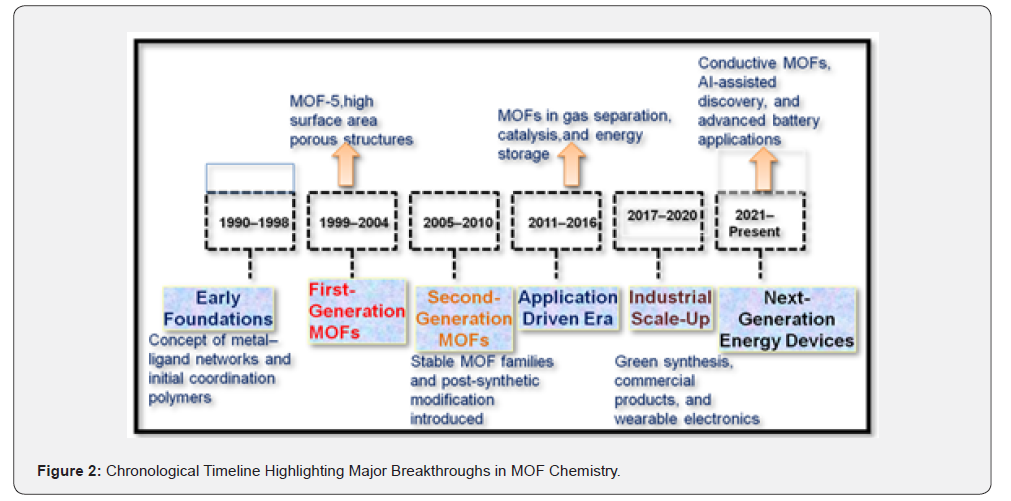
The development of Metal-Organic Frameworks (MOFs) traces a remarkable journey shaped by pioneering scientists from early structural concepts to advanced functional architectures is shown in Figure 1. This evolving timeline reflects how visionary contributions across decades transformed MOFs from laboratory curiosities into powerful materials for modern applications shown in Figure 2 [1-3]. Metal-organic frameworks (MOFs) represent a unique class of hybrid porous materials formed by the coordination of metal ions or clusters with multidentate organic linkers [1]. Their highly ordered structures, tunable porosity, and large surface areas provide a versatile platform for a wide range of applications including gas storage [2], catalysis [3], sensing [4], and particularly energy storage and conversion [5]. In the context of next generation energy technologies, MOFs offer an unparalleled ability to integrate multiple functionalities such as redox activity [6], ion diffusion channels [7], and catalytic centers within a single framework [8].
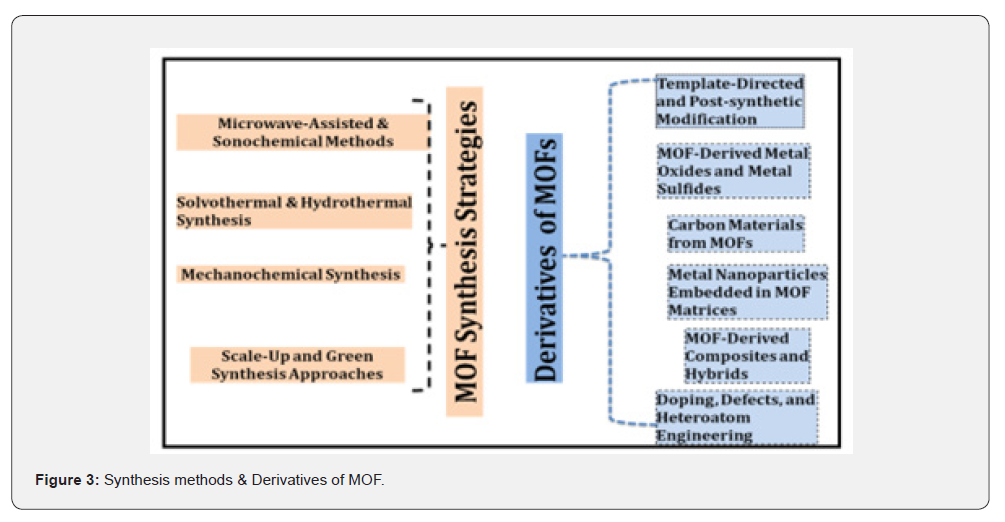
Various synthesis methods & derivatives of MOFs are shown in Figure 3. Recent research has focused on leveraging the structural and chemical diversity of MOFs to develop advanced electrodes [9] and catalysts for batteries [10], supercapacitors [11], and fuel cells [12]. Rational design strategies incorporating metal node selection [13], organic linker functionalization [14] and post synthetic modification [15] enable fine tuning of electrochemical properties. Moreover, the derivatization of MOFs into carbonaceous [16], metallic [17], or composite nanostructures [18] through controlled pyrolysis or chemical conversion has expanded their applicability, providing enhanced electrical conductivity and stability suitable for practical devices.
MOFs in Energy Storage Devices
Batteries (Li-ion, Na-ion, Li-S, and metal-air systems)
In lithium ion and sodium ion batteries, MOF derived materials exhibit superior cycling stability due to their hierarchical porosity and uniform distribution of electroactive species [19]. Study of MOF Derived FeS/C Nanosheets for High Performance Lithium-Ion Batteries reports a MOF precursor yielded material with high porosity and uniformly dispersed FeS active sites [20]. The authors attribute improved Li⁺ transport and charge storage to the large specific surface area and hierarchical porous structure inherited from the MOF. This work also demonstrates that the MOF derived structure addresses electrode pulverization and preserves active material dispersal over cycles. Analogously, MOF derived Na₃V₂(- PO₄) ₃/C and Co-MOF composites [21] have demonstrated stable Na⁺ intercalation kinetics and improved reversibility, highlighting MOF adaptability beyond Li based systems.
In lithium sulfur batteries, MOFs serve as sulfur hosts, effectively confining polysulfides and mitigating the shuttle effect [22]. MOF‑Derived Bifunctional Co₀. ₈₅Se/NC Nanoparticles Embedded in N‑Doped Carbon for Lithium‑Sulfur Batteries shows MOF derived Co₀. ₈₅Se/NC-S host material that maintains high capacities (1361, 1001 and 810mAh g⁻¹ at 0.1,1,3 C) over 400 cycles at 1C [23]. MOFs and their derivatives have made substantial contributions to battery research as both electrode materials and structural templates. The intrinsic porosity of MOFs facilitates ion transport, while the presence of redox active sites enables charge storage. Upon pyrolysis, MOFs yield nanostructured carbon frameworks, transition metal oxides, sulfides, and phosphides materials that exhibit high specific capacities and improved rate performance. MOF Derived NiO-NiCo₂O₄@PPy Hollow Polyhedron as a Sulfur Immobilizer for Lithium Sulfur Batteries describes a MOF precursor converted into a NiO-NiCo₂O₄@PPy composite as a sulfur host for Li-S batteries. The hollow polyhedral morphology (from the MOF template) enhanced electrolyte/electrode contact and improved rate ability: initial discharge capacity ~ 963mAh g⁻¹ (at 0.2C) and good cycling at 1C [24].
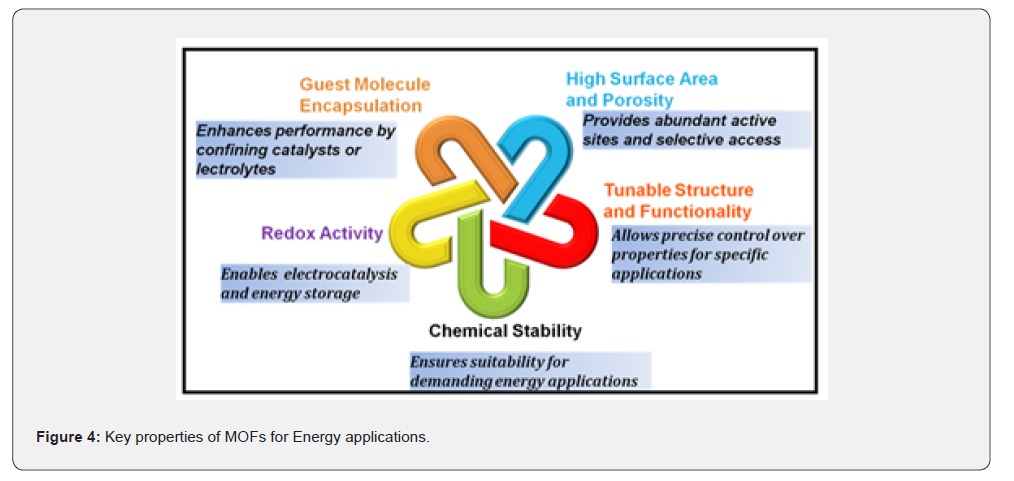
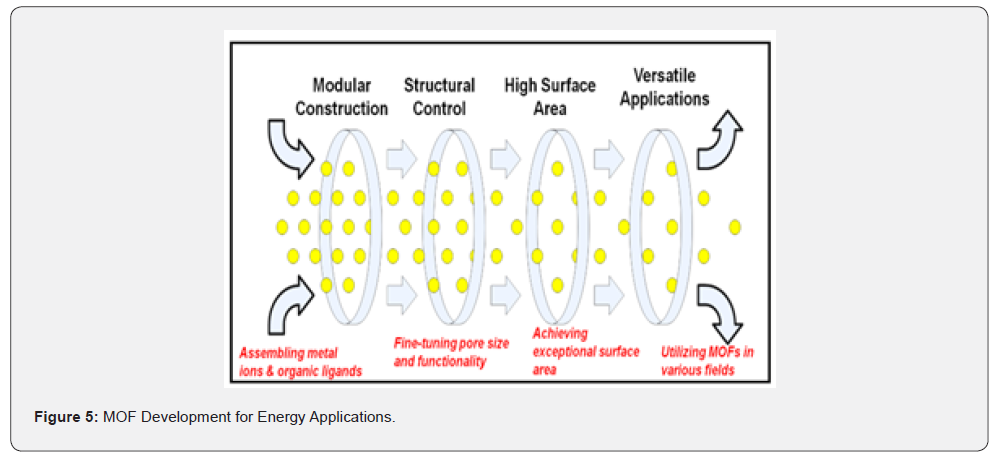
Similarly, in metal-air batteries, MOF derived catalysts promote oxygen reduction and evolution reactions (ORR/OER), enhancing round trip efficiency. Facile Synthesis of a MOF Derived Co-N-C Nanostructure as a Bifunctional Oxygen Electrocatalyst for Rechargeable Zn-Air Batteries (Luo et al., 2023) describes pyrolysis of a Co/Fe/Zn zeolitic imidazolate framework (ZIF) to a Co-N-C catalyst with E₁/₂ (ORR) ~ 0.854V and significant OER performance. In a Zn-air battery the peak power density was ~ 275mW cm⁻² and cycling stability over 180h [25]. Despite these advantages, challenges such as volume expansion, sluggish ion diffusion in dense frameworks, and structural degradation during cycling remain to be addressed. Various key properties MOFs Figure 4 & 5 combine high surface area, tunable porosity, and adaptable metal- ligand chemistry to enable efficient charge, ion, and molecular interactions essential for advanced energy applications.
Supercapacitors
The high surface area and tunable pore structures of MOFs make them ideal candidates for supercapacitor electrodes. In the review by SK Shinde et al. [26], the authors report examples where a MOF (e.g., HKUST‑1) is composited with graphene (rGO) to overcome poor conductivity of the pure MOF. They cite a 10 wt% rGO/HKUST-1 composite which achieved a specific capacitance of ~ 385Fg⁻¹ at 1A g⁻¹, whereas pure HKUST-1 showed only ~ 0.5F g⁻¹ [26-29]. This suggests that combining MOFs with conductive carbonaceous materials (graphene) improves power density, rapid charge discharge capability via improved electrical pathways and more effective utilization of the high surface area/ tunable porosity of the MOF. To overcome this, hybrid structures such as MOF/graphene, MOF/carbon nanotube, and MOF/MXene composites have been engineered to combine the electrochemical double layer behavior of carbonaceous materials with the pseudocapacitive properties of MOFs leading to improved performance [27]. Zhu et al. [28] prepared a composite of a conductive MOF (Ni‑HHTP where HHTP = 2,3,6,7,10,11-hexahydroxytriphenylene) with a MXene nanosheet substrate (Ti₃C₂Tₓ) denoted MXene@Ni- HHTP-x. The optimized composite (MXene@Ni-HHTP-2) achieved a specific capacitance of ~ 416.6F g⁻¹ at 0.5A g⁻¹ in an asymmetric supercapacitor [28]. The MXene based composite further exemplifies the synergy between conductive substrates and redox active MOFs, highlighting the potential for hybridization strategies in scalable supercapacitor designs. These hybrid electrodes demonstrate improved power density, rapid charge discharge capability, and mechanical robustness over prolonged cycling. Additionally, strategies such as heteroatom doping (N, S, P) and post synthetic modification have further enhanced the electrochemical response by introducing additional redox active sites and improving conductivity pathways.
Fuel cells and electrocatalysis
MOFs and their derivatives are increasingly vital in electrocatalysis, serving as precursors for efficient catalysts in ORR, OER, and HER [30]. The highly dispersed active metal sites and tunable coordination environments in MOFs facilitate efficient catalytic activity. A study on a MOF precursor (a cobalt-based MOF / ZIF structure) pyrolyzed to yield a Co-N-C nanostructure indicated that this material exhibited ORR half wave potential (E₁/₂) of 0.854V (in O₂-saturated 0.1M KOH) which is comparable to commercial Pt/C catalysts under the same conditions [31]. For OER, the onset and current density were also good. In a practical Zn-air battery using this catalyst, the peak power density reached ~ 275mW cm⁻² and the cycling stability was > 180h [25]. This demonstrates that MOF derived M-N-C catalysts can rival Pt in activity while offering superior cost effectiveness and structural tunability. The work highlights the role of high surface area, well dispersed metal sites (Co in N-doped carbon), and hierarchical porosity (inherited from the MOF precursor) offering efficient mass transport and electron transfer [32]. The introduction of heteroatoms and the formation of hierarchical pore structures significantly enhance mass transport and electron transfer during electrochemical reactions [33,34]. Achieving long term operational stability and resistance to corrosion under harsh fuel cell conditions remains a major research focus as the long-term operation under acidic or high temperature fuel cell environments still leads to catalyst degradation via metal aggregation or carbon corrosion.
MOF derivatives and composite architectures
Controlled thermal or chemical conversion of MOFs enables the synthesis of a wide variety of functional derivatives, including carbon materials, metal oxides, sulfides, phosphides, and single atom catalysts. These derivatives inherit the morphological precision of the parent MOFs, allowing for tunable porosity and well-dispersed active sites. Integration of MOF derived materials with conductive supports such as graphene, MXenes, or carbon nanotubes has proven highly effective in mitigating intrinsic conductivity limitations and enhancing electrochemical performance. For instance, ZIF-67-derived Co₃O₄@C/graphene hybrids have exhibited enhanced conductivity and mechanical integrity in Liion anodes [35]. The synergistic effects between the conductive matrix and electroactive sites yield materials with superior charge transport, high mechanical strength, and multifunctionality.
Flexible and solid-state energy devices
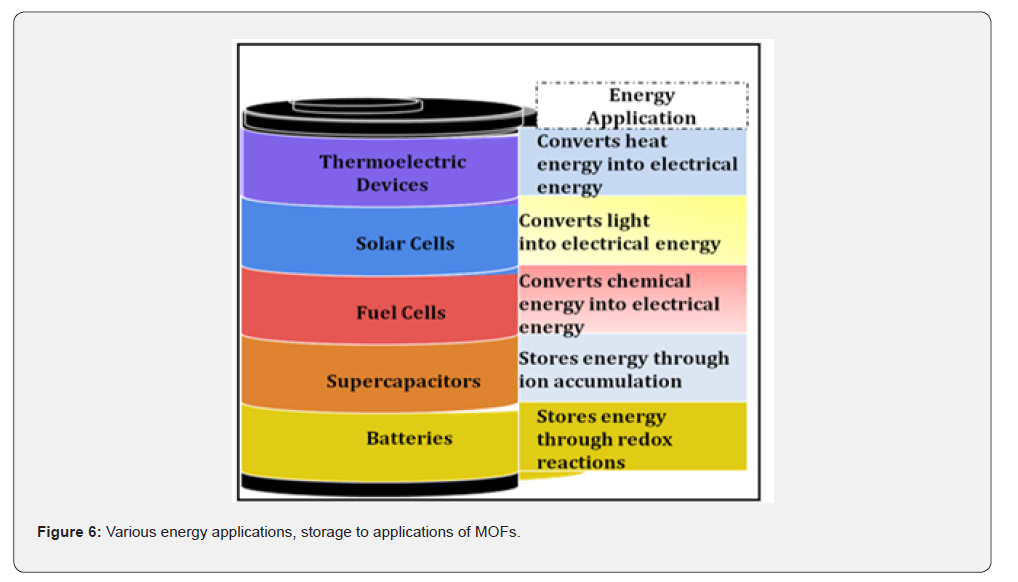
The development of flexible and solid-state energy devices has driven new innovations in MOF-based materials. The incorporation of MOFs and their derivatives into flexible electrodes provides mechanical resilience [36], foldability, and adaptability for wearable electronics. MOF-based solid electrolytes and separators are also being explored for safer and more compact device architectures. A recent study reported a flexible MOF derived NiCo₂O₄/ CNF electrode maintaining 90 % capacitance after 5000 cycles under bending stress. Current research emphasizes enhancing interfacial compatibility, ionic conductivity [37], and long-term durability under mechanical stress [38-39]. Such hybridization strategies are central to achieving practical electrochemical performance benchmarks. Future designs should emphasize integrating MOF flexibility with scalable fabrication methods, such as 3D printing. Various applications of MOF are illustrated in Figure 6.
Theoretical insights and emerging opportunities
Computational approaches, including density functional theory (DFT) and machine learning (ML), are increasingly being utilized to accelerate MOF discovery. DFT helps elucidate electronic structures, reaction mechanisms, and adsorption behaviors, while ML enables high throughput screening of vast MOF databases to predict optimal candidates for specific energy applications [40]. Recent ML frameworks have screened >10,000 MOF structures for optimized electronic conductivity and stability, accelerating discovery timelines. Computational and data driven approaches now complement experimental efforts in understanding structure property correlations in MOFs.
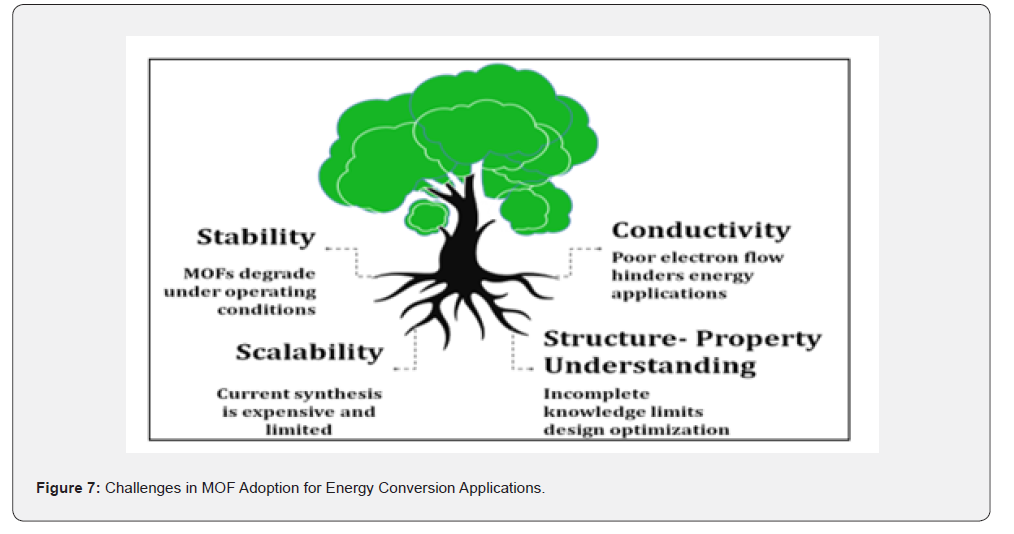
In parallel, sustainable synthesis routes using green solvents, bioderived linkers, and ambient-condition assembly methods are gaining popularity. Addressing challenges in large-scale production, environmental stability, and cost-effectiveness remains crucial for commercial deployment of MOF-based energy materials. Figure 7 illustrates the key scientific, structural, and practical challenges that limit the widespread adoption of MOFs in energy conversion applications.
Conclusion
Bridging the gap between laboratory scale synthesis and commercial device integration remains the foremost challenge. MOFs and their derivatives have demonstrated remarkable versatility and potential across diverse next generation energy systems. The combination of tunable composition, structural precision, and multifunctionality positions them as strong contenders for future high performance energy devices. Continued progress in scalable synthesis, in depth mechanistic understanding, and data-driven material discovery will be essential to fully realize their potential in real-world applications. Future research should focus on integrating MOF based materials into practical device architectures while ensuring environmental sustainability and economic viability. Overall, MOF-based materials are poised to drive the evolution of sustainable, high performance energy technologies through interdisciplinary innovation.
References
- Cai G, Yan P, Zhang L, Zhou HC, Jiang HL (2021) Metal-organic framework-based hierarchically porous materials: synthesis and applications. Chem Rev 121(20): 12278-12326.
- Sahayaraj AF, Prabu HJ, Maniraj J, Kannan M, Bharathi M, et al. (2023) Metal-organic frameworks (MOFs): the next generation of materials for catalysis, gas storage, and separation. Journal of Inorganic and Organometallic Polymers and Materials 33(7): 1757-1781.
- Jiao L, Wang Y, Jiang HL, Xu Q (2018) Metal-organic frameworks as platforms for catalytic applications. Adv Mater 30(37): 1703663.
- Zhang LT, Zhou Y, Han ST (2021) The role of metal–organic frameworks in electronic sensors. Angew Chem Int Ed Engl 60(28): 15192-15212.
- He B, Zhang Q, Pan Z, Li L, Li C, et al. (2022) Freestanding metal-organic frameworks and their derivatives: an emerging platform for electrochemical energy storage and conversion. Chem Rev 122(11): 10087-10125.
- Li J, Ott S (2024) The Molecular Nature of Redox-Conductive Metal-Organic Frameworks. Accounts of Chemical Research 57(19): 2836-2846.
- Fu L, Yang Z, Wang Y, Li R, Zhai J (2021) Construction of metal‐organic frameworks (MOFs)-Based membranes and their ion transport applications. Small Science 1(2): 2000035.
- Wei YS, Zhang M, Zou R, Xu Q (2020) Metal-organic framework-based catalysts with single metal sites. Chemical reviews 120(21): 12089-12174.
- Yan R, Ma T, Cheng M, Tao X, Yang Z, et al. (2021) Metal-organic‐framework‐derived nanostructures as multifaceted electrodes in metal–sulfur batteries. Adv Mater 33(27): 2008784.
- Wang W, Yang K, Zhu Q, Zhang T, Guo L, et al. (2024) MOFs‐Based Materials with Confined Space: Opportunities and Challenges for Energy and Catalytic Conversion. Small 20(37): 2311449.
- Shaikh T, Pise S, Bhosale R, Vadiyar M, Nam KW, Kolekar S (2025) A review and perspective on advancement in metal-organic framework-based composites for supercapacitors: from dimensionalities to functionalities. Energy & Fuels 39(5): 2396-2421.
- Nik Zaiman NFH, Shaari N, Harun NAM (2021) Developing metal‐organic framework‐based composite for innovative fuel cell application: An overview. International Journal of Energy Research 46(2): 471-504.
- Chen W, Ma B, Zou R (2025) Rational design and controlled synthesis of MOF-derived single-atom catalysts. Accounts of Materials Research 6(2): 210-220.
- Baumann AE, Burns DA, Liu B, Thoi VS (2019) Metal-organic framework functionalization and design strategies for advanced electrochemical energy storage devices. Communications Chemistry 2(1): 86.
- Mandal S, Natarajan S, Mani P, Pankajakshan A (2021) Post‐synthetic modification of metal–organic frameworks toward applications. Advanced Functional Materials 31(4): 2006291.
- Wang C, Kim J, Tang J, Kim M, Lim H, et al. (2020) New strategies for novel MOF-derived carbon materials based on nanoarchitectures. Chem 6(1): 19-40.
- Xu G, Zhu C, Gao G (2022) Recent progress of advanced conductive metal–organic frameworks: precise synthesis, electrochemical energy storage applications, and future challenges. Small 18(44): 2203140.
- Shahzadi S, Akhtar M, Arshad M, Ijaz MH, Janjua MRSA (2024) A review on synthesis of MOF-derived carbon composites: innovations in electrochemical, environmental and electrocatalytic technologies. RSC advances 14(38): 27575-27607.
- Song G, Shi Y, Jiang S, Pang H (2023) Recent progress in MOF‐derived porous materials as electrodes for high‐performance lithium‐ion batteries. Advanced Functional Materials 33(42): 2303121.
- Zhao J, Hu Z, Sun D, Jia H, Liu X (2019) MOF-derived FeS/C nanosheets for high performance lithium-ion batteries. Nanomaterials 9(4): 492.
- Prabu AN, Yogapriya L, Balachander K, Somasundaram K (2025) Air-powered Innovation: Exploring the Future of Aluminum-Air Batteries. J Environ Nanotechnol 14(3): 573-590.
- Kang X, He T, Zou R, Niu S, Ma Y, et al. (2024) Size effect for inhibiting polysulfides shuttle in lithium‐sulfur batteries. Small 20(8): 2306503.
- Xie Y, Cao J, Wang X, Li W, Deng L, Ma S, et al. (2021) MOF-derived bifunctional Co0. 85Se nanoparticles embedded in N-doped carbon nanosheet arrays as efficient sulfur hosts for lithium–sulfur batteries. Nano Letters 21(20): 8579-8586.
- Xu F, Jin B, Li H, Ju W, Wen Z, et al. (2019) MOF-derived NiO-NiCO2O4@ PPy hollow polyhedron as a sulfur immobilizer for lithium-sulfur batteries. New Journal of Chemistry 43(46): 18294-18303.
- Luo X, Zheng Z, Hou B, Xie X, Wang CC (2023) Facile synthesis of a MOF-derived Co-N-C nanostructure as a bi-functional oxygen electrocatalyst for rechargeable Zn-air batteries. RSC advances 13(27): 18888-18897.
- Shinde SK, Kim DY, Kumar M, Murugadoss G, Ramesh S, et al. (2022) MOFs-graphene composites synthesis and application for electrochemical supercapacitor: a review. Polymers 14(3): 511.
- Cao Z, Momen R, Tao S, Xiong D, Song Z, et al. (2022) Metal-organic framework materials for electrochemical supercapacitors. Nano-micro letters 14(1): 181.
- Zhu R, Gu Y, Liu L, Lu J, Pang H (2024) Integration of conductive MOF and MXene for high-performance supercapacitor. New Journal of Chemistry 48(23): 10593-10598.
- Song Z, Cheng N, Lushington A, Sun X (2016) Recent progress on MOF-derived nanomaterials as advanced electrocatalysts in fuel cells. Catalysts 6(8): 116.
- Wang X, Zhou J, Fu H, Li W, Fan X, et al. (2014) MOF derived catalysts for electrochemical oxygen reduction. Journal of Materials Chemistry A 2(34): 14064-14070.
- Tang W, Mai J, Liu L, Yu N, Fu L, et al. (2023) Recent advances of bifunctional catalysts for zinc air batteries with stability considerations: from selecting materials to reconstruction. Nanoscale Advances 5(17): 4368-4401.
- Ge D, Liao L, Li M, Yin Y (2022) Metal-organic framework-derived atomically dispersed Co-NC electrocatalyst for efficient oxygen reduction reaction. Catalysts 12(11): 1462.
- Zhang J, Suo W, Han Y, Cao Y, Xu Y, et al. (2025) Co nanoparticles encapsulated in N-doped carbon nanotube materials derived from new metal-organic frameworks for oxygen electrocatalysis. Journal of Materials Chemistry A 13(1): 669-679.
- Guo Y X, Huang CH, Gandomi YA, Hsieh CT, Liu WR (2023) Synthesis and electrochemical properties of CO3O4@ reduced graphene oxides derived from MOF as anodes for lithium-ion battery applications. Sustainability 15(6): 4988.
- Cai J, Song Y, Chen X, Sun Z, Yi Y, et al. (2020) MOF-derived conductive carbon nitrides for separator-modified Li-S batteries and flexible supercapacitors. Journal of Materials Chemistry A 8(4): 1757-1766.
- Cheng P, Liu S, Jia X, Jiang Y, Zhang X (2025) Robust MOF-Based Composite Solid-State Electrolyte Membrane for High-Performance Lithium–Metal Batteries. Nano Letters 25(15): 6152-6159.
- Lin R, Jin Y, Li Y, Zhang X, Xiong Y (2023) Recent advances in ionic liquids-MOF hybrid electrolytes for solid-state electrolyte of lithium battery. Batteries 9(6): 314.
- Kamath PD, Elena AM, Rosen AS, Zanca F, Persson K (2025) Machine Learned Potential for High-Throughput Phonon Calculations of Metal-Organic Frameworks. In AI4X 2025 International Conference, pp: 17.
- Zanca F, Glasby LT, Chong S, Chen S, Kim J, et al. (2021) Computational techniques for characterization of electrically conductive MOFs: quantum calculations and machine learning approaches. Journal of Materials Chemistry C 9(39): 13584-13599.
- Sa B, Hu R, Zheng Z, Xiong R, Zhang Y, et al. (2022) High-throughput computational screening and machine learning modeling of Janus 2D III–VI van der Waals heterostructures for solar energy applications. Chemistry of Materials 34(15): 6687-6701.

























