




 GJIDD Home



Abstract
The involuntary and forced sterilization of people with disabilities is a practice rooted in eugenic ideologies seeking to control reproduction under the guise of public welfare. Social policy toward immigrants and “the feebleminded” during the progressive era, particularly the first two decades of the 20th century, was driven most obviously by the progressives’ belief in the need for segregation, and subsequently sterilization, to preserve the race, meaning, of course, the white race. The belief that “the feebleminded” were degenerate beings responsible for many if not most social problems; that they reproduced at an alarming rate and menaced the nation’s overall biological fitness; and that their numbers were being incremented by undesirable ‘new’ immigrants from southern and eastern European countries was, if not fully accepted at the turn of the century, well on its way to being the credo of science and society, or at least progressive society, by then. When, in 1927, the U.S. Supreme Court ruled that involuntary and forced sterilizations were constitutional for inmates of institutions for the insane and the feebleminded, and criminal penitentiaries, the practice expanded rapidly. This manuscript explores the historical trajectory, legal frameworks, and debates surrounding involuntary and forced sterilization with a focus on the role of the Virginia State Colony in the American eugenic tragedy.
Involuntary and Forced Sterilization of People with Disabilities
The Role of the Virginia Colony
The involuntary and forced sterilization of people with disabilities is a practice rooted in eugenic ideologies seeking to control reproduction under the guise of public welfare. Social policy toward immigrants and “the feebleminded” during the progressive era, particularly the first two decades of the 20th century, was driven by the progressives’ belief in the need for segregation, and subsequently sterilization, to preserve the race, meaning, of course, the white race. The belief that “the feebleminded” were degenerate beings responsible for many if not most social problems; that they reproduced at an alarming rate and menaced the nation’s overall biological fitness; and that their numbers were being incremented by undesirable ‘new’ immigrants from southern and eastern European countries was, if not fully accepted at the turn of the century, well on its way to being the credo of science and society, or at least progressive society, by then.
When, in 1927, the U.S. Supreme Court ruled that involuntary and forced sterilizations were constitutional for inmates of institutions for the insane and the feebleminded, the practice expanded rapidly. Particularly vulnerable, even among these already vulnerable populations, were women who were deemed to be feebleminded. This article explores the historical trajectory, legal frameworks, and debates surrounding involuntary and forced sterilization with a focus on the role of the Virginia State Colony in the American eugenic tragedy.
American Origins
The initiative for sterilization came from the increasing popularity of the new science, or pseudoscience, of eugenics. Inaccurately based on Darwinian principles of natural selection and the rediscovered principles of Mendelian laws of inheritance early eugenic efforts, so called “positive eugenics” focused on the patterns of sex, life, heredity, and information for married persons and persons considering marriage, family coordination, and social purity.1 Drawing from the work of the British scientist who coined the phrase eugenics, meaning “good in birth”, these efforts sought to increase the number of children born to parents from “fit” families, meaning wealthier, upper class white families. In America, particularly, this positive eugenic focus was soon overshadowed by efforts not to increase reproduction of the “fit,” but to decrease the reproduction of the so-called “unfit.” The primary tools wielded by proponents of negative eugenics were segregation through institutionalization, marriage restriction legislation, and forced sterilization.
Between 1907 and 1921, eighteen states passed sexual sterilization statutes and by January 1, 1921, an estimated 3,233 people had already been forcibly sterilized. The majority of those sterilized during this initial period were people in institutions for the insane, for the simple reason that they were more likely to be released from the institution than were people who were deemed to be feebleminded, and their release was made contingent upon undergoing sterilization. That began to change in the early 1910s. In 1912, psychologist Henry Herbert Goddard published The Kallikak Family, one of the increasingly popular “eugenic family” studies that began with the 1878 publication of The Jukes by Richard Dugdale [1]. The Kallikak family study relayed the largely invented story of a family (given the fictional name Kallikak) tracing back from a woman, called Deborah Kallikak, who was a resident of the New Jersey institution at which Goddard worked, The Vineland Training School.2 Goddard reported he had found two lines of a family with a “good strain” associated with upstanding members of the community and a “poor strain,” alleged to have led to multiple generations of people associated with feeblemindedness, criminal behavior, and pauperism.31 The name Kallikak was derived from the Greek word Kallos (beauty) and Kakos (bad). Goddard further claimed he could identify a higher functioning group of persons with feeble-mindedness, whom he labeled as morons, and who could be identified through the new mental tests [2]. While the Kallikak study was discredited as faulty science, it was nevertheless embraced broadly as the classic study of eugenics and it influenced public policy for decades in the United States and beyond [3.4].
The Kallikak study became a source of fuel for the negative eugenics movement and forced sterilization of people with intellectual and developmental disabilities. Undergirding eugenics was an essential belief in the danger to society of people with disabilities. As Green (2025, p. 119) noted in referring to this belief at that time: Turned out into the world by irresponsible non-disabled people, the feebleminded would be abandoned and taken advantage of. Then they would take up vicious habits and become the all too recognizable people whose stories showed up…each day. Without guidance, they would tear apart the fabric of a steadily advancing modern society, and this seemed to be the antithesis of a social duty to prevent the perpetuation. of such indignities [5].
The first institution for people with intellectual disability in the United States was the Massachusetts School for the Feebleminded and Idiotic, later renamed the Fernald State School. As Director, Walter Fernald was involved in the early eugenics movement, seeing institutionalization as a form of eugenic measures by segregating persons in order to prevent the transmission of feeblemindedness. However, he opposed involuntary sterilization, indicating a preference for strict measures related to social and sexual quarantines. Fernald became an outspoken critic of the practice of sterilization with particular concern noted of the risk of consequences for the people’s mental health [5]. The idea of involuntary and forced sterilization received a far warmer reception in Virginia. Joseph DeJarnette, director of the largest facility serving people identified as having mental illness, became the foremost advocate for eugenic sterilization for people labeled insane, epileptic, alcoholic, criminal, and syphilitic, along with people deemed to be “imbeciles,” “idiots,” and “the feebleminded” in general. His ardent support of eugenics was reflected in a poem he wrote in praise of selective human breeding; it was entitled Mendel’s Law: A Plea for a Better Race of Men [6.7]. It included these excerpted verses: This is the law of Mendel, And often he makes it plain, Defectives will breed defectives, And the insane breed insane. Oh, why do we allow these people. To breed back to the monkey’s nest, To increase our country’s burdens, when we should only breed the best. Oh, you wise men take up the burden, and make this your loudest creed. Sterilize the misfits promptly-All not fit to breed. Then our race will be strengthened and bettered, and our men and women blest, not apish, repulsive, and foolish, for we should breed from the good and the best.
DeJarnette was among major proponents of the establishment of a colony in Virginia to house people with epilepsy and feeblemindedness. The Virginia State Colony would become the national home of the sterilization movement.
Virginia’s Home for Sterilization
The Virginia State Colony for Epileptics opened in 1910 and within four years its mission would officially be broadened as it was recast as Virginia State Colony for Epileptics and Feebleminded. The initial Superintendent for the Colony was Dr Albert Priddy. In his Second Annual Report (1911), he indicated “it is reasonable to anticipate a rapid increase in epileptics and mental defectives. Therefore, it seems not inopportune to call the attention of our lawmakers to the consideration of legalized eugenics” (p. 29) [8]. Priddy emphasized that epilepsy and feeblemindedness would need to be controlled by a combination of permanent custodial care and the application of sterilization procedures for selected cases [8].
Priddy’s observations were consistent with emerging policy within the Commonwealth of Virginia’s Board of Charities and Corrections (1915) who noted that: “the marriage of mental defectives should be prohibited by law and that there should be a law authorizing the sterilization of such persons and the state should have authority to segregate and detain mentally defective persons under proper conditions and limitations” [9]. Dr. Priddy did offer a cautionary note in his fourth annual report that sterilizations “can never become a general procedure, on account of the many objections that can be raised to it, nor in practical results compare with… segregation and custodial control [10]”. Sterilizations, in spite of this tepid warning, would nevertheless become part of the reality of the Virginia Colony.
In his Second Biennial Report (1922-23), Priddy’s recommendations were for: the application of legalized eugenics for the prevention of this growing blight…. by restricting the marriage of epileptics, the insane, feebleminded, and confirmed alcoholics, and < considering> the practicability of the law permitting sterilization of inmates. (p. 10) [11].
Dr. Priddy provided further context for sterilization: Each day in the custodial care of delinquent high-grade moron girls and women of good physical strength and health impresses me with the gravity of the responsibility which the state and the institutions for the feebleminded assume in keeping these people in institutions indefinitely to enforce morality in actions or rather to restrain them from overt acts of immorality. If they are to be kept from indulging in sexual immorality, it means that they are to be kept a lifetime in institutions under the strictest custody to restrain them from committing acts which, under the law, would be misdemeanors. This to any fair-minded thinker must appear to be a cruel and unjust degree of punishment for their weaknesses…. It certainly seems more humane and just to give them a milder and less severe method of attaining the desired end.” (p. 27) [11].
Dr. Priddy acknowledged that there were surgeries that had already been performed and described as for health reasons, that coincidentally made the individual sterile. These were done in response to a rationale of a disease but not yet legally as a eugenic measure. He performed numerous sterilizations himself in the first decade of the Colony’s existence and reported that he had been positively impressed with the results [11].
Establishing a Legal Basis
The core issue that arose had to do with the legality of involuntary sterilizations. This question had been consistently sidestepped by the practices at the Virginia Colony and other institutions in which a rationale was created of the need for the procedure for varied health reasons. But there was an acknowledgement that there was the potential for legal liability. To create a national focus, at least among American eugenicists, for the use of forced sterilization, the Eugenics Record Office, established by America’s foremost eugenicists, Charles B. Davenport and Harry Hamilton Laughlin, issued two reports pertaining to sterilization, referred to as Eugenics Record Office Bulletin numbers 10A and 10B, both titled Report of the Committee to Study and to Report on the Best Practical Means to Cut Off the Defective Germ-Plasm in the American Population. Bulletin 10B was subtitled The Legal, Legislative and Administrative Aspects of Sterilization [12].
In 1922, a decade after these initial reports, Laughlin published a compilation of data about sterilization laws, statutes, and practices titled of Eugenical Sterilization in the United States [13].
The intent was to provide a blueprint for compulsory sterilization legislation that might be developed throughout the United States. One reason that Eugenical Sterilization was able to galvanize the passage of state sterilization laws was because it was published by the Municipal Court of Chicago, an entity with credibility in legal circles. In the book, Laughlin proposed a “model” sterilization law. The focus of this model law was to provide a constitutionally sound and administratively efficient mechanism for sterilizing people deemed to be genetically defective. It specifically included people identified as being mentally ill, epileptics, alcoholics, blind, deaf, physically deformed, and those with chronic diseases (e.g., feeblemindedness) believed to be hereditary. The law reflected Laughlin’s belief that sterilizations would improve the genetic quality of the population by preventing the transmission of undesirable traits. Further, the argument again was made that sterilization was more humane and cost-effective than institutionalization and lifelong care [12,13].
In 1924, Laughlin was approached with an opportunity to test the airtightness of his model sterilization law. Laughlin had mailed a copy of Eugenical Sterilization to Albert Priddy, who, along with DeJarnette, and Attorney/Legislator Aubrey Strode, believed it would be prudent, and necessary, for this law to be sanctioned by Virginia law. The model sterilization law developed by Laughlin provided guidelines for possible legal action. Receiving legal approval, however, was not straightforward. DeJarnette recalled the process: In 1920 at a meeting of the General Board of State Hospitals, Dr. Priddy and I were ordered to prepare a bill for the sterilization of the unfit. We prepared the bill, and it was presented before the…House of Delegates. We were rewarded for our trouble by < being> laughed at by the lawmakers who suggested they might fall victim to their own legislation….. Ridicule is often an effective weapon. But this time it only postponed the passage of the sterilization law. Goaded on by the statistics of the defectives of our state, Dr. Priddy and I determined to make another effort…. This time we carried our troubles to Senator A.S. Strode…whose sympathy and interests were already enlisted….Judge Strode wrote Virginia’s sterilization law. The bill was introduced < again> and passed almost unanimously….Our Virginia law is both humane and economical and is destined to save millions of dollars and more in accidents, crimes, disgrace, suffering, and poverty and eventually to raise our standard of intelligence....The people of Virginia are and should be eternally grateful (italics added) to Judge Strode for giving this legislative masterpiece to humanity [14].
The1924 Virginia statute established the legal policy for the sexual sterilizations of “inmates” of state institutions. The state law (General Assembly. Chapter 46B of the Code of Virginia § 1095h–m (1924), p. 569) specified in part the following: Whenever the superintendent of the Western State Hospital, Eastern State Hospital, Southwestern State Hospital, or Central State Hospital, or of the State Colony for Epileptics and Feeble-Minded, shall be of the opinion that it is for the best interests of the patients and of society that any inmate of the institution under his care should be sexually sterilized, such superintendent is hereby authorized to perform, or cause to be performed by some capable physician or surgeon, the operation of sterilization on any patient confined in such institutions afflicted with hereditary forms of insanity that are recurrent, idiocy, imbecility, feeble-mindedness or epilepsy; provided that such superintendent shall have first complied with the requirements of this act [15].
The timing of the passage of Virginia’s 1924 law was coincidental with the recent arrival of a new inmate at the Colony. Carrie Buck would be perceived to be the perfect subject for such a case. She would inadvertently function as the plaintiff in the national test case seeking to affirm the use of involuntary sterilization [7]. After her father died, Carrie was taken from her mother, Emma, at age three and had been living in a foster home in Charlottesville. In 1923, she was reported to have been raped by the foster family’s nephew and was impregnated. The family rejected that claim and argued that the pregnancy was evidence of her promiscuity and feeblemindedness. After the birth of her child, Vivian, Carrie was formally identified as feebleminded and committed to the Virginia State Colony [7].
Carrie’s mother, Emma Buck, had previously been institutionalized in 1920, so the 1924 placement of Carrie constituted an unusual family reunion. The unsubstantiated, and false, assertion that her daughter, Vivian, was also likely to be feebleminded now further added to the creation of Carrie Buck’s story as the ideal test case of the new Virginia law [16-18]. The family pattern, as described, provided Dr. Priddy with a perfect opportunity to move forward in the courts. He would have the chance to promote eugenics and support sterilization in Virginia. This case would supply an opportunity for the law to determine whether the new Virginia law would withstand a constitutional challenge [7].
The case was initially heard in the Amherst Circuit Court with Dr. Priddy the defendant. Aubrey Strode, co-author of the sterilization statute, served as defense attorney. A local lawyer, Irving Whitehead, was assigned to represent Carrie; he was a member the Colony’s Board of Directors, was on the State Board of Hospitals, and had a building at the Colony named for him. The case was “a friendly legal suit” [7,16]. Key witnesses in the trial were prominent individuals in the eugenics movement. Harry Laughlin, author of the Eugenical Sterilization, had never met Carrie nor directly assessed her. Nevertheless, he provided a written deposition as expert testimony, based in part on information provided to him by Priddy, verifying that Carrie, and her daughter, were feebleminded and further that the family were representatives of “shiftless, ignorant, and worthless class of antisocial whites” [15,16].
Arthur Estabrook, Davenport and Laughlin’s colleague at the Eugenics Research Office, visited the Virginia Colony, saw Carrie personally, met her mother, read case histories, visited the home where she had stayed, and tested her sister Doris Buck (who also was at the Colony by that time). He concluded that Emma Buck was a feebleminded woman and that she had three feebleminded children. He reported that she inherited the germplasm from the maternal side of her family and carried the defective strain. He concluded that Carrie was clearly feebleminded and her daughter, Vivian, only six months old at the time, was also likely to be feebleminded [16,19].
While the claims about Carrie and Emma being feebleminded were unsubstantiated beyond the questions raised about charges of immorality, the reality of Vivian’s level of intellectual functioning was pure fiction, particularly given her young age. Social worker Caroline Wilhelm noted “I do not recall and I’m unable to find any mention in our files of having said that Carrie Buck’s baby was mentally defected. I < only> said that we should not want to take the responsibility of placing so young a child, whose mother and grandmother are both mental defectives” [7,20]. As renowned historian of science, Stephen J. Gould, reported (1984), Vivian’s subsequent school record refuted the assumption of feeblemindedness [21].
Dr. DeJarnette also provided testimony, stating, “it would be impossible to estimate the blessing of a sterilization to a family with the mentally defective daughter likely over-sexed and < who> at any time could bring upon her family a lifetime of care and disgrace.” DeJarnette had a strong personal stake in the case; he had performed many of the 1,200 sterilizations at Western State [17,22].
Dr. Priddy testified that Carrie’s sterilization would prevent the spread of mental deficiency to future generations: I have ascertained that she is feebleminded of the lowest grade moron class. Her mental age is nine… The history of all such cases in which mental defectiveness, insanity and epilepsy develop in the generations of feeble-minded persons is that the baneful effects of heredity will be shown in descendants of all future generations. Should she be corrected against childbearing by the simple and comparatively harmless operation, she could leave the institution, enjoy her liberty in life, and become self-sustaining (p.44) [7].
In 1925, the Amherst Court upheld the order for Carrie’s sterilization [7]. After Dr. Priddy’s death, Dr. John Bell, the new Colony Superintendent, became the namesake of the case. In communication with Attorney Strode, he stated: “if you are of the opinion that this case should… be carried on in my name, it is agreeable with me as I am in entire sympathy with the effort being made to reach a final conclusion as to the legality of this sterilization procedure” (p. 173) [15]. The case passed rapidly through the lower courts, consistently approving the sterilization [23].
The case, by then known as Buck v. Bell, was appealed to the U.S. Supreme Court. In an 8-1 decision, the Court accepted the premise that Carrie, Emma, and Vivian were “feeble-minded” and thus it was in the interest of the Virginia to have Carrie sterilized.
The Virginia Sterilization Act was confirmed as not a violation of the Constitution [23].
Associate Justice Oliver Wendell Holmes delivered the majority opinion: We have seen more than once that the public welfare may call upon the best citizens for their lives. It would be strange if it could not call upon those who already sap the strength of the State for these lesser sacrifices, often not felt to be such by those concerned, in order to prevent our being swamped with incompetence. It is better for all the world if instead of waiting to execute degenerate offspring for crime, or to let them starve for their imbecility, society can prevent those who are manifestly unfit from continuing their kind. The principle that sustains compulsory vaccination is broad enough to cover cutting the Fallopian tubes. Three generations of imbeciles are enough [24].
It remained quite likely that none of the three members of this family were in fact feebleminded and certainly not imbeciles. Nevertheless, these extraneous facts were not apparent in the series of legal considerations [18].
Justice Holmes also spoke, more or less, to equality of access to sterilizations: It is said < that> it might be if this reasoning were applied generally < the law> fails when it is confined to the small number who are in the institutions named and is not applied to the multitudes outside. It is the usual last resort of constitutional arguments to point out shortcomings of this sort. But the answer is that the law does all it is needed when it does all that it can, indicates a policy, applies it to all within the lines, and seeks to bring within the lines all similarly situated so far and so fast as its means allow. Of course, so far as these operations enable those who otherwise must be confined to be returned to the world, and thus open the asylum to others, the equality aimed at will be more nearly reached [24].
This ironic reasoning seemed to imply that sterilization could be considered as a human right to which many people with disabilities should now have access. Upon the decision of the Supreme Court, the sterilization could now proceed. On October 19, 1927, Dr. Bell performed the surgery (i.e., salpingectomy, the cutting of the Fallopian tubes) on Carrie Buck at the Halsey- Jennings building, the location where early sterilizations took place at the Colony.19 Soon thereafter, Carrie’s sister, Doris, would also be sterilized. Regardless of whether the surgery was voluntary, now such procedures had been confirmed to be legal [25].
After the Virginia law was upheld by the U.S. Supreme Court in Buck v. Bell, Virginia aggressively initiated the program of involuntary sterilizations. It became a part of the institutional routine of surgeries for so-called “mental defectives with cacogenic (dysgenic, related to or causing degeneration in offspring) potentialities [26].” The surgical floodgates now opened wide.
Impact
The response to the decision of the Supreme Court was immediate. Within ten years, over 1,000 sterilizations would occur at the Virginia Colony [22]. The annual pattern was continual with selected numbers of 94 in 1929, 159 in 1930, and 88 in 1934 [27]. These people were among the victims of the approximately 8,300 procedures that would be performed under state law [28].
In 1931, Dr. Bell reported on the progress made with sterilizations in his follow-up report (quotation shortened): Of the 447 persons sterilized at the State Colony, only ten remain in the institution, the others having been returned to their families or friends, minus the great menace to Society of their reproduction…. Mental levels in cases ranged from four years to eleven and onehalf, and from chronological ages from thirteen to thirty-seven. Of this number, nineteen were epileptic females and 47 were epileptic males; 309 were feeble-minded females and 72 feebleminded males. Overall, < there were> 328 females and 119 males.
As to the preponderance of the females a word of explanation will suffice. More of them come to the institution than males < because> they are more quickly apprehended by social agencies. Males of a suitable type for sterilization and release can evade serious contact with welfare agencies or local officials to a greater extent. The female defective is more dangerous eugenically than the males because she falls an easy prey to the sexual aggressions of males of superior intellect as well as to those of her own mental level. On the contrary, the feeble-minded male cannot enter serious competition with the normal male for the affections of the normal female. It is, therefore, evident that if all mentally defective women were sterilized, there would be but little reproduction of feeble-minded persons from these sources.(p. 7) [29].
The case served as a platform for Bell’s later work as a nationally recognized expert in the field of eugenics. He remained a vocal advocate for eugenic sterilization throughout his career, writing numerous advocacy documents (e.g., Eugenic Sterilization, Biological Relationship of Eugenics to the Development of the Human Race) and presenting lectures that promoted and defended the practice [30]. His philosophy was straightforward and uncompromising: We maintain that the parole of mental defectives without sterilization is, on account of their propensity to produce defective children, fraught with considerable danger both to the individual and to the State. We further feel that it is vastly more humane to relieve these individuals of a function which they cannot properly use and allow them to return to their homes, than to keep them confined in an institution for the greater part of their young lives. Freedom to many of these is a priceless possession and they have an inalienable right to life, liberty, and the pursuit of happiness. It naturally follows that sterilization and liberation is a just and humane procedure. It is also a sound economic policy in that it converts a definite liability into a reasonable asset (p. 2-4) [30].
The Virginia State Hospital Board summarized data between 1924 and 1949, indicating that a total of 2218 persons had been sterilized during this quarter century, including 918 men and 1550 women, an average of 89 per year [31,32]. The rate coincided with the dramatic growth in the institutionalized population in the state[23]. The rate of sterilization accelerated from its early beginnings; in 1949 alone, a total of 127 persons were sterilized, about two or three sterilizations each week. Sterilizations had become such a commonplace occurrence in Virginia that “cold data” on the practice were presented on the same page in the annual state reports opposite the data presented on the circulation of library books at state facilities, with classifications according to fiction, non-fiction, juvenile, and books for employees [23]. Sterilization was just a standard part of the weekly routine.
Exportation of the practice was significant. Within Virginia, aggressive sterilization practices were noted at the other state facilities; for example, in 1941, while there were 115 sterilizations at the Lynchburg Colony there were an additional 174 at the other six state facilities [33]. While restricted from commitment to Virginia’s White institutions including the Lynchburg State Colony, persons at the Central State Hospital and the Petersburg State Colony, which served only Virginians who were Black, had “full access” to this medical procedure [33], ironically under the then established policy of “separate but equal.” An approximate trend line is illustrated in figure 1 below [23].
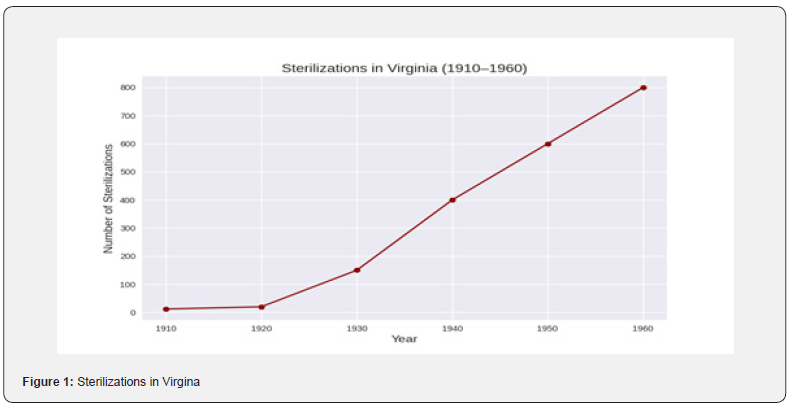
By 1937, 30 other states had passed legislation modeled on the Virginia law. With involuntarily sterilization confirmed as “constitutional,” persons who were deemed incompetent could be operated upon under the assumption that such procedures would lead to further prevention of the alleged hereditary transmission of traits inclusive of insanity, epilepsy, alcoholism, and feeblemindedness. A virtual laundry list of public scourges had been identified, and two straightforward solutions were offered: segregation in residential institutions and sterilization [34- 37]. Eventually approximately 4000 people from the Lynchburg Colony would be sterilized, representing about 50% of all people sterilized in the Commonwealth of Virginia and as many as 15% of people forcibly sterilized nationwide [23]. In1951, as the total sterilizations in the country exceeded 47,000, the state ranked second only to California in terms of reported procedures [25].
California had become the third state in the nation to pass a compulsory sterilization law in 1909. Subsequently, the Sonoma State School became the most aggressive home of sterilizations in the nation, outstripping the Virginia State Colony in this regard. Between 1919 and 1953, 55% of the total institutional population at Sonoma was sterilized (ages 7-70) or more than 5000 people, an average of over 3 procedures per week [23,38].
A national conference presentation by then Virginia Colony Superintendent Arnold promoted the widespread practice of sterilization and reported on the first one thousand persons who had been sterilized [35]. He acknowledged that some limited complications had emerged with the practice including two mortalities associated with the use of anesthesia. However, of the remaining 998 sterilizations (607 women, 391 men) who survived sterilization, none had had children (not a surprising observation). Most were reported to have come from lower class, poor homes and had not experienced “normal lives” prior to being institutionalized (raising the alternative question of whether their lives in the institution would be considered “normal”). A total of 404 of the women (67%) were reported to have been guilty of sexual immorality and 139 of these patients (23%) were said to have previously given birth to a total of 201 illegitimate children [35].
These state and national data reflect the fact that the predominant rationale for the use of involuntary and forced sterilizations was to interfere with possible further propagation. However, sterilization was also promoted from a financial perspective. The rationale was that sterilizing persons could have a direct impact on the total cost of institutional placement [25]. At the middle of the 20th century, for example, Gamble conservatively estimated that the national average cost of institutionalization was $350 per person per year. He concluded that the sterilization of over 25,000 people was associated with a savings of “336,000 inmate years” because these persons, once sterilized, could be returned to their communities [34]. Following this logic, with community placement they also would no longer be considered inmates at all.
Renowned psychologist, educator, and historian, Leo Kanner (1942) provided this perspective: Let us try to recall one single instance in the history of mankind when a feebleminded individual, or group of individuals, was responsible for the retardation or persecution of humaneness and science. They who caused Galileo to be jailed were not feebleminded. They who instituted the Inquisition were not mental defectives. The great man-made catastrophes resulting in wholesale slaughter and destruction were not started by idiots, imbeciles, and morons… One man whose IQ is probably not below normal has in a few years (i.e., in the 1930s and early 1940s) brought infinitely more disaster and suffering to this world than have all of the innumerable mental defectives of all countries < across all> generations combined. (p. 20) [39].
The practice of eugenic sterilization continued at the Virginia Colony (now the Lynchburg Training School and Hospital) through the 1960s, though the rate of sterilizations decreased over time. Then Superintendent Benedict Nagler noted that “we turned down lots of requests because we felt that they were not justified. The problem was that many times families insisted on sterilizations, which, in my opinion, were illegal because there was no hereditary disease[23].” This quote re-affirms the fact that the regular practice of providing these so-called therapeutic interventions had continued, albeit on a more limited scale. Sterilizations were last documented in the 1956 annual report, while the actual last recorded sterilization was in 1972 [28]. The enabling 1924 Act of the General Assembly of Virginia remained on the books until April 1974 [25]. This dark chapter had finally been closed but the repercussions would continue for decades and become most profound in Germany.
International Impact
The ultimate application of eugenics came not in the United States but in Germany. As early as 1920, the jurist, Binding, had identified three groups for possible euthanasia: those that were terminally ill, incurable idiots, and those who had suffered war injuries leaving them unconscious. Persons identified as feebleminded were referred to as “ballast” that could be jettisoned in order to right the ship of state [40]. Laughlin’s Eugenical Sterilization in the United States12 would become the basis for Nazi Germany’s 1933 law that legalized and promoted involuntary sterilization. The law proceeded directly from the pronouncement of Adolf Hitler that sterilization was “the most humane act for mankind” [40].
The Law for the Prevention of Offspring with Hereditary
Diseases was ratified on July 14, 1933. It specifically authorized
the forced sterilization of persons deemed genetically “unfit” to
reproduce deemed hereditarily ill [41-43]. Key components of the
law (as summarized) included:
1. Anyone suffering from a hereditary disease can be sterilized
by a surgical operation if…there is a high probability that his
offspring will suffer from serious physical or mental defects of a
hereditary nature. Anyone suffering from any of the following is
considered hereditarily diseased and can be sterilized: congenital
mental deficiency, schizophrenia, manic-depression, hereditary
epilepsy, St. Vitus dance (i.e., Huntington’s chorea), hereditary
blindness and deafness, serious hereditary physical deformity,
and chronic alcoholism.
2. Applications for sterilization can be made by the individual
to be sterilized. If this person is legally incompetent, has been
certified on account of mental deficiency, or is not yet 18, a
legal representative has the right to make an application on
this person’s behalf…. In other cases of limited competency, the
application needs to be approved by the legal representative.
3. Sterilization can be requested by the state physician and,
in the case of inmates of hospitals, nursing homes, and penal
institutions, by the head thereof.
4. The application is to be made to the eugenics court. The
facts upon which the application is based should be supported by
a medical certificate or confirmed in some other way.
5. Responsibility for the decision rests with the eugenics court
that has jurisdiction over the district in which the person officially
resides.
6. The eugenics court is to be attached to a district court
consisting of a judge acting as chair, a state physician, and another
physician certified by the German Reich and well-trained in
eugenics.
7. Once the court has decided on sterilization, the operation
must be carried out even against the will of the person to be
sterilized…. The state physician has to attend to the necessary
measures with police authorities. Where other measures are
insufficient, direct force may be used.
This law went into effect on January 1, 1934. It was signed into law by Reich Chancellor, Adolf Hitler, Reich Minister of the Interior, Wilhelm Frick, and Reich Minister of Justice, Dr. Franz Gürtner. [41,42].
While the actual numbers of persons who were sterilized are imprecise, estimates ran as high as 350,000 [43]. Clearly the total was far in excess of the number of victims in the United States with over 50% of the persons identified as feebleminded [41]. The law became a cornerstone of the Nazis’ broader racial hygiene agenda, which aimed to purify the German gene pool by preventing the transmission of perceived hereditary defects [3]. Consistent with this law (as noted above), the procedure could be requested by the individual, their guardian, or state institutions. It can nevertheless be assumed that the vast majority of sterilizations were involuntary and forced. The law sought to stem the dysgenic trend in which, it was argued, the population would otherwise be comprised of 20% of more who were hereditarily ill [43]. The program was ostensibly suspended due to public pressure in 1939 [23,41]. However, an alternative eugenic measure would supersede it and result in sterilizations no longer being used.
The impact of the 1933 German sterilization law was much further broadened when a secret directive was issued by Hitler in October 1939. This directive authorized an extension of the eugenics movement to the use of euthanasia in order to grant individuals ‘release’ from their condition. In Hitler’s own words, leaders would be charged with being responsible for identifying individual patients who were considered incurable and could be then granted mercy death after a critical evaluation of their functional state [40]. Initially, a requirement went out for hospitals and related facilities to report “deformed newborns” (e.g., idiocy, mongolism, microcephaly, hydrocephaly, deformities, paralysis) with responses used to create a database. The list would then be used as a basis for determining which individuals would be euthanized. The 1939 directive then led to the systematic killing of persons deemed “unfit to live” (e.g., mentally ill, chronically ill, physically or mentally disabled, elderly, institutionalized individuals) who were “unproductive” or “burdensome.” [45], Euthanasia would not only eliminate their hypothesized suffering but also would be financially beneficial by alleviating the need for care for the estimated 400,00 people living in instutions [44]. Family members would be told that their relative had died of some fictional illness and then they had been cremated to avoid an epidemic; for a fee, they could request to receive their ashes [40,43,44]. The initiative began In October of 1939 just one month before the initiation of World War II. The assumption was the advent of the war would distract public attention away from the implementation of this euthanasia policy [23].
Upon issuance of this dictate, over 70,000 persons who were deemed mentally retarded or mentally ill were executed. The offices of the adult killing program were housed at Villa Number 4 on Tiergarten Strasse in Berlin, which had been confiscated from its previous Jewish owners. The adult killing program soon became known by the address of the headquarters, Tiergarten Strasse 4, or eventually just T4 [45]. An additional 20,000 persons who were deemed to be socially and physically undesirable and also feebleminded and who had been housed in concentration camps were also exterminated [7,25]. It is logical to assume that many of these persons had previously been sterilized. The euthanasia procedure initially involved lethal injections and starvation, but it later evolved into gas chambers at the six designated killing centers set up within Germany [46]. The program laid the foundation for the Holocaust in which more than four million people were killed [47].
Revisiting the Legal Question
Fifty-six years after the passage of the 1924 Virginia sterilization law and 53 years after the Supreme Court decision in the 1927 Buck v. Bell case, a suit was filed in 1980 in the United States District Court. Poe v. Lynchburg Training School and Hospital was a landmark civil rights case. The focus was on whether involuntary sterilization was indeed illegal and had constituted a violation of the constitutional rights of the victims [48]. The case was filed on behalf of James Poe et al., four people who had been sterilized, and on behalf of the 8000+ other persons sterilized in the Commonwealth of Virginia who had neither given informed consent nor in many cases been notified the procedure had taken place [48].
The attorneys for the plaintiffs argued that their clients’ constitutional rights had been violated in multiple ways: by the sterilizations themselves, by the state’s failure to inform them of the procedures, and by the absence of the provision of followup care. Although the state law had been repealed in the interim (in 1974), nevertheless the court upheld the legality of the sterilizations based on the precedent set by Buck v. Bell (1927). At the same time, the court also acknowledged that the state’s failure to notify and provide support warranted further review. Four years later, a settlement was reached with the Commonwealth of Virginia, agreeing with its responsibility to inform people about what procedures had been performed, to acknowledge the sterilizations, and to provide support (e.g., counseling, medical treatment) [49,50].
Subsequent media releases provided public information
about the decision. A typical message was as follows:
In 1980, a lawsuit was brought on behalf of all men and
women involuntarily sterilized at Virginia institutions. Plaintiffs
alleged that residents were sexually sterilized without proper
notice of the circumstances, effects, and possible reversibility of
the operation… If you do not know whether you were sterilized,
while you were resident at one of the defendant institutions, you
may find out by calling 800-552-8957 toll free. Your records will
be checked, and you will be told whether you were sterilized. The
information will be kept confidential. If you were involuntarily
sterilized before 1974, you were part of the class that will be
bound by the proposed settlement [51].
Poe was a hollow victory for the victims of these procedures because no compensation was provided. Such considerations would be deferred for an additional three decades.
Conclusion
The final chapter of the travesty of involuntary sterilizations commenced in 2015. Thirteen years after a formal apology to the victims from then Governor Mark Warner and following multiple years of deliberation, the General Assembly approved a plan of compensation. The Eugenics Sterilization Compensation Program provided that persons would be eligible to request compensation if they were involuntarily sterilized at a state facility and if records confirmed the procedure had occurred. Eligibility also required that the individual be living as of February 1, 2015 [52].
Wildly inaccurate estimates indicated that as many as 700 people might seek compensation. The state balked at a proposed $50,000 in compensation for what could be a $35 million project [23]. Subsequently, compensation was set at $25,000, or half of what the adjacent state of North Carolina was awarding [53]. Given the decision to provide compensation coming 43 years after the last recorded sterilization, the vast majority of the victims were no longer alive, and thus few would potentially meet the criterion of February 1, 2015. Twenty-three applications were received in 2016; twenty-two were approved. In 2017, six additional applications were approved; only one additional award was made after that year. With only twenty-nine applications approved, the total amount allocated by Virginia was $725,000 [53,54].
By 2024, a total of 57 approved applications were reported in the state, with 26 from the Central Virginia Training Center. It was not surprising that former residents of the Colony represented the largest number (46%) of the approved applications [42], because this figure is consistent with the fact that the CVTC committed about 50% of the actual sterilizations in Virginia. Given that there were over 4000 forced and involuntary sterilizations at the Colony, the Central Virginia Training Center, the estimate would be that 1 in 153 person sterilized or 0.0065 of all of the persons institutionalized there received compensation [55].
Justice, in this form, was not only long deferred but also was extremely limited.
References
- Dugdale R (1877) The Jukes: A study of crime, pauperism, disease, and heredity. Putman.
- Goddard HH (1912) The Kallikak family: A study in the heredity of feeble-mindedness. Macmillan.
- Smith JD, Wehmeyer ML (2022) Good blood, bad blood: Science, nature, and the myth of the Kallikaks (2nd) American Association on Intellectual and Developmental Disabilities.
- Brookwood M (2021) The orphans of Davenport: Eugenics, the Great Depression, and the war over children’s intelligence. Liveright.
- Green A (2025) A perfect turmoil: Walter E. Fernald and the struggle to care for America’s disabled. Bellevue.
- DeJarnette J (1924) Mendel’s Law. Claude Moore Health Sciences Library. University of Virginia.
- Smith JD, Nelson KR (1989) The sterilization of Carrie Buck. New Horizons.
- Virginia State Epileptic Colony (1911) Second Annual Report of the Virginia State Epileptic Colony. Author.
- Virginia State Board of Charities and Corrections (1915) Mental defectives in Virginia: A special report of the State Board of Charities and Corrections to the General Assembly of 1916 on weak-mindedness in the State of Virginia - Together with a plan for training, segregation, and prevention of the procreation of the feeble-minded. Davis Bottom, Superintendent of Public Printing.
- Virginia State Epileptic Colony (1913) Fourth Annual Report of the Virginia State Epileptic Colony.
- State Colony for Epileptics and Feebleminded (1922-23) Second biennial report of the State Colony for Epileptics and Feebleminded. Author.
- Laughlin HH (1914b) Report of the Committee to Study and to Report on the Best Practical Means to Cut off the Defective Germ-Plasm in the American Population: The Legal, Legislative and Administrative Aspects of Sterilization. Eugenics Record Office Bulletin No. 10B, Cold Spring Harbor, NY.
- Laughlin H (1922) Eugenical sterilization in the United States. Psychopathic Laboratory of the Municipal Court of Chicago.
- DeJarnette JS (1947) Letter to Mr. John Dickson, Managing Editor of James T White & Co., New York. “additional papers.” Aubrey Strode collection, manuscripts Department, University of Virginia library, Charlottesville, VA.
- General Assembly. Chapter 46B of the Code of Virginia 1095h–m (1924) (2020) In Encyclopedia Virginia.
- Smith JD, Dictionary of Virginia Biography. (2020, December 7)) Carrie Buck (1906–1983) In Encyclopedia Virginia.
- Trombley S, Eadie B (1993) The Lynchburg story: Eugenic sterilization in America. Worldview Pictures.
- Lombardo PA (2008) Three generations, no imbeciles: Eugenics, the Supreme Court, and Buck v. Bell. Johns Hopkins Press.
- Arthur H, Estabrook (n.d.) Wikipedia.
- Wilhelm C (1924) Letter to Dr. Abert Priddy. From Letter from the Albemarle County Chapter, American Red Cross, to Dr. Albert Priddy)
- Gould SJ (1984) Carrie Buck’s daughter. Natural History Magazine 93.
- Dorr G, Dictionary of Virginia Biography (2020) Joseph S. DeJarnette (1866–1957) In Encyclopedia Virginia.
- Polloway EA, Smith JD (2026) The Colony and the Training School: A history of Virginia’s institution. Avon Press.
- Buck v. Bell, 274 U.S. 200, 47 S. Ct. 584, 71 L. Ed. 1000 (1927)
- Polloway EA, Smith JD (2024) The Colony, the Training School, and the Training Center: A history of Lynchburg’s institution. Avon Press.
- Virginia State Colony (1927-28) 19th annual report of the Virginia State Colony. Author.
- Virginia State Colony (1936) 27th annual report of the Virginia State Colony. Author.
- Smith JD, Polloway EA (1993) Institutionalization, involuntary sterilization, and mental retardation: Profiles from the history of the practice. Mental Retardation, 31, 208-214.
- Bell J (1931) Report on sterilization: An excerpt from John H. Bell’s Eugenic Control and its Relationship to the Science of Life and Reproduction. (2020) In Encyclopedia Virginia.
- Bell J (1929) The Ethics of Eugenics: An excerpt from Eugenical Sterilization (1929) (2020, December 07) In Encyclopedia Virginia.
- Prichard WI (1960) History: Lynchburg Training School and Hospital (installment #2) Mental Health in Virginia, 28-36.
- State Hospital Board (1949) 176th annual report of the State Hospital Board for the fiscal year ending June 30, 1949. Commonwealth of Virginia, Division of Purchase and Printing.
- State Hospital Board (1941) 168th annual report of the State Hospital Board for the fiscal year ending June 30, 1941. Commonwealth of Virginia, Division of Purchase and Printing.
- Harshman LP (1951) Nineteen years’ experience with a special sterilization act in Indiana. American Journal of Mental Deficiency 55: 377-380.
- Virginia State Colony (1937) 28th annual report of the State Colony for Epileptics and Feebleminded. Division of Purchase and Printing.
- Gamble CJ (1951) The prevention of mental deficiency by sterilization. American Journal on Mental Deficiency 56: 192-197.
- Arnold GB (1938, April) A brief review of the first thousand patients eugenically sterilized at the state colony for epileptics and feebleminded. Annual Meeting of the American Association on Mental Deficiency. AAMD, Richmond Virginia.
- Barber P (2021, November 4) How Sonoma County became the dark center of America’s forced sterilization. The Press Democrat.
- Kanner L (1942) Exoneration of the feeble-minded. American Journal of Psychiatry 99: 17-22.
- Bryant MS (2005) Confronting the "good death": Nazi euthanasia on trial, 1945–1953. University Press of Colorado.
- Law for the Prevention of Offspring with Hereditary Diseases (1933), published in: German History in Documents and Images.
- Law for the Prevention of Offspring with Hereditary Diseases (1933) In US Chief Counsel for the Prosecution of Axis Criminality, Nazi Conspiracy and Aggression. Volume V, Washington, DC: United States Government Printing Office, 1946, Document 3067-PS 880-883.
- Black, D., & Rushton, J. (Directors) (1991) Selling murder: The killing films of the Third Reich. [Film]. Domino Films, British Broadcasting Corporation.
- German History in Documents and Images. (n.d.) Hitler’s authorization of the euthanasia program (October 1939)
- Kuhl S (2024) The Nazi Connection: Eugenics, American racism, and German national socialism. Oxford University Press.
- Larsen E (2011) In the garden of beasts. Broadway Books,
- United States Holocaust Memorial Museum. (n.d.) Aktion T4: The Nazi euthanasia program.
- Poe v (1981) Lynchburg Training School and Hospital.
- Lombardo PA (1983) Involuntary sterilization in Virginia: From Buck v. Bell to Poe v. Lynchburg. Developments in Mental Health Law, 3 (3), 14: 18-21.
- Pegram CT (1980) Sterilization suit filed for victims. The Daily Advance.
- An important notice to all people who were residents of Lynchburg Training School and Hospital (1980) The Daily Advance.
- Virginia Department of Behavioral Health and Developmental Services (2015) Victims of Eugenics Sterilization Compensation Fund. Author.
- Sizemore B (2015) Virginia to compensate victims of forced sterilizations. Associated Press.
- Barber J (3/22/16, 1/30/17, 3/20/17, 6/30/17, 3/29/18, 4/1/20) Letters to report on the status of funds set aside for compensation to individuals who were involuntarily sterilized. Virginia Department of Behavioral Health and Developmental Services.
- Virginia Department of Behavioral Health and Developmental Services. (2025) Virginia Eugenical Sterilization Compensation Report – April 30, 2024 (RD102) Virginia General Assembly.

























