




 CRDOJ Home




Abstract
Background: Mulberry (Morus alba) leaf extracts containing 1-deoxynojirimycin (DNJ) may attenuate postprandial glycaemic responses through intestinal α-glucosidase inhibition. However, evidence regarding ready-to-drink pre-meal formulations remains limited.
Objective: To evaluate postprandial glucose responses following a standardized high- 25 glycaemic breakfast consumed with or without a mulberry-based liquid shot (Suxero®).
Methods: In this open-label, non-randomized, two-period observational crossover pilot study, 16 adults completed two test mornings separated by seven days. Participants consumed a standardized breakfast alone or preceded by a 60 mL shot containing mulberry leaf extract standardized to 5% DNJ, lemon peel extract and vitamin C. Interstitial glucose was assessed using continuous glucose monitoring at baseline and 30, 60, 120 and 180 minutes after meal initiation.
Results: Mean peak glucose was lower following the shot than under the control condition (203.3 ± 57.6 vs 238.5 ± 70.3 mg/dL; mean paired difference −35.2 mg/dL, 95% CI −56.7 to −13.7; p = 0.003), corresponding to a 14.8% reduction in group mean peak glucose. Peak values were lower in 13 of 16 participants. The three-hour incremental area under the curve was 19.3% lower but did not reach statistical significance (p = 0.14). No adverse events were reported.
Conclusion: Consumption of a DNJ-standardised mulberry-based shot before a high- glycaemic breakfast was associated with a statistically significant reduction in observed postprandial peak glucose in this small pilot study. The findings require confirmation in adequately powered, randomised, placebo-controlled trials.
Keywords: Mulberry; 1-deoxynojirimycin; Postprandial glucose; Glycaemic peak; Prediabetes; Metabolic syndrome; Continuous glucose monitoring; Dietary supplement; Crossover; Observational study
Abbreviations: AUC: Area Under the Curve; BMI: Body Mass Index; CGM: Continuous Glucose Monitoring; CI: Confidence Interval; DNJ: 1-Deoxynojirimycin; GLP-1: Glucagon- Like Peptide 1; iAUC: Incremental Area Under the Curve; MLE: Mulberry Leaf Extract; SD: Standard Deviation; T2D: Type 2 Diabetes
Introduction
Type 2 Diabetes (T2D) and its precursor states have reached epidemic proportions: the World Health Organization estimates that the number of adults living with diabetes rose from about 200 million in 1990 to 830 million in 2022, and that more than half of those affected are not receiving glucose-lowering treatment [1]. Prediabetes, defined by impaired fasting glucose, impaired glucose tolerance or an HbA1c of 5.7-6.4% [2], and the metabolic syndrome, a cluster of abdominal obesity, dysglycaemia, dyslipidaemia and hypertension [3], are far more prevalent than overt diabetes and are the stage at which dietary strategies have the greatest potential.
Within the daily glucose profile, the postprandial excursion is increasingly recognized as a relevant target in its own right. In the DECODE analyses, 2-hour post-load glucose predicted cardiovascular mortality independently of fasting glucose [4]; acute glucose fluctuations activate oxidative stress more strongly than sustained hyperglycaemia [5]; and in people with T2D, postprandial glucose was a stronger predictor of cardiovascular events than fasting glucose [6]. Beyond long-term risk, the magnitude of the postprandial rise and the subsequent dip influence appetite and energy intake in healthy adults, a plausible link between glucose spikes, post-meal fatigue and cravings [7]. Pharmacological blunting of postprandial glycaemia with the α-glucosidase inhibitor acarbose reduced progression to T2D and cardiovascular events in people with impaired glucose tolerance [8], establishing the principle that slowing carbohydrate digestion is clinically meaningful.
Mulberry (Morus alba L.) leaves contain polyhydroxylated alkaloids (iminosugars), chiefly 1- deoxynojirimycin (DNJ), which structurally mimic glucose and competitively inhibit intestinal α-glucosidases [9,10]. In healthy adults, DNJ-enriched mulberry powder suppressed the postprandial rise after sucrose in a dose-dependent manner, with 12 mg DNJ identified as the lowest consistently effective single dose [10]. Subsequent randomized crossover trials with standardized mulberry leaf extracts (MLE; typically, 5% DNJ, 200-250 mg per dose) showed reductions of roughly 30-40% in glucose and insulin incremental areas after maltodextrin or complex meals [11,12], an attenuated glucose response in prediabetic adults [13], reduced starch digestion in a 13C breath test [14], and comparable effects of mulberry fruit extract in healthy adults and in people with T2D [15,16]. Meta-analytic evidence supports a modest but consistent glucose-lowering effect of Morus alba preparations [17], and mulberry twig alkaloids are approved in China as a prescription antidiabetic agent with efficacy comparable to acarbose and fewer gastrointestinal side effects [18]. We have recently reviewed the clinical evidence for botanical products, including mulberry, in the management of T2D [19].
Timing appears to matter: the glucose-lowering effect of MLE depends on its presence in the gut at the moment carbohydrate arrives, and studies have found that extracts taken with or immediately before a meal are effective, whereas larger intervals before the meal weaken the effect [20,21]. Almost all available trials used capsules or powders dissolved in water under controlled laboratory conditions. A ready-to-drink liquid shot taken shortly before eating is a different and arguably more practical format, but it has not, to our knowledge, been evaluated in a clinical setting.
Suxero® (BerBerSan® GmbH, Schladming, Austria) is a 60 mL (2 oz) liquid pre-meal shot that combines a mulberry leaf extract standardised to 5% DNJ with a lemon (Citrus limon) peel extract standardized to 5% eriocitrin and vitamin C. Eriocitrin, the principal lemon flavanone, improved glycaemic markers and increased Glucagon-like Peptide 1 (GLP-1) in randomized trials in prediabetic adults over 12 weeks [22,23], has shown hepatic metabolic effects in preclinical models [24], and flavonoids of this class inhibit α-glucosidase in vitro [25]. Vitamin C supplementation has been associated with improved postprandial glycaemic control in T2D in a crossover trial [26] and with modest improvements in glycaemic markers in a meta- analysis [27]. Whether these components add to the acute effect of DNJ cannot be determined from a single-product observation and is not the aim of this report.
The objective of this observational pilot study was to investigate the association between consumption of a standardized mulberry-based liquid shot before a high-glycaemic breakfast and the subsequent postprandial glucose response in adults with heterogeneous glycaemic profiles. Particular emphasis was placed on peak glucose concentration and three-hour incremental glucose exposure. The study was intended to generate preliminary effect-size estimates to inform the design of future randomized, placebo-controlled clinical trials.
Materials and Methods
Design and setting
This was a prospective, open-label, non-randomized, two-period observational study with a within-subject comparison. Each participant completed two test mornings separated by a 7-day shout during which usual diet and lifestyle were maintained. On one morning the standardized meal was consumed alone (control condition); on the other the same meal was preceded by one shot of Suxero® (intervention condition). The first eight participants (sequence A) were observed in the order control → shot. To address the possibility that any difference merely reflected a period or familiarization effect, the next eight participants (sequence B) were deliberately observed in the reverse order, shot → control. Allocation to sequence was therefore by time of enrolment, not by randomization. All observations were performed in a single general practice in Austria (Dr. B. Bahadori) between 13 September and 13 October 2026.
Participants
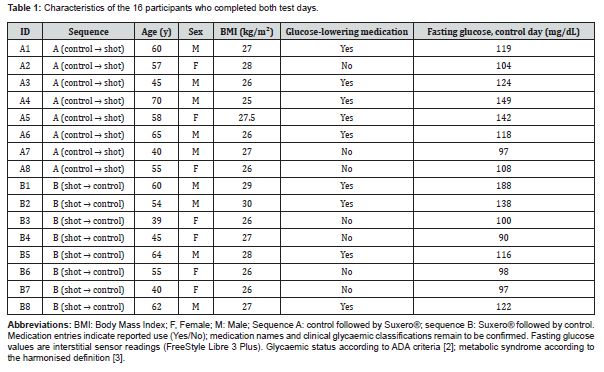
Adult volunteers (≥ 18 years) were recruited from among patients and acquaintances of the practice who expressed interest in a non-pharmacological approach to post-meal glucose control. The cohort comprised metabolically healthy individuals as well as individuals with prediabetes and features of the metabolic syndrome [3]; some participants were taking metformin, which was continued unchanged on both test days. Because the study was observational, no formal exclusion criteria beyond the following were applied: age under 18 years, pregnancy or lactation, known allergy to any ingredient of the product, inability to fast for 10 hours, and type 1 diabetes without stable insulin therapy. Individuals using insulin continued their usual regimen identically on both test mornings. Eighteen individuals began sequence A; two did not attend the second appointment and were excluded from analysis (no data from the first day are reported for them). All eight participants of sequence B completed both test days. Participant characteristics are summarised in (Table 1).
Test product
Suxero® is a 60 mL (2 oz) aqueous liquid shot containing Morus alba leaf extract standardized to 5% DNJ, Citrus limon peel extract standardized to 5% eriocitrin, and vitamin C (L-ascorbic acid), in water from Austria. The exact quantities per serving are proprietary; the DNJ content of one serving exceeds the 12 mg single dose identified as the lowest consistently effective amount in dose-finding work [10] and is at or above the DNJ doses delivered by the 200-250 mg extract capsules used in published randomized trials [11,12]. The product used was a non- commercial research batch, identical in composition to the marketed food supplement, supplied by the manufacturer (BerBerSan® GmbH, Schladming, Austria). Participants drank one shot 5-10 minutes before the first bite of the test meal.
Standardized test meal and procedure
Participants attended in the morning after an overnight fast of at least 10 hours, having consumed nothing but water on the morning of the test. A fasting glucose value was recorded immediately before the meal. The test meal, chosen to produce a pronounced glycaemic excursion, consisted of 150 g white toast (6 slices), 25 g strawberry jam and 250 mL still water, providing approximately 90 g of available carbohydrate with a high glycaemic index [28]; participants were asked to finish the meal within 30 minutes. Glucose was then recorded at 30, 60, 120 and 180 minutes after the start of the meal. Participants remained seated or engaged only in light activity during the 3-hour period and did not consume any other food or drink. On the intervention day the identical meal was preceded by the shot as described above; the meal composition, fasting requirement, timing and measurement schedule were otherwise unchanged. Participants were asked to keep their habitual diet and physical activity during the washout week and were not given dietary advice.
Glucose measurement
All participants wore a Continuous Glucose Monitoring (CGM) sensor (FreeStyle Libre 3 Plus, Abbott Diabetes Care, Alameda, CA, USA), which reports interstitial glucose every minute and has a mean absolute relative difference of about 8% against venous reference values in adults [29]. The sensor glucose value displayed at the scheduled time point was recorded on a paper case report form; the same sensor system was used by each participant on both test days, so that device-related bias cancels within the paired comparison. The fasting value on the test morning is referred to as the fasting glucose throughout, although it represents interstitial rather than capillary glucose.
Outcomes
The primary descriptive outcome was the peak glucose concentration (highest of the five scheduled readings). Secondary outcomes were glucose at each individual time point, the 3- hour incremental area under the curve above the fasting value (iAUC, trapezoidal rule, ignoring area below baseline, following standard glycaemic-response methodology [28]), the total AUC, the time to peak, and the proportion of participants whose peak reached or exceeded 200 mg/dL. Participants were asked about gastrointestinal or other symptoms at the end of each test morning.
Ethical considerations
This prospective observational crossover pilot study was conducted in a general-practice setting in Austria to evaluate postprandial glucose responses following consumption of a commercially available food supplement (Suxero®) with a standardized breakfast. Interstitial glucose concentrations were monitored using a continuous glucose monitoring system. All participants were informed orally and in writing about the study objectives, procedures, and intended use of their data, and provided written informed consent before participation, including consent for publication of anonymized results. Participation was voluntary, and participants could withdraw at any time. Data were recorded without direct personal identifiers and are presented using coded participant identifiers. The study was conducted with reference to the ethical principles of the Declaration of Helsinki [30]. No formal ethics committee approval or exemption determination had been obtained before study initiation; clarification of the applicable ethical review requirements is being sought from the appropriate ethics committee.
Statistical analysis
Given the pilot nature of the study, no formal sample-size calculation was performed; the sample of 16 completers was determined by the number of volunteers available in the observation window. Data are presented as mean ± standard deviation (SD) or as mean difference (shot minus control) with 95% confidence interval (CI). Within-subject differences were tested with the paired t-test and, because of the small sample and skewed iAUC distribution, confirmed with the Wilcoxon signed-rank test. Because the two sequences form a classical AB/BA crossover, treatment, period and carry-over (sequence) effects were additionally estimated with the standard two-sample approach of Senn [31]: the treatment effect was estimated as half the difference between sequences in the period-2 minus period-1 difference, the period effect from the corresponding sum, and carry-over from the between- sequence comparison of subject totals. Effect sizes are given as Cohen's d_z for paired data. The association between the control-day peak and the individual change in peak was assessed with Spearman's rank correlation. Pre-planned sensitivity analyses excluded (a) the three participants with the highest control-day peaks and (b) the three participants in whom the peak did not fall. Two-sided p-values below 0.05 were considered statistically significant; given the number of secondary comparisons, no adjustment for multiplicity was made and secondary p- values should be read as descriptive. Analyses were performed in Python 3.11 (SciPy 1.x).
Results
Participants
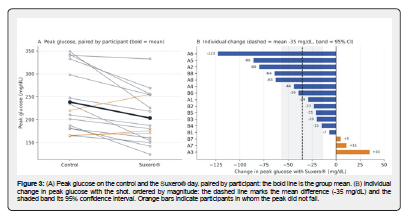
Sixteen participants (sequence A, n = 8; sequence B, n = 8) completed both test mornings and were included in the analysis. The mean age was 54.3 ± 9.7 years (range: 39–70 years), with nine males (56.3%) and seven females (43.8%). The mean body mass index (BMI) was 27.0 ± 1.3 kg/m². Nine participants (56.3%) reported using glucose-lowering medication, while seven (43.8%) reported no such medication. Fasting glucose concentrations on the control morning ranged from 90 to 188 mg/dL (mean 119.4 ± 25.2 mg/dL). Ten of the 16 participants reached a postprandial glucose peak of ≥200 mg/dL following the control breakfast, indicating substantial variability in glycaemic responses across the cohort. Two participants did not attend the second appointment for scheduling reasons and were excluded from the analysis; neither withdrawal was attributed to an adverse event. Individual participant characteristics are presented in (Table 1), and glucose measurements are detailed in (Table 2).
Glucose Profiles
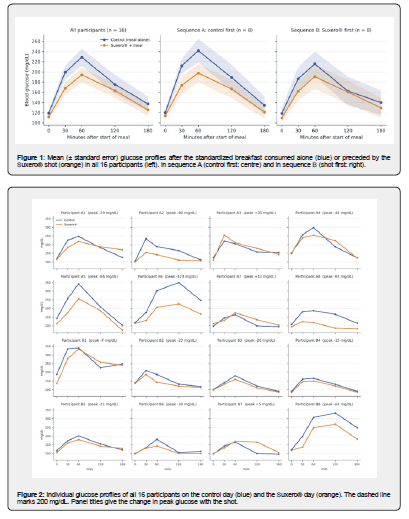
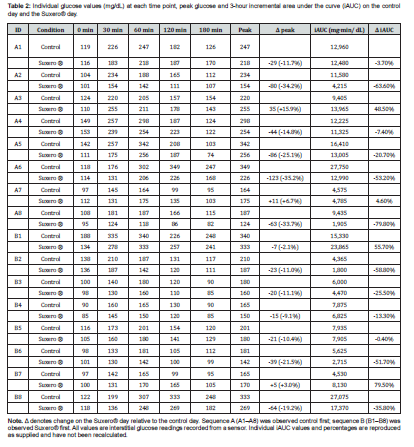
Mean glucose profiles are shown in (Figure 1) and individual curves in (Figure 2). After the control breakfast, glucose rose from 119.4 ± 25.2 mg/dL fasting to 199.2 ± 54.6 mg/dL at 30 minutes and 228.7 ± 66.0 mg/dL at 60 minutes, then fell to 175.7 ± 74.6 mg/dL at 120 and 137.2 ± 57.1 mg/dL at 180 minutes. With the shot, the corresponding values were 111.8 ± 17.2, 168.1 ± 49.1, 194.1 ± 57.0, 163.4 ± 57.4 and 125.4 ± 45.2 mg/dL. The mean difference was -31.2 mg/dL at 30 minutes (95% CI -47.9 to -14.4; p = 0.001) and -34.6 mg/dL at 60 minutes (95% CI -51.7 to -17.5; p < 0.001), whereas the differences at 120 minutes (-12.3 mg/dL, 95% CI -38.2 to 13.7; p = 0.33) and 180 minutes (-11.9 mg/dL, 95% CI -27.5 to 3.8; p = 0.13) were small and not statistically significant. Fasting glucose was marginally lower on the shot morning (-7.6 mg/dL, 95% CI -16.0 to 0.9; p = 0.076), a difference that is addressed by the baseline-corrected iAUC analysis below. Time to peak was unchanged in 15 of 16 participants (60 minutes in 11, 30 minutes in 3, 120 minutes in 2) and shifted from 60 to 30 minutes in one.
Peak glucose
Peak glucose was 238.5 ± 70.3 mg/dL on the control day and 203.3 ± 57.6 mg/dL on the shot day, a mean difference of -35.2 mg/dL (95% CI -56.7 to -13.7; paired t-test p = 0.003; Wilcoxon p = 0.003; Cohen's d_z = 0.87), corresponding to a 14.8% reduction of the group mean and a mean individual reduction of 13.3% (95% CI -21.2 to -5.5%). The peak was lower with the shot in 13 of 16 participants; in the remaining three (A3, A7, B7) it was higher by 35, 11 and 5 mg/dL respectively (Figure 3). The number of participants whose peak reached ≥ 200 mg/dL fell from 10 to 7. Individual reductions ranged from -7 to -123 mg/dL (Table 2).
Incremental and total area under the curve
The 3-hour iAUC above fasting was 11,442 ± 7,279 mg·min/dL on the control day and 9,234 ± 6,185 mg·min/dL with the shot, a mean difference of -2,208 mg·min/dL (95% CI -5,231 to 815; p = 0.14; Wilcoxon p = 0.12; d_z = 0.39), i.e. a 19% lower mean that did not reach statistical significance. The iAUC was lower with the shot in 12 of 16 participants. Total AUC showed the same pattern (-2,400 mg·min/dL, approximately -8%). The discrepancy between a clear peak effect and a non-significant iAUC effect reflects the shape of the individual curves: in several participants the shot lowered the early rise but was followed by a slightly higher or more sustained concentration at 120-180 minutes (e.g. A1, A7, B1, B7) (Figure 2), as would be expected when carbohydrate digestion is slowed rather than prevented.
Sequence, period and carry-over effects
The peak reduction was observed in both sequences: -47.4 mg/dL (95% CI -91.0 to -3.7; p = 0.037; 6 of 8 lower) in sequence A, in which the shot day came second, and -23.0 mg/dL (95% CI -40.5 to -5.5; p = 0.017; 7 of 8 lower) in sequence B, in which the shot day came first. The difference between sequences in the size of the effect was not statistically significant (p = 0.25). In the crossover model, the treatment effect on peak glucose was -35.2 mg/dL (95% CI -56.5 to -13.9; p = 0.003), the period effect was -12.2 mg/dL (p = 0.24) and there was no evidence of carry-over (p = 0.51). For iAUC, the treatment effect was -2,208 mg·min/dL (95% CI -5,237 to 821; p = 0.14), with no period (p = 0.31) or carry-over (p = 0.60) effect. Thus, the lower peak on the shot day cannot be attributed to the order of testing.
Sensitivity and responder analyses
Excluding the three participants with the highest control peaks (A6, B1, B8), it was -28.4 mg/dL (95% CI -49.4 to -7.3; p = 0.012). Excluding the three participants in whom the peak rose (A3, A7, B7), it was -47.2 mg/dL (95% CI -67.8 to -26.6; p < 0.001) and the iAUC difference approached significance (-3,361 mg·min/dL, 95% CI -6,762 to 40; p = 0.052). The magnitude of the peak reduction correlated with the control-day peak (Spearman ρ = -0.62, p = 0.010; Pearson r = -0.57, p = 0.020) (Figure 4): in the ten participants whose control peak was ≥ 200 mg/dL the mean change was -44.2 mg/dL (95% CI -76.6 to -11.8; p = 0.013; mean individual change -14.8%), compared with -20.2 mg/dL (95% CI -49.2 to 8.8; p = 0.13; -11.0%) in the six participants with a control peak below 200 mg/dL. The three participants without a peak reduction all had comparatively mild control-day excursions (peaks 164-220 mg/dL); in participant A3 the recorded meal timing on the shot day deviated from the protocol.
Tolerability
No participant reported gastrointestinal discomfort, nausea, hypoglycaemic symptoms or any other adverse effect on the shot day. The lowest recorded value on a shot day was 74 mg/dL at 180 minutes (participant A5), without symptoms; the same participant had 103 mg/dL at the same time point on the control day (Table 3).
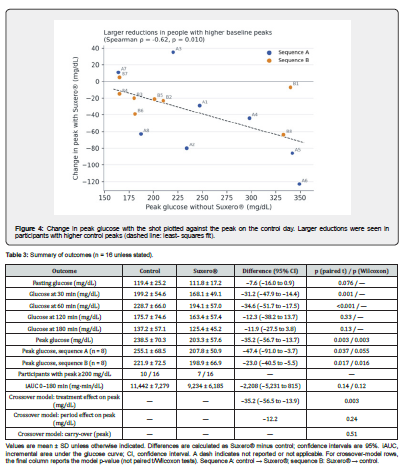
Values are mean ± SD unless otherwise indicated. Differences are calculated as Suxero® minus control; confidence intervals are 95%. iAUC, incremental area under the glucose curve; CI, confidence interval. A dash indicates not reported or not applicable. For crossover-model rows, the final column reports the model p-value (not paired t/Wilcoxon tests). Sequence A: control → Suxero®; sequence B: Suxero® → control.
Discussion
In this observational pilot study, a single 60 mL mulberry-based pre-meal shot consumed 5-10 minutes before a high-glycaemic breakfast was associated with a lower postprandial glucose peak in 13 of 16 adults, with a mean reduction of 35 mg/dL (about 15%) that was statistically robust in paired, non-parametric and crossover analyses. The effect was concentrated in the first hour after the meal, when the control breakfast produced its steepest rise, and was larger in participants with higher control-day excursions. Total 3-hour glucose exposure, by contrast, was only numerically lower, and the curves of several participants suggest a delayed rather than a reduced absorption of carbohydrate.
Comparison with published data
The size of the peak reduction is in line with trials of DNJ-standardized mulberry extracts in capsule form. Thondre et al. [11] reported about 30% lower glucose and insulin iAUC after a bread- based meal with 200-250 mg Reducose® [11]; Lown et al. [12] found similar reductions after maltodextrin [12]; and Kim et al. [13] observed a blunted glucose response in prediabetic adults [13]. Our peak reduction of 15% (mean) with a non-significant 19% reduction in iAUC is at the lower end of that range, which may reflect the open design, the heterogeneity of the cohort, the use of interstitial sensor glucose rather than venous plasma, the very large carbohydrate load of the test meal, and the timing of intake. The DNJ dose per serving is not a likely explanation, as it exceeds the doses used in the Reducose® trials. Importantly, the direction and timing of the effect, an attenuated early rise with convergence of the curves by 2-3 hours, is the signature expected from competitive α-glucosidase inhibition [9,14] and matches the profile described for mulberry extracts in the 13C-breath-test and dual-isotope studies, in which the extract reduced the rate of glucose appearance without changing glucose disposal [14,15].
The observation that participants with higher control peaks benefited most parallels findings with mulberry fruit extract in people with T2D, in whom the relative reduction was larger than in healthy volunteers [16] and is biologically plausible: when the glucose rise is small, there is little for a digestion-slowing agent to reduce. It also suggests that the natural target population for a pre-meal shot of this kind is people with impaired glucose tolerance or metabolic syndrome rather than metabolically healthy adults, a hypothesis that a future trial should test by stratified enrolment.
Recent findings by Yang et al. [32] provide an interesting pharmacological context for the present observations. In their randomized, four-period crossover study involving 12 adults with post-bariatric hypoglycaemia, acarbose-containing interventions significantly attenuated peak postprandial glucose concentrations, whereas total glucose exposure over 240 minutes remained unchanged. A similar response pattern was observed in our study, where consumption of Suxero® was associated with a significant 14.8% reduction in peak glucose concentration (−35.2 mg/dL; p = 0.003), while the 19.3% reduction in three-hour incremental glucose AUC did not reach statistical significance (p = 0.14). This similarity is mechanistically relevant because both acarbose and 1-deoxynojirimycin (DNJ), the principal bioactive constituent of mulberry leaf extract, inhibit intestinal α-glucosidase activity, potentially delaying carbohydrate digestion and attenuating early postprandial glucose excursions. Notably, Yang et al. [32] also highlighted gastrointestinal adverse effects as a recognized limitation of acarbose treatment. In contrast, none of the 16 participants in the present study reported gastrointestinal discomfort, nausea, hypoglycaemic symptoms or other adverse effects following Suxero® administration. The combination of a significant reduction in postprandial glucose peaks and an absence of reported acute adverse effects is an encouraging preliminary finding for this ready-to-drink botanical formulation. Nevertheless, differences in study populations, intervention protocols and glucose measurement methods, together with the small sample size and short observation period of our study, preclude conclusions regarding comparable efficacy or superior tolerability relative to acarbose. Larger randomized, placebo- controlled trials are warranted to confirm these findings.
Differences in enzyme selectivity may also be relevant to the gastrointestinal tolerability of α- glucosidase inhibitors. Whereas acarbose inhibits both intestinal α-glucosidase and α-amylase, 1-deoxynojirimycin (DNJ) predominantly targets α-glucosidase activity, as reviewed by Gao et al. [33]. Acarbose is associated with gastrointestinal adverse effects, particularly flatulence and diarrhoea, and occasional elevations in liver enzymes, as documented in its prescribing information [34]. In contrast, no gastrointestinal discomfort or other adverse effects were reported following Suxero® administration in the present study. Although differences in enzyme selectivity may contribute to differences in gastrointestinal tolerability, this hypothesis requires direct experimental confirmation, and the present findings do not establish superior safety of Suxero®.
Peak versus area under the curve
The dissociation between a significant peak effect and a non-significant iAUC effect deserves comment. Pharmacological α-glucosidase inhibition shifts carbohydrate absorption distally and over a longer period; the postprandial curve becomes flatter and broader, so that the peak falls more than the area [8,14]. In this study the shot lowered glucose by 31-35 mg/dL at 30 and 60 minutes but by only about 12 mg/dL at 120 and 180 minutes, and in four participants the 180- minute value was higher on the shot day. Whether a lower peak with unchanged exposure is clinically meaningful remains debated, but the evidence that acute glucose fluctuations, more than mean glycaemia, drive oxidative stress and endothelial dysfunction [5], together with the association of post-meal glucose dynamics with appetite and energy intake [7], suggests that peak attenuation is a reasonable intermediate target. The iAUC estimate in this study (-2,208 mg·min/dL, 95% CI -5,231 to 815) is also imprecise rather than null; with 16 participants the study had limited power for this secondary outcome, and the point estimate (-19%) is consistent with the published literature.
Timing, matrix and meal: why the effect may be smaller than in capsule trials Several methodological factors may have influenced the observed glucose response compared with previous trials of encapsulated mulberry extracts. First, administration timing may affect the efficacy of intestinal α-glucosidase inhibitors. According to the prescribing information for acarbose, maximal efficacy is achieved when taken immediately before or with the first bite of a meal, whereas administration approximately 30 minutes before eating substantially reduces its effect [34]. In previous Reducose® trials, the extract was administered with the meal [11,12], whereas Suxero® was consumed 5–10 minutes before breakfast. Although DNJ and acarbose share an inhibitory effect on intestinal α-glucosidase, their optimal administration times cannot be assumed to be identical. Second, the standardised breakfast contained approximately 90 g of available carbohydrate, representing a higher carbohydrate load than those used in previous trials [11,12], which may have influenced the observed response to competitive enzyme inhibition. Third, glucose concentrations were assessed at only five predefined time points using interstitial sensor readings, potentially limiting the precision of peak glucose and AUC estimates compared with more frequent plasma measurements. These factors warrant further investigation in randomized controlled trials comparing Suxero® administration shortly before versus with the first bite of a meal, using standardized mixed meals and more frequent glucose measurements.
The role of the reverse-sequence group
Our first eight participants were all observed with the control breakfast first. In such a design, any difference between days could reflect familiarization with the procedure, slower eating on the second occasion, unrecorded changes in diet during the washout week, or regression to the mean, rather than the product. Observing the next eight participants in the reverse order allowed us to estimate these period effects directly. The peak reduction was present in both sequences, the period effect was small and non-significant, and there was no evidence of carry-over, which is expected after a 7-day washout given the short gut residence of an α-glucosidase inhibitor. The smaller effect in sequence B (-23 vs -47 mg/dL) is compatible with a modest period effect that inflated the estimate in sequence A and deflated it in sequence B; the crossover estimate of -35 mg/dL, which balances the two, is therefore the most appropriate summary. We note that sequence B also had lower control-day peaks on average (222 vs 255 mg/dL), which, given the responder analysis, would itself predict a smaller absolute effect.
Possible contribution of the other ingredients
Suxero® contains, in addition to mulberry leaf extract, a lemon peel extract standardized to eriocitrin and vitamin C. Eriocitrin has improved fasting glucose, insulin resistance and GLP- 1 in randomized trials over 12 weeks of daily intake [22,23]; an acute effect on a single meal has not been established and seems unlikely to explain the present findings. Vitamin C in doses of 1 g/day improved postprandial glycaemia over four months in T2D [26], again a chronic rather than an acute effect. The present single-product observation cannot apportion the effect among the ingredients, and we attribute the acute peak attenuation primarily to DNJ. Factorial or ingredient-controlled designs would be required to address the question.
Strengths
Strengths of this study include the fully standardized, highly glycaemic test meal, which produced large and reproducible excursions against which an effect can be detected; the within- subject design, in which each participant served as his or her own control with the same continuous glucose sensor on both days; the inclusion of a reverse-sequence group that allowed formal assessment of period and carry-over effects; the general-practice setting and the use of a ready-to-drink format, which together approximate how such a product would actually be used; and complete reporting of all individual data, including the three participants in whom the peak did not fall.
Limitations
The limitations are substantial, and we wish to state them plainly. First, the study was small, open-label and not randomized; participants and the observing physician knew which condition applied on each day, and allocation to sequence was by time of enrolment. A placebo shot of identical taste and appearance was not available. Second, glucose was read from a continuous glucose sensor rather than measured in venous plasma, and only five scheduled readings over three hours were recorded rather than the 15-minute sampling customary in glycaemic- response trials [28]; sensor error of roughly 8% and the physiological lag of interstitial behind blood glucose [29] add noise and may blunt rapid peaks, although both acts equally on the two days within a participant. Third, the cohort was heterogeneous with respect to glycaemic status and medication, and individual characteristics are limited to those recorded in routine care; two participants of sequence A did not complete the study. Fourth, fasting glucose was slightly lower on the shot day (-7.6 mg/dL), which may reflect chance, regression to the mean or unrecorded behavioural differences; the baseline-corrected iAUC addresses this for the area outcome, but the absolute peak comparison is not fully independent of it. Fifth, the test meal was a single, deliberately high-glycaemic breakfast; the effect on mixed meals with protein, fat and fiber, which are digested more slowly and in which α-glucosidase inhibition typically produces smaller relative effects, is unknown [11,21]. Sixth, only a single acute exposure was studied; the effect of repeated daily use on fasting glucose, HbA1c, body weight or appetite, and the gastrointestinal tolerability of longer-term use, were not assessed. Seventh, the study was conducted and funded by the manufacturer of the product, and three of the authors hold shares in that company; while all raw data are reported and the statistical analysis is fully described, the potential for sponsor bias must be acknowledged. Finally, no multiplicity adjustment was applied to secondary outcomes, and the responder and sensitivity analyses are exploratory.
Implications and next steps
The present data provide an effect-size estimate for planning a confirmatory study: with a standardized mean paired difference of about 0.9 for peak glucose, a randomized, double-blind, placebo-controlled crossover trial with 30 participants would have more than 90% power to detect the peak effect and, with the observed iAUC effect size of about 0.4, approximately 60% power for iAUC; 50-60 participants would be needed to power the iAUC outcome adequately. Such a trial should randomize sequence, use a matched placebo, compare intake 5-10 minutes before the meal with intake at the first bite, measure plasma glucose and insulin at 15-minute intervals alongside continuous sensor glucose, include both a high-glycaemic and a mixed meal, enroll participants stratified by glycaemic status, and record gastrointestinal symptoms systematically. Until such data are available, the findings reported here should be regarded as preliminary and hypothesis-generating; they do not establish efficacy, and no claim regarding the prevention or treatment of any disease is made or implied.
Conclusion
In this exploratory two-sequence observational crossover study involving 16 adults, consumption of a standardized mulberry-based liquid shot (Suxero®), containing DNJ- standardized mulberry leaf extract, lemon peel extract and vitamin C, 5–10 minutes before a high-glycaemic breakfast was associated with a statistically significant reduction in observed postprandial peak glucose concentrations (−35.2 mg/dL; 14.8%; p = 0.003). The reduction was observed in both testing sequences and was more pronounced among participants with higher control-day glucose excursions. Although the three-hour incremental glucose area under the curve was numerically reduced by 19.3%, this difference did not reach statistical significance (p = 0.14), suggesting a possible attenuation or delay of early carbohydrate-derived glucose appearance rather than a demonstrated reduction in overall glucose exposure. Importantly, no gastrointestinal discomfort, nausea, hypoglycaemic symptoms or other adverse events were reported during the acute observation period, indicating encouraging short-term tolerability. Together, these findings highlight the potential of Suxero® as a practical, ready-to-drink botanical formulation for attenuating postprandial glucose peaks. Nevertheless, the small sample size, non-randomized design and absence of placebo control warrant cautious interpretation. Larger, adequately powered, randomized, placebo-controlled trials are needed to confirm efficacy, investigate the underlying mechanisms and establish longer-term safety and tolerability, particularly in individuals with prediabetes and metabolic syndrome.
Author Contributions
Babak Bahadori: study conduct, clinical supervision of all test days, data collection, writing of the manuscript. Bernhard Sikora: concept, statistical analysis, figures, writing of the manuscript. Nikon Moghadasian, Agnieszka Magg and Mohammed H. Moghadasian: literature research, critical review and revision. Babak Malekian: critical review, revision and correspondence. All authors provided final approval of the version to be published and agree to be accountable for all aspects of the work.
Acknowledgement
The authors thank the participants for their time and the practice staff for their support during the test mornings. The research programme of MHM is supported by the Natural Sciences and Engineering Research Council of Canada (NSERC).
Declaration of Interest
Bernhard Sikora, Agnieszka Magg and Babak Bahadori hold shares in BerBerSan® GmbH, the manufacturer of Suxero®. Babak Bahadori is the physician who conducted the study. Nikon Moghadasian is the son of Mohammed H. Moghadasian. The other authors have no conflict of interest to disclose. The potential for sponsor bias is discussed in the Limitations.
Data Availability
All individual glucose values are reported in Table 2. The analysis script is available from the corresponding author on reasonable request.
References
- World Health Organization (2024) Diabetes. Fact sheet World Health Organization, Geneva.
- American Diabetes Association Professional Practice Committee (2025) 2. Diagnosis and classification of diabetes: Standards of Care in Diabetes-2025. Diabetes Care 48(Suppl 1): S27-S49.
- Alberti KG, Eckel RH, Grundy SM, Zimmet PZ, Cleeman JI, et al. (2009) Harmonizing the metabolic syndrome: a joint interim statement of the International Diabetes Federation Task Force on Epidemiology and Prevention; National Heart, Lung, and Blood Institute; American Heart Association; World Heart Federation; International Atherosclerosis Society; and International Association for the Study of Obesity. Circulation 120(16): 1640-1645.
- DECODE Study Group, European Diabetes Epidemiology Group (2001) Glucose tolerance and cardiovascular mortality: comparison of fasting and 2-hour diagnostic criteria. Arch Intern Med 161(3): 397-405.
- Monnier L, Mas E, Ginet C, Michel F, Villon L, et al. (2006) Activation of oxidative stress by acute glucose fluctuations compared with sustained chronic hyperglycemia in patients with type 2 diabetes. JAMA 295(14): 1681-1687.
- Cavalot F, Petrelli A, Traversa M, Bonomo K, Fiora E, et al. (2006) Postprandial blood glucose is a stronger predictor of cardiovascular events than fasting blood glucose in type 2 diabetes mellitus, particularly in women: lessons from the San Luigi Gonzaga Diabetes Study. J Clin Endocrinol Metab 91(3): 813-819.
- Wyatt P, Berry SE, Finlayson G, O Driscoll R, Hadjigeorgiou G, et al. (2021) Postprandial glycaemic dips predict appetite and energy intake in healthy individuals. Nat Metab 3(4): 523- 529.
- Chiasson JL, Josse RG, Gomis R, Hanefeld M, Karasik A, et al. (2002) Acarbose for prevention of type 2 diabetes mellitus: the STOP-NIDDM randomised trial. Lancet 359(9323): 2072-2077.
- Asano N, Yamashita T, Yasuda K, Ikeda K, Kizu H, et al. (2001) Polyhydroxylated alkaloids isolated from mulberry trees (Morus alba) and silkworms (Bombyx mori L.). J Agric Food Chem 49(9): 4208-4213.
- Kimura T, Nakagawa K, Kubota H, Kojima Y, Goto Y, et al. (2007) Food-grade mulberry powder enriched with 1-deoxynojirimycin suppresses the elevation of postprandial blood glucose in humans. J Agric Food Chem 55(14): 5869-5874.
- Thondre PS, Butler I, Tammam J, Achebe I, Young E, et al. (2024) Understanding the impact of different doses of Reducose® mulberry leaf extract on blood glucose and insulin responses after eating a complex meal: results from a double-blind, randomised, crossover trial. Nutrients 16(11): 1670.
- Lown M, Fuller R, Lightowler H, Fraser A, Gallagher A, et al. (2017) Mulberry-extract improves glucose tolerance and decreases insulin concentrations in normoglycaemic adults: results of a randomised double-blind placebo-controlled study. PLoS One 12(2): e0172239.
- Kim JY, Ok HM, Kim J, Park SW, Kwon SW, et al. (2015) Mulberry leaf extract improves postprandial glucose response in prediabetic subjects: a randomized, double-blind placebo- controlled trial. J Med Food 18(3): 306-313.
- Józefczuk J, Malikowska K, Glapa A, Stawińska WB, Nowak JK, et al. (2017) Mulberry leaf extract decreases digestion and absorption of starch in healthy subjects – a randomized, placebo-controlled, crossover study. Adv Med Sci 62(2): 302-306.
- Boers HM, van Dijk TH, Duchateau GS, Mela DJ, Hiemstra H, et al. (2023) Effect of mulberry fruit extract on glucose fluxes after a wheat porridge meal: a dual isotope study in healthy human subjects. Eur J Clin Nutr 77(7): 741-747.
- Mela DJ, Alssema M, Hiemstra H, Hoogenraad AR, Kadam T (2024) Effect of low-dose mulberry fruit extract on postprandial glucose and insulin responses: a randomized pilot trial in individuals with type 2 diabetes. Nutrients 16(14): 2177.
- Phimarn W, Wichaiyo K, Silpsavikul K, Sungthong B, Saramunee K (2017) A meta-analysis of efficacy of Morus alba Linn. to improve blood glucose and lipid profile. Eur J Nutr 56(4): 1509- 1521.
- Qu L, Liang X, Tian G, Zhang W, Ma Q, et al. (2021) Efficacy and safety of mulberry twig alkaloids tablet for the treatment of type 2 diabetes: a multicenter, randomized, double-blind, double-dummy, and parallel controlled clinical trial. Diabetes Care 44(6): 1324-1333.
- Moghadasian N, Sikora B, Bahadori B, Malekian B, Magg A, et al. (2026) Efficacy of specific botanical by-products in the management of type 2 diabetes: a synopsis of preliminary evidence. Curr Res Diabetes Obes J 19(1): 556002.
- Takahashi M, Mineshita Y, Yamagami J, Wang C, Fujihira K, et al. (2023) Effects of the timing of acute mulberry leaf extract intake on postprandial glucose metabolism in healthy adults: a randomised, placebo-controlled, double-blind study. Eur J Clin Nutr 77(4): 468-473.
- Gheldof N, Francey C, Rytz A, Egli L, Delodder F, et al. (2022) Effect of different nutritional supplements on glucose response of complete meals in two crossover studies. Nutrients 14(13): 2674.
- Ribeiro CB, Ramos FM, Manthey JA, Cesar TB (2019) Effectiveness of Eriomin® in managing hyperglycemia and reversal of prediabetes condition: a double-blind, randomized, controlled study. Phytother Res 33(7): 1921-1933.
- Cesar TB, Ramos FMM, Ribeiro CB (2022) Nutraceutical eriocitrin (Eriomin) reduces hyperglycemia by increasing glucagon-like peptide 1 and downregulates systemic inflammation: a crossover-randomized clinical trial. J Med Food 25(11): 1050-1058.
- Hiramitsu M, Shimada Y, Kuroyanagi J, Inoue T, Katagiri T, et al. (2014) Eriocitrin ameliorates diet-induced hepatic steatosis with activation of mitochondrial biogenesis. Sci Rep 4: 3708.
- Proença C, Freitas M, Ribeiro D, Oliveira EFT, Sousa JLC, et al. (2017) α-Glucosidase inhibition by flavonoids: an in vitro and in silico structure-activity relationship study. J Enzyme Inhib Med Chem 32(1): 1216-1228.
- Mason SA, Rasmussen B, Loon VLJC, Salmon J, Wadley GD (2019) Ascorbic acid supplementation improves postprandial glycaemic control and blood pressure in individuals with type 2 diabetes: findings of a randomized cross-over trial. Diabetes Obes Metab 21(3): 674-682.
- Ashor AW, Werner AD, Lara J, Willis ND, Mathers JC, et al. (2017) Effects of vitamin C supplementation on glycaemic control: a systematic review and meta-analysis of randomized controlled trials. Eur J Clin Nutr 71(12): 1371-1380.
- Brouns F, Bjorck I, Frayn KN, Gibbs AL, Lang V, et al. (2005) Glycaemic index methodology. Nutr Res Rev 18(1): 145-171.
- Alva S, Brazg R, Castorino K, Kipnes M, Liljenquist DR, et al. (2023) Accuracy of the third generation of a 14-day continuous glucose monitoring system. Diabetes Ther 14(4): 767-776.
- World Medical Association (2025) World Medical Association Declaration of Helsinki: Ethical principles for medical research involving human participants. JAMA 333(1): 71-74.
- Senn S (2002) Cross-over Trials in Clinical Research. In: (2nd ), John Wiley & Sons, Chichester.
- Yang W, Kowalka A, Pacheco JL, Greener V, Alexiadou K, et al. (2026) Acute effects of acarbose and canagliflozin, alone and in combination, on postprandial GLP-1 and glycaemic responses in post-bariatric hypoglycaemia: a randomised crossover study. Diabetes Obes Metab.
- Gao K, Zheng C, Wang T, Zhao H, Wang J, et al. (2016) 1-Deoxynojirimycin: occurrence, extraction, chemistry, oral pharmacokinetics, biological activities and in silico target fishing. Molecules 21(11): 1600.
- AbZ-Pharma GmbH (2022) Acarbose AbZ 50 mg / 100 mg Tabletten. Fachinformation. Version 3, December. Sections 4.2, 4.8 and 5.1.