



 CRDOJ Home



Abstract
Objectives: This study was designed to evaluate the safety and efficacy of a 1064 nm device with Electric Stimulation (EMS) combined together in the same applicator for the treatment of abdominal adiposity in male patients.
Methods: Eight men were treated with a combined 1060 nm laser and electrostimulation device. Four abdominal applicators were applied using an elastic bandage and gel. Patients underwent four 30-minute sessions at 2-week intervals in the supine position (45°). Energy was adjusted based on adipose thickness and tolerance. Each session targeted alternating areas, so each region was treated twice. Assessments (BMI, photography, circumference, ultrasound) were performed at baseline, during treatment, and at 1- and 3-month follow-ups. All possible side effects were monitored.
Results: All patients completed treatment and follow-up. BMI remained stable (24.6 ± 1.9 to 24.1 ± 1.4 kg/m² at 3 months). Ultrasound showed a significant reduction (p<0.05) in abdominal fat across all sites. Mean fat thickness decreased by 22–30%: from 20.1 to 15.4 mm (left flank), 30.1 to 23.6 mm (left umbilical), 31.8 to 23.5 mm (right umbilical), and 19.9 to 14.0 mm (right flank). Abdominal circumference reduced from 93.5 ± 5.5 cm to 90.7 ± 2.7 cm (max −5.5 cm). Mild transient hardening occurred in 3% of treatments, resolving spontaneously.
Conclusion: the study demonstrates a significant reduction in abdominal adipose tissue, best detected by ultrasound. The combination of 1060 nm laser and electrostimulation appear to be an effective and non-invasive option, especially for patients bordering on normal weight and overweight.
Keywords: 1064 nm device; Electric stimulation (EMS); Male abdomen; Fat reduction
Abbreviations: EMS: Electric Stimulation; BMI: Body Mass Index
Introduction
Reducing abdominal circumference is not merely a cosmetic concern; it's essential for protecting the body and preventing cardiovascular risk. The adipose tissue that accumulates in the abdomen also acts as an endocrine organ, releasing inflammatory substances that promote the onset of type 2 diabetes, hypertension, and hypercholesterolemia [1].
Epidemiological data confirm that a 10-centimeter increase in waist circumference is associated with a 45% increase in the prevalence of cardiovascular disease. For this reason, guidelines emphasize the need to keep waist circumferences below certain safety limits, such as 102 cm for men, to significantly reduce the risk of heart attack [2].
Different strategies can also be implemented in combination. Among these, a targeted nutritional therapy is certainly fundamental [3] associated with a behavioral strategy that can improve sleep hygiene and stress management.
Furthermore, it is essential to invest in physical exercise, balancing both aerobic activity, which can be done with long training sessions to reduce fat tissue, and simultaneously complementing it with resistance training to preserve lean mass[4].
Another important factor that contributes to the reduction of adipose tissue is given by single-session surgical techniques such as liposuction [5] or laser lipolysis [6] which allows, through the use of cannulas, the destruction of the adipocyte and subsequent aspiration.
Finally, it may be useful to rely on non-invasive techniques that are applied externally with a programmed number of sessions, through electromagnetic sources such as microwaves [7] or the use of infrared lasers [8]which allow for selective adipocyte damage that the body will reabsorb over time through macrophage activity.
The wavelength of 1060 nm was already proven to be effective and safe in transmitting energy to the subcutaneous target through the skin with non-invasive technique for the fat reduction of the abdomen in men population even for treating dark skin [9].
Muscle stimulation with electromagnetic fields has also been shown to be safe and effective in increasing abdominal muscle trophism [10] with a simultaneous reduction in supra-muscular adipose tissue. This result can also be documented through ultrasound examination [11].
For this reason, in this study we evaluated the safety and efficacy of a 1064 nm device with Electric Stimulation (EMS) combined together in the same applicator for the treatment of abdominal adiposity in male patients.
Material and Methods
A total of 8 male abdomens (36-41 years) were treated with the device following a standard procedure (PHYSIQ 360, DEKA M.E.L.A srl, Calenzano, Italy).
The device can be used with up four independent 1060 nm laser applicators. The 60 × 40 mm laser area of each applicator has a cooled window and electrodes for electrical muscle stimulation.
Applicators are held in abdominal line thanks to an elastic bandage and transparent gel was applied to maintain good contact between the entire surface of the applicator and the skin.
All patients underwent 4 laser treatment sessions spaced at 2 weeks apart with all the four applicators uniformly placed.
For the 30 minutes abdominal treatment, patients were situated on their backs and with the head of the bed raised at 45°.
The intensity of the Power has been set according to the thickness of the adipose tissue and following a mild to moderate pain sensation for the laser and a suitable contraction for the electrostimulation.
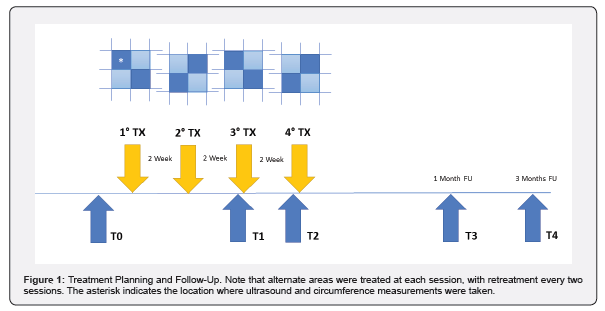
Each subsequent treatment targeted a different area than the previous one, and every two treatments targeted the same area. Therefore, although four sessions were performed, each area was irradiated only twice, as reported in the study plan of (Figure 1).
Body Mass Index (BMI), Photographic images, abdominal circumference measurements and ultrasound images were acquired Before (T0), Immediately before the third treatment (T1), Immediately before the fourth treatment (T2), at 1-month follow-up after the last treatment (T3) and at 3-months follow-up after the last treatment (T4).
The abdomen circumference measurements and the ultrasound images (5 centimeters to the left and right of the navel and on the iliac crest) were taken at the same distance from established reference points.
All possible side effects were monitored.
Patients were advised not to change their lifestyle, either physical or dietary.
Results
All patients completed treatment and follow-up visits.
Patients' BMI remained unchanged, with a slight progressive reduction, from a mean value of 24.6 ± 1.9 kg/m2 at baseline to 24.1 ± 1.4 kg/m2 at the 3-months follow-up (T4), as shown in (Figure 2).
Ultrasound observations showed a significant reduction (p<0.05) in abdominal adipose tissue between baseline and the 3-months follow-up.
Each measured point showed an improvement, as shown in (Figure 3).
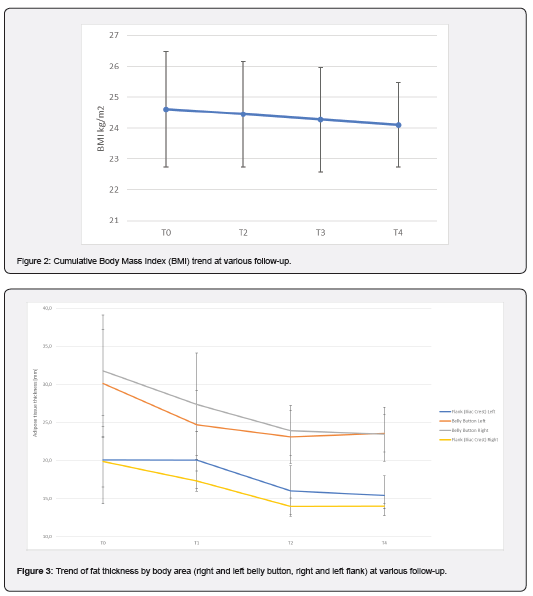
The left flank area (above the iliac crest) decreased from a mean initial fat thickness (T0) of 20.1 ± 5.8 mm to a value of 15.4 ± 2.6 mm at 3-months follow-up (T4), with a mean reduction of 23% and a maximum reduction of 7.9 mm.
The left umbilical area decreased from a mean initial fat thickness (T0) of 30.1 ± 7.1 mm to a value of 23.6 ± 2.5 mm at 3-months follow-up (T4), with a mean reduction of 22% and a maximum reduction of 11.2 mm.
The right umbilical area decreased from an initial mean fat thickness (T0) of 31.8±7.3 mm to a 3-months follow-up value (T4) of 23.5±3.6 mm with a mean reduction of 26% and a maximum reduction of 12.1 mm.
The right flank area (above the iliac crest) decreased from an initial mean fat thickness (T0) of 19.9 ± 3.3 mm to a 3-months follow-up value (T4) of 14.0 ± 0.3 mm, with a mean reduction of 30% and a maximum reduction of 8.9 mm.
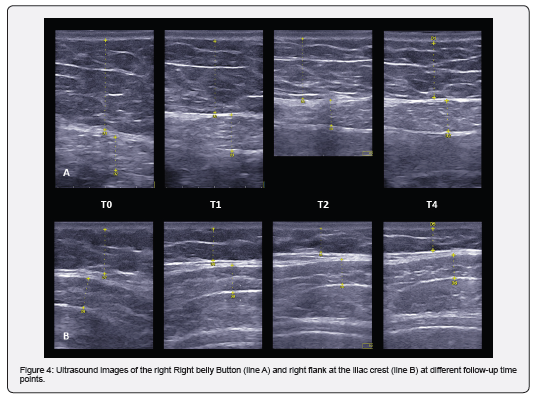
Figure 4 showed an ultrasound example of a patient, while (Figures 5 & 6) showed two photographic examples of the treated patients monitored at the third month after treatment.
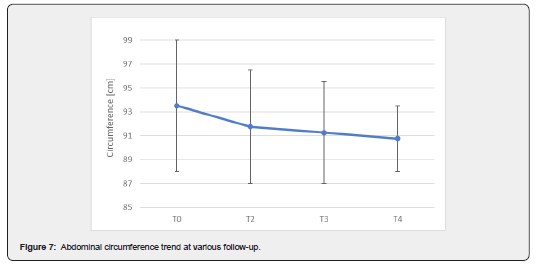
Finally, the abdominal circumference decreased from an initial mean value (T0) of 93.5 ± 5.5 cm to a 3-months follow-up value (T4) of 90.7 ± 2.7 cm, with a maximum reduction of 5.5 cm, as shown in (Figure 7).
Some patients (3% of the treatments) reported mild hardening of the treated area for a few days after treatment which resolved spontaneously without any side effects.
Discussion
From the data reported, it is possible to observe that a significant portion of patients were overweight (BMI >25 kg/m2), which progressively decreased over the 3-months follow-up.
This finding was confirmed by a reduction in abdominal circumference, as a prognostic indicator of cardiovascular risk.
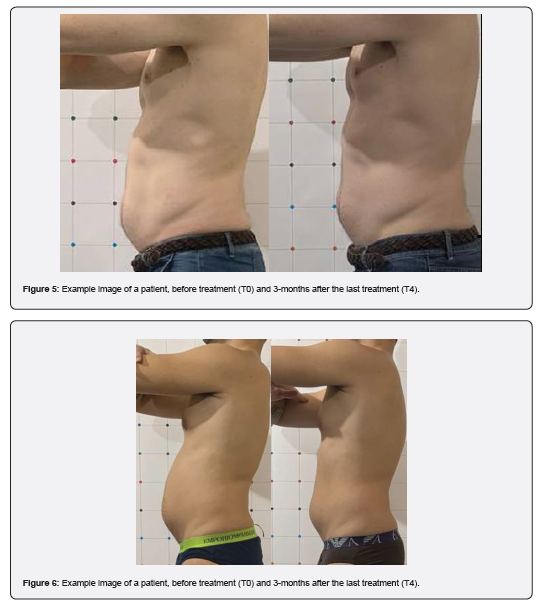
The most interesting finding emerging from the study was the significant reduction in adipose tissue through ultrasound examination.
The ultrasonic measuring technique is the best system for highlighting variations, as it highlights the improvements on a geometric level with greater precision and resolution, which are subsequently transferred to the circumference and photographic image.
This is also due to the fact that muscle stimulation enhances muscle trophism, potentially increasing circumference while adipose tissue is reduced. Therefore, the circumference assessment and photographic documentation allow for a postural assessment, but may underestimate the actual reduction in adipose tissue [11].
This reduction was also achieved with only two treatments in the same area, as the four treatments were alternated in different areas.
It is therefore reasonable to deduce that even more significant results can be achieved by increasing the number of sessions.
The direct action of the 1060 nm laser on the adipocyte and the synergy with electrical muscle stimulation generate a progressive lipolytic effect supported by simultaneous muscle exercise.
This type of treatment was recognized as a non-invasive therapeutic aid, especially appropriate for patients at the threshold between normal weight and overweight. (BMI = 25 kg/m2).
With this type of patient, a result that meets their expectations can be achieved, with a visible reduction in adipose tissue thickness.
Conclusion
In conclusion, the study demonstrates a significant reduction in abdominal adipose tissue, best detected by ultrasound. Notably, improvements were achieved with a limited number of treatments per area, suggesting the possibility of better results with additional sessions. The combination of 1060 nm laser and electrostimulation appear to be an effective and non-invasive option, especially for patients bordering on normal weight and overweight.
Author Contributions
Conceptualization AL, TZ; methodology, AL, TZ; software, AL, JB, TZ validation, AL, JB, IF, TZ; formal analysis, AL, TZ.; investigation, AL, TZ; resources, AL, TZ; data curation, AL, JB, TZ; writing-original draft preparation, AL, JB, IF, TZ; writing-review and editing, AL, JB, IF, TZ; visualization, AL, JB, IF, TZ; supervision, AL, JB, IF, TZ; project administration, AL, TZ; funding acquisition, AL, TZ. All authors have read and agreed to the published version of the manuscript.
Institutional Review Board Statement
The study was conducted in accordance with the principles of Declaration of Helsinki. No activity was carried out outside the scope of the device intended purpose or that no additional invasive or burdensome procedures were carried out compared to procedure performed under the normal condition of use of the device.
Informed Consent Statement
Informed consent was obtained from all subjects involved in the study.
Data Availability Statement
Data that support the study findings are available on request from the corresponding author (Irene Fusco).
Conflicts of Interest
Authors Jorilda Biba, Irene Fusco and Tiziano Zingoni were employed by El En Group. The remaining authors declare that the research was conducted in the absence of any commercial or financial relationships that could be construed as a potential conflict of interest.
References
- Wiley PTM, Poirier P, Burke LE, Després JP, Larsen GP, et al. (2021) Obesity and Cardiovascular Disease: A Scientific Statement from the American Heart Association. Circulation. 143(21): e984-e1010.
- Koskinas KC, Craenenbroeck VEM, Antoniades C, Blüher M, Gorter TM, et al. (2024) ESC Scientific Document Group. Obesity and cardiovascular disease: an ESC clinical consensus statement. Eur Heart J 45(38): 4063-4098.
- Landry MJ, Bagha Z (2026) Lifestyle management approaches for obesity. J Clin Lipidol 20(1S): 38-54.
- Recchia F, Leung CK, Yu AP, Leung W, Yu DJ, et al. (2023) Dose-response effects of exercise and caloric restriction on visceral adiposity in overweight and obese adults: a systematic review and meta-analysis of randomised controlled trials. Br J Sports Med 57(16): 1035-1041.
- Zendejas HG, Reavie DW, Azabache R, Guerrerosantos J (2020) Lipoplasty Combined with Percutaneous Radiofrequency Dermaplasty: A New Strategy for Body Contouring. Aesthetic Plast Surg 44(2): 455-463.
- Piccolo D, Mutlag MH, Fusco I, Bonan P (2023) Facial and body contouring with 1444 nm Nd:YAG laser-assisted lipolysis: Clinical evidence. Skin Res Technol 29(7): e13400.
- Hoffmann K, Zappia E, Bonan P, Coli F, Bennardo L, et al. (2024) Microwave-Energy-Based Device for the Treatment of Cellulite and Localized Adiposity: Recommendations of the "Onda Coolwaves" International Advisory Board. Bioengineering (Basel) 11(12): 1249.
- Mezzana P, Antonucci MG, Fusco I (2021) Preclinical and clinical evaluation on the performance and safety of a novel energy-based device for body shaping: A pilot study. J Cosmet Dermatol 20(8): 2486-2492.
- Bonan P, Fusco I, Madeddu F, Zingoni T, Ibrahim SMA (2025) Clinical Evaluation of a 1060-Nm Laser for Non-Invasive Fat Reduction of the Abdomen and Coulotte/Thighs in Men and Women. J Cosmet Dermatol 24(12): e70558.
- Negosanti F, Cannarozzo G, Zingoni T, Leone A, Fusco I (2022) Is It Possible to Reshape the Body and Tone It at the Same Time? Schwarzy: The New Technology for Body Sculpting. Bioengineering (Basel) 9(7): 284.
- Leone A, Piccolo D, Conforti C, Pieri L, Fusco I (2021) Evaluation of safety and efficacy of a new device for muscle toning and body shaping. J Cosmet Dermatol 20(12): 3863-3870.

























