



 CRDOJ Home



Abstract
A man in his early fifties who is a long-term survivor of AML and a recipient of a hematopoietic stem cell transplant (HSCT/HCT) complained of low energy, insomnia, and weakness. He was overweight, and laboratory testing revealed low serum testosterone and elevated follicle-stimulating hormone (FSH) and luteinizing hormone (LH) levels. Testing further revealed elevated insulin. Taken together, the patient exhibited characteristics of primary hypogonadal failure and risk factors for metabolic syndrome, which are not uncommon findings among long-term adult male survivors of AML/HCT. The patient opted for a conservative approach to management that entailed calorie-restricted but physically and psychologically sustainable dietary changes, regular resistance and cardiovascular training, and the use of a dietary supplement. Within 3–6 months, the patient lost a significant amount of weight (≈ 12%), gained strength and energy, and normalized his testosterone and insulin levels, all without incurring the financial costs and additional burdens associated with pharmaceutical or surgical interventions. Insomnia and reduced libido remained unresolved. This case provides an instructive example of the use of positive lifestyle changes to bring about favorable endocrine and symptomatic changes in an adult male with a history of AML/HCT.
Keywords: Chronic insomnia; Fludarabine; Thiotepa; Bone density; Insulin, Testosterone levels
Introduction
>A 53-year-old male presented with complaints of low energy, low libido, and chronic insomnia. He also complained about difficulty losing weight and gaining strength. He reported that he had been experiencing these problems for several years, despite adopting lifestyle changes that included dietary changes, regular exercise, efforts aimed at improved sleep hygiene, and the use of various dietary supplements. The patient’s health history included a diagnosis of and treatment for acute myeloid leukemia (AML).
The patient was first diagnosed with AML in 2011. Based on genetic and cytogenetic testing results, the patient was classified as intermediate risk and treated as an inpatient and outpatient with standard rounds of induction and consolidation chemotherapy (cytarabine and idarubicin). In 2013, the patient suffered a relapse. He was treated with a new allogeneic hematopoietic stem cell transplant (HPSC/HCT) technique that employed novel naive T cell-depleted stem cell grafts. The transplant was preceded by myeloablative conditioning composed of fludarabine, thiotepa, and total body irradiation (TBI; 1,320 cGy, 13.2 Gy) [1].
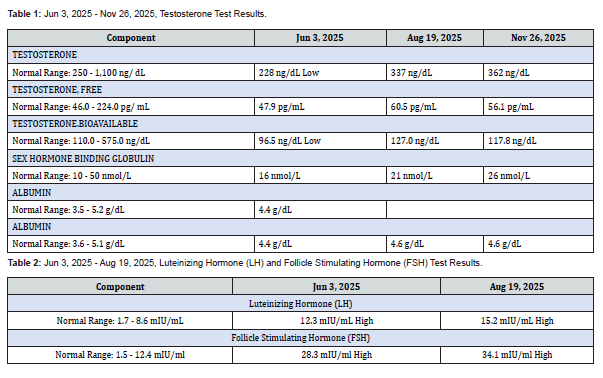
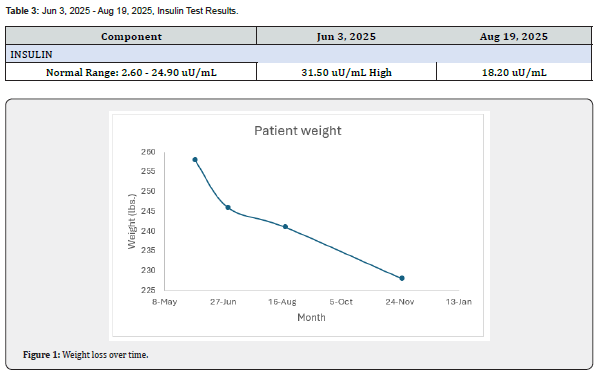
At his first June 3rd, 2025, visit the patient was measured at 5’8” tall and weighed at 258 lbs., and labs were ordered. For context, the patient played some college football and reported being 5’9” and weighing roughly 225 lbs. during his athletic prime. Lab testing revealed that the patient at baseline had borderline statistically abnormally low total testosterone (228 ng/dL) and bioavailable testosterone (96.5 ng/dL) levels but borderline statistically normal free testosterone (47.9 pg/ml). His LH and FSH levels were determined to be high at 12.3 mIU/mL and 28.3 mIU/ml, respectively. The patient’s baseline insulin level was measured to be an abnormally high 31.5 uU/mL, but his HbA1c was found to be in the normal range at 5.5%.
The test results and various treatment options, including testosterone replacement therapy (TRT), were discussed with the patient. He decided that he wanted to attempt to increase his testosterone levels, reduce his insulin level, and address his symptoms and complaints through weight loss and body enhancement by adopting a new diet and exercise program.
The patient used an online metabolic rate calculator to estimate his daily calorie burn. Based on the results, he settled on the goal of eating fewer than 1,800 calories per day (Mon-Sat) but while remaining psychologically satisfied. As such, the personalized diet plan he adopted required him to eliminate all eating before lunch, prepare and eat a single but enjoyable sandwich (≈ 600 calories) for lunch, eat a normal, well-balanced and enjoyable but reduced meal (≈ 1,000 calories) for dinner, and reduce his intake of added sugar and ultra processed foods. The patient allowed himself to eat small servings of fresh vegetables and fruits after lunch and dinner, with a strict eating cutoff of 9 PM. The patient eliminated all caloric beverages and limited himself to drinking water and one serving of coffee (black with 1-2 teaspoons of sugar/xylitol mixture) per day. On Sundays, the patient relaxed his dietary restrictions and allowed himself to eat an additional ≈ 500 calories, sometimes by eating additional food items, enjoying a dessert, or indulging in a little of both.
For his exercise program, the patient engaged in ≈ 1 hour of resistance/strength training 2x per week and ≈ 1 hour of cardio conditioning 2x per week. The weight training included lifting free weights and machine weights. The cardio training involved walking on a treadmill for about 30 minutes during a session.
On his Jul 1st follow-up appointment, the patient lost 12 lbs. and weighed in at 246 lbs. The patient agreed to get his FSH, LH, testosterone and insulin levels tested. The patient also agreed to receive a DXA bone density study.
On his Aug 19th follow-up appointment, the patient lost an additional 5 lbs. and weighed 241 lbs. His insulin levels declined to a normal level (18.2 uU/mL). His total testosterone (337 ng/dL), free testosterone (60.5 pg/mL), and bioavailable testosterone (127 ng/dL) all increased to within normal ranges. His LH and FSH levels were slightly elevated at 15.2 mIU/mL and 34.1 mIU/mL, respectively.
Based on his Aug 19th test results, the patient decided to continue with his diet and exercise weight loss and body improvement program and to add a dietary supplement to try and further boost his testosterone. The supplement was manufactured by Personalized Nutrients and consisted of 250 mg Fenugreek Extract (Trigonella foenum-graecum, 50% Saponins UV), 200 mg Pomegranate Fruit Extract (Punica granatum), and 200 mg Tongkat Ali Root Extract (Eurycoma longifolia Jack, EuryGold 5®), and was dosed at 2 capsules per day.
The patient’s Nov 26th self-reported weight was 228 lbs., and his test results indicated an increase in total testosterone (362 ng/dL) and maintenance of free testosterone (56.1 pg/mL) and bioavailable testosterone (117.8 ng/mL) at low normal levels (Figure 1) (Tables 1-3).
In terms of symptoms and behavior, the patient reported improvements in energy, affect and strength but no change in libido. However, while his physical strength increased, the patient failed to achieve his personal goal of bench pressing 225 lbs. (he increased his bench press to 215 lbs.; for context, his max bench press in college was reported to be 350 lbs..). He still complained of insomnia.
Discussion
On June 3rd, a male patient who had been successfully treated for AML 12 years earlier with a novel allogeneic HCT transplant that employed a conditioning regimen of chemotherapy and TBI presented with borderline low testosterone (228 ng/dL) and elevated LH (12.3 mIU/mL) and FSH (28.3 mIU/mL) levels. He complained of relative physical weakness, insomnia, and low libido, and he was overweight. This presentation is consistent with primary hypogonadism secondary to pretransplant chemotherapy and TBI.
Testicular tissue includes Leydig cells and Sertoli cells. Under the influence of LH, Leydig cells produce testosterone (androgenesis). In Sertoli cells, FSH and testosterone support the production of sperm (spermatogenesis). Both cell types are sensitive to the effects of radiation and various forms of chemotherapy, with Sertoli cells being more sensitive. Hence, the patient’s pattern of compensatory endocrine and gonadal dysfunction and reported symptoms are not uncommon for adult males who have undergone successful bone marrow transplant (BMT) or HCT/HSC/HPSC transplant [2-4]. Some relevant studies are reviewed briefly in what follows.
In 1996, Sanders et al. found that among 618 postpubertal men who had undergone high-dose cyclophosphamide with or without high-dose busulfan or TBI and bone marrow transplantation (BMT), only 25% (n=157) recovered testicular function, where recovered testicular function was defined as normal LH, FSH, and testosterone levels with evidence of sperm production [5].
Based on data gathered from 117 adult male patients who underwent BMT for a variety of hematological malignancies, Chatterjee and co-authors characterized two distinct functional subsets of LC insufficiency. Type I (compensated) was marked by high LH and normal T levels, while Type II (uncompensated) was indicated by high LH and low T levels [6].
A 2005 study by Somali et al. reported results for 31 adult (32.6 yrs) males who had undergone either autologous or allogeneic BMT/HSCT with chemotherapy conditioning alone. Hypergonadotropic hypogonadism was observed in 19% of male patients. LC strain (normal T and high LH) was evident in 32% and spermatogenesis damage (high FSH) in 68% of the male population [7].
In a 2014 study of adults (> 18 yrs) who underwent HPSC transplantation with chemotherapy (busulfan and cyclophosphamide (BU/CY)) but without TBI for acute leukemia, Vaezi et al reported that after one year testosterone levels were less than normal in 84% men and that according to their FSH and LH levels, 41% and 59% had secondary primary gonadal dysfunction, respectively [8].
A highly relevant report published in 2004 by Dupree and Dobbs described the case of a 34-year-old male who was a long term (20 year) survivor of chronic myelogenous lymphoma (CML). He had been treated with chemotherapy, BMTs, and donor lymphocyte infusions. He presented with fatigue, osteopenia, and hypogonadism from primary testicular failure due to prior CML therapy which was characterized by low testosterone (T = 220 ng/dL) and high FSH and LH (FSH = 35.5 μU/mL, LH = 10.0 μU/mL). The patient was treated with calcium, vitamin D, and testosterone supplementation, resulting in objective and subjective improvements [9].
Based on the pattern of LH, FSH and testosterone lab results, the patient described here was a candidate for TRT and was presented with that option. However, he elected to forge TRT and opted for an initial program of exercise, diet, and weight loss. This was certainly a reasonable approach given the association between obesity and hypogonadism, published reports that weight loss leads to increases in testosterone levels, and the many other health benefits of dietary improvement and weight loss, not to mention avoidance of the many expenses and side effects of pharmaceutical and surgical interventions [10]. Similarly, and perhaps unsurprisingly, a recently published systematic review found that various exercise programs consistently resulted in increased testosterone levels in males over the age of 40 [11].
What is noteworthy in the present case is that the patient’s August 19th follow-up showed that a dietary and exercise intervention alone resulted in ≈ 7.0% weight loss and normalization of testosterone levels (337 ng/dL), in the context of an older male who was a long-term survivor of AML and who presumably still suffered from some of the detrimental effects of TBI/chemotherapy on gonadal (LC and SC) function. Based on the post-weight-loss increases in LH and FSH, it can be reasonably hypothesized that the increase in testosterone was driven by some combination of diet-, exercise-, and weight-loss-induced compensatory HPG axis function.
The patient elected to add a supplement containing 250 mg/day of fenugreek (Trigonella foenum-graecum), 200 mg/day of Tongkat Ali (Eurycoma longifolia Jack) extract, and 200 mg/day of pomegranate fruit extract (Punica granatum) to his weight-loss and exercise program. The use of Tongkat Ali was a reasonable choice given that a recent meta-analysis confirms its efficacy in significantly increasing testosterone levels in healthy and hypogonadal men [12]. Tongkat Ali is rich in bioactive compounds that include quassinoids, quassinoid diterpenoids, canthin-6-one alkaloids, β-carboline alkaloids, squalene derivatives, triterpene-type tirucallane, tirucallane-type triterpenes, laurycolactone, and bioactive steroids. Proposed mechanisms of action include improved function of the HPG axis and reduced conversion of testosterone to estrogen through aromatase inhibition [12,13]. Likewise, 2020 and 2023 meta-analyses concluded that fenugreek extract improved testosterone levels in men [14,15]. Finally, the results of a 2023 randomized controlled clinical trial showed that a proprietary herbal blend of pomegranate (Punica granatum) and Theobroma cocoa seeds led to an increase in serum testosterone levels in healthy young males [16]. As of November 26th, dietary supplementation was associated with additional weight loss (12% total weight loss), an increase in total testosterone (362 ng/dL), and maintenance of free and bioavailable testosterone within normal ranges. It is not clear what contribution the supplement made to the additional weight loss and increased or maintained endocrine changes.
The is a significantly increased risk of metabolic syndrome and skeletal problems with leukemia patients who have undergone BMT/HPSCT, especially among pediatric patients and those who received TBI [17-19]. Thus, there is a need for monitoring and caring for survivors carefully [17,18]. Hence, the patient’s elevated June 3rd insulin level (31.50 uU/mL) was of concern and in need of management. A bone scan was also ordered. The bone scan came back normal. As mentioned previously, the patient opted for a conservative approach that consisted of improved diet and exercise to improve his endocrine and metabolic parameters. This resulted in normalization of insulin levels by August 19th.
It is worth offering some comments on the patients’ so far successful approach to making dietary changes. Aware of the fact that dietary changes often prove to be temporary and prone to failure, the patient committed himself to adopting dietary changes that would be physically and psychologically sustainable over the long term. Hence, based on prior experience and metabolic calculations using an online tool, the patient adopted a personalized dietary model calculated to help him, first, lose weight and, second, habitually maintain a healthier weight. For him, this meant eliminating breakfast, eliminating caloric beverages, using xylitol as a natural sugar substitute, snaking on raw fruits and vegetables, and making a general effort to reduce his intake of ultra processed foods and added sugar. The patient claims that he psychologically benefited from actively shopping for whole food ingredients and preparing lunches and dinners that he enjoyed eating and from allowing himself to indulge with moderation on Sundays. Finally, the patient reports that he is gradually progressing to a habitual maintenance diet that builds on his previous weight loss diet.
Conclusion
In summary, in early June of 2025 a male patient in his early 50s who was a long-term survivor of AML and who had undergone HCT presented with low testosterone and elevated FSH and LH, which are characteristic of primary gonadal failure. The patient also presented with obesity and hyperinsulinemia, which are characteristic of metabolic syndrome. The patient decided to adopt a conservative lifestyle intervention which included a calorie-restricted and more healthy but psychologically sustainable diet and regular resistance and cardiovascular exercise. By August 19th, the patient lost significant weight and all tested blood parameters had normalized. To further increase his testosterone levels, the patient supplemented with capsules of Fenugreek, Tongkat Ali, and Pomegranate which was associated with additional weight loss and increased testosterone. The case represents the successful use of 6 months of lifestyle modifications and natural dietary supplementation to lose significant body weight (12%) and improve and normalize objective endocrine and metabolic markers in a long-term male survivor of AML. The patient reports ongoing success with his diet and exercise program.
References
- Bleakley M, Heimfeld S, Loeb KR, Jones LA, Chaney C, et al. (2015) Outcomes of Acute Leukemia Patients Transplanted with Naive T Cell-Depleted Stem Cell Grafts. J Clin Invest 125: 2677-2689.
- Phelan R, Im A, Hunter RL, Inamoto Y, Stanghellini LMT, et al. (2022) Male-Specific Late Effects in Adult Hematopoietic Cell Transplantation Recipients: A Systematic Review from the Late Effects and Quality of Life Working Committee of the Center for International Blood and Marrow Transplant Research and Transplant Complications Working Party of the European Society of Blood and Marrow Transplantation. Transplant Cell Ther 28(335): 1-17.
- Socie G (2003) Nonmalignant Late Effects after Allogeneic Stem Cell Transplantation. Blood 101: 3373–3385.
- Georgakopoulos I, Kouloulias V, Ntoumas GN, Desse D, Koukourakis I, et al. (2024) Radiotherapy and Testicular Function: A Comprehensive Review of the Radiation-Induced Effects with an Emphasis on Spermatogenesis. Biomedicines 12(7): 1492.
- Sanders J, Hawley J, Levy W, Gooley T, Buckner C, et al. (1996) Pregnancies Following High-Dose Cyclophosphamide with or without High- Dose Busulfan or Total-Body Irradiation and Bone Marrow Transplantation. Blood 87(7): 3045-3052.
- Chatterjee R, Kottaridis PD, McGarrigle HH, Eliahoo J, McKeag N, et al. (2001) Patterns of Leydig Cell Insufficiency in Adult Males Following Bone Marrow Transplantation for Haematological Malignancies. Bone Marrow Transplant 28(5): 497-502.
- Somali M, Mpatakoias V, Avramides A, Sakellari I, Kaloyannidis P, et al. (2005) Function of the Hypothalamic-Pituitary-Gonadal Axis in Long-Term Survivors of Hematopoietic Stem Cell Transplantation for Hematological Diseases. Gynecol Endocrinol 21(1): 18-26.
- Vaezi M, Gharib C, Souri M, Ghavamzadeh A (2016) Late Complications in Acute Leukemia Patients Following HSCT: A Single Center Experience. Int J Hematol Oncol Stem Cell Res 10(1): 1-6.
- Dupree K, Dobs A (2004) Osteopenia and Male Hypogonadism. Rev Urol 6(6): 30-34.
- Genchi VA, Rossi E, Lauriola C, D Oria R, Palma G, et al. (2022) Adipose Tissue Dysfunction and Obesity-Related Male Hypogonadism. Int J Mol Sci 23(15): 8194.
- Zouhal H, Jayavel A, Parasuraman K, Hayes LD, Tourny C, et al. (2022) Effects of Exercise Training on Anabolic and Catabolic Hormones with Advanced Age: A Systematic Review. Sports Med 52(6): 1353-1368.
- Leisegang K, Finelli R, Sikka SC, Selvam PMK (2022) Eurycoma Longifolia (Jack) Improves Serum Total Testosterone in Men: A Systematic Review and Meta-Analysis of Clinical Trials. Medicina (Kaunas) 58(8): 1047.
- Rehman SU, Choe K, Yoo HH (2016) Review on a Traditional Herbal Medicine, Eurycoma Longifolia Jack (Tongkat Ali): Its Traditional Uses, Chemistry, Evidence-Based Pharmacology and Toxicology. Molecules 21(3): 331.
- Mansoori A, Hosseini S, Zilaee M, Hormoznejad R, Fathi M (2020) Effect of Fenugreek Extract Supplement on Testosterone Levels in Male: A Meta-Analysis of Clinical Trials. Phytother Res 34(7): 1550-1555.
- Isenmann E, Alisauskas P, Flenker U, Schalla J, Diel P (2023) The Anabolic Effect of Fenugreek: A Systematic Review with Meta-Analysis. Int J Sports Med 44(10): 692-703.
- Sreeramaneni PGA, Yalamanchi A, Konda MR, Cherukuri SHV, Maroon JC (2023) A Proprietary Herbal Blend Containing Extracts of Punica Granatum Fruit Rind and Theobroma Cocoa Seeds Increases Serum Testosterone Level in Healthy Young Males: A Randomized, Double-Blind Placebo-Controlled Study. J Diet Suppl 20(3): 411-427.
- Davis AS, Viera AJ, Mead MD (2014) Leukemia: An Overview for Primary Care. Am Fam Physician 89(9): 731-738.
- Saultier P, Michel G (2024) How I Treat Long-Term Survivors of Childhood Acute Leukemia. Blood 143(8): 1795-1806.
- Annaloro C, Airaghi L, Saporiti G, Onida F, Cortelezzi A, et al. (2012) Metabolic Syndrome in Patients with Hematological Diseases. Expert Rev Hematol 5(4): 439-458.

























