




 ASM Home




Abstract
The cultivation of Hong Kong political leaders confronts a structural contradiction: governance capacity demands the triple overlay of local grounding, national depth, and international perspective, yet cultivation design often remains one-dimensional—universities emphasize curricular internationalization, political parties rely on on-the-job experience, and training bodies focus on short-term seminars, with these three lines running in parallel rather than interlocking. This paper proposes a two-dimensional temporal–spatial matrix for Hong Kong political leadership cultivation, with time (undergraduate—master’s—doctoral) as the X-axis and space (local—national—foreign) as the Y-axis, while embedding “output-oriented practice” as a mode constraint in each cell. Theoretically, this paper introduces transformational leadership theory to define the competency goals and moral dimension of leadership, authentic leadership theory to explain the internal consistency between political loyalty and governance capacity under “One Country, Two Systems,” and situated learning with legitimate peripheral participation to explain why leadership capacity can only emerge through peripheral participation in communities of practice. The matrix advances three trade-off principles: the time axis cannot be skipped; the local space must serve as the mandatory primary anchor; and each stage must include at least one high-intensity output. Using the University of Hong Kong’s character and leadership education programme as a nodal case, this paper diagnoses Hong Kong’s institutional gaps in “local governance practice training” and “embeddedness in mainland governmental positions,” and proposes a three-anchor strategy: “local curriculum as foundation, mainland practice as depth, and international rules as spearhead.” The value of the matrix lies not in filling all nine cells, but in compelling designers to make explicit trade-offs at each cell rather than concealing substantive competency vacuums behind declarations of “patriotism and love for Hong Kong.”
Keywords: Hong Kong Political Leadership; Temporal–Spatial Matrix; Transformational Leadership; Authentic Leadership; Legitimate Peripheral Participation
Introduction
Discussions on cultivating Hong Kong political leaders have long oscillated between two extremes. One end is the “loyalty thesis,” which equates political reliability with the entirety of leadership qualification, neglecting that governance capacity requires long-term professional training. The other end is the “competence thesis,” which takes Western public administration curricula as its blueprint yet avoids the dual constraint that, under “One Country, Two Systems,” political leaders must simultaneously respond to the national constitutional order and local governance demands. Both discourses share a blind spot: they treat cultivation as a matter of “selecting people” or “taking courses” rather than a design problem requiring structural trade-offs across time, space, and mode.
The consequences of this blind spot are already evident. Hong Kong possesses the highest-density cluster of top universities globally, yet its political science and public administration curricula have long been organized around the Anglo-American system, with severe deficiencies in coverage of the constitutional foundations of “One Country, Two Systems,” mainland governance logic, and the political economy of the Global South. Meanwhile, young people interested in public affairs lack an institutionalized transitional pathway between university coursework and government positions: courses do not provide practical skills, internships do not constitute selection criteria, and positions do not connect to cultivation pipelines. Chen Man-hung, analyzing Hong Kong’s predicament, notes that Hong Kong’s external affairs have long relied on Anglo-American systems and colonial-era talent, with near-total cognitive vacuum regarding the histories, cultures, religions, and political dynamics of Belt and Road countries and the Global South. This diagnosis applies equally to political leadership cultivation: Hong Kong does not lack intelligent people; it lacks a structured pathway that sends intelligent people from the classroom to the governance site.
This paper proposes a two-dimensional matrix (time × space). Theoretically, it mobilizes three leadership and learning theory resources: transformational leadership theory defines “what kind of person a leader should become”; authentic leadership theory responds to “how loyalty and capacity can be unified under ‘One Country, Two Systems’”; and situated learning theory explains “how this capacity grows.”
Theoretical Framework: Three Leadership Theories and Their Matrix Implications
Transformational Leadership: The Dual Definition of Competency Goals and Moral Dimension
Transformational leadership theory was introduced by Burns [1] and extended by Bass [2]. Its core claim is that leadership is not merely transactional reward-and-punishment exchange but the elevation of followers’ moral levels and capacities through “idealized influence, intellectual stimulation, individualized consideration, and inspirational motivation.” Burns particularly emphasizes that the essence of transformational leadership is moral leadership—it pursues the expansion of values such as liberty, equality, and justice, rather than merely improving organizational performance. This distinction is crucial for Hong Kong political leadership cultivation: the leader’s goal is not “managing a department well” but shaping governance consensus and enhancing institutional legitimacy within the constitutional framework of “One Country, Two Systems.”
In the matrix, transformational leadership theory primarily operates on the terminal orientation of the X-axis and the cell-selection criteria of the Y-axis. The core of the undergraduate stage is not “how many courses have been completed” but cultivating the critical thinking required for “intellectual stimulation” and the empathy required for “individualized consideration”; the master’s stage requires real scenarios to test whether followers are willing to follow—this is precisely the function of internships and position-based experience; the doctoral stage should produce research capable of shaping governance rules. On the Y-axis, transformational leadership’s emphasis on the “moral dimension” means that the mainland cell cannot be reduced to “national conditions visits”; it must include deep understanding of governance ethics and institutional logic. The foreign cell cannot be reduced to “international perspective”; it must ask: in Global South and Belt and Road scenarios, can Hong Kong leaders articulate governance narratives different from Western-centrism?
Authentic Leadership: The Internal Unity of Loyalty and Capacity
Authentic leadership theory was systematized by Avolio, Luthans, and others in the 2000s [3]. Its core constructs include self-awareness, internalized moral standards, balanced processing, and relational transparency . Authentic leadership is not the license to “be oneself” but the leader’s clear cognition of their own values and sustained action in accordance with those values under pressure. The applicability of this theory to the Hong Kong context lies in that it provides a way of understanding “political loyalty” not as an externally imposed declarative requirement but as conscious action after the leader has internalized the constitutional order.
The trainability of authentic leadership is supported by research: leaders can develop stronger authenticity by reflecting on significant experiences, receiving feedback, and testing their values in real situations . The implication for matrix design is that each cell should include reflective output—not “participated” but “what judgment was made under pressure, and on what values was it based.” Community governance internships at the undergraduate stage require students to record “when residents’ demands conflicted with institutional constraints, on what basis did I make trade-offs”; mainland position internships at the master’s stage require submission of a “value tension analysis in policy implementation”; doctoral research requires confronting governance paradoxes of “efficiency and equity, openness and security.” The “internalized moral standards” dimension of authentic leadership must be trained precisely through these real, consequential choices, not through classroom lectures.
Situated Learning and Legitimate Peripheral Participation: How Leaders Grow
Lave and Wenger’s [4] situated learning theory defines learning as a process “occurring through participation in communities of practice.” Its core concept, “legitimate peripheral participation” (LPP), refers to novices acquiring tacit knowledge through obtaining a legitimate identity and moving gradually from the periphery to full participation in a community . This theory has been applied to leadership development research: Curnow [5] found that student activists’ leadership learning in social movement organizations was achieved precisely through a ladder from peripheral to core participation . Recent research has further employed “peer shadowing” as a pedagogical intervention for leadership development, finding that shadowers reinterpret leadership as situated practice through two processes: “seeing with” and “seeing through”.
The implication of this theory for Hong Kong political leadership cultivation is sharp: leaders are not stacked up by courses. A student who has completed “Public Policy Analysis” in class is not thereby equipped to handle resident conflicts in a district council; a master’s student who has finished a “Basic Law seminar” is not thereby able to make judgments conforming to the constitutional order in a government position. Each cell of the matrix must answer: with what legitimate identity does the learner enter which community of practice? Community internships at the undergraduate stage provide an entry point for “peripheral participation”; government/party positions at the master’s stage provide deeper legitimacy of participation; policy research at the doctoral stage requires obtaining a “listened-to” identity within think tanks or government advisory systems. Without such institutionalized entry points of legitimacy, “internships” are merely visits, and “research” is merely textual assignments.
Matrix Structure and Three Trade-off Principles
Matrix Structure
The matrix presented below in Table 1 is not a curriculum catalogue but a decision architecture. Its nine cells are deliberately kept sparse: each cell names the space–time combination and the dominant activity type, rather than listing every possible course, internship, or research output. This sparseness is intentional. A matrix that attempted to be exhaustive would reproduce the very problem it is designed to solve—the substitution of activity lists for structural choice. The reader should therefore approach each cell as a question rather than an answer: at this stage, in this space, what is the one thing that must happen for the next cell to be meaningful?
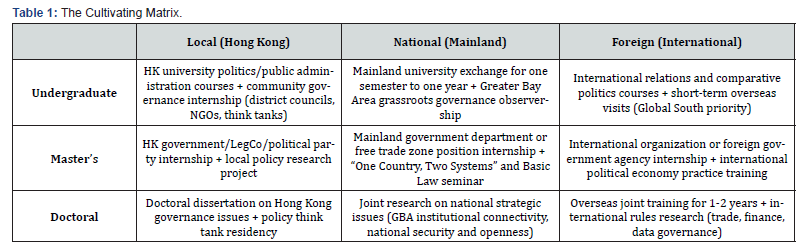
The three trade-off principles that follow in Section 3.2 specify how those questions are to be answered. Each cell is not a course list but a unit of cultivation decision-making. Designers must answer: which cell is the primary anchor at this stage? Which is the supplementary anchor? What is the output activity? Unselected cells mean explicit abandonment.
Three Trade-off Principles
Principle One: The time axis cannot be skipped. If the undergraduate stage does not complete the dual socialization of “local community + mainland national conditions,” government internships at the master’s stage easily degenerate into transactional experiences; if the master’s stage lacks mainland practical immersion, doctoral rule research will 脱离 the actual constraints of national governance. Authentic leadership theory supports this principle: leaders’ value formation depends on reflective integration of early experiences, and the judgment capacity of later stages presupposes the “moral schema” of earlier stages.
Principle Two: The local space must serve as the mandatory primary anchor; mainland or foreign space is selected as one supplementary anchor. No individual can achieve deep experience in all three spaces. The legitimacy foundation of Hong Kong political leaders lies locally; local governance practice training cannot be omitted. The choice of supplementary anchor forms two pathways: the “mainland depth type” takes government position internships and national strategy research as its depth, while the “international rules type” takes international organization internships and Global South rules research as its spearhead. Both pathways can lead to leadership positions, but the anchor logic must be clear—one cannot lack both mainland practice and international rules expertise, leaving only local classrooms.
Principle Three: Each stage must include at least one high-intensity output. The test criterion: does it require learners to produce externally evaluable outcomes under real pressure—a community governance proposal, a mainland policy research report, an international rules policy brief, a work product from a government internship? The “intellectual stimulation” dimension of transformational leadership requires activation through real problems, not simulated cases.
Case Filling and Gap Diagnosis
Nodal Case: Character and Leadership Education at the University of Hong Kong
The University of Hong Kong has made explorations in leadership education in recent years. Brooks et al. [6] report a case of a leadership and character cultivation programme at HKU, which used a creative combination of in-person and online learning to help students cultivate the character qualities required for “responsible leadership” during the critical period of intellectual and personal development . The value of this practice lies in its recognition that leadership is not merely a skill but the cultivation of character and judgment, resonating with the “internalized moral standards” dimension of authentic leadership [7-10].
However, this case also exposes the gaps identified by the matrix diagnosis: the programme is concentrated in the “undergraduate × local” cell and primarily consists of reflective learning within the campus. It does not answer: after completing character training, into which community of practice do students enter to continue developing? Is there selection and articulation between undergraduate community governance internships and this programme? Where are the entry points for mainland government positions at the master’s stage? How does doctoral policy research connect to leadership positions? The absence of these institutional articulations makes it difficult for undergraduate character education to translate into governance capacity.
Two Structural Gaps
Gap One: “Local × Master’s × Government/Party Internship” lacks institutionalized channels. Hong Kong university political science/public administration master’s programmes are primarily academically oriented; internship opportunities in government and political parties are highly dependent on personal networks, and there is no selection pipeline between internships and subsequent positions. In contrast to mainland universities’ “international organization reserve talent” programmes—where courses, selection, dispatch, internship, and placement form a closed loop—Hong Kong is in a state of “courses without channels, internships without articulation” in local governance practice training.
Gap Two: “National × Master’s/Doctoral × Government Position” is nearly blank. Institutionalized channels for Hong Kong youth to enter mainland government agencies or free trade zone positions are extremely limited. Existing “national conditions seminars” are mostly short-term visits and do not constitute entry points to communities of practice in the sense of legitimate peripheral participation. This means the “mainland depth type” pathway breaks down at the master’s stage: students cannot obtain a genuine identity of participation in mainland governance practice, and doctoral research on national strategy thus lacks operational texture.
It should be noted that the Hong Kong SAR government has recently begun to institutionalize leadership training within the civil service. The Civil Service College has launched the “Government Governance Talent Cultivation Programme,” providing 40 participants from various departments with seven in-depth learning activities between February and August 2026, including high-level thematic seminars, dialogues with experts and officials, and field visits to Shenzhen . The Civil Service College has also partnered with Peking University on a two-year Master of Public Administration programme, selecting 15 to 20 senior civil servants with leadership potential annually . These initiatives represent progress, but they operate primarily on in-service civil servants and do not address the pre-service cultivation gap identified by the matrix [11,12].
Three-Anchor Recommendations and Conclusion
Based on the matrix diagnosis, the priority strategy for Hong Kong political leadership cultivation is not spreading across three spaces but interlocking three anchors:
Local curriculum as foundation. Embed a required “Hong Kong Governance Practice” module at the undergraduate stage, covering district council operations, Basic Law jurisprudence, housing and youth policy, and other real issues, and require students to complete a supervised community governance internship. Internship evaluation is incorporated into course grades, forming a “course—internship—reflection” loop.
Mainland practice as depth. Negotiate with relevant mainland departments and Greater Bay Area cities to establish a “Government Position Observership Programme” for Hong Kong youth, lasting no less than three months, with positions set at the front line of policy implementation (e.g., free trade zones, sub-district governance, industrial parks). Mainland mentors are assigned during the observership, and observership outcomes serve as one reference for master’s stage selection. The theoretical basis for this design is triple-helix institutional collaboration: universities provide selection and course preparation, mainland governments provide practice positions, and Hong Kong political parties/think tanks provide subsequent placement.
International rules as spearhead. At the master’s and doctoral stages, focus on Global South and Belt and Road rules research, using international organization internships or overseas joint training as output vehicles. The goal is not to cultivate generalists “conversant with the West” but professionals capable of articulating Hong Kong perspectives in specific rule domains (trade facilitation, development finance, data governance)—precisely the manifestation of transformational leadership’s “intellectual stimulation” in governance scenarios.
The ultimate test of the matrix is not completeness on paper but whether it helps a designer, an institution, or a city make better trade-offs. Hong Kong does not need to catch up simultaneously across nine cells; it needs three interlocking anchors: local resolves the fundamental deficiency of “no governance training,” mainland fills the cognitive vacuum of “no national depth,” and international forms the differentiated spearhead of “rules expertise.” Leaders are not stacked up by courses; they grow through peripheral participation in real governance communities—the value of the matrix lies in making such participation traceable, grid-based, and subject to trade-offs.
References
- Burns J M (1978) Leadership. New York: Harper & Row.
- Bass B M (1985) Leadership and Performance Beyond Expectations. New York: Free Press.
- Avolio B J, Gardner W L, Walumbwa F O, Luthans F, May DR, et al. (2004) Unlocking the mask: A look at the role of authentic leadership and follower outcomes. The Leadership Quarterly 15(6): 801-823.
- Lave J, Wenger E (1991) Situated Learning: Legitimate Peripheral Participation. Cambridge: Cambridge University Press, United Kingdom.
- Curnow J (2014) Climbing the leadership ladder: Legitimate peripheral participation in student movements. Interface: A Journal for and about Social Movements 6(1): 130-155.
- Brooks E, Tse S, Wright J Y, Burdett E (2024) Character and leadership education: A case study from the University of Hong Kong. Tertiary Education and Management 30(2): 111-127.
- Chen Man-hung, Tan Yan Ji (2025) Political Remedial Course. on.cc East Net.
- Hung Kam-yuen (2025) The Training Cube: A Three-Dimensional Framework for Cultivating International Political Economy Talent. Hong Kong City Think Tank.
- National Scholarship Fund Management Committee (2026) Implementation Guidelines for the International Organization Reserve Talent Training Program. National Scholarship Website.
- Kjærgaard A, Meier F, Kempster S (2026) Seeing with and seeing through: Revealing leadership as an emergent, situated process through peer shadowing within leadership development. Management Learning.
- Civil Service Bureau, HKSAR Government (2025) Legislative Council Panel on Public Service: Leadership Development and Talent Training Programmes for the Civil Service. LC Paper No. CB(3)908/2025(02).
- Civil Service Bureau, HKSAR Government (2026) Progress Report on Civil Service Training. LC Paper No. CB(3)1035/1.