




 ASM Home




Abstract
Indonesia’s recent claim of food self-sufficiency in eight strategic commodities marks an important improvement in domestic production capacity, but a national production surplus does not necessarily guarantee affordable food for consumers. This qualitative narrative-integrative literature review examines the relationship between food self-sufficiency, price formation, household purchasing power, and food affordability in Indonesia. The review draws primarily on peer-reviewed studies published between 2020 and 2026 and uses recent official Indonesian evidence to contextualize current production, stock, and price conditions. It develops the concept of a self-sufficiency–affordability transmission gap to explain why national production surpluses may coexist with high, volatile, or spatially unequal consumer prices. The synthesis indicates that total production must become marketed surplus and pass through processing, storage, transport, wholesale, and retail systems before it can affect household access. Affordability is then determined by food prices relative to income, food-expenditure burdens, regional cost differences, social protection, and the cost of nutritionally adequate diets. Rice illustrates this problem particularly clearly because high production and public stocks can coexist with elevated milling prices and large geographical price differentials. The article proposes an affordability-adjusted self-sufficiency framework that combines sustainable productivity, efficient supply chains, strategic reserves, competitive markets, geographically responsive social protection, and nutrition-sensitive policy. Self-sufficiency should therefore be treated as an intermediate production achievement rather than the ultimate measure of food-policy success.
Keywords: Food Self-Sufficiency; Food Affordability; Food Security; Food Prices; Price Transmission; Marketed Surplus; Consumer Welfare; Agricultural Policy; Social Protection; Indonesia
JEL Classification: Q18; Q11; Q13; D12; I32
Introduction
Background
Food self-sufficiency occupies a prominent place in Indonesian political economy. The aspiration to produce sufficient food domestically reflects concerns about food sovereignty, international market volatility, foreign-exchange exposure, geopolitical shocks, climatic uncertainty, and the welfare of households whose livelihoods depend on agriculture. Following disruptions associated with the COVID-19 pandemic, climate shocks, export restrictions, geopolitical tensions, and commodity-price volatility, strengthening domestic production capacity has acquired renewed strategic importance. International research nevertheless cautions against equating self-sufficiency with comprehensive food security because domestic production and international trade can provide complementary forms of resilience while excessive dependence on either source can generate specific vulnerabilities [1-3]. Recent comparative work also shows that rice self-sufficiency remains politically durable precisely because governments use the concept to navigate competing producers, consumers, sovereignty, and market-integration objectives [4].
Against this background, the Government of Indonesia announced in 2026 that the country had achieved self-sufficiency in eight strategic food commodities: rice, maize, consumption sugar, broiler chicken meat, chicken eggs, shallots, large chili, and bird’s-eye chili [5]. The initial policy material frames the achievement principally in terms of projected domestic production exceeding national requirements for these commodities. This achievement is strategically important for a country with a large population, extensive geographical fragmentation, heterogeneous agricultural ecosystems, and long-standing concerns about staple-food imports. However, a production-requirement balance should be interpreted as evidence of domestic supply capacity rather than as a complete measure of household welfare.
An important conceptual and policy question therefore follows: what does self-sufficiency mean for ordinary households if food remains expensive relative to their purchasing power? This question is analytically important because production sufficiency and economic access occur at different stages of the food system and can therefore move in different directions. This question is not rhetorical. Food self-sufficiency refers predominantly to the source and adequacy of national supply, whereas food affordability concerns the relationship between the price of food and the economic resources available to households. The two dimensions are related but not identical. A country can produce enough food nationally and still experience high retail prices, geographical scarcity, seasonal shortages, unequal access, or household food insecurity. Conversely, a country may rely partly on international markets while maintaining relatively affordable food if trade, distribution, incomes, and social protection function effectively. Thus, national production capacity is an important component of food-system resilience, but it cannot serve as a complete measure of household food security [2,6].
Indonesia’s contemporary rice market illustrates this distinction particularly clearly. The contextual material for this article reports that, despite large government rice stocks and a claim of rice self-sufficiency, downstream rice prices remained relatively high and were affected by milling, distribution, and retail margins [7]. More recent official data reinforce the distinction between supply adequacy and consumer-price outcomes: in July 2026, average milling prices were Rp14,880/kg for premium rice and Rp13,694/kg for medium rice, and both categories increased from the previous month [8]. At the same time, nationwide consumer inflation was 2.88% year on year [9]. Aggregate inflation stability therefore cannot be treated as evidence that a strategic food commodity is equally affordable across households and locations. The persistence of rice-price pressure despite broader macroeconomic stabilization is consistent with evidence from Indrawati et al. [10], who document the 2023 rise in retail rice prices and the government’s use of stock-based market operations.
The geographical dimension is equally significant. Official food-price monitoring in June 2026 reported average medium-rice prices of approximately Rp13,080/kg in Zone I, Rp13,704/kg in Zone II, and Rp15,244/kg in Zone III, while Papua Pegunungan recorded approximately Rp20,000/kg [11]. These differences demonstrate why an archipelagic country cannot infer local accessibility directly from a national production surplus. They also indicate that regional logistics and purchasing power must be incorporated into any substantive assessment of self-sufficiency. Food affordability is also fundamentally distributional. Lower-income households generally devote a larger share of their resources to food and are consequently more exposed to staple-price increases. Faharuddin et al. [12] show that food-price increases can raise poverty in Indonesia, demonstrating that food-price policy is simultaneously agricultural, inflation, and social policy.
Evidence on food insecurity during shocks likewise highlights the importance of income, education, employment, assets, access to services, and local conditions [13-15]. For agricultural households, the welfare effect is further complicated because some farmers are net sellers of particular commodities but net purchasers of other foods. Recent demand-system evidence further shows that rice-price increases impose disproportionately larger welfare losses on Indonesia’s poorest expenditure quartile because rice demand remains highly inelastic among low-income households [16]. The producer-consumer relationship consequently cannot be reduced to a simple preference for ‘cheap food’. Farmers require remunerative prices to cover inputs, labor, land, financing, and risk, while persistently suppressing producer prices can undermine investment and future domestic production.
Conversely, continuously transferring higher farm-gate costs to consumers can weaken household food access. A sustainable institutional configuration must therefore allow farmer net returns to improve without making consumer prices unaffordable. Zega and Hakim [17] reinforce this concern by showing that improvements in rice self-sufficiency should not automatically be assumed to translate into farmer welfare. This article conceptualizes the problem as a self-sufficiency–affordability transmission gap. The term is introduced here as an analytical construct rather than an established indicator in prior literature. The gap exists when increases in domestic production sufficiency fail to produce proportionate improvements in consumer economic access because of limitations in marketed surplus, post-harvest systems, market structure, spatial distribution, price transmission, income, or social protection.
Urgency and Contribution
The distinction is particularly urgent because contemporary food policy pursues multiple objectives at once: adequate domestic production, farmer welfare, low and stable inflation, protection against external shocks, healthy diets, fiscal sustainability, and environmental resilience. These objectives can reinforce one another, but they can also generate trade-offs when procurement prices, retail ceilings, imports, stock management, or social transfers are poorly coordinated. Recent comparative research on Indonesia’s food-security architecture also emphasizes the country’s reliance on state intervention, buffer stocks, distribution systems, and social protection, which makes institutional coordination central to outcomes [18]. The policy challenge is therefore to manage complementarities and trade-offs rather than maximize a single production or price indicator. International literature increasingly treats food security as a food-systems problem rather than a production-volume problem alone. Research on supply-chain resilience, market concentration, trade, nutritious-diet costs, real food wages, and social protection demonstrates that access depends on interacting production, distribution, market, and household systems [19-22].
Evidence on diet affordability during shocks further shows that both income losses and diet costs determine whether households remain able to obtain adequate food, strengthening the case for combining market stabilization with social protection [23]. This article makes three contributions. First, it clarifies the conceptual distinction between self-sufficiency, availability, market supply, affordability, food security, and resilience. Second, it synthesizes recent evidence relevant to Indonesia’s 2026 self-sufficiency claim and examines mechanisms that can prevent aggregate production from translating into affordable retail food. Third, it develops a comprehensive policy architecture aimed at reconciling domestic production objectives with farmer viability, consumer purchasing power, regional equity, and nutrition.
Research Questions and Objectives
The review is guided by five questions. First, how should food self-sufficiency be conceptually and empirically distinguished from food security and food affordability? Second, what does Indonesia’s recent claim of self-sufficiency in eight strategic commodities demonstrate, and what cannot be inferred from aggregate production-requirement balances? Third, through what mechanisms can a domestic food surplus coexist with high, volatile, or geographically unequal consumer prices? Fourth, how should affordability be evaluated beyond nominal retail prices? Fifth, what policies are required to ensure that food self-sufficiency contributes simultaneously to affordable consumer access and sustainable producer welfare?.
Literature Review
Food Security, Self-Sufficiency, and Resilience
Food security is inherently multidimensional. Sufficient aggregate availability is necessary, but households also require physical and economic access, appropriate utilization, nutritional adequacy, and stability over time. A production-oriented indicator therefore captures only part of the food-security problem. Food self-sufficiency commonly refers to the extent to which domestic production can satisfy domestic requirements. Depending on the analytical purpose, it can be represented by a self-sufficiency ratio, production-to-requirement ratio, domestic supply share, import-dependency ratio, or commodity balance. These measures answer useful questions about the origin and adequacy of supply. They do not directly answer whether consumers can purchase that supply. Global analyses reinforce this distinction. Kummu et al. [1] find that greater international trade can increase the diversity of available food supplies while simultaneously increasing dependence on external sources, and Wassénius et al. [2] similarly show that production sufficiency and production diversity represent distinct dimensions of supply risk. Barel-Shaked and Buda [3] develop a typology in which different combinations of self-sufficiency and external exposure imply different resilience profiles.
Fisher et al. [4] add a political-economy perspective by showing that rice self-sufficiency has persisted across contrasting policy regimes because it can accommodate both nationalist production goals and continuing market integration. The implication is not that self-sufficiency is unimportant, but that it should be interpreted as one component within a broader resilience architecture. Resilience itself concerns the capacity of the food system to absorb, adapt to, and recover from disturbances. KC et al. [6] show that food-system resilience assessment increasingly incorporates exposure, sensitivity, adaptive capacity, and multiple scales rather than relying on a single supply indicator. Berdegué et al. [24] demonstrate that household and productive assets affect the ability to cope with shocks, while Bryan et al. [25] emphasize that resilience can be unequally distributed across gender and socioeconomic groups. Consequently, a food system can appear resilient in aggregate while populations remain highly vulnerable. Indonesia’s production strategy must also confront environmental sustainability.
Hatta et al. [26], examining newly opened tidal paddy fields in West Kalimantan, illustrates the agronomic and management challenges involved in expanding rice production, while Susanti et al. [27] argue that sustainable rice self-sufficiency depends on nutrient management and agroecological conditions. Increasing annual tonnage by degrading soils, exhausting water resources, or creating excessive input dependence would produce fragile rather than durable self-sufficiency. Production policy should therefore be assessed against both output and long-run resource productivity. An additional measurement distinction is between gross production and marketed production. Rifin [28] estimates that only around half of Indonesian rice production constitutes marketed surplus, with meaningful variation between Java and other regions. Production retained for household consumption, seed, wages in kind, losses, or other uses does not enter commercial channels in the same way as marketed grain. This makes marketed surplus a critical bridge between farm production statistics and market availability.
Why Production Surplus Does Not Mechanically Determine Consumer Prices
The retail price of food emerges from a chain rather than directly from national output. In simplified form, the consumer price can be represented as the farm-gate value plus processing, storage, financing, transport, wholesale and retail costs and margins, adjusted for taxes, subsidies, and regulatory effects. This decomposition emphasizes that additional domestic production will lower retail prices only when the resulting supply can move efficiently through the rest of the value chain. For rice, harvested paddy must be dried, transported, milled, sorted by quality, stored, packaged, financed, moved through wholesale networks, and eventually sold at retail. Each stage involves physical costs, losses, risks, working-capital requirements, and potentially economic rents.
Indonesian evidence supports the importance of price transmission. Kharisma and Indrawan [29] identify asymmetric price transmission in West Java’s rice market, implying that changes at one level of the chain may not be passed on proportionately or symmetrically to another. Utami et al. [30] demonstrate interdependence among quality-differentiated rice markets, highlighting that rice should not always be treated as a homogeneous commodity. Asrin et al. [31] likewise show that rice-price transmission remained an important issue during the COVID-19 period. Together, these studies indicate that the relationship between farm output and retail affordability is mediated by market adjustment rather than governed by a mechanical one-to-one pass-through. Complementing these transmission studies, Feryanto et al. [32] finds that rice retailers in traditional markets adjust price spreads in ways consistent with price stabilization and price averaging, suggesting that interventions focused only on retail prices may miss important wholesale-level dynamics.
Market structure can further influence transmission. Merkle et al. [20] argue that market power can affect food-system resilience because concentrated actors may influence procurement, stocks, contractual conditions, and price adjustments. Ihle et al. [19] show how fragmented supply chains and local market power can increase urban vulnerability during crisis conditions. Thus, an abundant harvest does not necessarily generate proportionate consumer-price reductions when bottlenecks or market power exist downstream. Public intervention is another determinant. Ruspayandi et al. [33] find that rice prices in Indonesia are influenced by several interacting variables, including paddy prices, production, consumption, government stocks, and BULOG’s market role. This supports a multi-instrument view of stabilization. Buffer stocks can shift supply across time, procurement can support farmers during harvest, and release operations can moderate consumer prices during scarcity.
Their effectiveness, however, depends on timing, volume, targeting stock quality, market expectations, and operational capacity. Transport and geography matter especially in Indonesia. Higgins et al. [34] show how mapping supply chains and transport constraints can identify costly links connecting farmers to markets in developing-country contexts, including Indonesia. Keefe et al. [35] argue that digitalization can strengthen agricultural supply-chain resilience by improving coordination and information flows, although infrastructure and institutional constraints remain important. In an archipelago of more than 17,000 islands, the cost of moving food from surplus to deficit regions is therefore a central component of national food security rather than a secondary logistical issue.
Trade policy also affects price formation and expectations. Brander et al. [36] show that trade-policy announcements can increase volatility in global food commodity markets, particularly under tight market conditions, while Consoli et al. [37] document the widespread use of food-policy interventions during the first years of the COVID-19 crisis. Emediegwu and Rogna [38] find substantial transmission of international cereal-price shocks to local markets in developing countries, although the degree and speed of pass-through vary by commodity and market. Gilbert et al. [39] further show that border measures matter but that much of the final retail price consists of domestic value added. Consequently, neither trade liberalization nor import restrictions alone can resolve high consumer prices when major costs originate inside the domestic value chain.
Affordability as More Than a Nominal Price
Affordability is a relationship between prices and resources rather than a nominal price level in isolation. Conceptually, it can be expressed as the cost of a required food basket relative to the economic resources available to a household. A food item costing Rp15,000 therefore has very different welfare implications for households earning Rp2 million and Rp20 million per month, which means that food prices must be interpreted together with income, wages, expenditure burdens, social transfers, household size, and location. Bai et al. [40], using evidence from 177 countries, show that nutrient-adequate diets cost substantially more than diets sufficient merely to provide basic dietary energy. Hirvonen et al. [41] similarly show substantial cross-country differences in the affordability of the EAT-Lancet reference diet. Springmann et al. [42] demonstrate that healthy and environmentally sustainable dietary patterns can involve very different cost implications across income groups and regions.
The literature has increasingly refined methods for monitoring these relationships. Bai et al. [43] show that the costs of nutrient adequacy differ by age and sex, while Wallingford et al. [22] emphasize the value of least-cost diets for monitoring food access and targeting interventions. Herforth et al. [44] describes the development of national systems for monitoring the cost and affordability of healthy diets, and Masters et al. [45] further develop least-cost healthy-diet affordability as a measure of food access. Kuri et al. [46] demonstrates that non-affordability of nutrient-adequate diets can function as an informative food-and-nutrition-security indicator, while Herforth et al. [47] validate the Healthy Diet Basket as a broadly comparable benchmark. These metrics also require methodological caution. Headey et al. [48] demonstrate that affordability estimates depend on assumptions about available income and household needs, while Latino et al. [49] show substantial spatial variation in healthy-diet costs within countries.
Such evidence is particularly relevant to Indonesia, where provincial food prices and household resources vary substantially. Transparent assumptions and subnational reporting are therefore essential if affordability indicators are to guide policy rather than merely describe national averages. Balagamwala et al. [50] propose the affordability gap as an especially policy-relevant concept. Instead of classifying a household simply as able or unable to afford an adequate diet, the gap measures how much additional purchasing power is needed. This can support better calibration of social transfers. Real food wages provide another useful metric. Headey et al. [21] argue that the ratio between wages and food prices can serve as a cost-effective high-frequency indicator of food access because affordability can improve even when food prices rise if incomes rise more rapidly or deteriorate under stable prices when income falls. Cattaneo et al. [23] similarly show that shocks to real income can move households from affordability into vulnerability even without a proportionate change in diet costs.
These findings support monitoring both sides of the affordability ratio rather than treating retail prices as a sufficient welfare indicator. The lived cost of food also extends beyond observed shelf prices. Daniel [51] shows that low-income households evaluate food costs in relation to waste risk, package size, satiety, family acceptance, and other practical constraints. Zorbas et al. [52] demonstrate how alternative price-monitoring approaches can compare healthy and unhealthy diets under different scenarios. Lewis et al. [53] further show that food-system shocks may affect prices of healthy and unhealthy foods differently. Accordingly, a comprehensive food-affordability dashboard should combine nominal prices, food inflation, volatility, real food prices, regional dispersion, household food-expenditure shares, real food wages, poverty effects, the cost of a healthy diet, affordability gaps, and the real value of social transfers. Using several complementary indicators reduces the risk that a favorable movement in one aggregate measure will conceal deterioration among commodities, regions, or household groups.
Affordability, Nutrition, and Indonesia
Food security cannot ultimately be reduced to rice security. A household can consume enough calories while lacking adequate protein, micronutrients, fruits, vegetables, legumes, or other foods needed for a healthy life. De Pee et al. [54], examining Indonesia, demonstrate the difficulty of simultaneously achieving nutrition, health, affordability, and environmental objectives. Diet improvement requires a diversified food system rather than the pursuit of cheap calories alone. Costlow et al. [55] likewise show globally that the availability of foods needed for healthy diets remains uneven. Recent Indonesia-specific evidence provides an important nuance. Costlow et al. [56] find that least-cost diets consistent with Indonesia’s dietary guidelines are financially within the food expenditure of most households, yet actual consumption remains dominated by discretionary and mixed foods while several healthier food groups are underconsumed.
Rahman and Ma [57] likewise show that digital exposure and socioeconomic context are associated with health-food consumption patterns in Indonesia, suggesting that information environments and consumer behavior also shape dietary outcomes. Affordability is therefore necessary but not sufficient because preferences, convenience, food environments, marketing, knowledge, and social norms affect what households ultimately consume. Knight et al. [58] show how “Fill the Nutrient Gap” modelling can combine diet-cost evidence with multisectoral policy design. De Pee and Turowska [59] similarly emphasize the information value of retail prices for nutrition security. These perspectives suggest that Indonesia’s future food-policy objective should evolve from “enough rice” toward affordable access to a healthy basket of foods.
Household Vulnerability and Social Protection
Indonesia’s household-level evidence confirms that food access is shaped by more than aggregate supply. Syafiq et al. [13] document household food-security challenges in urban and semi-urban areas during the pandemic. Akbar et al. [14] identify household socioeconomic characteristics associated with food security during the same period. Fatmah [15] similarly documents food-security determinants in Depok. Rural and agricultural households are heterogeneous. Samputra and Antriyandarti [60] show specific food-insecurity vulnerabilities among female farmers in rural Sleman, while Ardianti et al. [61] find that digital access is associated with food-security outcomes among agricultural households. Langlois et al. [62] demonstrate how recurrent flooding influences household food access in Central Java.
These studies illustrate why production statistics cannot substitute for household-level indicators and why vulnerability should be analyzed across location, livelihood, and gender rather than through national averages alone. Income policy also matters. Hasanah et al. [63] find that Indonesia’s minimum-wage policy can reduce dimensions of food insecurity among formal-worker households. This supports the broader proposition that food affordability can be improved through either side of the ratio: lowering the cost of food or increasing household resources. Indonesia’s social-protection reforms provide strong evidence regarding the latter. Banerjee et al. [64], evaluating the transition from in-kind rice distribution to electronic food vouchers, find improvements in targeting and recipient welfare, including increased assistance received by intended beneficiaries and poverty reduction among the poorest households. Rammohan and Tohari [65] report improvements in dietary diversity following food-voucher reform. Tangkudung and Nasrudin [66], however, demonstrate that a uniform nominal benefit has unequal purchasing power across regions because food prices differ spatially. This finding is particularly relevant for an affordability-adjusted self-sufficiency framework: a nationally identical transfer is not necessarily an equally valuable transfer.
Method
Review Design
This study employs a qualitative narrative-integrative literature review. It is explicitly not a systematic literature review (SLR), does not apply to PRISMA, and does not attempt exhaustive identification or quantitative pooling of every study related to food self-sufficiency and affordability. A qualitative literature review is appropriate because the research question cuts across agricultural economics, food security, nutrition, price transmission, logistics, international trade, social protection, household welfare, and Indonesian public policy. Narrative review allows conceptually heterogeneous evidence to be organized around mechanisms and policy relationships rather than reduced to a single pooled effect. Hall et al. [67] demonstrate the usefulness of narrative synthesis for assembling heterogeneous evidence, while Chigbu et al. [68] emphasize that rigorous literature reviewing still requires transparent searching, evaluation, and synthesis when the objective is not a formal systematic review.
Identification of Literature
The principal temporal window is 2020 to August 2026, reflecting recent food-system disruptions and contemporary Indonesian policy conditions. Peer-reviewed studies were prioritized when they addressed food self-sufficiency and resilience, agricultural production and marketed surplus, food-price formation and price transmission, market structure and supply chains, food affordability and purchasing power, healthy-diet costs, household food security, social protection, or Indonesian agricultural and food policy. This thematic scope was deliberately broad because the article seeks to explain the transmission from national production capacity to household economic access rather than estimate a single narrowly defined effect.
Literature identification was purposive and iterative. Search concepts included combinations of “food self-sufficiency,” “food affordability,” “Indonesia rice price,” “marketed surplus,” “price transmission,” “food security Indonesia,” “cost of healthy diet,” “food voucher Indonesia,” “food logistics Indonesia,” and related terms. Backward and forward citation chaining was used when relevant papers identified complementary concepts or empirical evidence. Because this is not an SLR, the review does not claim database exhaustiveness or calculate formal inclusion rates. Articles were selected according to conceptual relevance, recency, methodological credibility, applicability to Indonesia, and ability to illuminate the causal or institutional mechanisms linking production with affordability.
Supplementary Institutional Evidence
Peer-reviewed literature forms the principal analytical foundation. Official material from Statistics Indonesia (BPS), Badan Pangan Nasional (Bapanas), the Ministry of Agriculture, and related Indonesian public institutions is used to establish contemporary 2026 production, price, stock, and policy conditions.
The government’s self-sufficiency claim is therefore treated as policy-context evidence, while peer-reviewed research is used to assess its interpretation and welfare implications. This hierarchy prevents current official claims or media commentary from being used as substitutes for scholarly evidence when the article discusses causal mechanisms. A source-appraisal issue requires disclosure. Some contemporary policy materials report commodity-specific production and requirement figures alongside an aggregate production–requirement total that does not arithmetically reconcile with the commodity-level values.
Consequently, this review does not construct a quantitative comparison from those unreconciled figures. Instead, the self-sufficiency claim is assessed conceptually and corroborated with separate official evidence rather than treating the inconsistent aggregate as independently validated data. Official Bapanas material published in July 2026 separately states that eight strategic commodities had reached self-sufficiency and that public rice reserves were approximately 5.17 million tonnes at the beginning of July [69]. This corroboration supports the use of the 2026 claim as contemporary policy context while leaving the article’s broader analytical conclusions dependent on peer-reviewed literature.
Analytical Procedure
The literature was organized into six thematic categories covering the concepts and measurement of food self-sufficiency, Indonesian evidence on domestic production and marketed supply, food-price formation and transmission, household affordability and nutritional adequacy, distributional and geographical inequalities, and policy instruments connecting producer welfare with consumer access. These themes were selected because together they describe the sequence through which production capacity can, or may fail to, become household food access. The synthesis then traced the transmission sequence from production to marketed surplus, processing and storage, distribution, wholesale and retail markets, consumer prices, household purchasing power, affordability, and ultimately dietary and welfare outcomes. Evidence was compared across commodities, institutions, household groups, and locations, with particular attention to rice because it is Indonesia’s principal staple and has extensive recent evidence on production, procurement, stocks, regulation, and consumer prices.
Results
Theme 1: Indonesia’s Self-Sufficiency Claim Represents a Real Supply-Side Achievement-but a Narrow Welfare Indicator
The evidence supports interpreting Indonesia’s recent self-sufficiency narrative as an improvement in domestic production capability. Official sources report self-sufficiency across eight strategic commodities and substantial public rice stocks [5,69]. The central analytical issue is therefore not whether domestic production capacity has strengthened, but whether that capacity is transmitted into stable and affordable access for consumers. This achievement matters. Increasing the domestic capacity to produce essential foods can reduce exposure to specific external shocks, moderate foreign-exchange requirements, provide farmer income opportunities, and expand the policy space available during global shortages. Kummu et al. [1], Wassénius et al. [2], and Barel-Shaked and Buda [3] all support the proposition that domestic production capacity is a meaningful resilience asset.
Nevertheless, three qualifications follow from literature. They concern the difference between gross and marketed production, the timing of supply across seasons, and the geography of distribution across regions.
First, gross production is not the same as commercially available supply. Rifin [28] shows that Indonesian rice marketed surplus is substantially lower than total output. National production sufficient in accounting terms therefore does not imply that the same volume is available for redistribution through markets. Second, annual national balance obscures time. Harvests are seasonal but consumption is continuous. A surplus accumulated during peak harvest can coexist with scarcity or higher prices later if storage, working capital, or stock-release systems are inadequate. Third, national balance obscures place.
Surplus-producing areas may be geographically distant from deficit regions. Food must cross ports, roads, shipping systems, warehouses, and multiple market layers. The price paid by a consumer in Papua therefore need not resemble the price near a production center in Java or Sulawesi. Self-sufficiency is consequently best regarded as a supply-capacity indicator rather than a direct consumer-welfare indicator. Its welfare relevance depends on whether production becomes commercially available, reaches deficit areas at reasonable cost, and remains affordable relative to household resources.
Theme 2: Rice Reveals the Self-Sufficiency–Affordability Transmission Gap
Rice provides the clearest case for evaluating whether production success becomes household affordability. It combines high political salience with substantial public intervention, detailed price data, and a large literature on production, stocks, procurement, and market transmission. Indonesia entered 2026 with historically large public rice stocks, and by July Bapanas reported government rice reserves of more than five million tonnes [69]. Higher stocks nevertheless did not automatically produce uniformly declining market prices. This divergence makes rice an appropriate empirical illustration of the self-sufficiency–affordability transmission gap. BPS reported that in July 2026 average premium rice at the milling level reached Rp14,880/kg and medium rice Rp13,694/kg, representing monthly increases of 0.44% and 1.25%, respectively [8]. At the same time, national consumer inflation was 2.88% year on year, and month-to-month consumer prices were in slight deflation [9].
Thus, macroeconomic inflation and staple-food affordability were not moving identically, and aggregate price stability did not eliminate commodity-specific pressures. This apparent puzzle is consistent with the literature on price transmission. Kharisma and Indrawan [29] show that vertical rice-price adjustment in West Java can be asymmetric, while Utami et al. [30] find interconnected but differentiated price behavior across rice-quality categories. Asrin et al. [31] similarly demonstrate the importance of transmission relationships during pandemic-period disruptions. These findings indicate that downstream price behavior depends on market structure and adjustment processes rather than national production alone.
The contextual material also identifies a policy mechanism relevant to 2026: government procurement sought to protect farmers through a paddy purchase price, but relatively high paddy prices combined with milling, transport, and trading costs contributed to downstream rice prices [7]. This evidence should not be interpreted as showing that producer-price support is inherently undesirable. Instead, it demonstrates why affordability policy cannot rely on lowering farm-gate prices alone and must also address costs and margins elsewhere in the chain. Bapanas articulated this dilemma in May and July 2026, emphasizing that self-sufficiency should not be interpreted as requiring artificially cheap food and that policy must balance farmer welfare with reasonable consumer prices [70,71].
In July, average harvested-dry paddy prices were reported at around Rp7,000/kg, above the government purchase price of Rp6,500/kg [71]. These figures illustrate the need to protect production incentives while using downstream efficiency, market operations, and targeted assistance to contain consumer burdens. The economically relevant question is therefore not whether prices can be forced downward indefinitely, but whether unnecessary costs and margins between farmers and consumers can be reduced enough to create room for both viable farm-gate prices and affordable retail prices. This framing shifts policy attention from a zero-sum producer-consumer conflict toward productivity, logistics, competition, and targeted social protection.
Theme 3: Geography Converts National Surplus into Unequal Local Affordability
Official June 2026 evidence illustrates significant spatial price dispersion. Average medium-rice prices were approximately Rp13,080/kg in Zone I, Rp13,704/kg in Zone II, and Rp15,244/kg in Zone III, while Papua Pegunungan reached approximately Rp20,000/kg [11]. The magnitude of these differences shows that a national production balance can coexist with markedly different local affordability conditions. This pattern is analytically important. If self-sufficiency is reported only nationally, production in surplus areas offsets deficits elsewhere in the accounting identity. A household, however, cannot consume a national average. Food must be physically delivered to its local market.
Higgins et al. [34] show that transport-route optimization and supply-chain mapping can reveal material opportunities to reduce market-access costs. Keefe et al. [35] emphasize that digitalization can improve coordination and visibility but cannot substitute for physical infrastructure. Indonesia therefore needs to distinguish national self-sufficiency from effective regional availability, because surplus production has limited welfare value when it cannot be moved efficiently to deficit locations. Recent spatio-temporal modeling across 34 provinces likewise identifies persistent higher strategic-food prices in eastern Indonesia, reinforcing the case for region-specific logistics and stabilization interventions [72].
Geographical inequality also affects social protection. Tangkudung and Nasrudin [66] find that Indonesia’s non-cash food assistance has different real purchasing power across regions when nominal transfer values are uniform. The same nominal benefit therefore buys less food where prices are structurally higher. Policy therefore needs two spatial corrections simultaneously: reducing the geographical price penalty through logistics and adjusting transfers for the portion of that penalty that cannot quickly be eliminated. This dual approach recognizes that infrastructure reform is structural and gradual, whereas vulnerable households may require immediate protection from persistently higher regional food costs.
Theme 4: The Household Affordability Problem Is a Purchasing-Power Problem as Much as a Production Problem
Food access depends on resources as well as prices. The Indonesian household literature consistently supports this proposition. Faharuddin et al. [12] show that food-price increases can increase poverty, while Syafiq et al. [13], Akbar et al. [14], and Fatmah [15] demonstrate that household socioeconomic status strongly shapes food-security outcomes. Hasanah et al. [63] further show that improvements in real minimum wages can reduce particular dimensions of food insecurity among formal workers. These studies reinforce the view that affordability is determined jointly by food prices and household resources. External shocks further illustrate the role of income. Laborde et al. [73] demonstrate that the COVID-19 crisis increased the depth of healthy-diet unaffordability in low- and middle-income countries partly because incomes declined. Amolegbe et al. [74] show that food-price volatility can damage household food security.
Berdegué et al. [24] emphasize that assets determine households’ capacity to cope with shocks. Hence, consumer protection should not be designed exclusively around a target retail price. When production costs genuinely increase, forcing the entire adjustment onto farmers may be counterproductive. Targeted income support can sometimes protect vulnerable households more efficiently than imposing an artificially low price on all transactions. Indonesia’s own social-protection experience supports this argument. Banerjee et al. [64] show that replacing traditional in-kind rice transfers with electronic food vouchers substantially improved the amount of assistance received by intended recipients and produced welfare gains among poorer households. Rammohan and Tohari [65] find that the reform increased dietary diversity. These findings indicate that strengthening purchasing power and allowing more flexible food choice can connect food policy more closely to household welfare.
Theme 5: Self-Sufficiency Can Produce the Opposite Problem-Producer-Damaging Oversupply
The affordability debate is often framed as a problem of high consumer prices. Yet self-sufficiency can produce an opposite imbalance when supply increases faster than effective demand. The same transmission logic can operate in reverse when supply expands faster than effective demand. Under those conditions, production above aggregate requirements can depress producer returns if demand, storage, processing, procurement, or market development fail to absorb output, even while consumers benefit temporarily from lower prices. This evidence highlights an important principle: neither the lowest possible consumer price nor the highest possible producer price is an appropriate policy objective.
Sustainable policy must instead preserve incentives to produce while preventing food costs from imposing excessive burdens on net consumers. A sustainable food system requires a price corridor broad enough to give farmers an economic reason to continue producing but low enough to maintain access for consumers. Productivity improvement is central because it allows farmer income to rise through higher output and lower unit costs rather than relying only on higher selling prices. Sustainable intensification research such as Hatta et al. [26] and Susanti et al. [27] is therefore directly connected to affordability. Market development also matters for commodities with seasonal oversupply. Processing, storage, cold-chain infrastructure, institutional procurement, product diversification, and interregional marketing can stabilize producer prices without requiring consumers to pay more.
Theme 6: Affordable Rice Does Not Equal an Affordable Healthy Diet
Even perfect rice self-sufficiency would not constitute complete food security. Households require access to a diversified basket that supplies adequate protein, micronutrients, fruits, vegetables, legumes, and other foods needed for health. Bai et al. [40] demonstrate that obtaining nutrient adequacy costs substantially more than obtaining sufficient dietary energy. Bai et al. [43] further show that nutrient requirements and associated diet costs differ across demographic groups. Hirvonen et al. [41] and Springmann et al. [42] similarly demonstrate substantial variation in the affordability of healthy diets. For Indonesia, de Pee et al. [54] show that achieving nutrition, affordability, health, and sustainability objectives simultaneously is difficult.
Food policy must therefore consider not only rice, maize, and sugar, but also animal-source foods, fruits, vegetables, legumes, and other nutrient-rich products. Costlow et al. [56] add an especially important Indonesian insight: having sufficient expenditure to purchase a least-cost healthy diet does not guarantee that households will choose that diet. The transmission sequence therefore continues from affordable healthy food to food choice, actual dietary intake, and nutritional outcomes, with food environments, convenience, preferences, information, culture, and marketing influencing each step. Self-sufficiency policy should consequently be evaluated against an objective broader than staple availability: the ability of Indonesian households to obtain a diverse, nutritious diet without an excessive burden on household resources.
Discussion and Analysis
The Self-Sufficiency–Affordability Transmission Gap
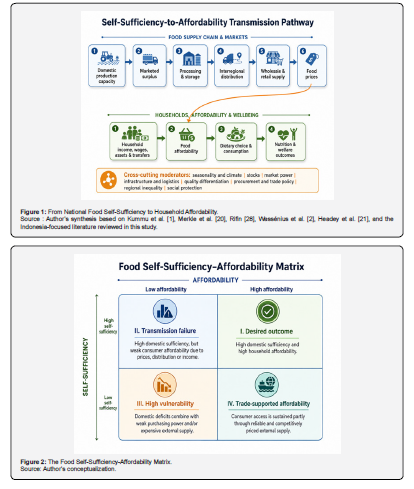
The thematic synthesis indicates that the widely perceived paradox of “self-sufficient but expensive” is not a logical contradiction. It arises because production sufficiency and household affordability occupy different stages of the food system. Self-sufficiency concerns whether domestic production is sufficient relative to national requirements. Affordability concerns whether households can economically obtain the foods they need. Between those two outcomes lie several transmission stages, each of which can weaken the connection. Figure 1 summarizes the article’s main analytical argument. A production surplus can improve affordability only when sufficient output becomes marketed supply, is preserved and processed efficiently, moves from surplus to deficit areas, enters competitive wholesale and retail markets, and reaches households whose incomes or transfers are sufficient to purchase it.
The figure explains why increasing farm output is neither irrelevant nor sufficient. Failure at any downstream stage can disconnect production from household welfare. If farmers retain a larger share of output for own use, marketed supply may rise less than total production. If milling or storage is capacity constrained, the cost of processed food may remain elevated. If islands or remote areas face expensive transportation, prices diverge spatially. If market power produces sticky retail prices, falling farm-gate costs may not pass rapidly to consumers. Finally, even a stable retail price may become unaffordable if household incomes decline. The policy implication is that self-sufficiency should be understood as an intermediate outcome. The final outcome is food and nutrition security.
Reframing the “Paradox”
The policy irony arises not because self-sufficiency mathematically requires low prices, but because public expectations often treat domestic surplus as synonymous with cheap food. A more rigorous interpretation distinguishes four combinations of domestic sufficiency and household affordability, each of which implies a different policy problem. Figure 2 treats self-sufficiency and affordability as separate analytical axes. The desired outcome is movement toward the high-self-sufficiency/high-affordability quadrant, rather than simply maximizing domestic production without regard to household access.
Quadrant II is particularly relevant to the article’s central question. It is possible to produce enough nationally yet fail to translate that capacity into consumer welfare. Such a condition is a policy problem, but not evidence that the concept of self-sufficiency itself is meaningless. Quadrant IV also deserves attention. Reliance on imports does not automatically imply food insecurity when trade is diversified, reliable, and affordable. Kummu et al. [1] and Wassénius et al. [2] show why resilience can draw on both domestic diversity and external supply. Trade should therefore be evaluated instrumentally rather than ideologically. A strategic food policy can prioritize strong domestic capacity while preserving rules-based contingency imports when domestic shocks threaten affordability.
The Anatomy of Consumer Prices
A central implication of the review is that governments cannot reliably reduce consumer prices without understanding where those prices are created. A value-chain perspective helps distinguish legitimate service costs from avoidable inefficiency, excessive risk premiums, or economic rents. Figure 3 decomposes the consumer price conceptually. The point is not that every intermediary margin is excessive, because processing, storage, transport, retailing, capital, and risk all have legitimate costs; rather, policy should identify where avoidable costs or rents prevent production gains from benefiting consumers.
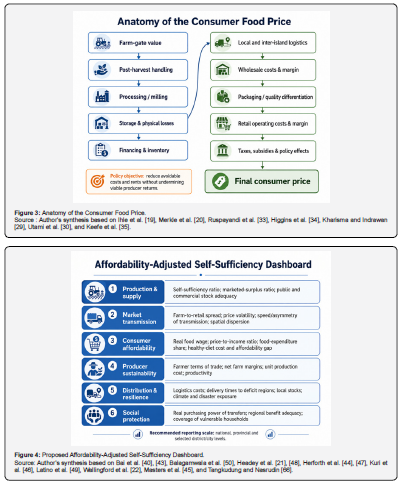
This decomposition clarifies the producer-consumer dilemma. Suppose the government increases the effective paddy price to strengthen farmer incentives. If milling, logistics, financing, and retail margins remain unchanged, the increase is likely to appear downstream. However, if productivity improves and post-harvest, transport, and intermediation costs fall, farmer net returns can rise even while retail-price pressure moderates. Policy should therefore focus less on distributing a fixed economic surplus between farmers and consumers and more on expanding that surplus by reducing inefficiency. Lower unit production, logistics, financing, and intermediation costs can improve farmer net returns while moderating retail-price pressure. The importance of market competition follows naturally. Price transmission literature suggests that downstream prices may not always adjust symmetrically. Monitoring farm-to-retail spreads by commodity, quality, region, and season would allow regulators to distinguish cost-based changes from anomalous margin expansion.
Affordability Should Be Measured as a Dashboard
If self-sufficiency alone is inadequate, the next question is what indicators should supplement it. The answer should preserve the informational value of production metrics while adding measures that show whether supply is transmitted into market and household welfare outcomes. A single replacement index is not necessarily desirable because food systems contain genuine trade-offs. Combining farmer income, consumer prices, production, nutrition, and spatial inequality into one weighted score could obscure rather than illuminate policy problems. An Affordability-Adjusted Self-Sufficiency Dashboard is therefore preferable because it retains the separate dimensions while allowing them to be monitored together. Figure 4 proposes such a dashboard by retaining conventional production metrics alongside indicators of market transmission, consumer affordability, producer sustainability, distributional resilience, and social protection. The framework is intended as a decision-support dashboard rather than a mechanically aggregated composite index.
The dashboard should be produced at both national and subnational levels. Indonesia’s regional heterogeneity makes province-level reporting particularly important, and BPS data for July 2026 show provincial headline inflation ranging from 1.46% to 5.47% even before commodity-specific and remote-area differences are considered [9]. Subnational reporting would therefore reduce the risk that favorable national averages conceal persistent affordability problems in high-cost regions. The healthy-diet component is important because staple-food sufficiency can coexist with nutrient insecurity. Methods developed by Bai et al. [40], Wallingford et al. [22], Herforth et al. [44], Kuri et al. [46], and Masters et al. [45] make systematic monitoring increasingly feasible. However, the methodological sensitivity identified by Headey et al. [48] means that assumptions should be reported transparently rather than presenting a healthy-diet affordability statistic as unquestionable.
A Policy Architecture for Translating Self-Sufficiency into Affordability
The evidence suggests that no single intervention can close the self-sufficiency–affordability transmission gap. A comprehensive strategy requires at least seven mutually reinforcing pillars. Recent Indonesian evidence also supports a multi-instrument approach: Akbar et al. [75] argue that resilient food security requires strategic allocation across production capacity, technology, distribution, and institutional coordination rather than production targets alone.
. Pillar 1: Raise productivity rather than relying predominantly on higher output prices
The most sustainable reconciliation of producer and consumer interests is higher productivity. If farmers generate more saleable output from the same or fewer inputs, their income can improve without requiring proportional increases in consumer prices. This strategy requires improved seed, irrigation, soil fertility, extension services, appropriate mechanization, pest management, climate adaptation, and better access to finance. Hatta et al. [26] and Susanti et al. [27] emphasize that production expansion must also remain agroecologically sustainable. Productivity gains that depend on unsustainably high input use would weaken rather than strengthen long-term affordability. Productivity policy should be evaluated using cost per unit of marketable output, not yield alone. High yields achieved through disproportionately expensive inputs can fail to improve either farmer margins or consumer affordability.
Pillar 2: Convert production into marketed surplus efficiently
Gross output that never enters the market cannot stabilize urban consumer prices. Rifin’s [28] findings make marketed surplus a critical policy indicator. Farmer aggregation, cooperatives, warehouse systems, access to working capital, transparent weighing and grading, local drying facilities, and reliable offtake arrangements can increase the share of usable production entering commercial channels. These interventions matter because the welfare effect of self-sufficiency depends on marketable supply rather than gross harvested output alone. Digital information systems can reduce search costs and improve coordination, as emphasized by Ardianti et al. [61] and Keefe et al. [35]. Digitalization should nevertheless be complemented rather than substitute for roads, electricity, warehouses, ports, and processing capacity. The strongest gains are likely to arise when information improvements and physical infrastructure are developed together.
Pillar 3: Reduce the Geographical Price Penalty
Indonesia requires an explicit food-logistics strategy linking production centers with structural deficit regions. Such a strategy should treat persistent inter-island price differentials as a measurable food-security problem rather than as an unavoidable feature of national geography. Policy should map commodity flows, identify high-cost routes, improve port and warehousing infrastructure, reduce unnecessary administrative friction, strengthen inter-island shipping reliability, and develop cold-chain capacity for perishables. Higgins et al. [34] provides a methodological basis for using supply-chain mapping and transport optimization to identify such bottlenecks. The objective should be measurable through a sustained narrowing of interregional price spreads after controlling for legitimate transport costs. This would give policymakers a clearer performance metric than aggregate national supply alone. Areas where structural transport costs remain exceptionally high may require explicit logistics support or regionally differentiated social transfers. What should be avoided is assuming that the national average price represents all Indonesians.
Pillar 4: Operate strategic stocks as a stabilization instrument, not a substitute for functioning markets
Public reserves are essential for managing harvest-season procurement, lean-season supply, emergencies, and severe price spikes. Indonesia’s exceptionally large public rice reserve in 2026 provides substantial stabilization capacity, with Bapanas reporting stocks above five million tonnes during the year [69,11]. The policy value of these stocks depends on timely procurement and release rather than on inventory size alone.
However, large stocks have value only when procurement and release are appropriately timed. Ruspayandi et al. [33] show that Indonesian rice-price formation depends on interactions among production, consumption, paddy prices, stocks, and BULOG intervention. Stock policy should therefore use transparent operational triggers incorporating harvest conditions, regional prices, stock-to-use ratios, volatility, and vulnerable household impacts. Excessive accumulation can be costly and may distort market incentives; insufficient or delayed release may fail to stabilize prices.
Pillar 5: Protect Competition and Increase Price-Chain Transparency
The state should regularly publish commodity-specific farm-gate, processing, wholesale, logistics, and retail-price indicators. Transparent chain-level data would allow regulators and researchers to identify whether unusual price movements originate in production costs, logistics, market concentration, or retail adjustment. Kharisma and Indrawan [29], Utami et al. [30], and broader market-power research by Merkle et al. [20] show why aggregate consumer prices are insufficient for diagnosing where transmission fails. Monitoring margins by commodity, quality, season, and region would create a stronger empirical basis for competition policy and market intervention. Competition policy should focus on market conduct and entry barriers rather than presuming that every intermediary margin is exploitative. Legitimate margins compensate services and risks. The policy objective is to identify persistent unexplained spreads, collusive behavior, exclusionary practices, or asymmetric transmission.
Pillar 6: Protect vulnerable consumers through purchasing power rather than suppressing all prices
A universal artificially low food price is costly because benefits also accrue to high-income consumers and costs may be shifted to farmers or public finances. Targeted assistance can protect vulnerable households more directly while preserving price signals needed for sustainable production. Targeted support can be more efficient. Indonesia’s experience with electronic food vouchers provides unusually strong evidence. Banerjee et al. [64] show major improvements relative to traditional in-kind delivery, while Rammohan and Tohari [65] document improved dietary diversity. The next step should be to make benefit adequacy geographically sensitive. Tangkudung and Nasrudin [66] demonstrate that an identical nominal benefit does not provide equal purchasing power throughout Indonesia. The benefit level could therefore be calibrated using a regional reference basket or affordability gap. Balagamwala et al. [50] provide a conceptual methodology for estimating how much additional purchasing power a household needs to afford a nutritious diet.
Pillar 7: Move from Commodity Self-Sufficiency Toward Affordable Healthy Diets
A mature national food strategy should not stop at the question of whether enough rice, maize, or sugar is produced. Its ultimate objective should be reliable and affordable access to a nutritionally adequate basket of foods across income groups and regions. Evidence from Bai et al. [40], Springmann et al. [42], de Pee et al. [54], Costlow et al. [55], and Costlow et al. [56] supports a shift toward the affordability and actual consumption of healthy diets. Rahman and Ma [57] further indicate that food environments and information exposure can affect health-food consumption in Indonesia, so nutrition policy must address behavior as well as prices.
This means coordinating agriculture, health, nutrition, education, trade, social protection, and food-environment policies. Institutional food procurement0including schools and nutrition programs—can help create stable demand for nutrient-rich domestic foods if procurement is predictable and does not destabilize other market segments. Healthy-diet policy must also recognize that affordability does not determine food choice alone. Consumer information, marketing rules, school food environments, convenience, preparation time, and cultural preferences all affect diets.
Trade Should Be a Resilience Instrument, not a Binary Measure of Policy Success
Self-sufficiency debates often frame imports as evidence of failure. Literature supports a more nuanced position. Kummu et al. [1] show that trade can diversify food supply, while Wassénius et al. [2] show that domestic production diversity and self-sufficiency can reduce other forms of vulnerability. Brander et al. [36] demonstrates that trade-policy actions and announcements can also create volatility during periods of tight global supply, and Emediegwu and Rogna [38] show that international cereal-price shocks can transmit rapidly to local markets in developing economies. Trade policy should therefore be designed around resilience and predictability rather than symbolic import minimization. Indonesia’s own recent experience illustrates the value of contingency flexibility: Habir and Negara [76] report that weaker rice production in 2024 coincided with record price pressures and substantial imports used to restore domestic availability and price stability.
The appropriate strategy is consequently strategic domestic capacity combined with contingency trade flexibility. This approach preserves incentives to strengthen competitive domestic production while maintaining an emergency instrument when domestic shocks, stock shortages, or regional bottlenecks threaten affordability. Imports should not substitute systematically for improving competitive domestic production where Indonesia has viable comparative and social advantages. Neither should imports be prohibited symbolically when a domestic shock creates temporary scarcity that imposes large welfare costs on consumers. Rules-based import triggers could incorporate projected supply balances, public and commercial stocks, expected harvests, price deviations, and regional shortages. Predictability would reduce uncertainty for farmers, traders, and consumers.
The Producer–Consumer “Trade-off” Can Be Reduced but Not Entirely Eliminated
Food policy inevitably contains distributive choices. A higher farm-gate price transfers income toward producers; a lower retail price benefits net consumers. Since many Indonesian farmers are simultaneously consumers, the distribution is more complicated than two separate populations. Policy should therefore seek a welfare-compatible price corridor. The lower bound should preserve viable production incentives, while the upper bound should protect household access and prevent staple costs from imposing disproportionate welfare losses. Productivity, reduced losses, logistics efficiency, competition, and targeted subsidies can enlarge the space between these bounds.
The July 2026 farmer terms-of-trade index of 127.84 suggests that aggregate farmer exchange conditions were relatively favorable, although a national index cannot represent every farm type or commodity [8]. At the same time, BPS reported that producer prices in agriculture, forestry, and fisheries increased by 3.79% year on year in the second quarter of 2026 [77]. These indicators underline the importance of monitoring producer-side cost and price dynamics together with retail affordability. Producer indicators should therefore be monitored simultaneously with retail prices, poverty, and healthy-diet affordability. A policy framework that observes only one side of the market risks interpreting gains to producers or consumers as system-wide welfare improvements when they may instead reflect a redistribution of costs.
Conclusion and Policy Recommendations
Indonesia’s achievement of higher domestic food production capacity is economically and strategically significant. The country’s 2026 claim of self-sufficiency in eight strategic commodities indicates that domestic production has strengthened sufficiently for the government to characterize a large share of strategic food needs as domestically supplied. That achievement deserves recognition as an important availability and resilience milestone, but it should not be treated as the terminal measure of food-policy success. The central conclusion of this qualitative literature review is that food self-sufficiency is a necessary or highly desirable condition for certain dimensions of food-system resilience, but it is neither necessary nor sufficient by itself for consumer affordability. Self-sufficiency measures where food comes from and whether domestic production can cover requirements.
Affordability measures whether households possess sufficient purchasing power to obtain food at prevailing prices. Food security requires the two to be connected through functioning markets, effective distribution, adequate income, and resilient institutions. The apparent paradox of “self-sufficient but expensive” therefore reflects what this article conceptualizes as a self-sufficiency–affordability transmission gap. Domestic output must become marketed surplus; surplus must be processed and stored; food must move between surplus and deficit locations; wholesale and retail markets must operate competitively; prices must remain compatible with household resources; and social protection must reach households for whom market income is insufficient. Rice demonstrates these relationships particularly clearly.
Indonesia can simultaneously hold large public reserves, report sufficient domestic production, maintain remunerative paddy prices, and experience rising milling prices or substantial regional retail-price differentials. Such coexistence is economically possible because different indicators capture different stages of the food system. The appropriate policy response is not to abandon self-sufficiency. Nor is it to equate self-sufficiency with autarky or administratively force prices downward regardless of production costs. The objective should instead be to make self-sufficiency socially consequential. Six substantive policy conclusions follow from the review. Together they redefine self-sufficiency as a production achievement that must be connected to market performance, purchasing power, regional equity, producer viability, and nutrition before it can be interpreted as a welfare achievement.
First, Indonesia should retain conventional self-sufficiency ratios but report them together with marketed-surplus, stock, farm-to-retail spread, regional price-dispersion, real food-wage, farmer-welfare, and healthy-diet affordability indicators. Second, production policy should prioritize sustainable productivity and lower unit costs because this creates the strongest structural basis for reconciling farmer income with consumer affordability. Third, logistics and regional market integration should be treated as core food-security policy because national surplus has limited welfare value when remote consumers continue to face persistent geographical price penalties. Fourth, procurement, buffer-stock management, market operations, and contingency imports should operate through coordinated and transparent rules, with the objective of maintaining prices within a viable producer-consumer corridor rather than pursuing either the lowest consumer price or the highest producer price.
Fifth, vulnerable consumers should be protected directly through well-targeted transfers whose real value reflects regional food costs and household needs. Sixth, the national objective should gradually evolve from commodity self-sufficiency toward nutrition-sensitive and affordability-adjusted food security, so that policy success is judged by whether citizens in every region can obtain adequate, safe, diverse, and nutritious food without an excessive burden on household resources while farmers receive sustainable returns. In this sense, self-sufficiency should be understood as the beginning of the welfare question rather than its conclusion. A food system is genuinely successful when domestic productive strength is translated through efficient institutions and equitable markets into affordable food on people’s tables.
References
- Kementerian PPN/Bappenas (2024), Rencana Pembangunan Jangka Panjang Nasional (RPJPN) 2025–2045 and Visi Indonesia Emas 2045. Jakarta, Indonesia: Kementerian PPN/Bappenas.
- Ananta A (2020) Prospek mega-demografi menuju Indonesia Emas 2045. Jurnal Kependudukan Indonesia 15(2): 119-132.
- Rostiana E and Rodesbi A (2020) Demographic transition and economic growth in Indonesia. Jurnal Economia 16(1): 1-17.
- Nurarifin and Ridena S (2020) The role of ICT and human capital development in pursuing a demographic dividend and improving economic welfare in Indonesia. The Journal of Indonesia Sustainable Development Planning 1(2): 113-124.
- Kotschy R, Suarez Urtaza P, and Sunde U (2020) The demographic dividend is more than an education dividend. Proceedings of the National Academy of Sciences 117(42): 25982-25984.
- Badan Pusat Statistik (BPS) (2022) Analisis Profil Penduduk Indonesia. Jakarta, Indonesia: BPS.
- Badan Pusat Statistik (BPS) (2026) Hasil Survei Penduduk Antar Sensus (SUPAS) 2025. Jakarta, Indonesia: BPS.
- Cai F (2020) The second demographic dividend as a driver of China's growth. China & World Economy 28(5): 26-44.
- Ogawa N, Mansor N, Lee SH, Abrigo MRM, and Aris T (2021) Population aging and the three demographic dividends in Asia. Asian Development Review 38(1): 32-67.
- Ziesemer T and von Gässler A (2021) Ageing, human capital and demographic dividends with endogenous growth, labour supply and foreign capital,” Portuguese Economic Journal 20(2): 129-160.
- Kudrna G, Le T, and Piggott J (2022) Macro-demographics and ageing in emerging Asia: The case of Indonesia. Journal of Population Ageing 15: 7-38.
- Badan Pusat Statistik (BPS) (2026) Keadaan Ketenagakerjaan Indonesia Februari 2026. Jakarta, Indonesia: BPS.
- OECD, OECD Economic Surveys: Indonesia (2024) Paris, France: OECD Publishing.
- Santoso RP, Sahadewo GA, Sugiyanto C, and Setiastuti SU (2022) Informal and formal wage differences based on cohorts in Indonesia. Economies 10(12): 317.
- Sen K (2024) Broken ladders? Labour market inequality in Indonesia and India. Bulletin of Indonesian Economic Studies 60(2): 161-191.
- Sari VA and Tiwari S (2024) The geography of human capital: Insights from the subnational Human Capital Index in Indonesia. Social Indicators Research 172: 673-702.
- Paramitasari N, Khoirunurrofik BR Mahi, and Hartono D (2024) Charting vocational education: Impact of agglomeration economies on job–education mismatch in Indonesia. Asia-Pacific Journal of Regional Science 8(2): 461-491.
- Beatty A, Berkhout E, Bima L, Pradhan M, and Suryadarma D (2021) Schooling progress, learning reversal: Indonesia's learning profiles between 2000 and 2014. International Journal of Educational Development 85: 102436.
- Jafrin N and Masud MM (2021) Demographic dividend and economic growth in emerging economies: Fresh evidence from the SAARC countries. International Journal of Social Economics 48(8): 1159-1174.
- Singh P and Kumar S (2021) Demographic dividend in the age of neoliberal capitalism: An analysis of employment and employability in India. The Indian Journal of Labour Economics 64(3): 595-619.
- Berde É, and Kurbanova M (2023) Does the demographic dividend with human capital development yield an economic dividend? Evidence from Central Asia. Post-Communist Economies 35(2): 154-178.
- Marois G, Zhelenkova E, and Ali B (2022) Labour force projections in India until 2060 and implications for the demographic dividend. Social Indicators Research 164: 477-497.
- Baerlocher D, Parente SL, and Rios-Neto E (2021) Female labor force participation and economic growth: Accounting for the gender bonus. Economics Letters 200:109740.
- Utomo A, Ananta A, Setyonaluri D, and Aryaputra C (2022) A second demographic transition in Indonesia? China Population and Development Studies 6: 288-315.
- Utomo A, McDonald P, Utomo I, and Hull T (2021) Do individuals with higher education prefer smaller families? Education, fertility preference and the value of children in Greater Jakarta. Child Indicators Research 14(1): 139-161.
- Widyastari DA, Isarabhakdi P, Vapattanawong P, and Völker M (2020) Marital dissolution in postmodern Java, Indonesia: Does early marriage increase the likelihood to divorce? Journal of Divorce & Remarriage 61(8): 556-573.
- Yusa IGPD and Gitaharie BY (2024) How the demographic dividend affects economic convergence: Insights from Indonesia. Economics Development Analysis Journal 13(3).
- Yusa IGPD, Suprayitno AW, and Wafi FA (2025) Does financial inclusion enhance Indonesia's first demographic dividend?. Economics Development Analysis Journal 14(1).
- Indrawati SM and Kuncoro A (2021) Improving competitiveness through vocational and higher education: Indonesia's vision for human capital development in 2019–2024. Bulletin of Indonesian Economic Studies 57(1): 29-59.
- Ariansyah K, Wismayanti YF, Savitri R, Listanto V, Aswin A, et al. (2024) Comparing labor market performance of vocational and general school graduates in Indonesia: Insights from stable and crisis conditions. Empirical Research in Vocational Education and Training 16(5).
- Putranto FGF, Natalia C, and Pitriyani NKD (2024) Closing the gap between education and labor market requirement: Do vocational education matter? The Journal of Indonesia Sustainable Development Planning 5(3): 181-191.
- Choi S, Li H, and Ogawa K (2023) Upper secondary vocational education and decent work in Indonesia: A gender comparison. International Journal of Educational Development. 101: 102833.
- Choi S, Li H, Ogawa K, and Tanaka Y (2024) Secondary vocational education and decent work in Indonesia: Differences between urban and rural areas. International Journal of Training Research 22(2): 125-146.
- Anastasia H, Hadju V, Hartono R, Samarang, Manjilala, et al. (2023) Determinants of stunting in children under five years old in South Sulawesi and West Sulawesi Province: 2013 and 2018 Indonesian Basic Health Survey. PLOS ONE 18: e0281962.
- Laksono AD, Wulandari RD, Amaliah N, and Wisnuwardani RW (2022) Stunting among children under two years in Indonesia: Does maternal education matter? PLOS ONE 17(7): e0271509.
- Mulyaningsih T, Mohanty I, Widyaningsih V, Gebremedhin TA, Miranti R, et al. (2021) Beyond personal factors: Multilevel determinants of childhood stunting in Indonesia. PLOS ONE 16(11): e0260265.
- Cameron L, Chase C, Haque S, Joseph G, Pinto R, et al. (2021) Childhood stunting and cognitive effects of water and sanitation in Indonesia. Economics & Human Biology 40: 100944.
- Lestari E, Siregar A, Hidayat AK, and Yusuf AA (2024) Stunting and its association with education and cognitive outcomes in adulthood: A longitudinal study in Indonesia. PLOS ONE 19(5): e0295380.
- Cahyadi N, Hanna R, Olken BA, Prima RA, Satriawan E, et al. (2020) Cumulative impacts of conditional cash transfer programs: Experimental evidence from Indonesia. American Economic Journal: Economic Policy 12(4): 88-110.
- Halim HC Johnson, and Perova E (2022) Preschool availability and women's employment: Evidence from Indonesia. Economic Development and Cultural Change 71(1): 39-61.
- Andrina M (2022) Maternal employment and childcare arrangements in Indonesia: The needs for childcare support policies. Masyarakat Indonesia 48(2): 221-236.
- Kim JH and Williams BD (2021) Minimum wage and women's decision-making power within households: Evidence from Indonesia. Economic Development and Cultural Change 70(1): 359-414.
- Miranti R, Sulistyaningrum E, and Mulyaningsih T (2022) Women's roles in the Indonesian economy during the COVID-19 pandemic: Understanding the challenges and opportunities. Bulletin of Indonesian Economic Studies 58(2): 109-139.
- Kusumawardhani N, Pramana R, Saputri NS, and Suryadarma D (2023) Heterogeneous impact of internet availability on female labor market outcomes in an emerging economy: Evidence from Indonesia. World Development 164: 106182.
- Oishi Y and Wie D (2023) Importing inequality: Trade liberalisation, technology and women's employment. Bulletin of Indonesian Economic Studies 59(3): 391-419.
- Olivia S, Gibson J, and Nasrudin R (2020) Indonesia in the time of COVID-19. Bulletin of Indonesian Economic Studies 56(2): 143-174.
- Suryahadi A, Al Izzati R, and Yumna A (2021) The impact of COVID-19 and social protection programs on poverty in Indonesia. Bulletin of Indonesian Economic Studies 57(3): 267-296.
- Temenggung D, Saputro A, Rinaldi R, and Pane D (2021) Managing recovery and seizing reform opportunities. Bulletin of Indonesian Economic Studies 57(1): 1-28.
- Pangestu M and Armstrong S (2025) Is this time different? Indonesia's response to uncertainty. Bulletin of Indonesian Economic Studies 61(3): 297-332.
- Pritadrajati D (2023) Does social assistance disincentivise employment, job formality, and mobility? Labour Economics 84: 102398.
- Siregar TH (2022) Investigating the effects of minimum wages on employment, unemployment and labour participation in Java: A dynamic spatial panel approach. Bulletin of Indonesian Economic Studies 58(2): 195-227.
- Ridhwan MM, Rezki JF, Suryahadi A, Ramayandi A, and Ismail A (2024) The impact of COVID-19 lockdowns on household income, consumption and expectations: Evidence from high-frequency data in Indonesia. Bulletin of Indonesian Economic Studies 60(1): 67-94.
- Pratomo DS, Fitanto B, Athoillah M et al. (2025) The fragile workforce: Indonesian youth workers vulnerability during the COVID-19 pandemic,” International Journal of Adolescence and Youth 30(1): 2526467.
- Al Ayyubi MS, Pratomo DS, and Prasetyia F (2023) Does pre-employment card program improve Indonesian youth labor market performance in pandemic era? Cogent Economics & Finance 11(2): 2267752.
- Purwa T, Meidika YA, and Krismaningtyas Y (2023) Dampak pandemi COVID-19 terhadap penduduk usia muda yang tidak bekerja, bersekolah, maupun mengikuti pelatihan (NEET) di Jawa Timur. Jurnal Ekonomi Indonesia 12(1): 29-53.
- Poetiray MYG, Purnomo D, and Utomo AW (2023) Peluang dan tantangan pemanfaatan bonus demografi pada aspek ketenagakerjaan di Kota Salatiga. Jurnal Kependudukan Indonesia 18(1): 1-14.
- Asrofi DAN, Pratomo DS, Pangestuty FW, Tasmilah and Al Ayyubi MS (2026) Double care burden, women's participation, and household welfare in Indonesia. Development Studies Research 13(1): 2688100.
- Hendarmin and Wahyudi ST (2023) Structural transformation patterns and factors that influenced: The case in Indonesia. Jurnal Economia 19(1): 112-126.
- Ke Y (2024) ASEAN Four's middle income trap dilemma: Evidence of the middle technology trap. Asian Review of Political Economy 3(14).
- Thawley C, Crystallin M, and Verico K (2024) Towards a higher growth path for Indonesia. Bulletin of Indonesian Economic Studies 60(3): 247-282.
- Yudhistira MH, Brodjonegoro BPS, and Qibthiyyah RM (2024) Unlocking urban potential. Bulletin of Indonesian Economic Studies 60(2): 129-159.
- Soseco T, Olivia S, and Oxley L (2024) Interprovincial wealth inequality by factor components in Indonesia. Bulletin of Indonesian Economic Studies 60(2): 193-215.
- Wahyuni RNT (2024) Regional convergence and spatial shift-share analysis of labor productivity in Indonesia. Signifikan: Jurnal Ilmu Ekonomi 13(2): 291-302.
- Falentina AT, Resosudarmo BP, Darmawan D, and Sulistyaningrum E (2021) Digitalisation and the performance of micro and small enterprises in Yogyakarta, Indonesia. Bulletin of Indonesian Economic Studies 57(3): 343-369.
- Trinugroho I, Pamungkas P, Wiwoho J, Damayanti SM, and Pramono T (2022) Adoption of digital technologies for micro and small business in Indonesia. Finance Research Letters 45: 102156.
- Affandi Y, Ridhwan MM, Trinugroho I, and Hermawan Adiwibowo D (2024) Digital adoption, business performance, and financial literacy in ultra-micro, micro, and small enterprises in Indonesia. Research in International Business and Finance 70: 102376.
- Handayani PW, Nasrudin R, and Rezki JF (2024) Reliable electricity access, micro and small enterprises, and poverty reduction in Indonesia. Bulletin of Indonesian Economic Studies 60(1): 35-66.
- Nasir MS, Salim A, and Wen J (2024) Does information and communication technology improve labor productivity? Recent evidence from the Southeast Asian emerging economies. Growth and Change 55(1): e12708.
- Kudrna G, Piggott J, and Poonpolkul P (2025) Sustainable and equitable pension reform for emerging economies: An application to Indonesia. Economic Modelling 148: 107080.
- Asmorowati S, Schubert V, and Supeno E (2024) Stretching the social protection system beyond capacity: Tensions between governance capacity and conceptualisations of elder care in nursing homes in Indonesia. International Journal of Sociology and Social Policy 44(11/12): 1200-1218.
- Seftiani S (2022) Learning from pandemic COVID-19 toward ageing societies in Indonesia: Building resilience with adaptive social protection. Masyarakat Indonesia 48(2): 237-247.
- Ngadi D Asiati, Aini YN, Purba YA, and Rajagukguk Z (2025) Increasing labor social security membership for informal workers in Indonesia. Cogent Social Sciences 11(1): 2534139.